
How this Artist Conveys her emotions through art

👁 270 Views
Mathilde’s paintings breathe emotion into color, transforming portraits into luminous fields of tenderness, intensity, and rhythm. After stepping away from a career in fashion and communication, she returned to painting with renewed urgency in 2020, and since then has built a body of work that speaks of presence, intimacy, and human connection.
Known for her bold yet delicate palettes, soft acid tones, translucent layers, and unexpected contrasts, her practice balances intensity with calm, gesture with stillness. From her debut solo show Les Âmes bleues in 2023 to her participation in Art Paris 2024 and the publication of her first monographic book Palettes, Mathilde’s work continues to expand across canvases, books, and public spaces. In this interview, she describes how her art is both deeply personal and profoundly collective: a search for the colors of the soul.
Hi Mathilde, you stepped away from a career in fashion and communication to paint full-time. What motivated you to return to art and how has that decision shaped your creative life?
Hi, and thank you for the question. Yes, I initially explored the world of fashion and communication, which taught me a lot about image, storytelling and rhythm — but something essential was missing. I’ve always had a deep, almost physical connection to painting. It’s how I process the world, how I connect to others, how I breathe, really. In 2020, something shifted. Maybe it was the stillness of that year, or a sense of urgency I could no longer ignore. I felt the need to return to that instinctive, manual, emotional gesture of painting — and once I did, I couldn’t stop. It felt like coming home. Since then, painting has completely reshaped my life. It gave me back a voice I had put aside. Now I build my days and projects around color, volume, and emotion. Each canvas and each public space I work on is a continuation of that decision — to live fully through art.
What are the tones you like experimenting with and how do you decide the palette for a specific piece of work?
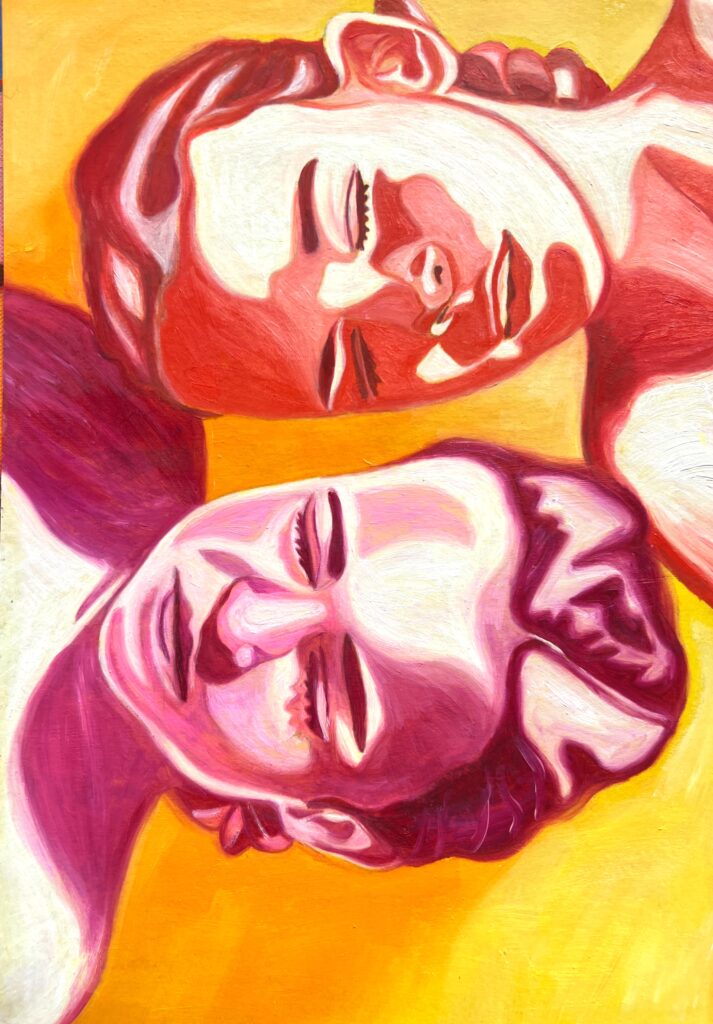
Color is absolutely central to my work — it’s both a tool and a language. I often describe my palette as tender and bold at the same time, with soft acid tones, luminous transparencies, and occasional high-saturation contrasts that vibrate on the canvas. I love colors that feel slightly “off” — that push harmony into something more emotional, more surprising. The palette for each piece comes from a combination of instinct, emotional resonance, and the specific story or face I’m working with. Sometimes the tones arise from a place — the faded greens of a garden, the dusty pinks of a childhood memory. Other times, I build the palette from the light in a photograph I’ve taken of a model or a passerby. I don’t use color to represent reality but to intensify presence — to make the soul behind the face glow, shimmer, or dissolve. That’s why I rarely pre-plan my palette completely. I let the painting guide me as I go, listening to how each tone interacts with the others and how the face begins to speak back.
As an artist, how do you balance portraying intense emotions and yet being calm enough to be able to do so?
That balance is at the very heart of my practice. My work often stems from emotional intensity — moments of love, solitude, transformation, or even rupture. But to give those emotions form, I need to enter a space of stillness. Painting becomes a kind of meditative process for me, a way to stay present and listen closely to what the face, the light, the silence have to say. There’s a paradox there, but it’s also what makes the process so rich: I’m channeling something deeply alive and complex, but through gesture, through color, through composition — all of which require attention and care. The emotions are not always mine — many of the portraits I paint are based on people I encounter, photograph, or imagine. I see myself almost as a translator of their inner world. And to translate honestly, I need to slow down, to breathe with the work.
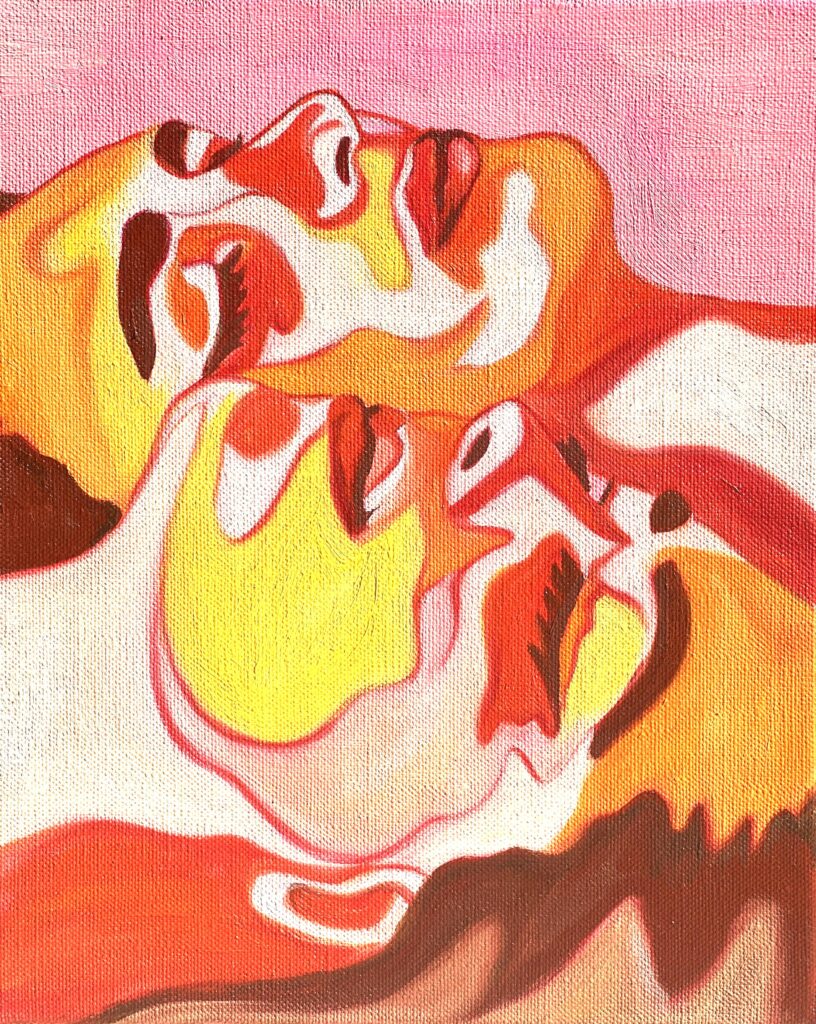
Summer medidation, 19×25 cm, oil on canvas
What is that one piece that has deeply impacted you during its creation and even after that?
One of the most transformative pieces for me was part of the series Les Âmes bleues. It was a portrait painted during a time of deep personal transition. As I worked on the layers of color and light, I felt as though I was rediscovering both the subject and myself. Even now, I still feel connected to that painting—it holds a certain vibration, a kind of quiet intensity that reminds me why I paint.
What are the main challenges of merging everyday life and fine art in community spaces?
The biggest challenge is to remain both sincere and accessible. Community art must speak to everyone without losing depth. Navigating logistics, time, and sometimes skepticism from those unfamiliar with contemporary art requires patience and clarity. But the reward is immense—when people see themselves in a mural, or feel represented in a public piece, it’s incredibly powerful.
Has your voice or approach changed since your earliest works? If so, what have you discovered along the way?
Absolutely. In my early work, I was more focused on form and composition. Over time, I’ve learned to embrace emotion and vulnerability in my process. I’ve also discovered how important community and shared narratives are to my practice—art doesn’t have to be solitary.
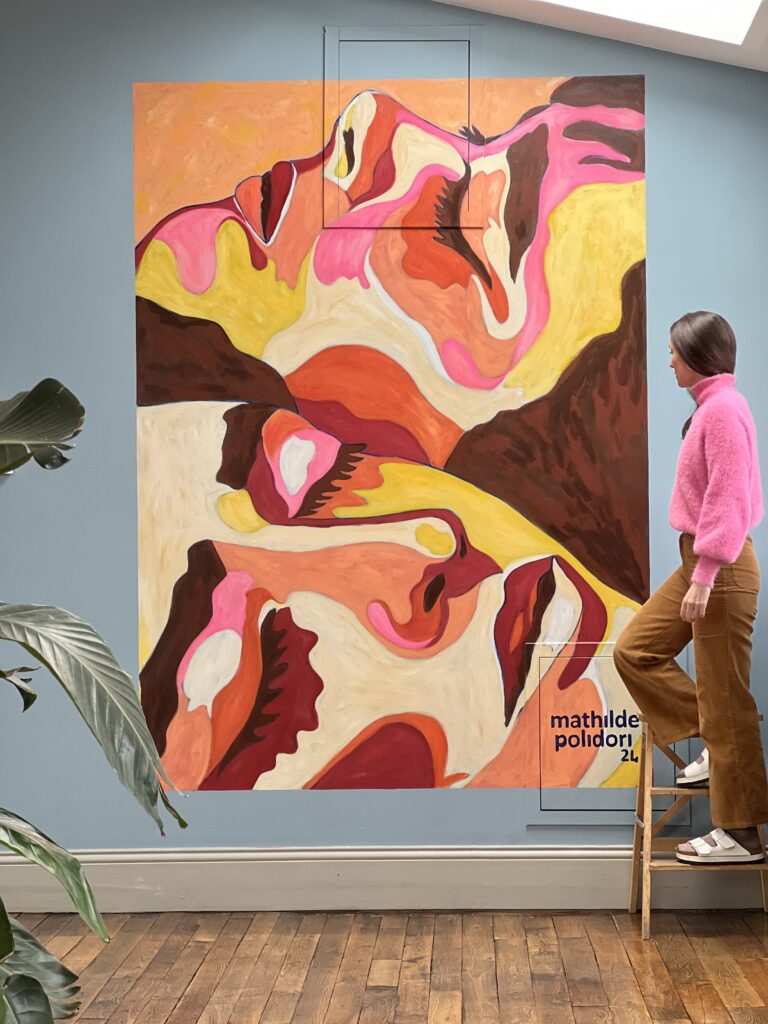
You debuted your first solo show, “Les Âmes bleues,” in November 2023, and then at Art Paris 2024. How have these exhibitions shaped you as an artist?’
Les Âmes bleues was a turning point—it allowed me to present my universe fully. Art Paris gave me another kind of exposure, with a broader audience and a new level of professional dialogue. Both shows gave me confidence and helped me clarify where I want to go next.
Your first monographic art book “Palettes” was published in October 2024. How did translating your visual work into print affect your ideas about portraiture and color?
Seeing my work on paper, in a bound format, forced me to think about sequencing, rhythm, and narration. Palettes became more than a collection—it was a story about how I see color, skin, emotion. It gave me distance and also new insight into the coherence of my work.
What non-artistic ritual or everyday habit helps you reconnect with your practice when the pace feels fast?
Walking. Alone, without music. Just listening to the city, watching light on buildings, observing people. It empties my head and brings me back to what matters. Also, talking with my daughters—they often say the most poetic and honest things without realizing it.
Are there any new projects or exhibitions that you’re excited about being a part of?
Yes! In 2025, I’m working with the city of Bagneux on a large-scale public art project called Les Visages de Bagneux, and with Bordeaux for the 10th anniversary of the Promenade Sainte-Catherine. Both involve creating immersive, colorful works in dialogue with the people and the place. And in spring 2026, I’ll present a new solo exhibition, Chuchotement, in Romainville.
In Polidori’s words, painting is not just an artistic gesture but a way of breathing, translating, and connecting. Her journey from rediscovering her voice in the stillness of 2020 to sharing it with audiences in galleries and community spaces reminds us that art can be both intimate and universal. With upcoming large-scale projects in Bagneux and Bordeaux, and a new solo exhibition Chuchotement in 2026, Mathilde continues to explore how color and portraiture can hold space for memory, transformation, and shared humanity. Her story is one of courage, clarity, and devotion to art as a living, evolving language.
To learn more about Polidori, click the following links to visit her profile.