




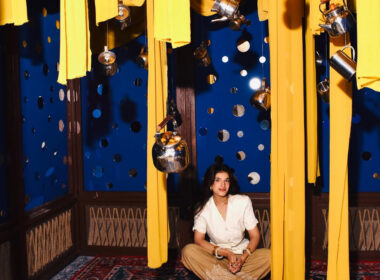

Not Just Dogs: Charuka Arora’s New Exhibition Now Live on Artsy
👁 25 Views
Now on view April 1–27, 2026, presented by Arts to Hearts Project on Artsy
There is a painting in Charuka Arora’s new exhibition that stopped me before I could read the title. The dog in it sits with a stillness that does not feel like patience. It feels like something that has been arrived at. A composure that cost something. The eyes do not perform warmth or invitation. They simply exist, directed outward, holding the gaze of whoever has the nerve to hold them back.
Then I read the title. Ms. Diana And something I did not expect to feel arrived.
Not sentiment. Not the comfortable warmth of a portrait. Something closer to recognition. The recognition you feel when you see someone in a room and understand, before a word is spoken, that they have a full and complicated interior life that has nothing to do with you and everything to do with them. The recognition that is also, if you are honest, a small form of accountability. You have seen them now. You cannot unsee them.
This is what Not Just Dogs does. And it does it so quietly, so precisely, that by the time you understand what has happened, it has already happened.
The Show– Not Just Dogs
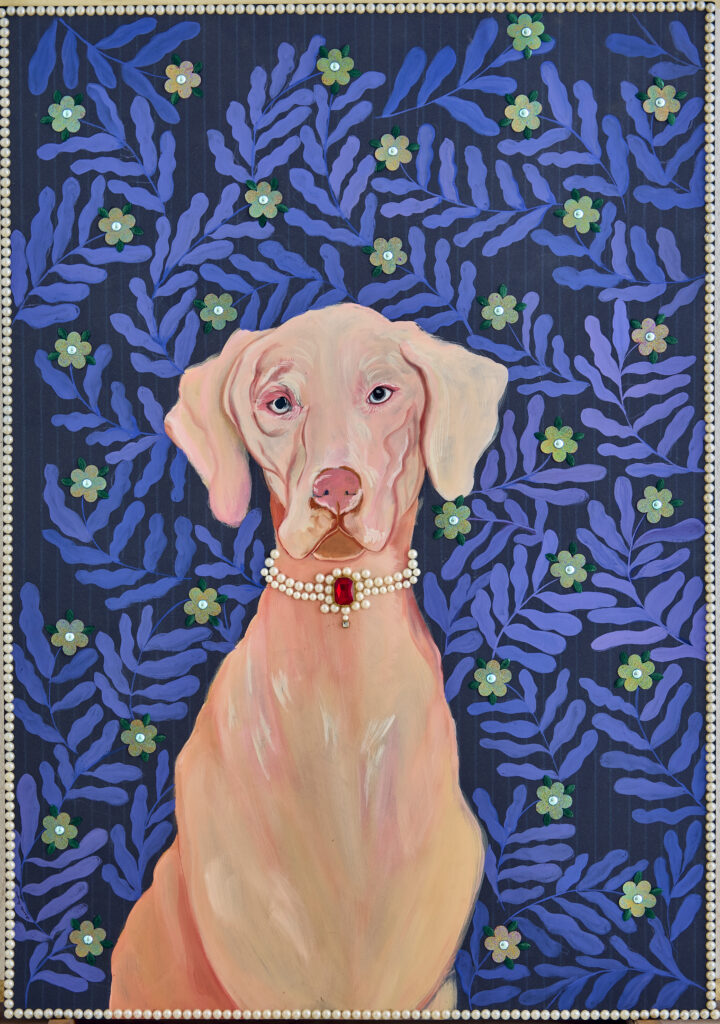
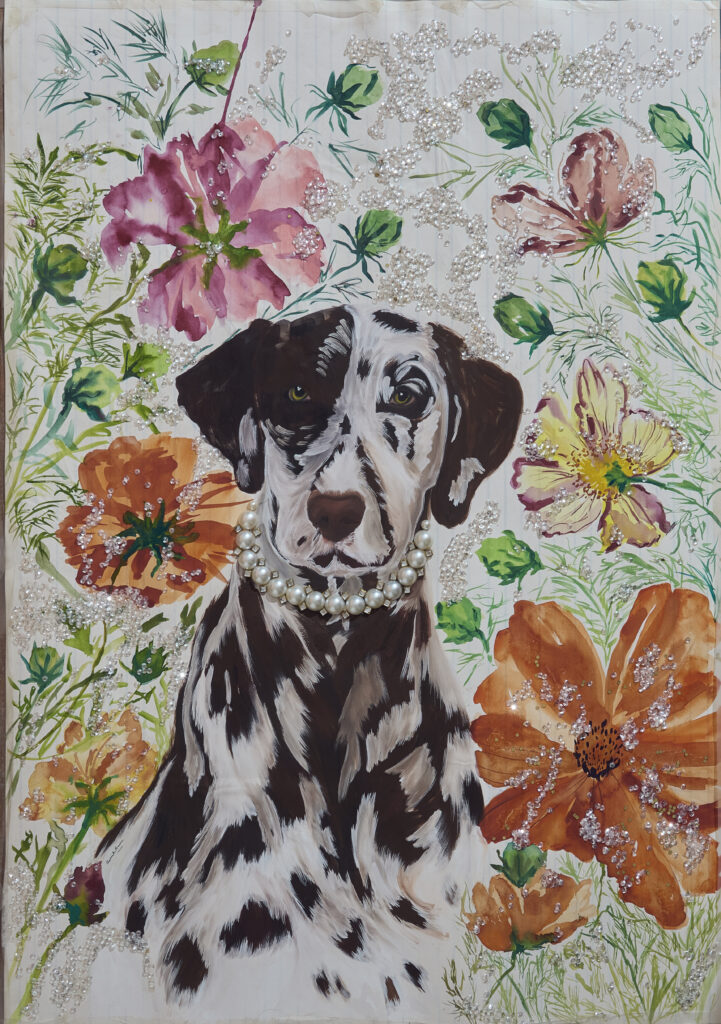
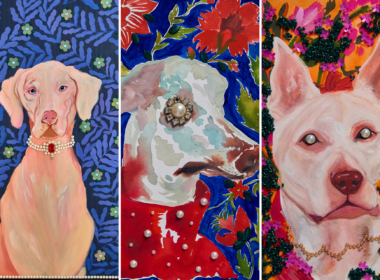
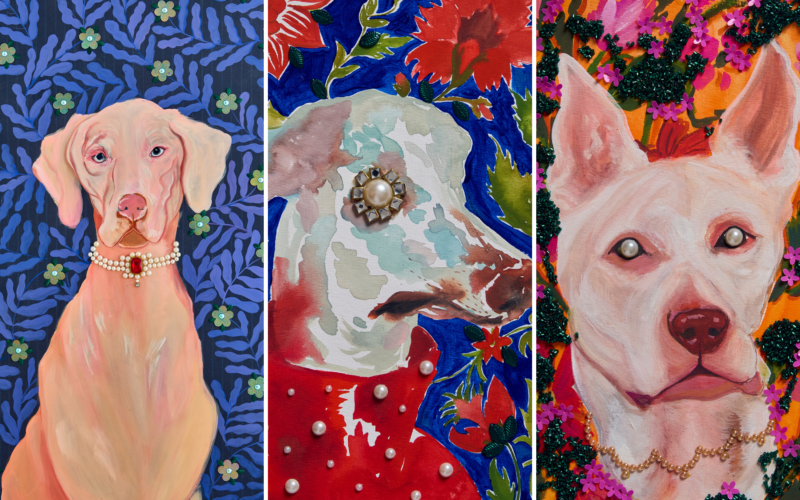
Not Just Dogs is Charuka Arora’s latest body of work, presented by Arts to Hearts Project and on view exclusively on Artsy from April 1 through April 27, 2026. The exhibition brings together a series of dog portraits, each one named after a woman, each one built through Arora’s process of layered painting and handcrafted embellishment. Watercolour, gouache, and acrylic form the ground of each work. Pearls, beads, and rhinestones are applied over the surface, one by one, in a process that is as much an act of care as it is an act of making.
The result is a body of work that looks, at first encounter, like one thing and reveals itself, gradually, to be something much larger.
What a Name Does
The decision to name each work after a woman is the exhibition’s most important gesture, and Arora made it with complete intention.
Ms. Diana. Ms. Pia. Ms. Sia. Ms. Tia. Ms. Alice.
It would be easy to describe this as a conceptual device. A clever gesture. But to call it clever is to underestimate it, because what the naming actually does is not intellectual. It is visceral. It works on you before your brain has finished processing it. You read the title and something in the painting changes, not the painting itself, but your relationship to it. The subject is no longer a category. She is a person. And you feel, before you can articulate it, that you owe her something different than you were about to give her.
This is what names do. They are not labels. They are claims. They assert that something exists in a particular way, that it is specific, that it cannot be fully substituted for anything else. To give a name is to say: this one. Not dogs in general. Not women in general. This one, here, now, looking back at you.
Arora has spoken about the moment of recognition she is reaching for, the moment when the viewer reads the title and feels the shift. What she is less explicit about, perhaps because it does not need to be said, is what that shift reveals about the viewer. Because the shift only works if something was being withheld before it. Which means you were, until a second ago, prepared to look at a subject and not fully see her. Prepared to give her less than she was owed.
The naming catches you in that preparation. And holds you there, gently, long enough for you to feel it.
The Grammar of Adornment
The paintings themselves are extraordinary objects, and they need to be understood as objects, not images, to be fully received.
Arora begins each work with watercolour, building a ground that is luminous and unstable, colour that blooms and bleeds and cannot be entirely controlled. Over this she layers gouache, then acrylic, building opacity and depth in stages, each layer modifying what came before, none of them entirely disappearing. The resulting surface holds time within it. You are not looking at a finished image. You are looking at a record of decisions, each one visible in the accumulation of material beneath the one that followed it.
Then the embellishments arrive. Pearls. Beads. Rhinestones. Thread. Applied one by one, by hand, in a process that Arora describes as intuitive but that is also, clearly, a form of sustained devotion. Each element placed where it belongs. Not scattered. Not applied for effect. Placed, with the deliberation of someone who has thought carefully about what each surface deserves.
In Arora’s practice, adornment is a language with a specific grammar. She grew up in Agra, in a culture where the decorative arts are not separate from the fine arts, where craft and embellishment carry meaning, where objects worn close to the body, jewellery, fabric, the materials of adornment, are also carriers of identity, memory, and inheritance. The beads and pearls that trace the figures in Not Just Dogs are not ornamental in any dismissive sense of the word. They are the point. They say: this subject has been attended to. This subject has been dressed for the sitting she deserves. This subject, in the language of material, has been honoured.
There is a long and painful history of denying that honour to both dogs and women. Of treating the adornment of women as vanity, as frivolity, as evidence of superficiality rather than depth. Arora’s paintings refuse that denial completely. Beauty, in these works, is not decorative. It is political.
The Backgrounds Are Not Backgrounds
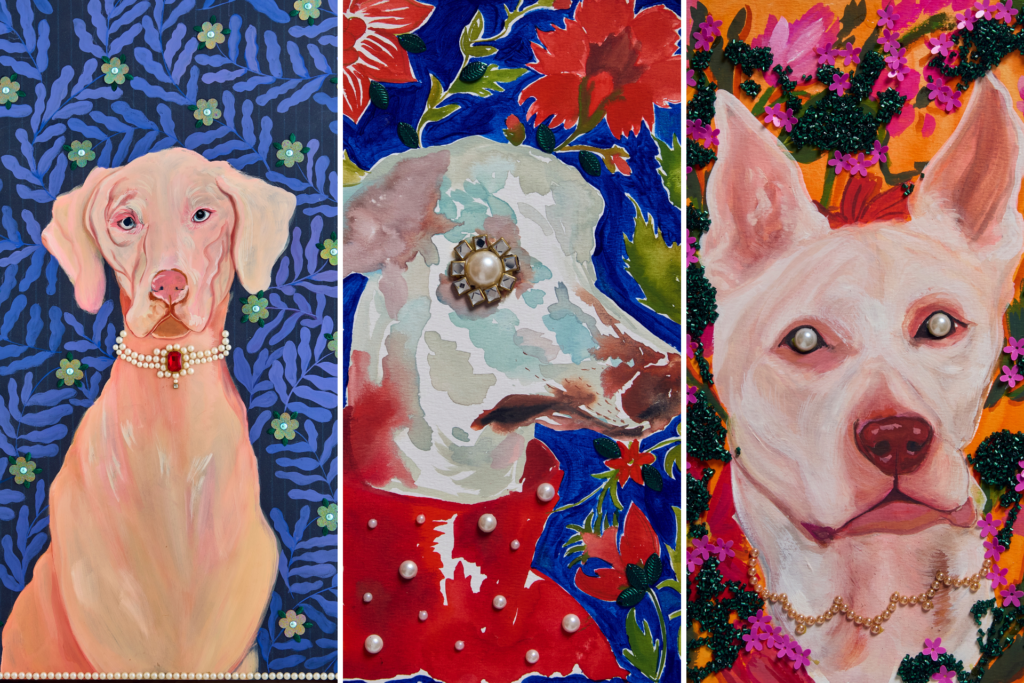
One of the most persistent misconceptions about decorative pattern in painting is that it is passive. That the figure is the subject and the pattern is the setting, the thing your eye moves through to reach what matters.
In Arora’s work this is completely wrong, and Not Just Dogs makes it more visible than anything she has done before.
The dense, repeating patterns that surround each figure are drawn from the craft traditions of North India, from textiles, block prints, embroidery, the visual grammar of a culture that Arora carries in her hands as much as in her memory. They press in around each figure with the insistence of a world that belongs entirely to the subject at the centre. They say: she comes from somewhere. She has a context. She is not a figure floating in neutral space, available for whatever projection you wish to place on her. She has a world, and it is dense and beautiful and entirely hers.
This matters more than it might initially seem. Because one of the primary ways we diminish people, and particularly women, and particularly women who come from cultures that Western institutions have historically treated as peripheral, is by stripping them of context. By presenting them as figures without worlds, without histories, without the layered particularity that makes a life a life rather than a symbol.
Arora’s backgrounds refuse this stripping. They insist on context with every centimetre of pattern.
On What We Owe the Lives We Overlook
Arora is not making didactic work. She is not illustrating a thesis. The paintings in Not Just Dogs are not arguments for a position, however correct that position might be. They are something more difficult and more valuable than that. They are experiences.
But experiences have implications. And the implication of standing in front of Ms. Adele or Ms. Whitney and feeling what these paintings make you feel is that the capacity for that feeling was always in you. You could always have extended this quality of attention to a dog. To a woman. To anyone you passed on the way to something you considered more important. The paintings do not give you a new capacity. They reveal one you already had and were, for whatever reason, holding back.
That is a more uncomfortable thing to sit with than a thesis. A thesis you can agree with and move on. This you have to carry.
Both dogs and women have long been asked to occupy simplified narratives. Loyalty. Gentleness. Beauty. Obedience. They are loved, often genuinely, within those narratives, but rarely seen beyond them. Arora is interested in what lies beyond them. Her paintings do not offer resolution or comfort. They offer presence. The particular, unresolvable presence of a subject who has been given a name and now refuses to be reduced to anything less.
About Charuka Arora

Charuka Arora is an internationally exhibited visual artist, designer, and founder of Arts to Hearts Project, based in India. She holds a B.A. in History and Advertising from Delhi University and pursued formal design studies at Pearl Academy in New Delhi and Domus Academy in Milan, a background that grounds her practice in both historical inquiry and contemporary design thinking.
Her work sits at the intersection of painting, handcrafted collage, and material embellishment, exploring womanhood, cultural memory, adornment, and the emotional textures of inheritance. She has exhibited internationally at The Other Art Fair in Los Angeles and London, presented work at Woman Made Gallery in Chicago, and participated in curated exhibitions and art fairs across the UK, Europe, and India.
Not Just Dogs marks a more intimate register within that practice, one in which the personal and the political are held in the same painted surface, neither one subordinating the other.
About Arts to Hearts Project
Arts to Hearts Project is global publishing and a community platform for artists to be seen, supported, and celebrated. What began as a podcast, raw and honest conversations with women working in the arts, has grown into a global platform encompassing publications, open calls, exhibitions, grants, and a community of thousands of artists across the world. The organisation has published over thirty international books and celebrated more than ten thousand artists worldwide.
The decision to present Not Just Dogs on Artsy reflects Arts to Hearts Project’s commitment to bringing the work of its artists to the widest possible audience, on platforms where collectors, curators, and art lovers are already looking.
Why This Show, Why Now
We are living through a period of sharp, sustained argument about who deserves to be seen, whose stories matter, whose presence is worth protecting. Arora does not enter that argument directly. But she makes work that insists, painting by painting, name by name, that the question of who we choose to see is one of the most consequential questions we can ask.
To look at Ms. Alice and feel the shift that her name produces is to understand, briefly and viscerally, what it would mean to look at everything that way. Every face on the train. Every name on a door. Every being that crosses your path carrying a life you will never fully know.
Arora is not asking you to become that person permanently. She is just asking you to be that person, in front of her paintings, for as long as you can stand it.
That is where Not Just Dogs begins. And in some quiet way, it never entirely ends.
Not Just Dogs is on view April 1 through April 27, 2026, on Artsy, presented by Arts to Hearts Project. All works are available for inquiry and purchase through the Artsy listing. For collector enquiries, contact Arts to Hearts Project at info@artstoheartsproject.com.