
This is for those who think mistakes have ruined their work I Kim Byungkwan
👁 144 Views
At Arts to Hearts Project, we’re always drawn to artists who make you look twice. Not because their work is shocking or trying too hard, but because it shifts something in how you see things you thought you already understood.
When we were planning our Best of the Art World editorial, we wanted artists who weren’t just technically skilled we wanted voices that challenged visual habits, that made familiar things feel strange again, that cracked open perception in ways you didn’t expect.
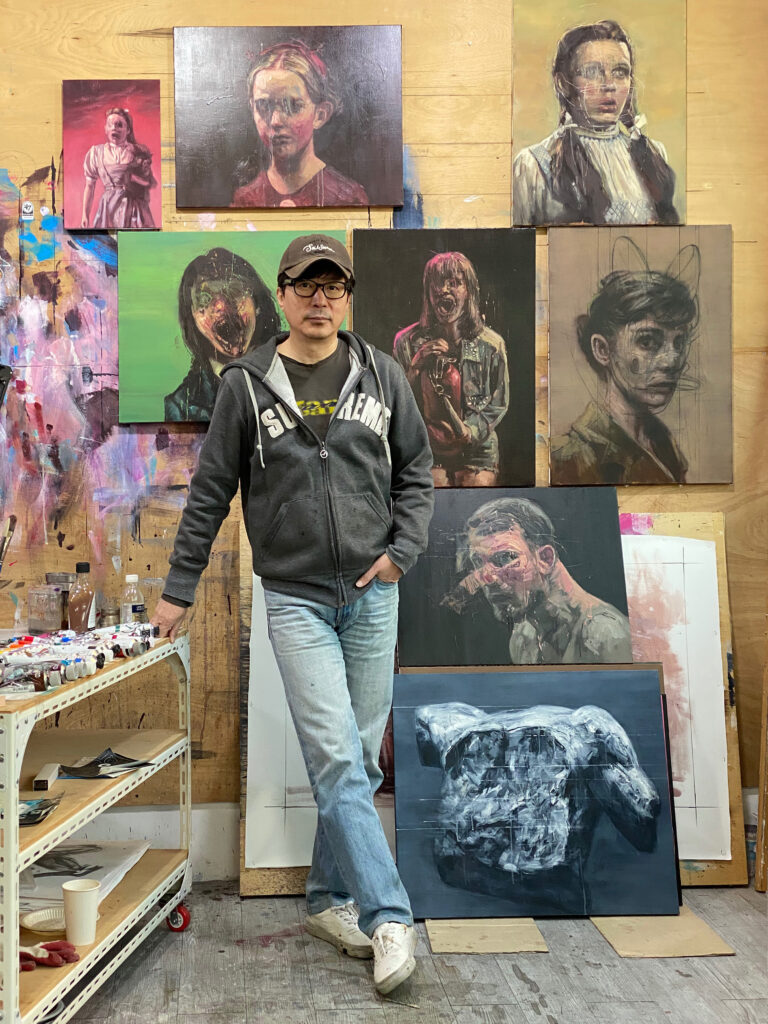
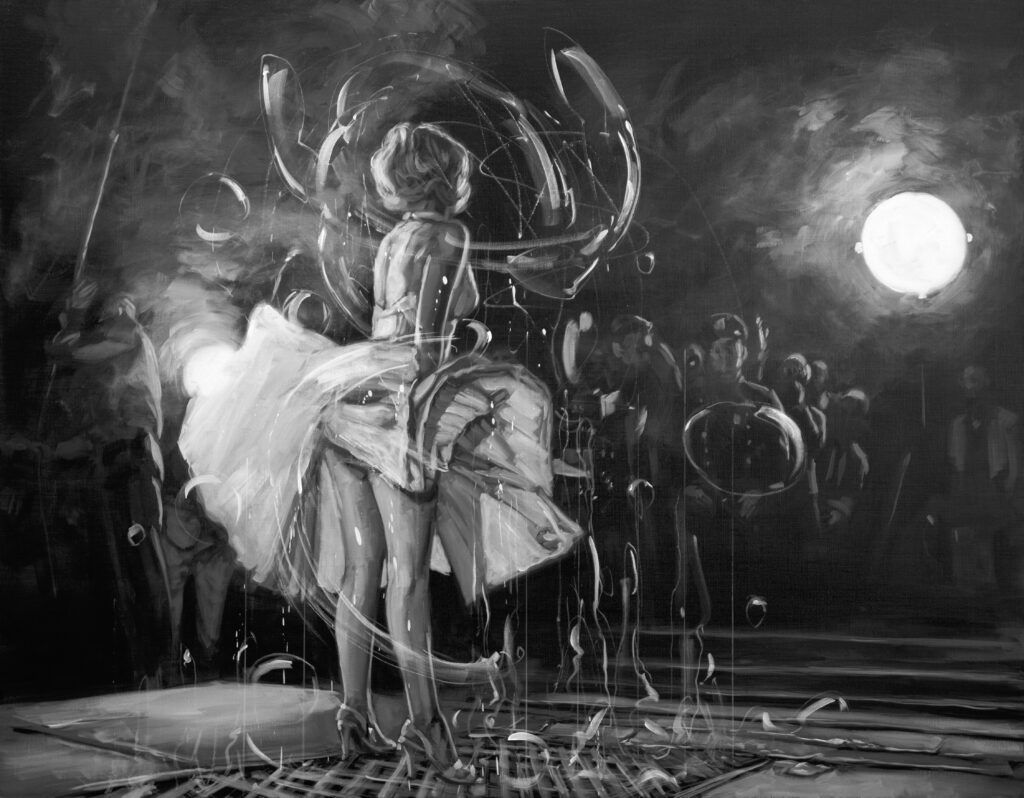
Then we came across Kim Byungkwan’s work, and we knew immediately he belonged here. His portraits of Hollywood icons and recognizable figures aren’t what you expect. They’re distorted, broken apart, scratched, dripped on marks that most artists would consider mistakes. But in Kim’s hands, those “mistakes” are the entire point. They’re deliberate cracks in finished forms, ruptures in familiar faces that force you to see differently.
We reached out to him for this editorial, and I’m genuinely excited for you to read this conversation. Because Kim’s philosophy challenges something every artist wrestle with the fear of messing up what’s working. That moment when a brushstroke goes wrong and you freeze, wondering if you’ve just destroyed hours of work. Kim doesn’t freeze. He invites the chaos in on purpose.
Before we get into our conversation with him, let me tell you about Kim and why his approach matters.
He grew up in Seoul during a time when foreign cultures were flooding in from every direction. It was chaotic. Adults around him were trying hard to instill traditional Korean identity, teaching him what it meant to be Korean. But honestly? He felt way more connected to the messy jumble of global influences colliding around him than to any single cultural tradition.
The joy of moving between different cultural worlds naturally made him reject linear thinking. He became fascinated by the point where various cultures blend into what he calls a “cultural stew” something you can’t define with any single label. His entire cultural foundation, he says, was built on distraction.
As a teenager, he discovered Baroque art. And I don’t mean he casually liked it. He was obsessed. Velázquez, Rembrandt, Goya—he’d look at high-resolution photos of their paintings and literally couldn’t sleep. The way light worked in Baroque painting captivated him so deeply that it pulled him toward traditional oil painting techniques.
So you’ve got this artist whose brain works in chaotic, non-linear ways because of how he grew up, but whose hands are trained in classical painting methods that are centuries old. That combination is what makes his work so compelling.
What really crystallized his approach was watching David Lynch’s Eraserhead. There’s this scene where the protagonist is sleeping next to his wife, and Lynch films her in this completely alien way even though she’s just lying there exactly as she is. No special makeup. No effects. Just a different way of looking. That insight unlocked everything for him.
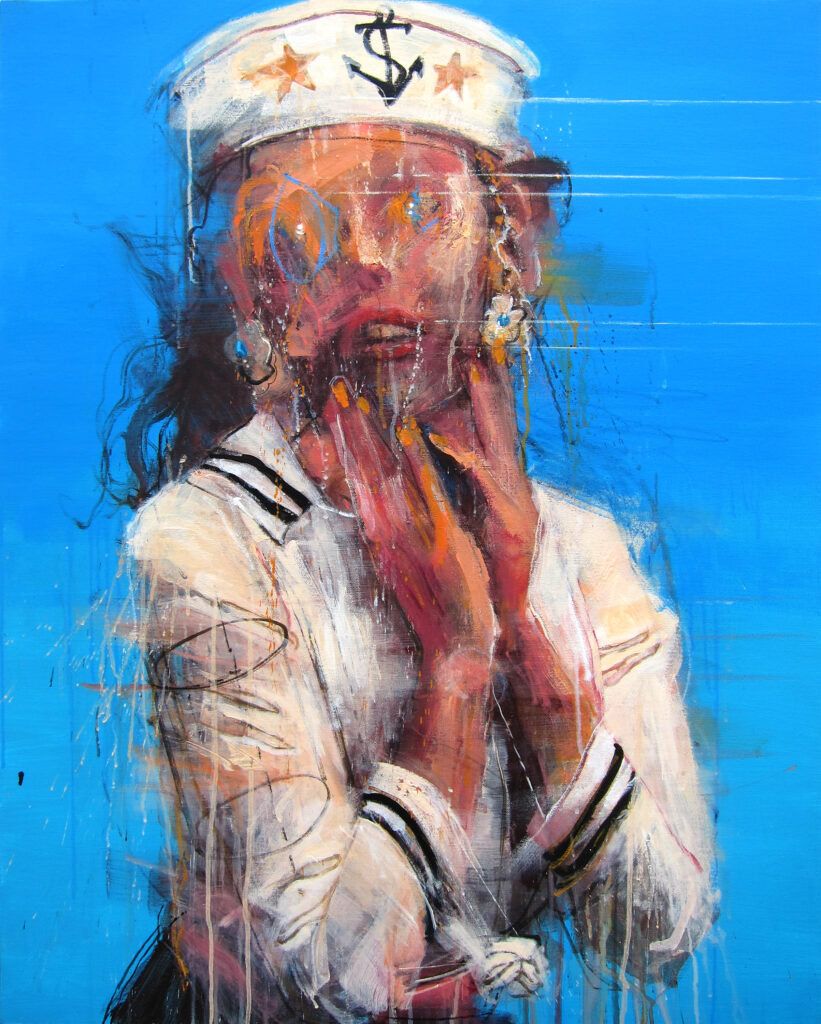
He started painting things everyone recognizes Mickey Mouse, Marilyn Monroe, classical masterpieces and then deliberately breaking them. Scratching the surface. Letting paint drip. Erasing parts. Creating what he calls “cracks” in these completed, iconic forms.
Because here’s what he understands that most of us don’t think about: those famous images have become walls in our perception. We see Mickey Mouse and our brain just goes “yep, that’s Mickey Mouse” and moves on. There’s no space for seeing anything new. The image is so finished, so established, that it actually limits how we can think about it.
Kim paints them specifically to crack those walls open. To create space where there wasn’t any before.
Also, most of us tend to panic when something goes wrong when paint drips where it shouldn’t, when a mark disrupts what we were building, or when something outside our control challenges the vision, we had in mind. We often see these moments as problems that need to be fixed.
But, Kim sees them as opportunities. He doesn’t trust the analytical system operating in his brain. He intentionally gets lost on the surface of objects to escape their original purpose. Having lost his coordinates, he lingers and wanders, allowing scattered brushwork and chance variables to lead him somewhere before analysis even begins.
Let’s hear from Kim about how his upbringing shaped his thinking, why he breaks familiar images, and how he treats mistakes as part of the process.
Q1. Can you share your background and early experiences in Seoul how did your environment and upbringing first draw you to explore visual imagery and painting?
Growing up in Seoul, I was surrounded by a chaotic influx of foreign cultures. While the adults tried to instill traditional Korean culture as my identity, I felt a much closer affinity to the jumble of diverse global influences. The joy of traversing different cultural domains unconsciously led me to reject consistent or linear thinking. I was particularly fascinated by the point where various cultures blend into a sort of “cultural stew” that cannot be defined by any single label. Ultimately, my cultural foundation was built on “distraction.” It is ironic that this distraction—which usually fosters fragmentation—became the guiding rule for my work, but I actively embrace it as a central axis of my practice. When disparate sources merge, ferment, and produce unexpected, eccentric forms, I simply observe and enjoy the process as a bystander.
Q2. You’ve described comfort and routine as forces that limit perception. Can you describe an artistic moment when you first felt the need to push beyond that comfort zone?
I don’t believe there was a single, specific moment when I felt the need to push beyond my comfort zone. Rather, it is the cumulative result of various emotions that have built up throughout my life.
If I had to identify a source, it would be an innate sense of rebellion against the demands of large, overarching systems that has always resided within me.
Those inherent dispositions gathered over time, naturally leading me to long for something beyond the ease of convention.
Q3. Your work deliberately tries to bring strangeness out of familiarity by challenging what you call “visual habit.” How did this idea first crystallize for you in your own artistic thinking?
The idea first crystallized through a new sense of “strangeness” I felt in a scene from David Lynch’s film Eraserhead. There is a moment where the protagonist is sleeping next to his wife, and the director captures her through a very alien lens, even though she is shown exactly as she is without any special makeup. Watching that, I thought deeply about how true strangeness might not come from a new object, but from the most familiar one. I realized that this kind of strangeness acts as a shocking device that creates a “crack” in our mundane daily lives. Consequently, while maintaining the overall form of the figures in my paintings, I began partially erasing them, creating scratches, and splashing paint. One could say it was an attempt at “defamiliarizing the painted subject.” Like most artists, I believe my work has been deeply influenced by such great masters.
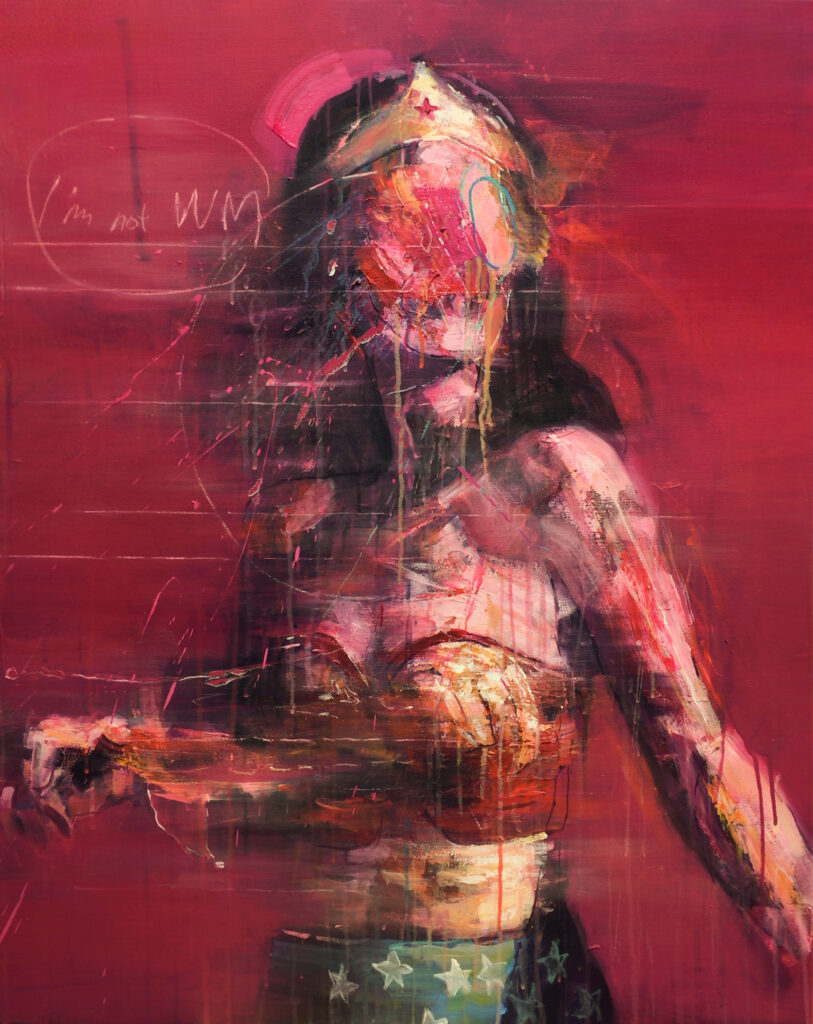
Q4. Your portraits of Hollywood icons and recognizable figures are often heavily distorted. What specific qualities in these familiar images make them ripe for reinterpretation?
Famous cartoon characters and classical masterpieces function as solid icons with finalized forms; the boundaries of their territory are firmly closed. These established stereotypes often overwhelm the painter, carrying the risk that the resulting work will merely reproduce the existing meaning of the icon. I believe this risk is precisely why I paint. I choose these subjects because of an intense desire to “escape”—to create a crack in the rigid wall of perception that surrounds us and reveal “something else” entirely.
Q5. When you break apart a familiar face or figure, are you seeking to expose something underneath, psychologically, culturally, or perceptually?
For me, painting a portrait is not about digging into someone’s inner self; rather, it is about painting the “phenomenon-turned-surface” that wraps around them. The feedback of modern individuals, who react sensitively to trends and syndromes, is merely a surface flowing like an afterimage on a screen. Acknowledging that searching for a fixed “identity” might be a futile hope, I choose to express only the exterior (the surface), revealing the trajectory of the epidermis floating upon a sea of distraction.
Q6. Your work often combines expressive brushwork with figurative foundations. How do you transition from the initial image to a finished piece that feels emotionally charged?
Allowing for numerous variables beyond the artist’s control is the core event that takes place within my painting process. A figurative foundation is a very appropriate stage for these experiments, as it is akin to creating cracks upon a completed form. Through variables—where paint is applied or left blank, where outlines are hidden or exposed, or where pigments drip under the influence of gravity—the form settles into “something else” while retaining only a hint of resemblance. I see these variables as paths leading to another “open window” within the form.
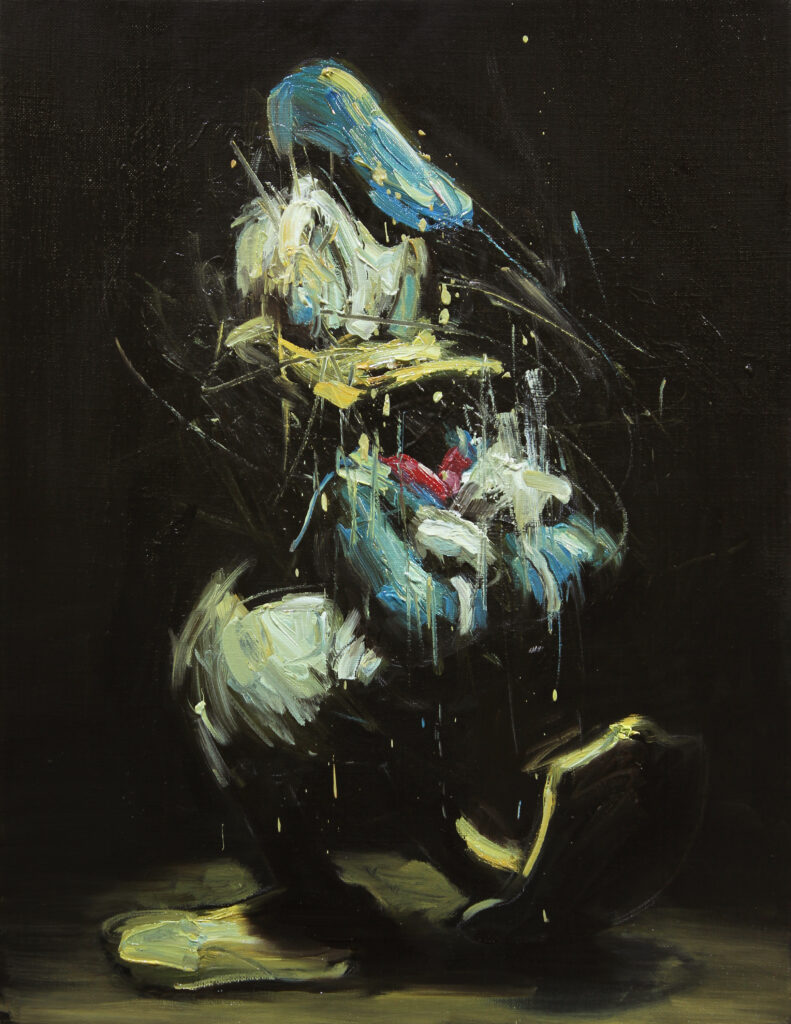
Q7. You work primarily in oil on canvas with varnish, creating vivid surfaces that are both traditional and contemporary. How does your choice of medium affect the viewer’s experience?
I remember my first intense impulse toward painting was the moment I encountered high-resolution photographs of Baroque art. During my adolescence, I was so captivated by masters like Velázquez, Rembrandt, and Goya that I couldn’t sleep.
My desire to express the light found in Baroque painting naturally led me toward traditional techniques and materials.
The foundation of my work process is rooted in classical painting, upon which I integrate the variables and possibilities afforded by contemporary art.
Q8. How do you think pop cultural iconography images that are repeated endlessly in media shapes our visual habits before we even encounter your work?
These icons are etched so deeply and firmly into people’s perceptions that they end up constraining us. As finalized forms, their interpretive horizons are already set, acting as a massive barrier that traps our vision in a specific routine and blocks other possibilities. This “visual habit” ultimately influences our way of thinking, causing us to view the world simply as the media dictates. I believe this is detrimental because it shuts down all the other myriad ways of perceiving an object.
Q9. Do you think your work asks viewers to question who they’re seeing, or how they’re seeing and how are the two connected?
When I paint portraits, I never attempt to represent a specific “someone.” Whoever the person is, they gain anonymity the moment they pass through my canvas, as I want the subject to remain merely an element of the painting. If I were faithful to the reproduction of a specific individual, every element of the painting would exist solely for that person. To answer briefly, I want to show the “painting” itself, not the “who.” This attitude stems from a will to escape the act of representation, where painting merely copies its referent.
Q10. Your solo shows such as Spectacle and Second Layer span different cultural contexts. How do audiences in Korea, Europe, and elsewhere respond differently to your work?
An interesting observation is that, in Korea, there isn’t a strong preference for portraits; culturally, people tend to avoid hanging portraits in living spaces. Surprisingly, however, I feel that my portraits are more popular in Western regions, including Europe. I don’t yet know the exact reason, and I don’t try to guess. My priority is to paint the subjects that interest me as an artist, rather than focusing on what an audience might prefer.
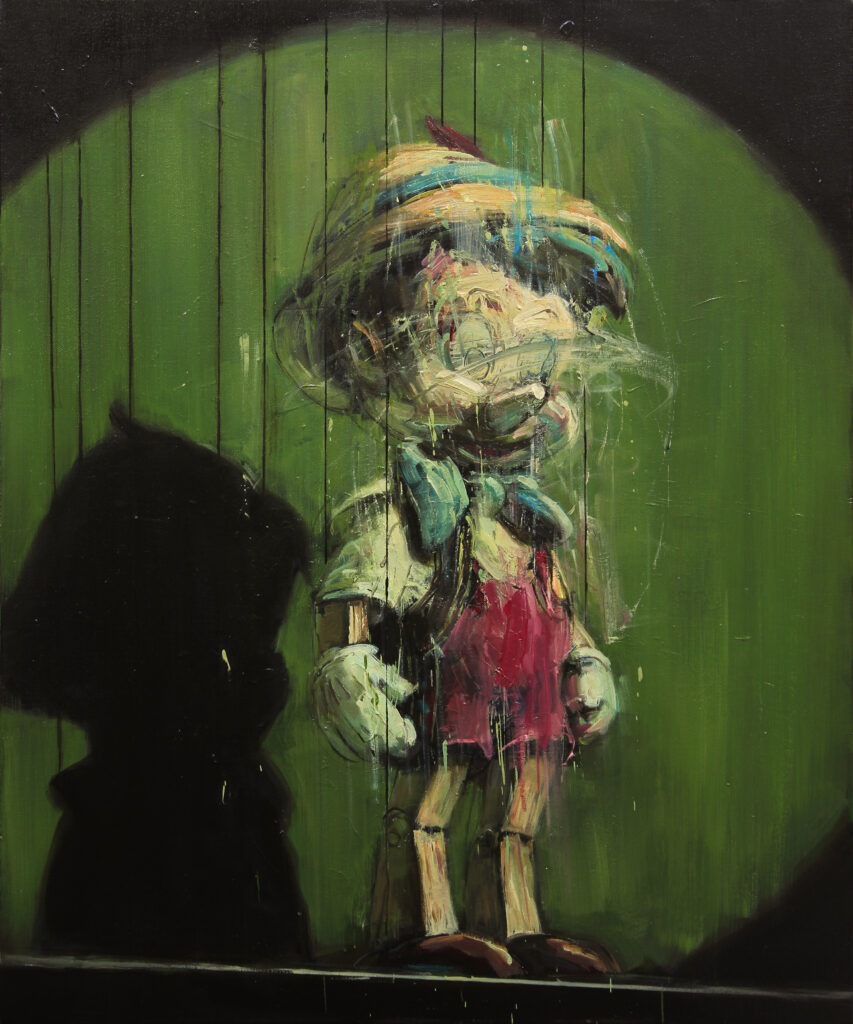
Q11. What do you see as the core challenge for contemporary painting today remixing familiarity, or discovering new forms of expression?
I believe the core challenge for contemporary painting is the “pursuit of form detached from narrative.” It is vital for the painted form not to be an illustration subservient to a story between the past and the future, but to exist as a material entity situated in the “present.” The challenge of modern painting lies in leaving traces of a will to become “painting” itself, breaking free from the narrative dependency of the subject matter.
Q12. Your exhibitions often have evocative titles like Hysteria and Empty Girl. How do these titles shape the way you frame a body of work conceptually?
Titles initiate a minimal will to avoid misunderstandings caused by one’s own perceptual processes. For instance, “Version 0.0” represents a desire to return to a state before analysis begins, while “Redrawn Icons” serves as a conceptual framework that suggests a path of aimless pictorial play, sliding across a solid surface.
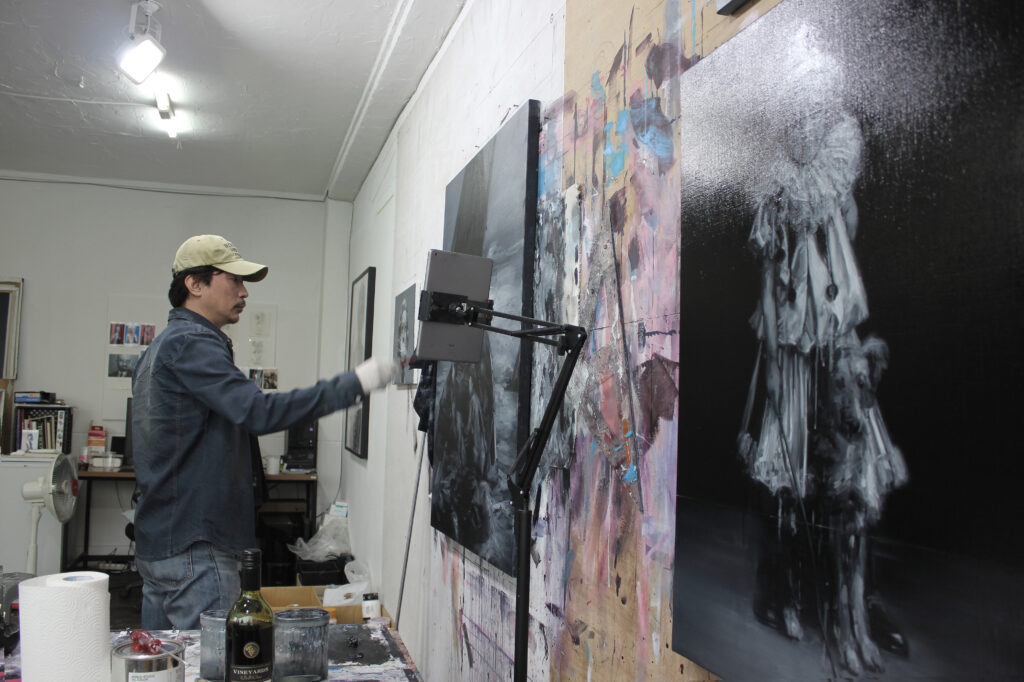
Q13. As an artist committed to expanding visual perception, how do you train yourself to remain open to new ways of seeing rather than falling back into habit?
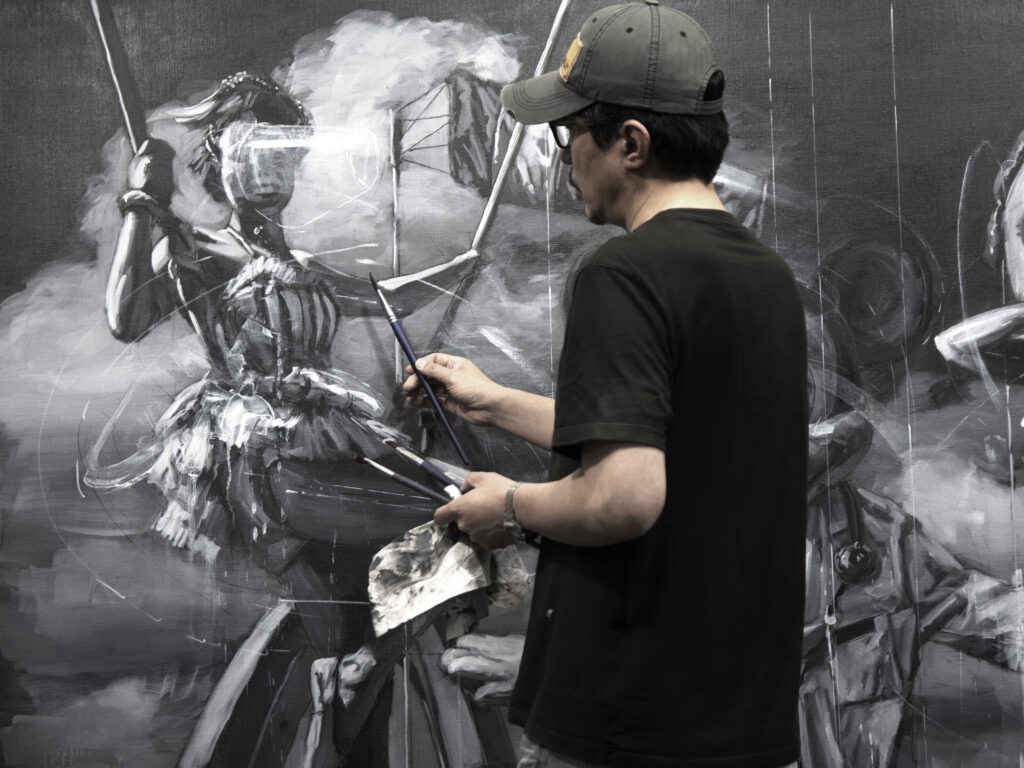
I train myself by “not trusting the analytical system operating in the brain.” I intentionally choose to get lost on the surface of an object to escape its original purpose. Having lost my coordinates, I linger and wander, allowing for scattered brushwork and chance variables to reach a point before analysis and misunderstanding begin. Thus, I always strive to position myself at the boundaries between different domains.
Q14. If someone stood in front of your work without any art background, what experience or reaction would you hope they take away first?
I hope they experience a “crack” in the rigid wall of perception that surrounds our world. I wish for the “something else” revealed through the painting to function as an open “window” to a new world. I want them to realize that one doesn’t necessarily have to go through a logical analysis to perceive an object, and instead experience the wonder of a strange world found off the beaten path of familiarity.
Q15. What advice would you offer artists who want to push beyond visual routine and develop a voice that makes people see differently?
Understand that “completion” can also lead to another form of closure. Therefore, adopt the attitude that the beginning and end of every work is merely a process. Do not fear hysterical marks like scattered brushwork, scratches, or drips of paint. These are traces of a will to reach the essence of “painting” by escaping the intended purpose of the subject matter.
As our conversation with Kim drew to an end, I sat back thinking about how differently he sees the creative process.
Most of us spend years building skills so we can have more command over our work. Better technique means fewer surprises. More experience means knowing exactly what we’re doing. The goal is mastery executing our vision precisely as we imagined it.
Byungkwan’s entire approach flips that on its head. He’s technically trained, deeply skilled in classical methods. But he uses all that training to intentionally lose control. To get lost. To let things happen he didn’t plan for.
And here’s what hit me: that’s not weakness. That’s freedom. We think control protects us. That if we can just get good enough, skilled enough, practiced enough, we won’t have to face uncertainty anymore. But what if uncertainty is where the real work begins? What if the moments we feel most lost are when we’re actually closest to making something that matters?
Kim paints iconic images, forms so established and complete that most artists wouldn’t dare touch them. But that’s exactly why he does it. Because their completeness has become a prison. They’re so finished that they’ve closed off the possibility of seeing them any other way.
His answer? Crack them open. Create ruptures. Make space where there wasn’t any. And that’s not just about painting famous faces. That’s about how we approach everything we make.
How many of us are trapped by our own skills? Working with techniques we’ve perfected so thoroughly that they’ve become limitations? Repeating what works because we’re afraid of what might happen if we don’t?
Here’s what I want you to hear: you don’t have to stay there.
The thing you think you’ve mastered might be the very thing holding you back. Your greatest skill might be your biggest constraint. And sometimes the bravest thing you can do is deliberately break what you know how to do well, just to discover what you don’t know how to do yet.
That’s terrifying, I know. It means letting go of the safety you’ve built. It means facing the possibility that you might fail, might make something that doesn’t work, might waste time going in directions that lead nowhere.
But it also means the possibility of discovering something you never could have planned. Of making work that surprises even you. Of breaking through the walls you didn’t realize you’d built around your own creativity.
Kim s shown me that completion is just one moment in an ongoing process. That the work doesn’t end when we think it’s finished it transforms. And the risks we’re most afraid of taking might be the only ones capable of leading us somewhere genuinely new.
You have permission to break what’s working. To crack open what feels too complete. To trust that losing control might be how you finally find your real voice.
Follow Kim Byungkwan through the links below and witness what becomes possible when someone uses mastery not to stay safe, but to discover what happens when they let go and trust the unknown.