

The Masterpieces Their Artists Never Finished
10 Paintings Frozen in Time
Every great work of art tells a story. Yet some of the most fascinating stories in art history are found in paintings that were never truly finished. The masterpieces their artists never finished often reveal unexpected insights into the creative process, preserving moments of experimentation, ambition, and interruption that completed works rarely show.
For centuries, museums and galleries have celebrated completed masterpieces, the polished works that artists presented to the world as their final vision. But unfinished paintings offer something far rarer. They allow us to witness creativity in motion. Instead of seeing only the destination, we are invited into the journey itself, where ideas are still forming, revisions remain visible, and the artist’s hand seems frozen in the act of creation.
The reasons these works remain incomplete are as varied as the artists who made them. Some were interrupted by death before the final brushstroke could be applied. Others were abandoned when opportunities, ambitions, or historical events pulled their creators in unexpected directions. A few became victims of technical failures, while others reveal artists who deliberately embraced incompletion as part of their creative philosophy.
What makes these paintings so compelling is not merely what they are, but what they might have become. An unfinished masterpiece leaves room for imagination. It invites viewers to speculate, to fill in missing pieces, and to wonder how the final work might have looked had fate taken a different course. In many cases, the absence becomes just as important as the image itself.
From Leonardo da Vinci’s lost mural that may still be hidden behind the walls of Florence to a portrait interrupted by the death of a sitting president, these works reveal moments when art collided with circumstance. They expose the ambitions, struggles, experiments, and imperfections that often disappear beneath a finished surface.
Sometimes, what an artist leaves unfinished can tell us more than what they complete. These ten remarkable paintings prove that masterpieces do not always need an ending to leave a lasting mark on history.
1. The Battle of Anghiari – Leonardo da Vinci
The Greatest Unfinished Masterpiece That Vanished from History

Most unfinished paintings can still be visited in museums. They hang on walls, their missing sections visible to anyone willing to look closely. The Battle of Anghiari is different. Not only was it never completed, it disappeared entirely. Today, one of the most ambitious projects ever undertaken by Leonardo da Vinci exists largely through sketches, copies, historical descriptions, and centuries of speculation.
The story begins in 1503, when the government of Florence commissioned Leonardo to paint a monumental mural in the Palazzo Vecchio. The subject was the Battle of Anghiari, a military victory that had become a source of civic pride for the Florentine Republic. This was not intended to be a simple historical scene. Leonardo envisioned a sprawling, emotionally charged depiction of war that would capture the chaos, violence, and psychological intensity of battle unlike anything seen before.
What survives from preparatory drawings suggests a masterpiece in the making. At the center was a furious struggle for a military standard, with soldiers and horses twisting into a whirlwind of aggression. Faces contorted with rage, muscles strained under pressure, and every figure seemed caught in a moment of explosive action. Contemporary observers were stunned by what they saw. Some described it as one of Leonardo’s greatest achievements, even in its incomplete state.
Then everything went wrong.
Rather than using traditional fresco techniques, Leonardo experimented with a new method involving oil-based paints applied to the wall. The innovation proved disastrous. The paint reportedly failed to dry correctly and began to deteriorate almost immediately. Faced with technical failure and distracted by other projects, Leonardo abandoned the work before it could be completed.
The mystery deepened over the following decades. Renovations transformed the hall, and the mural vanished from view. Some historians believe it was destroyed. Others argue that it may still survive hidden behind later walls, concealed beneath renovations carried out by Giorgio Vasari. Modern investigations have searched for traces of the lost masterpiece, fueling one of art history’s most enduring mysteries.
More than five hundred years later, The Battle of Anghiari remains legendary not because people can see it, but because they cannot. It represents the ultimate artistic “what if”, a masterpiece interrupted by experimentation, lost to time, and immortalized by its absence. Few unfinished works have generated so much fascination, and perhaps none have inspired so many generations to keep searching for what was left behind.
2. The Adoration of the Magi – Leonardo da Vinci
The Masterpiece Leonardo Abandoned for a Bigger Dream

Some unfinished paintings feel incomplete. The Adoration of the Magi feels alive.
Commissioned in 1481 by Augustinian monks for the Church of San Donato a Scopeto near Florence, the painting was meant to depict one of Christianity’s most celebrated moments: the arrival of the Three Wise Men bearing gifts for the infant Jesus. For most artists of the Renaissance, the commission would have resulted in a carefully ordered religious scene. For Leonardo da Vinci, it became something far more ambitious, and ultimately, something he would never finish.
At first glance, the work appears chaotic. Dozens of figures crowd the composition. Some kneel in reverence, others gesture animatedly, while still others seem lost in their own conversations and emotions. Unlike traditional depictions of the biblical event, Leonardo transformed the scene into a living drama filled with movement, curiosity, and psychological complexity. Mary and the Christ Child remain calm at the center, but around them the world seems to swirl with energy.
What makes the painting extraordinary is that viewers can witness Leonardo’s thought process almost directly. Because the work was abandoned before the final layers of paint were applied, much of the underdrawing remains visible. Instead of a polished Renaissance masterpiece, we see a genius actively constructing one. Sketches emerge from shadows, figures overlap, and unfinished details hint at ideas that were still evolving when Leonardo laid down his brush.
Modern technology has only deepened the mystery. Infrared scans and restoration studies have revealed hidden architectural structures, additional figures, and even scenes of conflict buried beneath the visible surface. Some scholars believe these details reflect Leonardo’s fascination with human nature, suggesting that he intended the painting to explore not just a religious event but the broader tensions between violence, faith, and civilization.
The reason it remained unfinished was simple: Leonardo left Florence. In 1482, he accepted an invitation to join the court of Ludovico Sforza in Milan, where opportunities in engineering, architecture, military design, and scientific experimentation beckoned. The monks waited for him to return and complete the altarpiece, but he never did.
Ironically, what began as an abandoned commission became one of the most valuable windows into Leonardo’s creative mind. Finished masterpieces reveal an artist’s conclusions. The Adoration of the Magi reveals the journey itself. More than five centuries later, that unfinished journey continues to captivate historians, artists, and anyone curious about how genius takes shape on a canvas.
3. The Entombment – Michelangelo
The Mystery Painting Michelangelo Walked Away From

For an artist whose name is synonymous with some of the greatest masterpieces ever created, it is easy to forget that even Michelangelo left works unfinished. Yet among his most intriguing abandoned projects is The Entombment, a painting so mysterious that art historians are still debating exactly why it was never completed.
The work depicts one of the most solemn moments in Christian tradition: the body of Jesus being carried to the tomb after the Crucifixion. At first glance, the painting appears unmistakably Michelangelesque. The figures possess the sculptural strength and muscular anatomy that became the artist’s trademark. Their bodies twist and strain beneath the weight of grief, creating a sense of movement that feels almost carved rather than painted.
But look closer, and the painting begins to reveal its secrets.
Large portions remain unfinished. Some figures are little more than outlines. Areas of clothing and background are only partially developed. Certain sections appear carefully worked, while others seem frozen midway through creation, as though Michelangelo simply stepped away one day and never returned. The result is a work suspended between conception and completion.
The circumstances surrounding the painting are just as puzzling. Historians believe it was created around 1500–1501, shortly after Michelangelo’s first stay in Rome. One theory suggests it was commissioned for a church altar, but documentation is scarce, and no surviving contract definitively identifies the work. What is known is that Michelangelo abruptly left Rome and returned to Florence during this period, abandoning several commitments along the way.
Some scholars believe The Entombment became a casualty of that transition. Others argue that the artist may have grown dissatisfied with the composition. Such behavior would not have been entirely out of character. Michelangelo was famously demanding of himself and often viewed artistic perfection as something perpetually out of reach.
The timing of the painting’s abandonment has also fueled speculation because it coincides with a turning point in Michelangelo’s career. Around this period, he was presented with an opportunity that would forever alter his legacy: the commission to sculpt what became the legendary statue of David. If true, one of history’s most celebrated sculptures may have come at the expense of one of its most fascinating unfinished paintings.
For centuries, The Entombment slipped quietly through history, overshadowed by Michelangelo’s more famous achievements. Yet its unfinished state is precisely what makes it remarkable today. The visible sketches, incomplete figures, and unanswered questions transform the painting into something more than a religious image. It becomes a rare glimpse into an artist caught between projects, ambitions, and moments of profound change, a masterpiece not of completion, but of possibility.
4. Madonna with the Long Neck – Parmigianino
The Renaissance Masterpiece Trapped Between Perfection and Completion

Few paintings in art history are as strangely beautiful, or as deliberately unsettling, as Madonna with the Long Neck. Created by Parmigianino in the 1530s, the work has captivated viewers for centuries with its dreamlike proportions, elegant distortions, and lingering sense that something is not quite right. What many visitors don’t realize, however, is that the painting was never actually finished.
Commissioned for a funerary chapel in Parma, the work was intended to depict the Virgin Mary holding the Christ Child, surrounded by angels and saints. On the surface, all the essential elements are present. Mary dominates the composition, her neck elongated with almost swan-like grace. The infant Christ sprawls across her lap in an unnaturally dramatic pose, while a crowd of angels gathers beside them. Yet the more closely one examines the painting, the more its unfinished nature begins to emerge.
A towering column rises behind the figures but abruptly fades into incompletion. Parts of the architectural background remain undeveloped. Certain details appear only partially rendered. In the lower right corner, the tiny figure of Saint Jerome seems disconnected from the rest of the composition, as though he inhabits a different visual world altogether. These unfinished elements create an odd tension, making the painting feel suspended between reality and imagination.
The reason for this interruption lies in the artist’s untimely death. Parmigianino spent years refining and revising the commission, driven by a perfectionism that bordered on obsession. Unlike the balanced harmony favored by earlier Renaissance masters, he embraced the emerging style known as Mannerism, which celebrated elegance, exaggeration, and artistic experimentation. The elongated neck, oversized limbs, and distorted proportions were not mistakes, they were deliberate attempts to create an idealized beauty that transcended ordinary human form.
But perfection proved elusive. Before he could complete the painting to his satisfaction, Parmigianino died in 1540 at just thirty-seven years old. The work remained unfinished, frozen at the exact point where his artistic ambitions ended.
Ironically, the painting’s incompletion enhances its power. The unfinished spaces amplify its dreamlike atmosphere, making it feel less like a traditional religious image and more like a vision caught between worlds. More than four centuries later, Madonna with the Long Neck continues to fascinate viewers because it embodies both the brilliance and the frustration of artistic ambition. It is a masterpiece that seems forever on the verge of becoming something even greater, and perhaps that is exactly why it remains unforgettable.
5. Victory Boogie Woogie – Piet Mondrian
The Painting Still Changing When Its Creator Died

When most people think of Piet Mondrian, they picture strict black lines and blocks of red, yellow, and blue arranged with mathematical precision. Yet his final work, Victory Boogie Woogie, tells a far more dynamic story. It is not merely an unfinished painting, it is a snapshot of an artist in the middle of a creative evolution, still experimenting, still revising, and still searching for something new when death suddenly intervened.
Mondrian arrived in New York in 1940 after fleeing war-torn Europe. The city electrified him. Its glowing lights, geometric streets, and relentless energy felt like a living version of the abstract language he had spent decades developing. Just as influential was the music he discovered there. Jazz and boogie-woogie rhythms fascinated him, inspiring a fresh visual approach that was more vibrant and playful than his earlier works.
Victory Boogie Woogie became the culmination of that excitement.
At first glance, the painting appears deceptively simple, a network of colorful squares and rectangles dancing across the canvas. But closer inspection reveals a work still in progress. Instead of paint alone, Mondrian used hundreds of small pieces of colored tape, moving them around repeatedly as he refined the composition. The surface became a laboratory of experimentation where nothing was fixed and every element remained open to change.
This unfinished state offers a rare opportunity. Most completed masterpieces conceal the countless decisions that shaped them. Here, viewers can practically see Mondrian thinking. Tiny adjustments reveal his constant search for balance, rhythm, and movement. The painting feels less like a finished object and more like an ongoing conversation between artist and canvas.
The title itself reflects a moment of optimism. Created during the final years of World War II, Victory Boogie Woogie celebrated Mondrian’s hope that the Allied forces would triumph and that a new era would emerge from the devastation of war. The word “Victory” captured both political hope and personal excitement about the future.
That future never arrived for the artist. In 1944, Mondrian died of pneumonia before he could complete the work. The painting was left exactly where he had stopped, preserving his final artistic experiment in a state of perpetual becoming.
Unlike many unfinished masterpieces that evoke loss, Victory Boogie Woogie radiates energy and possibility. It feels unfinished not because something is missing, but because it remains alive with movement. More than eighty years later, viewers are still drawn into its pulse, witnessing the final creative journey of one of modern art’s greatest innovators.
6. The Unfinished Portrait of Franklin D. Roosevelt – Elizabeth Shoumatoff
The Portrait Interrupted by History Itself

Most unfinished paintings are abandoned because an artist loses interest, accepts another commission, or dies before the work can be completed. The Unfinished Portrait of Franklin D. Roosevelt is different. It remains unfinished because history intervened in the most dramatic way imaginable.
In the spring of 1945, the Second World War was nearing its end, and President Franklin D. Roosevelt was leading the United States through one of the most critical moments in modern history. Although the public knew little about it, Roosevelt’s health had been deteriorating for months. He appeared exhausted, but few understood just how serious his condition had become.
Artist Elizabeth Shoumatoff arrived at the Little White House in Warm Springs, Georgia, to paint the president’s portrait. The commission seemed routine enough. Roosevelt sat for several sessions, chatting comfortably and appearing in good spirits despite his declining health. Shoumatoff worked steadily, capturing his familiar expression and the relaxed confidence that had defined much of his presidency.
Then, on April 12, 1945, everything changed.
While Shoumatoff was painting, Roosevelt suddenly complained of a severe headache. Moments later, he collapsed. The sitting ended immediately as doctors rushed to his aid. Within hours, the president was dead from a massive cerebral hemorrhage.
The canvas remained exactly where it was.
Unlike many unfinished portraits that simply lack detail, this painting feels frozen in a specific moment. Roosevelt’s face is largely developed, his likeness clearly recognizable, yet portions of the composition remain incomplete. The unfinished sections serve as a visual reminder that both the painting and Roosevelt’s life were abruptly interrupted on the same day.
What makes the work particularly haunting is the knowledge that the artist never intended it to become a historical artifact. She was simply documenting a living president. Instead, she unknowingly captured the final hours of one of the most influential leaders of the twentieth century.
Shoumatoff later created a completed version of the portrait, but it is the unfinished original that continues to attract the greatest attention. The visible brushwork, unfinished areas, and sudden ending transform it into something more powerful than a conventional presidential portrait. It is not merely a depiction of Roosevelt, it is a record of a pivotal moment when history changed course.
Few unfinished artworks carry such emotional weight. The painting stands as a reminder that sometimes a work remains incomplete not because the artist stopped painting, but because time itself refused to continue.
7. Portrait of George Washington (The Athenaeum Portrait) – Gilbert Stuart
The Unfinished Face That Became America’s Most Famous Image
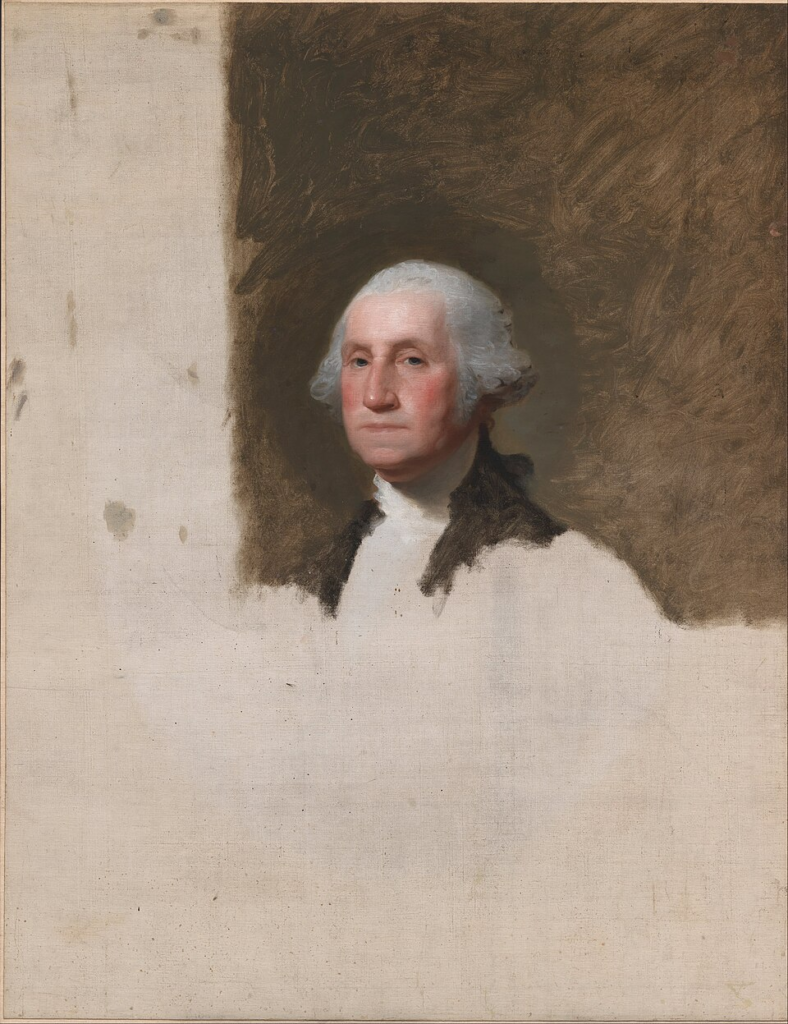
It is one of the great ironies of art history that the most recognizable image of George Washington was never actually finished.
Today, millions of people encounter this portrait every day without realizing it. It stares back from the United States one-dollar bill, appears in countless textbooks, and has become one of the defining visual representations of the nation’s first president. Yet the original painting, known as the Athenaeum Portrait, remains unfinished more than two centuries after it was begun.
The artist behind the work, Gilbert Stuart, was widely regarded as one of the finest portraitists of his era. By the 1790s, he had established a reputation for capturing not just the likeness of his subjects but also their personalities. When he was commissioned to paint President George Washington, Stuart understood that he was creating an image that would help define how future generations remembered the revolutionary leader.
There was just one problem: Washington was not an easy subject.
Unlike many sitters who enjoyed being painted, Washington reportedly found portrait sessions tedious and uncomfortable. Years of military service, public responsibilities, and advancing age had given him a reserved demeanor that artists struggled to capture. His dentures, far more cumbersome than modern versions, altered the shape of his jaw and made achieving a natural likeness even more challenging.
Despite these obstacles, Stuart eventually produced a portrait that perfectly balanced dignity, intelligence, and restraint. But rather than finishing the entire canvas, he made a surprising decision. He stopped.
The face was completed with remarkable care, while large portions of the body, clothing, and background remained only partially painted. Far from being an act of laziness, this was a calculated business strategy. Stuart realized he could use the unfinished portrait as a master template from which to create numerous copies for eager patrons. Instead of delivering the original and moving on, he kept it in his possession and reproduced the image again and again.
The plan worked brilliantly. Dozens of replicas were commissioned, spreading Washington’s likeness throughout the young nation. Over time, the unfinished original became the source of the most iconic image of the president ever created.
What makes the Athenaeum Portrait so fascinating is that its unfinished state was intentional. Unlike other works on this list, it was not interrupted by death, disaster, or changing circumstances. Stuart chose to leave it incomplete because doing so made the painting more useful to him.
Centuries later, the portrait remains a reminder that unfinished art is not always the result of failure. Sometimes, as Gilbert Stuart discovered, incompletion can become part of a masterpiece’s success.
8. James Hunter, Black Draftee – Alice Neel
The Missing Man Who Never Returned to Finish His Portrait

Some unfinished paintings tell us about the artist. Others tell us about history. James Hunter, Black Draftee tells us about a person who seemingly vanished, leaving behind a mystery that has never been fully solved.
Painted in 1965 by Alice Neel, the work emerged during one of the most turbulent periods in American history. The Vietnam War was escalating, the Civil Rights Movement was reshaping the nation, and a generation of young men faced the possibility of being drafted into military service. It was in this atmosphere of uncertainty that Neel met James Hunter.
Neel had an unusual approach to portraiture. Rather than focusing on celebrities or wealthy patrons, she often painted ordinary people she encountered in everyday life. She was fascinated by personality, vulnerability, and the emotional truths hidden beneath appearances. When Hunter arrived for a sitting shortly after learning he had been drafted, she immediately recognized the complexity of the moment.
The portrait captures a young man suspended between two futures. Hunter sits quietly, his expression thoughtful and distant. There is no heroic pose, no patriotic symbolism, and no dramatic gesture. Instead, Neel presents him as a human being wrestling with uncertainty. His face carries a mixture of apprehension, contemplation, and resignation that feels deeply personal.
Yet the painting remains unfinished.
Neel completed much of Hunter’s face and outlined significant portions of his body, intending to continue the work during future sittings. But those sittings never happened. Hunter never returned.
What happened next remains unclear. Unlike many unfinished portraits where the reason for abandonment is well documented, the story of James Hunter dissolves into mystery. His name does not appear on the Vietnam Veterans Memorial, suggesting he was not killed in the war under that identity. Beyond that, reliable information becomes scarce. Whether he moved away, changed his plans, avoided military service, or simply disappeared from Neel’s life remains unknown.
Rather than treating the unfinished state as a problem, Neel embraced it. She eventually signed the painting and exhibited it as a completed work. The blank and partially rendered sections became part of its meaning. Hunter’s absence was no longer a flaw in the portrait—it was the portrait.
Today, James Hunter, Black Draftee stands as one of the most emotionally powerful unfinished paintings of the twentieth century. The empty spaces echo the unanswered questions surrounding its subject, transforming a simple portrait into a haunting meditation on uncertainty, identity, and the countless lives forever altered by war.
9. Treaty of Paris – Benjamin West
The Painting Diplomacy Refused to Complete

Most unfinished paintings are the result of an artist’s decision, an unexpected death, or a lack of time. The Treaty of Paris is unusual because it remained unfinished for a far more human reason: nobody wanted to be associated with defeat.
The painting commemorates one of the most significant diplomatic events in modern history. On September 3, 1783, representatives of Great Britain and the newly independent United States formally signed the Treaty of Paris, bringing the American Revolutionary War to an end. For the Americans, it was a moment of triumph. For the British, it was a painful acknowledgment that thirteen colonies had successfully broken away from the empire.
To immortalize the historic event, renowned painter Benjamin West was commissioned to create a grand scene depicting the negotiations. West was uniquely positioned for the task. Although born in Pennsylvania, he had built his career in England and enjoyed considerable prestige in British artistic circles. He understood both sides of the conflict and possessed the reputation necessary to document such a monumental occasion.
The American delegates cooperated readily. Figures such as Benjamin Franklin, John Adams, and John Jay agreed to be represented in the composition. West carefully painted them gathered around a table, their presence conveying the confidence of a nation that had secured its independence.
The British delegation, however, refused.
Embarrassed by the loss and unwilling to sit for a portrait commemorating their defeat, the British representatives declined to participate in the project. Without their likenesses, West could not complete the composition as intended. The result is one of the strangest unfinished masterpieces in history: a diplomatic meeting where only one side appears.
The empty space is impossible to ignore. Where the British negotiators should stand, there is nothing. The absence transforms the painting from a straightforward historical record into a visual symbol of wounded pride and political discomfort. In a sense, the missing figures tell the story just as effectively as painted ones could have.
More than two centuries later, The Treaty of Paris remains fascinating precisely because it is incomplete. Its unfinished state reminds us that history is not only shaped by victories and agreements, but also by the emotions that follow them. Sometimes the most revealing part of a painting is not what the artist included, it is what others refused to become.
10. Turning Road – Paul Cézanne
When Unfinished Became a Revolutionary Artistic Language

If many of the unfinished paintings on this list were abandoned because of death, circumstance, or mystery, Turning Road presents a different possibility altogether: what if the painting was never meant to be fully finished in the first place?
Created by Paul Cézanne during the final years of his career, Turning Road embodies the artistic philosophy that would ultimately reshape modern art. Unlike the polished realism that dominated earlier centuries, Cézanne was less interested in creating perfect illusions than in exploring how we actually perceive the world. The result was a style that often appeared incomplete to his contemporaries but would later influence generations of artists, including the pioneers of Cubism.
At first glance, Turning Road depicts a simple landscape. A winding path cuts through the countryside, framed by trees and patches of vegetation. Yet the longer one studies the canvas, the more unusual it becomes. Certain areas are richly developed with color and form, while others seem barely touched. Portions of the canvas remain exposed, revealing gaps where many artists would have continued painting. The transitions between finished and unfinished sections feel deliberate, creating a visual rhythm that guides the viewer’s eye across the composition.
For some observers, these blank areas suggest that Cézanne simply never completed the work. Others argue that the unfinished appearance was an intentional part of his process. Throughout his later years, he became increasingly cautious about overworking a painting. He famously feared that one unnecessary brushstroke could upset the delicate balance he was trying to achieve. Rather than forcing every section to conform to a polished whole, he often allowed portions of the canvas to remain open, trusting the viewer’s eye to complete the image.
This approach was revolutionary. By emphasizing structure, color relationships, and perception over perfect finish, Cézanne laid the groundwork for many of the artistic movements that followed. What once appeared unfinished began to look remarkably modern.
In many ways, Turning Road serves as the ideal conclusion to a list of unfinished masterpieces. It challenges the very definition of completion itself. Is a painting unfinished because the artist stopped working on it? Or can an artwork be complete precisely because it leaves something unresolved?
More than a century after Cézanne’s death, that question remains unanswered. And perhaps that is the painting’s greatest achievement. Unlike the other works on this list, Turning Road does not simply represent an unfinished masterpiece, it asks whether the idea of a “finished masterpiece” truly exists at all.
Art history often celebrates perfection. We admire the completed masterpieces that seem to embody confidence, certainty, and artistic triumph. Yet the paintings on this list remind us that some of the most powerful works ever created exist in a state of incompletion.
Their unfinished nature allows us to see what is usually hidden. We witness Leonardo searching for solutions, Michelangelo moving between ambitions, Mondrian experimenting with new ideas, and Cézanne questioning what it even means for a painting to be finished. In these works, the creative process remains visible, preserved like a conversation that was unexpectedly interrupted.
Many of these paintings owe their enduring fascination to the very circumstances that prevented their completion. A president’s sudden death, a mysterious disappearance, a failed artistic experiment, a diplomatic slight, or an artist’s relentless pursuit of perfection transformed ordinary commissions into extraordinary stories. The missing brushstrokes became part of the narrative.
Perhaps that is why unfinished artworks continue to captivate us centuries later. They feel more human. Unlike completed masterpieces, they reveal uncertainty, hesitation, ambition, and vulnerability. They remind us that creativity is rarely a straight path and that even the greatest artists struggled with limitations, distractions, and unfinished dreams.
In a world obsessed with finished products and final results, these paintings offer a different perspective. They suggest that value is not found solely in completion, but also in the ideas, experiments, and possibilities left behind.
After all, some masterpieces are remembered not because they reached the end of their story, but because they never did.
Which unfinished painting fascinates you the most?
Enjoyed exploring these unfinished masterpieces? Discover the artist who shaped Vincent van Gogh’s way of seeing the world in our article, The Artist Van Gogh Never Stopped Learning From: