
The Latest in the Art World: Public Art, Cultural Shifts, and Major New Commissions

This week’s Latest in the art world, public space became a powerful stage for conversation, memory, and cultural transformation. From monumental installations in New York and Berlin to Banksy’s surprise intervention in central London, artists and institutions continued to reshape how audiences experience art beyond traditional gallery walls. At the same time, major exhibitions, leadership appointments, and ambitious commissions reflected a broader shift toward participation, accessibility, and interdisciplinary practice across the global cultural landscape. Together, these stories reveal an art world increasingly defined not only by spectacle, but by its ability to provoke dialogue, collective reflection, and new ways of engaging with history, identity, and public life.
Tuan Andrew Nguyen Unveils Monumental Buddha Sculpture on New York’s High Line


Vietnamese artist Tuan Andrew Nguyen has unveiled a monumental new public sculpture on the High Line in New York. Titled The Light That Shines Through the Universe (2026), the 27-foot-tall sandstone Buddha now stands at the intersection of 10th Avenue and 30th Street, where it will remain on view through fall 2027.
Commissioned as part of the High Line Plinth program, the sculpture references the ancient Bamiyan Buddhas of Afghanistan, two monumental cliffside statues that were destroyed by the Taliban in 2001. Nguyen’s work recreates the form of one of the Buddhas, while introducing a striking contemporary intervention: glowing hands cast from melted artillery shells. Suspended slightly apart from the sandstone body, the hands symbolize resilience and the possibility of hope despite irreversible loss.
Nguyen, who received a MacArthur Fellowship in 2025, is widely recognized for work that explores erased histories, displacement, and the lingering impact of war and colonial violence. Across film and sculpture, his practice often centers stories and memories that have been overlooked or suppressed. With The Light That Shines Through the Universe, those themes take on a monumental public form, transforming the High Line into a site of remembrance, reflection, and repair.
In a statement accompanying the installation, Cecilia Alemani, director and chief curator of High Line Art, described the sculpture as “a powerful and poetic counterpoint to extremism and iconoclasm,” emphasizing how the work resurrects the memory of cultural heritage destroyed by violence while affirming its enduring significance.
The commission joins a growing lineage of ambitious large-scale installations on the High Line, following previous works by artists including Iván Argote, Pamela Rosenkranz, and Sam Durant.
As public art increasingly becomes a space for confronting history and collective memory, Nguyen’s installation reflects a broader shift toward monuments that question, heal, and reimagine rather than simply commemorate. Through scale, symbolism, and material transformation, The Light That Shines Through the Universe offers a reminder that even after destruction, cultural memory continues to endure.
Chanel Presents Major Lina Lapelytė Commission at Berlin’s Hamburger Bahnhof
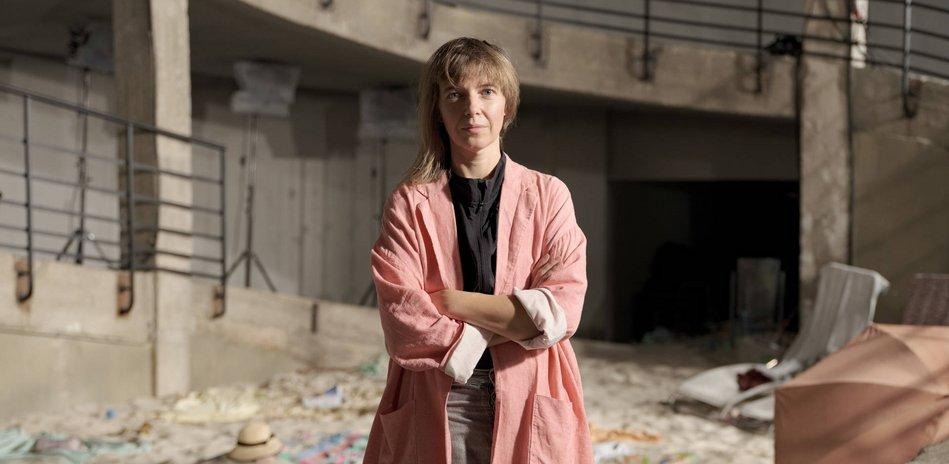
Lithuanian interdisciplinary artist Lina Lapelytė is set to open a major new large-scale installation and performance work at Hamburger Bahnhof as part of Berlin Gallery Weekend 2026. Titled We Make Years Out of Hours (2026), the project marks the second edition of the Chanel Commission and officially opens on May 1, with performances continuing through January 10, 2027.

Transforming the museum’s historic former train hall into an immersive participatory environment, the installation features 400,000 small wooden cubes spread across the vast industrial space. Some are carefully stacked into temporary architectural forms, while others remain scattered in piles throughout the hall. Visitors are encouraged to actively engage with the work by building and dismantling structures themselves, turning the exhibition into a constantly shifting collective landscape.
At the center of the project is a sonic and poetic dimension. A libretto woven through the installation draws from texts by celebrated writers including Etel Adnan, Ocean Vuong, and Mahmoud Darwish. Themes of love, grief, hope, and community echo throughout the space, while performers periodically activate the installation through collaborative singing and construction alongside visitors.
In a statement accompanying the exhibition, co-directors Sam Bardaouil and Till Fellrath described the work as a reflection of Hamburger Bahnhof’s ongoing commitment to participation, inclusion, and collective imagination. Rather than functioning solely as a site for viewing art, the installation reimagines the museum as a place of encounter and shared authorship.
The commission is supported through the Chanel Culture Fund, an initiative focused on supporting ambitious artistic projects, exhibitions, and cross-cultural dialogue. Yana Peel, Chanel’s president of arts, culture, and heritage, noted that the project exemplifies artistic practices grounded in care, collaboration, and shared experience across generations and communities.
This latest commission follows the inaugural Chanel Commission at Hamburger Bahnhof, awarded to Czech artist Klára Hosnedlová for her installation embrace. Together, the initiative signals a growing investment in immersive, participatory art practices that position audiences not as passive viewers, but as active contributors within the work itself.
Tate Britain to Explore British ’90s Art and Fashion in Major New Exhibition

Tate Britain is set to open a major exhibition this fall examining the cultural collision of art, fashion, and photography that reshaped Britain during the 1990s. Titled The 90s: Art and Fashion, the exhibition is curated by former British Vogue editor-in-chief Edward Enninful and will run from August 8, 2026 through February 14, 2027.
Bringing together more than 100 works by nearly 70 artists and designers, the exhibition traces a decade defined by creative rebellion, experimentation, and the collapse of boundaries between disciplines. Emerging from the economic recession of the early 1990s, Britain witnessed a surge of new artistic voices who transformed fashion, photography, and contemporary art into interconnected cultural forces.
The exhibition will feature works by key figures associated with the Young British Artists movement, including Tracey Emin, Sarah Lucas, Jenny Saville, and Chris Ofili, alongside photographers such as Juergen Teller, Corinne Day, Wolfgang Tillmans, and Nick Knight.
Fashion also takes center stage, with garments from influential designers including Alexander McQueen, Vivienne Westwood, John Galliano, and Stella McCartney. Together, the works capture a period when London’s underground culture, DIY publishing, nightlife, and street style radically shaped the visual language of a generation.
Speaking about the exhibition, Enninful described 1990s London as “raw, unstable, and full of possibility,” emphasizing the decade’s refusal of hierarchy across art, music, fashion, and image-making. Rather than focusing on a single movement, the exhibition explores the collective energy that defined Britain’s cultural transformation during the era.
Highlights of the show include Steve McQueen’s early film Bear (1993), alongside Chris Ofili’s Turner Prize-winning painting No Woman, No Cry (1998). The exhibition will also be accompanied by a publication edited by Enninful and curator Dominique Heyse-Moore, featuring contributions from artists and cultural figures including Sonia Boyce and Yinka Shonibare.
San Francisco Appoints Its First-Ever Executive Director of Arts and Culture

The city of San Francisco has appointed Matthew Goudeau as its first-ever executive director of arts and culture, marking a major structural shift in how the city plans to support and expand its creative sector.
The newly created role arrives at a significant moment for the city’s cultural landscape, as local arts funding is expected to increase this year despite growing concerns around federal arts support nationwide. Under the leadership of Daniel Lurie, the city has emphasized the arts as a key driver of economic recovery, tourism, and civic identity.
As executive director, Goudeau will oversee the consolidation of several major cultural agencies, including the San Francisco Arts Commission, Grants for the Arts, and the San Francisco Film Commission, into a single unified department aimed at strengthening collaboration and public support for the arts.
Goudeau was selected following a nationwide search that drew nearly 260 applicants. Prior to the appointment, he served as chief development officer at Yerba Buena Center for the Arts, where he led fundraising and strategic partnership initiatives. He also previously directed Grants for the Arts and has worked across San Francisco’s cultural infrastructure under six different mayoral administrations.
Beyond city government, Goudeau’s background includes fundraising leadership at the Chinati Foundation and the David Ireland House in San Francisco’s Mission District. His work has supported major public art initiatives, including a permanent installation by artist Robert Irwin.
In a statement following the announcement, Goudeau emphasized his long-standing connection to San Francisco’s arts community and his commitment to supporting artists, cultural workers, and institutions across the city. The appointment signals a broader effort to position culture and creativity at the center of San Francisco’s future growth, while reinforcing the city’s reputation as one of the country’s most influential artistic hubs.
Banksy Statue Mysteriously Appears in Central London

A new public artwork by elusive street artist Banksy has unexpectedly appeared in central London, drawing crowds and widespread speculation before the artist confirmed its authenticity through social media.
Installed overnight in Waterloo Place in St. James’s, the sculpture depicts a suited man carrying a large flag that completely obscures his face as he steps forward from a plinth. Positioned among historic monuments and memorials, the work immediately sparked conversations around nationalism, political power, and blind authority, recurring themes often explored throughout Banksy’s practice.
The installation sits near statues of Edward VII and Florence Nightingale, alongside memorials connected to the Crimean War. Its placement within one of London’s most historically symbolic public spaces has been widely noted as central to the work’s impact.
As with many of Banksy’s interventions, the piece appeared without warning in the early hours of the morning, executed in the artist’s signature guerrilla style. A video later shared through Banksy’s official channels confirmed the work’s authenticity after online speculation quickly intensified.
Speaking to the BBC, journalist and The Banksy Story podcast creator James Peak described the positioning of the sculpture as “absolutely knockout,” interpreting the obscured figure as a commentary on leadership, ego, and power disconnected from vision or awareness.
While Banksy is primarily associated with graffiti and stencil-based interventions, the artist has previously experimented with sculptural works in public space. One of the most notable examples was The Drinker (2004), a satirical reinterpretation of Auguste Rodin’s The Thinker, which briefly appeared in London’s West End before being removed.
The latest installation continues a recent wave of Banksy projects across London, including murals near the Royal Courts of Justice and a widely discussed series of animal-themed works unveiled throughout the city in 2024. As with many of the artist’s unsanctioned interventions, it remains unclear how long the sculpture will stay in place before authorities intervene.
Taken together, this week’s developments point toward a cultural landscape that is becoming more immersive, public-facing, and deeply interconnected. Whether through large-scale installations, experimental exhibitions, or institutional change, artists and organizations are increasingly challenging how art is encountered and who it is meant to reach. From the streets of London to museum halls in Berlin and New York, contemporary art continues to move beyond static display, inviting audiences into experiences shaped by participation, memory, politics, and shared imagination.