



Why Sofía Ruiz sews real thread into the eyes of her oil painted figures

At Arts to Hearts Project, our Women Artist Award celebrates women who are making work from the places most people avoid. Not the comfortable places. Not the resolved ones. The messy uncertain in-between places where identity is not fixed and memory cannot be trusted and the things that scared you as a child are still sitting in the room with you decades later.
Sofía Ruiz works from exactly that place. And we are honoured to have her as a selected artist for the Women Artist Award.
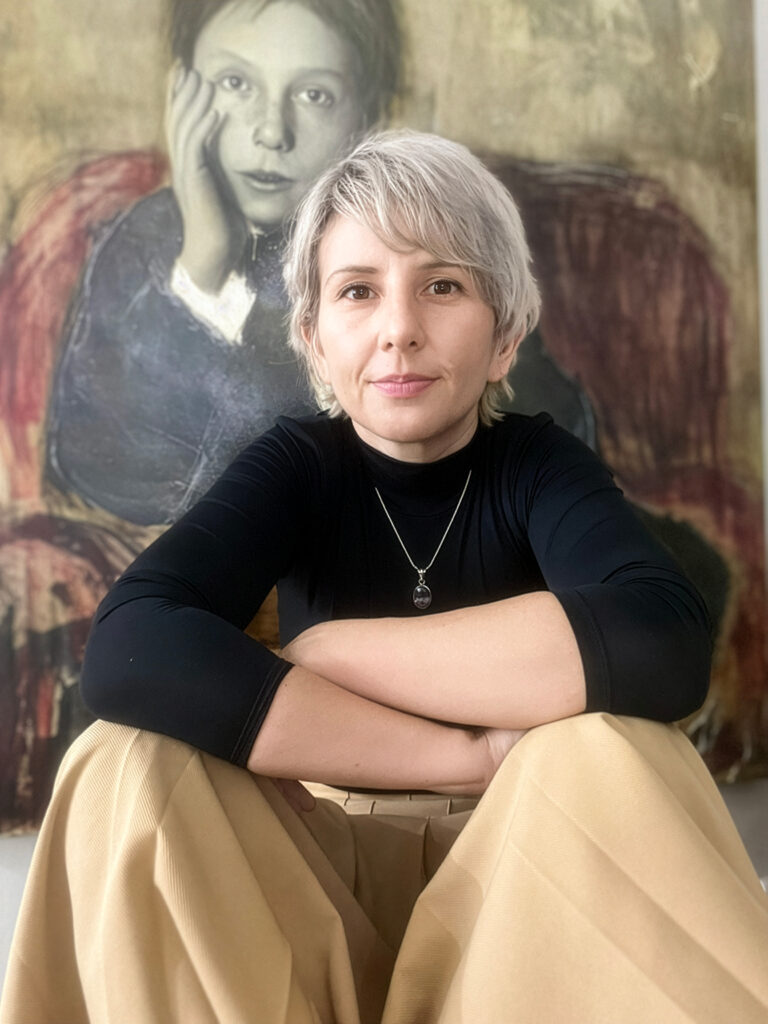
Her practice begins with absence. Her mother has amnesia. Growing up there were missing stories, missing images, missing pieces of the family history that most people can reach for whenever they need to remember who they are and where they came from.
Sofía did not have that. She had gaps. And those gaps taught her something that became the foundation of everything she makes. That identity is not solid. It is assembled from whatever pieces are available, some real, some remembered wrong, some completely invented to fill the space where something used to be.
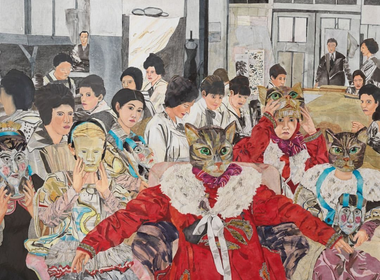
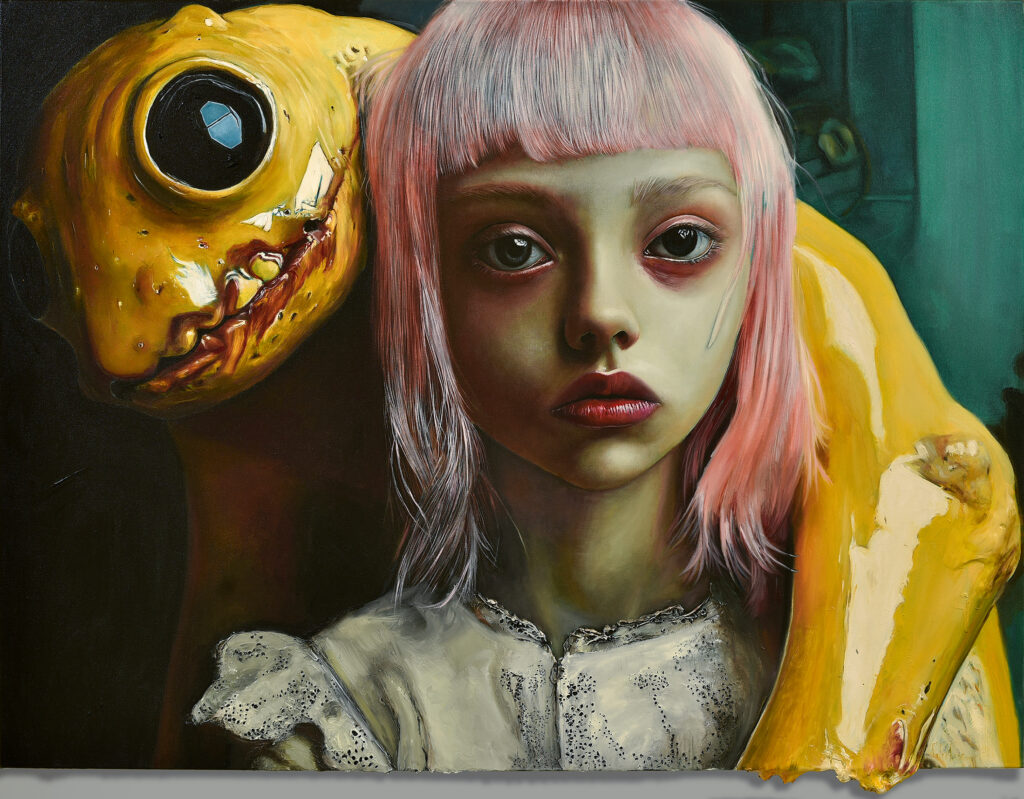
That understanding lives in every painting she makes. She paints children alongside strange creatures that hover in the space between threatening and tender. They are not monsters exactly. They are not protectors exactly. They are something else. Something that has been there so long the child has stopped being afraid and started just living with it. Sofía is interested in that moment.
The moment where fear becomes familiar. Where something that once overwhelmed you becomes something you carry around with you every day without even noticing it anymore. She calls it a domestication of terror. And when you see it in her paintings you recognise it from your own life even if you have never put words to it before.
She works across oil, acrylic, and thread. Oil for the slow introspective pieces. Acrylic when the emotion is raw and needs to come out fast. Thread when the surface needs to feel like something is being repaired or something is barely holding together. She chooses materials based on what the painting needs emotionally, not what will look the most polished.
When she paints she describes going into a trance-like state where things surface that she could never arrive at through thinking. Distortions, gestures, decisions that come from underneath. And then she steps back, looks hard, edits, adjusts. She lets intuition and analysis take turns running the show and the paintings find their truth somewhere in between the two.
She has gotten more honest over time. More comfortable with strangeness. More willing to let the painting be uncomfortable without trying to fix it.
That willingness shows in everything she makes now. The work is quiet but it is not gentle. It is the kind of quiet that makes you pay attention because you can feel that something real is happening underneath the surface.
Let’s get to know Sofía through our conversation with her about growing up with gaps in memory, what those strange creatures beside her children really are, and why she believes the most honest art comes from the places most people would rather not look.
Q1. Can you share your background and the early experiences that shaped your path toward painting?
A defining influence was growing up with gaps in memory within my own family, particularly connected to my mother’s amnesia. The absence of images, stories, and clear narratives made me aware of how identity is not fixed, but constructed through fragments, omissions, and reinterpretations.
This led me to explore painting as a space where memory can be both revealed and distorted. Over time, questions of duality began to emerge, how we see ourselves versus how we are seen, what is internal versus external. And my work became a way to hold these contradictions.
Q2. Your paintings often depict children in ambiguous psychological spaces alongside surreal figures. How do you approach the representation of childhood not just visually, but emotionally in your work?
I approach childhood less as a literal stage of life and more as an emotional and psychological state that continues into adulthood. In my work, children are not simply representations of innocence, they become carriers of tension, vulnerability, and unresolved experience. I’m interested in that space where something feels familiar but slightly off. The surreal figures often emerge as extensions of internal states; fears, memories, or unconscious thoughts that take on a presence of their own.
By placing them alongside children, I try to suggest how early experiences can shape the way we relate to ourselves over time. It’s less about illustrating childhood and more about evoking the complexity of how it is remembered, felt, and carried within us
Q3. Many of your figures are paired with imaginary companions: creatures that are neither wholly threatening nor entirely benign. How do you balance tension and tenderness in these relationships?
I see these imagined companions as a way of externalizing what is difficult to name: forms of fear, anxiety, or emotional residue that don’t fully disappear, but instead stay with us. The idea of a kind of “domestication of terror” is important in my work: these figures are not purely threatening, but neither are they safe. They exist in a space of negotiation. The tension comes from their ambiguity, their scale, their presence, the way they inhabit the same space as the figure.
But at the same time, there is often a quiet intimacy in how they relate. They are close, sometimes protective, almost familiar. That’s where tenderness begins to enter. I’m interested in how we learn to live alongside what disturbs us, how fear can become something we carry, even care for, as a way to cope with a sense of disconnection. These relationships reflect that paradox: an attempt to coexist with what once felt overwhelming, until it becomes part of our internal landscape.
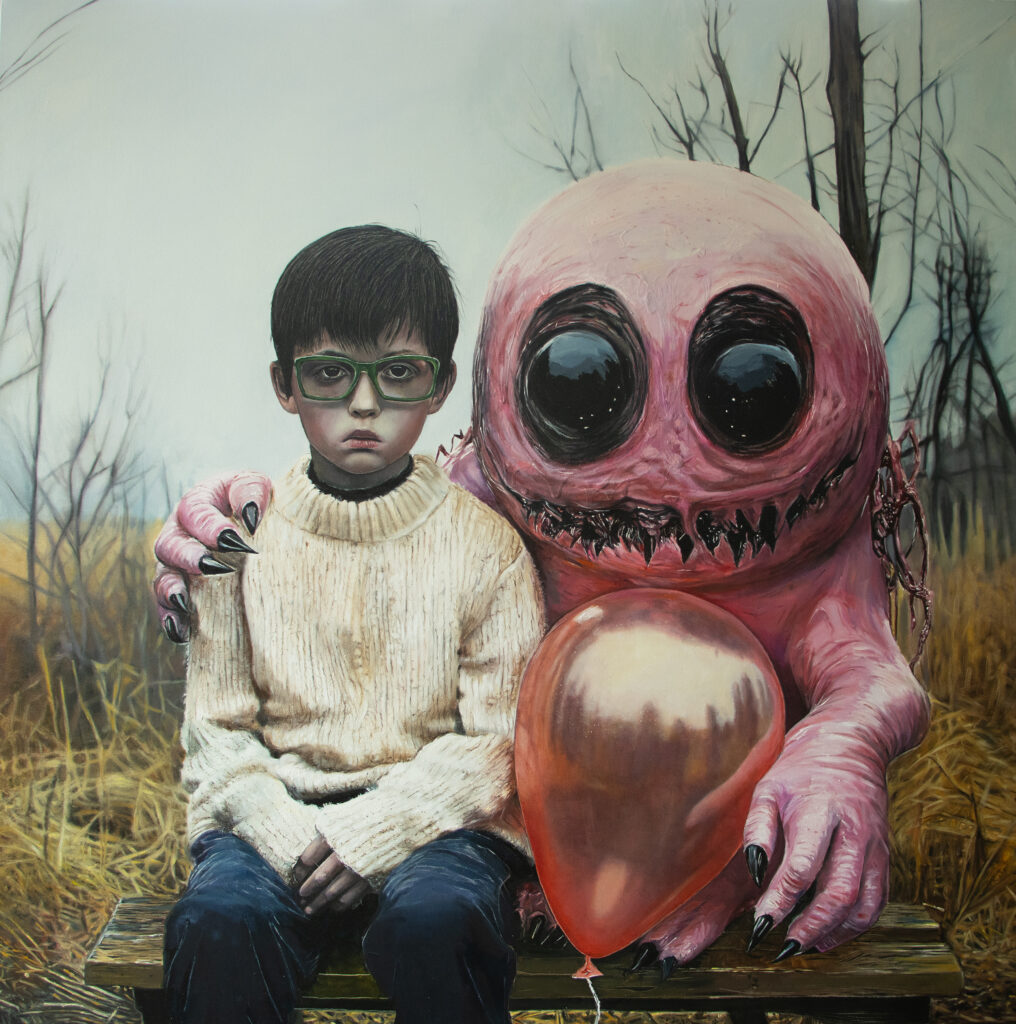
Q4. In works like The Neighbours and Mysterious Allies, juxtaposition plays a key role. How do symbolic objects, toys, or fantastical figures function conceptually within the narrative of your paintings?
These elements function as psychological anchors within the composition. Objects like toys or familiar forms carry a certain coded innocence, but when displaced or paired with fantastical figures, they begin to shift in meaning. I’m interested in how these symbols operate as fragments of memory, partial, unreliable, and often charged with emotion, including fear. A toy, for example, can suggest comfort, but also control, projection, or the quiet presence of something unsettling beneath the surface. It can hold both protection and unease at the same time.
Q5. You work across oil, acrylic, and even incorporate thread into your surfaces. How do you decide which medium best serves the emotional tone of a particular piece?
I choose the medium based on the emotional tone I’m trying to reach. Oil allows for a slower, more introspective process. Acrylic feels more immediate and rawer, helping to build tension or instability. If I use thread, it adds a physical dimension, it suggests repair, fragmentation, or an attempt to hold something together. For me each material becomes a way of translating different states,
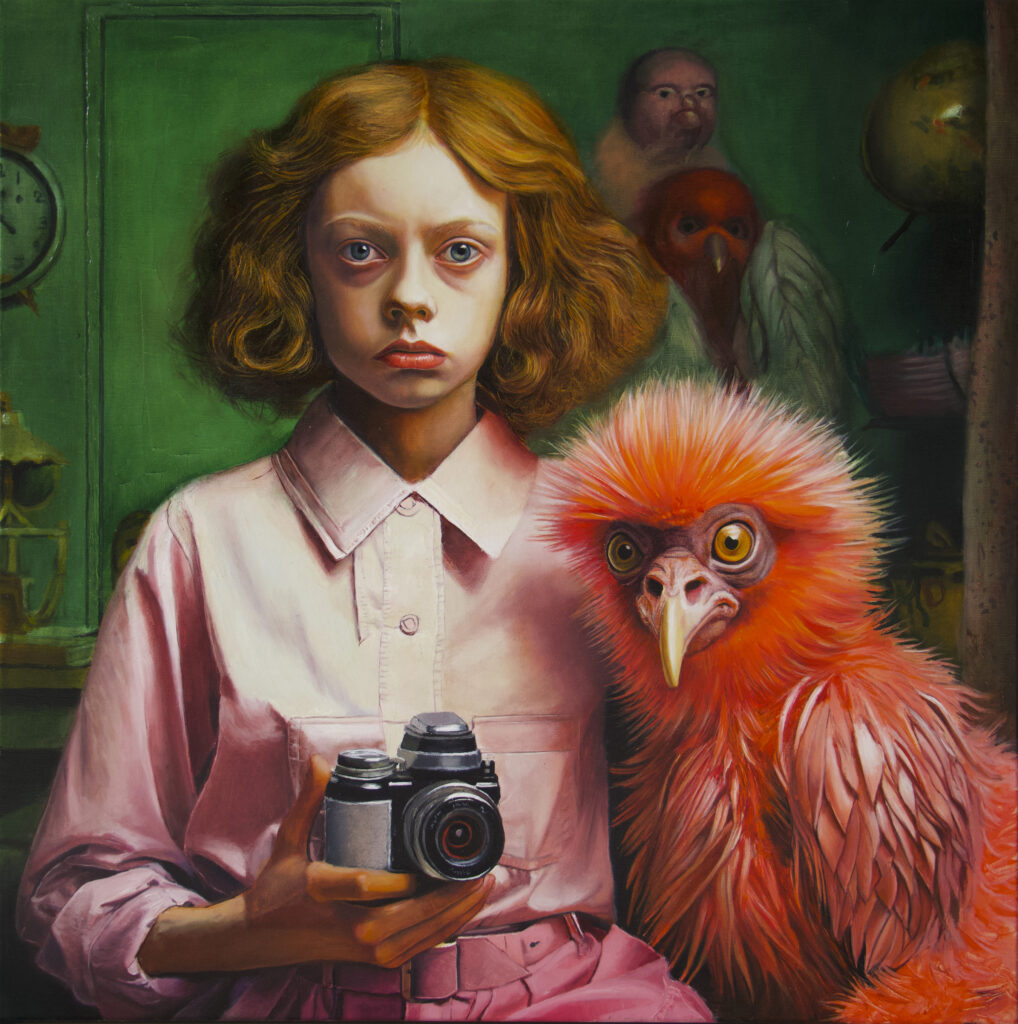
Q6. You’ve described entering a “trance-like state” during painting. How do you maintain clarity of expression through moments of intuitive flow versus analytical control?
I move back and forth between those two states. The trance-like moments allow things to surface more honestly, gestures, distortions, or decisions that I wouldn’t arrive at through logic alone.
But I don’t stay there the whole time. There’s always a point where I step back and look more critically, almost like editing. That distance helps me understand what the painting is actually communicating and whether it still holds the emotional tension I’m looking for. For me, clarity doesn’t come from controlling the image completely, but from allowing intuition and analysis to correct each other.
Q7. How do you think your work speaks to contemporary conversations about memory, identity, and psychological experience, both inside and outside Latin American art contexts?
My work comes from experiences that are very personal, but they are also widely shared. Themes like fear, disconnection, and duality are not limited to a specific context. While my perspective is shaped by my context in Latin America, especially through family dynamics here, My themes are not limited to one place. I try to create work that feels both intimate and open, so others can recognize parts of their own experience in it.
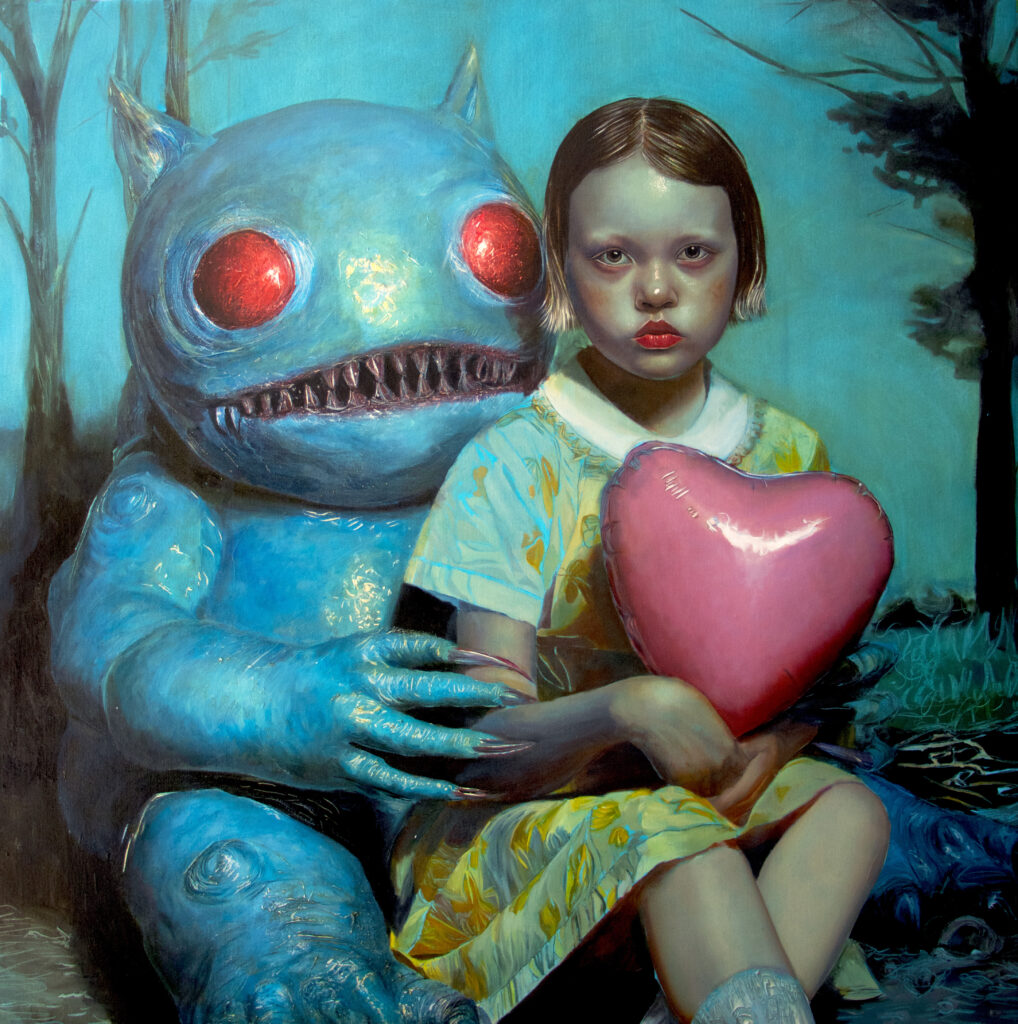
Q8. When someone stands in front of your painting, what do you hope they feel before they begin interpreting it?
Before interpretation, I hope they feel something immediate, almost instinctive. A sense of unease, but also curiosity. Something that draws them in, even if they don’t fully understand why.
Q9.Looking back at your earlier work, what do you feel has evolved most, your technique, your symbolism, or your emotional depth?1 response
I Think my work has become more honest and more direct in how it deals with fear, fragmentation, and disconnection. My technique and symbolism have also developed, but mainly in service of that. I feel more open now to letting the image be more strange, more ambiguous, and to trusting what emerges. There’s a stronger sense of allowing complexity to exist without needing to resolve it.
Q10. What advice would you give artists who want to create work that is both technically strong and emotionally complex?
I think it’s important to develop both at the same time, but not in the same way. Technique comes from discipline, practice, repetition, and truly understanding your materials. But emotional complexity comes from being honest, even when it’s uncomfortable. I would say: try not to over control the work.
Leave space for things you don’t fully understand yet. At the same time, step back, edit, and refine what’s there. For me, it’s about finding a balance: having enough technical control to support the image, but enough openness to allow something real, imperfect, or even ugly to come through.
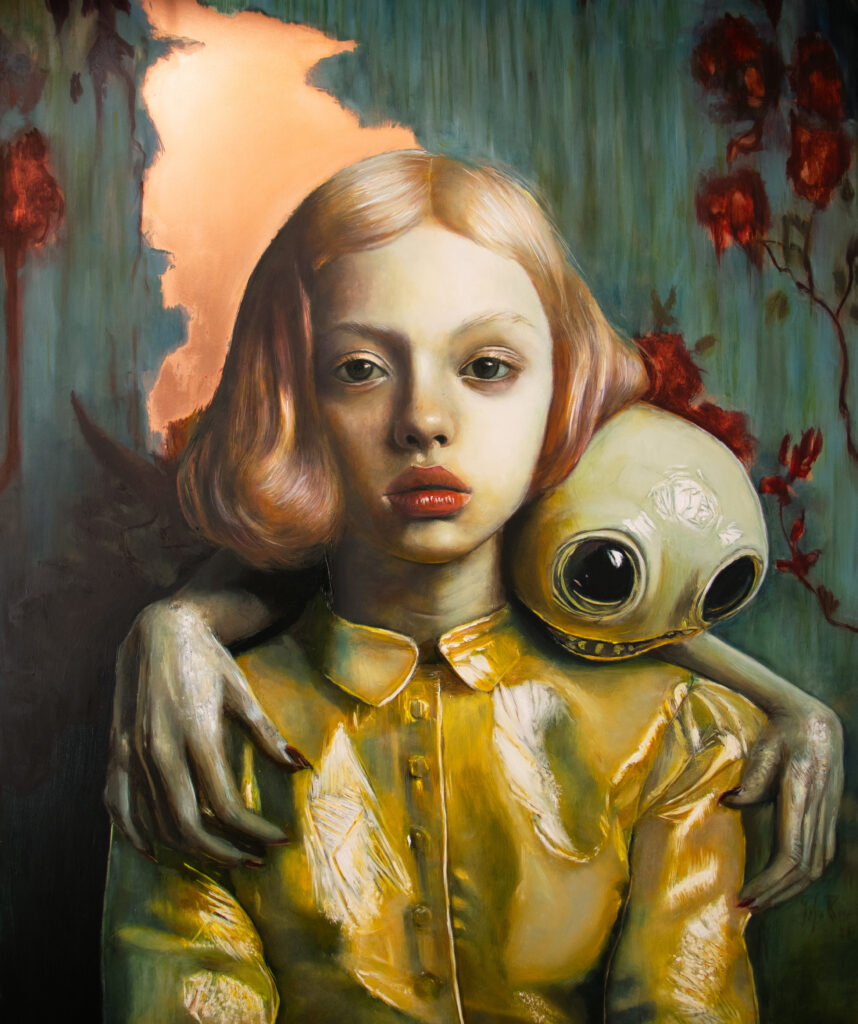
As our conversation with Sofía came to a close, we needed a minute. Not because anything dramatic happened. Just because she had been so honest about things that most people keep tucked away that we wanted to sit with it before moving on.
And honestly the thing we keep coming back to is courage. Not the loud kind. The quiet kind. The kind where you paint the stuff that lives in the corners of your mind, the fears that never fully left, the memories that have holes in them, the creatures you invented as a child to make sense of things that did not make sense, and you put all of that on a canvas and let strangers look at it. That takes something. That takes a willingness to be seen in the places you are least comfortable being seen.
We talk to a lot of artists. A lot of them make beautiful work. A lot of them have strong technique. But not many of them go where Sofía goes. Into the space where things are unresolved and messy and uncomfortable and still somehow tender.
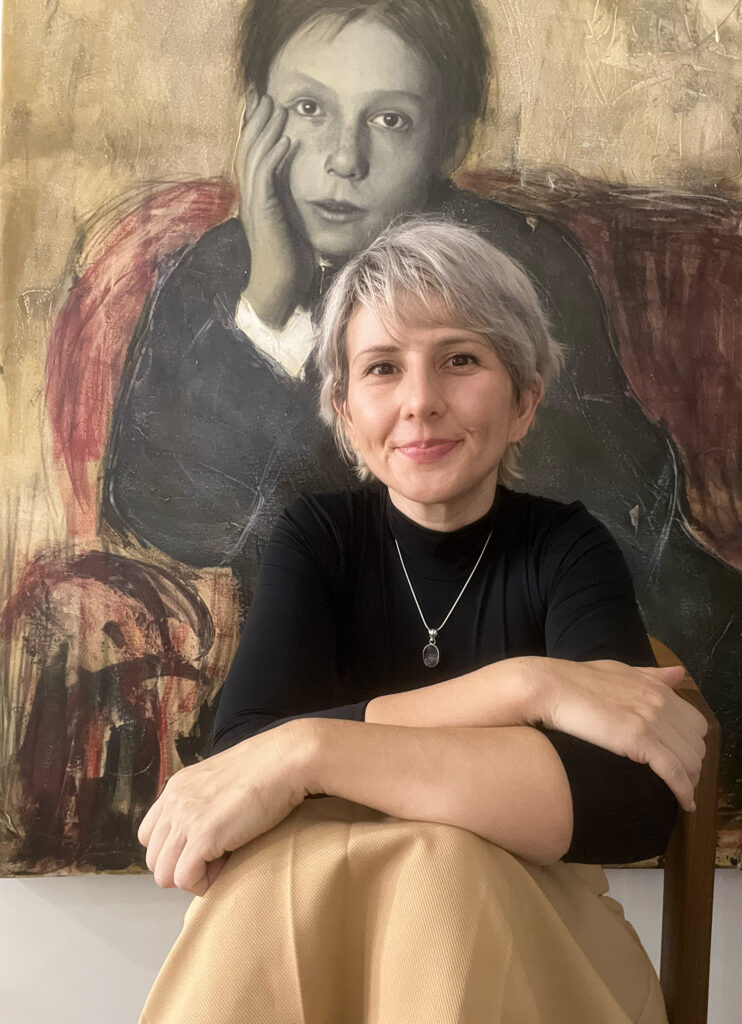
She does not make dark art for the sake of being edgy. She makes honest art. And honest art is sometimes dark because life is sometimes dark. That is all. She is not performing pain. She is just not hiding it.
And here is what we really took away from this conversation. That the things we are afraid to put in our work are usually the things that make the work matter. The imperfect thing. The strange thing.
The ugly thing we want to edit out because we are worried people will not like it. Sofía leaves those things in. On purpose. And her paintings are more alive because of them. More human. More true. We think every artist needs to hear that. That polishing everything until it is smooth and safe is not making the work better. It is making it emptier.
For anyone thinking about collecting Sofía’s work, here is what we want you to know. These paintings do not behave like most paintings. They do not settle into the background of a room. They change the room. They bring a presence that is quiet but persistent. You will notice them differently on different days depending on what you are carrying. Some days they will feel tender.
Some days unsettling. Some days both at the same time. And that is not inconsistency. That is depth. That is a painting doing what the best paintings do, meeting you wherever you are and showing you something about yourself you were not expecting to see. The longer you live with her work the more it opens up. And the more it opens up the more you realise how much was hiding in there all along.
Follow Sofía Ruiz through the links below and spend time with an artist who paints the things most of us carry but never talk about.