

Watch & Listen to this podcast Episode.
In this episode of the Arts to Hearts Project, Charuka sits down with painter and teacher Emily Jeffords for a candid conversation about creating a life with art when things are not always smooth.
Charuka opens up about losing her mother during COVID, moving back home, and how hard it was to keep her practice alive. She shares how slowly, even from a tiny table in her room, she found her way back to making because she needed it for herself. Emily relates to her own experiences of grief and significant life changes, and together they discuss how art can carry you through even the most challenging seasons.
The conversation is filled with small but practical lessons. Believe in your work before expecting others to do so. Keep the business side simple with clear photos, a straightforward shop, and a regular way of connecting with people. Focus more on building an email list than chasing social media trends. Choose a few topics you want to share online and return to them instead of trying to do everything. If you have children or a busy home, let them be near you instead of fighting it, and use the short windows of quiet time well.
Above all, show up in small ways. Even a brief session, a quick photo, or a few lines written down can add up over time. This is what helps you stay motivated in the long run without burning out.
This set effectively summarizes and segments the detailed content of the interview into easily navigable chapters for viewers.
Chapters
00:00 Introduction and Background
01:23 The Journey of an Artist
05:16 Believing in Yourself as an Artist
07:09 Art as a Healing Process
11:48 Navigating Grief and Creativity
18:11 The Importance of Space and Structure
20:34 Authenticity in Art and Social Media
24:48 Following Pleasure in Creativity
29:48 Balancing Roles and Responsibilities
32:32 Balancing Creativity and Business
39:43 Navigating Mental Bandwidth and Distractions
48:45 Marketing Strategies for Artists
59:18 Embracing Longevity in Creative Practice
Charuka (00:01.113)
Welcome to the podcast, Emily, right from the reels to the screen. I’m very, excited to have.
Emily Jeffords (00:07.006)
I’m happy to be here. That was very cute from the reals to the screen, I like that.
Charuka (00:12.623)
You know that’s real because I’ve seen you you were one of the earliest people while I was not even anywhere close to a podcast or you know I, it just never came natural to me contrary to a lot of people that feel this is very easy, it’s never been that easy and I know you’ve also had similar thoughts but I’ve seen you, I’ve seen you one of the early people that I’ve seen and
admired and learned. So from that to her, it really is a real to scream for me because now from looking at you from you know on my phone to now having a conversation on the screen even if not in person, it’s truly a privilege.
Emily Jeffords (00:59.732)
It is very sweet to be here. Thank you for inviting me and for creating this space, for pouring some of your energy and time into just like giving a space for artists to talk and to share openly. think that’s, we need more of that. So thank you for doing that.
Charuka (01:14.629)
Thank you. Okay, like I know most of people who would joining us right now wouldn’t know you, but let’s say if somebody wouldn’t, how would you introduce yourself?
Emily Jeffords (01:25.252)
I never think anyone knows me. So I’m very good about being like, hi, Emily. Okay, hi, I’m Emily. I am an artist. I am a mother. I’ve been an artist professionally since 2007 when I had my first group show with another artist in college. was our senior project and it was so empowering because if anyone here
Charuka (01:27.193)
Hmm.
Yeah
Emily Jeffords (01:54.08)
I’m sticking to the artists that are also in the room with us. If anyone has gone to art school or had any kind of art training, you know that you are taught how to just be an incredible creator, how to paint well, how to do lithographs, how to be a good portraitist. Like you’re taught a skill and you can do that so well. But when it came time for me to create my show in my senior year of college to
Charuka (01:57.19)
Okay.
Charuka (02:20.21)
You You
Emily Jeffords (02:22.062)
you know, set up my prices and my like sales goal and submit all of that to my professors. They quite literally said, what is this? And I’m like, this is my sales goal. This is my price list. What are you talking about? They actually began laughing and I was like, wait, what? I’m here to sell my art. I’m here to like make money at this show. I can’t take all these pieces home with me. I don’t even have a home to go to. Like what? I’m getting rid of all this art is what I was thinking and telling myself.
and they were like, well, yeah, I mean, well, just go try, just try. And I’m like, okay, I’m going to try. So at that show, and I’m telling you the story because I think it shows a level of tenacity that I wish was easy to tap into as an adult. I was still a child quite literally, not really, but you know, I was, I was so young that I was like, okay, what can you do to get people with comfortable enough means.
Charuka (03:10.641)
Absolutely.
Young. Okay.
Emily Jeffords (03:20.256)
to purchase art in the door. So I created, this is again back in like the stone ages of graphic design. So I was on there with my like, I don’t even know the program, but some old program, designing a postcard that I mailed to the affluent neighborhoods in my community where my college was. And I invited everyone, I told everyone, I put up posters, like I was hustling and guess
people came. And yes, they came, which that’s good. I have had shows where people don’t come and that takes another level of tenacity to be like, and I’m still going to keep doing this. But at this particular show, they did come and I was smart and woven some various price points and different products like some some prints that I created in printmaking and some digital prints, paintings, large and small, all these things.
And I well exceeded the sales goal that I gave my professors. And I wasn’t, I wasn’t gloating, but we had like a meeting afterwards and I was like, okay, so do you want to take it back? And we were joking and you we had a good rapport, but also I’m like, no, we can do this. We can do this. Um, which is also, think my first time convincing myself that my art was worth taking a bit of a risk on. And again, I’m young, naive, and I’m anxious.
Charuka (04:29.465)
Yeah.
Yeah. Yeah. Thank
Emily Jeffords (04:49.612)
But there was that push and pull of I have to be the one that believes in myself, even if I work with the gallery, even if I get signed by an incredible licensing deal, even if I partner with a huge brand, which all those things have happened in my career. And none of them would have happened if I didn’t believe in myself. And none of them would have succeeded had I not believed in myself. And that’s, I think,
Charuka (05:11.977)
You didn’t. Yeah.
Emily Jeffords (05:19.284)
not to be overlooked because it’s one thing to say that, and especially if anyone has like children, you say that to your kids and you just kind of like, yeah, believe in yourself. You got this, you got this. But the reason that I think it’s extremely valuable for artists to settle into this is because as an artist, all you’re doing in the studio is opening up your vulnerable self. And that self is not
Charuka (05:42.957)
Yeah.
This is emotional. Yeah. And we take so many decisions in like while you’re making work, it makes you so much more confident.
Emily Jeffords (05:47.486)
infused with this ego that says, I’ve got this, can do this, I believe in myself. That’s like, I’m going to try something new. And is it working? I don’t think it’s working. my god, this looks terrible. Okay. no, wait, hold on. We’re coming back. And you go through all of this journey of vulnerability. Yeah, and it’s tender.
Emily Jeffords (06:15.404)
Yeah. So going through that process of knowing that your work is meaningful, first and foremost to you, whenever I strip back a lot of the, I’ve built a lot of things around my art and it becomes a little bit easier to step into the studio and create the collection and do the thing and meet the collectors and all these things. But when I strip it back, even if there were no eyes on my work, would I still think that it’s
meaningful, but I still think that it’s beautiful just because of what it gave me. And so this past year, I spent a lot of time creating art that no one has seen and they might not ever see. I don’t know, maybe, maybe they will. But at the moment, they’ll see it. And I didn’t create it for that purpose. I created it because I needed the very tangible reminder that this beautiful, vulnerable work is meaningful in and of itself, regardless of it.
Charuka (06:58.427)
Yeah.
Charuka (07:12.828)
Yeah. With it. Yeah. Yeah. No, I completely relate to this. think, you know, this is something that comes up a lot on the podcast.
Emily Jeffords (07:14.542)
sees it or validates it or promotes it. That’s not the value. The value happens privately to me, with me.
Charuka (07:32.547)
But it’s also part of who I am now and it’s changed me. When I lost my mom a couple of years ago, after her passing, you know, my trajectory was just before COVID, I was having a lot of sales. My work was getting a lot more attention than I’d ever seen. And I was able to sell out collections. And you know, somebody like me who, you know…
It felt very unreal because when you’re not at Pace people you’ve not met countries you’ve never been to. know those people are looking at your work, supporting you, wanting that. And somebody who would always, you know, I wasn’t somebody who was looking out for, I’m going to be the best artist. I was like, you know what, I really, can I make a living out of this? Can this really pay me? Do people really like, is my work something that, or if somebody would pay,
Because I had grown up with this idea that people would tell me, like, you know what? You scam people. Who pays for their paintings? Who does that? And for me, that felt like, and I’m telling you, in the first couple of trial, it felt like I wasn’t doing right because it felt like, my God, why would people pay me because I’m cutting papers from magazine and making something, or just painting or doing something.
Emily Jeffords (08:40.462)
That’s wild.
Charuka (08:58.784)
And then it felt very close to me and I felt like and the kind of the precision and even within my own thoughts because when I started to learn, okay, you know, that’s not true and all of those things. But when my mom passed away, I had, you know, and I’d moved back home. It was covid second wave, you know, a couple of years before that, everything, all of this was happening. And you feel like with every year you start to build momentum and you know, you’re feeling that you’re reaching a peak and you only go upward.
and everything came down. I lost my momentum because I was moving and I’d come here and then suddenly I lost my mom to COVID and I couldn’t, I don’t know what, I mean, I just couldn’t process that for a couple of months I couldn’t go to the studio. And for me, was really, really, even today, it’s really hard for me to…
Emily Jeffords (09:38.305)
So.
Charuka (09:56.876)
you know, be a lot more visible. And I have this something that I continually work upon. But, you know, sharing my work for my own self and my work had become a very, very big source of healing. So while I was doing everything else, like, you know, I had to do like be on the podcast, you know, and it was also distraction because, you know, you disassociate from the grief. But then I was processing my art via that grief.
Emily Jeffords (10:19.682)
Yeah, you have to. Yeah.
Charuka (10:26.846)
And for a very long time, I never shared any of it. And I kept asking, and this is something I used to ask myself before this, that would I make something or would I still choose to be an artist if I never get paid at all? And it truly happened to me and life gives you answers for quite a few years since then because I just didn’t have the mental bandwidth and…
I needed art for myself more than I needed for the world because I had to process so many emotions, so much time and I’d made so much art but I barely shared any bit of it at all. And like you said, like, you know, and I realized, you know, even today if life gets too busy, I have too many things to handle. I know that even if I’m making art, it’s first for me and then for the world. So I really associate with the idea that you…
Emily Jeffords (11:25.378)
Yeah. And also back to that, like when you were saying that it was so hard to show up during that season, because I mean, grief is an all encompassing brain chemistry changing phenomenon and you can’t rush through it. You can’t control it. You don’t even know what its impact is going to be on your body. You might, you might exhibit your grief in ways that people are like, wait, what?
Charuka (11:40.926)
Absolutely.
Emily Jeffords (11:52.847)
I didn’t go through a loss of a person, but I went through the ending of my marriage in 2022. And to what you’re saying, I showed up in the ways that I had to because I had to. This is my job. This is my business. Three children. can’t not make money. I have to do my work.
Charuka (11:53.149)
Is that.
Charuka (11:58.24)
Add
Charuka (12:11.649)
Yeah, and you have people to pay and there’s a lot of obligations that you just can’t deny.
Emily Jeffords (12:17.836)
Right. And in every other way, I, if it wasn’t a necessity, I couldn’t do it. I just couldn’t rise to the occasion. It felt like too raw, too vulnerable. Like everything about it felt not even scary. That’s not quite the right word, but just like I didn’t have the capacity to even make a simple Instagram story. I couldn’t do it. And I sat down with a dear friend of mine who’s
Charuka (12:36.416)
capacity.
Charuka (12:44.448)
you
Emily Jeffords (12:45.438)
marketing expert and I’m like, I don’t know what to do. I think I’m broken. I don’t know how to show up. I don’t know how to do like, I am still me. What is happening? Why can’t I be me? And she was so sweet and just like, Emily, you are grieving in a way that your body is going through these trauma responses right now. And then she recommended just really practically for anyone that might be feeling too vulnerable. She said, create a safe bubble in your home.
And when you walk into that bubble, everything in there is safe and you are you. And nothing else is coming in, just the essence of who you are. Just like find your little bubble. can be like four feet by, you know, eight feet or something that you just put it around you. And when you step in, you’re like, okay, what do I need to say today? What do need to do today? Not to like disassociate or have an out of body experience, but just to be like in this energetic bubble.
Charuka (13:22.611)
Okay. Okay.
Emily Jeffords (13:44.545)
I have the capacity and I can leave the bubble and I can go back to my mess and I did, trust me. But it was such a sweet little like cognitive moment. And then not only did I create the little bubble around what do I need to do to show up and to not, there’s a beautiful poem that has a line that says, what will you do? I need to know that you will do what it takes to feed the children. That line was on repeat, my mind do what it takes to feed the children, which can be metaphorical. It can be your dog. can be.
Charuka (13:46.77)
Yeah. Yeah.
Yeah. Yeah. Yeah.
Emily Jeffords (14:14.21)
but do what it takes to be an adult. But then I expanded that bubble and I’m like, this bubble is going to fill my entire studio, which wasn’t big. It was a little space in my house. And I’m like, I’m gonna create a bubble around my studio and nothing bad will come in here, nothing. And I’ve stuck by that and it’s still true to this day. I don’t let any negative energy in my studio. I won’t listen to a podcast. It’s like a true crime podcast. I don’t have any.
hard conversations in my studio. If I get a phone call that I’m like, it’s probably about this thing. I’m going to walk out of my studio. I’m like, nothing will come in here that feels negative. And I think that’s so power. I think that’s so powerful. Yeah.
Charuka (14:49.388)
Yeah, powerful. You know what? Again, I also, I’m right sitting at a corner. And you know what’s about grief and hard seasons? Sometimes something’s
trigger a series of events in your life. I don’t know how to explain that. I’m sure you would relate to it. Any kind of instance that happens in your life, a loss of a person, a relationship, it really is not that moment. It’s also a trigger of so many things and negative energies and problems that it can create. So when my mom passed away, I came here and
from living all by myself, having a lot of time and having a home of my own to being able to go in a house where I had so many people, very little privacy, moving from studio to studio. I used to go and record from city to city, from someone’s house, someone’s kitchen, someone’s table. And even in my room, even if I had a studio, wasn’t like, it’s take it.
took so much of my stability away at that point. And right now where exactly I am and you know while I feel so uncomfortable a lot of times recording this podcast because before I used to have a much nicer background, much nicer night, all of those things that we always chase. But you know what I was like you know if I let one thing get to me and it’s only a series of things that I will keep letting go. And at a point I used to think like I had a big studio so I would make bigger works, I would do all of those things.
And when I started to contract me and I really enjoy as a person, as an artist, I really enjoy having art very accessible. Like I can walk into the studio and then just make and not wait for the right moment. So this is exactly where I am. I have this tiny table. This is very popularly also on my Instagram. And right here is like you said, I created this four by four, very small. Every morning I wake up.
Emily Jeffords (16:53.495)
I agree with that.
Emily Jeffords (17:02.446)
Charuka (17:08.264)
This is where I sit every morning at night. And while you say this is also a physical space, it’s also become like, it’s given me structure. Like in the morning, nobody can come in. At night, nobody comes in. During the day, there could be help. Somebody’s knocking, somebody’s, if I’m around. But that structure has given me so much. It’s also broken a lot of myths that necessarily I don’t have to always like, knowing that I can make art anywhere. Like I have this tiny book.
this tiny book and this like, and I have brushes that carry in my bag that I keep here and then bigger ones that I keep everywhere else. So like, I think while adversity can be painful, hard, it’s also something that also answers the bigger questions where we keep asking like, you know, why am I doing this? Is it that important? What is the role of like, I know if I don’t paint, I get itchy like.
something happens to me. like my emotions to come out.
Emily Jeffords (18:12.27)
It’s like a blockage. You have to move through it. You have to go create.
Charuka (18:15.771)
Yeah, absolutely, absolutely, absolutely.
Emily Jeffords (18:21.112)
I mean, I always struggle with the idea of like, I just turned 40 and it does feel like there’s a moment, thank you, but there’s a moment where, thank you, I feel young. This is kind of what I’m like, I think we’ve been sold a little bit of a lie that you have essentially 15 vibrant and capable ears. And I’m like, my, I don’t.
Charuka (18:27.631)
You look amazing and so young.
Charuka (18:44.092)
Yeah.
Emily Jeffords (18:49.698)
What I’m trying to say is I’ve always imagined there’s this large scale body of work living inside of my body. there’s to do that, I need the bigger studio. I need a bigger place. I need the bigger thing. That’s not where I am right now. We’re in my studio right now and it’s not big and it works. And I paint outside when I need to and it works. But I’m like, I’m not dying at 41. I don’t think unless something crazy happens.
Charuka (18:56.186)
Hmm.
Charuka (19:16.609)
Yeah.
Emily Jeffords (19:19.901)
30 more years to create the work that I’m like, I need to do this, I need to do this. Why do I think my capacity is going to go? I mean, of course, like aging might happen and that is what it is. But I look at Monet’s paintings that he created in his 80s and they fill the entirety of your rural landscape. can’t even see where he didn’t paint. That level of creative execution in…
Charuka (19:35.78)
Yeah.
Emily Jeffords (19:47.423)
later life, like I am leaning into that. I am heading towards that. That’s what I want to be in my eighties for sure. I’m like, that’s incredible. So I think it’s so life giving to be like, this is what I have capacity for right now. And I have time. I have so much time. I have like all of us, anyone listening, you do what you can and do what feels most congruent and most aligned now.
Charuka (19:58.141)
That’s okay. Yeah.
Emily Jeffords (20:17.164)
And if that means that you’re painting a lot of like five inch pieces, that’s completely okay. That’s actually maybe smart because the market is changing and you might have an easier time selling smaller work right now. And that’s also completely okay. Things are cyclical. Trends change, patterns change. So if you’re leaning into something, just be there and be content with that for sure. If it’s working.
Charuka (20:33.763)
Yeah.
Charuka (20:44.397)
I love that advice. And also I think a lot of times it’s also we look, I think with Instagram and being online there’s a lot of advantages. I honestly have a hard time as an artist. I have a terrible time showing up online let’s be very honest. But I do appreciate like you know I look at you know from the other end of the lens. When we’re looking for artists we’re looking for people. Instagram is really our go-to tool.
But then also, I think as artists, while we learn a lot, and businesses gain a lot out of it, but as artists, I think there’s so much of self-comparison, a lot of baggage that we feel because we feel like, I’m not relevant because maybe I don’t have a bigger studio. I’m not relevant maybe because I don’t have a bigger gallery.
Emily Jeffords (21:35.074)
Yeah.
Charuka (21:38.116)
I’m not relevant because maybe, and I’m not saying this for anyone else, these are just thoughts that have come to me time and again. Like, you know, I’m not relevant because I don’t have thousands of followers, but you know, I’ve also made up my mind that this is a choice I’ve made continually. Like Instagram has added this really extra layer to the whole ecosystem. And it’s an opt in and opt out, we continually have to decide.
And know that it’s not a comparison like, you know, my goal as an artist can be very different versus who I am on Instagram, how it does can be very different. And it’s a choice I have to make. But also knowing that the parameters that my success does not depend on being successful or looking at other people online. That’s something that we have to continually tell ourselves.
Emily Jeffords (22:19.425)
Mm-hmm.
Emily Jeffords (22:36.638)
I mean, the algorithm is such a player in all of this also. And it can feel so tempting to like look around to see what’s trending, to see what the algorithm is, is, you know, making go viral for whatever silly reason that it is doing that. And but I just really feel like what the algorithm wants is for everyone to become the same.
Charuka (23:05.336)
Yeah.
Emily Jeffords (23:05.378)
But what humans want is for everyone to feel self-identified and self-actualized, which we’re all going to look different. And it’s such a weird place to be putting your creative work because you’ll notice that some things, even amongst the things that you post, some things do better on the algorithm than other things. And it’s because the algorithm is looking for these triggers of like, do you check these 10 boxes? Cool. Then we’ll promote you in some certain way. But that’s
Charuka (23:10.586)
Yeah.
Charuka (23:20.667)
Yeah.
Emily Jeffords (23:35.311)
creating a network of similarities. And I don’t think humans find that very exciting. After you see 10 reels that feel similar by different creators, you’re like, give me something different, which hopefully the algorithm will learn and maybe bring more nuance into the scene. That would be wonderful. But until then, just kind of keep that at the back of your mind and back to that, create what you need to create.
Charuka (23:47.93)
Famous.
Emily Jeffords (24:02.818)
Be present with where you are in your journey. Again, the idea of no negative thoughts belong in the studio, that’s a negative thought. So try to push that out of your own brain. I’m not speaking to just you. I’m like speaking to myself too. I’m like, it just becomes such an inhibitor. And I feel this. I feel this and I know how to work the algorithm. I’m still like, my gosh, this is so toxic. It’s genuinely so toxic for our creativity.
Charuka (24:14.716)
No, I’m taking that advice.
Charuka (24:24.227)
Yeah.
Emily Jeffords (24:32.258)
to feel like we have to kind of split our brains and create authentically and create in a trend? What? No, no, that’s crazy. It is, and it’s just, I just feel like I really want to encourage artists to lean into authenticity and to trust that your buyers are going to resonate with that and they’re going to see it and they’re going to want it.
Charuka (24:39.112)
Yeah. Right.
Very hot.
Charuka (24:58.489)
Yeah.
Emily Jeffords (25:00.674)
The work that you create that excites you is always better work. It’s always better. And really the things that you photograph or film that excite you are always better. So I think if we can just follow that glimmer of pleasure that’s been since going through my separation and leaving the ending of my marriage, that idea has been the most healing portion of all of this. Follow pleasure.
Charuka (25:08.793)
Okay.
Charuka (25:23.422)
. you
Emily Jeffords (25:30.616)
follow and it doesn’t mean like hedonistic lifestyle. It means like, look at that shadow dancing on the light that I want to sit here and look at that for five whole seconds. I can do that. Or do I want to run a retreat in Italy? Yeah, that makes me feel so happy. want to like these kinds of things where it’s like, does that feel exciting to me? Can I follow that line a little bit further? I think it leads to better everything, everything better life.
better sales, better resonance with your audience, better, like obviously better work in general. So, all the pleasure.
Charuka (26:06.931)
Yeah. You know, on this line, I want to ask you something. OK, you don’t only paint like, you you’re not an artist. And as we all know,
being an artist even in today’s time, it’s a lot of work, you know, not only creating the work, but there are so many layers that are already added to the work. There’s promotion, marketing, reach out, edit, and then even the creative part, I think. There’s so much more depth that we all need in our own creative journeys, specifically, like you said, as we grow more into it, the more years we go into it, like.
You know, I’ve also felt this difference 10 years ago to now, how I look at my work, what I feel about it, how authentic I am to it. like I look at things very differently and I know that 10 years later from now, I would even look at more differently. But then you also have more roles. Like you said, I’m only talking about professionally right now, which is, you run a business, you have a membership, you create the course and…
Then we all have our own commitments when it comes to a person like your mother. We are also people at the end of the day where we have our own. And as an artist also there’s so much we want our souls to be fed in. But there’s this continuous fight in today’s world where we are always we have so many rules to play, bills to pay. It’s no longer cheap. It never was, but it’s even gotten expensive to be an artist or we just.
Emily Jeffords (27:41.329)
wait, I think you cut out for a moment.
Charuka (27:46.284)
Did you lose me?
Emily Jeffords (27:50.993)
wait.
Charuka (27:52.362)
I’m here.
Emily Jeffords (27:55.662)
Can you hear me?
Charuka (27:57.046)
Yeah, yeah, I can hear you.
Emily Jeffords (27:59.503)
Oh, there you are. Okay, okay. It just cut out for a minute. I’m like, wait, this is the worst time to cut out. I’m so sorry.
Charuka (28:02.424)
No problem. Where did you hear me last?
Emily Jeffords (28:08.526)
that we have so many roles to play.
Charuka (28:11.35)
Yeah, so many roles and like, know, unlike social media where everything looks easy, everything looks no matter how real it gets, everything. We always look at other person and feel like, see, in spite of everything that she’s going through, she has a life together. Like how and you know, how you know, I still remember after my mom, I used to do this series of an Instagram live in podcast and
Emily Jeffords (28:29.59)
Yes.
Charuka (28:40.475)
I have grown up with this conviction I wouldn’t give up and I don’t like quitting things because I keep on telling myself I’m not a quitter I’m going to get through this which is always not the right approach because I’ve understood being more calm to myself, more gracious, all of those things but it helped, it did get me through a time. very recently after my mom, I had calls scheduled and I felt like I had people
their time and you know I had people depending on me so I had to show up and I also needed distraction. So I would be miserable entire day like really really miserable and I would be crying and I would be dealing with so much emotions at home and just 30 minutes before the call I would clean myself up put a little makeup and I would show up and believe me I look much happier in those videos where
Emily Jeffords (29:20.11)
you
Charuka (29:38.933)
rather than I’m right now here on this call. And even while I look at those things, I know what I was feeling. It may not be looking like that, but even the paintings didn’t look like that, even my calls didn’t look like that, but I really know what I felt. So like, you know, we have that baggage as well. Coming back to my question is how, as an artist, as a person, not only really as an
How are you managing these roles? And to take it one step further, would you share a few stories specifically, let’s say, as an artist, something that helped you break through a tunnel in your own business, in your personal life? Specifically, I feel like a lot of people, you know, I have heard from a community. I have children. I’m going through a very hard time. I’m not able to focus on my work. I also have a full-time job. I’m really struggling.
and this is the most common I feel like most common so for all of us let’s hear that
Emily Jeffords (30:41.006)
Yeah. Okay. I hear this every single time we have a live workshop inside of the collective or anything of that nature that’s so common to be like, how can I find the capacity within myself to fall in love with my work, to do my work, to create a website, to photograph my work, to pitch to brands, to pitch to galleries, to like all the things. And you’re right. I have layered in a lot of, a lot of
things over the years, a membership course. I love teaching, so that comes very naturally to me. Okay, some things that are just kind of like trends that I’ve seen. And again, I’m gonna kind of think back to the process of growing something a little bit more organically where it was just me, back when it was like, it was all coming out of my energy. And I say that because now I have two employees and they’re
angels and they are so smart and they are just good, good people. Good people. had a surgery a couple of weeks ago and they brought me a teat fairy basket and they were just so, yes, I’m okay. I’m okay. But it was just, they’re just that kind of giving kind of person. So I feel so blessed to have support. But I’m going to think back to when it was just me in the studio.
Charuka (31:49.729)
Are you all right?
Charuka (31:57.846)
Okay. you
Emily Jeffords (32:06.682)
And again, my number one goal has always been, I need to do what it takes to both honor my creative self and keep my children happy and healthy, because that’s always been my job. I’ve always been the only breadwinner, primarily. So, and I had kids when I was in my young 20s. So it’s always been my role. I think with those two goals in mind,
Charuka (32:26.358)
Yeah.
Emily Jeffords (32:35.768)
which you don’t have to have kids to have the goal of you want to make money with your work, you want to survive and this is your job and you want to make it your job. Or at least if you have a full time job, it’s beautiful supplemental income and you want to see your work appreciated and you want to see it purchased. So I fully support that and I don’t think that is a sellout in the slightest at all. So with those two goals in mind, the first thing that I think about is can I simplify
Every should that I’m ticking off in my brain Can I simplify if I have like I should be doing this I should do this I should just write all of those down. Those are all probably little Ideas that are good to be aware of but write all of them down and then be like, okay. Yes I see this list and this list is is lovely Which ones are actually priorities for me right now? I think that for most artists the priority should be
Charuka (33:28.165)
you you
Emily Jeffords (33:33.551)
creating beautiful work and don’t forget this one. They are both happening together, okay? Create beautiful work and set yourself up for success to be able to sell that work. And that looks like, again, we’re not gonna complicate this, but that looks like having beautiful photographs. You can do it, you can do it, you can do it.
Having some kind of online presence, it could be Etsy, it could be your own website, it could be Saatchi, could be, think there’s a whole massive list, we have like a whole list in the collective about places that you can sell your work if you want to. Again, pick one or pick two, but don’t pick the whole list.
Charuka (34:12.941)
One.
Emily Jeffords (34:16.106)
Yeah, like don’t spread yourself too thin because what will happen is either I see a lot of artists falling into the category of like, just want to paint, paint, paint, paint, especially if they have a job that brings them income. And especially if they have that are taking a lot of energy from them. It’s so beautiful to fall into your creative work and to be like, my gosh, I need, it’s like having a bubble bath for your brain and for your heart. It’s just like, I needed that.
Charuka (34:27.224)
Yeah. Yeah.
Emily Jeffords (34:43.256)
The business side isn’t going to give you that limerence. It’s not going to give you that, you know, that those, right. It’s not going to give you that spike of like, that felt good. But we’re going to tell ourselves it’s still necessary and we’re going to find the pleasure within that. So for me, I think taking a beautiful photograph, my gosh, it is the most gratifying thing. It is, when I look at my camera, I’m like,
Charuka (34:48.062)
Glamour.
Yeah.
Charuka (35:05.959)
You love that.
Emily Jeffords (35:11.252)
It’s perfect. Like that to me, I’ve not tricked myself because I think it is actually true. It makes me so happy. But I’ve told myself often enough that I need to get my fix in this area too. When I create a website and I scroll through it I’m like, it’s so beautiful. Find those little glimmers. Again, we’re going for the pleasure. Find as much pleasure as you can in the business side of things. I’ve worked on this for so many years that now
Charuka (35:12.858)
No.
Emily Jeffords (35:40.226)
The only thing that isn’t pleasureful is maybe like, I have to keep up with my bookkeeping. That’s just boring. That’s just boring. Let’s be, I can’t do it myself. I can’t gaslight myself and that’s just boring. That’s kind of all.
Charuka (35:46.182)
Yes. Yeah. Really.
Find someone who finds that pleasurable.
Emily Jeffords (35:59.861)
I, this is the thing is I have someone that does my bookkeeping for me, but, there are things that she has to get my, like, what is this? What is this? And it’s only like five things a month. It’s not even that much, but I’m like, my God, so boring. So the key, those two things happening simultaneously, both the creative side and the business side. The other switch to this is sometimes I see artists.
Charuka (36:08.435)
Yeah.
Charuka (36:12.252)
My guys.
you
Emily Jeffords (36:27.374)
focusing just on their business and they’re building the website and they’re making it this huge deal in their brains and they’re spending like a hundred hours on it. And I’m like, have you gotten to paint? Have you gotten to go into your studio and make some mugs? Like have you like, don’t make it this hard, make it easy. Go on Squarespace, it’s so simple. Go on Etsy, it’s so simple. Like don’t make.
Charuka (36:47.444)
Yeah.
Emily Jeffords (36:54.376)
Don’t make the business too big of a deal. I say that so often in the collective because I want creatives make these things into mountains. And I’m like, that is a bump. That is a speed bump. You’re going to go over that speed bump and you’re going to keep practicing. And we’re going to be going over a million speed bumps in our careers. We’re going to be practicing photography thousands of times. Don’t make this one photograph a mountain.
Charuka (36:56.83)
Yeah. Yeah. Yeah.
Emily Jeffords (37:20.866)
Don’t make this one listing on your website a mountain. It’s one of thousands. It’s just, just keep practicing. I talk about like the idea of 1 % better every day. You just show up and you’re not going to be that different than you were just a tiny bit better. Like just you practiced and now you’re a tiny bit better at this. So I think that’s so gratifying, but back to our earlier conversation. If you are soaking yourself with
Charuka (37:33.847)
Keep it. Yeah.
Yeah. Yeah.
Emily Jeffords (37:49.087)
the shoulds of comparison to people that are showing their best versions of themselves online. That’s just it’s going to be really, really hard to find those glimmers of pleasure because you’re going to be like, yeah, but it’s not as good as this. Like, don’t do that to yourself. Honestly, I shouldn’t be saying this because I want you to follow me. like unfollow if you need to like unfollow and turn off
Charuka (38:08.723)
Every, I’ve been on it.
Emily Jeffords (38:18.798)
Yeah, like if you need to, if you’re in such a rut because you keep piling dirt on yourself by saying, I’m not as good as them, not as good as them, unfollow all of them. Maybe even, I don’t need, just do what you need to do to take care of yourself because your willingness and excitement to show up is that valuable. And it’s worth being like, okay, I’m going to delete Pinterest off my phone or I’m going to
Charuka (38:28.061)
Yeah.
Charuka (38:33.715)
Yeah.
Emily Jeffords (38:48.566)
you know, do it, do whatever makes you most aligned in this moment. I will say I have also, because the Instagram algorithm is what it is. I have been spending a lot more time on TikTok and it’s been really fun for me because I’m not good at it. It’s so different than I have so few followers that I get to be amateur. get to be someone that’s like,
Charuka (39:03.245)
Okay.
Charuka (39:12.211)
Anyway, yeah.
Emily Jeffords (39:17.686)
I don’t know what I’m doing here and I’m doing it so badly and it’s kind of refreshing to get that perspective going back to like, don’t know how to do this because when you practice something, you become good at it and you also become bored with it unless you’re challenging yourself.
Charuka (39:19.111)
Thank
Charuka (39:32.243)
Yeah, and also there’s a baggage like you know you feel like like you you would want to mess things up and you take things too seriously because you feel like you have more on at stake than you ever had.
Emily Jeffords (39:38.658)
You
Emily Jeffords (39:51.459)
Cause your track record of practice and like those, those bumps that we talked about, you’ve done so many of them that now you’ve locked yourself into a pattern that’s worked hopefully, but also like that’s boring. I want to change things up and like, you know, feel a little bit of freedom. So yeah, that’s been fun and slowly.
Charuka (40:04.186)
Yeah. Yeah.
Charuka (40:09.522)
What about mental bandwidth? you know, a lot of us struggle with… Specifically, I’m asking you. I don’t have children, but I have niece and nephew and love them to the core. They spend a lot of time around me. They’ve been around with… I’ve been at home today and they’ve been here all with me 24-7. And, you know, I love these like that because I feel like they’re around and…
Emily Jeffords (40:15.906)
the
Charuka (40:37.594)
I love their energy because again it’s a constant reminder to have fun, enjoy. But it’s also a lot of mental space that they take and knowing that you also have business commitments, you have work commitments and then you know today I’ll be where you are. I had thought I would get through my calls, have the children in the house, I’ll get my paints down and I’ll just paint a couple of hours because I knew I had recordings at night.
But my calls didn’t finish. The children needed attention and my calls didn’t finish and I was so exhausted and I knew I had to go for the calls. I just couldn’t. And a lot of times even when we are, there’s also lot of distraction. In today’s time, the distraction is only going higher and higher. So how do you deal with that? you experience that? I’m sure you do.
Emily Jeffords (41:29.655)
Yeah.
That’s great question. And I think it’s very applicable to those that have children because it’s so obvious to see this. But I think what you’re saying about the distraction, like noise, that’s high for everybody. Everybody. It’s like heightened distractions and heightened dopamine hits, which are very distracting. So really practically,
Charuka (41:49.361)
Yeah.
Charuka (41:58.1)
Yeah.
Emily Jeffords (42:02.046)
I now I have a 16 year old, a 14 year old and a seven year old. When my daughters who are 16 or 14, they were little. I brought them to the studio with me. They were with me all the time in the studio. They’re very calm people. Yes. And I would give advice to other parents that would be like, how do you do this? I can’t imagine doing it. how do you? And I would say, because this is who my daughters were, I would say just communicate with them.
Charuka (42:07.112)
wow goodness.
Charuka (42:14.921)
Yeah, that’s good.
Charuka (42:20.401)
Yeah.
Emily Jeffords (42:31.564)
Like just tell them what you need and they’ll be like, okay, mommy. And then you can both coexist so beautifully. my, and I’m so thankful that was actually my experience with them. Then my son was born and this is not at all part of a gender discussion, but he’s a different human. He is extremely curious, which is great. But that means that I have to hear all day long about robots and NASA.
and how do you make slime and how do you build a car out of out of bike parts and I’m like I don’t know I don’t know any of these things non-stop and all these things I will say for anyone that has young kids that’s in more of that phase of like they will actually drain you of energy that does shift as they grow so there is an end in sight not that you want any phase to be over because that’s
Charuka (43:08.575)
Yeah.
Emily Jeffords (43:30.284)
whatever, but as they grow, they do need you less and less and less, which means your energy is now more and more your own. And now you’re out. Now with my teens, like they need me, of course, but they’re also very self-sufficient and energetically self-sufficient. So it does get better, but then you, you know, your little ones are now older, which is kind of sad, but that’s okay. Really practically when they’re small, my biggest tip that I stand by,
Charuka (43:36.765)
Martin Martin.
Charuka (43:52.196)
Okay.
Emily Jeffords (43:59.887)
with all the perspective that I have now is not just to communicate, although that is helpful. My biggest tip is don’t resist their presence because when you resist their presence, they begin to resist whatever you’re trying to do. So I would tell myself, like, don’t resist his presence. I do resist my productivity. And that’s absolutely true. So even now, when he’s here with me, he’s at school right now. But when he’s here with me, he would just be near me.
Charuka (44:08.208)
Yeah. Yeah.
Emily Jeffords (44:29.266)
And I wouldn’t be telling him, out of the room, be quiet, go away, like you, because then he fights harder to be with me and to like get his, you know, what he wants or what he needs, because all needs for all humans of all ages, all behaviors are the results of needs that are either met or unmet. And that is very obvious in children. If they have unmet needs, their behavior is going to react to that in whatever scale a need is happening.
Charuka (44:54.96)
Yeah.
Yeah.
Emily Jeffords (44:58.996)
So I learned that and so when I’m painting, he’s with me and we paint together and we like, we have boundaries and I’ll be like, okay, now you’re done on this piece. I’m going to keep working on it. You begin this new piece and we’ll just kind of like co-exist in the studio that way. But then also genuinely, I am not a screen mom at all, but every now and then I’ll be like, you know what? One hour of Snoopy. And then I’ll use my time so wisely. And I’m like, one hour.
of like, I’ll prep myself for whatever that one hour is meant to do. I’ll prep myself, I’ll start the TV, he’ll watch one hour and then I get to focus for one hour and that happens and that’s okay. That’s totally okay. But I think, again, back to like, maybe you need to paint small, maybe you need to do whatever you can, especially if your energy is tapped and if you need to just remind yourself that your work is worth the effort.
Charuka (45:29.087)
Yeah.
Emily Jeffords (45:58.431)
do the work that’s easiest to do. Just in general. So for example, sometimes when my kids are home a lot and we have like a lot of time and my energy feels very depleted, but creativity fills me and I know that and I know that I like feel happy after I create. I’ll just sit on the living room floor and I’ll work on a piece like I did this piece on the living room floor. It’s small. I could just easily like sit there and
Charuka (46:03.423)
That’s true.
Charuka (46:23.783)
Emily Jeffords (46:28.29)
you know, just play with it. For the zilcining, it’s like six by 12 inches. It’s like a smaller floral piece. And my kids were on the couch just chatting away and being silly. And like, we could all do that. And I could kind of like multitask in a way. Parents are very good multitasking. So there is that.
Charuka (46:35.374)
Yeah, yeah, absolutely. That’s true. That’s very true. And I think it is also kind of a rhythm. I think I’ve personally experienced that, you know, we make it harder for ourselves. I’ve experienced this personally where
I do not put that pressure and that pressure of course always comes externally. Maybe I’m growing older and I feel like the fear I don’t have enough time or when I look somebody else or I go online and like I see someone else’s pretty pictures and I’m like I didn’t and I think in that sense of it we get so overwhelmed with things we’re not doing versus inner season which feels very witty and hard or whatever we can make of.
Just knowing that I can show up for my art and make for myself, that also feels like a privilege. Like, you while you’re struggling to even make time, and if you’ve got that, we happily take it.
Emily Jeffords (47:47.691)
Yeah, absolutely. Yeah, I feel like this is one, I think one of the little tricks that I find to be really helpful is when my energy feels like it’s going into places that I’m like, my gosh, I’m not doing anything substantial. I’m not doing anything that’s worth like celebrating. I do believe that one of my little tricks is to take photos.
of whatever’s happening, even if it’s mid process and everything is a little bit messy and chaotic. For some reason in my brain, when I see a photograph of what’s happening, it’s romanticized in a way that like just seeing it isn’t. So I take a lot of photographs mid process of my studio of things just like as they are, I’m not going to like, stage or perfect something. I’ll just be like, this is what’s happening. And then when I see
Charuka (48:24.821)
Yeah.
Thank
Charuka (48:37.554)
Setting up.
Emily Jeffords (48:41.846)
lens, it’s like, it’s so beautiful. That’s so beautiful. So maybe lean into that a little bit. And that also helps you see that even if you don’t have like that giant gallery ready quality of work in this moment, the beauty in the everyday little minute moments is still present and worth
Charuka (48:44.182)
Yeah. Yeah.
Charuka (49:04.21)
Yeah.
Emily Jeffords (49:07.276)
of all you seeing and secondly maybe you can share that and like that’s worth people seeing also. So there’s something I think celebratory about that process for me.
Charuka (49:15.954)
Yeah, I love that. One last question before I let you go. This is extended beyond our expectation, but I want to the advantage of the last question. And this is something, of course, I didn’t think this conversation would go in this direction. But like I said, I wanted it to be as free and original as it could be.
Emily Jeffords (49:27.5)
Yeah.
Charuka (49:36.776)
One thing I still want to ask, because this is something I’m sure a lot of people ask, and I’m going to still relate to the point that we are. I think for a lot of creative people, marketing has been a bottleneck. It’s been something that they have to train themselves in. For most, not for all, but for most. And I think even in that case, think there are two. It’s a lot of people who can be more extroverts or can talk about it.
or market, a lot of people still feel stuck when it comes to their own work. That’s very common, right? Now, with you, think you have this really wonderful energy where you are also very wonderful at marketing. You’ve all these years grown very beautifully, done so many different things. And I’m also putting the context, like you said, like
Emily Jeffords (50:14.22)
Yes.
Charuka (50:36.489)
specifically showing one nervous to being able to train yourself to build up a skill which is marketing yourself, sharing, photography, speaking, all of those things. But then, you know, I didn’t come from it but then I also acquired and learned it. But then what hit the wall for me was, you know, while you’re going through a really hard season, like you said, and I was like, you know, while you have the wind,
like you have fire burning, gets really hard for people to show up and to continue to show up and to also say like, know, this is life, life gets hard, things happen, we mature, you have children, some child, you you will have children who have fallen sick, you may have complicated relationships, we all like, you know, I’ve come to the fact that as we grow older, life happens, it never stops, it continues to keep happening.
So how do you, how artists can find themselves, feel safe and confident while navigating specifically this Instagram with trends and like, you know, beautiful content and like oversharing and all of those things. How have you navigated specifically? I’m sure you would have had your own journey from starting 10, 15 years ago to now and how you’ve evolved in different seasons and how you’ve marketed your work.
Emily Jeffords (52:04.366)
Good questions. The nice thing about having been sharing my work and marketing my work for a long time online, like 14 years, I think, online is I’ve gotten to see a lot of patterns. And the pattern that has always been true, especially true now, is the algorithm, whatever, we can kind of call it what it is. It just wants to see
Charuka (52:20.779)
Yeah.
Emily Jeffords (52:32.97)
that you are showing up in a way that is a pattern for you. So one thing that I recommend for lot of artists is it can be really tempting to want to find trends and trending audios and copy and do the things and like whatever. That to me feels like a hamster quite literally spinning on a hamster wheel. Like I don’t know how else to put it but that is what it is because you’re always like chasing the next thing and doing this and
Charuka (52:57.554)
Absolutely.
Emily Jeffords (53:00.948)
If something catches your eye and you’re like, that’s cute, I wanna do that. Go for it, I love doing that, I do that often. But what I would say is find the things that you want to talk about. So for the artist in the room, it’s gonna be your creative process, your completed pieces, supporting those completed pieces because you can’t just talk about them once anymore, you have to talk about them repeatedly.
Charuka (53:03.18)
Next. you
Emily Jeffords (53:28.194)
That’s at least three main pillars right there. You can weave in whatever supports your work. If you’re a floral painter, then maybe you even, your garden, or you weave in whatever. You can expand them out a little bit, but those three things are really important to just kind of bring back consistently to what you’re going to share. And now, once you have your three things that you’re going to share, and I’m talking about Instagram specifically for this, but we could expand this to the most valuable platform is,
Charuka (53:32.843)
Yeah. Yeah.
Emily Jeffords (53:56.705)
in my opinion, email marketing. By far, I could talk about that for a long time. But that’s if you’re going to spend your very limited energy in one place, I would lightly touch Instagram and I would heavily pour my efforts into email. And they can have some crossover, you can pull your Instagram people into your email, you can use Pinterest to pull into your email, you know, yeah, but if you’re gonna, you know, if you have 10 followers on Instagram, versus 10 email subscribers,
Charuka (54:02.443)
Email. It’s sorted.
Emily Jeffords (54:25.868)
These 10 followers are feathers in the wind. yeah, the 10 email subscribers are 10 qualified buyers that are like, tell me more, tell me when to buy, tell me how to buy. They are like lining up checkbooks out, to use like an old metaphor. But the Instagram followers, you may or may not ever see them. They may or may not ever see you. And they’re like, hey, what you doing?
Charuka (54:44.043)
Yeah. Ha ha.
Emily Jeffords (54:55.03)
They’re so, just because of the nature of the algorithm and of the platforms that we’re talking in. So pour yourself a new email. But for Instagram, once you figured out your three main topics that you’re really gonna hone in on, and you can expand, as I said, you can have five, you can have six maybe, but for sure those two or three. Yeah, know what you’re saying in this space. But from there, just get really clear on
Charuka (55:15.209)
More concentration.
Emily Jeffords (55:25.304)
how you wanna talk, how you want to show up. And again, like back to that bubble metaphor of like in this space I am safe, you can apply that to the digital space also. In this kind of content, I feel really safe. So for me, if I were like back in 2022 when I was very, very traumatized and had a really hard time showing up online, I could post photos because that felt very safe.
Charuka (55:29.098)
you
how you got this? Yeah.
Emily Jeffords (55:49.903)
And I could do, what else, I think I was doing some like video reels that didn’t include me talking. My cat’s gonna be really. Picasso, come here. Okay, bye. He wants, he’s gonna join me. I’m yowing at my feet. But just figure out what kinds of content you feel most comfortable sharing and then just lean into that. And you don’t have to do everything.
Charuka (56:02.378)
He wants to join? He’s most welcome.
Emily Jeffords (56:18.848)
The things that you see on your screen may or may not be for you. Amy Poehler, she’s a comedian here in the US. She has the sweetest saying that was in her book that came out probably like 20 years ago, but it was the line, good for you, not for me. Love that. Good for you, not good for you, not for me. Good for you. Just keep that in the back of your mind and you’re like, that’s cute. Good for you, not for me. And just do more.
Charuka (56:28.521)
Yeah.
Charuka (56:46.002)
Not for me.
Emily Jeffords (56:48.59)
that work or at least do the methods that feel like you can thrive within them. And the algorithm eventually is going to catch up and be like, you’re the girl that posts your paintings in a carousel every Tuesday. Got it. We now know how to categorize you because the algorithm is a categorization machine. It’s not a persona. There’s no being like, you’re
Charuka (56:52.553)
Yeah.
Yeah, I love that idea. Great tip.
Emily Jeffords (57:14.988)
you’re not creating the best art, we’re gonna throw you, no one is in the backend doing that. The algorithm was looking for pattern recognition and looking for ways to quantify what you’re doing. And when it figures that out, it’s more likely to share your work with people that enjoy that same pattern. So, and then you can create a you know, like a really basic marketing calendar. I’m a type B girly, surprisingly,
Charuka (57:37.833)
You
Emily Jeffords (57:44.755)
a lot. But to me, it’s a little bit more organic than that. But if that feels too loosey goosey for you, then just create a calendar. Every Tuesday, you share this. And on Wednesday, Thursday, Friday, Saturday, Sunday, you forget about it. You think about it on Monday, you share it on Tuesday, like, you keep it that simple. It doesn’t have be full-time job at all. make it small. These are not mountains. They’re little bumps. It’s okay. Just keep going.
Charuka (57:59.18)
Yeah. Yeah.
Charuka (58:12.537)
one day, one at a time. I think what’s very powerful is consistency. I definitely would agree with you. even if you, some days, you know, while I was getting back to my practice, even after my mom, I knew I didn’t have the courage to go all in in a studio. And I’ve seen all kinds of things. Like currently, I’m in a place where I don’t have a large-scale studio. And I’ve been at places where I used to have two studios at a time.
Emily Jeffords (58:15.486)
One at a time. Yes, exactly.
Charuka (58:41.903)
and much more and more accessible and all of those things. But I’ve also realized what ties me and what even with the business and all of those things, is just even if I could write a caption and if I had to write, let’s say, an email or even a paragraph or an article, just showing off for a few lines every day, if that is all I could do.
Even that counts. Like it builds up. Like we wouldn’t know today. But when you look back, you’ll know, showing up for that 20 minutes, 15 minutes, and five minutes really made the difference.
Emily Jeffords (59:25.134)
It can be that simple. like I said earlier, we’re here for longevity. I think if scaling back a little bit and knowing that you are not done, I’m now 40, so at 41, I’m not done. I am going to keep going and I’m going to keep thriving. Yeah, making sure that you don’t fall into that burnout because you think it all has to happen right now. It doesn’t.
Charuka (59:31.069)
Yeah.
Charuka (59:43.943)
just getting started.
Charuka (59:52.921)
Yeah, yeah. Yeah, thank you so much, Emily. I really appreciate your time. Thank you for your wonderful advice for the calmness that you brought in and for a lot of abundance in this conversation. think I’ve taken away and I’m sure people who are who will listen, who currently listening, they will. So I really appreciate before I let you go, do you want to tell people where they could find you, support you?
Emily Jeffords (59:54.562)
Be sustainable.
Emily Jeffords (59:59.982)
Okay.
Charuka (01:00:21.901)
and follow you.
Emily Jeffords (01:00:24.23)
you can find me at Emily Jeffords and EmilyJeffords.com. you can find the collective at EmilyJeffordslearn.com and those are my spaces. If you want to find me on TikTok, you can do that. it’s for all of us because like I said, I’m not very good at it.
Charuka (01:00:43.399)
I’ll make sure everything is linked in the article for the podcast and I really appreciate and I hope you have a wonderful day.
Emily Jeffords (01:00:53.099)
You too. Thank you.
Emily Jeffords (01:00:57.807)
Yay!
Charuka (01:00:58.395)
Thanks.
.
About the Guest(s):

Episode Summary:
In this conversation, Emily Jeffords shares her artistic journey, emphasizing the importance of self-belief and the healing power of art. She discusses navigating grief, balancing roles as an artist, and managing distractions in a fast-paced world. Emily also offers insights into marketing strategies for artists and the role of social media in their creative processes. The conversation highlights the significance of authenticity and following one’s passion in the art world.
Key Takeaways
- Self-belief is crucial for artists to succeed.
- Art can serve as a powerful healing tool.
- Navigating grief can impact creativity significantly.
- Creating a safe space for creativity is essential.
- Social media can be both beneficial and detrimental for artists.
- Marketing should not overshadow the creative process.
- Finding joy in small creative acts can be fulfilling.
- It’s important to prioritize mental health and well-being.
- Artists should focus on authenticity over trends.
- Building a supportive community can enhance an artist’s journey.
Notable Quotes:
None of the opportunities in my career would have happened if I didn’t believe in myself, and none of them would have succeeded if I hadn’t kept believing.”
“When I strip it back, even if there were no eyes on my work, I ask myself, would I still think it’s meaningful? That answer has to be yes.”
“Nothing negative comes into my studio. No heavy conversations, no dark podcasts. This space has to stay safe for me to create.”
“Don’t turn every task into a mountain. Think of them as speed bumps. You’ll go over many of them in your career, and each one makes the next easier.”
“The work you create that excites you is always better work. If it excites you, it will resonate with others too.”
Charuka Arora is the founder of the Arts to Hearts Project and Host of the Arts to Hearts Podcast. She is also an acclaimed Indian artist known for her contemporary embellished paintings. Her unique blend of gouache, collage, embroidery, painting, and drawing explores the intersection of art, culture, heritage, and womanhood. Through her work, she tells stories of female strength and encapsulates them in pieces that can be treasured for generations.

Charuka’s work draws inspiration from Hindu mythology, recognizing women as vessels of Shakti, the cosmic energy. She beautifully portrays powerful goddesses like Durga Maa riding a tiger or lion, symbolizing their unlimited power to protect virtue and combat evil.
Through her art, Charuka invites us into the world of women, showcasing their beauty, strength, and resilience. Her creations not only exhibit exceptional talent but also serve as an inspiration and a symbol of hope for those challenging societal norms.
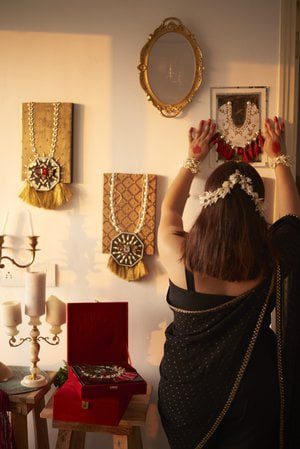
Arts to Hearts Podcast is a show delving into the lives and passions of renowned artists. From running creative businesses and studio art practices to cultivating a successful mindset, Charuka Arora engages in heartfelt conversations with her guests. Experience your personal happy hour with your favorite artists right in your studio.
Through candid discussions, Charuka and her guests reveal the joys and challenges of a vibrant creative life, both within and beyond our studios. Get ready to be inspired and uplifted as you tune in.
This episode of the Arts to Hearts Project is a warm sit-down between Charuka and painter and teacher Emily Jeffords. They discuss getting started, grief and change, raising kids while working, the push and pull of social media, and how to stay present when life is noisy.

How Emily began and why belief mattered
Emily’s first big step was a college group show in 2007. She priced her work, set a sales goal, mailed postcards to nearby neighbourhoods, and invited everyone she could. People came, pieces sold, and she surpassed the goal her professors had laughed at. That moment taught her something that has stayed with her ever since. You have to believe in your work first. That belief carried her through gallery shows, partnerships, and new projects.
Making work even when no one is watching
Emily shared that she spent the past year creating pieces that no one has seen. She did it because she needed it. That choice helped her remember that the value of making is not only about public approval. It can be about the quiet change it brings to the maker.

Grief, slowdown, and starting again
Charuka spoke about losing her mother to COVID and how everything seemed to stop at once. She moved homes, lost her studio stability, and was unable to enter the studio for months. Art slowly returned as a way to process what words could not hold. She did a lot of work but did not share much of it. It was for her. Emily connected with her story through a hard season of her own in 2022, when even posting a short story on Instagram felt impossible.
A friend suggested a simple practice. Create a safe bubble in the home or studio where nothing heavy is allowed. Emily took that literally. No hard calls inside. No grim podcasts. A serene place to create and reflect. It helped her find enough capacity to keep going.
None of the opportunities in my career would have happened if I didn’t believe in myself, and none of them would have succeeded if I hadn’t kept believing.
Emily Jeffords- Arts to Hearts podcast s05e13

Small corners and everyday routines
Space does not need to be grand. Charuka works from a tiny table and a sketchbook she can open at dawn and late evening. That small setup brings structure when everything else is unsettled. Emily agreed. She paints outside when she needs more room, and otherwise keeps her studio simple. Big work can wait for another season. There is time.
Time is not running out.
Turning forty made Emily look forward rather than panic. She pointed to Monet’s painting in his eighties. If smaller canvases fit life right now, that is fine. The point is to maintain a pace that can be sustained.

Don’t turn every task into a mountain. Think of them as speed bumps. You’ll go over many of them in your career, and each one makes the next easier.
Emily Jeffords- Arts to Hearts podcast s05e13
Instagram without losing yourself
Instagram has real benefits, but it also feeds comparison. Emily’s take is clear. The platform tends to reward sameness, while people are drawn to difference. Chasing every trend is exhausting. Instead, choose a few pillars and return to them again and again for most painters, that might be process, finished pieces, and a little context around each body of work. Patterns help people understand what you do. They also help the platform understand when and whom to show your posts to.
If energy is limited, Emily would put most of it into email. Ten newsletter subscribers are far more reliable than ten social followers. You can still post lightly on Instagram and invite people to join your list. Think of social as the front porch and email as the living room.
Simplify the business side.
Artists often swing between two extremes. Only making and ignoring the business entirely, or overbuilding the business side and barely making a profit. Emily suggests a middle road. Keep making work. At the same time, set yourself up to sell it. That usually means clear photos, a simple online shop, and consistent posts or emails.
Do not turn every task into a mountain. Treat them like small speed bumps you will meet many times. Photographing work, writing a listing, and sending a note to your list. Each pass makes the next one easier.

One way Emily stays motivated is by looking for small sparks in tasks that could feel dry. A crisp photo of a painting. A tidy product page. A site that is pleasant to scroll through. Those can be quietly satisfying. And for the few things that never feel good at all, like bookkeeping, get help if you can.
When I strip it back, even if there were no eyes on my work, I ask myself, would I still think it’s meaningful? That answer has to be yes.
Emily Jeffords- Arts to Hearts podcast s05e13
Kids, noise, and energy
Emily has three children. When they were little, she tried to push them out of the studio, and it only made the tug of war worse. What helped was the opposite. She stopped resisting their presence. Sometimes they paint beside her. Sometimes they hang out nearby. When she needs one focused hour, she might put on a cartoon and make that hour count.
When energy is low, she chooses work that is easy to do in that moment. Small pieces on the living room floor. Prep that does not require complete focus. Parents become skilled at weaving work into the cracks of a day.
Both Emily and Charuka returned to a simple truth. You do not need a perfect session to make progress. A few lines of writing. One in process photo. Twenty minutes of paint on paper. These small moves add up over weeks and months. Think long term. The goal is a pace you can keep.
This conversation is for anyone trying to make a life with art while juggling grief, kids, rent, and the daily lists. The message is steady and kind. Make work that matters to you. Protect a small pocket of space where you can think and try things. Keep business repeatable and straightforward. Share, but do it in a way that suits you. Most of all, keep going in small steps.
You can find Emily at emilyjeffords dot com and on Instagram at emilyjeffords. Her membership for creatives is available at emilyjeffordslearn.com.
Click here to read more about the Arts to Hearts Podcast and its episodes.
Listen to this & other episodes on
How Artist Sarah Fishbein Turns 1950s Romance Comics into Modern Paintings
Inside Susie Sprinkel’s Art Stories Woven with Fabric and Thread
How The Restless Creative Anita Clipston Turns Trauma into Art
Inside Radhika Gupta-Buckley’s Creative Journey with Indian Roots