


From City Noise to Mountain Silence: How Place Shapes Dylan Gill’s Paintings
👁 62 Views
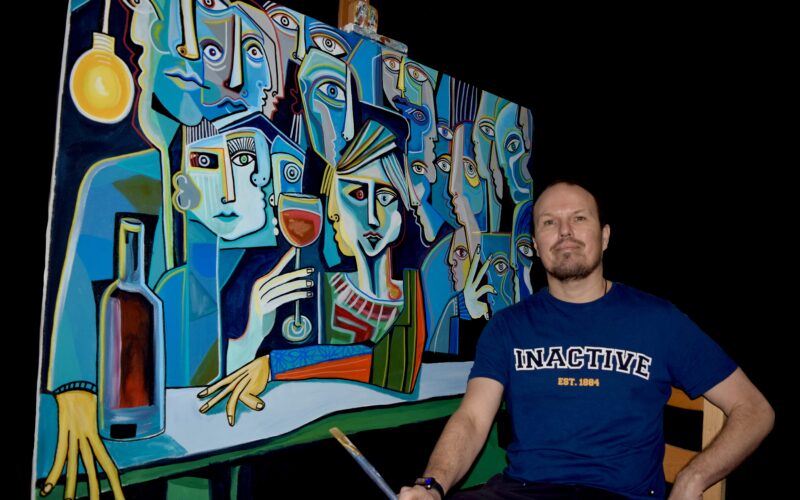
Some artists emerge from silence, others from noise. Dylan Gill comes from the hum in between the emotional frequencies that run through a city long before anyone learns how to name them. His story begins in the working-class pockets of London, the places that rarely make it onto postcards but hold the pulse of the city together. It was there, surrounded by people who carried their lives through grit, humour, and hard work, that Dylan first learned how to see. Not just to look, but to really see the shifting moods on a stranger’s face, the tension in a conversation, the sudden brightness in someone’s eyes when hope slips in unexpectedly.
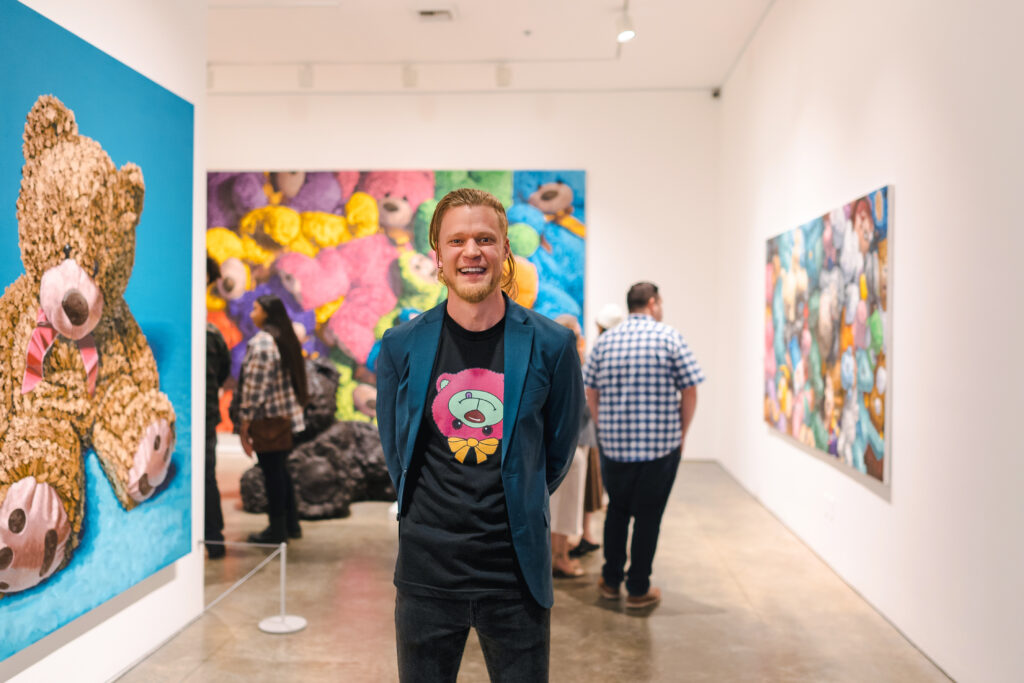
For this week’s Best of the Art World series, we had the honour of sharing the journey of Dylan Gill an artist whose work grows from the small, instinctive ways he learned to see the world. As a child, he had no idea these quiet observations would one day shape his entire practice. He just drew what came naturally. Faces shifted colour with feeling, lines bent to match the energy around him. Even then, life revealed itself to him in layers and he answered with colour, shape, and gentle distortion, long before he knew he was building the language of his future art.
Growing up in this version of “real London” also taught him something else: resilience born from responsibility. He watched his father build a life through sheer determination, showing him what it meant to work hard and carve out independence. Those lessons followed him everywhere through difficult days at school, through moments were keeping his head down meant staying safe, and into his early understanding that observation can be its own kind of survival. All of this settled quietly into his artistic language, long before he entered Goldsmiths.
By the time Dylan reached art school, he wasn’t trying to invent a voice, he was learning to trust the one that had been forming in him since childhood. His paintings didn’t come from pre-planned sketches or calculated formalism. They came in flashes, sudden visions while listening to music, scenes revealed in dreams, emotional signals that rose to the surface when the world around him became too loud. He often describes painting as working with something unseen, as if another presence steps into the room with him. For him, creation is never a technical act; it is a spiritual collaboration, an opening.
Nature deepened that connection. A chance encounter with impossibly red wildflowers in a meadow stayed with him for years their colour so intense it seemed to vibrate out of reality. Moments like this taught him that colour has a life of its own, that emotion can exist outside the boundaries of explanation. Inverness, with its expansive landscapes and quiet mountains, offered him a place to breathe differently. In those wide-open spaces, he found the inner stillness that allows his work to emerge. Without nature, he says, he would lose himself; the city alone would close in too tightly.
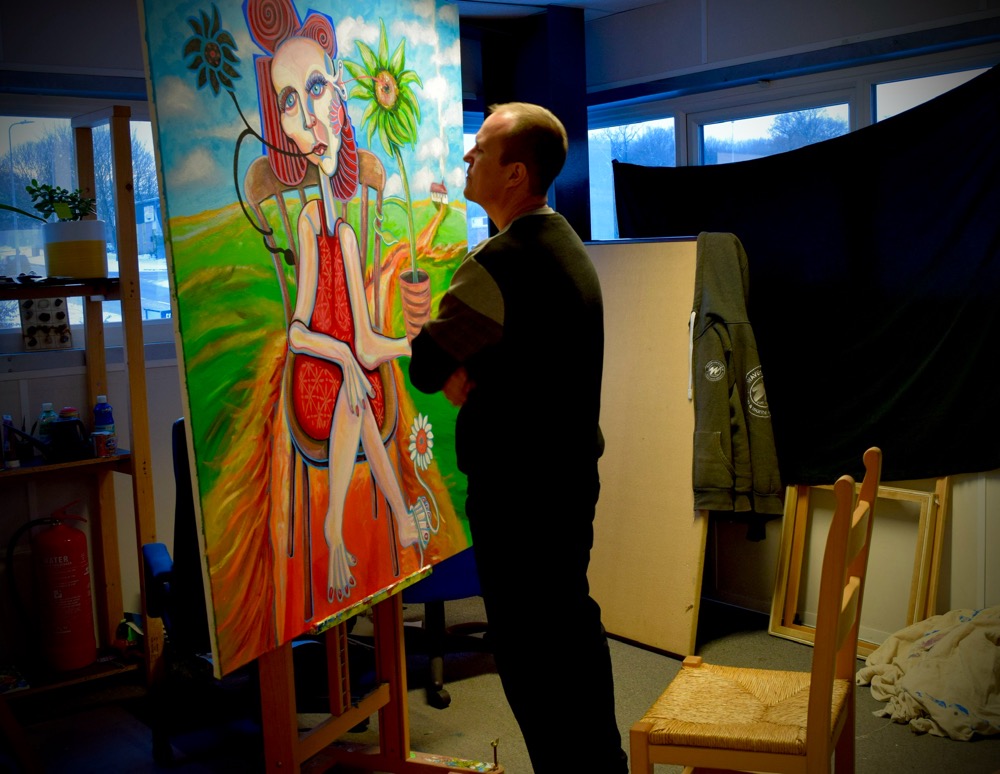
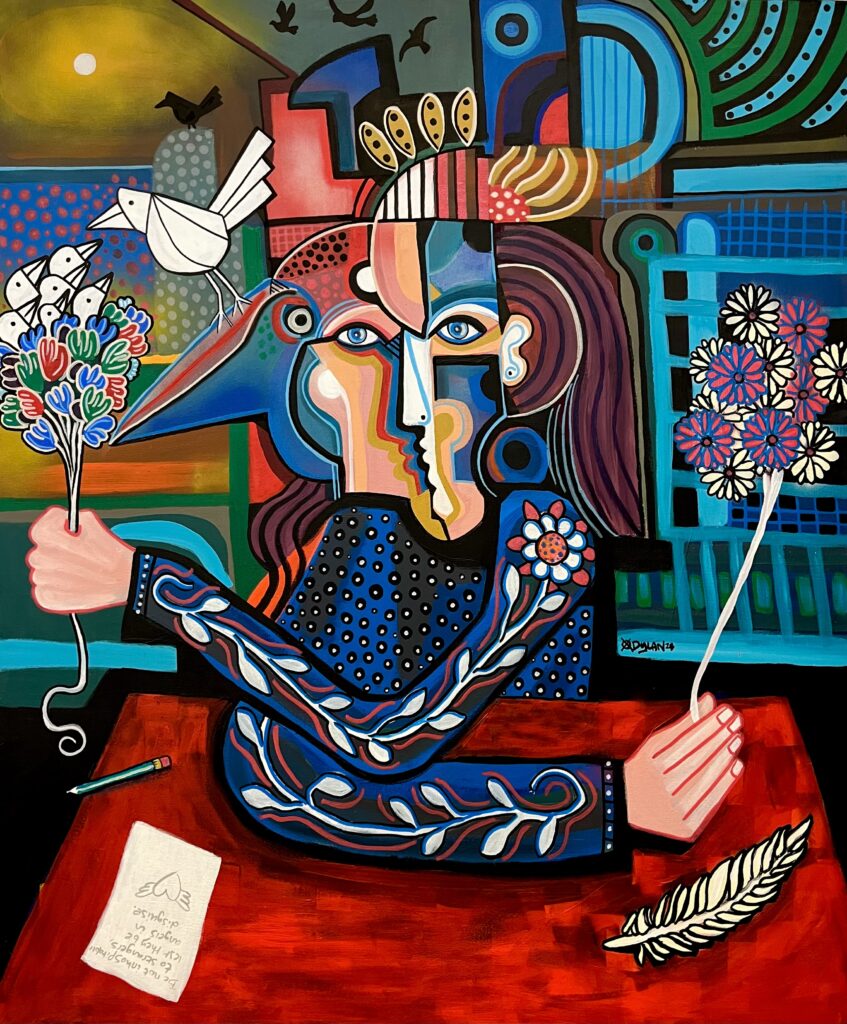
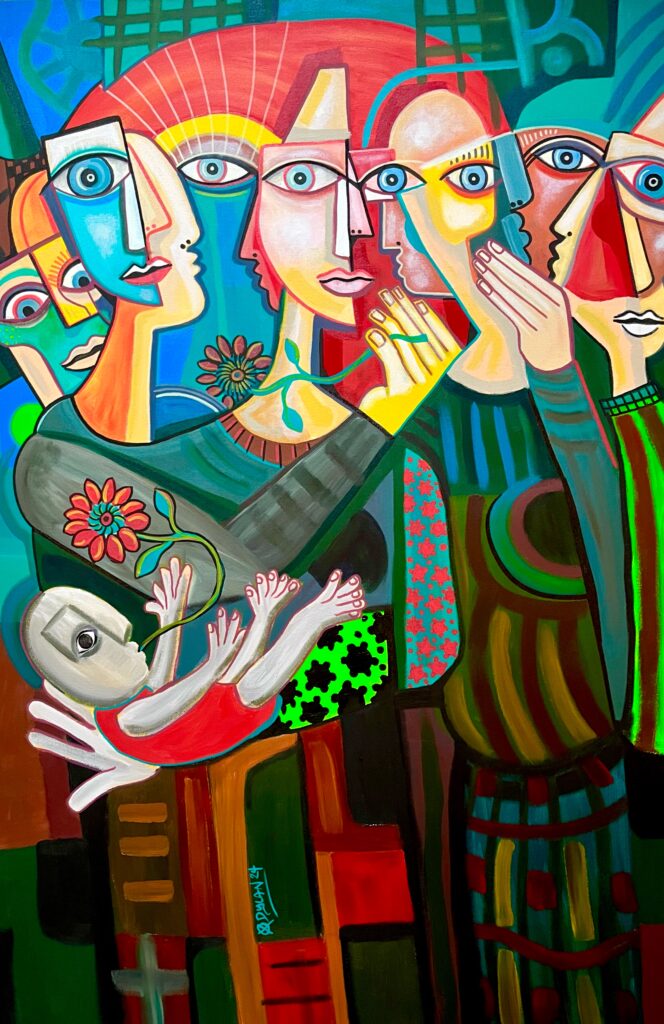
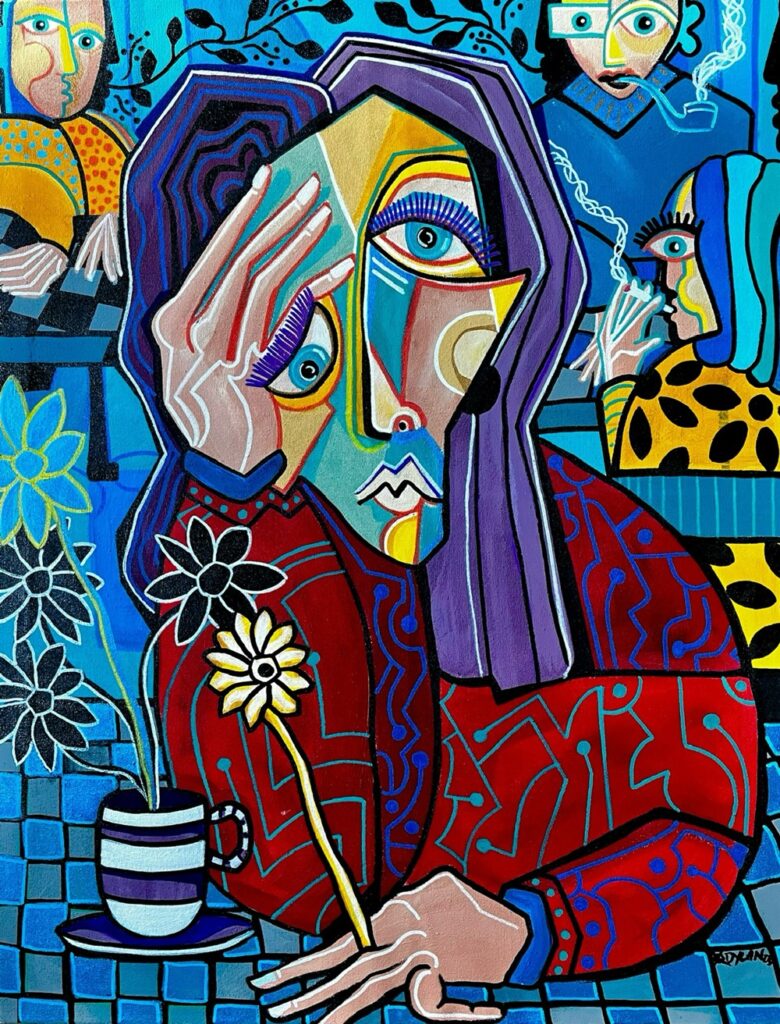
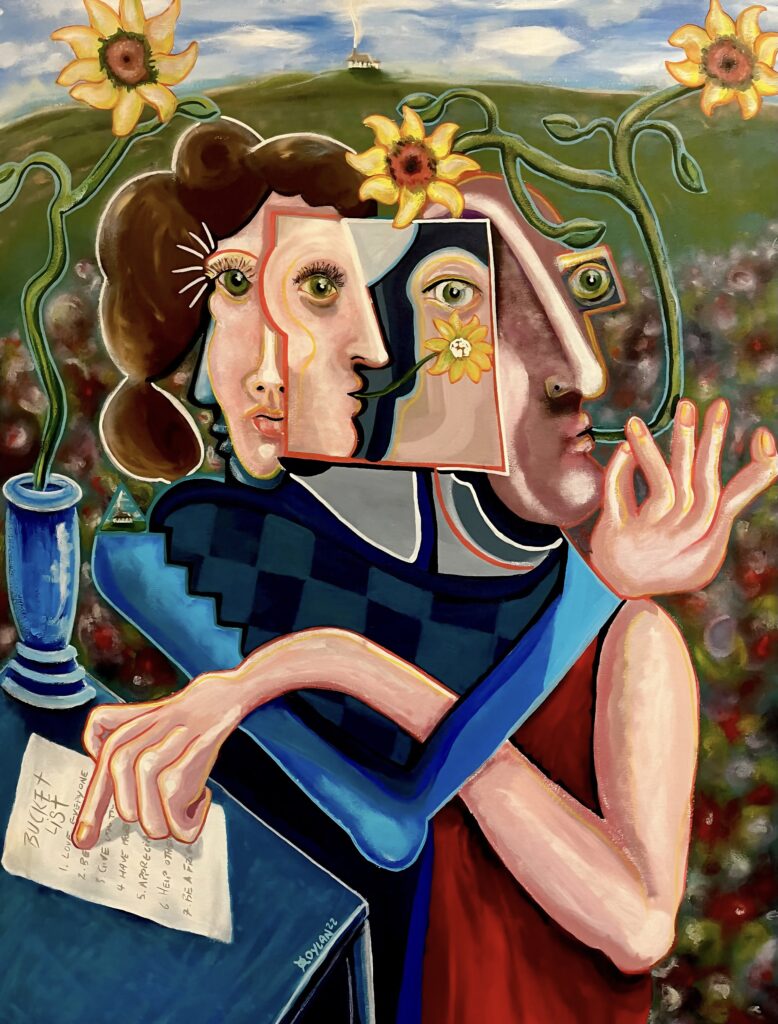
Today, his paintings hold the complexity of being human with honesty and tenderness. His figures exist in overlapping emotional states joy brushing up against anxiety, contentment sitting beside restlessness, love holding hands with doubt. He paints these moments simultaneously because that’s how people really feel them. A single canvas becomes a conversation between different inner worlds, each tugging at the viewer’s own emotional memory.
Though inspired by Cubist pioneers like Picasso and Léger, Dylan does not emulate them. Instead, he lets their boldness remind him that perfect lines are not the point, truth is. Their influence frees him to be imperfect, expressive, adventurous, unfiltered.
Across two decades, one thing has remained constant in Dylan Gill’s journey: the belief that art should be felt before it is understood. His work invites you not to decode it, but to meet it to step into its layers, sit with its colours, and let its emotional vibration find whatever part of you it touches first.
Dylan paints from a place few people slow down long enough to access. His world is shaped by quiet observations, spiritual sensitivity, gritty beginnings, and a lifelong commitment to staying true to what he feels rather than what he’s told to be. And in a crowded contemporary landscape, that clarity that inner compass is what sets him apart.
Let’s step into his story and explore how these memories, environments, and signals have shaped the artist he continues to become.
Q1. You were born in London and studied fine art at Goldsmiths, University of London. How did your upbringing and environment in what you call the “real London” shape your vision as an artist?
So, when I say real London I mean not central London where the tourists gather and live under the illusion for a short while that London I really like the city that’s been put there for them. I grew up in the working class London, the part that holds London together through graft. As a child growing up I saw that being a hard worker got results in life. Not having to scrimp and save but always being able to live a life without worries & stress. My dad was a hard worker. He taught me how to be an entrepreneur. Even as a child I would knock on doors offering car washing etc at my weekends. School was always tough, I saw that by being quiet and keeping my head down I was able to get through the days without conflict. But all these experiences helped me artistically. As a child like all children I loved to draw. I was fascinated by peoples actions and expressions. I saw their mood swings in colour. I’d draw blue faces, red faces and so on. The energy of my childhood which surrounded me and dictated to me was what shaped my art.
Q2. Your paintings are often described as “geometric distortion, bold colour palettes, emotional resonance”. How do you balance geometry and emotion in your work?
My art comes to me in flashes. I feel the piece before I paint it. I don’t plan it until I vision it and then I work with it. The imagery that you see on canvas came to me either whilst listening to music or in a dream. I see & feel the work before I paint it. Art to me is a spiritual thing. I feel like I’m working with other invisible beings at times. This is the only way to explain it.
Q3. Colour plays a strong role in your work. Can you talk about a palette decision or colour-moment in one of your pieces where you knew you had captured something essential?
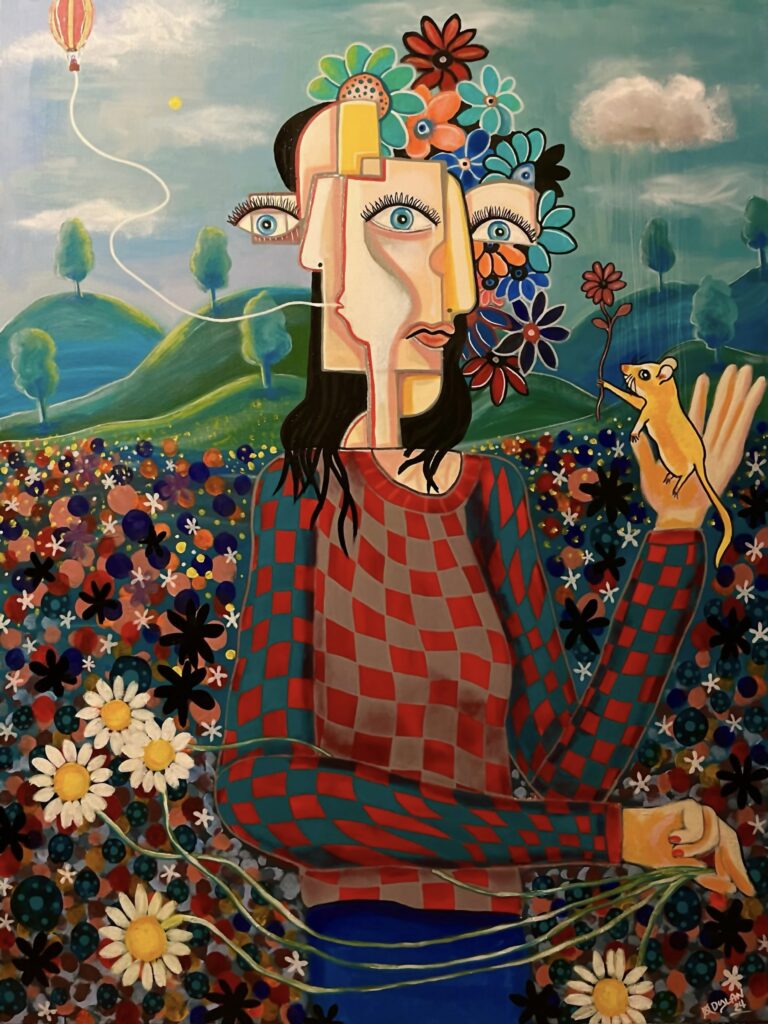
Colour is very important, especially bold bright colours and just sit on the canvas perfectly. I once came across some flowers in a meadow that were so red and vibrant that I couldn’t outline them in my mind. They weren’t fixed to their surroundings, just there existing in what seemed the wrong dimension for them. I try to resonate with those flowers in my work. Nature has taught a lot about colour.
Q4. You write about tuning into “emotional signals that vibrate just below the noise of modern life”. Could you describe a moment when your work came directly from such a signal?
Silence within whilst the busy world around me is in full flow is a way of shifting away from the world and becoming an observer. I’m able to see the different layers of vibration that creates as it goes along in detail. All my work is created in this environment. As a child I loved peace and as an adult.
So in a noisy world I take my self somewhere else within. This is the only way I can create
Q5. How do you balance the viewer’s interpretation with your own intention? When you complete a work, are you ready for the viewer to find their own story, or do you wish them to arrive at something closer to your original idea?
I want the viewer to resonate with my work in their own personal way. I’m just the messenger delivering a message to them in metaphor.
Q6. Your paintings often depict figures in simultaneous, compartmentalised states of happiness, anxiety, love or anger. Why was this Mult perspectival representation important for you?
Love for instance has many layers. There is no one explanation for love. If we see emotion in layers we can then judge how much in love we are or how sad we are. Feelings run deep. We can be happy one moment and sad the next or just content. I like to tell the story of many moments in time but in one image. One image that can connect with the viewer on different levels of emotion. So even if the viewer can’t work out the story they might feel the piece on an emotional level.
Q7. You mention a trip to Inverness and the idea of “spiritual rewilding”. How important are environment and geography (outside London) for your inspiration now?
Very important. If I stayed in London I’d go crazy. Nature is freedom and I mix it up sometimes with city life. Inverness is so open, I visit the mountains and forests when I’m there.
Q8. You refer to the influence of Cubist pioneers such as Pablo Picasso and Fernand Léger. What aspects of their work still surprise or challenge you today?
I love the expressionistic atmosphere of their work. They remind me that it’s ok to not be perfect with my lines and teach me to be adventurous at times. Their work even after seeing it for many years still looks thresh and new and inspirational to me.
Q9. How has your work evolved since the early days (around 1999) to where you are now? What’s remained constant, and what has shifted considerably?
I try to escape perfection which I have done since those early days but still find it hard. I am finding it easier now though to show more expression in my work.
Q10. What one piece of advice would you give to an emerging artist who is trying to find their authentic voice, particularly within the crowded field of figurative/abstract art?
Forget about the multitude of artists in the world. Be yourself, focus on yourself and tell yourself that whatever will be, I was born to be an artist. I will see this through until the end.
What emerges most clearly from our conversation with Dylan Gill is this: his art is built on the courage to feel deeply and the patience to observe what others overlook. Every story he shared from childhood moments of sensing emotions in colour to the quiet inner worlds he retreats into as an adult reveals an artist who creates not from theory, but from instinct, intuition, and lived experience. He paints the emotional layers most people carry but rarely articulate, allowing his canvases to hold the full complexity of what it means to be human.
His practice is guided by sensitivity rather than spectacle. Instead of pushing viewers toward a single interpretation, he invites them to bring their own memories and emotions to the work. That openness, that generosity of meaning, is what gives his paintings their quiet power. They don’t demand; they resonate. They leave room for others to breathe inside them.

Throughout his journey from the working-class rhythm of “real London” to the expansive calm of Inverness Dylan has stayed rooted in the belief that art should be honest, imperfect, vibrant, and spiritually alive. Nature, dreams, music, silence: all of these shape the emotional signals that guide his hand. And what stays constant is his refusal to dilute those signals for the sake of trends or expectation.
In the end, Dylan’s voice stands out because it is not trying to be anything other than itself. His work reminds us that creativity begins in the places we truly pay attention the shifts in feeling, the flashes of vision, the quiet truths beneath the noise.
Follow Dylan Gill to witness a practice shaped by intuition, emotional depth, and the kind of sincerity that stays with you long after the canvas fades from view.