



How does a painter find peace through nature?

👁 177 Views
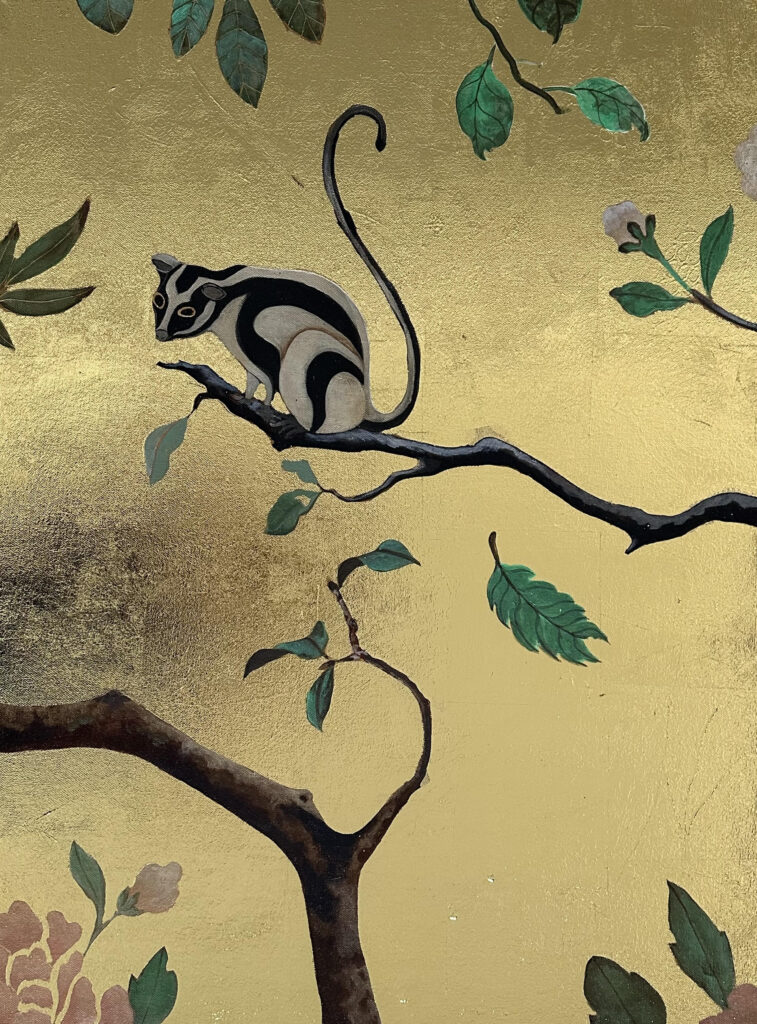
This interview with Sara Rodriguez Serrano provides an intimate glimpse into how a self-taught, multidisciplinary painter approaches her work with quiet intensity and a profound connection to the natural world. Throughout our conversation, she discusses how her practice has evolved—from portraits to animals and now to landscapes, and what has drawn her along that path. She shares the ideas behind her series, The Inner Forest, explaining how painting night scenes changed her understanding of darkness and how her background in architecture continues to shape her approach to building each composition.
Sara speaks about nature as both teacher and companion. After moving from Spain to Canada, she found herself surrounded by vast forests that became an endless source of calm and inspiration. Long walks, the sound of the wind, and the slow rhythm of observation became part of her creative process. In the studio, she describes how each new work begins with the first strokes, which she sees as the start of a conversation with the canvas. The piece develops its own presence as she works, and she admits that the most surprising moment often comes at the end, when she suddenly realises the painting is finished.
Her materials play a central role in this dialogue. Oil paint attracts her for its weight, texture, and depth, while watercolour, ink, and mixed media give her freedom to experiment. Through her series The Inner Forest, Sara explored how darkness can be transformed through colour. What began as a response to uncertainty became a way to see night not as something to fear but as a space full of small lights, possibilities, and calm. She explains how this theme resonates with her own experiences of change and growth, where painting becomes a means to transforming fear into clarity.
Sara’s architectural training still influences her thinking, especially in how she organises space, balance, and proportion within a canvas. Even when her work feels free and expressive, an underlying structure guides her choices. Yet emotion is always at the centre. For her, each painting begins with a feeling she wants to explore rather than a scene she wants to reproduce. That emotional impulse determines colour, movement, and atmosphere, allowing the work to grow from within.
Throughout the interview, she also reflects on learning and experimentation. Although largely self-taught, Sara has taken courses and participated in outdoor painting contests. These experiences have shaped her curiosity and reinforced her belief that growth means staying open to new ideas. She sees each encounter and technique as an opportunity to learn, not a fixed rule to follow.
What emerges from our exchange is a portrait of an artist who finds meaning in observing, listening, and transforming. Sara’s paintings capture the quiet conversation between light and dark, movement and stillness, presence and imagination. Through her words, we come to understand how painting becomes a process of discovery, where nature offers not just a subject but a way to see the world anew.
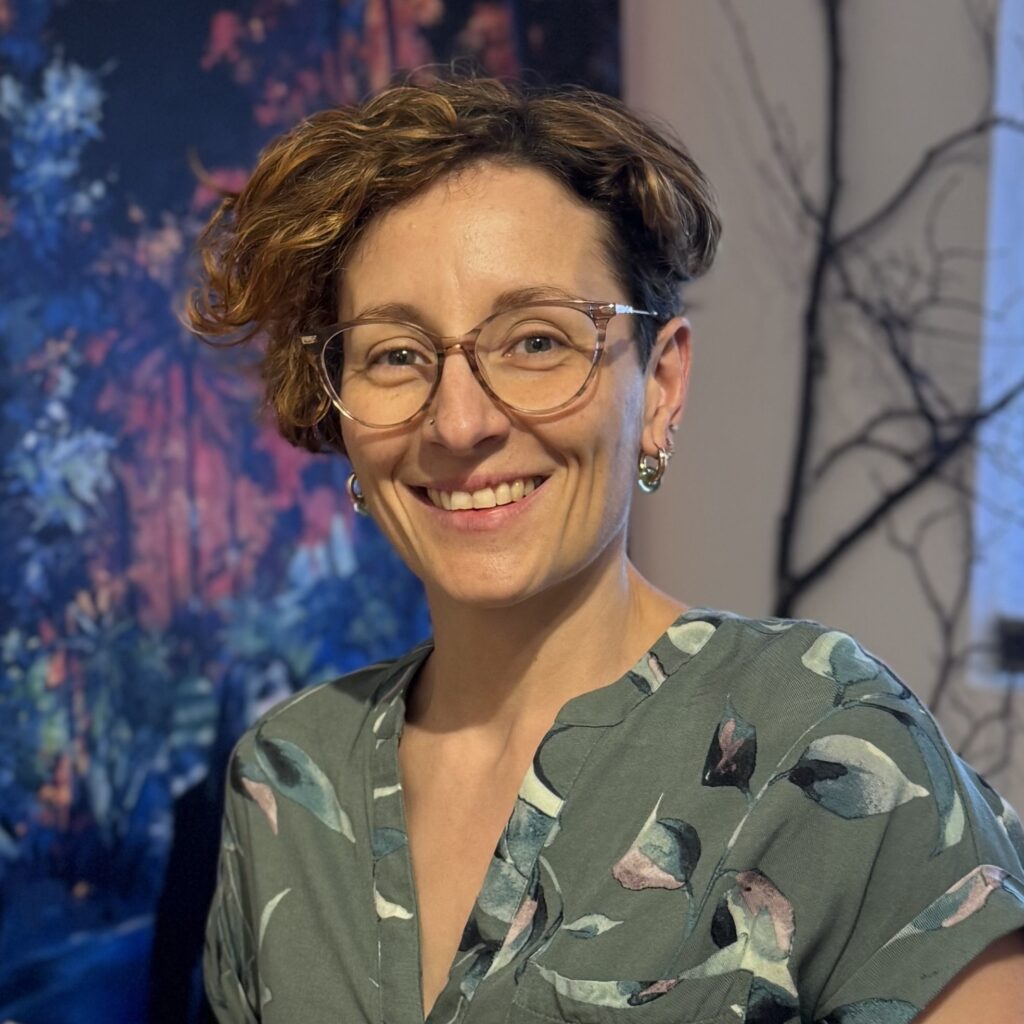
I am a multidisciplinary, self-taught artist with a naturalist spirit. I am guided by a naturalist spirit and a deep passion for observing and connecting with everything around us. Nature is my primary source of inspiration; it has always given me the impetus to take on new challenges and to enjoy each creation. I also consider it a balm for the soul, necessary for staying connected with oneself. My art explores the subtle link between the senses and emotions. I seek to make the invisible visible, capturing imperceptible details to evoke deep emotions. I focus on the beauty of small things, often inspired by places with unique, inspiring energy.
I’ve always loved the conversation with the painting — from its beginnings, its emergence, and its development — and the way each work manages to capture a special moment within itself. I love to immerse myself in their layers, textures, and complexities. Each canvas is a process of transformation, a living path that allows me to leave a trace of my emotions and convey them to others. This process is at the heart of my artistic practice. My style is distinguished by dreamlike effects that invite escape. I mainly use oil paint, drawn to its effects, textures, and the personality it can convey.
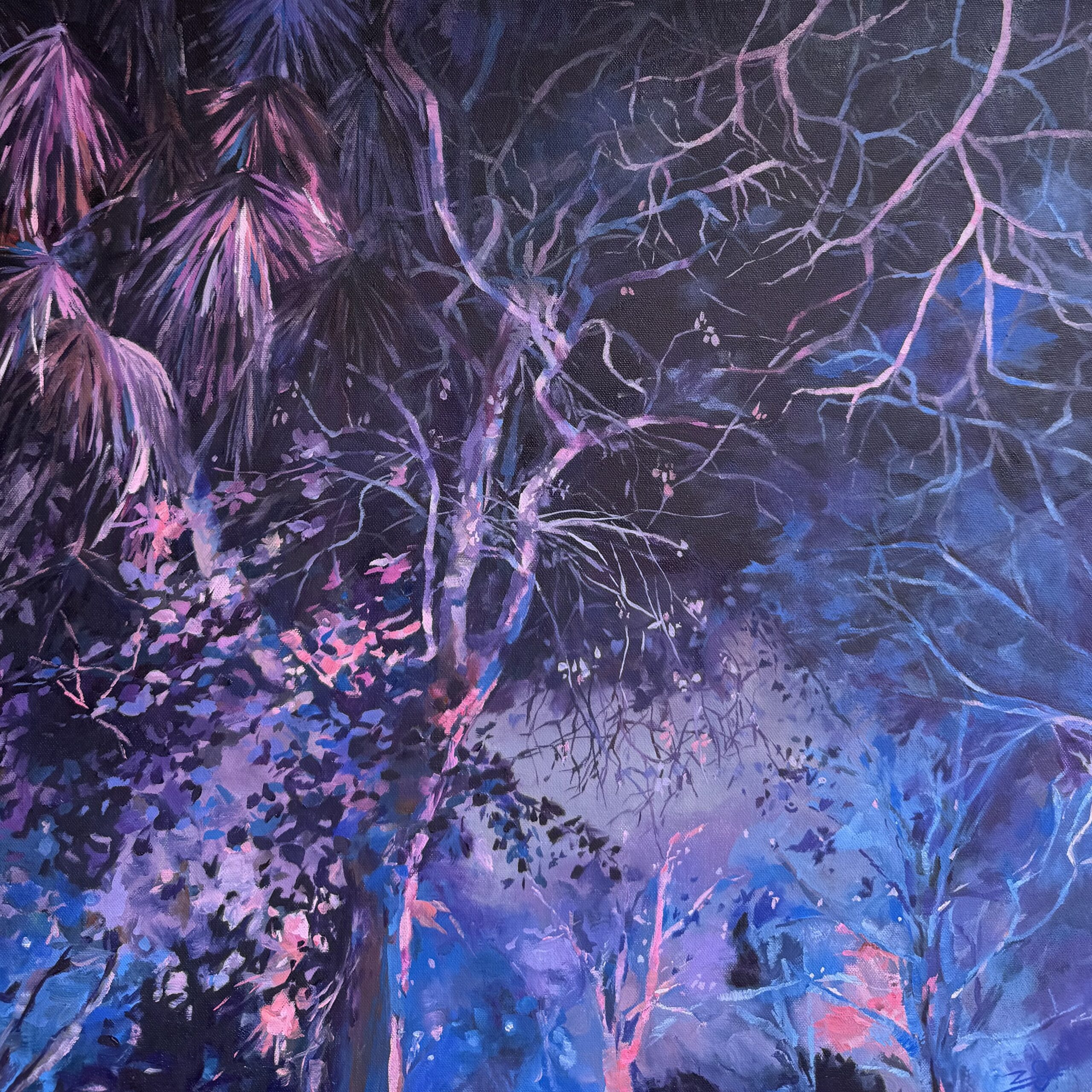
I also use other media, such as watercolour, mixed media, and ink, which allow me to give free rein to my creativity. At this moment in my artistic career, I am very inspired by the study and observation of nighttime in nature, and I can transcribe into my paintings what my eyes see, the colours and light beyond the darkness, making fears, uncertainties, and unknowns disappear—and transforming them into light, colour, and beauty.
1. Sara, in “The Inner Forest” series, you explored the shift from darkness to light through colour. What drew you to that idea, and how did painting night scenes in nature change the way you see it?
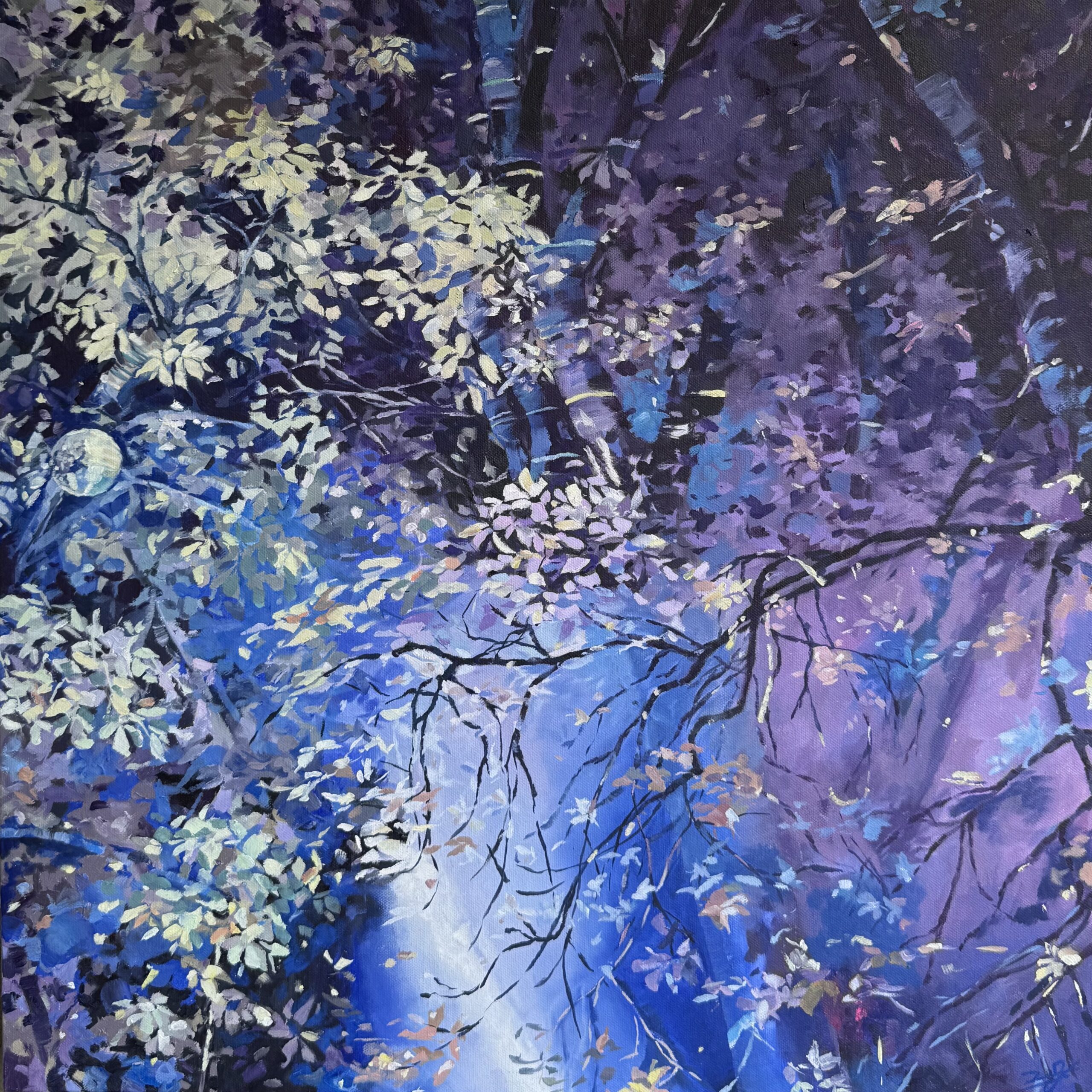
Choosing that theme was a very personal decision. I reached a point in my life where I felt the need to take a significant step, to make profound changes, even if that meant facing the unknown and confronting everything that frightened me. Darkness, in that sense, represented that uncertainty. However, I have always found in nature a kind of refuge —a source of calm and confidence that sustains me, even in the most challenging moments. Painting night scenes in nature allowed me to see that darkness from another perspective—not as something harmful or threatening, but as a space full of possibilities, subtle lights, and silences that speak. Through colour, I attempted to convey that inner transformation: how, even in the darkest moments, new opportunities, clarity, and beauty can emerge. ‘The Inner Forest’ was, in many ways, a journey back to myself.
The most striking and rewarding part is going from a blank canvas to the first strokes. It’s like starting a conversation and opening up a relationship.
Sara Rodriguez Serrano
2. Over time, you’ve moved from painting portraits to animals and now landscapes. What usually inspires you to move in a new direction?
Since I was little, I have felt a powerful connection to nature, but my recent move has indeed made a big difference. When I moved from Spain to Canada, I encountered an imposing, almost overwhelming natural environment that had a profound impact on me. Walking alone in the forest, stopping to listen and observe, has given me a new way of being present. That intimate connection with the environment has become a constant source of energy and inspiration for my work. It is in those moments of silence with nature that the desire to create often arises.
3. You describe your process as one of transformation, where the canvas slowly comes to life. What moments in that process feel the most unexpected or rewarding for you?
The most striking and rewarding part is going from a blank canvas to the first strokes. It’s like starting a conversation and opening up a relationship. At that moment, you begin to get to know the canvas and the paint, and as you progress, you create the overall composition with its unique personality, weaknesses, and strengths. I would say the most unexpected moment is the end. It may seem obvious when a painting is finished, but it is actually very subjective and depends on the artist. Sometimes you think you still have a few days left, only to find out that it’s all over in a few hours.
4. Coming from an architecture background, do you find that sense of structure or design still plays a role in how you build your compositions?
My training in architecture definitely continues to influence my approach to painting. Architecture taught me to think in terms of structure, balance, space, and functionality, and those principles remain present, although I now apply them more intuitively and emotionally. When composing a work, I think a lot about how space is organised within the canvas, how forms, voids, and tensions are distributed, and how to combine colours. Even when the piece is very gestural or free, there is a structural basis that guides that expressiveness. Architecture gave me tools to build, and now I use them to translate feelings and internal states into images.
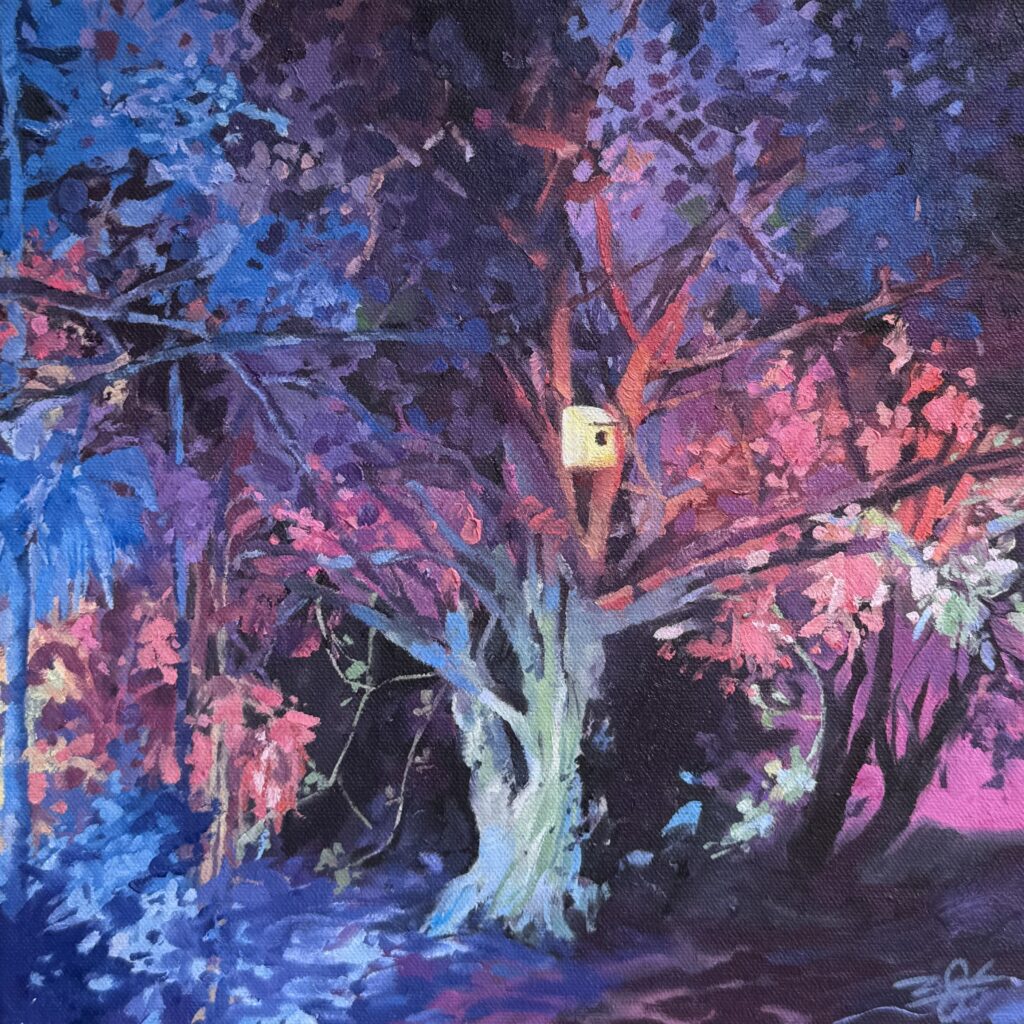
“Painting night scenes in nature allowed me to see that darkness from another perspective, not as something negative or threatening, but as a space full of possibilities, subtle lights, and silences that speak.
Sara Rodriguez Serrano
5. Nature seems to be at the heart of everything you do. When you start a new piece, do you rely more on observation, imagination, or an emotion you want to explore?
Without a doubt, what moves me most when I begin a work is the emotion I want to explore or convey. Although it sometimes stems from a specific experience in nature, I don’t seek to represent it literally; instead, I aim to translate what I felt at that moment. It’s inevitable, considering that I’m a compassionate person; everything I experience affects me deeply, and that is reflected directly in the way I work. Emotion guides my decisions: the energy of the stroke, the temperature of the colour, the contrasts, the atmosphere, and even the spaces of silence on the canvas. I observe, I imagine, yes, but always from that inner place, where emotion is what organises and gives meaning to everything.

6. You’ve learned from different teachers and techniques over the years while remaining self-taught in many ways. How have those experiences shaped the way you see growth and experimentation in your work?
I am an inquisitive and sensitive person, and when something touches my heart, I naturally want to delve deeper, learn more, and understand it from different angles. All the courses I’ve taken have stemmed from that genuine desire to discover new possibilities, to open myself up to other ways of seeing and feeling art. I think each one has left a mark on my work—there’s a little bit of each experience in what I do. I’m fascinated by how each artist has a unique vision, not only in what they observe, but in how they express it.
Participating in quick painting contests in nature, for example, has taught me a lot: seeing how, faced with the same scene, each person creates an entirely different interpretation is something that continues to amaze me. All of this has reaffirmed for me that growing as an artist is not about seeking a single truth, but about always being open to experimenting, changing, and continuing to explore.
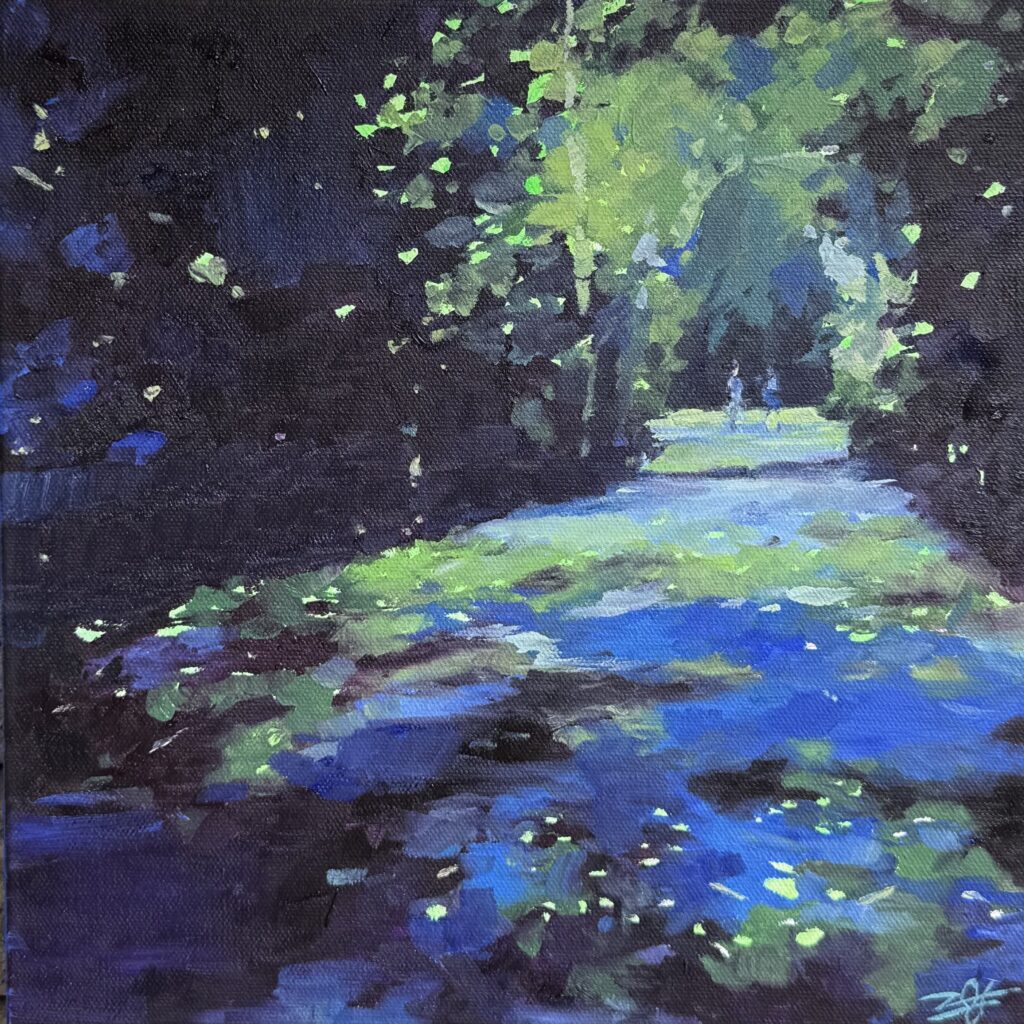
Sara Rodriguez Serrano’s paintings offer a quiet journey through emotion, colour, and the natural world. Her work is about seeing beyond what is visible and finding meaning in moments that might otherwise pass unnoticed. Each canvas begins with an emotion and grows into a space where light, colour, and silence meet.
Through her study of nighttime landscapes and her fascination with transformation, she shows how change can bring clarity and peace. Her path from architecture to painting reminds us that creativity often grows from curiosity and from allowing each experience to shape the next. From her, we learn that creating is not about control but about listening, observing, and letting something true emerge through patience and care.
To learn more about Sara Rodriguez Serrano, click the following links to visit her profile.
Arts to Hearts Project is a global media, publishing, and education company for
Artists & Creatives. where an international audience will see your work of art patrons, collectors, gallerists, and fellow artists. Access exclusive publishing opportunities and over 1,000 resources to grow your career and connect with like-minded creatives worldwide. Click here to learn about our open calls.