
Galina Gumbarova on Why Her Mixed Media Practice Needed a Corporate Career to Exist

👁 15 Views
At Arts to Hearts Project, we have always loved finding artists whose creative life did not begin in an art school or a studio or even with the belief that they were allowed to call themselves an artist. Some of the most honest work we have come across has been made by people who spent years doing something else entirely before they finally let themselves make what they were always meant to make.
That is what drew us to Galina Gumbarova when we were putting together Arts to Hearts Magazine Issue 11.
Galina is one of those artists whose path makes no sense until it makes complete sense. She grew up in Russia, in the Soviet Union, doodling in school notebooks, painting at home, feeling that pull toward art that some people are just born with. But her parents were university professors and they wanted serious subjects.
So, art school never happened. Instead, she witnessed the collapse of the Soviet Union, got selected for a student exchange programme to the US at eighteen, stayed for seven years, got a bachelor’s degree, then an MBA, met her Ukrainian husband on the same programme, moved to London, built a career in brand management, had two kids.
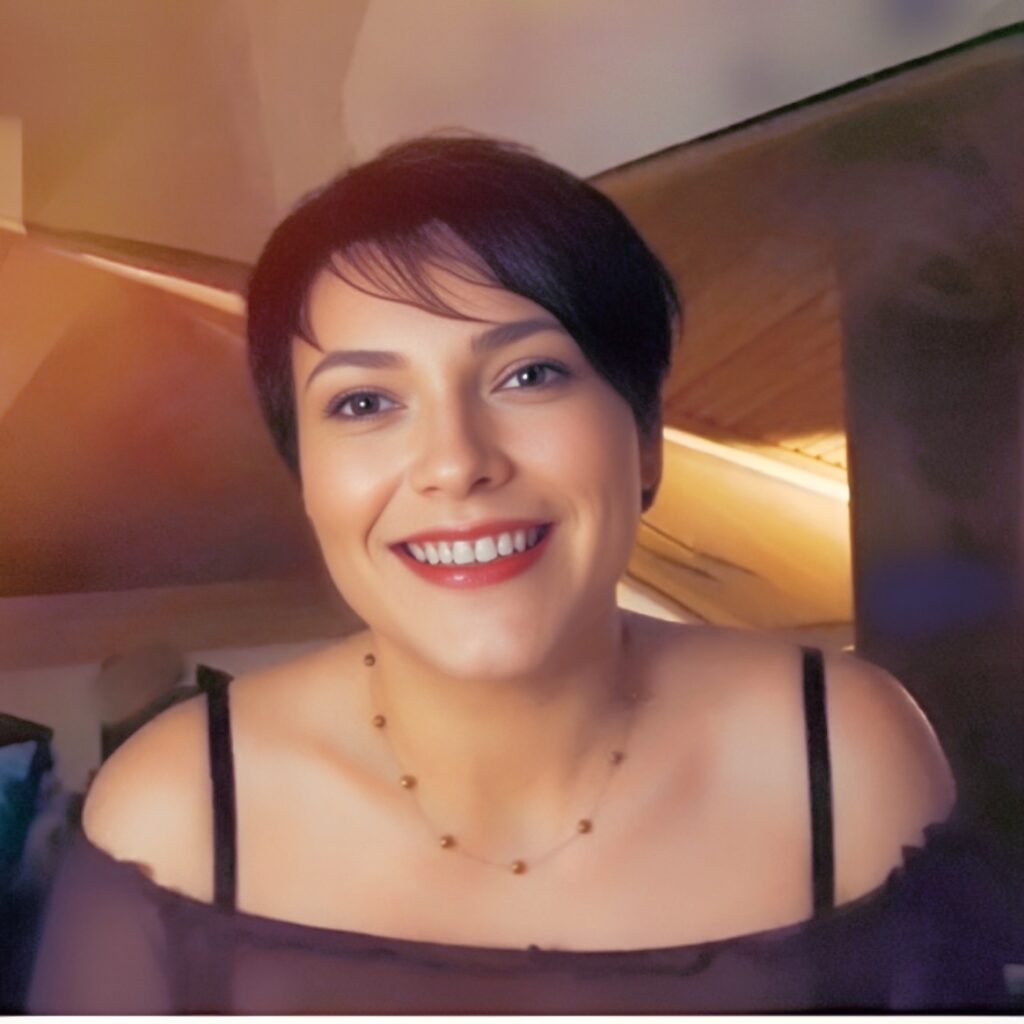
And through all of it, art never stopped calling. That is the part of her story that gets us. Because it would have been so easy to let it go. To say that chapter closed, I have a career now, I have a family, there is no room. But Galina kept finding room. She took classes from local artists. She explored different techniques through workshops.
She enrolled in the Mastery Programme at the Milan Art Institute and it changed everything. Her skills sharpened. Her voice became her own. And what had been a quiet thing she carried alongside her life became the centre of it.
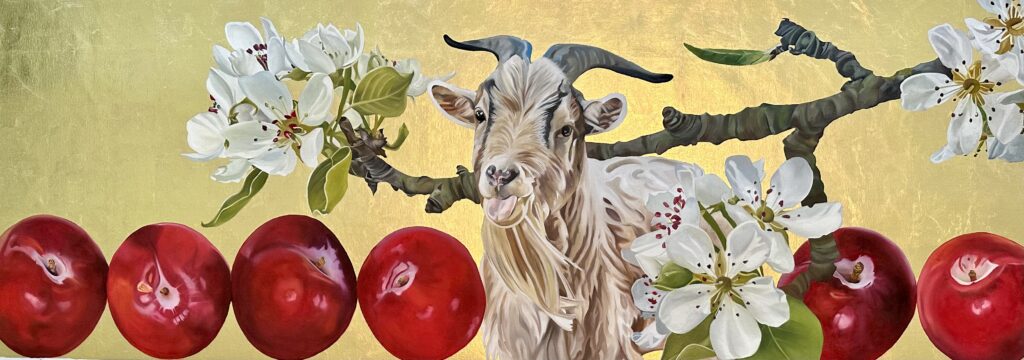
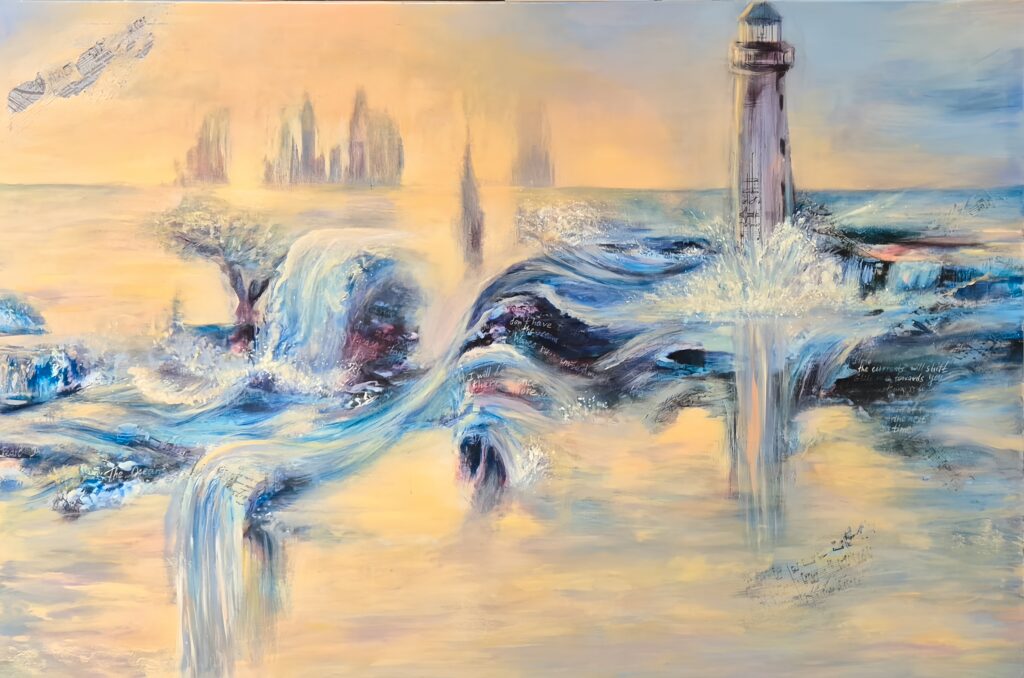
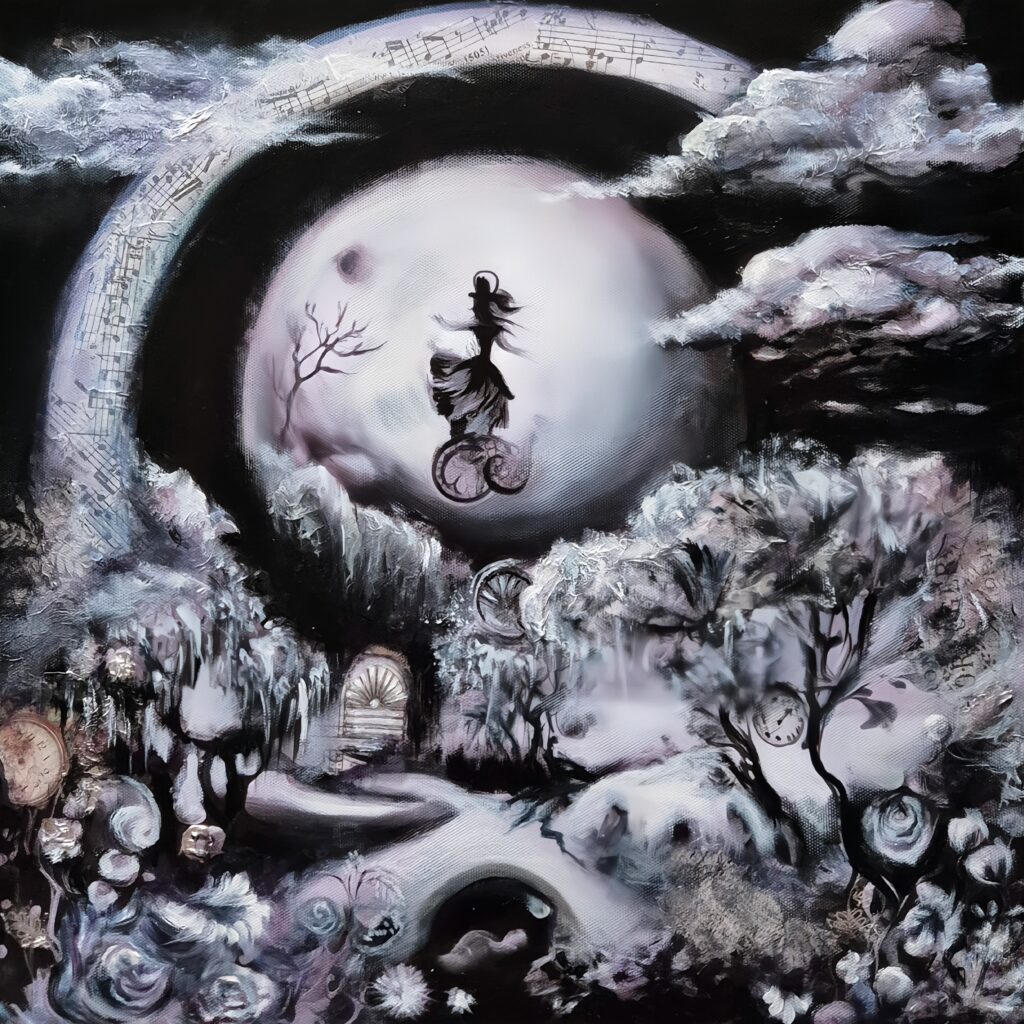
Her work now is layered in every sense of the word. She paints mixed media pieces that hold collage, hidden messages, fragments of poetry, lyrics, quotes buried into the surface for only the curious eye to find.
She works on three to six paintings at once, moving between them depending on her mood, letting each one call her when it is ready. She has never experienced creative block. Her problem, she says, is the opposite. She gets inspired constantly and by everything.
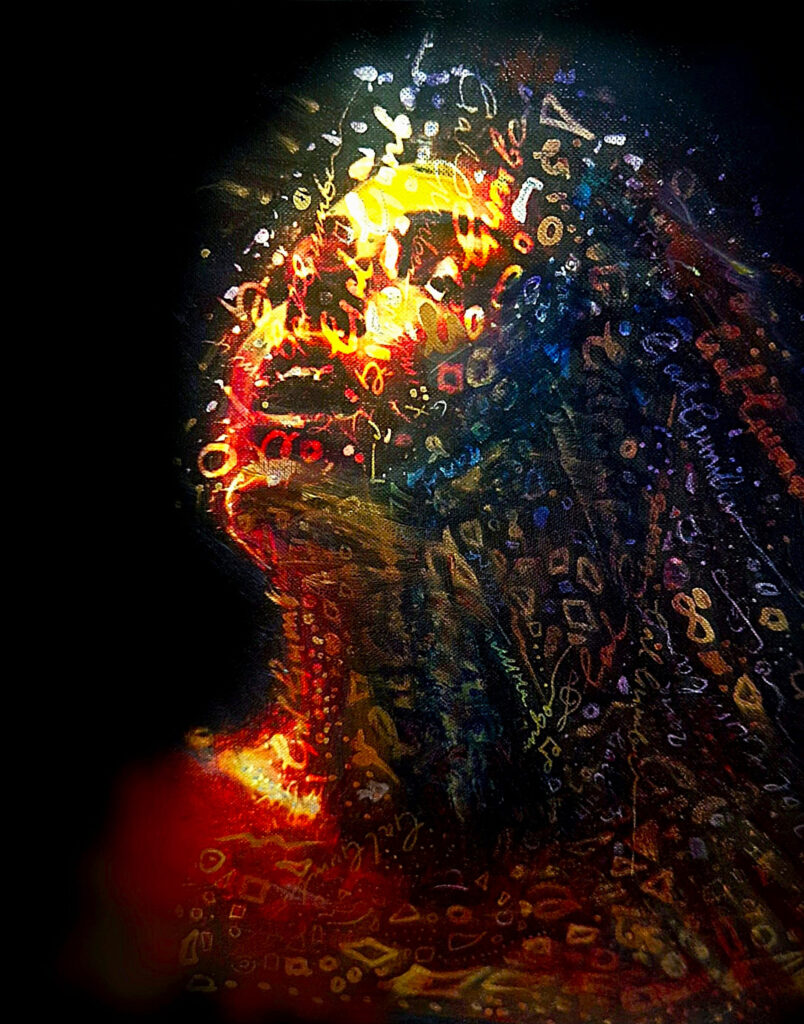
And there is a depth to her work that goes beyond technique. When the war started in 2022 it hit her personally. Family in Russia. Family in Ukraine. She poured that pain into a painting and it helped. But then she looked at it and realised she did not want that feeling on her wall. And she did not want to put that weight on her viewers either.
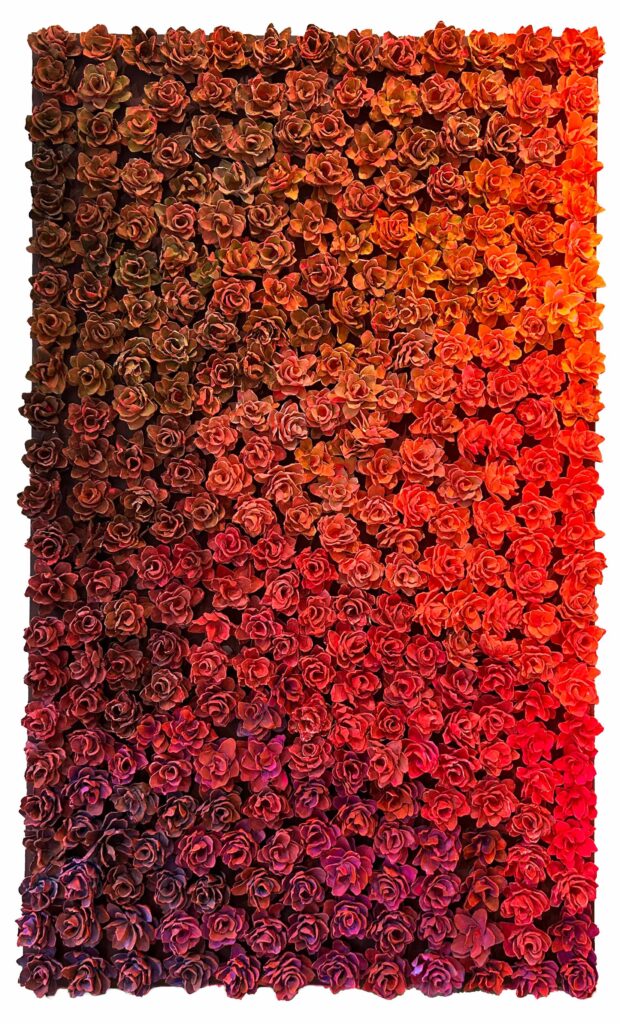
So she did something different. She made a whole series called Scars of Silver and Gold about transforming pain into beauty. About looking at the marks life leaves on you and seeing them not as damage but as proof that you survived.
That is Galina. She does not paint suffering. She paints what comes after it.
Let’s hear from Galina about how a corporate career quietly built the artist she is today, why she hides messages inside her paintings, what music and poetry do to her process, and how she learned to stop fighting her own nature and let inspiration lead.
Q1. Your journey began long before you started selling art, can you share with us how growing up in Russia and later studying at the Milan Art Institute shaped the way you think about art and colour?
Art has always been my passion. I’ve been doodling on the sides of my school notebooks, drawing and painting in the albums at home for as long as I remember myself. Only my parents – both university professors – believed I should have concentrated on more serious subjects instead, and so I never got to study in any art schools as a child. I grew up in Russia (the Soviet Union then), and it was part of our school programme to visit museums, theatres and exhibitions regularly. It made a big impact on me as an artist, although back then of course we were likely to roll our eyes, trying to be cool and rebellious teens. I witnessed the collapse of the Soviet Union and the end of the Cold War and was one of the lucky first students to be selected for the USA exchange programme at the tender age of 18. The one-year programme extended to seven, as I stayed to get my bachelor’s degree and then the MBA. This is also where I met my Ukrainian husband, who came on the same programme that year. After graduating we moved to work in London. As busy as I was with my brand-management work and later, with my two kids, art never stopped calling to me. I started taking classes from some great local artists, exploring a variety of techniques through different workshops and tutorials. The Mastery Programme by the Milan Art Institute proved transformative, helping me refine my skills and develop a distinct artistic voice. I have been exhibiting and selling my art in different London venues – together with art societies and on solo shows. Recently, I opened my art shop online Art-GalGumba.co.uk, allowing me to connect with art collectors from around the world on a more personal level.
Q2. You describe working on three to six paintings at once, switching between them depending on mood. Can you talk about how this fluid studio practice influences the emotional coherence of your work?
I have never experienced an artistic block; my problem tends to be of the opposite nature. I get inspired -constantly and by so many different subjects and styles, it can be very distractive. The solution came with experience, I stopped fighting my nature, stopped forcing myself to finish a painting before moving on to the next one. Now, if I’m suddenly burning to explore a new idea/technique/medium – I let myself do so. Who knew life could be so simple and satisfying?! I enjoy working on different series simultaneously. They usually have different style, subject and colour theme, giving me freedom to choose what I feel like painting on any particular day. For me such fluid approach works perfectly. I go to my studio with excitement and thrill every time, wondering which painting would call me.

Q3. Many of your works are inspired by music, lyrics, poetry, films, and books. Can you talk about a specific piece where a song or quote led you to an emotional insight you might not have reached otherwise?
Recently, the lyrics of Lorde’s song “Flicker” gave me an insight about painting “the other side of pain”, it became a base for the whole series of paintings – “Scars of Silver & Gold”. The war that started in 2022 crushed me as I have family in Russia and in Ukraine. The painting that was born at the time was therapeutic for me as I poured my pain into it. However, later I realised that I never wanted to have it on my wall to remind me of that feeling. Moreover, I realised that I wouldn’t want to burden my viewers with such feelings either, instead I wanted to bring light and hope to those who felt that way. And then the lyrics of the song came to mind with a different insight: I’m a princess cut from marble, smoother than a storm And the scars that mark my body, they’re silver and gold My blood is a flood of rubies, precious stones It keeps my veins hot, the fire’s found a home in me It made me think about how every encounter, challenge, and joy we experience in life, every significant person and event would leave their marks on us. In this series I wanted to transform vulnerability and pain into beauty, resilience, and strength, to celebrate the stubborn hearts and their triumph over life’s obstacles. I hope this collection would invite the viewers to see their own “scars” as symbols of courage and strength. They are of Silver & Gold.
Q4. In your A Million Miles Away collection you start paintings with no idea of what you will make, letting them evolve spontaneously before refining them. What do these initial “unguided” moments reveal about your artistic intuition?
This is my favourite stage of art-creating process. The pressure is off, I’m just playing, experimenting, enjoying the freedom and spontaneity of the moment. I put on some music and start a painting with a blank mind -a million miles away- having no particular idea of what I wish to paint. Often, I like to start with collages – gradually adding different colours, textures, some favourite quotes or bits of poems. I love the moment of revelation of what a painting wants to become, suddenly I see an image amidst the chaos, a figure, an idea, a face, a thought. And then I know in which direction I want to develop the piece. Post-factum,
I enjoy tracing different elements of the painting to some thoughts, people, events – recent or old.
Q5. You describe the stage where a painting becomes an “ugly mess” before it makes sense. How do you navigate moments of uncertainty in your process, and what tells you that a work is about to resolve?
Freedom and joy of the first stage creating “a million miles away” painting often comes with a price. Allowing “anything goes” approach sometimes leaves me with a very busy background. Standing before the chaos I’ve created, I feel both the thrill of discovery and the tremor of uncertainty. With experience, increasingly, the balance in that mixture is shifting from fear towards the excitement. The previous victories give me confidence, that I will find the way to calm down the chaos with some atmospheric resting spaces and neutral colours. And then I will add some interest and balance with the focus point. And if it doesn’t make sense right away, I like to put such painting aside and work on something else. When I return to it much later, I can see it with the different eyes and resolve any problems.
Q6. Your conceptual approach varies from collection to collection. How do you decide when a series is complete, and what marks the shift to a new thematic idea?
I like to work on a few series simultaneously. This allows me to respond to sudden inspirations, explore different themes and styles, combine, adapt, come up with new ideas and grow as an artist. Some series I keep coming back to over and over again, after trying myself in something else.
Q7. Many collectors comment that your hidden messages create personal connections. How much do you think about audience discovery while you are making a work?
I’ve always been inspired by art that is not obvious, the themes that make me wonder and contemplate. In turn, I aspire to create art that intrigues the viewers’ minds, brings them some insights and inspirations. I like hiding interesting details, quotes and symbols throughout my paintings to be found only on a close inspection. And most of all, I love the fact everyone will have a unique take on what they see.
Q8. How do you see the relationship between the viewer’s personal interpretation and the original intent of a painting?
I am often asked what meaning I put into my paintings, and although I have my own thoughts and insights, to me it is much more interesting and important that different viewers will have their own interpretations. I believe, an artist can touch somebody with their art on a very personal level without ever planning or realising it.

Q9. You’ve been creating for years and constantly expanding your ideas. What shifts have you noticed in your work overtime conceptually, technically, or emotionally?
Just like most artists, I started with painting different subjects in all sorts of media, studying and reproducing the works of famous artists, then in time developing my own style, my own voice. My goal now is not only to produce a captivating visual art, but also to stimulate meaningful discussions and inner reflections on human nature, fresh starts, and the complexity of individuals with all their flaws and virtues. I feel that in the world so full of hate and destruction lately, it’s even more important for artists to create art that projects light, beauty and hope.
Q10. When someone stands in front of your painting and discovers those hidden layers, what do you hope they feel first before they start interpreting?
Surprise, delight and wonder. I like to reward the curious eyes with some hidden treasures to ponder. I believe the original art on the wall is like a portal to different world, sometimes even other dimension. I want to invite my viewers into the worlds full of beauty, meaning, and intrigue.
Q11. What advice would you give artists who want to weave personal narrative, music, words, and layered meaning into their own visual practice?
I think it’s very important to find your unique artistic voice – what do you stand for, what kind of message you want to send to the world. I’m deeply inspired by the power of words, so I would advise to reflect on the artist’s favourite songs, poems, books – what made those words to resonate? Which of your paintings project similar feelings or thoughts?
As our conversation with Galina came to a close, something hit us that we were not expecting.
This is a woman who was not allowed to go to art school. Who spent decades in boardrooms and brand meetings while the artist inside her waited. Who moved across continents, raised a family, built an entire career that had nothing to do with a canvas. And then a war broke out and her world split in half. Family on one side. Family on the other. And what did she do? She painted. And then she looked at what she painted and said no. I am not leaving people in the dark. I am taking them toward light.
That is not just an artistic decision. That is a life philosophy.
Galina does not believe art should burden people. She believes it should reward them. She hides treasures inside her paintings. Quotes, lyrics, poetry, symbols. Things you will only find if you lean in close enough. If you care enough to look. She wants the curious eye to be surprised. She wants you to feel delight before you feel anything else. And in a world that keeps handing us heaviness, that is a radical act.

She works on six paintings at once because that is who she is. She gets inspired by everything. Music, films, books, a conversation, a lyric that hits differently on a Tuesday afternoon. For years she thought that was a flaw. That she was too scattered, too distracted, too all over the place. And then she stopped fighting it. She let herself be exactly who she is. And everything opened up.
That might be the most important thing she said in our entire conversation. That she stopped forcing herself to be a different kind of artist and let herself be the artist she actually is. And suddenly the studio became the most exciting room in her life.
Here is what Galina taught us. That you do not need permission to start. That every year you spent doing something else was not wasted, it was preparation. That your scars are not ugly, they are silver and gold. That the chaos inside you is not a problem, it is your superpower. That hiding something kind inside your work for a stranger to discover is one of the most beautiful things a human being can do. And that choosing to bring light when you have every reason to sit in darkness is not naivety. It is the bravest thing an artist can offer the world.
Follow Galina Gumbarova through the links below and see what happens when someone stops waiting for the right time and starts making from exactly where they are.