







The First Artists in Human History

👁 11 Views
Long before museums, galleries, or art markets existed, long before anyone spoke of “artists” or “art history,” the first artists in human history were already creating images that would outlast entire civilizations. Deep inside caves scattered across Europe and Southeast Asia, archaeologists have discovered paintings of animals, mysterious symbols, and human handprints that date back more than 40,000 years. These images were created with mineral pigments often red ochre or charcoal applied directly onto stone walls illuminated only by firelight. What survives today are fragile traces of a creative impulse that emerged long before writing, agriculture, or cities transformed human society.
For archaeologists and historians, these cave paintings represent one of the earliest windows into the human mind. The ability to represent an animal, a symbol, or even one’s own hand requires more than technical skill; it requires imagination, memory, and the ability to translate experience into visual form. In other words, these early images suggest that prehistoric humans were not only surviving their environments but also interpreting them. They were observing animals, remembering their forms, and transforming those observations into images that others could recognize.
Over the past few decades, discoveries across multiple continents have dramatically expanded our understanding of early art. Sites such as Chauvet Cave in France and Leang Tedongnge Cave in Indonesia have revealed that artistic expression appeared surprisingly early in human history. Far from being primitive or accidental markings, these paintings demonstrate careful observation, deliberate technique, and a striking awareness of the natural world.
Taken together, these discoveries raise a profound question that continues to fascinate researchers today: why did humans begin creating art in the first place?
One of the Oldest Paintings Ever Found


One of the most striking discoveries in the story of early art was made not in Europe, where many of the most famous cave paintings are located, but on the Indonesian island of Sulawesi. Hidden within a limestone cave known as Leang Tedongnge Cave, archaeologists uncovered a reddish depiction of a wild pig that has been dated to at least 45,500 years ago, making it one of the oldest known examples of figurative art ever discovered. Unlike abstract markings or simple patterns, figurative art refers to images that represent identifiable objects from the real world, in this case, an animal that early humans would have encountered in their daily lives.
The discovery was reported in the scientific journal Nature by an international team of researchers that included archaeologists from Griffith University. To determine the painting’s age, scientists used uranium-series dating, a method that analyzes mineral deposits that form naturally on cave walls over time. By measuring the age of the calcite layers that had formed over the artwork, researchers were able to estimate when the painting must have been created.
What makes the Sulawesi pig painting particularly fascinating is not just its antiquity but its intention. The animal’s body is carefully outlined in red pigment, and details such as the shape of the head and legs are clearly recognizable. Nearby hand stencils and traces of additional figures suggest that the cave may have been used repeatedly as a place for image-making and symbolic activity. Discoveries like this challenge the long-held assumption that sophisticated artistic expression emerged only later in human development. Instead, they reveal that tens of thousands of years ago, early humans were already capable of translating observation and memory into deliberate visual representation.

Ice Age Artists of Europe

While discoveries in Southeast Asia have pushed the timeline of art deeper into human history, some of the most visually extraordinary examples of prehistoric painting come from Europe. Among the most celebrated sites is Chauvet Cave, located in the Ardèche region of southern France. Discovered in 1994 by three amateur speleologists, the cave revealed a remarkably preserved collection of more than 400 animal images created roughly 36,000 years ago, during the Upper Paleolithic period.
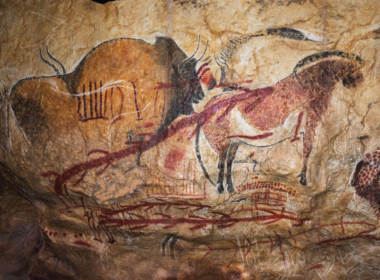
What immediately astonished archaeologists was the sophistication of these paintings. The walls of Chauvet are filled with images of animals that once roamed Ice Age Europe: horses, mammoths, cave lions, rhinoceroses, and bears rendered with a striking sense of movement and anatomical awareness. Rather than static outlines, many of the figures overlap or appear in sequence, suggesting motion across the cave walls. The artists used charcoal and mineral pigments, sometimes combining drawing and shading techniques that demonstrate a surprising understanding of depth and contour.

The discovery of Chauvet Cave challenged earlier assumptions that prehistoric art evolved slowly from crude beginnings toward more refined imagery. Instead, the cave revealed that early artists were already capable of producing complex and visually compelling compositions. Today, the site is protected as a World Heritage Site by UNESCO, both for its extraordinary state of preservation and for the insights it provides into the cultural life of early human communities. For researchers, Chauvet offers powerful evidence that artistic expression was already deeply embedded in human culture during the Ice Age, long before the emergence of agriculture or urban civilizations.
The Handprints That Cross Time


Among the most moving traces of prehistoric creativity are not the carefully drawn animals that populate many cave walls, but the simple handprints left behind by the people themselves. Inside El Castillo Cave in northern Spain, archaeologists have identified a series of red hand stencils that may date back more than 40,000 years, placing them among the earliest known forms of cave art in Europe. These images appear strikingly simple at first glance, yet they carry an immediacy and emotional resonance that few other prehistoric artworks can match.
The technique used to create these hand stencils was surprisingly straightforward. A person would place their hand against the cave wall and blow pigment, often red ochre mixed with water or saliva around it. When the hand was removed, the surrounding pigment formed a negative silhouette, preserving the exact shape and proportions of the hand that had once touched the stone. What remains on the wall is not just an image but a direct physical trace of an individual who lived tens of thousands of years ago.
Research conducted by archaeologists from the University of Bristol, published in the journal Science, suggests that some of these markings may predate many other forms of European cave art. Looking at these handprints today creates an unusual sense of proximity to the distant past. The person who left that mark lived in a radically different world shaped by Ice Age climates and wild animals, yet the gesture itself feels unmistakably human, a quiet declaration of presence preserved across millennia.
Why Humans Began Creating Art
Archaeologists have uncovered remarkable evidence of early artistic expression, but one question continues to intrigue researchers across disciplines: why did humans begin making art in the first place? Unlike tools or shelters, which clearly served practical purposes related to survival, the motivations behind cave paintings are less immediately obvious. Yet the widespread presence of prehistoric imagery across continents suggests that art played a meaningful role in the lives of early human communities.
One theory proposes that many cave paintings were connected to ritual or spiritual practices. Several cave sites appear to have been used repeatedly over long periods of time, and many of the paintings are located deep within cave systems rather than in areas where people lived or cooked. This has led some archaeologists to believe that certain caves may have functioned as ceremonial spaces. Images of animals, particularly powerful species such as bison, horses, or mammoths may have been connected to hunting rituals, symbolic beliefs, or early mythologies that helped communities understand the forces shaping their world.
Another explanation suggests that early art served as a form of communication or knowledge sharing. By depicting animals and scenes from the natural environment, prehistoric artists may have been transmitting information about hunting strategies, migration patterns, or animal behavior. In societies without written language, visual imagery could have played an important role in teaching younger generations about the landscapes and creatures surrounding them.
Some anthropologists also argue that art may have helped strengthen social bonds within early groups. Creating images together often deep inside caves illuminated by firelight could have reinforced shared stories, cultural identities, and collective memories. What remains clear is that artistic expression appeared astonishingly early in human history, long before agriculture, cities, or writing emerged. Creativity, it seems, was already woven into the fabric of human life.
Art Before Museums, Markets, or Fame
When we think about art today, it is almost impossible to separate it from the institutions that surround it. Museums preserve it, galleries exhibit it, collectors acquire it, and markets assign value to it. Yet the earliest artists lived in a world where none of these structures existed. Tens of thousands of years before the first cities or written languages appeared, people were already creating images in caves using the most basic materials available to them, earth pigments, charcoal from fires, and natural rock surfaces shaped by geological time.
These prehistoric environments were vastly different from the carefully lit exhibition spaces we associate with art today. Many cave paintings were created deep underground, far from the entrances where people lived. To reach them would have required navigating narrow passages and dark chambers illuminated only by flickering torchlight. The act of painting itself may have been a communal experience, carried out during gatherings that combined storytelling, ritual, and shared cultural practices. In these moments, the cave walls became more than geological formations, they became surfaces for imagination, memory, and symbolic expression.
Despite their fragile materials, these paintings have endured for tens of thousands of years. Protected by stable cave environments, they survived shifting climates, geological changes, and the rise and fall of countless human societies. Today they stand as some of the oldest surviving cultural artifacts created by our species.
What these ancient works remind us is that art did not begin with institutions or markets. It began with an impulse: the desire to observe the world, to remember it, and to leave a mark behind. Long before anyone could have imagined museums or art history, humans were already creating images that would outlast their own civilizations.
The Legacy of the First Artists
The caves that preserve these ancient images were never meant to function as galleries, yet today they are among the most important cultural archives humanity possesses. Each painting, stencil, or engraved line offers a glimpse into the lives of people who lived tens of thousands of years ago long before written history could record their stories. What makes these works extraordinary is not only their age but the continuity they reveal. Despite the vast gulf of time separating us from these early artists, their impulse to create feels strikingly familiar.
Across continents, from Southeast Asia to Europe, prehistoric cave art suggests that the urge to represent the world visually emerged independently in multiple human communities. Whether depicting animals, leaving handprints, or creating abstract symbols, early humans were experimenting with ways to transform experience into images. These artworks hint at storytelling traditions that have been lost to time, rituals that may never be fully understood, and cultural systems that existed long before civilizations left written records behind.
For modern viewers, encountering these paintings can feel almost surreal. Standing before a hand stencil or animal drawing that is tens of thousands of years old creates an unusual sense of connection with the past. The individual who placed their hand against the cave wall or sketched the outline of a horse lived in a world radically different from our own. Yet the act itself, the desire to mark a surface, to represent something meaningful, to leave evidence of one’s presence remains deeply human.
Perhaps that is the most powerful legacy of the first artists. Their works remind us that creativity did not begin with museums, movements, or markets. It began with people observing, imagining, and responding to the world around them. This feature draws on archaeological research and findings published in leading journals and institutions, including Nature, Science, and UNESCO.
When you look at a 40,000-year-old handprint or animal painting, you are seeing a moment of creativity that has survived for millennia.
What do you think these earliest artworks reveal about human nature?
Was art born from ritual, storytelling, survival or from a deeper need to understand the world and our place within it?