
Dima Kashtalyan uses thousands of hand-placed dots to create his dark navy paintings

At Arts to Hearts project, we have always believed that the most compelling creative practices are the ones built not from a single dramatic decision but from years of quiet, relentless dedication from showing up every single day and choosing to go deeper rather than wider.
Our Best of the Art World editorial was built to celebrate exactly that kind of artist. And today we are genuinely thrilled to introduce you to one who has been building something extraordinary for over twenty five years.
Dima Kashtalyan was born in Belarus and is now based in Warsaw, Poland. His journey began on the streets with graffiti, with spray cans and walls and the unstoppable energy of a teenager who simply needed to make things.
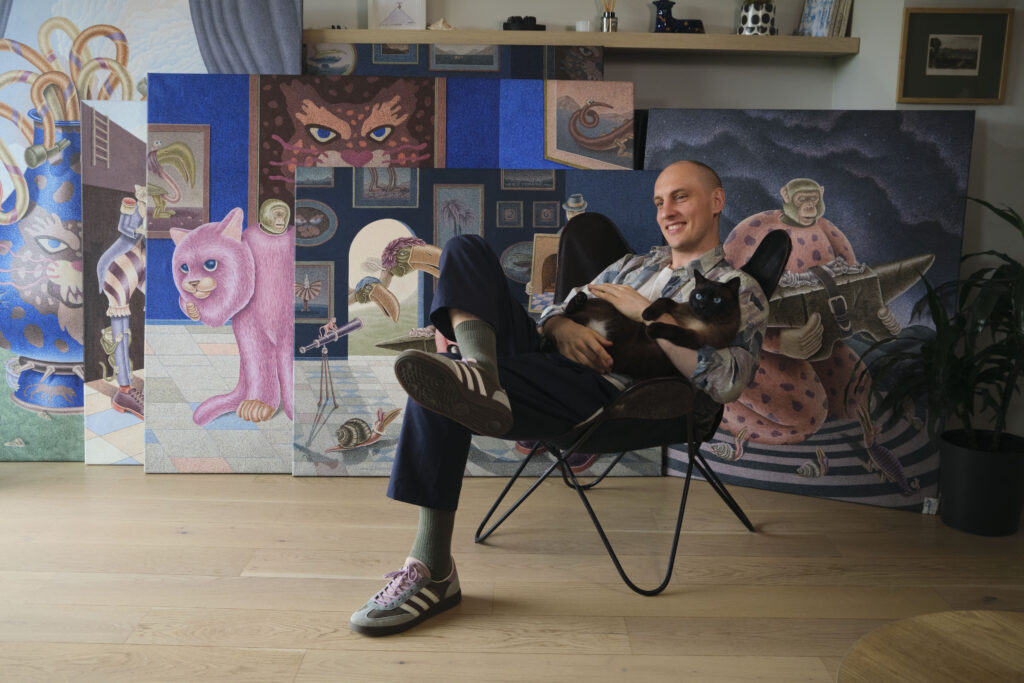
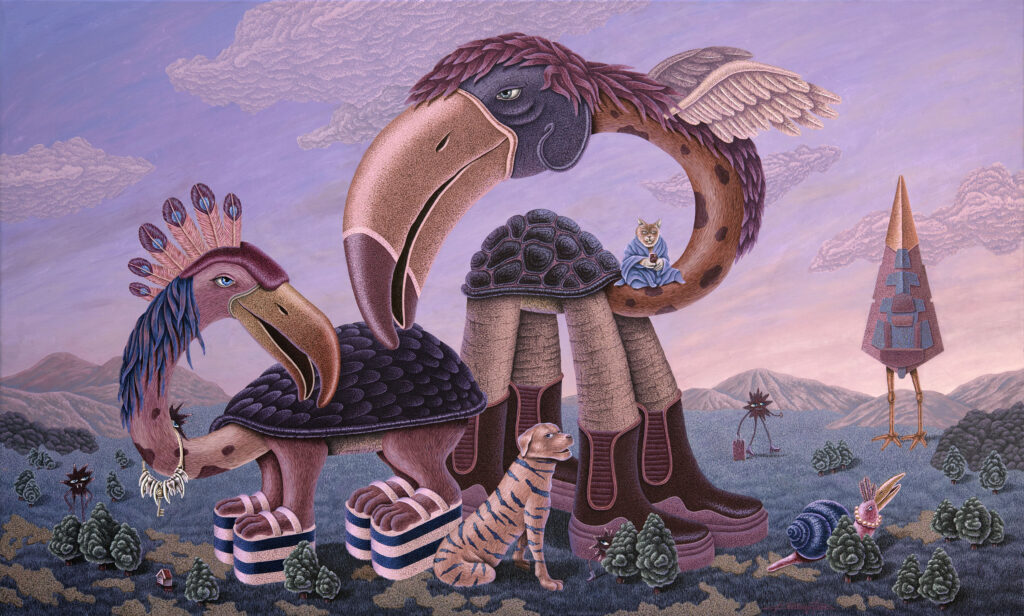
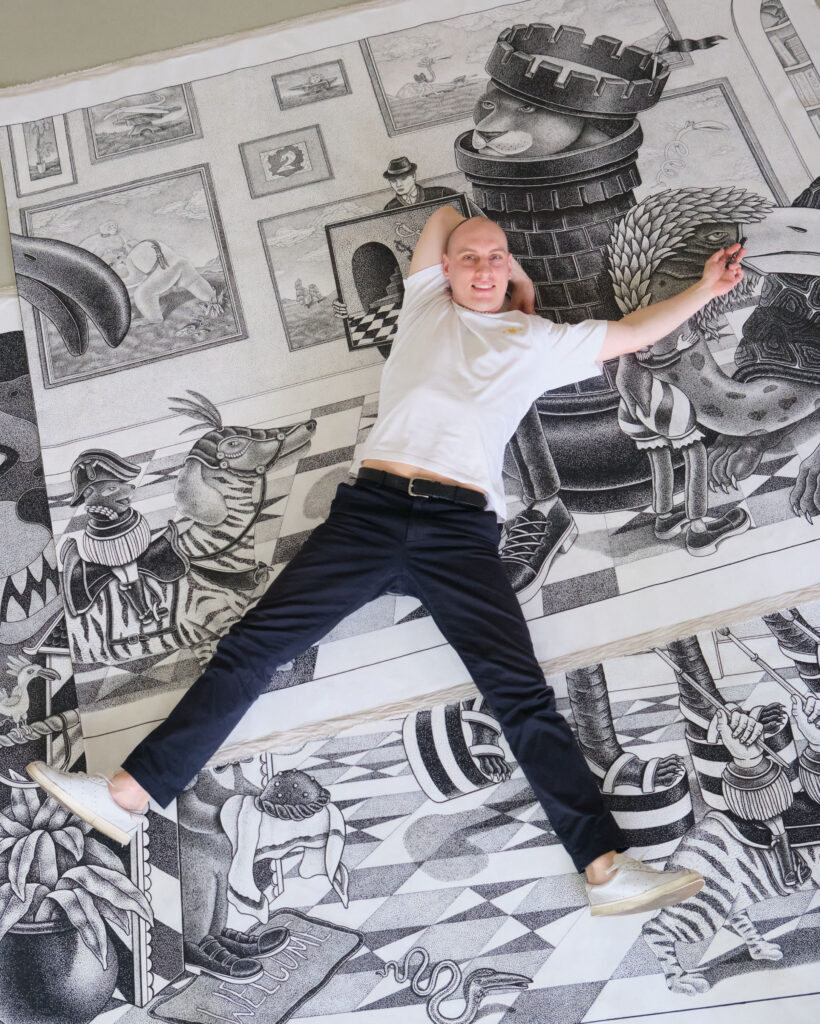
That energy never went away. It simply transformed. And what it has become is one of the most technically extraordinary and symbolically layered practices in contemporary art today. His signature is unmistakable. Dotwork, pointillism, and stippling thousands upon thousands of tiny marks built up into surfaces of such density and intricacy that viewers often stand in front of his work genuinely unable to understand how it was made.
He works in black and white and full colour, on paper and linen and walls, creating images that look familiar at first glance and reveal something entirely unexpected the longer you look.
Because that is what Dima does he takes ordinary objects and infuses them with symbolic weight, with hidden meaning, with layers of narrative that reward patience and curiosity in equal measure. His work does not explain itself. It invites you in and lets you find your own way through.
And the world has found its way in. From the streets of Belarus to solo exhibitions in Barcelona, Taipei, Wroclaw and Warsaw. From spray cans to collaborations with The New York Times, Lavazza, Harper’s Magazine, and Entertainment Weekly.
From local walls to the Royal Watercolour Society Open at Bankside Gallery in London, Art Rotterdam, Art Taipei, and festivals across Australia, Ireland, Spain, and beyond. It is a journey built entirely on the quality of the work and the conviction behind it. Nothing else.
And through all of it the graffiti walls and the gallery shows and the international commissions the same thing has always driven him. Honesty. A deep belief that creative work matters, that it carries responsibility, and that it should reflect something true.
Let’s get to know Dima through our conversation with him and discover the streets, the symbols, and the hidden worlds behind one of the most quietly extraordinary practices working today.
Q1. Dima, can you share how exploring different mediums led you to fine art?
The graffiti period, especially in the beginning, was driven by youthful excitement, enthusiasm, and an unstoppable urge to create. My main motivation was simply to do graffiti because I genuinely enjoyed it and it gave me pleasure. Years have passed, and my creative focus has shifted toward other forms of artistic expression, but that relentless energy to create has stayed with me. I still make my work because I sincerely love doing it, and I devote myself to it completely.
Another thing I would point out is that at the beginning of my graffiti journey (just like at the beginning of any technical or stylistic path for a creative person), I had very little knowledge and even fewer skills. So whenever I was making something – especially on walls with spray cans and other tools – I constantly had to improvise, learn, and push beyond my own limits. I also remember always wanting to make each new piece better than the last one.
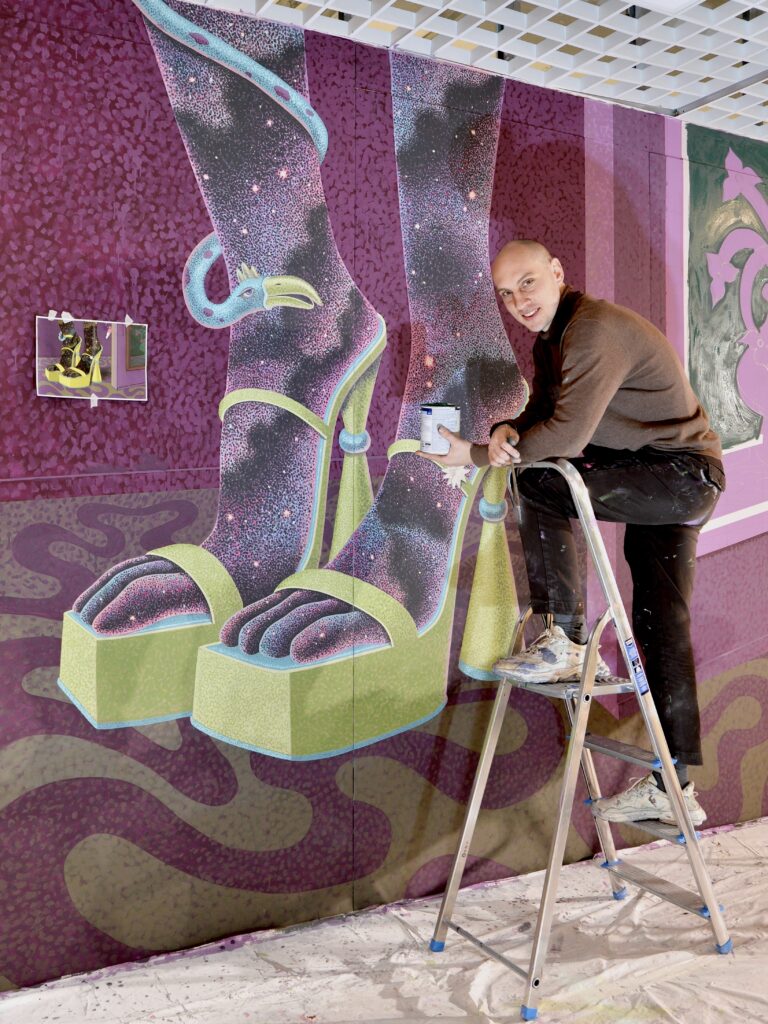
Those practical skills have stayed with me, shaped me, and continue to help me today. I still try to do better than I did yesterday, to come up with something new and more original compared to what I’ve done before. I’m also not afraid to step into unfamiliar technical territory when I haven’t done something before, because I know I can practice, learn and figure it out. Working on walls of different proportions and scales also expanded the boundaries of my imagination and changed my perception of what I could or couldn’t do, and what I might be capable of trying.
Because of that, I’m not afraid to take on a new project, an unconventional format, or a large-scale canvas or mural. I’m confident in myself and I’m not afraid of failure. I think graffiti, along with working on walls of different formats, in different conditions and states of repair, has helped me tremendously and made me more resilient when it comes to trial and error on the path of being an artist.
Q2. Your work is filled with symbols and hidden narratives. Why do you prefer expressing ideas indirectly?
That’s a difficult but interesting question. I think that, as a viewer and as a person, what matters most to me are the meaning, originality, and level of craftsmanship in the works I see, listen to, or experience in theater or cinema, for example. It’s hard to say exactly why I’ve always been more drawn to this richer, more layered way of expressing ideas, both in the work of other artists and in my own. I think this way of thinking and expressing myself started to take shape in my childhood and only grew stronger over the years.
I spent a lot of time in my imagination, making things up and creating a reality that felt brighter and more enjoyable than everyday life. So in the beginning, it wasn’t a deliberate attempt to communicate meanings or messages through hidden imagery. It was simply an endless flow of imagination, constantly reinterpreting ordinary objects, looking for sea turtles and dolphins in rain puddles, imagining that a paper clip wasn’t just a paper clip but an actual character, or that my bicycle was really a racing jeep with gear shifts.
I simply enjoyed discovering images in abstract things and blending different objects and ideas together. The next stage, I suppose, was the desire to express myself through those very images in my drawings. Gradually, it became interesting for me to communicate my thoughts and create a dialogue with the viewer. It just so happened that my mind had already developed in a certain way and naturally showed me how to approach it. It suggested that this way of expressing my thoughts felt the most authentic to me.
At some point, I also realized that other forms of expression simply wouldn’t work for me. I wouldn’t be able to use them with the same sincerity, either toward myself or toward the audience. It would feel as though I was imitating rather than speaking genuinely from the heart.
Q3. The same image keeps returning throughout your Floating Home series. What does this floating home represent to you?
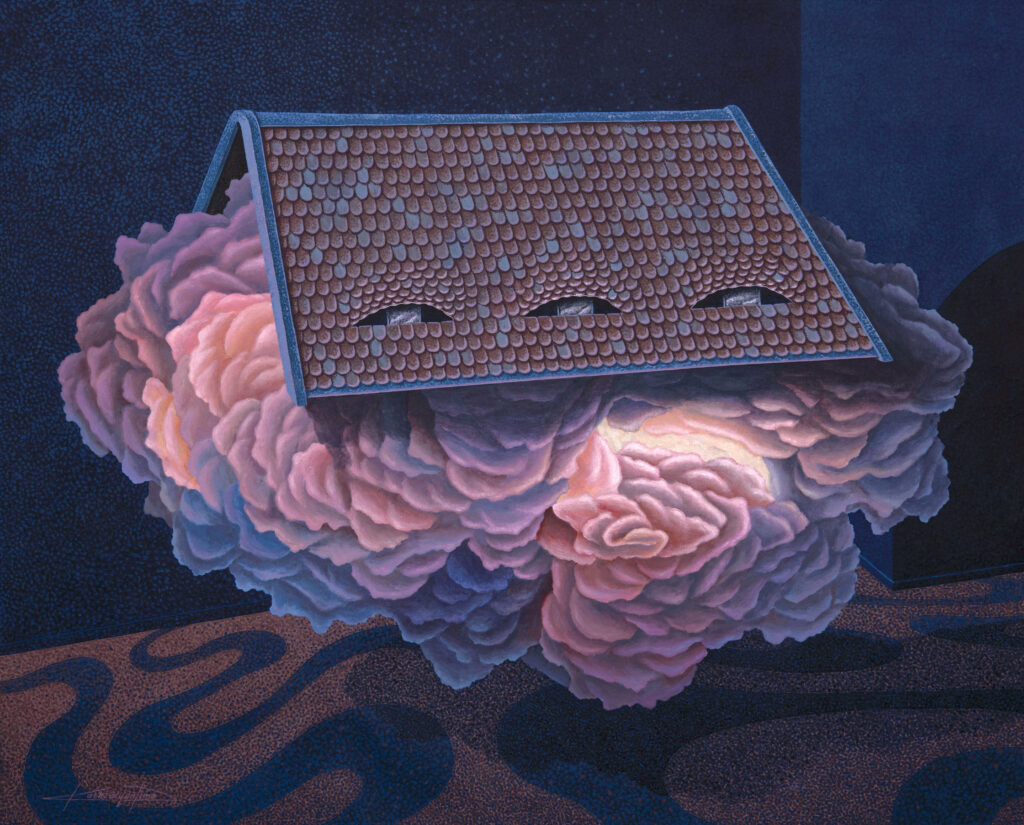
In this series, the house-cloud symbolizes and evokes important feelings that begin in early childhood. It represents the feeling of home, of something deeply familiar. It holds the comforting smells we associate with safety, memories of loved ones, meaningful places and objects, the scent of my grandmother’s attic in the countryside, the places where I grew up, fell in love, and walked barefoot through puddles after a summer rain. Over time, this house-cloud absorbs more and more of these important emotions and symbols, and they travel with us wherever we go.
For each person, this house may have a different architecture, because everyone has their own life path, their own collection of experiences, people, and places. Not every feeling or memory sheltered beneath its roof is pleasant, but they are all important. They stay with us throughout our lives and influence our choices and our state of mind. Through the cloud, I want to show that the feeling of home is not static – it moves and changes along with us.
The cloud seems so close, as if you could embrace it or wrap yourself in it, yet it remains out of reach, existing somewhere between the physical world and the world of emotions and memories. In today’s world, people often move from place to place, sometimes many times throughout their lives.
Sometimes these moves are forced and happen against their will. But the feelings that matter most, the places we remember, the people we carry with us, and our sense of home all move with us. My Flying Homes paintings are a deeply meaningful part of my artistic practice. I want to preserve them both on my canvases and within myself.
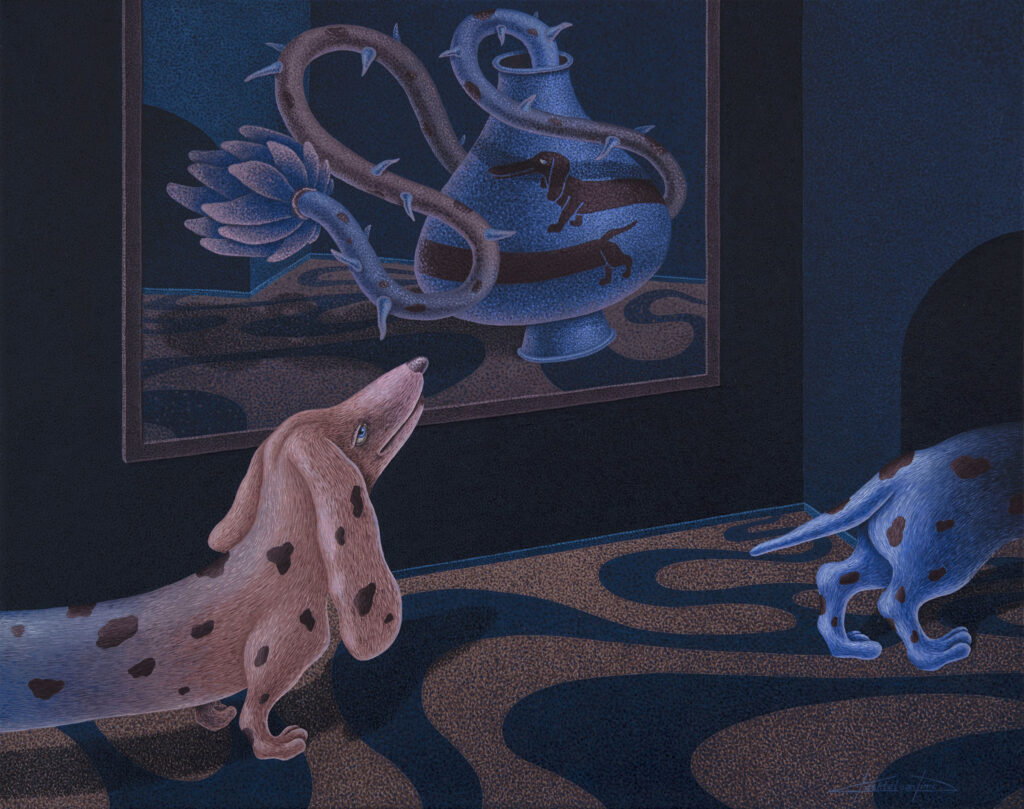
Q4. Caramel Dachshund in the Museum brings humour to work that also explores war and displacement. How do you balance the two?
That’s a good question, and I’m still trying to answer it for myself. It’s more difficult for me than it is for viewers to judge my own work, how serious it is, or how much humor it contains. I spend so much time looking at my paintings while creating them that my perspective becomes quite distorted. To be honest, though, I think my works are actually quite cheerful and kind, regardless of the subjects they touch upon. The people who follow and collect my art often confirm that.
I don’t think I want to bring raw, unfiltered pain into my work by literally depicting tanks bombing cities or other horrors. That simply doesn’t feel authentic to me as an artist, and it rarely inspires me as a viewer either. There is already an overwhelming amount of pain and suffering in real life, all around us. The constant pressure of the information space, combined with the logic of capturing people’s attention, tells us that the “hottest” topics and the most explicit pain attract the most attention.
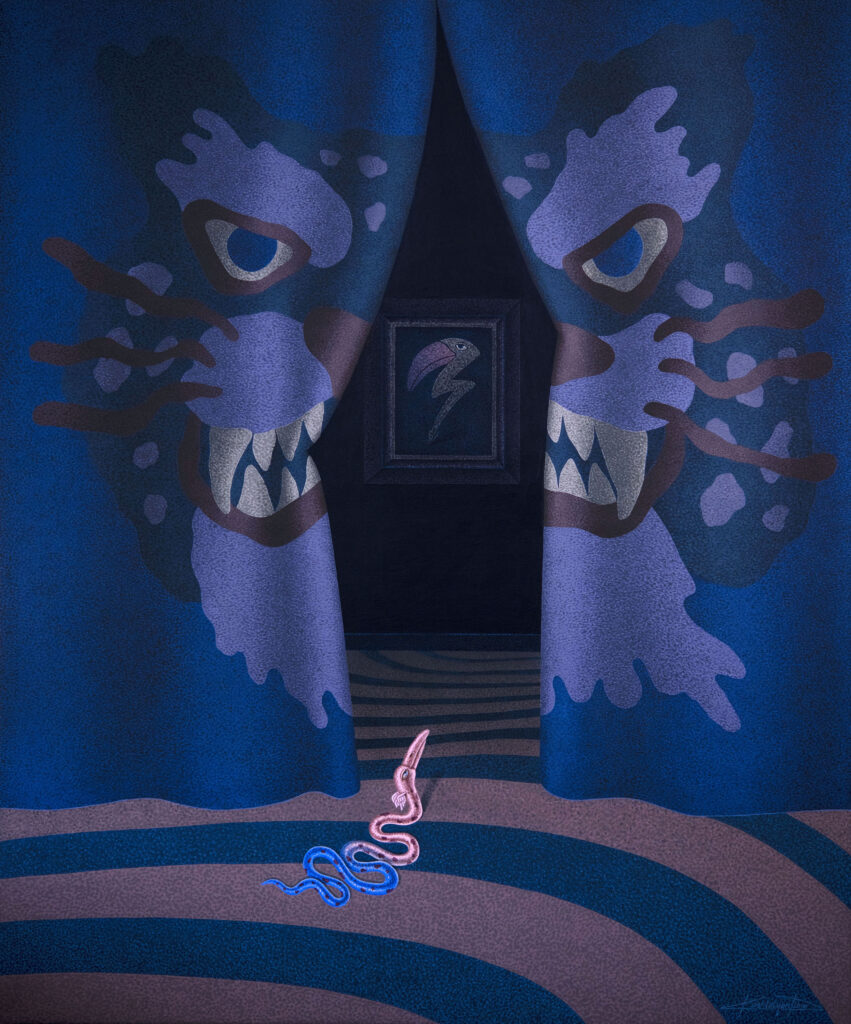
There is already so much of that, and I don’t feel the need to reproduce it in my paintings. Besides, I spend a great deal of time creating my work, and I wouldn’t want to spend all – or even most – of that time in an extremely serious state of mind. Fortunately, my glass is more often half full than half empty, even though my life has had, and continues to have, its difficult moments.
More literal imagery – such as a tank bombing an apartment building or a police officer beating a defenseless woman during a protest – is also, in my opinion, quite uninteresting from an artistic perspective. Those images already speak entirely for themselves. They have been created and recreated millions of times. Without taking a creative step to one side or the other in interpreting a situation, and without a touch of humor, tanks remain just tanks, and batons remain just batons. They carry no trace of the artist’s own voice, no new meanings or ideas. I think humor in life, in my work, and a sense of self-irony help me keep going. They help me move through difficult periods and come to terms with things that would be much harder to understand or endure without that perspective. At the same time, a little humor and a sense of lightness in art make it possible to step beyond the limits of our existing reality and look at ordinary things from a different angle.
Q5. Your work embraces incredible detail. What does detail allow you to express that simplicity cannot?
To be honest, I often have an internal dialogue about technique – about how labor-intensive my process is, how much detail is really necessary, and whether it’s possible to simplify my work without losing my identity as an artist. There was a time when I genuinely worried that if I stopped using dots – especially the graphic dot work combined with color in my full-color paintings – I would somehow stop being myself, and people would no longer recognize those works as being by Dima Kashtalyan. It took me time to realize that wasn’t true. I also feel the pressure of time.
In the era of social media and the ever-increasing speed of life and information, it often feels as though I’m constantly hearing the same message: as an artist, you need to be more efficient, you need to create new work faster – ideally a new piece every day – and to do that, you have to simplify your technique. I can feel how quickly audiences become saturated, and it sometimes seems as though they, too, are pushing artists to work faster while somehow continuing to surprise them every single time. Sometimes I do make simpler works. I create characters that are almost logo-like in their simplicity, and they occasionally appear as small elements within my larger compositions.
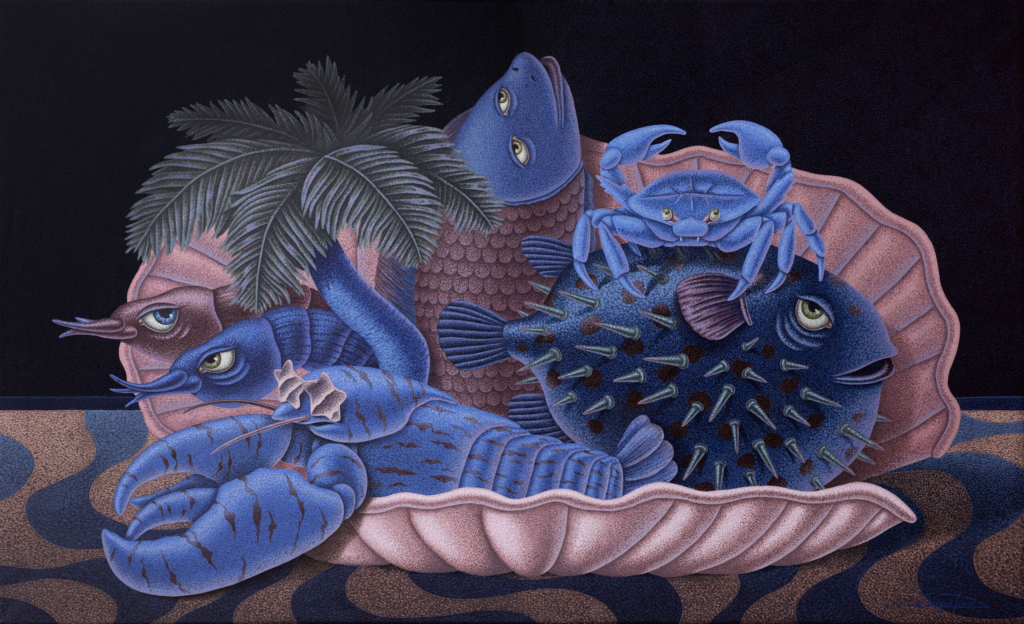
Warsaw. 2024
I genuinely enjoy making them. But even those pieces take me a long time because I create them so rarely, and I’m still trying to preserve my own character while making them look stylish – which is far more difficult than it seems. That’s why I rarely return to those experiments. Unfortunately, there simply isn’t enough time for everything. I would even say that I would love to have the talent – or perhaps the skill developed over many years – to convey character and emotion with just two or three lines, to create visually simple works that are still expressive, stylish, unmistakably personal, and carry a recognizable artistic voice.
But I don’t possess that ability. Creating simple work is easy; creating work that is truly original, distinctive, expressive, and personal while remaining simple is incredibly difficult. Working with a higher level of detail feels much more natural to me. I think, in part, I began working this way because I was deeply inspired by the final visual result. I would look at that vibrating, intricate surface and think, this is exactly what I love – I want to see work like this, and I want to create it. Later, I realized that viewers were responding to that aspect of my work as well. They often mention the sense of wonder it creates, and sometimes they simply can’t understand how it was made technically. In that sense, our perceptions aligned, and this approach became something that feels completely authentic to me. That’s why I continue to follow this technical path.
Q6. How do personal experiences and the world around you come together in your paintings?
To be honest, I don’t really focus on that. Before I start drawing, developing an idea, or working on a sketch, I’m not thinking, I hope this becomes a universal idea or a question that resonates with as many people as possible around the world. I simply continue following the same genuine passion for creating. I accumulate different thoughts and emotions – whether they come from my personal life or from my response to the world around me. Gradually, some of them reach the point where I feel they could become an interesting subject to explore, something I genuinely want to create and believe I can express well at that particular moment.
Only rarely do I feel an impulsive need to react immediately to something happening around me. And even more rarely do those impulses actually become finished works, because my process of creating original pieces requires a great deal of time for reflection and then for technical execution. By the time that process is complete, many things may have changed. The issue or question may no longer be relevant, or it may have evolved in a completely different direction.
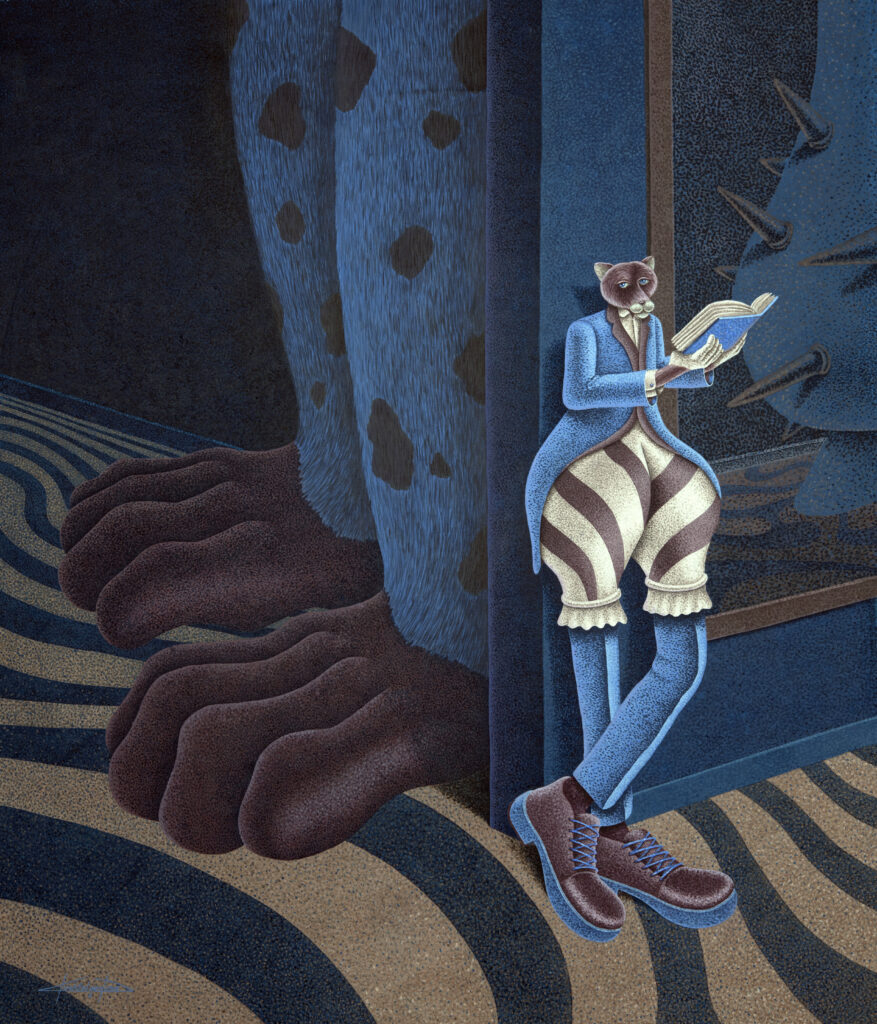
That’s why I don’t chase those kinds of ideas. Why do my paintings about personal experiences or current issues resonate with people from such different parts of the world? I think it’s because personal emotions are often surprisingly universal. The same is true for subjects such as war, inequality, the extinction of wildlife, and many others. These are not problems unique to one particular region – they affect, or at least concern, people everywhere. I should also admit that a long time ago I realized that I wanted to share my work with a broad audience and create a dialogue through it.
I wanted to be heard. I never wanted to be a local artist whose work only explores themes that are understandable to people from Belarus, where I come from. Perhaps that mindset came from my experience with graffiti, which has always been a language that people understand all over the world. There are some regional differences, of course, but overall it is an international culture and a universal visual language. It makes it remarkably easy to find like-minded people almost anywhere, even without speaking the local language. Over time, I naturally carried some of those principles into my own artistic language. As a result, my work often doesn’t require any special cultural vocabulary to be understood by viewers and art lovers from different countries and backgrounds.
Q7. How has social media changed the way artists share and audiences experience art?
To be honest, I try to think about social media the same way I think about electricity. By that I mean that social media has become an inseparable part of modern life. There are things I like about it and things I don’t, but I accept it and use it both as a person and as an artist. And honestly, I’m glad it exists and grateful for everything it has given me. Take electricity as an example. I use it every day. It makes life easier and provides so many useful things that have become almost indispensable.
Most of the time we don’t even think about it – we simply accept it as part of everyday life and use countless devices powered by it. At the same time, electricity can be dangerous. It can injure or even kill a person. Yet we continue to use it with gratitude and are happy that it exists, even if we rarely think about it. And when electricity was first becoming part of everyday life, many people were terrified of it. They feared losing their jobs or their familiar way of life. Some may even have believed it was the work of the devil or something similar. I think the same analogy applies to social media.
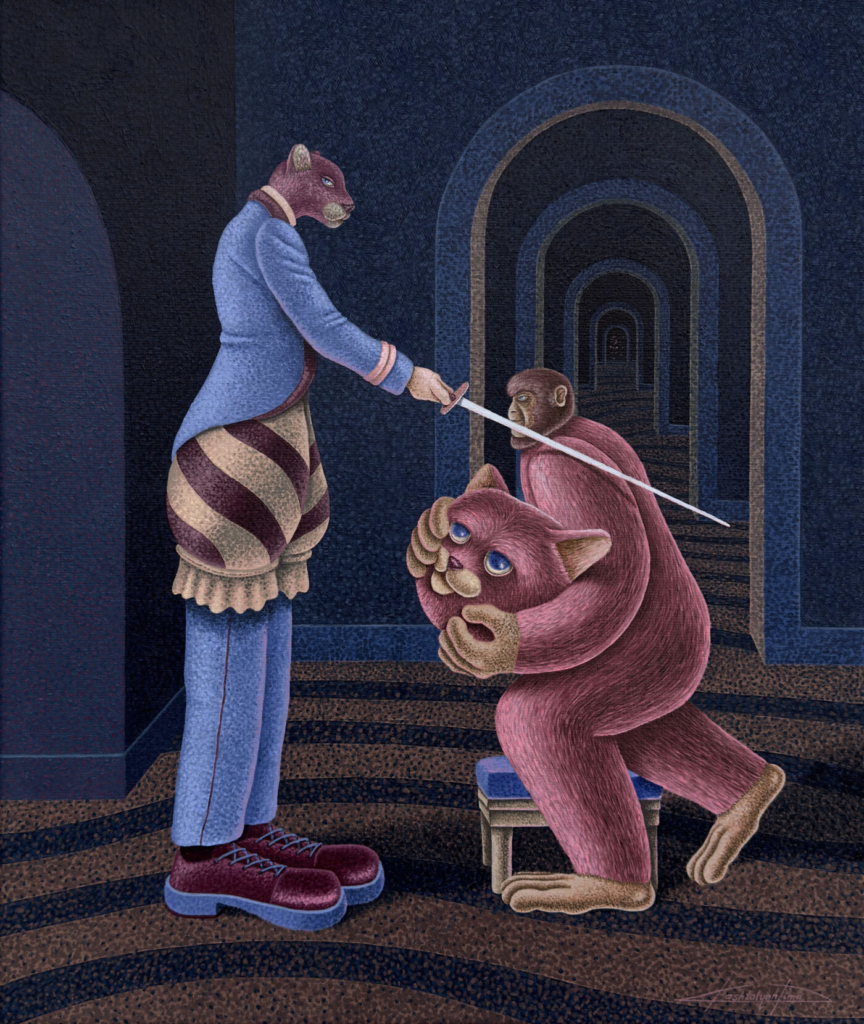
Original size: 50 x 60 cm. Materials: acrylic on linen. 2026
It has many dark sides and many aspects that negatively affect people’s lives, including the lives of artists. The important thing is to find a balance – not to become its prisoner and not to believe in the illusion that social media alone will turn you into an artist with a million followers, that you’re somehow destined to become “the one.”
For me personally, social media is an important and extremely useful professional tool. It allows me to share my thoughts and my work, to be more visible, to build new connections, and to communicate quickly. I certainly wouldn’t want to go back to exchanging paper letters through the mail. So for me, social media is unquestionably a positive thing.
Q8. Looking back at your graffiti days, what would surprise your younger self most about the artist you are today?
In the context of this interview, the first thing that would surprise my younger self is that I’m giving interviews like this one, and to other international media, as an artist. It would also surprise him that other people are reading my thoughts and answers and are genuinely interested in them. When I was younger, I never thought about anything like that, and I certainly never dreamed in that direction. The second thing would be the amount of progress I’ve made in my work through years of persistence, reflection, self-criticism, and constant searching.
I think that if someone had shown my current work to my sixteen or eighteen-year-old self – my large-scale, highly detailed graphic pieces that I’ve learned to create – I would have been genuinely impressed. I would probably have thought, Wow, the artist who made these draws so well. I wish I could get even a little closer to that level someday. This may sound immodest, but I truly believe I’ve made significant progress as an artist, and that’s also how my younger self would have seen it, given the perspective, experience, and knowledge I had at that age. In reality, many things would surprise me.
I would be amazed that I now communicate with and am friends with professional artists from all over the world. Some of them once seemed completely out of reach to me – I admired their work and was inspired by it. And then, somehow, everything changed. They began following my work, enjoying it, talking with me, meeting in person, and even collaborating on the same projects.
I would also be surprised that art managers and art directors from major brands and publications reach out to me.
That an art director from The New York Times might write to say they like my style and want me to illustrate one of their articles. I would be amazed that people I’ve never met, living on another continent, enjoy my work so much that they frame and hang a magazine page featuring one of my illustrations in their homes. And I would be deeply moved to know that my work has inspired people for years, and that later it even inspires some of their children, who decide to pursue creativity themselves and enroll in art school.
As our conversation with Dima drew to a close, we kept coming back to one thought. That the work which finds you years later the piece you bought and still stop in front of, the image that keeps giving you something new was almost never made quickly. It was made by someone who believed the idea deserved more than a first instinct.
And in an art world that does not value that nearly enough, Dima is doing something quietly radical. He is making work that withholds. That asks you to slow down. That puts meaning inside meaning inside meaning and trusts that the person standing in front of it will stay long enough to find it.
Not because it demands attention with spectacle or shock or anything loud. But because it earns it. Because the longer you look, the more it gives back. Because there is always something else another symbol, another layer, another ordinary object that turns out to be something far more than it first appeared.
That is extraordinarily difficult to achieve. Most artists who try to build that kind of depth produce work that feels heavy or inaccessible. Dima’s work never feels any of those things. It is warm. It has humour. It carries genuine feeling underneath all the intricacy.
And that combination of technical mastery and emotional honesty, of complexity and warmth is what gives his practice its particular and completely unmistakable quality.
For those who collect work they genuinely want to live with work that is still giving them something new six months after they brought it home, that catches them differently on different days, that earns its place on a wall every single morning Dima’s paintings are exactly that. The kind built to last. The kind that reward the patient eye for as long as it keeps looking.
Follow Dima Kashtalyan through the links below and spend some time with his world. We promise it will keep showing you something new.