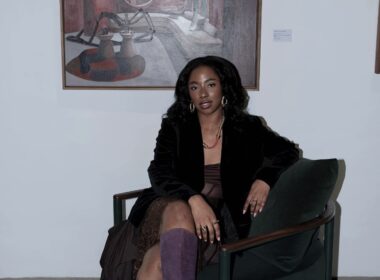

Can a painting carry the voices of our ancestors?

👁 141 Views

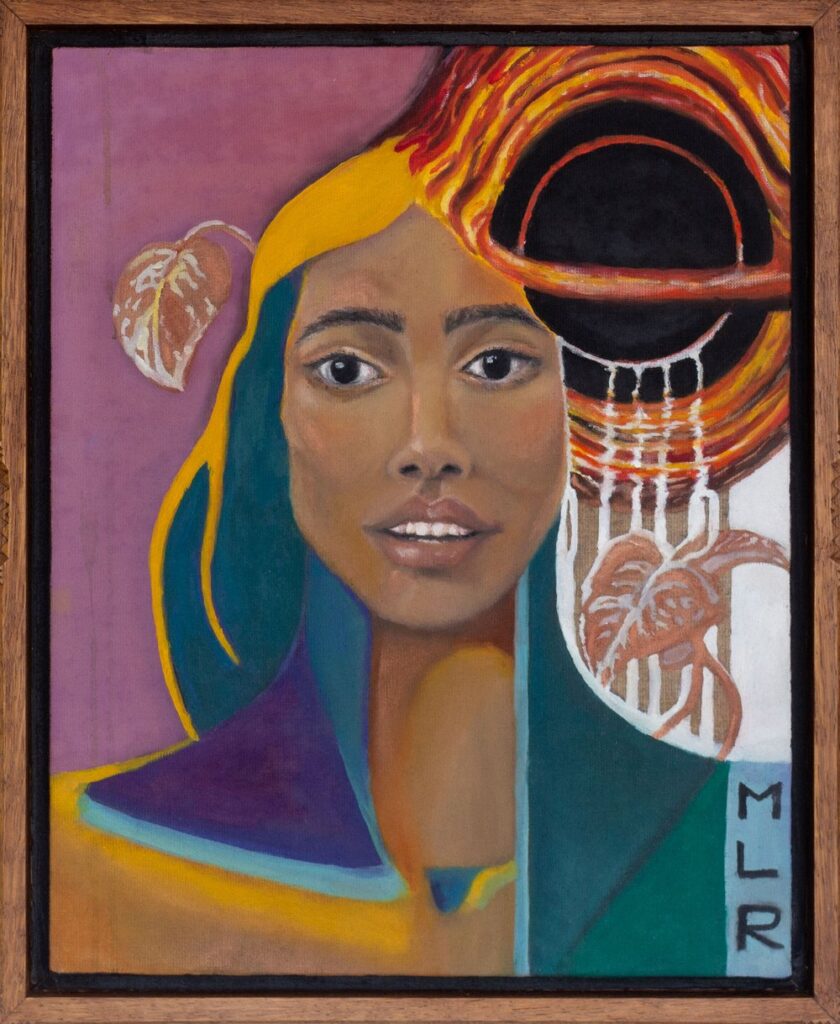
In this conversation, Jamaican artist Melissa Lyn invites us into a world where heritage, history, and faith intersect to form something larger than individual identity. Her portraits, rich in symbolism and historical dialogue, move between ancestral memory and present realities, offering a way of seeing that is both grounded in research and guided by intuition.
Melissa speaks about how meeting her father from Ghana redefined her understanding of self and reshaped her artistic purpose. Through her series Reimagining Ancestors, she explores how stories once fragmented by colonialism can be pieced together again through art. Her portraits don’t simply retell history; they question what we’ve been taught to believe, reconfiguring narratives of African and Caribbean identity that were once silenced or distorted.
In this interview, she shares how biblical references, African cosmology, and her fascination with time, transformation, and symbolism inform her creative process. From her award-winning work, Reimagining Nanny: Avatar Erzulie, to her reflections on Christ as a celestial being, Melissa unpacks how ancestral knowledge, spirituality, and scholarship coexist in her studio practice.
What stands out most is her commitment to truth, not the kind written in textbooks, but the living truth found in stories, symbols, and the people who carry them. She speaks candidly about finding direction beyond formal education, the importance of understanding the business of art, and how learning about one’s lineage can awaken a sense of purpose.
Through her words, we don’t just meet an artist , we encounter a seeker tracing the invisible threads that link generations. This conversation reminds us how rediscovering where we come from can become a lifelong creative act.
Melissa Lyn is a featured artist in our book, “Art and Woman 2025” You can explore her journey and the stories of other artists by purchasing the book here:
https://shop.artstoheartsproject.com/products/art-and-woman-edition-

Melissa Lyn is a Jamaican Visual Artist blending history and symbolism in bold, stylised portraits. Her work, inspired by African heritage and the Bible, reimagines ancestors and their descendants, transcending time. Melissa’s creative journey began in 1998, when she was a longstanding member of her junior school choir, participating in several JCDC Festival Folk & Gospel song competitions. Transitioning into high school, Melissa entered several art competitions and received tremendous support from her school community to pursue art as a career. In 2012, she furthered her studies at The Edna Manley College of Visual Arts and Design, where she majored in Illustration and minored in Ceramics.
At age 18, Melissa was reunited with her father, who is from Kwahu, Ghana. The experience shifted Melissa’s approach to creating art to discover the truth about her identity. “When I look at the faces of my ancestors and those of the people in my everyday life, I see biological numeric algorithms. People are spiritual creation concepts, and each person adapts to their time. Etymologically, all these identities, African, Negro, Caribbean, etc, prove historically that we are the same people who broke up into various tribes. The traditions and customs based on historical influences may be different, but without a doubt or contradiction, we are who our ancestors were.” In 2022, Melissa received 3 Gold medals and the Best Artist award in the category of Drawing at the JCDC Visual Arts Competition.
Her works earned multiple local and international features such as The Sky Gallery Jamaica (2023), The Jamaica Gleaner (2018), Artly Mix Cultural Space Brazil (2023), Mango Seed Collective Journal (2025) and Art & Woman Book Edition 2 (2025). Melissa’s studio project Reimagining Nanny appeared in the National Gallery of Jamaica’s Face of Us catalogue. Melissa is a Tour Guide at Kingston Creative, a non-profit organisation that fosters a vibrant creative ecosystem through the revitalisation of Downtown Kingston.

1. Your portraits often bring historical and biblical figures into a modern space. How do you choose which ancestors or stories to bring forward in your work?
I definitely believe the past has influenced the present. I have a few elders that I consult when I need to clarify any confusion or doubts about time-transcending correlations. I’m grateful to have such a circle of friends. The company of older folk is an invaluable treasure. My choices are fluidly guided when it comes to selecting what is featured in my portraits. Whatever subject of interest I’m researching at the moment, or any discourse that challenges my perspective, will naturally inspire the pieces I create. In 2023, while I was studying the book of Ephesians, I came across a video on ancient Sumeria and found two archival photographs of a stone tablet that were curiously interesting.The “Wakanda Forever” movie trailer had just been released, and while I was watching it, I recalled glimpsing a temple painting of Kukulkan, the feathered serpent god of the Aztecs. As I delved deeper into the visuals I’d come across, more puzzle pieces started to appear.
One day, my friend and I were discussing time travel, and I brought up the topic of shapeshifting, which eventually led us to challenge the possibility of Jesus Christ being a hybrid. My friend referred to two primary scriptures, Ezekiel 1:5-11, which describes the prophet Ezekiel’s visions of angels and Luke 24:12-16, which describes the disciple Peter’s journey to Emmaus shortly after Jesus’s crucifixion and burial.
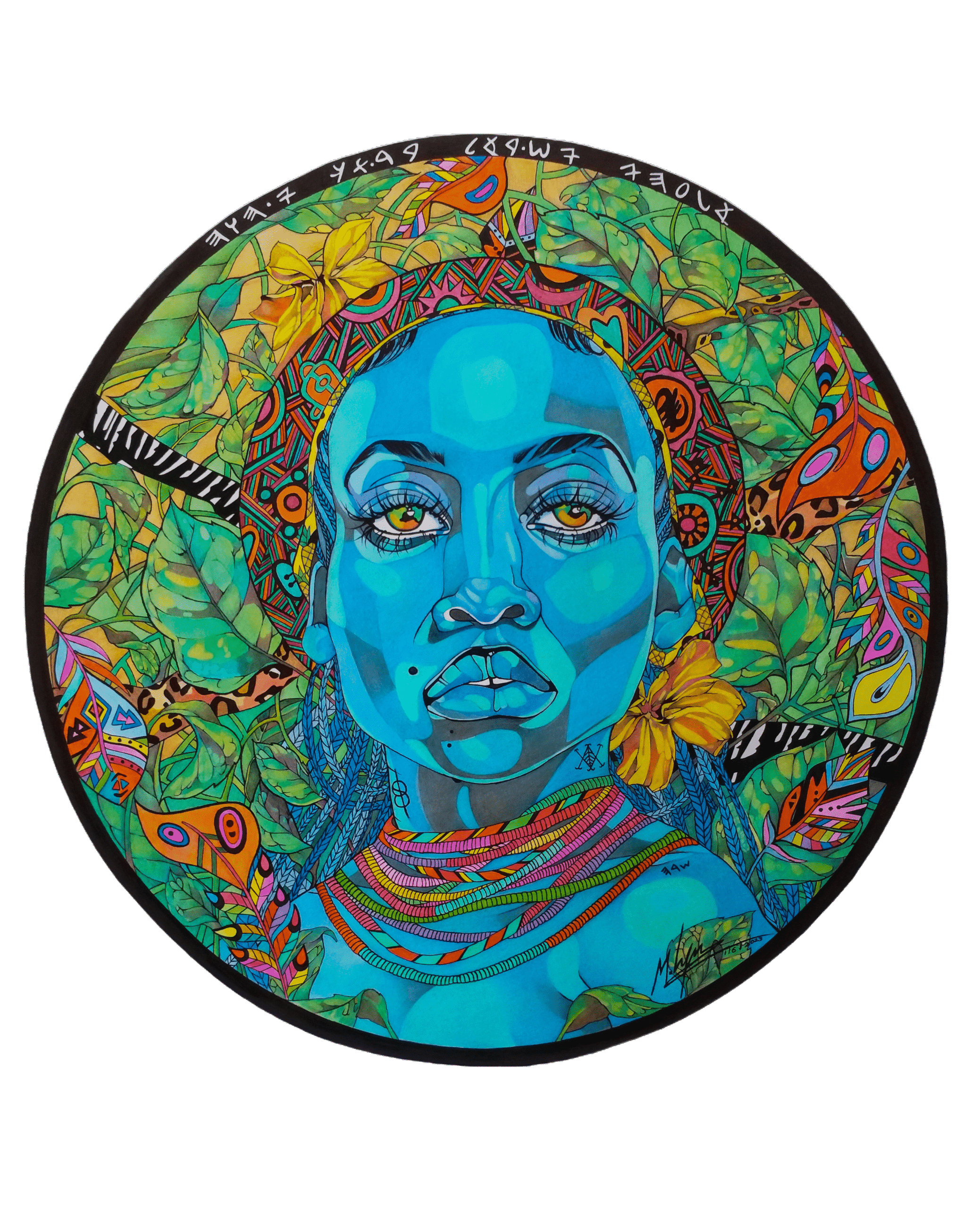
It was said that a man drew near to Peter and some others who were discussing Jesus’s missing body from the tomb. No one was able to identify that the man who stood nearby them was actually Jesus himself. At that moment, everything began to make sense to me. I started to analyse how other religions depicted Jesus Christ including how some deities in other cultures make direct reference to Christ’s superhuman abilities. I was inspired a month later to create the Reimagining Christ project. However, to avoid controversies, as most Jamaicans are colonially religous, I portrayed Christ as a blue skinned child, to symbolize His metamorphism. I added a few symbols to the piece that hold subliminal messages, which therefore would raise questions and eventually open up the conversation about who Christ really was; a celestial deity in human form with rare super intelligence and capabilities, possessing a pure, gentle spirit.
Once I’ve fully understood the lessons behind historical experiences and the way it has shaped the relationships between the different peoples involved, then and now, I am in a better position to apply truthfully what I’ve learnt to other situations, as well as in my art. Currently in the studio, I’m focused on reimagining ancestors and their descendants and how they have crossed paths through time. So far, in addition to Christ, I’ve created Nanny and look forward to completing Cudjoe, a much larger piece,
There’s empowerment and liberation that comes with understanding your identity in life. I want people to feel that through my art.
Melissa Lyn
2. A lot of your pieces challenge the way African and Caribbean identities have been portrayed over time. What do you hope people start to see or question when they experience your work?
The “proverb and byword” narratives in colonial discourse by people of African descent towards each other, has resulted in Negroes all over the globe to assimilate into segregation; thus severing ties between powerful nations of people who were once a unified, indomitable force. This traumatic conditioning of the mind has created taboos, mass hysteria and even structural violence and discrimination, especially towards indigenous groups of Negroes. It has unfortunately resulted in a malicious misrepresentation of African identities, whereby such peoples have become the victims of perpetual genocides, rape, poverty, cultural appropriations, natural resource wars, replacement and displacement theology.
In an assiduous effort, I created this series of reimagining ancestors to share with my audience the truths about ancestral groups, by way of symbols. So far the symbols have helped to arouse curiosity and foster a discussion. It’s a strategic way for me to accommodate the bulk of information and thought process behind creating the pieces. I retell history through pop culture visual expressions that are appealing to younger audiences, as the mission is to educate and empower the future generations. There is a healthy sense of worth that comes with knowing the indomitable legacy of an ancestral bloodline that is carried deep within one’s DNA.
I’d appreciate more broader discussions and increased networking opportunities that is geared towards strengthening African identity. I’m passionate about using my work as a step in that direction to help guide myself and hopefully others who are on a path to discovering their roots, identity, and purpose.

3. In “Reimagining Nanny: Avatar Erzulie,” you connect two powerful women from different cultures. What inspired you to link their stories together?
Nanny used her skills based on folk and religious West African practices to conduct successful raids that contributed to the escape of 1000 slaves. As a herbal connoisseur, Nanny’s expertise in mixing different herbs to create medicines including poisons, were defense tactics and health aid utilized by Maroon soldiers during their battles with the British. Seeing that Nanny preserved these practices, I was curious to find out the origins. I wondered why it was important to Nanny to have included these practices along her journey to becoming the woman she is known for today. While conducting a series of epistemology studies, one strikingly similar character I was able to identify with Nanny was Grande Ayizan, a Haitain loa (spirit).
Ayizan is an important ancestor, connecting spiritual knowledge with the Earth and the lineage of priestesses. This discovery also led me to study more about the lives of Haitain women and their role in developing Haitain culture, which I unfortunately find that most people misinterpret out of fear. Women play a key role in environmental protection and socio-economic development. They are often the guardians of biodiversity, keepers of traditional knowledge, custodians of local culture and experts in traditional medicine. Nanny was definately guided by the spirit of Ayizan, and Nanny’s spirit guides those Caribbean grandmothers and mothers in passing down the knowledge and customs of traditional medicine to present and future generations.
To not embodiy that spirit of preservation, would lead to health and access disparities, removing low costs healthcare options for the marginalized, reducing the ability to provide holistic care as well as limiting future scientific research and drug discovery.
4. Leaving college and finding your own direction must have been a big turning point. How did that experience shape the way you approach your creative path today?
Yes it was. Sound knowledge in finding direction leads to making conscious decisions based on a healthy sense of worth, which is crucial in every area of your life. Due to adverse circumstances, I opted not to pursue further formal acaedemic training in art in order to explore art as a viable career. Most people underestimate creatives in business and as such they are often subject to abuse. At this point in my journey, I have prioritized learning to be mentally competent in entering various contractual agreements, familiarizing myself with intellectual property and commercial laws as well as developing new skills in adapting to modern technology to maximize achievable goals.
I’m very disappointed that the business of art is not taught extensively in schools, and I’ve only come to see art institutions celebrate the few that have succeeded, while neglecting the broader challenges faced by majority of graduates. There is a lack of guidance on essential practical skills, and I needed answers, so I embarked on my own initiative to build a professional network, which is crucial if I want to attain wealth in the real world doing what I really love the most. I also navigate this life by fulfilling obligations that do not trespass on my beliefs, morals and principles.
I’m not intimidated by the criticisms of others who think that constantly being in the spotlight, doing what everybody else does defines success. I am comfortable in my own energy and enjoy success without having to negatively compromise and sabotage my integrity. I’m satisfied with where I am in every stage of my life and I have no regrets. I had to put in the work and understand myself first, so I could deservingly manifest this interview and all other blessings.

People are spiritual creation concepts, and each person adapts to their time.
Melissa Lyn
5. Your spiritual journey has clearly influenced your worldview. In what ways has that understanding of faith and history guided how you build your visual narratives?
I no longer align myself with any religion, and I find that since I have been doing that, my mind is open to understanding the world more, not limiting myself and learning intrinsically about my creativity. As a child growing up, I was familiar with my Asian Jamaican heritage, because I grew up with my mother’s side of the family. I never had any knowledge of my father, and I felt like something was missing from me. Out of ignorance, I associated people of African descent with slavery, mass violence and other negative connotations, depicted by society. I used to question those negative feelings a teenager while attending high school and also while accompanying my Christian family and friends visiting different denominations of churches. Often these occasions of asking questions left me with hardly any reasonable answers or it resulted in vain arguments and controversies. When I met my dad 15 years ago, I became aware of my African roots which stemmed from Ghana. Our conversations drove me to do more research on my Ghanaian background. The deeper I got into this rich history, I started to feel more whole. This continuous research answered a lot of the questions I had. Society in all its glory and amusement has been built from the blood, sweat, tears and intelligence of Arican Negroes. The Bible is a valid reference to that history and I am up for the challenge in refuting that. Most people of African heritage have very little to no knowledge of their true identity. Many African Tribes’ cultures are identical to that of the Biblical Hebrews, for e.g.: Congo, Zulu, Ewe, Ashanti, Yoruba, Shona, etc. African languages can be traced back to Ancient Bantu Hebrew, for e.g.: Swahili, Ndebele, Kikongo, Tswana etc. I’m trying to let people know and become more aware of that, by means of conversation and in some sense, through my art.

6. You started out singing in choirs and later earned national awards for your drawings. What keeps you inspired to keep learning, creating, and telling new stories through your art?
The priveledge to wake up each day and embrace life, will keep me inspired and encouraged to create and learn more, for as long as I live. I understood in later years why God directed me on this path to become an artist. Certain experiences became existent so that I could have a better understanding of Him, what He requires, the reasons for the whys and hows of life as well as fulfilling His purpose for my life. Everything I do, in some sense, surrounds the creative space. If I try to divert, either by thought or action, I feel shallow. I realize the more I learn, the less I know. Growing up I was criticized for asking questions. There are many people out there unhappy because they are forced into decisions as a result of generational conformities, rather than knowing the truth for themselves. I remember being in that dark place. There’s empowerment and liberation that comes with understanding your identity in life. I want people to feel that, through my art!
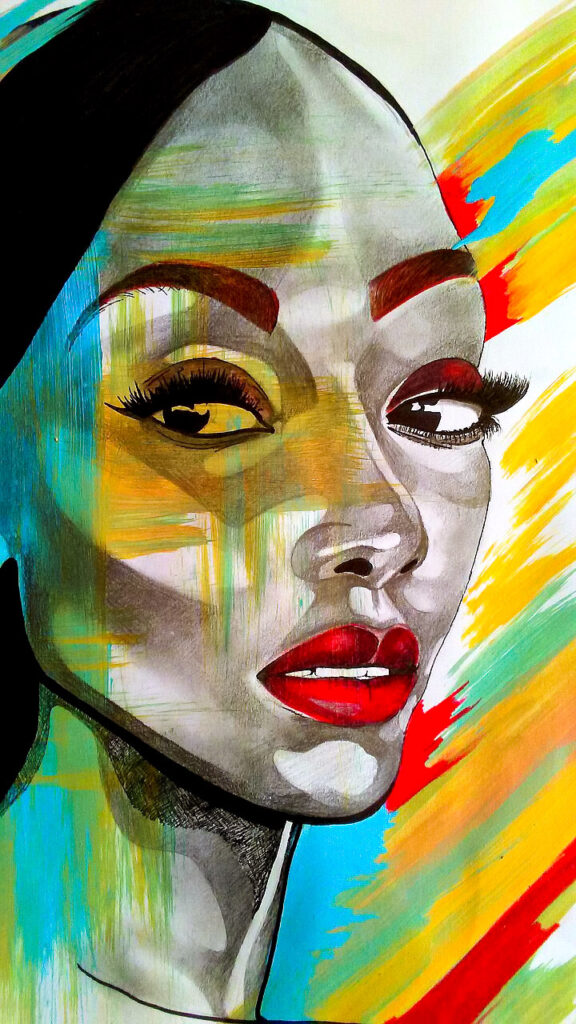
Through her work, Melissa Lyn brings the past into conversation with the present. Her portraits move beyond likeness; they are visual research projects, each filled with symbols that speak to ancestry, migration, and spiritual lineage. By linking biblical narratives, African heritage, and Caribbean identity, she encourages her audience to look closer at the histories often left untold.
Melissa’s journey teaches us that art can be a means of discovery. Her story is not simply about creating images but about piecing together a fragmented heritage and turning it into a dialogue that crosses time and culture. She reminds us that understanding who we are often begins with asking who came before us—and that those answers live not only in books but in the imagination, in conversation, and in the act of creation itself.
To learn more about Melissa, click the following links to visit her profile.
Arts to Hearts Project is a global media, publishing, and education company for
Artists & Creatives. where an international audience will see your work of art patrons, collectors, gallerists, and fellow artists. Access exclusive publishing opportunities and over 1,000 resources to grow your career and connect with like-minded creatives worldwide. Click here to learn about our open calls.