

8 Paintings That Capture the Quiet Beauty of Melancholy
Some emotions don’t ask to be seen. They come in quietly, settle down beside us, and leave just as quietly. Melancholy is one of them. There is no sharp sting of grief, no crushing weight of despair. It’s that feeling you get after a meaningful goodbye, after everyone has gone and there’s only the silence of an empty room, the comfort and pain of rereading an old letter, or the strange nostalgia for a moment you know you can never return to. Perhaps that’s why artists have spent centuries exploring the beauty of melancholy, finding grace in emotions that are often difficult to put into words.
Artists have been trying to capture this quiet complexity for centuries. They have painted people looking through windows, walking snowy streets, sitting alone on late-night trains, or simply lost in their thoughts. These scenes don’t always tell us exactly what is wrong. They don’t have to. Instead, they invite us to fill the silence with our own memories, questions, and emotions. Perhaps that’s why they continue to move us long after they were created.
Melancholy has always had a special place in art history. These works don’t live in dramatic scenes of tragedy or celebration. They thrive in subtlety. A lowered gaze, an empty chair, a dimly lit room, or the space between two people can speak more than an elaborate narrative ever could. They remind us that being alone isn’t always the same as being lonely, and sadness isn’t always something we need to escape. Sometimes, these quieter emotions help us understand ourselves a little better.
The paintings on this list span centuries, countries, and artistic movements, but they are united by something deeply human. Some explore missing someone who is no longer here. Others reflect on solitude, memory, quiet contemplation, or the loneliness that can exist even in the middle of a crowded city. Together, they show that melancholy is more than sadness. It’s about pausing long enough to notice the emotions we usually carry in silence.
If you’ve ever experienced these feelings yourself, or simply appreciate art that whispers instead of shouts, these eight artworks are a gentle reminder that the beauty of melancholy lies not in sadness itself, but in its ability to connect us through shared human experiences. They ask only that we look, that we feel, and perhaps, that we recognize a small part of ourselves within them.
1. John Everett Millais’ Ophelia

Some paintings ask for a close look. Ophelia says you should take it slow.
Shakespeare’s tragic heroine in serene float among wildflowers. The water is barely moved around her, the trees are still above her head, and for a moment it’s hard to remember that you’re looking at one of literature’s most heartbreaking endings. It is that subtle tension between beauty and tragedy that has made Ophelia one of the most enduring images in the history of art.
John Everett Millais’ masterpiece, painted between 1851 and 1852, is based on William Shakespeare’s Hamlet. Millais did not illustrate the drama of Ophelia’s death, but painted the haunting stillness around it. Instead of panic we see surrender. But we don’t see violence, we see nature lovingly hold her. Millais spent months painting the riverbank from life with great care, populating it with flowers chosen for their symbolic meanings: violets for faithfulness, poppies for death, daisies for innocence, and forget-me-nots for remembrance. Every detail adds to the silent poetry of the moment.
It’s not just the tragic tale that keeps Ophelia in motion. It’s the way the painting communicates the strange calm that can come with great sadness. Many of us know what it feels like to hold emotions that never fully show themselves to the world. Millais puts a face to that feeling. More than 150 years later, Ophelia teaches us that melancholy isn’t always loud. Sometimes it creeps in quietly, lovely enough to make us pause and true enough to make us feel seen.
2. Saudade, Almeida Júnior

All our feelings we cannot express in words. “Saudade,” in Portuguese, is the feeling of a deep yearning for someone or something that is absent, inaccessible, or out of reach. It’s a mixture of love, absence, nostalgia, and hope all at once. It’s a bittersweet feeling that is both comforting and painful. Almeida Júnior’s Saudade has a face for that feeling.”
Painted in 1899, the work depicts a woman standing quietly in her home, holding a letter close to her chest. Her eyes are lowered, her expression restrained, and the room around her is almost bare. If you look closely, her dark clothing has often been interpreted as mourning attire, hinting that the letter may carry the weight of a personal loss. Yet Júnior never confirms the story. We don’t know who wrote the letter or why she returns to it. That uncertainty is what gives the painting its lasting power. Instead of providing answers, he leaves space for us to bring our own memories and emotions into the scene.
He was an artist known as one of Brazil’s most celebrated painters, known for his remarkable honesty in depicting everyday life. Here, he shows that deep feelings don’t always require big gestures. A piece of paper, a bare room, a lonely thoughtful figure, and you have a story that seems universal. The painting shifts focus from one woman’s memories to the quiet moments we all experience when the past unexpectedly finds its way back into the present.
Perhaps this is why Saudade still resonates over a hundred years later. Most of us have held onto a photograph, re-read an old message, or encountered an object that instantly transported us to another time. These memories seldom wait for an invitation. They just show up, bringing back people we’ve loved, places we’ve left, or versions of ourselves we’ve outgrown. Saudade doesn’t demand we let go of those feelings. Instead, it quietly insinuates that longing is a part of love and that some memories are dear because they can never be lived again.
3. A Prisoner in His Cell by Nikolai Yaroshenko

Sometimes when we’re stuck, hope doesn’t disappear. It simply becomes smaller.
In A Prisoner in His Cell, Russian painter Nikolai Yaroshenko invites us into a sparse room where a solitary man sits surrounded by bare walls and heavy silence. There is little to distract the eye: a simple bed, a table, and a small window that lets in a sliver of light. It’s a scene stripped of comfort, yet it never feels entirely without hope. That tiny window quietly changes everything.
Painted in the late nineteenth century, the work reflects Yaroshenko’s remarkable ability to capture the emotional depth of everyday life. Rather than focusing on a dramatic narrative, he invites us to pause with a single figure caught in a moment of waiting. We aren’t told what brought the man here or how long he has been confined. Instead, the painting shifts our attention to something far more universal: what it feels like to wait, to wonder, and to hold onto hope when the future is uncertain.
The painting’s greatest strength lies in what it leaves unsaid. The prison walls can certainly be read as physical barriers, but they also speak to the invisible prisons many of us experience throughout our lives. Grief, regret, loneliness, anxiety, or circumstances beyond our control can make even familiar places feel confining. Like Yaroshenko’s prisoner, we often find ourselves searching for the smallest glimpse of possibility, a conversation, a memory, or a quiet moment that reminds us life extends beyond the walls we’ve built or inherited.
More than a century after it was painted, A Prisoner in His Cell continues to feel remarkably relevant. It reminds us that resilience isn’t always dramatic. Sometimes it looks like choosing to face another day. Sometimes it means lifting your eyes toward the light, even when it seems impossibly far away. In that quiet act of looking outward, Yaroshenko finds not only melancholy but also one of humanity’s most enduring qualities: the quiet refusal to give up hope.
4. Alexander Egorov On the Bell Tower
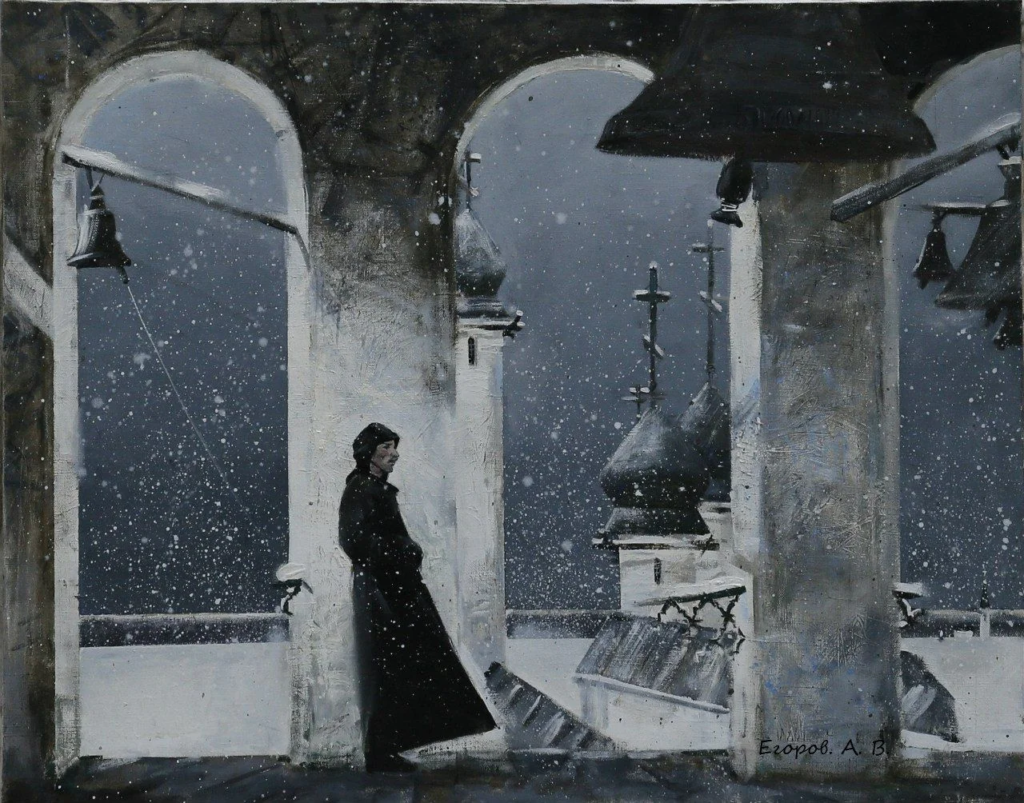
Snow has a way of quieting the world. It dulls familiar landscapes, muffles sound and makes the most bustling places meditative spaces. That stillness becomes almost palpable in Alexander Egorov’s On the Bell Tower.
In the painting a solitary figure is perched way up high on a bell tower, looking out over a town covered in snow. The rooftops extend away in the distance beneath a pale winter sky, the world below impossibly distant. No crowd, no obvious story unfolding, no dramatic action. Instead, Egorov finds a rare kind of silence, the kind that makes you stop thinking about where you’re going and just notice where you are.
What is so compelling about this work is the point of view. From this height the town looks so quiet and almost untouched, and the lone figure stands between two worlds. The tower lets you see everything, but it also puts space between you and it. It’s a feeling many people know about. Sometimes in life we step away from the noise around us not because we want to leave the world but because we need a little space to understand the world.
Rather than depicting solitude as something bleak, Egorov considers it as something meaningful. The painting implies that being alone is not always equal to being lonely. Solitude can give us a chance to think, to breathe, and to listen to thoughts that everyday life often drowns out. The stark winter landscape drives home that idea, reminding us that silence can be as comforting as it is strange.
»On the Bell Tower, because it doesn’t ask us to solve anything. It just gives you a rest. In a world that’s always telling us to go faster, to speak louder, to stay connected, Egorov gently reminds us of the power of being able to stand still for a moment, to look out at the world with fresh eyes.
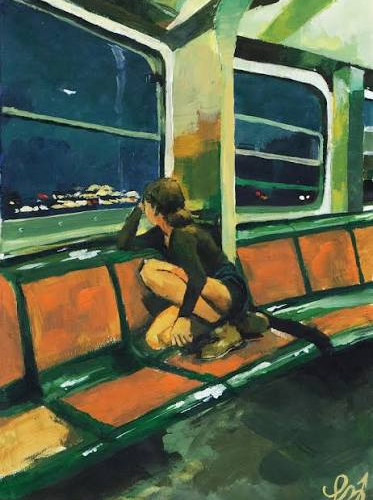
5. Lauren Zaknoun – Night Riding

There are few times as introspective as the drive home in the dark. The city is alive. Lights flash past the window. The world outside keeps on turning. Your thoughts appear frozen. Night Riding by Lauren Zaknoun perfectly captures that familiar feeling with exceptional tenderness.
The painting shows a single passenger, absorbed in thought, on a night-time journey. Neon streaks across the glass, the city dissolves into streaks of light, and the outside world is just a fleeting background. There is nothing out of the ordinary happening, but it is a very intimate scene. It’s the kind of moment that most people have had but rarely stop to notice – the quiet pause between where you’ve been and where you’re going.
Zaknoun knows how to find emotion in everyday life. She tells the story by means of atmosphere rather than dramatic expression or elaborate setting. The soft glow of artificial light, the empty surrounding space, and the rhythm of the moving vehicle contribute to a sense of quiet introspection. We don’t know what the passenger is thinking! And that’s exactly what makes the painting so relatable. It might be somebody reviewing a conversation, thinking about the day, or just taking a moment of quiet before heading home.
Night riding is particularly relevant today in many ways. Today we are surrounded by notifications, conversations, and distractions, and there is little time to sit with our own thoughts. But those in-between times – the late-night train ride, the bus journey, the silent drive down familiar streets – are often the only times when we really listen to ourselves. They can remind you of things, of questions unanswered, or of unexpected clarity.
It is what makes this painting quietly powerful. It reminds us that sadness isn’t only about life’s biggest moments. Sometimes it appears in the regular ones, slipping into the spaces between destinations. And while those moments can feel lonely at first, they also offer us something increasingly rare: the opportunity to slow down, reflect and reconnect with the person we’ve been too busy to hear.
6. Evening Daria Kalashnikova

The day passes and the world appears to breathe out. The adrenaline fades, the chatter quietens and familiar spaces are filled with another kind of silence. It is during these unremarkable evenings that our minds tend to drift the most. Daria Kalashnikova’s Evening captures that moment of time when the outside world slows just enough for our inner world to speak.
The painting depicts a lone figure facing a window, illuminated in the last light of the evening. No dramatic narrative, no obvious event is taking place. Instead, Kalashnikova concentrates on a sensation most of us are familiar with: a silent interlude between the obligations of the day and the unknowns of tomorrow. The window is no longer part of the setting. It’s a soft threshold between what’s going on outside and what’s going on inside.
The power of Evening lies in its restraint. The artist does not use expressive gestures or elaborate symbolism to convey emotion. With a thoughtful attitude, subdued colours and soft light, calm reflection is enough. The person could be thinking about someone they miss, going over a conversation, or simply enjoying a rare moment of peace and quiet. The painting never tells us. Each viewer discovers their own story in it.
It’s that openness that still makes the work so interesting. We all have our nights when we sit by the window a little longer than we should, watching the sky get dark and our thoughts get away. Sometimes those moments bring clarity. They sometimes leave us with more questions than answers. Either way, they remind us that reflection isn’t a waste of time, but part of understanding ourselves.
The evening does not invite us to solve the problems of life, nor to chase away melancholy. Rather, it suggests that these more subdued feelings are worthy of space too. In a culture that so often prizes constant motion and productivity, Kalashnikova gently reminds us of the importance of simply standing still, of letting the light fade and of giving ourselves a moment to feel whatever it is that the day has left behind.
7. Reverie. By Mikhail Strizhenov.

Some memories don’t herald their return. They come softly, carried on a familiar scent, a passing tune, a thought that takes us back before we know it to another time. Mikhail Strizhenov’s Reverie is that fragile space where memory and imagination softly melt into each other.
The title itself gives a clue. A reverie is a daydream, a period when the mind leaves the present and wanders through places, people, and possibilities that are only in memory or hope. In Strizhenov’s painting the central figure is completely immersed in that inner world. The scene around them drops into the background, and their expression hints at a conversation happening somewhere off-camera. It’s a tender moment, but one that instantly feels familiar.
Strizhenov does not offer the viewer a definite story but leaves it up to the viewer to decide. Is it the image of someone they loved before? Think of a decision that changed everything? Or just taking pleasure in the quiet comfort of a memory that won’t die? The painting doesn’t answer those questions, and that is exactly what makes it so compelling. Its silence calls out to us to populate the unknown with bits of our lives.
What makes Reverie particularly poignant is that it recognizes that melancholy isn’t always painful. Sometimes it’s soft. Sometimes it’s wrapped in gratitude for moments that have passed. Looking back can feel like a loss, but it can also remind us of how much we have loved, how far we have come, and how some experiences continue to shape us long after they’ve ended.
Reverie is, in many ways, an invitation to pause. It reminds us that our interior lives deserve as much attention as the world rushing by outside. Not all memories must be abandoned; not all silent moments must be filled. Sometimes a little time to drift is enough to reconnect to parts of ourselves that we thought we had forgotten.
8. Edward Hopper: Nighthawks, 1942

Few paintings have depicted loneliness more memorably than Edward Hopper’s Nighthawks. You might not have ever studied art history, but you’ve certainly seen it before: a brightly lit diner on a dark city street, a handful of strangers sharing the same space, and an overwhelming sense of silence hanging in the air. It’s a scene that feels instantly familiar, but impossible to fully explain.
Nighthawks (1942) has no readily apparent story. We don’t know who these people are, or what brought them here, or if they’ve spoken a word to each other. Hopper doesn’t answer those questions on purpose. Instead, he is concerned with something far more universal: the quiet distance that can exist between people even when they are only a few feet away.
The painting was created in an age of global uncertainty, but its emotional reach goes far beyond its own historical moment. Hopper was drawn to the rhythms of modern urban life where crowded streets and glowing shop windows could still make people feel profoundly alone. The diner’s warm light promises comfort, but the large windows create an invisible barrier between the people inside and the empty streets outside. It’s a quiet reminder that being surrounded by people doesn’t necessarily keep us from feeling isolated.
What makes Nighthawks last is how easily it mirrors modern life. Many of us will have had moments like this, not necessarily in a late-night diner but in cafes, airports, or offices or on trains, where we are physically present but emotionally somewhere else. We spend our days sharing spaces with strangers, with thoughts and worries that no one around us can see. Hopper provides that mute reality with a universal image.
It seems appropriate to end this journey with Nighthawks, for it does not put us in despair. Instead, it reminds us of something oddly reassuring: that everyone we pass has an inner life as rich and complicated as our own. Melancholy, longing, hope, and loneliness are not feelings; we feel alone. They are part of what keeps us whole. And maybe that is why Hopper’s masterpiece still resonates across generations, because it whispers to us that even when we’re lonely, we are never alone trying to find light in the darkness.
Art has always been a refuge for melancholy, not because artists sought to glorify sadness, but because they knew that our most muted feelings are often our most profound. Longing, solitude, nostalgia, uncertainty, and reflection are all experiences that connect us across cultures, generations and histories. The faces, places, and stories may be from different centuries, but the feelings these paintings evoke are eerily familiar.
The eight artworks on this list remind us that melancholy is not something to fear or to be overcome as quickly as possible. Sometimes it’s just an invitation to cease. It prompts us to look inwards, to revisit stored-away memories, to love the people we love, or to find solace in moments of stillness that modern life rarely allows. These paintings don’t offer simple answers or tidy endings. Instead, they leave room for reflection, enabling us to sit with feelings that are often difficult to articulate but impossible to ignore.
Perhaps that is why these works still speak to us so powerfully long after they were painted. From Ophelia’s gentle surrender to Saudade’s bittersweet yearning, to a prisoner’s hopeful search for light to the silent conversations taking place in the late-night diner of Hopper’s paintings, each picture reminds us that vulnerability is part of the human experience. They teach us that beauty and melancholy can live side by side and that even our most intimate feelings have been felt by thousands before us.
In a world that often tells us to move faster and feel less, these works of art ask us to do the opposite. To decelerate. To see. Remember. And perhaps, in seeing something of ourselves in these paintings, we learn that melancholy is not really sadness at all. Sometimes, it’s just another way to be beautifully, deeply human.
Which painting best captures melancholy for you?
If this collection left you wanting to explore the darker, more mysterious side of art, don’t miss our feature on 8 Paintings That Capture the Dark Imagination of Zdzisław Beksiński. His haunting dreamscapes offer a fascinating contrast to the quiet melancholy explored in these works.