




A Studio Visit and Interview with Alice d’Apolito

This week, we’re launching a new series of our virtual studio visit interviews. Think of it as pulling up a chair in an artist’s workspace, sharing the quiet rhythms of their day, and getting to know the small details that shape their creativity. For our very first visit, we’re spending time with Alice d’Apolito, also known as Lice-works, a self-taught Italian painter whose life flows gently between the UK and Japan.
Through this interview, Alice invites us into her creative space, sharing what her days look like as she works, paints, and dreams. She discusses how her ideas often emerge in her sleep before finding their way onto wooden panels, how she sets the mood in her studio with light, music, and simple rituals, and why she concludes each day with a small dance of gratitude.
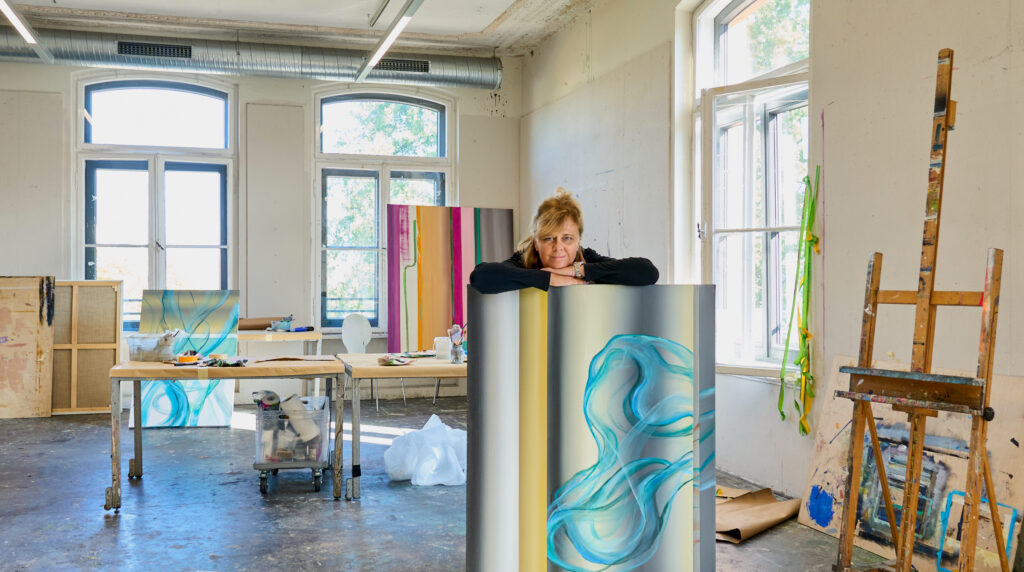
We also meet some of her companions along the way, her four pet snails, especially Tommy, the largest, who sometimes joins her in the studio. Her space is carefully arranged for different tasks, but the spot by the big window remains her favourite. Right now, the studio carries the natural smell of wood, a detail that ties closely to her practice. In this visit, Alice gives us a glimpse into both her art and the quiet daily rhythms that surround it.

My name is Alice d’Apolito, also known as Lice-works, an Italian self-taught painter with a background in Cinema and animation, residing between the UK and Japan. I’m a painter who is inspired by all my surroundings, but my ideas mostly come from my dreams. My paintings are a celebration of vibrant colours, clean lines, and hauntingly pale faces and forms in playful settings, giving my characters, my alter ego, and myself space to breathe, meditate, and reconnect with nature and culture by prioritising the emotions themselves that arise, rather than crowding them with many things. “I want to tell a story, capture the essence of movement within the stillness of paint.
I want to give substance to the oneiric world and imprint memories enclosed with me in a piece of art”. My influences come not only from the rich imagery of Japanese arts and the surrealistic aesthetics, but also from expressionist painters such as Egon Schiele, who have guided me since college. I believe my style now has a hint of Asian pop influence, thanks to my extensive travels to Japan. But my style developed way before my asians adventure. In fact, most people who see my work for the first time often think I’m a Japanese artist, but to be honest, it’s primarily because of the way I draw eyes. I shift the focus away from “The Big Eye” painting syndrome and towards conceptualising the eyes with neat, clean lines instead.
1. Can you describe your typical studio day and creative process?
As soon as I enter my studio, I open my blinds, as vitamin D is essential, and I often put my radio on, but it really depends on how I feel. I collect all my ideas, and I’m starting to bring them to life by transferring the sketch to my wood panel, studying my colour palette and starting to paint. Sometimes I will prepare my wood by cutting it, but it really depends on the project I’m working on. When it’s time to go home, I always perform a lil dance to express gratitude to my body and mind.

2. What is the primary inspiration behind your current body of work?
My experiences on Earth.
3. What is your favourite memory or incident from your studio?
When a big wasp came out from nowhere, as my windows were closed, I had to take it outside the window through the glass. It was terrifying as I’m terrified of wasps, but I was proud of myself for moving out and surpassing my fears.

4. Do you have any studio assistants, or do visitors, such as pets or children, often accompany you?
I don’t have a studio assistant yet, but I’d love to have one when I start earning more. But I have four pet snails at home, and Tommy, the biggest one, sometimes accompanies me.
5. How would you describe a dream studio for yourself?
I currently have a dream studio!


6. What does your studio smell of right now?
My studio smells mostly of wood.
7. If you could set up your studio anywhere in the world, where would it be?
In Shanghai, or Japan! Or maybe all over the world.


8. Can you discuss any ongoing projects or plans for your work?
While in Tokyo, I initiated a new project by transforming the sketches I created in Japan last year into an interactive A3 oil painting, primarily in black and white. If you’d like to know more, you can follow my Instagram page @dapolitoalice. I appreciate your support!
9. How do you organise your space?
Dividing the space of my studio for different tasks! Like a desk for sending emails, etc, a painting area, lots of trolleys with wheels, a storage corner, etc.


10. What is your favourite corner in the studio?
The corner near my big window.
Our virtual visit to Alice d’Apolito’s studio leaves us with a sense of a place that’s warm, thoughtful, and filled with quiet energy. The smell of wood hangs in the air, light pours in through the big window, and sometimes a snail or two keeps her company while she paints.
What comes through most is how Alice treats her studio as both a workspace and a place to breathe and take care of herself. The takeaway from this visit is striking yet straightforward: her art stems from the same small moments of care, patience, and play that shape her daily life.
Visit our website to explore the virtual studio spaces of other artists. To be featured on our website, remember to apply for this month’s call for art.
Read more about Alice on her Website and Instagram.
Arts to Hearts Project is a global media, publishing, and education company for
Artists & Creatives, where an international audience will see your work of art, patrons, collectors, gallerists, and fellow artists. Access exclusive publishing opportunities and over 1,000 resources to grow your career and connect with like-minded creatives worldwide. Click here to learn about our open calls.