
The Story Behind Guernica
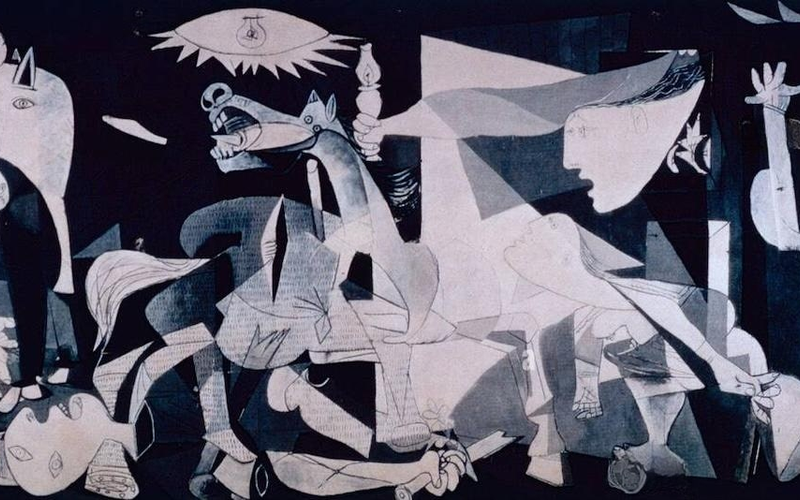
The painting that turned one devastating day into a lasting image of war.
On April 26, 1937, a town in northern Spain became the site of one of the most devastating aerial attacks of the Spanish Civil War.
Within days, news of the destruction had reached Paris. Pablo Picasso was there, working on a painting he had been commissioned to make for the Spanish Pavilion at that summer’s International Exposition.
He had not yet found the right subject.
The bombing changed that.
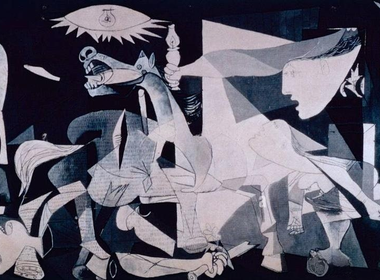
A few weeks later, Picasso would finish Guernica, a vast black-and-white painting that turned the destruction of one Basque town into one of the most recognisable images of war ever made.
But the story behind Guernica is not only the story of a bombing. It is also the story of how an artist responded to news, how a painting changed while it was being made, and how one work eventually travelled far beyond the event that inspired it.
Before Guernica, there was a commission
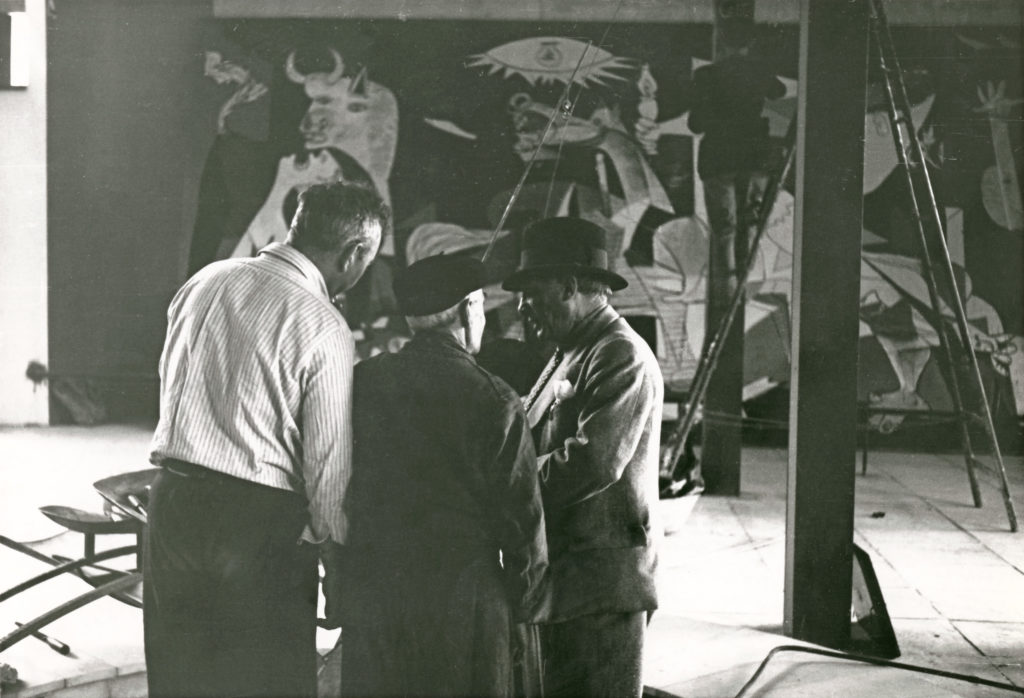
Calder and Pablo Picasso with Mercury Fountain in the Spanish Pavilion at the Paris World’s Fair, July 1937
Picasso had been asked by the Spanish Republican government to create a work for the Spanish Pavilion at the 1937 International Exposition in Paris.
The Spanish Civil War had begun in 1936, after a military uprising against the Republican government. Francisco Franco’s Nationalist forces received crucial military support from Nazi Germany and Fascist Italy, while the Republican side received assistance from the Soviet Union and international volunteers.
Picasso was already responding to the conflict in his work. Earlier in 1937, he had begun The Dream and Lie of Franco, a series of prints attacking Franco and supporting the Republican cause.
But the large painting for Paris remained unresolved.
Then came the news from Gernika.
What happened on April 26, 1937?
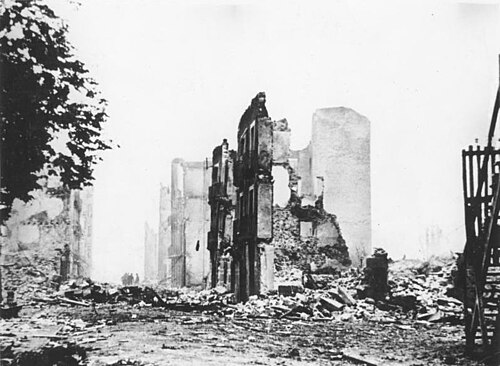
Guernica in ruins, 1937
Gernika was an important centre of Basque political and cultural life. On April 26, German aircraft of the Condor Legion, together with Italian aircraft supporting Franco’s forces, attacked the town.
The Museo de la Paz de Gernika records that the first bombs fell at around 4:20 p.m. The bombing continued in successive waves until approximately 7:40 p.m. More than 85 percent of the town’s buildings were destroyed, and fires continued for days. The Basque government recorded 1,654 deaths, although the number of people killed remains historically disputed.
The attack quickly became an international story.
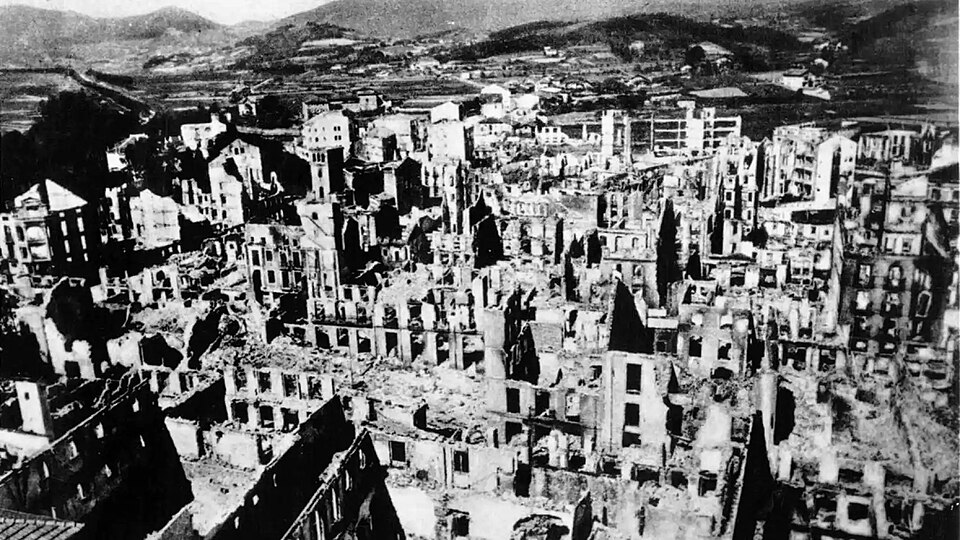
Damage sustained during the air attack
Journalist George L. Steer reported from the scene for The Times, describing the destruction and challenging claims that the town had been destroyed by retreating Republican forces. His account helped carry news of Gernika beyond Spain.
For Picasso, the reports arriving in Paris provided the subject he had been searching for.
Picasso starts again
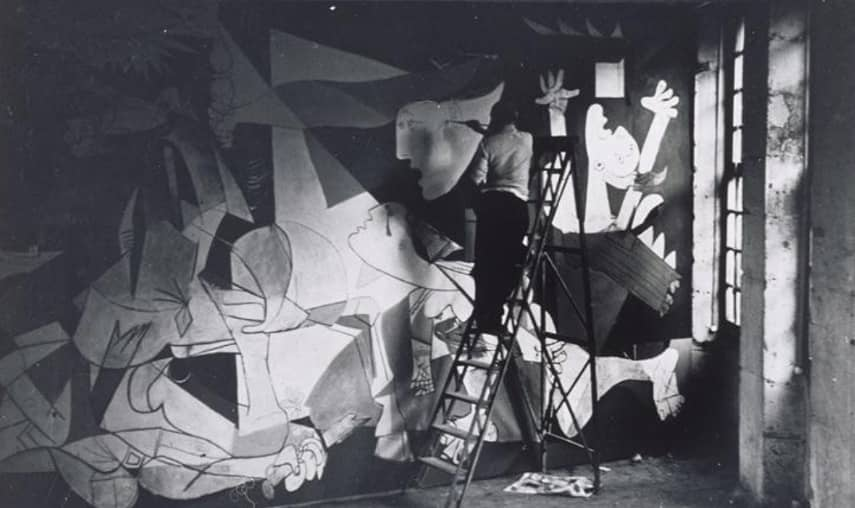
On May 1, Picasso began work on Guernica.
He had only weeks before the Paris Exposition opened.
Rather than producing a straightforward illustration of the bombing, he began building a scene filled with fractured bodies, animals, distorted faces and overlapping forms.
The painting changed considerably during this process.
Dora Maar photographed Picasso working on the canvas between May 11 and June 4, creating a rare visual record of its development. The photographs show figures being moved, altered and removed as Picasso gradually reworked the composition. Technical studies by the Reina Sofía have also revealed changes beneath the finished surface.
The final painting measures 349.3 by 776.6 centimetres.
It is enormous.
That scale matters. Guernica was made to occupy a wall at the Spanish Pavilion, confronting visitors with a scene that could not easily be taken in from a distance.
There is no battlefield in Guernica
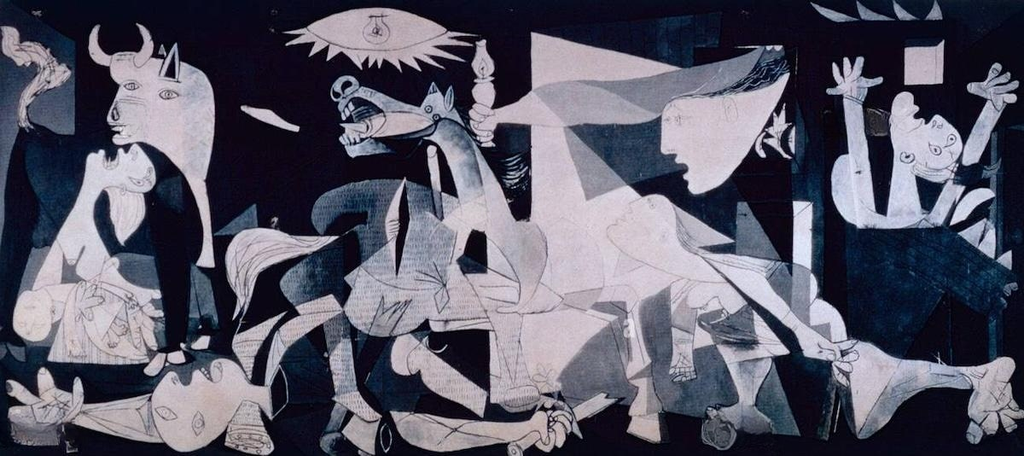
Perhaps the first thing to notice about Guernica is what Picasso chose not to show.
There are no aircraft.
No identifiable soldiers.
No flags.
No battlefield.
Instead, there is a mother holding her dead child on the left. A bull looks out from above them. A wounded horse dominates the centre. A fallen figure lies beneath the chaos, his broken sword still in his hand. At the right, women appear caught in a scene of fire, movement and fear.
The painting does not reconstruct the bombing street by street.
It gives us its human consequences.
And Picasso did not provide a single explanation for every figure.
The bull and horse, particularly, have generated decades of interpretation. They had already appeared repeatedly in Picasso’s work, including his imagery around bullfighting and the Minotaur. Scholars have connected them to ideas ranging from Spain and violence to suffering and political conflict.
But Picasso resisted the idea that viewers should be given a fixed dictionary of symbols. The Reina Sofía’s research into the painting likewise emphasises how its imagery has generated multiple readings over time.
That ambiguity is part of the painting’s history, not something that needs to be solved before we can understand it.
Why is it black and white?
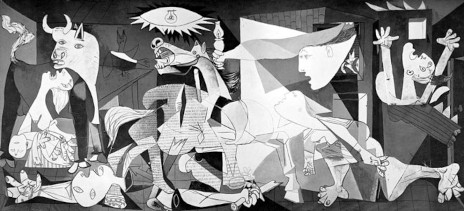
Guernica is almost entirely monochrome.
There is no red for blood, no blue sky and no warm colour to distinguish one figure from another.
The choice has often been connected to the photographs and newspaper reports through which Picasso encountered news of the bombing. The Reina Sofía describes the painting’s grisaille palette as closely connected to the visual language of photography, film and the press.
That connection is important.
In 1937, photographs were becoming an increasingly powerful way of experiencing events that happened far away. Images of war could move from a battlefield to a newspaper and then into homes across Europe.
Picasso took that visual language and made it monumental.
But instead of giving viewers a photograph of what happened at Gernika, he gave them something far less literal, and much harder to look away from.
And then there is the light
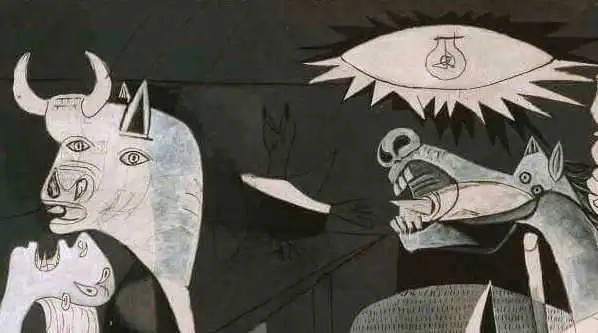
Pablo Picasso, Guernica, close-up of the light bulb, horse and bull
Two light sources appear near the top of the composition.
One is an electric bulb. Below it, a figure stretches forward holding a lamp.
Their meaning has been debated extensively, and Picasso did not leave behind a definitive explanation that settles the question.
Still, their presence fits the larger tension running through the painting.
Guernica was made for an international exhibition celebrating art, technology and modern life. Yet the painting showed another side of modernity: the ability of aircraft and industrial technology to bring destruction to civilians.
The electric bulb sits directly above the scene.
Whether we read it as technology, illumination, surveillance, truth, or something else is ultimately open to interpretation.
Picasso left that space open.
Read More: The Story Behind Girl with a Pearl Earring
Guernica had a life beyond Paris
The painting was unveiled at the Spanish Pavilion in July 1937.
After the exhibition, it travelled internationally, helping draw attention to the Republican cause and raising funds for Spanish refugees.
Then Spain’s political future changed.
Franco’s Nationalist forces won the Civil War in 1939, and Picasso decided that Guernica should remain outside Spain until democratic institutions had been restored.
During the Second World War, the painting was placed in the care of the Museum of Modern Art in New York for safekeeping. In 1958, Picasso extended its loan indefinitely, linking its eventual return to the restoration of democracy in Spain.
It remained in the United States for decades.
Finally, in September 1981, Guernica returned to Spain.
It was first displayed at Madrid’s Casón del Buen Retiro. In July 1992, it moved to the Museo Nacional Centro de Arte Reina Sofía, where it remains today.
The journey took more than forty years.
By the time Guernica came home, the political circumstances that had kept it away had changed completely.
From one town to a universal image
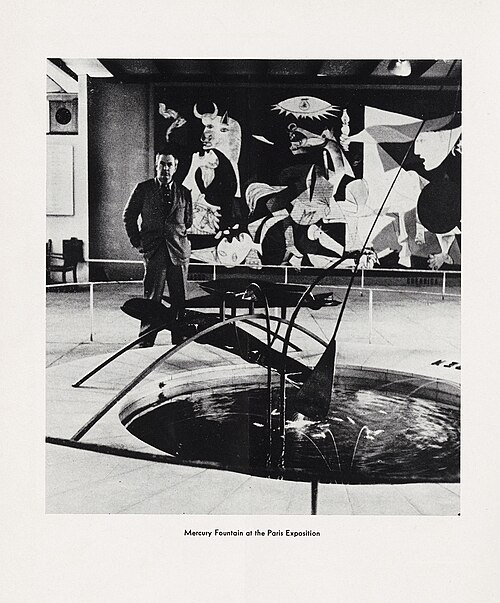
Guernica at the 1937 exhibition, with sculptor Alexander Calder and his Mercury Fountain
The title has always kept the painting tied to Gernika.
But the painting itself contains very little that fixes it to 1937.
That is one reason its imagery has continued to appear in later protests and responses to war. The Reina Sofía’s Rethinking Guernica archive documents the painting’s long political afterlife and its repeated use as an anti-war image in different countries and historical moments.
Each new context adds something to its history without erasing the original one.
The painting was made because of Gernika.
It was never only about Gernika.
Read more : Five Bookshops to Visit in Paris
Why Guernica still matters
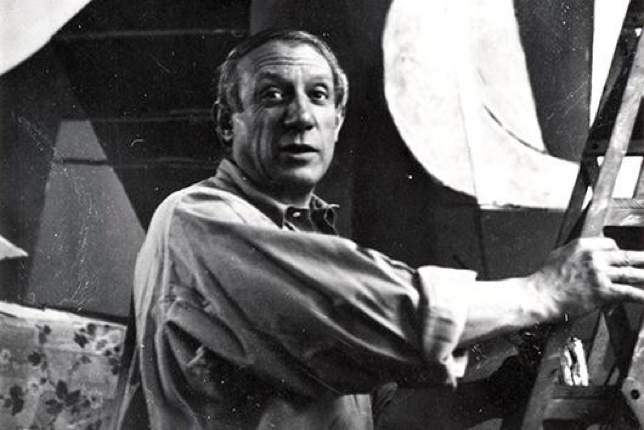
Dora Maar, Picasso on a stepladder in front of Guernica, 1937
Nearly ninety years later, the story behind Guernica remains remarkably straightforward at its centre.
A town was bombed.
News of its destruction reached an artist living in Paris.
An unfinished commission changed direction.
And within weeks, Picasso produced a painting that would outlive the war that inspired it.
What makes Guernica enduring is not that it gives us every answer.
It doesn’t.
It leaves us with a mother and child, a wounded horse, a bull, broken bodies, burning buildings and a scene that refuses to become a neat historical illustration.
The event belongs to 1937.
The painting does not.
That is why the story behind Guernica is still worth telling. It reminds us that a work of art can begin with one particular moment in history and, over time, become part of how generations remember it.
Explore the current open calls and submit your work: apply.artstoheartsproject.com