

Nadia Klionsky Paints the Mystery of Nature Through Oil Painting
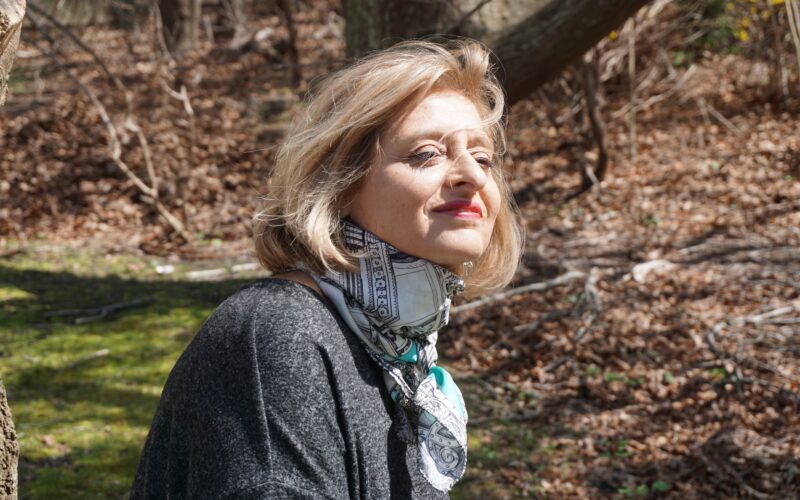
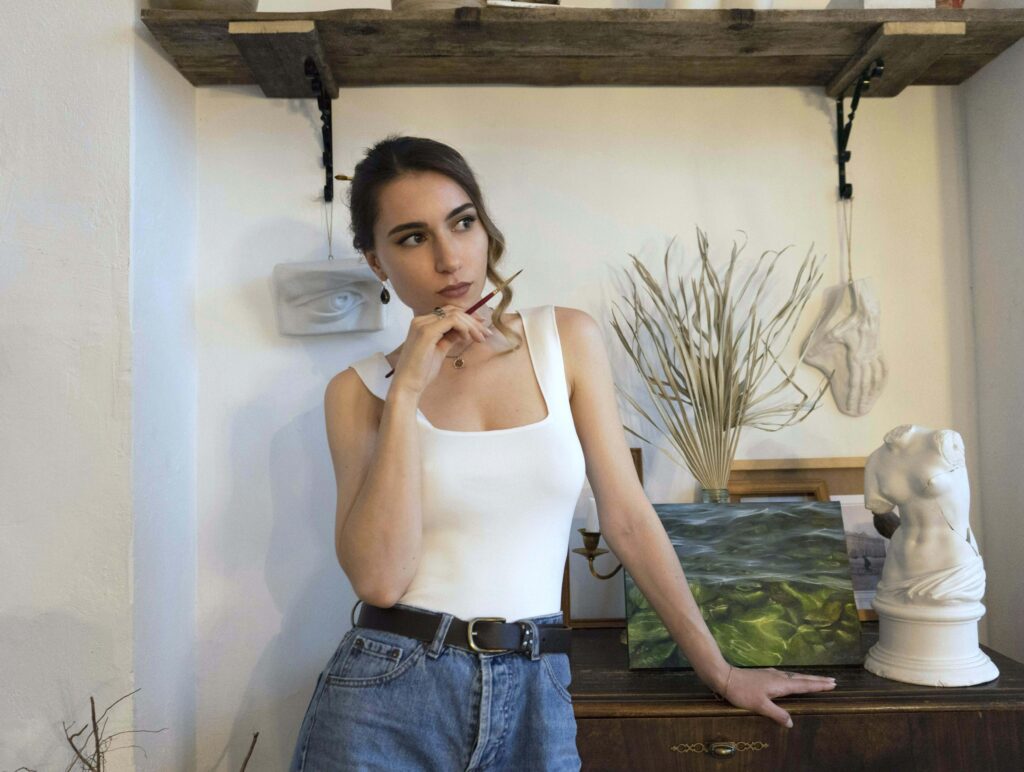
At Arts to Hearts Project, our Women Artists on the Rise Edition 4 brought us one hundred women painting in every possible register, the bold and the experimental, the raw and the deeply personal. But every so often a body of work arrives that asks you to slow down, to stop and simply stand in front of it. That is what happened with Nadia Klionsky’s paintings.
Nadia is one of our selected artists in this edition, a classically trained painter born in St. Petersburg and taught first by her father, the renowned artist Marc Klionsky, who remained her mentor until his passing in 2017.
After her family immigrated to the United States she carried that training into Cooper Union, the Pennsylvania Academy of Fine Arts and the Philadelphia College of Art. But the reason her work stays with you has less to do with her pedigree than with what actually happens on the canvas.
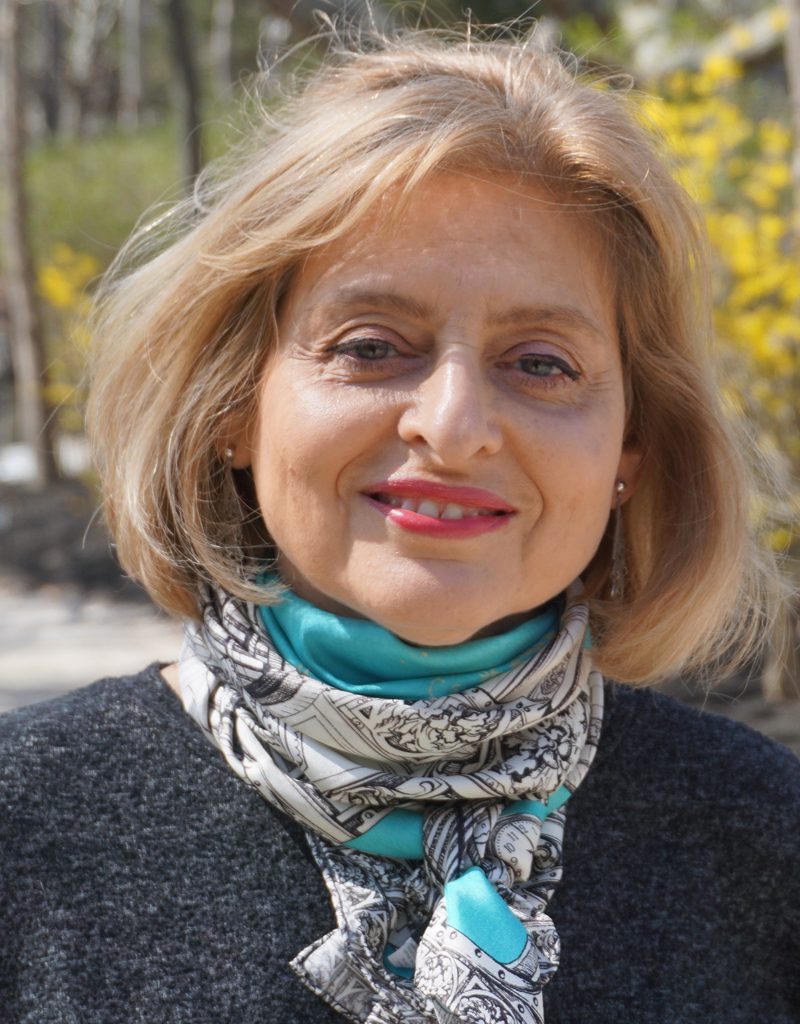
She works in oil, and she works patiently, building light and atmosphere until a scene stops being a scene and becomes something closer to a feeling you can step inside. By her own account she is trying to bring traditional technique together with contemporary concerns, using the shifting conditions of weather and light to hold both the passage of time and a sense of timelessness.
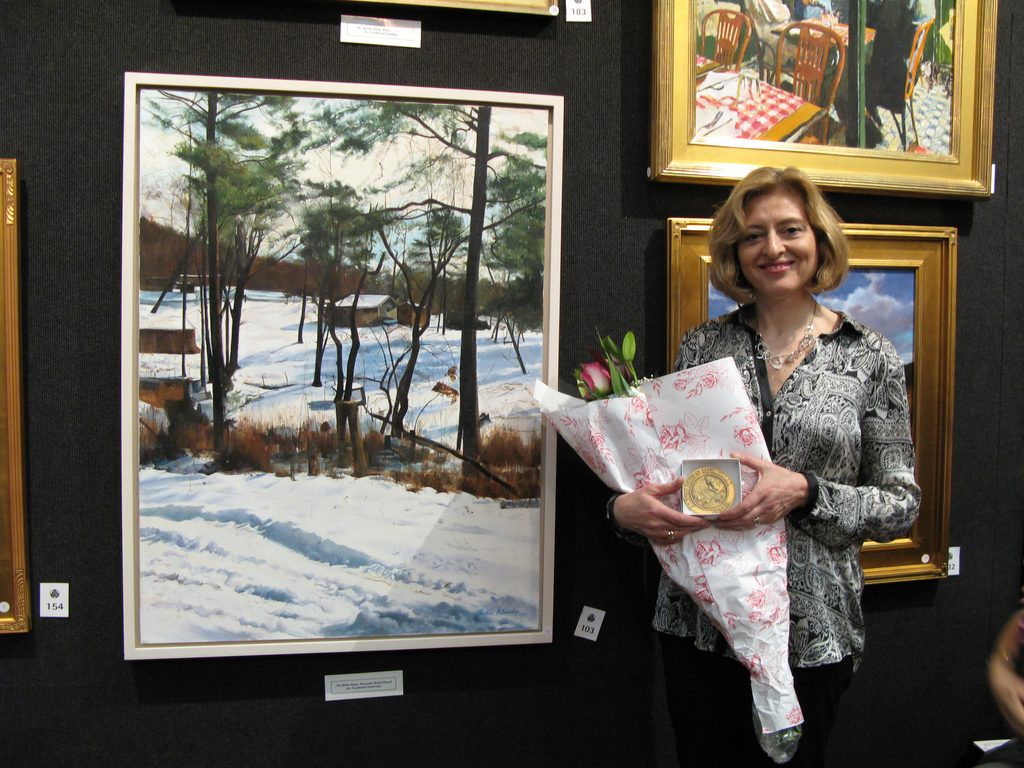
You can feel that intention everywhere. In the way she paints water as pure energy and life, drawn to how it ebbs and flows regardless of anything we want from it. In the quiet corners of the winter woods she is always looking to disappear into, transfixed by snow and its textures and the long blue shadows the trees throw across the ground.
But it is the in-between that she loves most. That fragile threshold where something solid begins to dissolve and you are no longer quite sure what you are seeing. She is endlessly drawn to fog and mist and drifting cloud, to the moment a familiar thing turns strange and dreamlike.
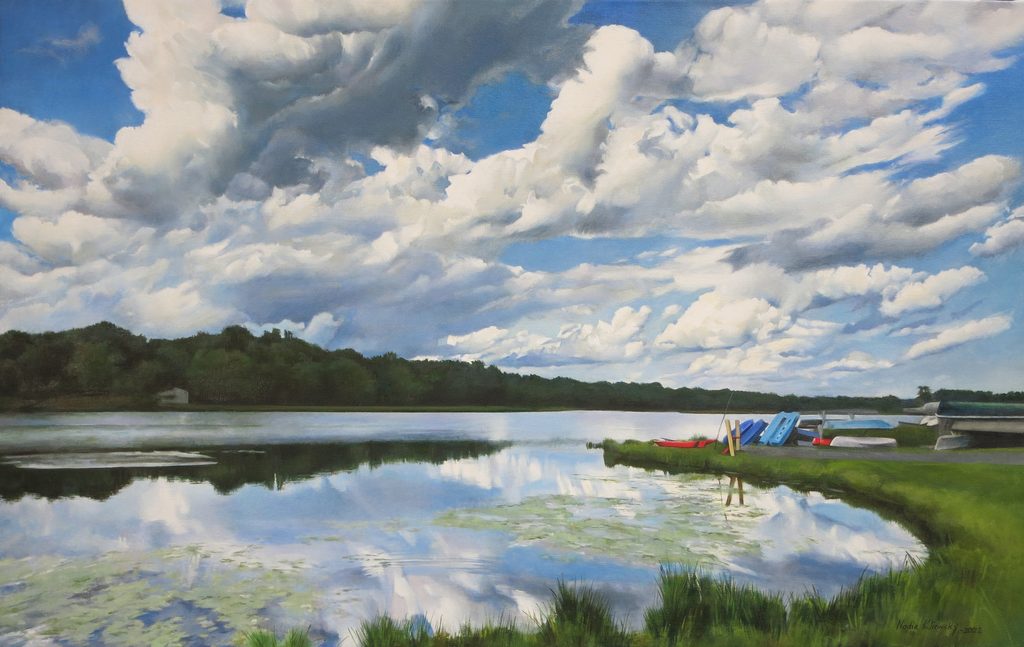
Painting fog, she says, is like writing a fairytale. She is transfixed by the unknown depth in every misty perspective, the way it feels as if time stops to make room for our feelings, leaving each viewer to decide for themselves what lies beyond.
That feeling of mystery is an important part of her work. Nadia does not want to tell viewers exactly what to feel or see. Instead, she creates the mood and leaves space for each person to bring their own memories and emotions to the painting. Her landscapes become personal experiences rather than simply pictures of nature.
Now let’s hear from Nadia about the father who taught her to paint, why fog feels like a fairytale, and why she believes a strong foundation is what truly sets an artist free.
Q1. Can you tell us a little about your background and how your journey as a painter began?
I was born in St. Petersburg, Russia. My father was an artist, and my mother was a former actress and linguist. As far back as I can remember, I always knew I would become an artist. There was never any doubt in my mind. I grew up in the 1960s, when Abstract Expressionism began making its way into Russia and became a lively topic of conversation—especially in our home, where my parents often gathered with artist friends. Those discussions left a lasting impression on me. One of my earliest memories happened when I was about five or six years old.
While on a walk with my mother, I picked up a small rock with sharp edges. When we got home and she was in the kitchen, I quietly went into the living room and scratched three sides of our brand-new, high-polished mahogany wall unit as high as I could reach. When my horrified mother asked what I was doing, I calmly replied, “I’m making abstract art.”
Fortunately, she found it funny years later. I began my formal art education at the age of ten at the Intermediate Art School affiliated with the St. Petersburg Academy of Fine Arts. After my family immigrated to the United States in 1974, I continued my studies in New York, eventually attending Cooper Union, the Pennsylvania Academy of the Fine Arts, and the Philadelphia College of Art.
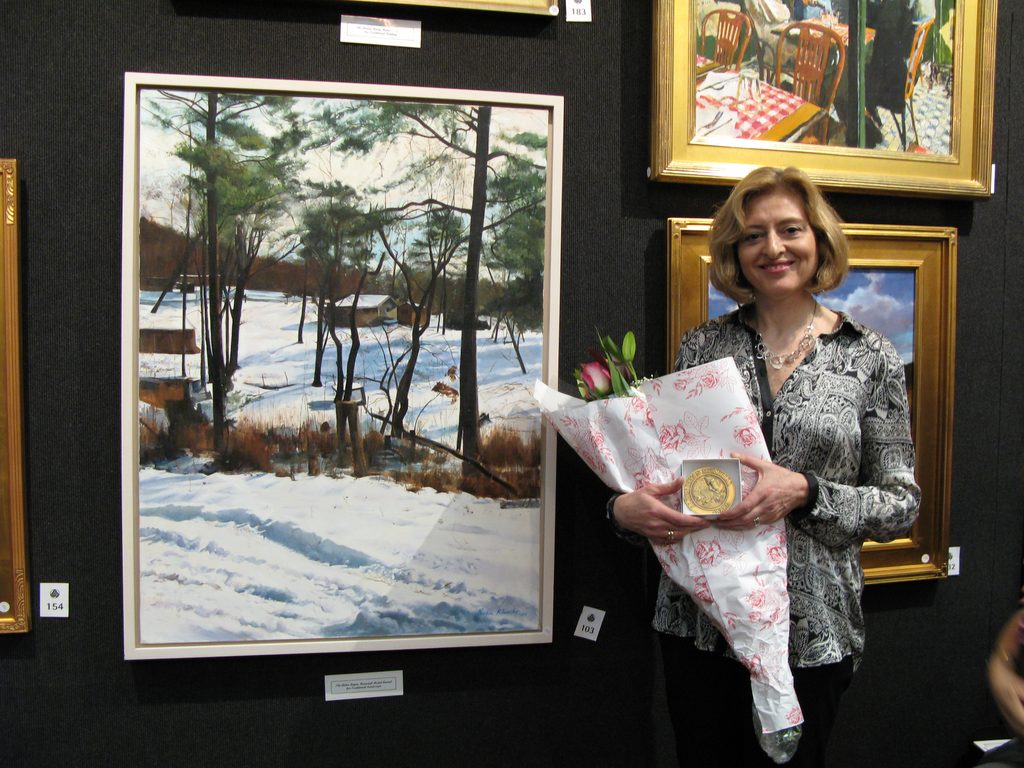
Q2. Your father, Marc Klionsky, was your first teacher and mentor. What is the most important lesson you learned from him?
My father taught me to love drawing and painting and to approach both with passion.
By his own example, he showed me the importance of staying curious, trying new ideas and mediums, and never being afraid to experiment. Most importantly, he taught me perseverance to stay the course, to keep painting despite challenges and setbacks, and to trust that a lifetime of dedication is what truly shapes an artist.
Q3. Your practice has moved from conceptual works to landscapes and seascapes. What led to this shift?
One summer, while traveling through the American Northeast, I found myself unexpectedly transported back to my earliest memories of the fields and untamed forests of Eastern Europe. The landscape awakened something deeply familiar, bringing my childhood vividly back to me. It felt as though I had come full circle. It was in those early landscapes that I first experienced the brilliance of winter light, the fleeting warmth of long summer days, and the quiet transitions between the seasons.
Those moments shaped my sense of time, change, and the passage of life. Returning to those memories inspired me to look more closely at the natural world, and my work gradually shifted toward landscapes and seascapes rooted in direct observation.
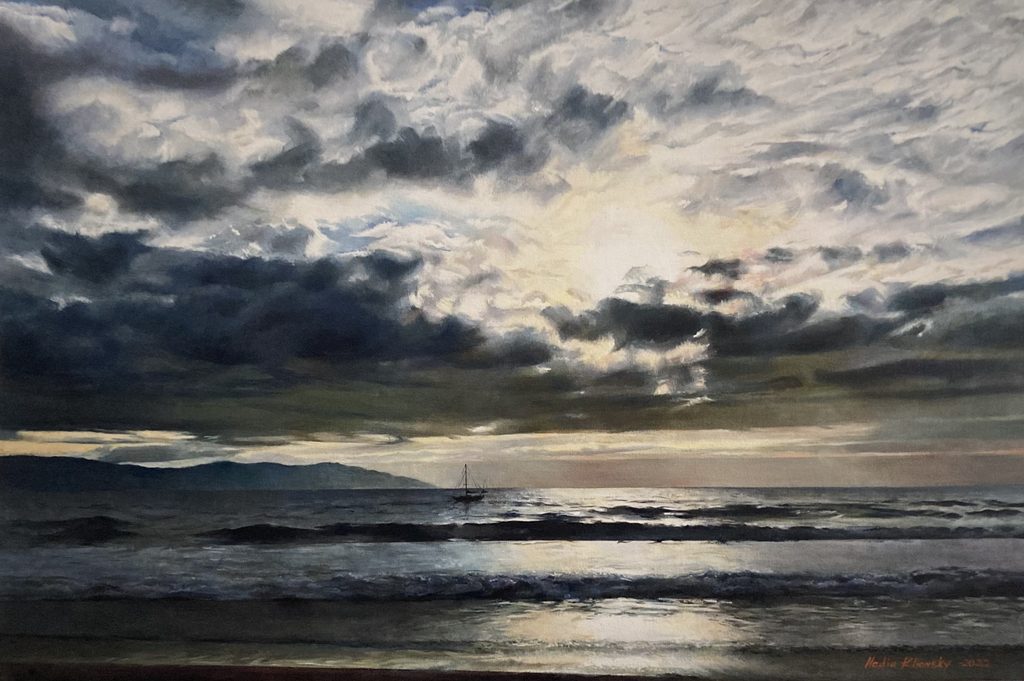
Q4. You have described painting fog as being like writing a fairytale. What makes fog such a compelling subject for you?
To me, fog represents mystery something unknown, elusive, and intriguing. It exists in the space between what is seen and what is imagined.
Painting fog feels like taking a step toward abstraction while remaining rooted in the real world.
It captures that fleeting moment when something solid and recognizable begins to dissolve, inviting the viewer to slow down, wonder, and complete the story in their own imagination.
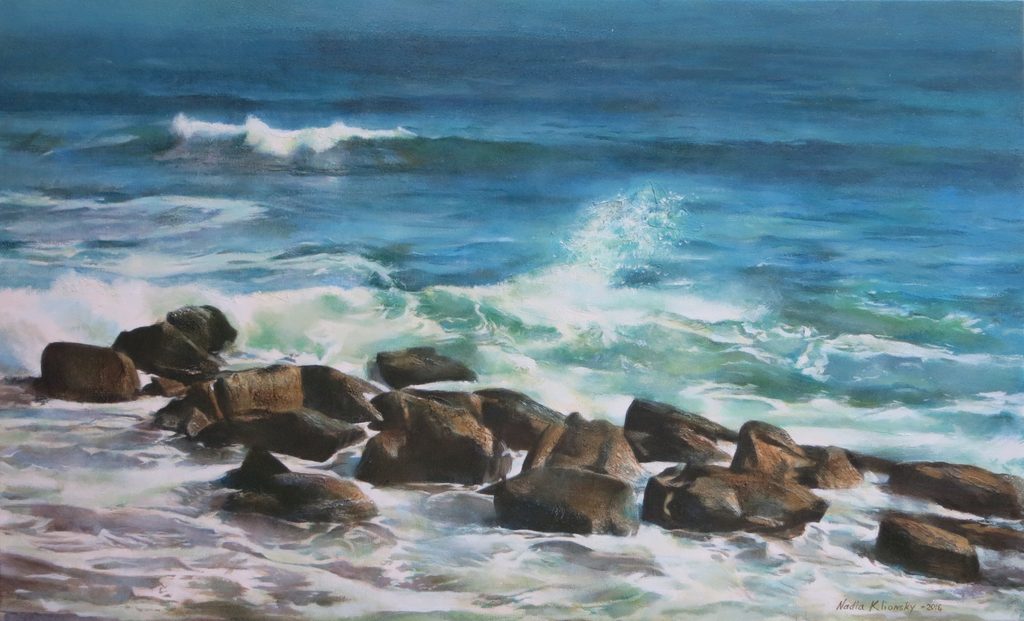
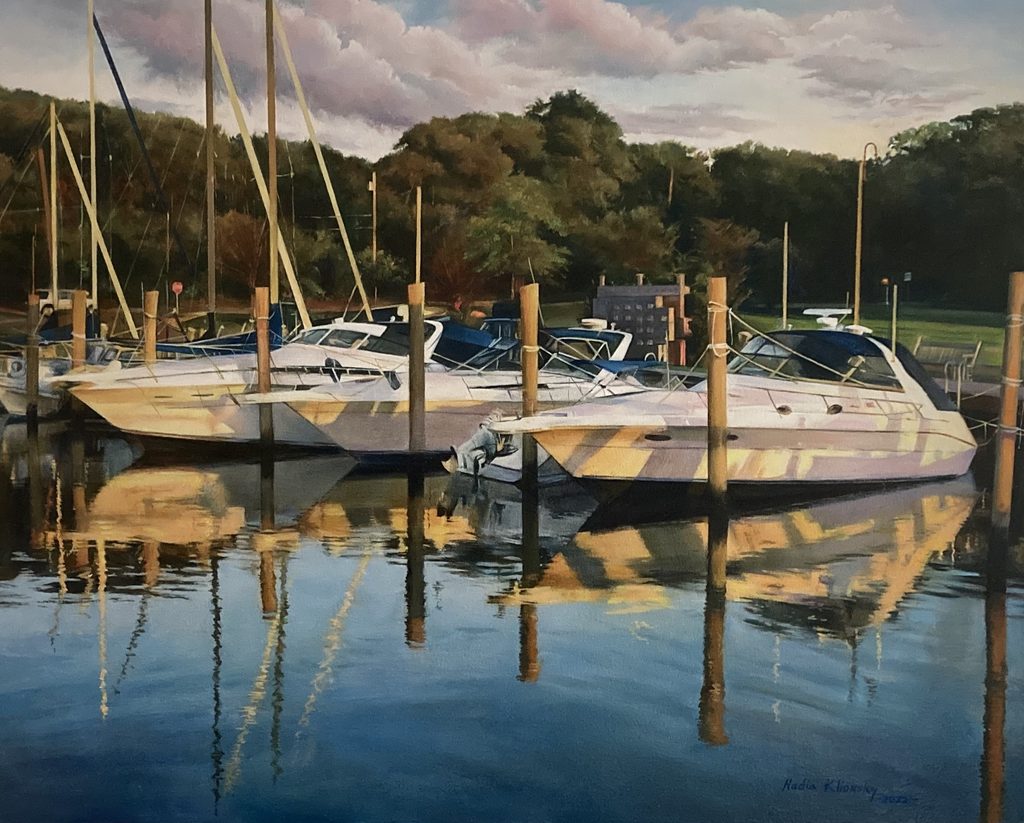
Q5. In works like Breaking Waves and Sailboat at Rest, what interests you about painting both the energy and stillness of water?
My paintings explore the quiet dialogue between nature and the human spirit.
The changing moods of water often reflect our own emotional landscape. At times it is calm and contemplative; at others, powerful and restless.
I am drawn to because they speak to different aspects of the human experience. My hope is that these paintings invite viewers into a place of reflection and transcendence, where the landscape becomes more than a scene in nature it becomes a mirror of our inner world.
Q6. Has your oil painting technique changed as your work has moved toward landscapes and seascapes?
Yes, my technique has evolved along with the direction of my work. My current landscapes and seascapes are rooted in careful observation and are painted with a greater level of realism and detail. In contrast, my earlier conceptual paintings were much freer in their execution more expressive, partially abstracted, and built with energetic brushwork and rich textures. Although the techniques are quite different, both bodies of work are driven by the same desire to express an idea or an emotional experience.
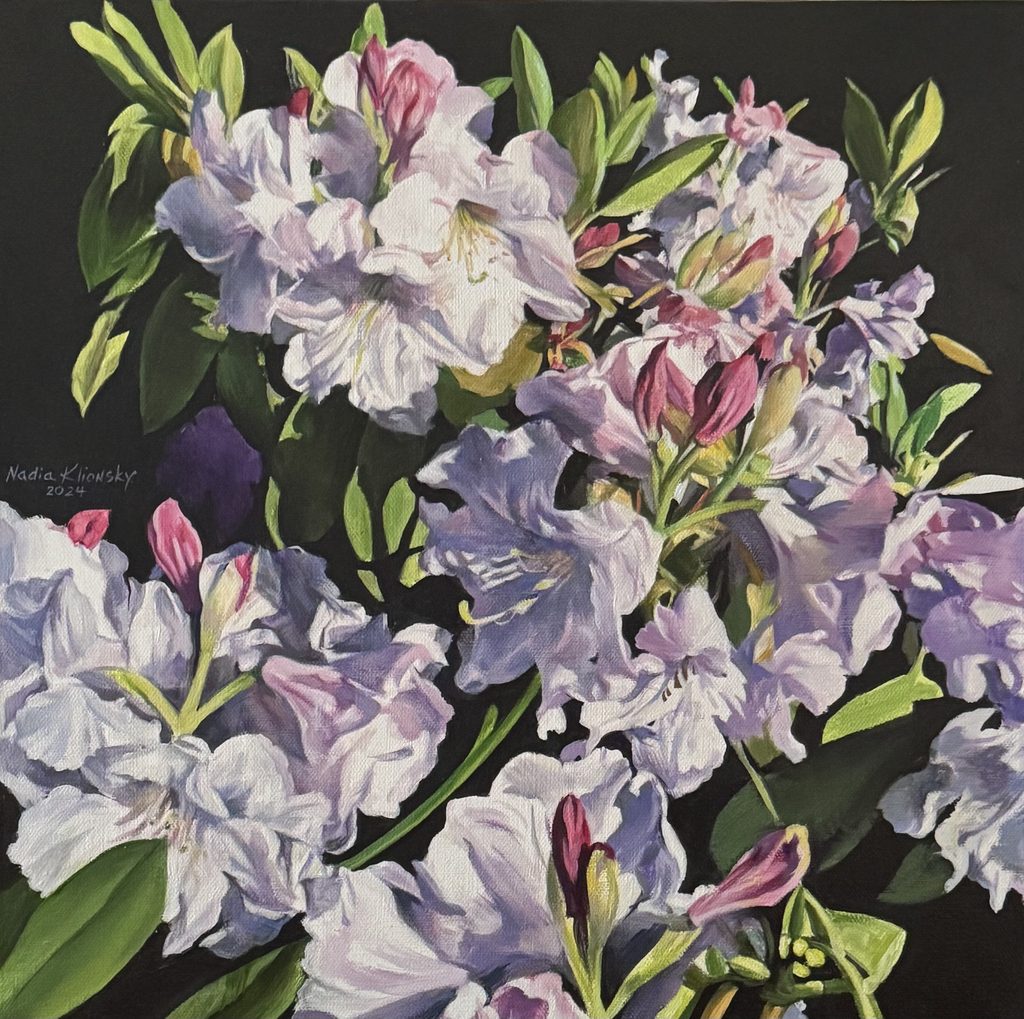
Q7. In Blooms of Hope, flowers explore resilience and renewal. What led you to develop this idea as a series?
I believe that now, more than ever, we need beauty in our lives.
Blooms of Hope grew from that belief. Flowers became a symbol of resilience and renewal—the quiet strength to begin again after difficult times. Through resilience, we return to what is essential and timeless within us. My hope is that these paintings remind viewers of that enduring inner strength and inspire them to move forward with renewed vitality, hope, and a sense of possibility.
Q8. When you return to subjects like water, fog, or changing light, how do you keep the work from becoming repetitive?
Every painting tells a different story and carries its own unique mood. Nature is constantly changing, and every moment of light, water, or atmosphere is fleeting and can never be repeated. Even when I return to the same subjects, I discover new emotions, new rhythms, and new possibilities. The landscape may be familiar, but the experience of seeing it is always different.
Q9. Landscape painting has a long history. What can contemporary painters still bring to this tradition?
I believe that contemporary landscape painters must first study and understand what has come before them. The long tradition of landscape painting deserves respect and appreciation, as it provides a foundation for future generations of artists. By learning from the past, artists can develop their own unique vision and bring a personal interpretation and new perspective to this enduring tradition.
Q10. Has your definition of success changed as you have built your life as an artist?
What is most important to me is to remain dedicated to my practice—to continue exploring and developing my ideas and to keep growing as an artist. Over time, my definition of success has become less about external recognition and more about the commitment to the creative process itself. Once a work is completed, I feel ready to share it with the public and begin an engaging conversation between the painting and the viewer.
Q11. What advice would you give artists who want to build a lasting practice while allowing their work to evolve?
The most important advice I can give artists is to build a strong foundation—to learn their craft, study art history, and understand what has been created before them. Once you have developed and mastered your skills, you can move into the world with confidence and begin creating work that is truly your own.
Whether your path leads you toward abstraction, conceptual art, installation, or any other direction, a strong foundation will give you the confidence, knowledge, and discipline to express your ideas with clarity and create work that feels authentic and professional.
By the time we finished talking with Nadia, we kept circling back to memory. To the strange way a certain light, or a quiet field, or a wall of fog can reach into you and pull up something you thought you’d long forgotten.
Her paintings work exactly like that. You look at a snow-covered wood or a harbor going soft at dusk, and before you know it you’re somewhere in your own past, some place you can’t quite name but somehow recognize. She isn’t really painting scenery.
She’s painting a feeling, and handing it to you, and letting it become yours. Stand with one of her canvases for a minute and something in you settles. You slow down. You start noticing things you’d normally walk right past.
And there’s a lot to take from the way she has built her life in art, most of it passed down from her father. Learn the craft first, she says. Really learn it. Study the painters who came before you, put in the years, and only once the skill is truly yours should you go off and make something nobody else could.
Then the hard part: keep at it. She’s honest that a life in art is mostly perseverance, showing up through the dry spells and the doubt, trusting that the real work is the staying. Wherever you end up going, that early foundation is what lets you go there freely.
There’s also hopefulness in everything she makes. She really believes we need beauty right now, maybe more than ever, and her flowers say it best, delicate things that somehow keep blooming, that keep starting over after the worst of it. It isn’t a soft or naive hope. It’s the kind you only earn by living a while, the kind that knows how heavy things can get and still bets on better days.
For collectors, her work brings something a lot of art doesn’t: stillness. These are patient, beautifully made paintings, full of light and air, the kind that keep revealing more the longer you live with them. Hang one in your home and you’ve opened a small window onto somewhere calmer, a daily nudge to slow down and a quiet reminder of both how fast time goes and how much of us stays.
Follow Nadia Klionsky through the links below and see her work for yourself.
This is the final week to submit to our Art and Woman edition. Submissions close on 30 August. And we are looking for women artists who understand that the art is never the whole story. It is a doorway. Into a life, the victories and the struggles, the dreams and the doubts, the quiet years nobody witnessed and the moments that changed everything.
If you paint, draw, photograph, sculpt, stitch, or build in ways nobody else would think to, and if your work carries the truth of the life behind it, we want to see what you are doing. Medium does not matter. Geography does not matter. Career stage does not matter. What matters is that there is a real woman, and a real story, inside the work.
The window is almost closed. Every artist featured in our publications was once someone who took a breath and submitted before the deadline passed. This could be your edition, but only if you do not wait.