
Are These Artists Who Predicted The Future?
Hopper, Caillebotte, and Tooker were not artists who predicted the future of our loneliness decades in advance. They were filing a report on the present that accumulated to now, and we have spent a century refusing to read it.
Every few months the carousel comes around again. The artists who predicted the future. Dali saw AI imagery. Bosch saw the algorithm. Hopper saw the smartphone before the smartphone existed. Don’t get me wrong, the images are gorgeous. The captions land and the saves pile up. Quite lucrative, even.
But the framing is wrong and wrong in a way that costs us something.
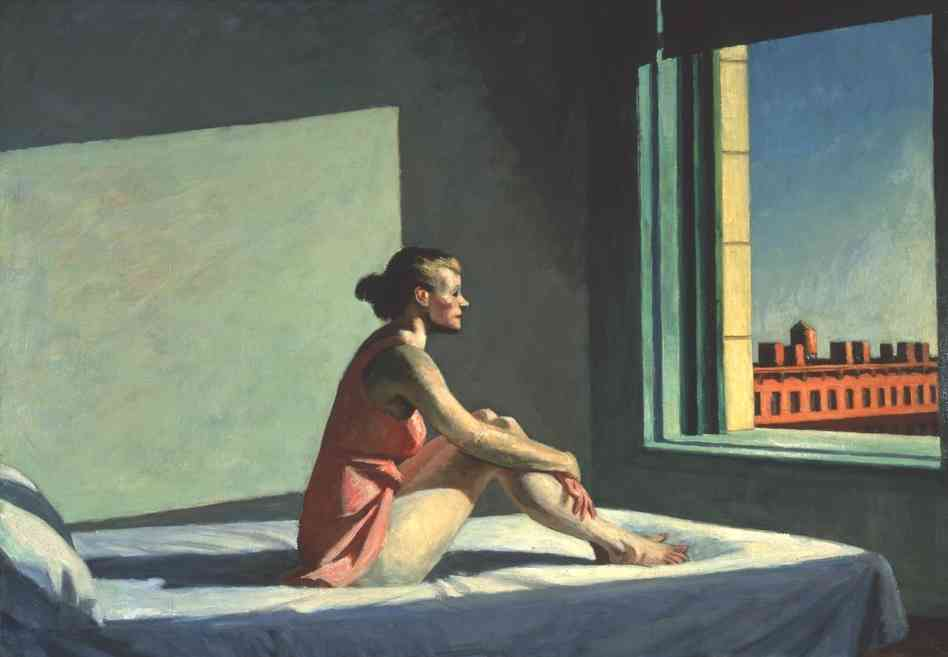
Hopper is not an artist who predicted the future. He painted it. It was already sitting in front of him, fully formed, under fluorescent light. Calling these paintings prophecy moves the start date of the loneliness crisis to somewhere in the present. But the fact is, it started a long time back. The artists repeatedly documented it, but we refused to pay heed.
There Are No Aritists Who Predicted The Future: The Condition Was Already Architectural by 1877
Artists who predicted the future are a myth. The condition we are doomed with now started earlier than Hopper. Start with Gustave Caillebotte.
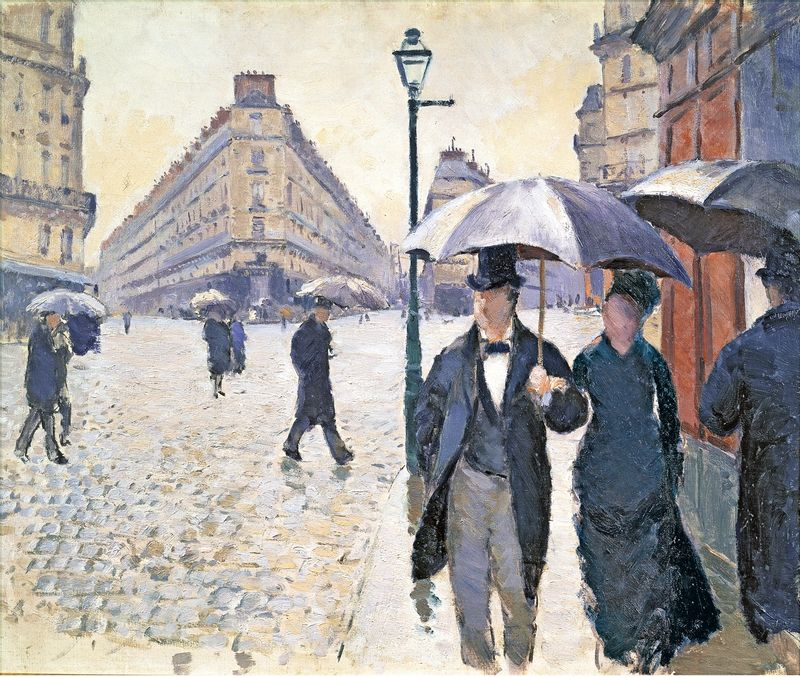
Paris Street; Rainy Day was painted in 1877 and shown at that year’s Impressionist exhibition. The setting is a street near the Saint-Lazare station, in a district that the railroad’s expansion and Baron Haussmann’s urban program had radically remade over the preceding two decades. Every street and every building in the picture had gone up within the artist’s own lifetime. Twenty-four pedestrians occupy the canvas.
Read More: The Beauty of Paris Through 7 Timeless Paintings
Almost none of them look at each other. The art historian Rose-Marie Hagen made the sharpest observation about the umbrellas: they appear to shield the figures from other people as much as from the weather. Caillebotte widened the boulevard beyond its real dimensions, which pushes the figures further apart and leaves them wandering past one another without contact.
This is not artists who predicted the future. This is not a man imagining what alienation might feel like one day. This is a painter standing in a city that had just been rebuilt around the movement of strangers, recording the result. The loneliness was in the street plan.
Hopper’s Denial Is The Most Useful Sentence In The Argument
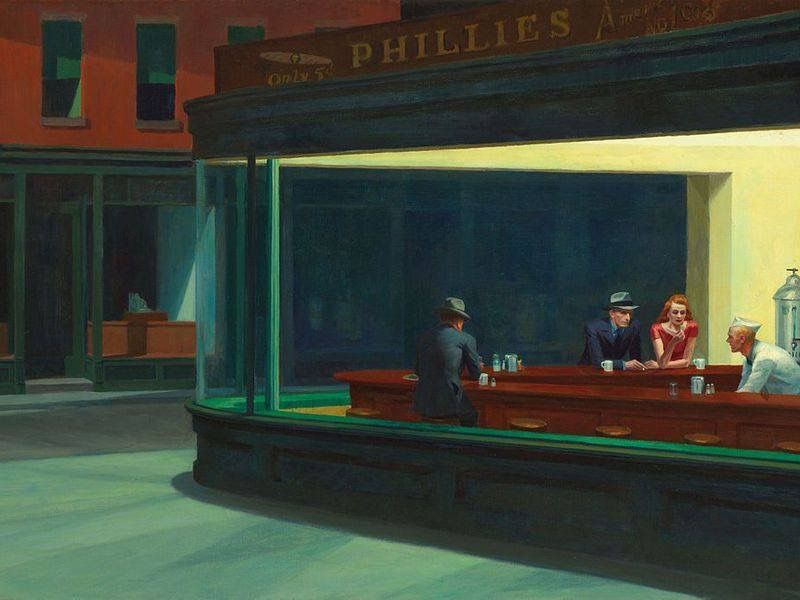
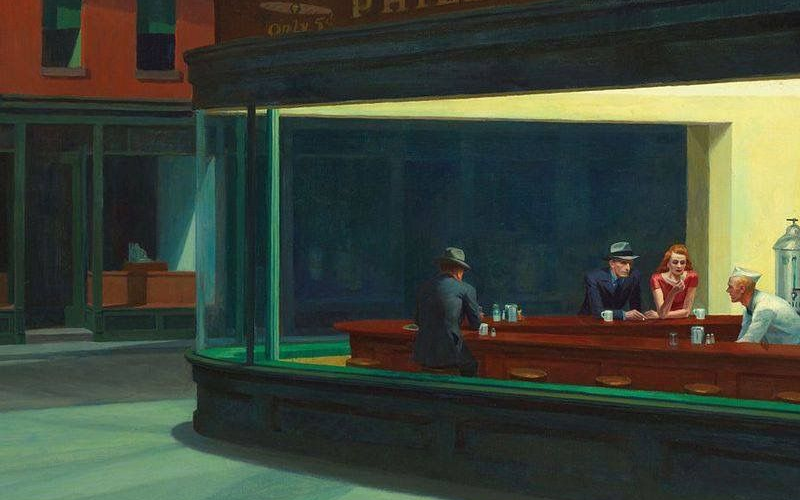
Nighthawks was finished in January 1942. The Art Institute of Chicago, which has owned it since that year, frames it as Hopper’s response to the bombing of Pearl Harbor and America’s entry into the war. There is no door into the diner. The angled glass seals the space and puts the viewer outside it, looking in.
Then there is what Hopper actually said about it. He rejected the idea that he had deliberately loaded this or any painting with symbols of human isolation and urban emptiness. He conceded only this: “Unconsciously, probably, I was painting the loneliness of a large city.”
Read More: 9 Edward Hopper Paintings That Celebrate the Beauty of Solitude
Artists who predicted the future would know he is prophesying. Hopper thought he was painting a restaurant on Greenwich Avenue and could not fully explain why it came out the way it did. The condition was so ordinary, so completely absorbed into the texture of 1942, that the man rendering it in oil could not name it on purpose.
More than foresight, it is ambient truth, caught by someone paying closer attention than everyone else.
2020 Was The Test, And The Prophecy Theory Failed It
In March 2020, the writer Michael Tisserand posted four Hopper canvases of solitary figures with a one-line caption: “We are all Edward Hopper paintings now.” It collected hundreds of thousands of likes, and the critic Jonathan Jones followed with a full essay in The Guardian. ARTnews published a rebuttal arguing the opposite. It almost started the whole series of artists who predicted the future.
The popular reading was that Hopper had seen lockdown coming. He hadn’t. A condition he documented in 1942 was still running at full capacity in 2020, unchanged in structure, and it took a global emergency and a suspension of normal life before a large number of people recognized it as their own.
We didn’t discover that Hopper was one of the artists who predicted the future. We discovered we had been living in the painting the whole time and calling it Tuesday.
George Tooker Removes All Doubt, Because He Told Us
If Hopper is circumstantial evidence, George Tooker is a signed statement.
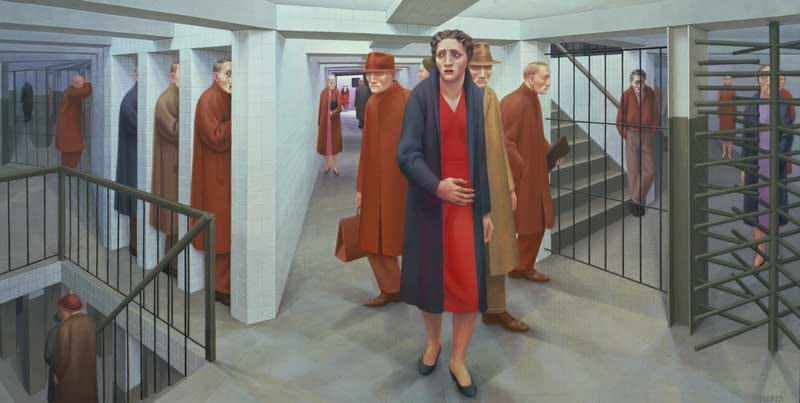
The Subway, painted in egg tempera in 1950 and held by the Whitney, uses multiple vanishing points to build a station where every figure stands physically close to others and psychologically estranged from all of them. Commuters are locked inside the grid cast by the metal grating’s shadows. The passages lead nowhere. Tooker described the work of this period as protest painting, driven by anger at the dehumanization of urban society and the isolation it produced. He chose the subway specifically because, to him, it represented “a denial of the senses and a negation of life itself.”
The commute existed. The office existed. The apartment where you knew none of your neighbors existed. Tooker was not warning us about a future arrangement of life. He was objecting to the current one, not as one of the artists who predicted the future but as someone living in the conditions, and we filed the objection under aesthetics.
What The Paintings Are Actually For
They are not signs of artists who predicted the future. These are not warnings. Warnings point forward. These point sideways, at the room you are already standing in.
Hopper’s wedge of glass with no door. Tooker’s exits that lead nowhere. Caillebotte’s boulevard was built wide enough to hold a crowd and keep every person in it apart. Three artists, three cities, seventy-three years between the first and the last, and one consistent finding.
They did not see the future. They saw us, clearly, and left the evidence where we could find it.
We are the ones who showed up late.
Postscript: Every artist in this piece was painting faces that refused to meet. Caillebotte’s pedestrians look past each other. Hopper’s four diners look at nothing. Tooker’s commuters look anywhere but sideways. If your work does the opposite, we want to see it. The 101 Art Book: Faces Edition is open now, inviting 101 artists worldwide to explore identity, emotion, and the stories a human face carries. Submissions close on 10 September 2026.