


7 Paintings That Capture the Beauty of Rain
Few things transform a landscape as completely as rain. Streets become mirrors, colors deepen, familiar landscapes soften, and even the busiest places seem to slow down for a moment. While some associate rainy days with melancholy, others find comfort in the steady rhythm of falling raindrops. For pluviophiles, those who love the rain, it offers a rare kind of peace, inviting reflection, nostalgia, and quiet wonder.
Artists have long been captivated by this transformation. Across centuries and cultures, rain has been far more than a weather phenomenon. It has symbolized divine protection in Indian miniature paintings, the unstoppable march of progress in nineteenth-century Britain, the quiet poetry of everyday life in Japan, and the emotional landscapes of Impressionist Europe. Some painters rendered every raindrop with remarkable precision, while others suggested an approaching storm through darkened skies, shimmering reflections, or a sea of umbrellas.
In this collection, we’ll journey through seven remarkable artworks that reveal the many faces of rain. From sacred monsoon scenes and mist-covered countryside to bustling city streets and fleeting moments beneath gray skies, these paintings remind us that the beauty of rain lies not only in the storm itself but in the stories, emotions, and memories it awakens. Whether you’re a devoted pluviophile or simply someone who enjoys the occasional rainy afternoon, these masterpieces might just make you see the next downpour a little differently.
Krishna Protects Gopis from the Rain by the Rajput School: A Monsoon Filled with Love and Devotion
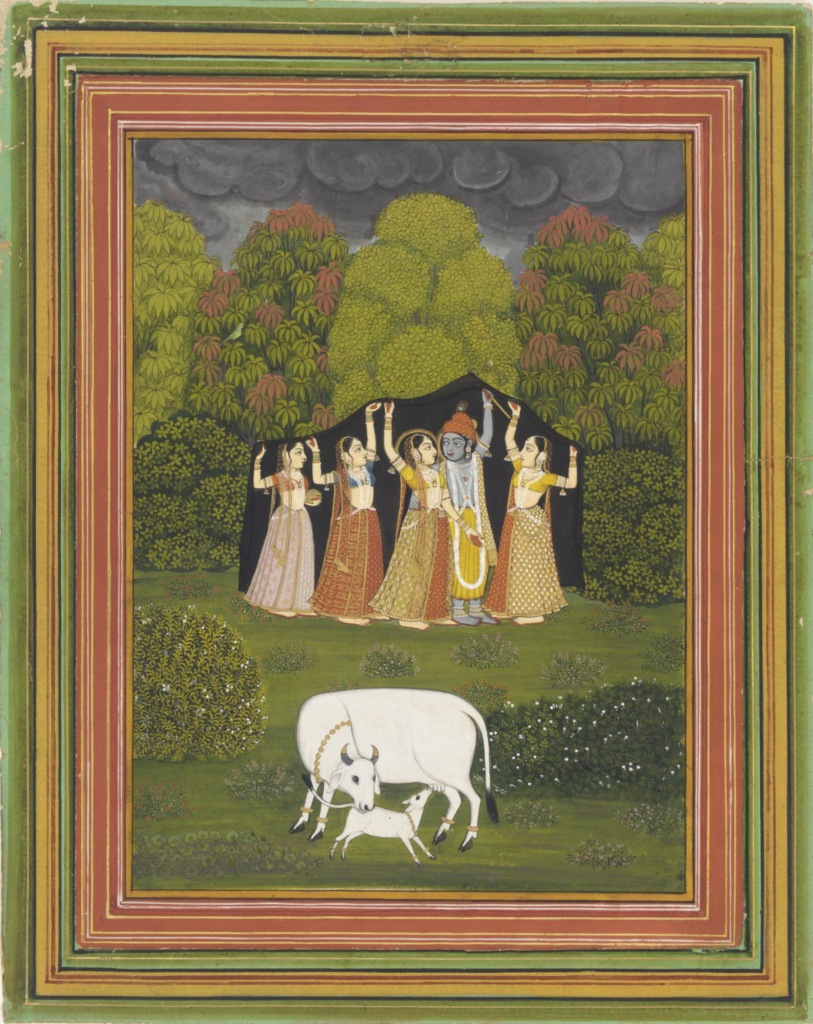
Long before artists used rain to express melancholy or solitude, painters in India’s Rajput courts celebrated it as a symbol of love, renewal, and divine grace. In Krishna Protects Gopis from the Rain, created by the Rajput School in eighteenth-century Rajasthan, the approaching storm isn’t the true subject. Instead, it quietly brings together one of Hindu mythology’s most beloved pairs, Krishna and Radha. Beneath brooding monsoon clouds, the two share an intimate glance while those around them seek shelter, creating a striking contrast between the chaos of the weather and the calmness of eternal love.
The painting is rich with symbolic details. Krishna’s luminous blue skin, golden robes, and halo immediately identify him as the divine protector, while Radha’s graceful presence reinforces their timeless bond. Around them, attendants gather beneath a canopy as the lush garden bursts with flowering trees and vibrant greenery, reminding us that the monsoon is not merely a season of storms but one of abundance. A cow and calf graze peacefully in the foreground, a subtle reference to Krishna’s childhood in Vrindavan and his role as the beloved cowherd.
Interestingly, the rain itself is barely visible. Rather than painting individual raindrops, the Rajput artist evokes the coming shower through dramatic dark clouds, windswept foliage, and figures instinctively reaching for cover. The atmosphere does all the storytelling, allowing viewers to feel the weight of the monsoon before it fully arrives.
Unlike many Western rain paintings that associate wet weather with loneliness or introspection, Krishna Protects Gopis from the Rain presents rainfall as something deeply life-giving. Here, the storm becomes a quiet witness to devotion, transforming the landscape into a place where nature, mythology, and love exist in perfect harmony.
Rain, Steam and Speed – The Great Western Railway by J. M. W. Turner: When Nature Meets the Machine
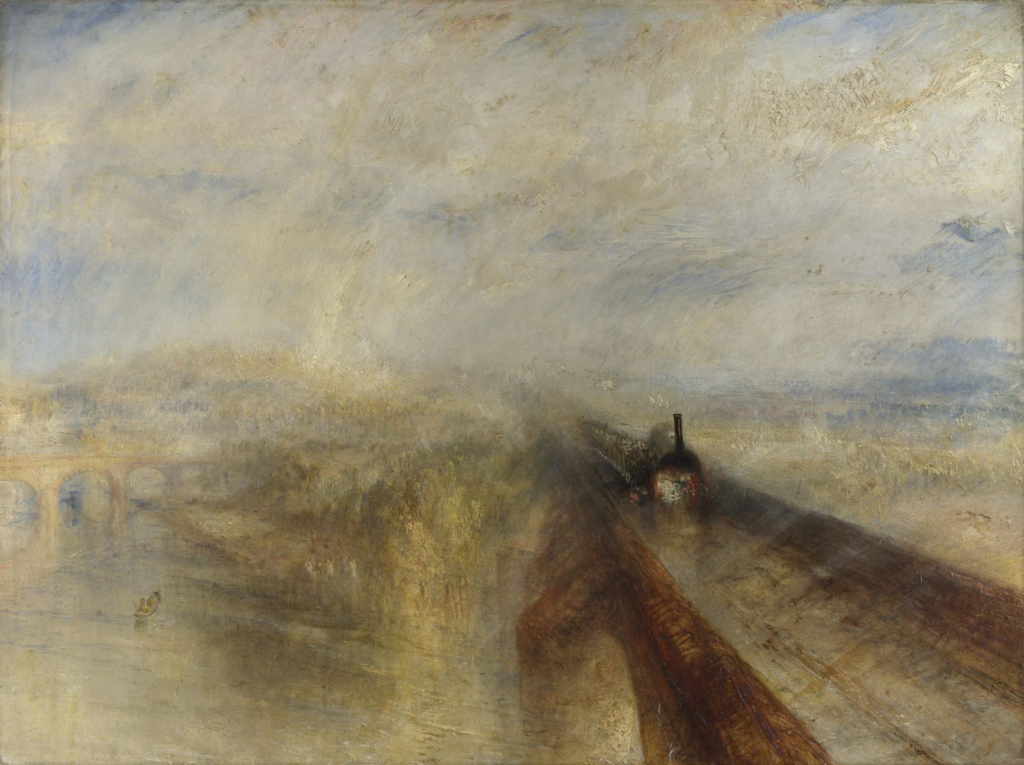
Few artists painted weather with as much drama as J. M. W. Turner, and Rain, Steam and Speed – The Great Western Railway is perhaps his most breathtaking tribute to a storm in motion. At first glance, the canvas feels almost impossible to grasp. Rain dissolves the landscape into a haze of golden light and swirling mist, while a locomotive charges straight toward the viewer with astonishing force. Nothing appears completely solid, yet every brushstroke contributes to the sensation of movement, making you feel as though you’re standing in the middle of the downpour as the train races past.
Painted in 1844, during the height of Britain’s Industrial Revolution, the work captures more than a rainy afternoon. It reflects a world undergoing rapid transformation, where steam-powered technology was beginning to reshape everyday life. Turner places the speeding train at the heart of a landscape softened by rain, suggesting that modern industry and the natural world were no longer separate forces but part of the same evolving story. Even the famous Maidenhead Railway Bridge beneath the locomotive seems to emerge and disappear through the mist, blurring the line between reality and atmosphere.
Look closely, and you’ll notice a tiny boat drifting quietly on the river below. Its gentle pace contrasts sharply with the roaring train overhead, creating a subtle reminder of how quickly the world was changing. Turner doesn’t present this contrast as a conflict but as a coexistence between old and new, stillness and speed, nature and invention.
What makes Rain, Steam and Speed – The Great Western Railway so unforgettable is that rain is never treated as a mere backdrop. It becomes the very element that unites steam, smoke, light, and landscape into one extraordinary vision. More than 180 years later, the painting still feels remarkably modern, proving that even the wildest storm can become a symbol of progress, possibility, and awe.
Rain by Vincent van Gogh: Finding Beauty in a Quiet Downpour
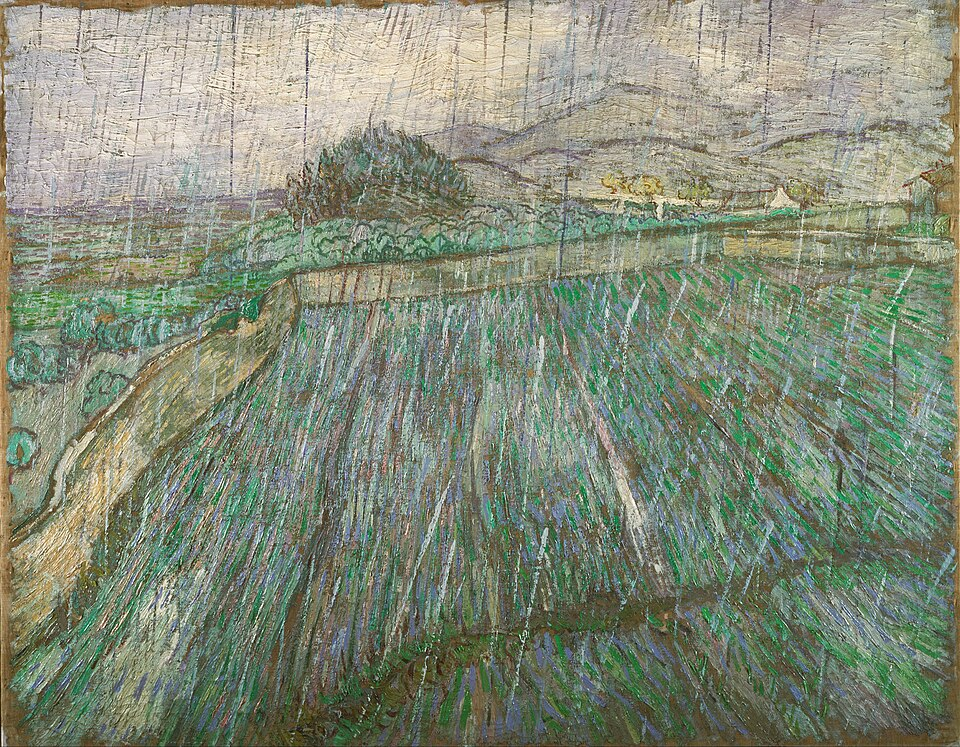
When people think of Vincent van Gogh, they often imagine blazing sunflowers, swirling stars, or vibrant cypress trees. Yet one of his most moving landscapes is Rain, a painting that captures the quiet poetry of a rainy day with remarkable sensitivity. Created in 1889 while Van Gogh was staying at the asylum of Saint-Paul-de-Mausole in Saint-Rémy, the work looks out across fields seen from his bedroom window. Instead of turning inward during this difficult chapter of his life, Van Gogh continued to observe the changing world outside, transforming even an ordinary rain shower into something deeply expressive.
The first thing that catches the eye is the rain itself. Rather than blending it softly into the landscape, Van Gogh paints long, fine diagonal lines sweeping across the canvas, creating the illusion of falling water. This striking technique was inspired by Japanese ukiyo-e prints, whose bold graphic style fascinated him throughout his career. The rhythmic lines don’t simply depict rain—they make you feel its steady, uninterrupted descent, as if you’re watching the storm unfold from the safety of the window.
Unlike the bright yellows and intense blues found in many of his paintings, Rain is filled with muted greens, earthy browns, and cool grays. These restrained colors create an atmosphere of stillness, where the fields appear wrapped in mist and the distant hills quietly fade into the horizon. The landscape feels suspended between movement and silence, revealing Van Gogh’s extraordinary ability to find emotion in the simplest moments.
What makes Rain so compelling is its sense of hope beneath the gloom. The storm doesn’t overwhelm the landscape, it nourishes it. Even during one of the most challenging periods of his life, Van Gogh found beauty in nature’s smallest transformations, reminding us that rain can be more than a symbol of sadness. Sometimes, it is simply a gentle pause that allows the world to breathe before beginning again.
Early Summer Rain by Utagawa Kunisada I: Turning Rain into Visual Poetry
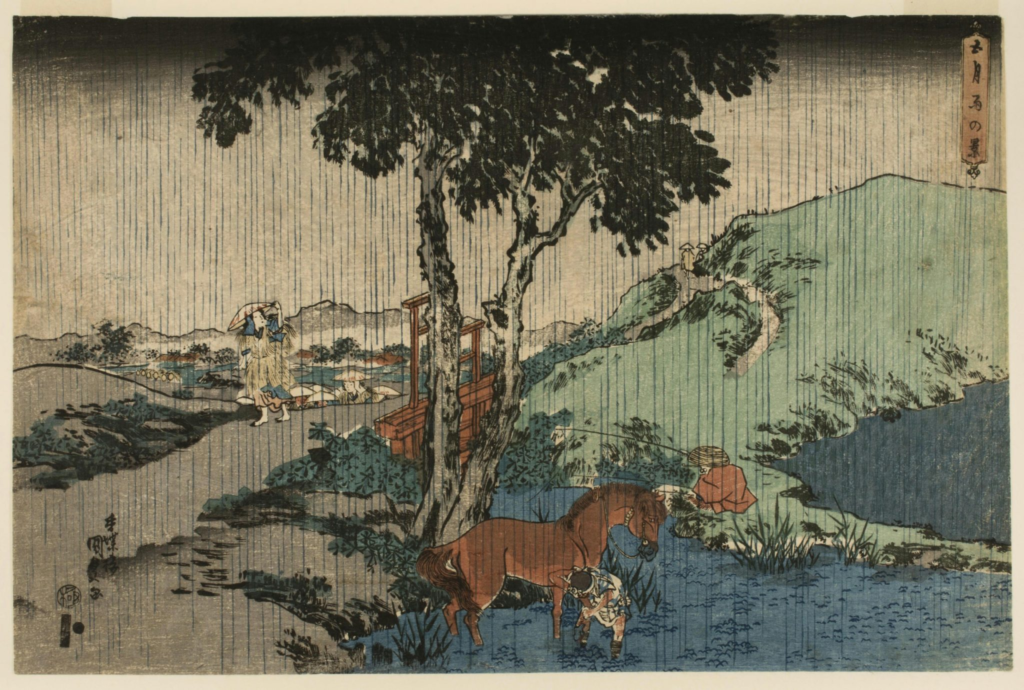
Long before European artists began experimenting with dramatic rain effects, Japanese printmakers had already mastered the art of depicting a passing shower. In Early Summer Rain (Samidare no Kei), Utagawa Kunisada I transforms rainfall into something both elegant and rhythmic, proving that even the simplest lines can evoke an entire atmosphere. Rather than making the storm the focus, he invites viewers to notice how everyday life quietly continues beneath it.
At first glance, the composition feels serene. Rolling hills, calm waters, and winding paths stretch across the landscape in perfect balance. But look a little closer, and small figures begin to emerge throughout the scene. Some walk along the paths, others continue their daily routines, seemingly unfazed by the weather around them. The rain falls in precise, evenly spaced parallel lines, a hallmark of ukiyo-e woodblock prints. Instead of appearing chaotic or heavy, the shower feels measured and almost musical, giving the landscape a gentle rhythm that guides the eye across the image.
Published in 1832 as part of the Unlimited Series of Landscapes, the print reflects the Japanese appreciation for nature’s fleeting moods. Rain isn’t presented as an obstacle or an inconvenience but as another beautiful moment within the changing seasons. This quiet philosophy would later influence European artists such as Vincent van Gogh and Edgar Degas, who admired Japanese prints for their bold compositions and innovative ways of portraying weather and movement.
What makes Early Summer Rain so enduring is its remarkable restraint. There are no dramatic gestures or emotional outbursts, only the peaceful coexistence of people and nature. Kunisada reminds us that rain doesn’t always demand attention. Sometimes, it simply becomes part of life’s rhythm, gently washing over the landscape while the world carries on, one quiet moment at a time.
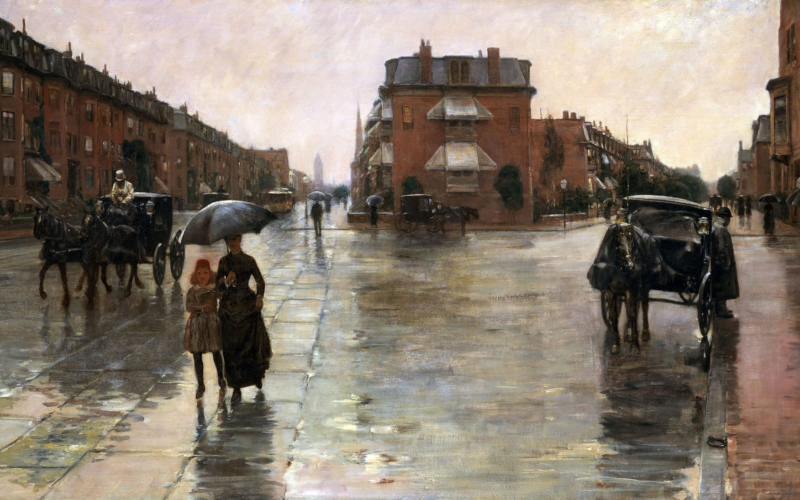
Rainy Day, Boston by Childe Hassam: An Ordinary Street Transformed by Rain

A rainy city has a way of slowing everything down, inviting us to notice reflections, shifting light, and the quiet rhythm of everyday life. Childe Hassam captured that feeling beautifully in Rainy Day, Boston, an Impressionist masterpiece that turns an ordinary street into a scene filled with atmosphere and elegance. Painted in 1885, the work offers a glimpse of Boston’s South End, where horse-drawn carriages roll through rain-slicked streets and pedestrians move beneath umbrellas, wrapped in the muted colors of a wet afternoon.
Unlike artists who treated rain as dramatic or overwhelming, Hassam focused on its subtle effects. The damp pavement reflects the surrounding buildings, softening their edges and giving the city an almost dreamlike quality. The overcast sky mutes the palette, allowing gentle grays, browns, and hints of blue to create a calm, contemplative mood. Even with people and carriages moving through the composition, there is a surprising sense of stillness, as though the rain has briefly paused the city’s usual pace.
One of the painting’s most intriguing features is its composition. Rather than placing a figure or landmark at the center, Hassam leaves the middle of the boulevard remarkably open, drawing the eye down the broad, rain-covered street. This layout reflects the influence of Paris, where the artist admired Baron Haussmann’s grand boulevards during his travels. Yet despite its European inspiration, the painting feels unmistakably American, preserving a moment in Boston’s rapidly changing urban landscape.
What makes Rainy Day, Boston so timeless is its ability to celebrate the beauty of the everyday. There are no heroic events or dramatic storms, only familiar people going about their lives beneath gray skies. Hassam reminds us that sometimes the most memorable scenes are the ones we might otherwise hurry past, especially when the rain encourages us to slow down and truly look.
Jockeys in the Rain by Edgar Degas: Capturing Motion Beneath a Storm
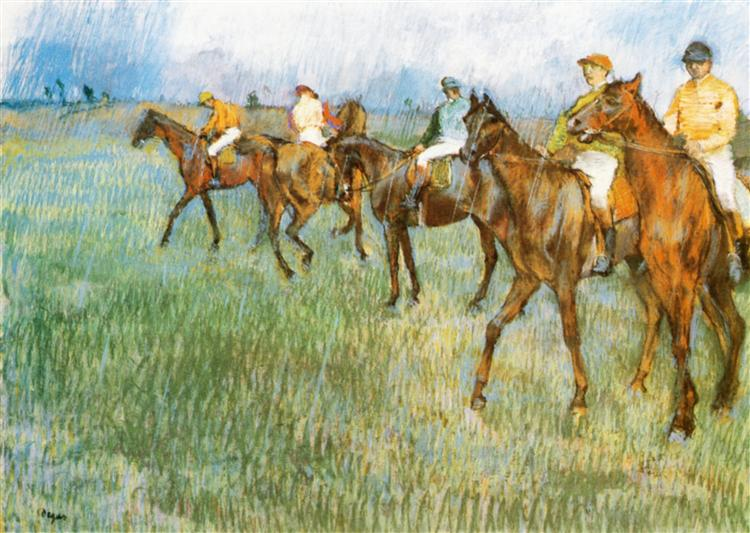
When Edgar Degas painted movement, he rarely chose obvious moments. Rather than focusing only on his famous ballerinas or racehorses in full stride, he often found beauty in the pauses between action. In Jockeys in the Rain, Degas places five riders and their horses beneath a gray, rain-soaked sky, creating a scene that feels both fleeting and quietly cinematic. Nothing dramatic appears to happen, yet the painting hums with anticipation, as though the rain has momentarily suspended time before the race resumes.
The composition is strikingly open. The jockeys are scattered across a broad landscape instead of being tightly grouped, allowing the vast field and heavy atmosphere to dominate the scene. Delicate diagonal strokes sweep across the canvas to suggest falling rain, a technique inspired by the Japanese woodblock prints that fascinated many European artists in the nineteenth century. Rather than painting every raindrop, Degas uses rhythm and repetition to let viewers sense the weather through movement alone.
Unlike traditional sporting scenes that celebrate competition and victory, Jockeys in the Rain is more interested in observation than spectacle. The horses stand calmly, the riders appear relaxed, and the rain softens every edge of the landscape. The weather becomes a quiet equalizer, reducing both humans and animals to small figures within the vastness of nature. It is an unexpected perspective from an artist so often associated with bustling theatres and lively rehearsals.
What makes this painting memorable is its subtlety. Degas transforms a brief, ordinary moment into something contemplative, reminding us that rain can change not only the appearance of a landscape but also its emotional tempo. Instead of rushing the story forward, the shower creates space for stillness, patience, and reflection, qualities that make this one of his most quietly compelling works.
The Umbrellas by Pierre-Auguste Renoir: A Rainy Street Filled with Untold Stories
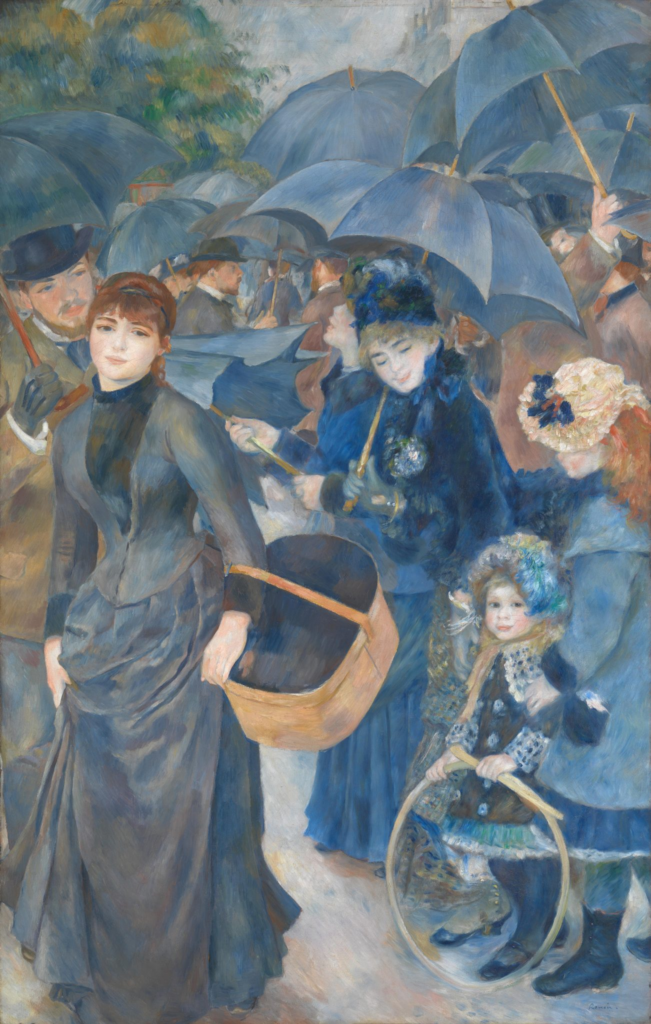
Rain often brings strangers together, if only for a fleeting moment, and Pierre-Auguste Renoir captures that beautifully in The Umbrellas. Set on a bustling Paris street, the painting is filled with people weaving through one another beneath a sea of dark umbrellas. At first glance, it feels like a simple snapshot of city life, but the longer you look, the more stories begin to emerge. Every figure seems caught in a different moment, turning an ordinary rainy afternoon into a scene rich with curiosity and quiet human drama.
Rather than placing the focal point at the center, Renoir guides our attention toward a young woman walking without an umbrella. Surrounded by people sheltered from the rain, she immediately stands out. Her calm expression contrasts with the busy crowd around her, while a well-dressed gentleman beside her appears to glance in her direction, hinting at a narrative the artist never fully reveals. Nearby, an elegantly dressed mother and her daughters add another layer to the composition, reflecting the different lives unfolding within the same fleeting moment.
Although the rain itself is barely visible, its presence shapes everything in the painting. The tightly packed umbrellas create a rhythmic pattern across the canvas, while the cool light and muted sky suggest a damp Parisian day. Renoir doesn’t need falling raindrops to convince us of the weather; instead, he lets the reactions of people tell the story. The storm becomes something experienced collectively, connecting strangers through shared circumstance.
More than a century after it was painted, The Umbrellas remains one of art history’s most beloved depictions of rain because it reminds us that weather is never just about the sky. Sometimes, a passing shower changes the way people move, notice one another, or briefly share the same space. In Renoir’s hands, a rainy street becomes a stage where countless untold stories quietly unfold.
Rain has inspired artists in countless ways, but these seven paintings reveal that it has never carried just one meaning. It can be a symbol of divine love, a force of nature, a quiet companion to solitude, or simply the backdrop to an ordinary day made extraordinary. Whether it’s Turner’s storm racing alongside a locomotive, Van Gogh’s peaceful fields seen through falling rain, or Renoir’s crowded Parisian streets beneath a canopy of umbrellas, each artist reminds us that the weather we often overlook can hold remarkable emotional depth.
Perhaps that’s why rainy-day paintings continue to resonate across centuries. They encourage us to slow down, notice the details, and appreciate the fleeting moments that storms create, reflections on wet streets, softened landscapes, shared shelter, and the quiet beauty that appears when the world pauses for a while.
What’s your favorite thing about the monsoon season?
Loved discovering these rain-soaked masterpieces? You might also enjoy exploring another side of art history with our feature, 7 Vampire Artworks That Tell the Story, where myth, mystery, and symbolism come together in unforgettable works.