

7 Famous Artworks That Explored Madness Before Modern Psychology
Throughout history, madness has been one of humanity’s greatest mysteries. Long before psychology emerged as a scientific discipline, people turned to religion, mythology, and folklore to explain behaviors they could not understand. Emotional distress, hallucinations, grief, obsession, or irrational actions were often interpreted as signs of divine punishment, demonic possession, or moral failure rather than conditions deserving empathy and care. As societies struggled to make sense of the human mind, artists began doing something remarkable, they gave these invisible experiences a visual form.
Art has always reflected the emotional landscape of its time, and nowhere is this more evident than in the many masterpieces that explore madness in its various forms. From the symbolic chaos of medieval paintings to haunting portrayals of institutional life, from mythological figures consumed by excess to deeply personal expressions of anxiety and grief, artists have continually challenged viewers to confront emotions that are often difficult to articulate. These works do more than depict mental anguish; they reveal changing cultural attitudes toward vulnerability, compassion, fear, and the complexities of the human psyche.
Rather than offering simple answers, these masterpieces invite us to ask difficult questions about what it means to lose control, how societies define “normal,” and why art has long served as a bridge between inner experience and outward expression. Together, these seven artworks that explored madness reveal how each generation interpreted one of the most profound and enduring aspects of the human condition.
1. When Madness Was Seen as Sin: The Chaotic World of The Garden of Earthly Delights
Artwork: The Garden of Earthly Delights (c. 1490–1510)
Artist: Hieronymus Bosch

Long before psychiatry, therapy, or even the language to describe mental illness existed, people searched for explanations for behaviors they could not understand. In medieval Europe, what we might recognize today as psychological distress was often interpreted through a religious lens. Hallucinations, irrational behavior, emotional instability, or uncontrollable impulses were frequently viewed as signs of demonic influence, divine punishment, or the consequences of moral corruption. Art became one of the most powerful mediums through which these fears were visualized, and few artists captured this worldview more vividly than Hieronymus Bosch.
Painted around 1490–1510, The Garden of Earthly Delights remains one of the most enigmatic masterpieces in Western art history. At first glance, it appears almost fantastical, a sprawling landscape populated by oversized fruits, exotic animals, hybrid creatures, and countless nude figures engaged in curious and often inexplicable activities. Yet beneath its dreamlike surface lies a carefully constructed moral narrative. Designed as a triptych, the left panel presents the Garden of Eden, the central panel immerses viewers in scenes of earthly pleasure and temptation, while the right panel descends into a terrifying vision of Hell. Together, they offer a powerful warning about the consequences of unchecked desire and the loss of spiritual discipline.
What continues to make Bosch’s work extraordinary is its uncanny psychological quality. Although rooted in medieval Christian beliefs, its strange imagery feels surprisingly modern. The distorted figures, impossible landscapes, and surreal combinations of humans, animals, and objects evoke the disorienting logic of dreams, or nightmares. Centuries before Surrealism emerged, Bosch created a visual language that continues to fascinate psychologists, art historians, and viewers alike because it captures the unsettling feeling of a world where reason has collapsed.
Rather than portraying madness as the struggle of a single individual, Bosch suggests that chaos can consume entire societies when morality gives way to excess. More than five centuries later, The Garden of Earthly Delights remains one of art history’s most haunting explorations of fear, temptation, and the fragile boundary between order and disorder, reminding us that the human mind has long been one of art’s most compelling mysteries.
2. Compassion Before Psychiatry: Father Jofré Protecting a Madman
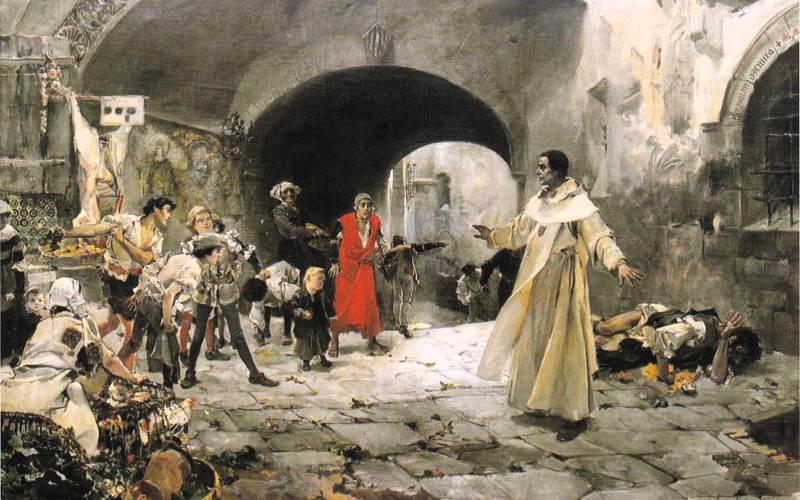
Artwork: Father Jofré Protecting a Madman (c. 1887)
Artist: Joaquín Sorolla
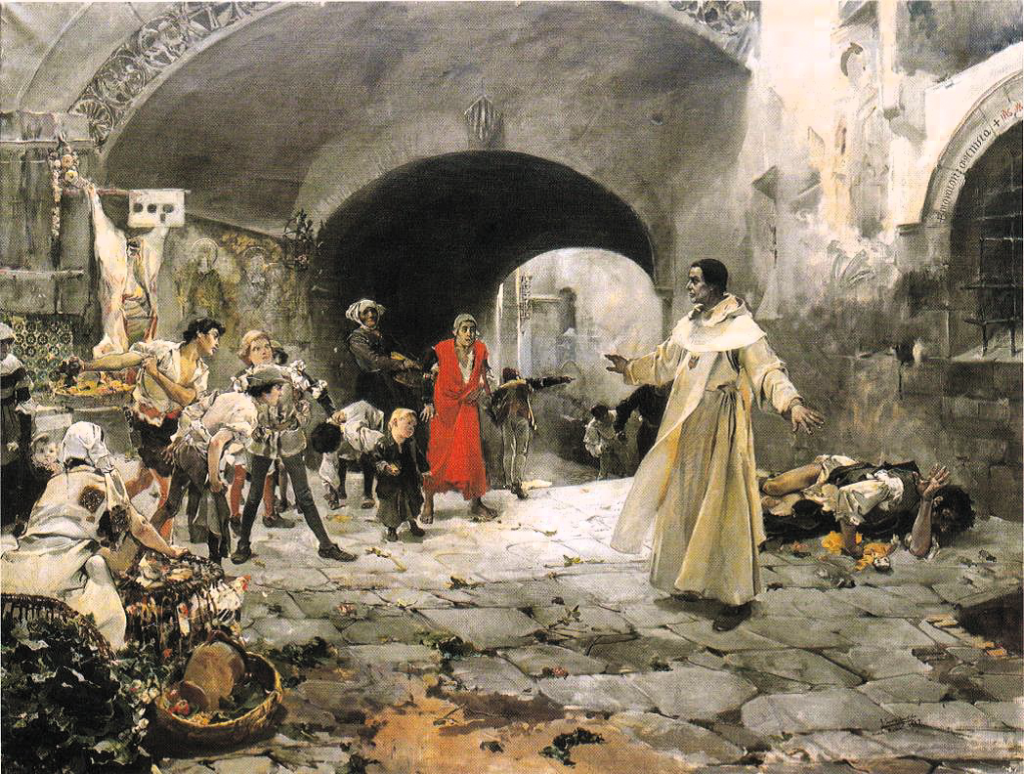
When we think of historical attitudes toward mental illness, images of chained patients, overcrowded asylums, and widespread fear often come to mind. For centuries, those who behaved differently were misunderstood, ridiculed, or even believed to be possessed by evil spirits. Yet, hidden within this difficult history is a remarkable story of compassion, one that Spanish painter Joaquín Sorolla brought to life in Father Jofré Protecting a Madman.
The painting is inspired by a real event from the early fifteenth century involving Father Joan Gilabert Jofré, a Mercedarian friar in Valencia. According to historical accounts, Father Jofré witnessed a mentally ill man being violently attacked and mocked by a crowd in the streets. Rather than turning away, he intervened, shielding the man from further abuse. The incident deeply affected him and led him to advocate for the care and protection of people experiencing mental illness at a time when empathy toward them was exceptionally rare.
Sorolla captures this defining moment with striking emotional intensity. At the center of the composition, Father Jofré stands as a calm yet commanding presence, physically placing himself between the vulnerable man and an aggressive crowd. The contrast is powerful. While the surrounding figures embody fear, ignorance, and cruelty, Father Jofré represents dignity, compassion, and moral courage. Instead of portraying the man as a spectacle or a threat, Sorolla emphasizes his humanity, encouraging viewers to see him as someone deserving of care rather than condemnation.
The story extends beyond the canvas. Inspired by this encounter, Father Jofré helped establish the Hospital dels Folls (“Hospital of the Innocents and the Insane”) in Valencia in 1409, widely regarded as one of Europe’s earliest institutions dedicated to the humane care of people with mental illnesses. Although medical understanding was still limited, the hospital represented a significant shift away from punishment toward protection and support.
Unlike many artworks that associate madness with fear or chaos, Father Jofré Protecting a Madman tells a different story, one rooted in empathy. It reminds us that long before modern psychiatry emerged, there were individuals who challenged societal prejudice and recognized the importance of treating vulnerable people with kindness. In the broader history of art, Sorolla’s painting stands as a moving tribute to compassion, proving that sometimes the most radical act is simply choosing humanity over judgment.
3. Behind the Walls of an Asylum: Francisco Goya’s Unflinching Look at Madness
Artwork: The Madhouse (c. 1812–1819)
Artist: Francisco Goya

What happens when society chooses to hide what it cannot understand? Long before mental health became a subject of scientific research or public conversation, those living with psychological illnesses were often confined behind the walls of institutions that prioritized control over care. Few artists captured this harsh reality as powerfully as Francisco Goya in The Madhouse.
Created during one of the most turbulent periods of Goya’s life, the painting offers a haunting glimpse into the conditions of early nineteenth-century psychiatric asylums in Spain. Rather than presenting an orderly hospital or a place of healing, Goya reveals a dim, claustrophobic interior where men occupy a cramped enclosure under the watch of unseen authority. Some figures shout, others gesture wildly, while a few appear withdrawn into themselves. Their movements differ dramatically, yet they share the same confined space, reinforcing the sense that individuality has disappeared behind the label of “madness.”
The composition itself heightens this emotional weight. Light filters in from high windows, illuminating only fragments of the room while leaving much of the space submerged in shadow. This dramatic contrast between light and darkness does more than create atmosphere, it reflects the uncertainty surrounding mental illness during Goya’s lifetime. Patients were visible enough to be feared but rarely understood. Their humanity existed, yet it remained obscured beneath layers of superstition, misunderstanding, and institutional neglect.
The painting also carries a deeply personal dimension. Goya endured profound physical and emotional hardships throughout his life, including a severe illness that left him permanently deaf. He lived through war, political upheaval, and periods of isolation that profoundly shaped his artistic vision. While historians caution against reducing his work to autobiography, these experiences undoubtedly sharpened his sensitivity to suffering, alienation, and the darker aspects of human existence.
Unlike sentimental portrayals, The Madhouse refuses to offer easy comfort. Instead, it confronts viewers with difficult questions: Who decides what is considered “normal”? What happens when fear replaces compassion? And how does society treat those whose minds function differently? More than two centuries later, the painting remains unsettling because it exposes not only the suffering within the asylum, but also the attitudes of the world outside its walls. In doing so, Goya transformed a hidden social reality into one of art history’s most enduring reflections on mental illness, exclusion, and the human condition.
4. Intoxication, Excess, and the Fine Line Between Reason and Chaos: Bacchus
Artwork: Bacchus (1496–1497)
Artist: Michelangelo

Madness in art has not always been portrayed through suffering or psychological distress. Sometimes, it appeared in the form of ecstasy, intoxication, and the deliberate surrender of reason. During the Renaissance, artists often turned to classical mythology to explore the more unpredictable sides of human nature, and few works embody this idea as strikingly as Michelangelo’s Bacchus.
Created when Michelangelo was in his early twenties, the marble sculpture depicts Bacchus, the Roman god of wine, fertility, and revelry. Unlike the idealized gods of ancient sculpture who stand poised and perfectly balanced, Bacchus appears noticeably unstable. His body leans awkwardly, his gaze is unfocused, and his posture suggests that he is struggling to remain upright after drinking deeply from the goblet he holds. Behind him, a mischievous satyr quietly nibbles at a cluster of grapes, subtly reinforcing the themes of indulgence and excess.
This departure from classical perfection was remarkable for its time. Rather than presenting divinity as calm, rational, and controlled, Michelangelo portrayed a god overcome by his own pleasures. The sculpture captures a fleeting moment where confidence begins to dissolve into vulnerability, inviting viewers to consider how easily reason can give way to impulse. The slight imbalance in Bacchus’s stance is so convincing that many viewers instinctively feel he might topple forward at any moment, a masterful demonstration of Michelangelo’s understanding of anatomy, movement, and psychological expression.
Beyond mythology, Bacchus reflects a broader Renaissance fascination with the duality of human nature. Wine symbolized celebration, creativity, and communal joy, but it also represented the dangers of losing self-control. In literature, philosophy, and art, intoxication often served as a metaphor for emotional excess, irrational behaviour, and the blurred boundary between freedom and chaos. Michelangelo distilled these ideas into a single figure whose physical instability mirrors a deeper loss of restraint.
Unlike later artworks that directly depict mental illness, Bacchus explores a different form of madness, one that is temporary, symbolic, and deeply rooted in ancient myth. It reminds us that the history of madness in art extends beyond medical conditions to include moments when passion, desire, and excess overwhelm reason. Through this extraordinary sculpture, Michelangelo transformed marble into a meditation on one of humanity’s oldest questions: how much control do we truly have over ourselves when temptation takes hold?
5. Distorted Bodies, Disturbed Minds: Egon Schiele’s Radical Vision of the Human Psyche
Artwork: I Will Gladly Endure for Art and My Loved Ones (1912)
Artist: Egon Schiele

By the early twentieth century, artists were no longer using madness solely as a religious warning or a mythological symbol. Instead, they began turning inward, exploring the complexities of the human psyche through deeply personal and emotionally charged works. Among the most provocative voices of this shift was Austrian Expressionist Egon Schiele, whose unsettling portraits challenged conventional ideas of beauty, sanity, and the human body.
Schiele’s I Will Gladly Endure for Art and My Loved Ones exemplifies his fearless approach to self-expression. The figures in his work are often elongated, angular, and unnervingly thin, with twisted limbs, hollow eyes, and tense, almost contorted poses. Rather than striving for anatomical perfection, Schiele intentionally distorted the body to reveal emotional and psychological truths. His paintings invite viewers to look beyond physical appearances and confront the vulnerability, desire, loneliness, and anxiety that lie beneath the surface.
At the time, Schiele’s work shocked audiences. His frank depictions of sexuality and the nude human form challenged the conservative values of early twentieth-century Vienna, leading to accusations of obscenity and even a brief imprisonment in 1912. Yet these controversies often overshadow the emotional depth of his art. His figures are not merely provocative, they are profoundly exposed, stripped of social pretence and presented with an honesty that can feel both uncomfortable and deeply moving.
Expressionism sought to communicate inner experience rather than external reality, and Schiele became one of its most powerful practitioners. Through jagged lines, muted colours, and exaggerated forms, he transformed the body into a mirror of the mind. Every bent limb and intense gaze seems to speak of emotional conflict, making the viewer feel the weight of psychological tension rather than simply observe it.
Unlike earlier artists who depicted madness as something imposed from the outside, through sin, possession, or institutionalisation, Schiele presented emotional unrest as an intimate part of the human experience. His work suggests that the mind’s struggles are often invisible, finding expression through gesture, posture, and the fragile language of the body itself.
More than a century later, Schiele’s paintings continue to provoke strong reactions because they refuse to romanticise pain or disguise vulnerability. Instead, they remind us that art has the power to express emotions that words often fail to capture, making visible the hidden complexities of the human psyche.
6. The Painting That Made Anxiety Visible: The Scream
Artwork: The Scream (1893)
Artist: Edvard Munch

Few artworks have become as universally associated with emotional distress as Edvard Munch’s The Scream. More than a century after its creation, its haunting central figure, with hands pressed against its face beneath a swirling, blood-red sky, remains one of the most recognizable images in the history of art. Yet despite its fame, the painting is often misunderstood. It is not simply a portrait of fear; it is an attempt to visualize an overwhelming psychological experience that words struggle to describe.
The inspiration for The Scream came from an experience Munch recorded in his diary. While walking with two friends near Oslo at sunset, he described suddenly feeling exhausted as the sky turned “blood red.” In that moment, he wrote that he sensed “an infinite scream passing through nature.” This account has become one of the most quoted passages in art history because it reveals that the scream does not necessarily come from the figure itself. Instead, the figure appears to be reacting to a terrifying force that seems to engulf the entire landscape.
Everything in the composition reinforces this emotional intensity. The bridge cuts sharply across the canvas, leading the eye toward the solitary figure isolated from the two distant companions who continue walking without noticing its distress. The sky ripples with vivid reds and oranges, while the fjord and surrounding hills seem to twist and vibrate, dissolving the boundary between the external world and the inner mind. Munch abandons realistic representation in favour of emotional truth, allowing colour, line, and movement to communicate feelings that cannot be easily articulated.
Created during the rise of Expressionism, The Scream transformed personal emotion into universal experience. Although scholars have interpreted the work through lenses ranging from anxiety and grief to existential dread, its enduring power lies in its openness. Viewers from different cultures and generations continue to recognize something familiar in its distorted forms, whether it is stress, loneliness, uncertainty, or the feeling of being overwhelmed by the modern world.
Rather than offering an explanation for madness, Munch gives shape to an emotion that many people have felt but few could visualize. In doing so, The Scream became more than a masterpiece of Expressionism; it became a timeless symbol of the fragile relationship between the human mind and the world around it. Even today, its silent cry continues to echo across generations, reminding us that some emotions transcend both language and time.
7. Beauty, Grief, and the Tragedy of Ophelia: When Madness Floated into Art
Artwork: Ophelia (1851–1852)
Artist: John Everett Millais

Few images in Western art capture the haunting intersection of beauty and tragedy as memorably as John Everett Millais’ Ophelia. Inspired by Hamlet, the painting depicts one of literature’s most heartbreaking moments: Ophelia, driven into emotional despair after the death of her father and the rejection of the man she loves, floating silently in a stream moments before her death. Rather than portraying the chaos that led to her breakdown, Millais freezes a single, quiet instant, inviting viewers to contemplate the fragile boundary between life, grief, and psychological collapse.
Completed in 1852, Ophelia is celebrated as one of the defining masterpieces of the Pre-Raphaelite Brotherhood, a movement known for its extraordinary attention to nature and symbolism. Every flower surrounding Ophelia carries meaning drawn from Shakespeare’s text and the Victorian language of flowers. Poppies suggest death, daisies symbolize innocence, violets evoke faithfulness, while willows growing along the riverbank represent forsaken love. These carefully chosen botanical details transform the landscape into an emotional narrative, where nature mourns alongside the tragic heroine.
What makes the painting especially compelling is its striking contrast between serenity and sorrow. Ophelia’s face appears peaceful, her hands gently outstretched, and her richly embroidered dress spreads across the water like a luminous tapestry. Yet beneath this visual beauty lies a devastating story of loss, isolation, and emotional fragility. Millais avoids sensationalizing her suffering; instead, he creates a deeply poetic meditation on grief, allowing silence and stillness to carry the emotional weight.
The work also reflects Victorian attitudes toward women’s mental health. During the nineteenth century, emotional distress in women was frequently romanticized or misunderstood, often reduced to notions of “female hysteria” or delicate sensibility. Through Ophelia, these cultural perceptions found one of their most enduring visual expressions. While modern audiences may interpret her story through the lens of trauma and mental health, the painting also invites reflection on how societies have historically viewed vulnerability, particularly in women.
More than 170 years after its creation, Ophelia continues to captivate audiences because it balances exquisite beauty with profound sadness. It reminds us that madness in art is not always depicted through dramatic gestures or terrifying visions. Sometimes, it is conveyed through quiet resignation, symbolic detail, and the stillness of a single moment. In Millais’ hands, Ophelia becomes more than Shakespeare’s tragic heroine, she becomes a timeless symbol of the emotional depths that art has the power to reveal.
The history of madness in art is not simply a history of mental illness, it is a history of how humanity has tried to understand itself. Across centuries, artists have transformed fear, grief, obsession, vulnerability, and emotional turmoil into powerful visual narratives that continue to resonate today. While our understanding of mental health has evolved significantly, these works remain relevant because they remind us that emotions often transcend time, culture, and language.
Whether through Bosch’s surreal visions, Goya’s haunting asylum, Munch’s overwhelming anxiety, or Millais’ tragic Ophelia, each masterpiece offers a different perspective on the fragile relationship between the mind and the world around it. Together, they demonstrate that art is not only a reflection of history but also a mirror of our shared emotional experiences.
If you could add one more artwork to this list, which masterpiece would you choose?
If these masterpieces sparked your curiosity, why not continue exploring the stories behind art? Our roundup of art films every artist and art lover should watch offers another fascinating way to experience the worlds, struggles, and inspirations of great artists.