
5 artists on the feedback that kept them creating

At Arts to Hearts Project, we talk to artists every day about their process, their struggles, their breakthroughs. But there is one conversation we do not have often enough. About feedback. About the moment someone said something about your work that changed how you saw it or how you saw yourself.
Because making art is a lonely process. You spend hours alone with a piece, pushing through doubt, making decisions nobody will ever see. And then you put it out into the world and you wait. Most of the time people say it is beautiful and move on. But every once in a while someone says something that tells you they actually saw what you were trying to do. That they felt the thing you were not sure anyone would notice.
Those moments keep artists going. We asked our community one simple question: What is the best feedback you have ever received on your artwork?
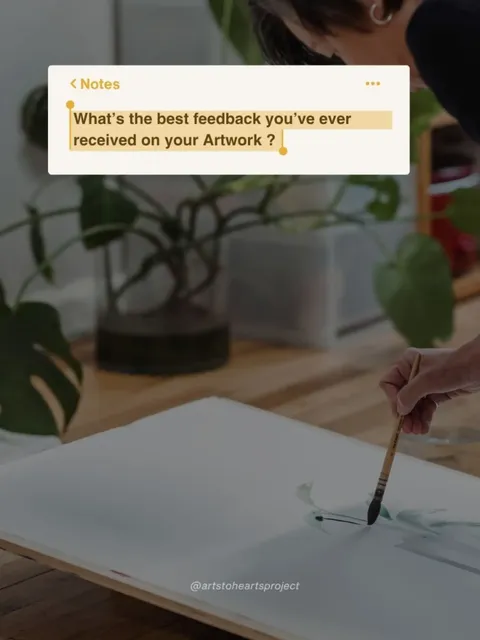
And here is what they shared with us.
A stranger walked into her studio and handed her the best reason to keep making art.
Most feedback tells you that your work is beautiful. Occasionally, if you are lucky, someone tells you that your work is true. And every once in a while, someone walks into a room, stands in front of something you made, and tells you that they saw themselves in it. Not a polished version. Not the version they show the world. The real one. The one still figuring out who it is becoming.

He had just walked away from a career treating children with cancer because he could not carry the weight of it anymore. He was starting over. And he walked into Marina’s open studio in Berlin, stood in front of her work, and felt completely at home. He wanted one piece for the young women he would be helping. And another for himself. Because it felt like his.
What Marina @marina.schulze.art took away from that moment is something every artist needs to hear. It is not about what you intended to say. It is about the space your work creates when someone else walks into it and brings their whole life with them. She made it. He needed it. And somehow, without planning any of it, they found each other.
Nobody taught her how to talk about art. Maybe that is exactly why what she said was so perfect.
We have read exhibition reviews. We have read catalogue essays. We have read carefully worded statements from collectors who have spent decades looking at art. And none of it, not one word of it, has ever come as close to describing what a painting actually does to a person as what an eight year old girl said standing in front of a large canvas full of daisies.

She did not talk about the brushwork. She did not mention the composition or the shades of green. She closed her eyes and told the artist that inside her mind, she could still wander among the flowers. That she could touch them. That they were all still there.
That is the thing every artist is quietly hoping for and almost never gets to witness. That your work becomes a place someone carries inside them long after they have walked away. Not a memory of seeing something beautiful. An actual place they can return to. This girl will grow up and forget many things. We are willing to bet the daisies will not be one of them.
G. Angel Afsar @skyawareness.creativearts received that feedback and we think a part of her will hold onto it forever. As she should.
She told her the vision was real. Then she told her to push it further. That changed everything.
Most feedback is safe. It tells you what is working. It reassures you. It sends you back to the studio feeling good about what you are already doing. And there is nothing wrong with that. But every once in a while someone looks at your work and instead of telling you how far you have come, they tell you how far you could still go. That kind of feedback is rarer. And it is the kind that actually moves you.
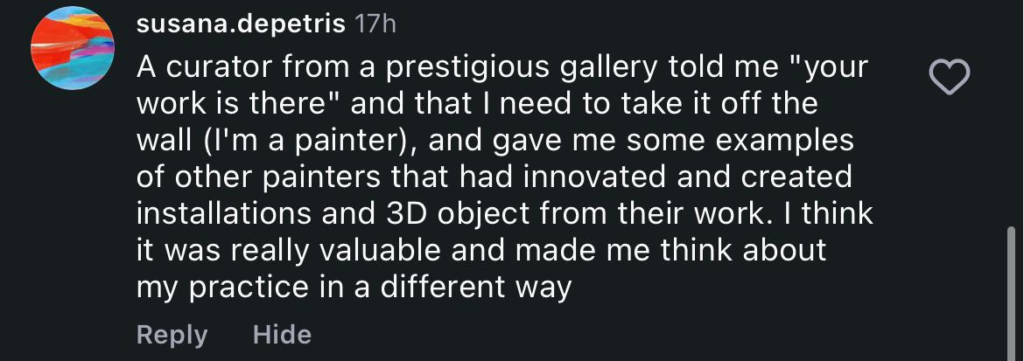
A curator from a prestigious gallery looked at Susana Depetris @susana.depetris work and said your work is there. Which sounds like a compliment. And it was. But it was also the beginning of something harder and more valuable. Because the next thing she said was that Susana needed to take it off the wall. To stop thinking of herself only as a painter and start thinking about what her work could become in space. She gave her examples. She pointed her toward artists who had made that leap. And Susana listened.
She did not leave that conversation feeling praised. She left thinking about her entire practice differently. And we think that is the highest thing a piece of feedback can do.
Susana Depetris @susana.depetris took that challenge seriously. And something tells us her work has never quite sat still on a wall since.
It was already finished when they walked in. But somehow they were the ones who completed it.
There is a difference between someone liking your work and someone needing it. Liking is easy. Liking is polite. Liking is what most people do when they stand in front of art and do not quite know what to say. Needing is something else. Needing means the work has crossed a line and entered a person in a way they did not see coming. In a way they cannot explain and do not want to.

A couple saw Bill Lindemann @restartist.bill three panel sculpture in a gallery. Then they came to his studio to hear about it. And when they got there, the words that came out were not I love this or this is incredible or how much does it cost. They said we cannot live without this piece. And Bill felt something he had not expected. That he had made it just for them. Even though he had never met them. Even though the piece had existed long before they walked through his door.
That is the part of making art that cannot be planned or manufactured or taught. You work alone, from your own instincts, your own experience, your own creative decisions. And then two strangers show up and recognise something in it as entirely theirs. Bill called it a beautiful dance between the mind of the artist and the mind of the viewer. We think that is exactly right.
Bill Lindemann @restartist.bill makes work that apparently has a way of finding the people it belongs to. And that is not an accident. That is what honesty in art does.
When the person whose job it is to stay composed cannot stay composed, you know you made something real.
There is a version of success in the art world that looks like reviews and sales and gallery representation. And those things matter. But there is another kind of success that has no official name and no metric and no place on a CV. It is the moment your work bypasses every defence a person has built and lands somewhere so deep that they cannot hold themselves together in front of it. That kind of success does not happen often. And when it does, you do not forget it.
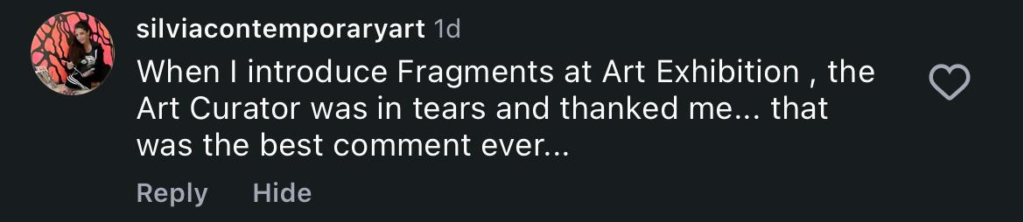
Silvia Pusceddu.DE @silviacontemporaryart introduced her work Fragments at an art exhibition. And the curator cried. Not a polite emotional response. Not a murmured that is lovely. Actual tears. From someone whose entire career has been built around looking at art professionally, forming opinions, finding language for what they see, staying composed. All of that training and all of that experience and Silvia’s work went straight past it. And the only thing the curator could find to say was thank you.
Not I love this. Not this is brilliant. Thank you. As in, I needed this. As in, something in this piece gave me something I did not know I was missing. That is not a professional response. That is a human one. And for an artist, there is no higher place to reach.
Silvia Pusceddu.DE @silviacontemporaryart makes work that apparently does not ask permission to affect people. It just does.
What surprised us most wasn’t the number of responses. It was how every single answer revealed a completely different reason for making art.
Some create to heal. Some to hold on to memories. Some because making art is simply part of who they are, something they can’t imagine not doing. Every story felt deeply personal, yet together they reminded us of something we all share. Art helps us stay connected. To ourselves. To the people we love. To the person we’re still becoming.
There were so many thoughtful responses that we couldn’t include them all here. If you have a few minutes, we really encourage you to read through the original Instagram post and its comments. We’ve linked it below. There are so many stories worth sitting with.
To everyone who shared so openly, thank you. What started as one simple question became a conversation we found ourselves returning to again and again. That happened because you were willing to be honest.
We’ll keep asking these questions. About why you make art. What inspires you. What challenges you. And what keeps you coming back to your practice, even on the difficult days. Because those are the conversations that bring artists together.
If you’re not already part of our Instagram community, we’d love to have you there. The next question we ask might be one that inspires your story.