
Why Ivana Babic breaks face into geometric forms instead of painting them realistically

At Arts to Hearts Project, for our Magazine Issue 12 which carried the theme This Is Me, we received so many submissions. And most of them responded with something personal, something vulnerable, something that said here I am. But Ivana Babic did something different.
She responded with something philosophical. And somehow that ended up being the most personal response of all because it came from a place of genuinely questioning who she is rather than performing a polished version of it.
Ivana is one of our selected artists for this issue. And her work is the kind that asks you to look twice and then a third time and each time you see something you missed before.
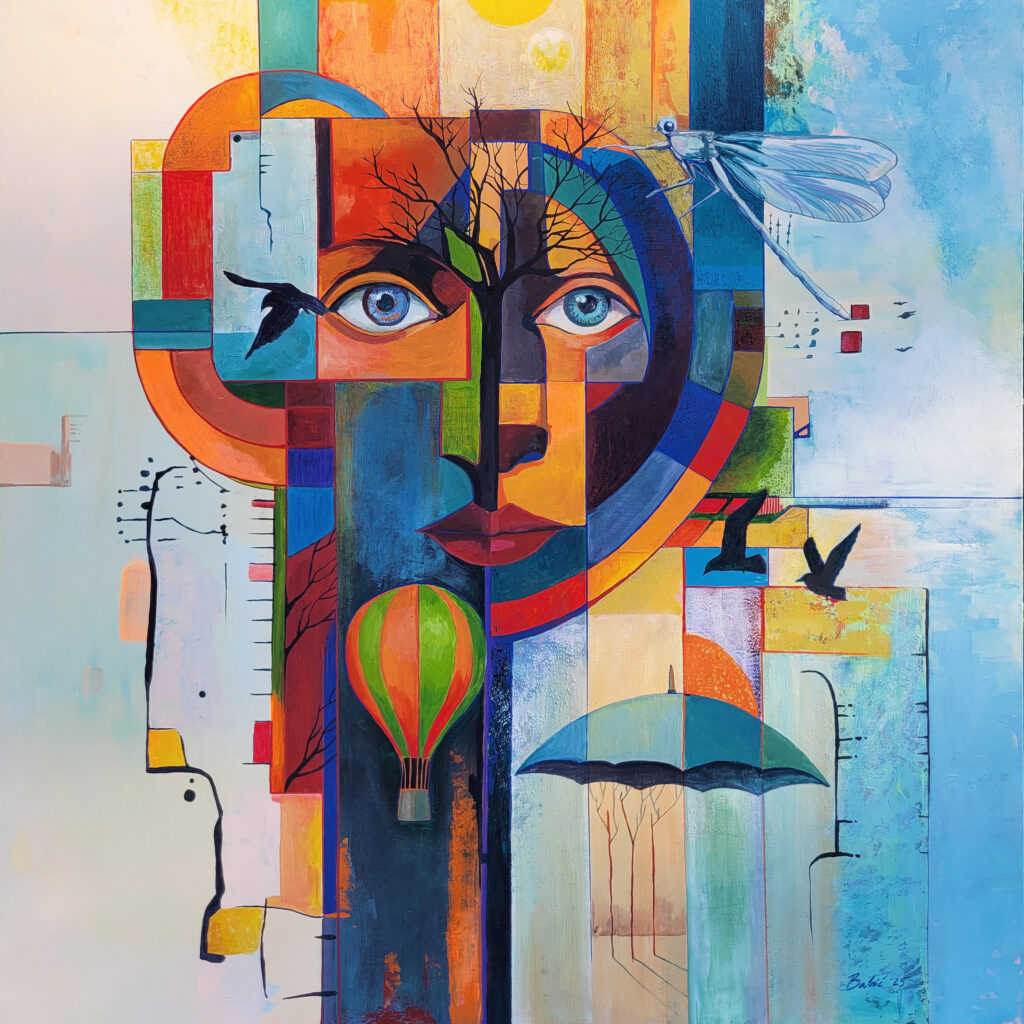
She paints figures that are not quite whole. Faces that are fragmented into geometric forms that feel architectural and emotional at the same time. And instead of that making the paintings feel broken it makes them feel more honest than any intact portrait could.
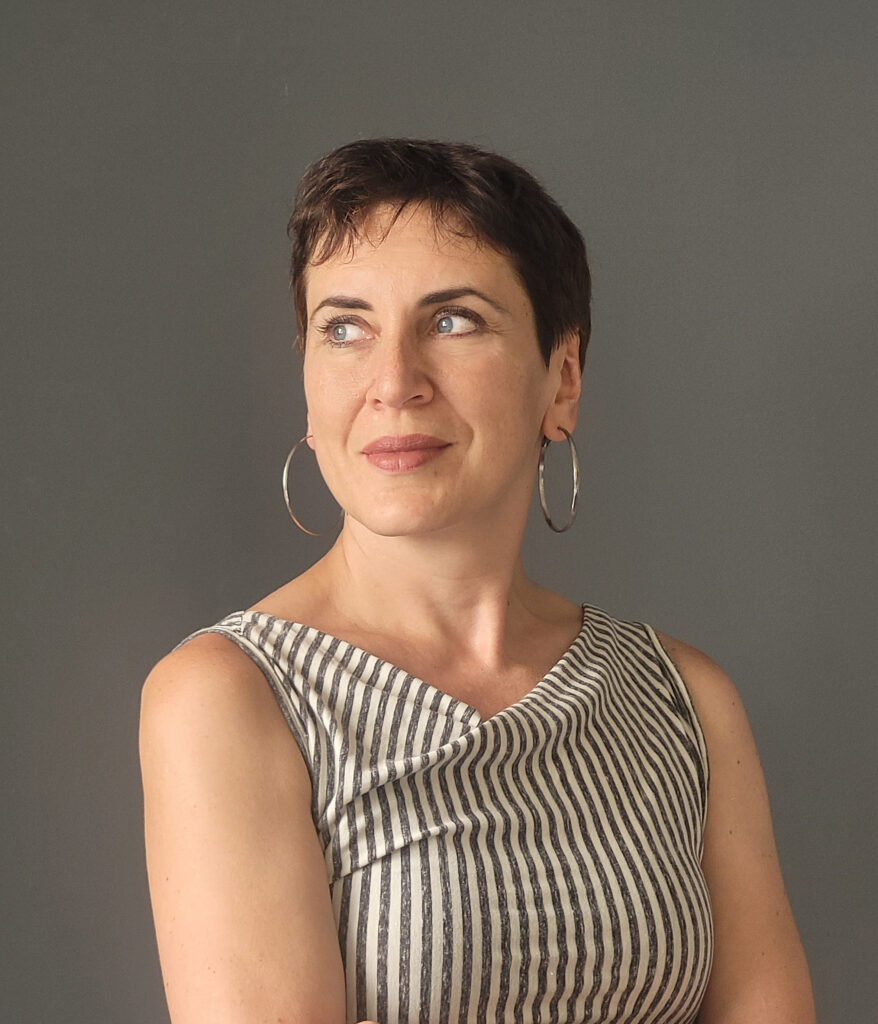
There is a way she talks about why she does this that we do not want to give away because hearing it from her in the interview lands much harder than any summary we could write.
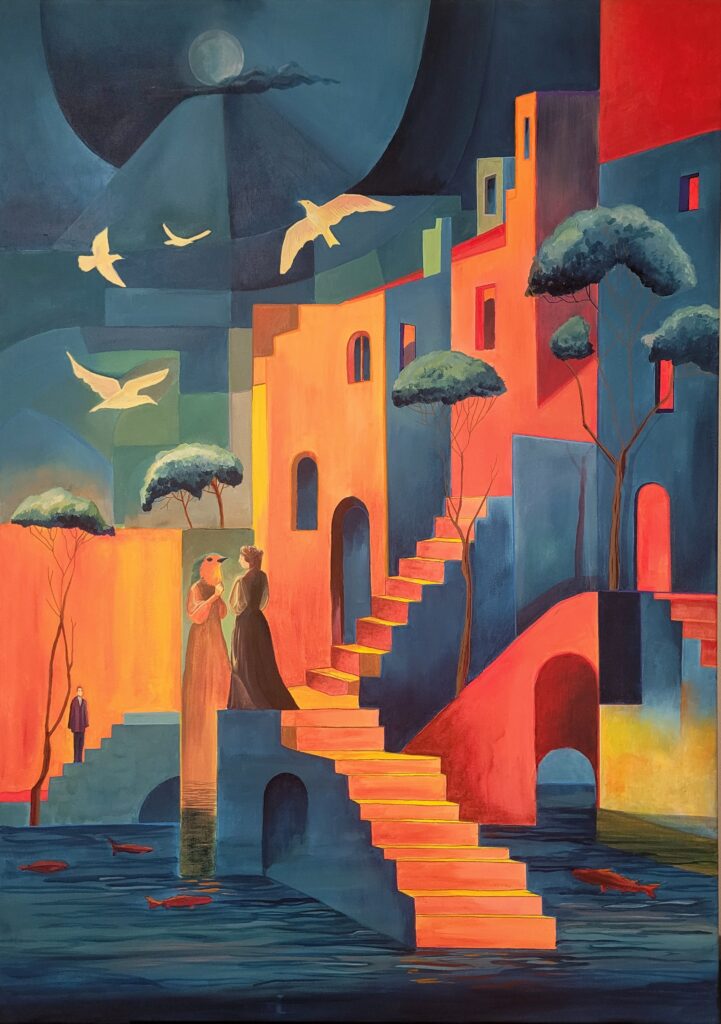
Her paintings are also full of spaces that do not exist in the real world. Stairs going nowhere, doors opening into ambiguity, windows looking out onto something you cannot quite identify. These elements do something specific inside her compositions and what they represent to her is worth hearing directly.
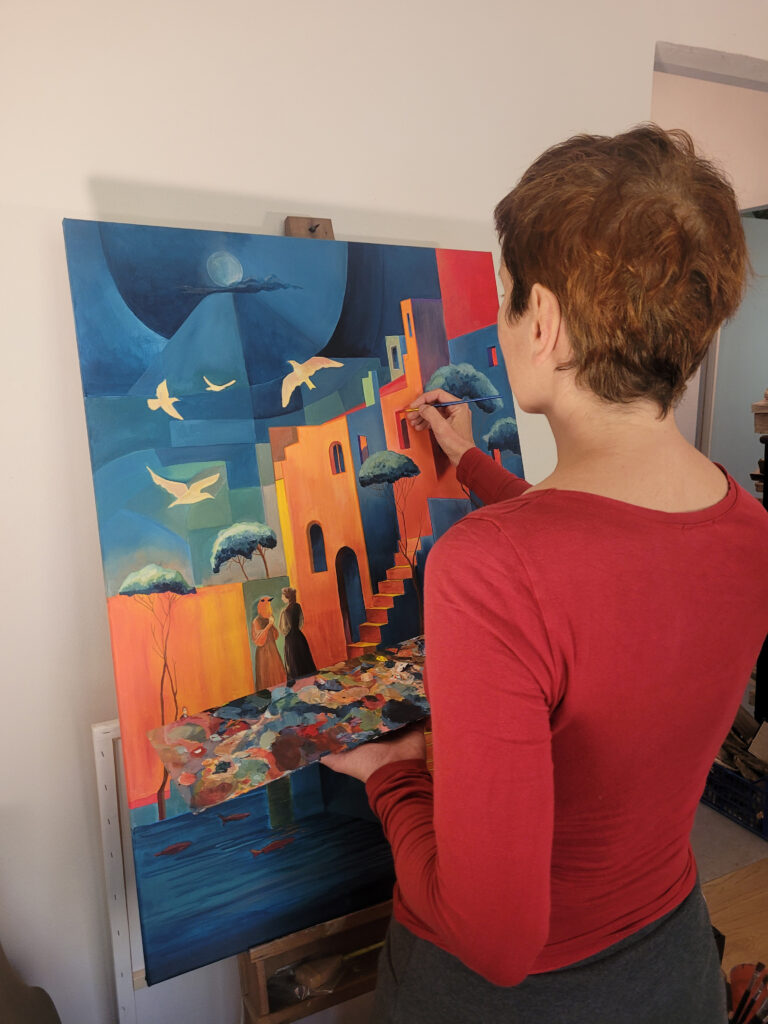
She comes from both a design and a painting background and you can feel both of those worlds in every piece she makes. One brings clarity and structure. The other brings depth and intuition. How she holds those two things together without one overtaking the other is part of what makes her practice interesting to us.
In a world drowning in fast disposable images, painting is doing something right now that nothing else can do. And Ivana knows exactly what that something is. Her perspective on it is one of the most clear-eyed things we heard from any artist in this edition and it is worth your time.
Let’s get to know Ivana through our conversation with her about broken faces, impossible doorways, and why painting still matters when the world has forgotten how to look slowly.
Q1. Could you share your journey into art and how your approach to the human figure has evolved over time?
My journey into art was not a single decision, but something that unfolded gradually, almost inevitably. I have always perceived reality as layered: what is visible is only a surface, and beneath it there are emotional, symbolic, and invisible dimensions that call to be expressed. Art became the language through which I could access and translate those layers. I began with a more intuitive and exploratory approach, moving between different media and disciplines, including design. Over time, this duality between structure and intuition became central to my practice.
Design gave me a sense of clarity, proportion, and intention, while painting allowed me to enter a more fluid, introspective space. The human figure, in my work, is not treated as a physical or anatomical subject, but as a threshold. It is a presence rather than a body. In earlier works, the figure was more implicit: suggested through spaces, gestures, or fragments.
As my visual language evolved, it became more defined, yet still suspended between visibility and dissolution. I am interested in the moment where identity is not fixed, where the figure becomes a passage between inner and outer worlds. Often, the body dissolves into geometric structures, light, or symbolic elements, as if it were both emerging and disappearing at the same time.
This reflects my ongoing exploration of consciousness, memory, and transformation. Rather than depicting the human form, I try to evoke what it means to be: to exist within time, perception, and inner experience. In this sense, the figure becomes less an object to observe and more a space to enter.
Q2. Your portraits are built through fragmented forms what draws you to breaking the face apart rather than depicting it whole?
I don’t experience the face as something whole or fixed. For me, identity is not a stable surface: it’s something constantly shifting, layered, and often contradictory. Breaking the face apart is a way to move closer to that inner complexity rather than simplifying it. The fragmentation is not an act of destruction, but of revelation.
By interrupting the continuity of the face, I try to create space for what is usually invisible – thought, memory, emotional residue, time. Each fragment can hold a different state, almost like multiple moments coexisting within the same presence. There is also an intuitive pull toward structure, perhaps coming from my background in design.
Geometric elements allow me to build a kind of internal architecture, where the figure is both constructed and deconstructed at once. It becomes less about resemblance and more about perception. I’m interested in the tension between recognition and loss of form. When the face begins to dissolve, it asks the viewer to engage differently: to not just “see” a person, but to sense something beyond appearance. In that sense, I’m not breaking the face apart to fragment it, but to open it.
Q3. Stairs, doors, windows, and surreal interiors appear throughout your work what role do these spaces play in your visual storytelling?
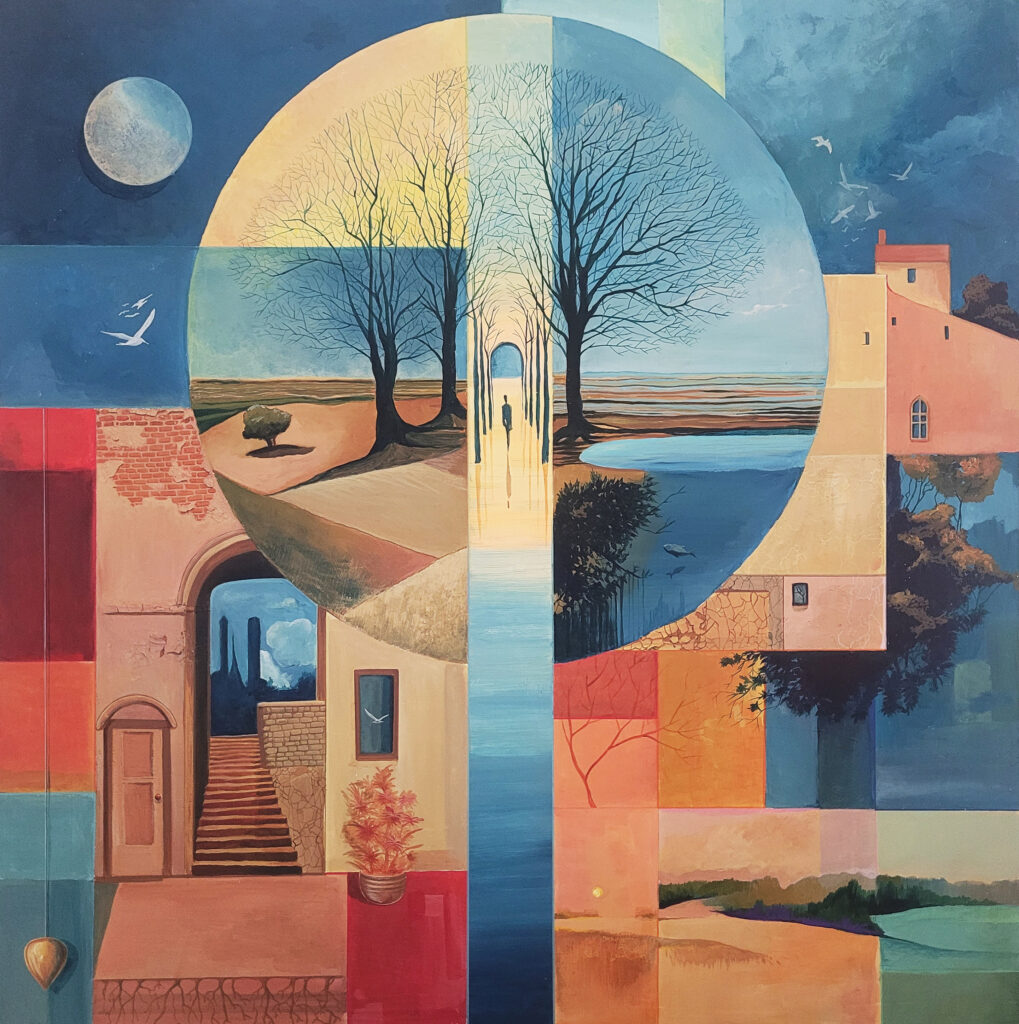
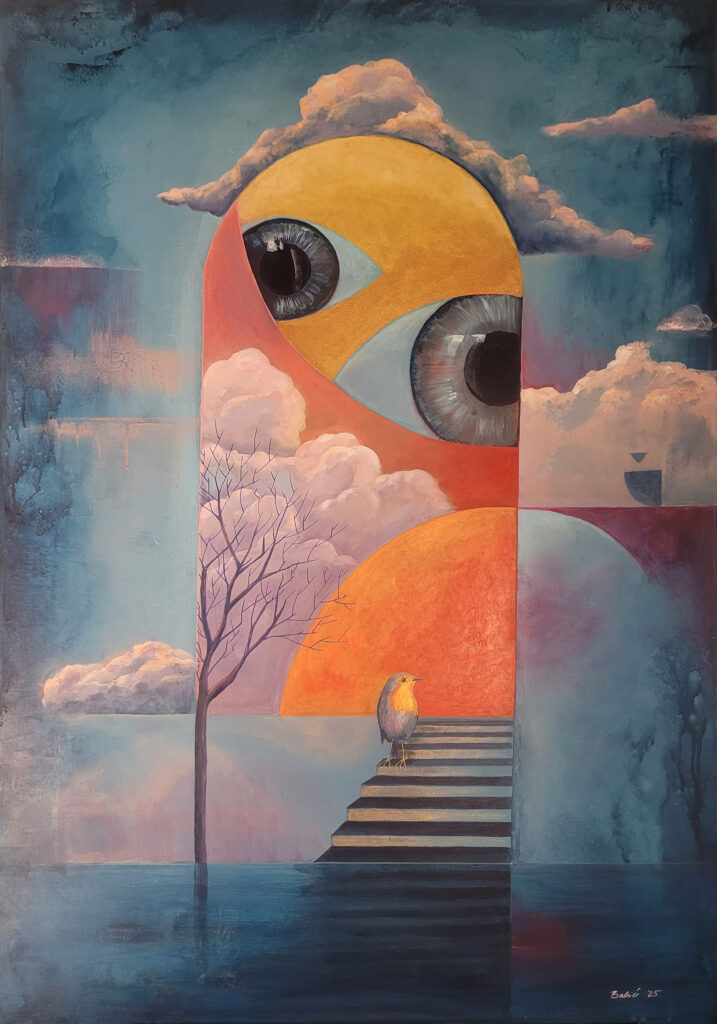
These elements: stairs, doors, and windows function as thresholds rather than physical spaces. They represent transitions between inner and outer worlds, between what is visible and what is hidden.
I use architecture as a way to give form to psychological states. These spaces feel familiar, yet they don’t belong to a specific place – they exist between memory and dream. In my work, they guide the viewer through the image, suggesting movement, passage, and transformation rather than a fixed narrative.
Q4. Birds, animals, balloons, and solitary figures recur in your paintings how do these motifs find their way into the work?
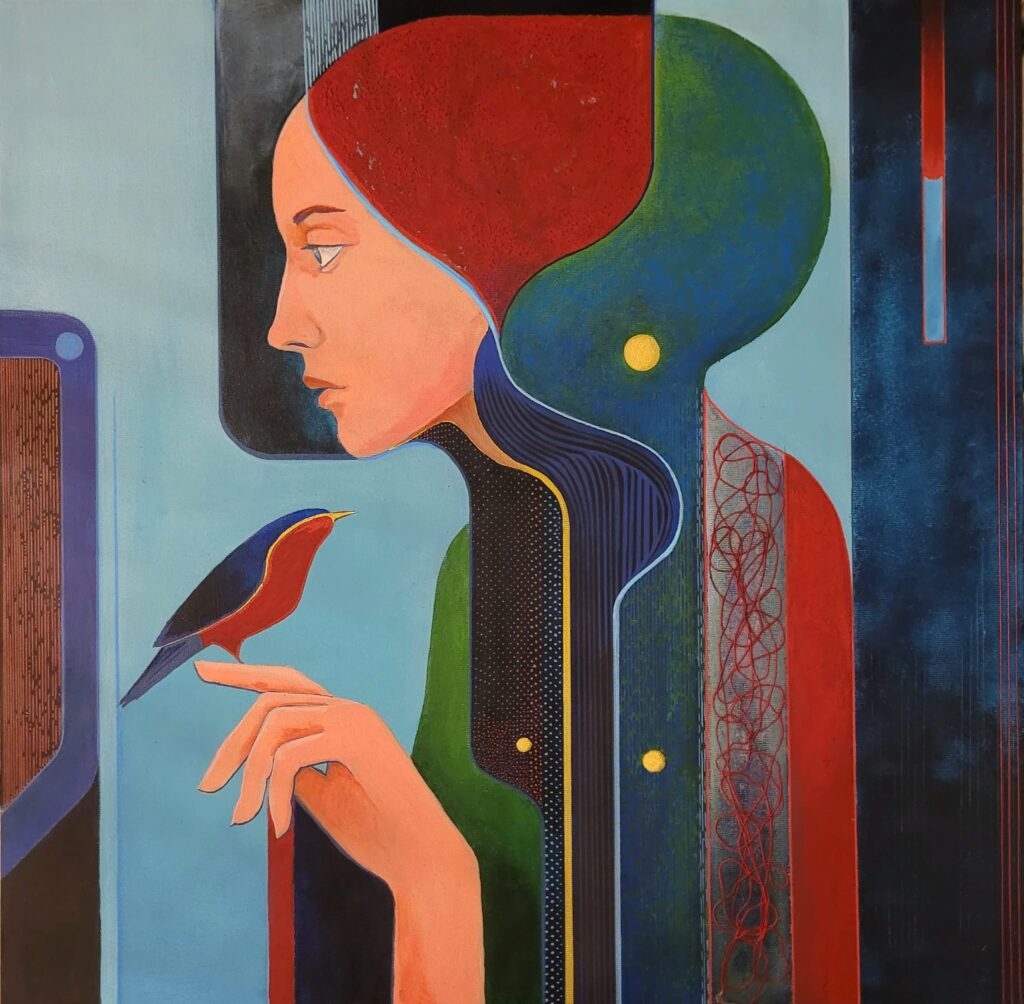
These motifs are consciously introduced, but they carry meanings that continue to evolve within the work. I return to them intentionally, using them as recurring anchors within my visual language. For me, they function as symbolic presences. Birds often suggest a perspective beyond time, something that observes without being fully part of the human condition.
Animals carry a more instinctive, grounded energy. Balloons introduce a fragile tension between lightness and control, while isolated figures reflect states of introspection and disconnection. Their role is to open associations rather than define them allowing each work to remain slightly unresolved, and each viewer to enter it differently.
Q5. Color feels both structural and emotional in your paintings how do you balance those two roles?
Color, for me, is both a structural element and an emotional frequency. I often begin with it as a way to organize the composition, to create balance, tension, and rhythm within the space. At the same time, each color carries an inner resonance. Warmer tones tend to ground the work, while cooler ones open it toward silence and introspection.
The balance comes from allowing these two roles to coexist: color as something that builds the image, and at the same time transforms how it is felt. I don’t separate composition from emotion; they emerge together through the same choices.
Q6. Many of your works bring together different realities and perspectives how do you make those worlds coexist within a single composition?
I approach the composition as a space where different layers of perception can coexist rather than align into a single, coherent reality. I’m interested in how we experience time and space internally where memory, presence, and imagination overlap. Instead of constructing a linear perspective,
I allow multiple viewpoints and moments to enter the same frame. These layers are often held together through geometry, rhythm, or color, so the image doesn’t collapse into chaos but remains in a kind of suspended balance. For me, it’s not about representing multiple realities, but revealing that they are already happening at the same time within our perception.
Q7. Do you see your work as more personal, or as something viewers can project themselves into?
It begins from a very personal place, but I don’t see it as private. The work is rooted in my own perception and inner experience, yet it is intentionally left open.
I try not to define meanings too clearly, so the viewer can enter the work with their own associations.
In that sense, it becomes a shared space – something that holds my perspective but is completed through someone else’s gaze.
Q8. In a time where images are constantly produced and consumed, what role do you think painting still holds today?
In a time of constant image production, painting offers something fundamentally different: it asks for time. Both in its making and in its viewing. Unlike fast, consumable images, a painting holds presence. It resists immediacy and invites a slower, more attentive kind of looking. In that sense, it becomes a space of pause, where perception can deepen. I think painting today is not about competing with the speed of images, but about offering an alternative – something more embodied, more reflective, and less fixed in meaning.
Q9. Do you feel your work is in conversation with contemporary art trends, or does it exist more independently of them?
I’m aware of contemporary art discourse, but I don’t consciously position my work in relation to trends. My process is more inward – driven by questions that feel persistent rather than current. That said, every work inevitably exists within its time. So even if the intention is independent, there is always a subtle dialogue with the present. I see my practice as moving alongside, rather than within, trends-connected, but not defined by them.
Q10. Do you find yourself measuring success through recognition, or through something more internal, like growth and clarity in your work?
External recognition has its place – it creates opportunities and visibility, but I don’t see it as the measure of the work itself. What matters more to me is a sense of alignment: when the work feels precise, necessary, and clear in its own language. That internal clarity is what I recognize as progress. In that sense, success is less about validation and more about moving closer to what I’m trying to understand and express.
Q11. What advice would you give to artists who are trying to develop a visual language that feels both personal and sustainable over time?
I think it starts with paying attention to what genuinely returns – images, forms, or questions that keep appearing over time. That repetition is often the beginning of a personal language. At the same time, it’s important not to fix it too early.
A visual language needs space to evolve, otherwise it risks becoming a formula. Sustainability comes from staying connected to curiosity rather than style allowing the work to shift, while keeping a core sensibility that remains true.
As our conversation with Ivana came to a close, we kept sitting with something simple that most people never really think about. That what you see on the surface of a person is almost never the full picture. There are layers underneath. Memories and contradictions and shifting states that all exist at the same time but never show themselves all at once.
Most portrait painters try to pin a person down. Ivana does the opposite. She cracks the face open and lets you see that there is no single version. There are many. And they are all happening simultaneously.
That idea goes way beyond painting. How many of us are walking around performing a stable version of ourselves when the reality is that we are messy and contradictory and constantly becoming something new? Ivana’s work gives that mess permission to exist. You do not have to be one thing. You can be all of it at once and all of it counts.
And her response to the theme This Is Me is probably the most nuanced we received for this entire issue. Because her This Is Me is not an answer. It is a question. This is me but which version and from which angle and at which moment? That questioning is what makes it feel honest. She is not showing you a finished self. She is showing you a self that is still in process. And honestly that is truer than any polished self-portrait could ever be.
She also made us think about painting and time in a way that has stayed with us. That painting asks for slowness in a world obsessed with speed. That a painting holds something a scrolled-past image never will.
Making something in 2026 that only reveals itself slowly, that refuses to give you everything on the first look, that is not old-fashioned. That is one of the most necessary things an artist can do right now. And Ivana is doing it with every single piece.
For anyone thinking about collecting her work, these paintings give back more the longer you live with them. The layers of symbolism and structure and emotion do not show themselves all at once. You will see something different in a month than you see today because you will have changed and the painting will be ready with something new for whoever you have become. That is the kind of art that earns its place in your home every single day.
Follow Ivana Babic through the links below and see what a portrait can do when it stops trying to capture a person and starts trying to open them.