




Why “Dogs Playing Poker” Ended Up Everywhere?
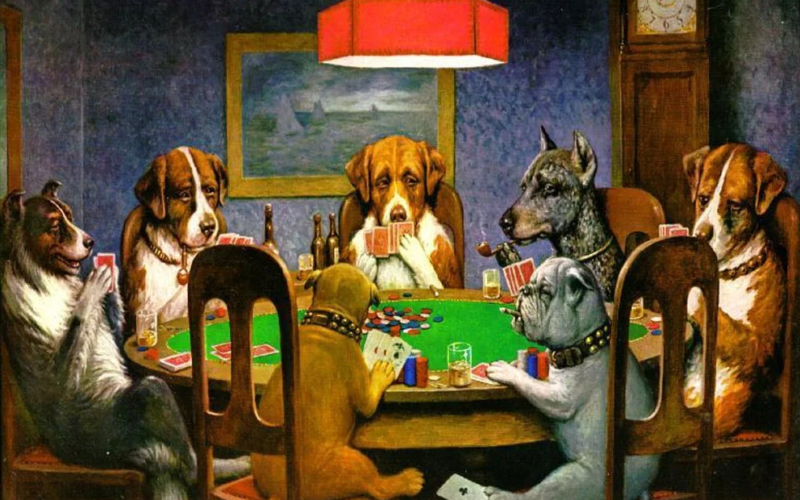
Almost everyone recognizes Dogs Playing Poker.
Even people who know nothing about art history have seen those tense card tables, cigar smoke curling through the air, suspicious glances between bulldogs, and exaggerated poker faces frozen in absurd seriousness. The image has appeared everywhere, bar walls, calendars, sitcoms, parody posters, internet memes, and thrift stores, becoming so embedded in popular culture that it feels less like a painting and more like a permanent cultural reference.
But here’s the strange part: the art world never really respected it.
For decades, critics dismissed Cassius Marcellus Coolidge’s famous dog paintings as kitsch, overly commercial, unserious, lowbrow entertainment made for mass appeal rather than artistic greatness. They weren’t created for museums or elite collectors. They were advertisements. Joke paintings. Disposable images designed to sell cigars and decorate calendars.
And yet, more than a century later, these poker-playing dogs remain more recognizable than thousands of “serious” masterpieces hanging quietly inside museums.
That contradiction raises a fascinating question: what actually makes an artwork survive?
Is great art defined by technical brilliance and critical approval? Or do the images that truly endure succeed because ordinary people keep carrying them forward generation after generation?
Because somehow, against all expectations, Dogs Playing Poker refused to disappear. And in doing so, it may have revealed something uncomfortable about art itself: history is not always shaped by what critics admire, but by what people remember.
The Painting Was Never Meant for Museums
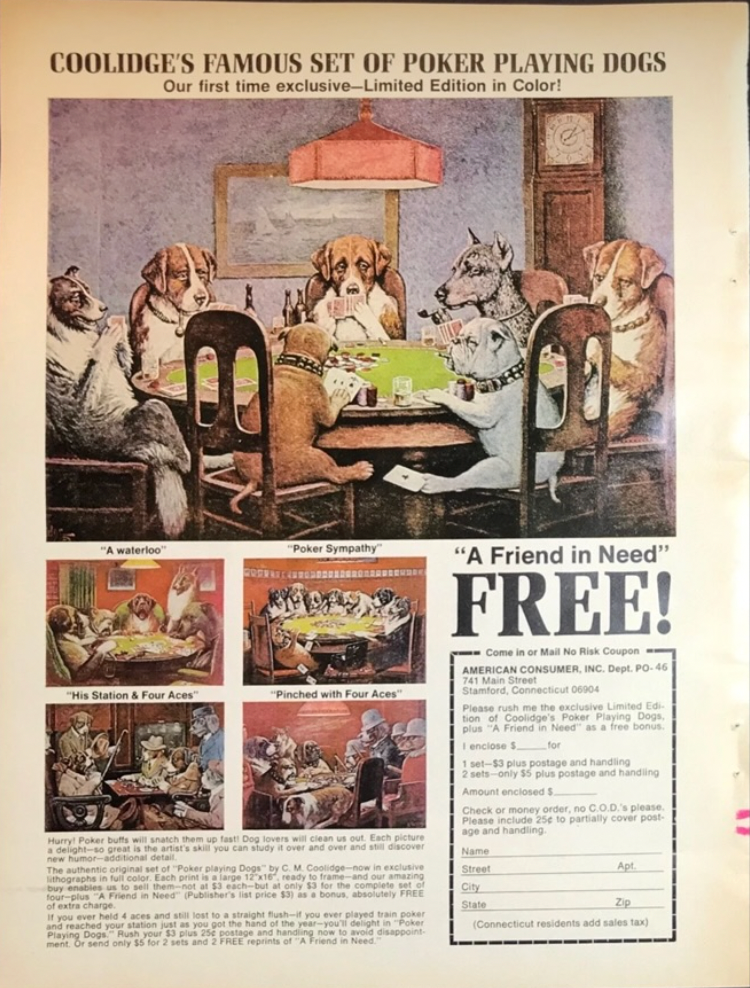
Long before Dogs Playing Poker became one of the most recognizable images in popular culture, it was never supposed to be “important” art at all. It wasn’t painted for galleries, collectors, or elite critics. It was created to sell cigars.
That’s what makes its story so strange.
In the early 1900s, artist Cassius Marcellus Coolidge was hired by the advertising company Brown & Bigelow to create illustrations for cigar promotions and calendars. The paintings were commercial from the beginning, designed to circulate through homes, bars, offices, and shops rather than hang inside prestigious museums. At a time when advertising was exploding across America, businesses needed images people would actually remember. Coolidge understood that instinctively.
And people remembered dogs playing poker.
The scene was absurd, humorous, and instantly readable. You didn’t need art education to understand it. You didn’t need to study symbolism or composition. The image worked in seconds. A table. A card game. Suspicious expressions. Cigars. Chaos. Humor. It invited ordinary people in immediately.
That accessibility became its greatest strength.
Ironically, many paintings created for museums disappeared into art history textbooks, while this “joke” painting escaped the walls of elite culture entirely. It entered everyday life instead. It was reproduced endlessly on posters, calendars, postcards, bar signs, and eventually internet memes.
That may be why Dogs Playing Poker survived for over a century: it was never trying to impress the art world. It was trying to stay in people’s lives, and it succeeded.
Why People Instantly Connected With It
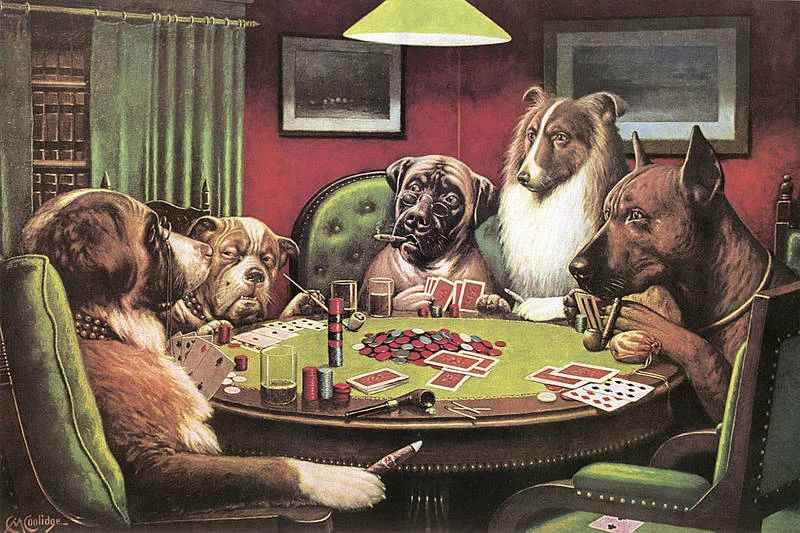
Part of the reason Dogs Playing Poker became unforgettable is surprisingly simple: people immediately understood it.
The painting doesn’t ask viewers to decode complicated symbolism or understand art theory. The scene explains itself in seconds. A group of dogs sits around a poker table, staring each other down with suspicion, confidence, anxiety, and bluffing pride. Even without words, the tension feels familiar.
That familiarity is what made the image powerful.
Coolidge gave the dogs distinctly human emotions, but he never made the scene feel overly sophisticated or distant. Instead, the painting feels playful and strangely relatable. Everyone recognizes the atmosphere: the friend who cheats, the overconfident player, the nervous observer, the dramatic bluff. The dogs become exaggerated versions of human behavior, which makes the humor work instantly.
And unlike many “serious” paintings of the era, this image never intimidates the viewer.
A lot of fine art survives inside museums but struggles outside them because ordinary audiences feel excluded from the experience. Dogs Playing Poker does the opposite. It welcomes people immediately. You don’t need context to enjoy it. The joke lands whether you’re an art historian or someone seeing the image on a bar wall for the first time.
That emotional accessibility helped the painting travel across generations.
Even today, the image still works because it captures something timeless: people love seeing themselves reflected in absurd ways. Beneath the humor, the painting is really about human behavior, ego, deception, tension, performance, and play. The dogs simply make those emotions easier, funnier, and more memorable to recognize.
The Art World Called It “Kitsch”
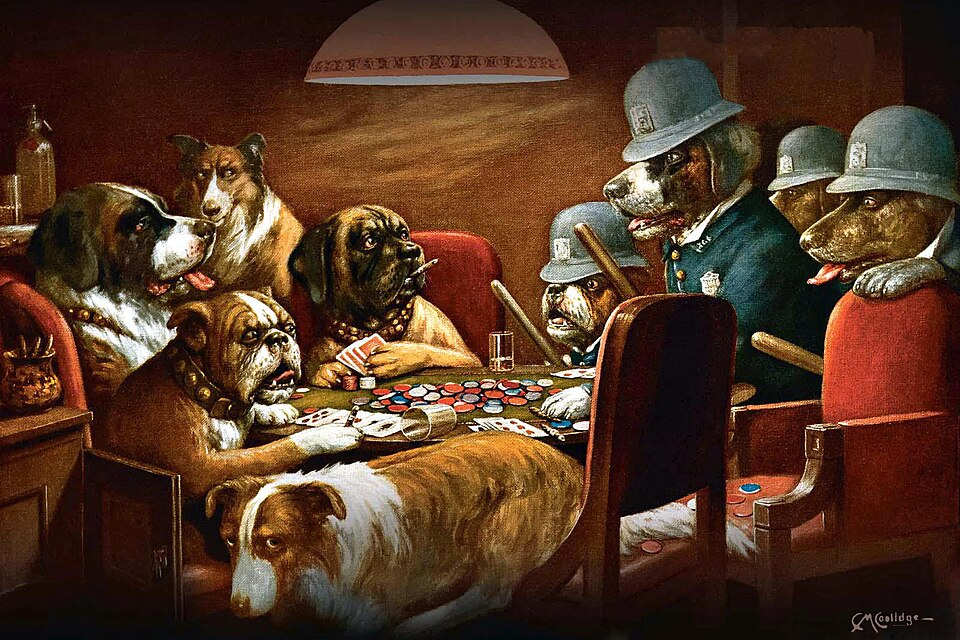
For decades, Dogs Playing Poker occupied a strange place in culture: wildly popular with the public and deeply embarrassing to much of the art world.
Critics dismissed it as kitsch, a word often used for art considered overly sentimental, commercial, shallow, or made purely for mass appeal. In elite circles, the painting became shorthand for “bad taste.” It was the kind of image people joked about hanging in cheap bars or bachelor apartments, not serious galleries.
But that reaction reveals something bigger about how art is judged.
Historically, the art world has often separated “high” culture from “popular” culture. Serious art is expected to challenge viewers, demand interpretation, or display technical innovation. Dogs Playing Poker seemed to do none of those things. It was funny, accessible, commercial, and intentionally entertaining. To many critics, that immediately made it less valuable.
Yet the public never stopped loving it.
While countless respected paintings faded into obscurity outside museums, Coolidge’s dogs remained alive in everyday culture. People reproduced them, referenced them, parodied them, and passed them down across generations. The image became part of collective memory in a way most celebrated artworks never do.
That creates an uncomfortable question for the art establishment: if millions of people continue connecting with an image for over a century, can it really be dismissed as meaningless?
In many ways, Dogs Playing Poker exposed a tension that still exists today. Critics often decide what deserves prestige. But audiences decide what survives culturally.
The elite world saw lowbrow entertainment.
Ordinary people saw an image they genuinely enjoyed living with, and that difference changed the painting’s legacy forever.
Mass Reproduction Changed Everything

What truly transformed Dogs Playing Poker from a funny painting into a cultural phenomenon wasn’t the artwork alone, it was how often people saw it.
Cassius Marcellus Coolidge created the series during a moment when advertising and mass printing were rapidly changing American culture. His paintings appeared on calendars, cigar advertisements, postcards, prints, and promotional materials that spread far beyond galleries or collectors’ homes. Unlike traditional fine art, these images weren’t rare. They were everywhere.
That constant visibility mattered.
Most paintings exist in limited spaces. You travel to a museum to see them. But Dogs Playing Poker entered ordinary life directly. It hung in barbershops, offices, living rooms, garages, bars, and restaurants. People encountered it casually, repeatedly, and over long periods of time. Eventually, the image stopped feeling like a painting and started feeling like part of culture itself.
In many ways, Coolidge accidentally understood something that defines modern visual culture: repetition creates permanence.
The more people saw the image, the more recognizable it became. And because the painting was humorous and easy to understand, it reproduced perfectly across formats. It didn’t lose its impact when printed cheaply or seen briefly. In fact, its simplicity made it stronger.
That idea feels incredibly familiar today.
Internet memes, viral images, and social media all work through repetition and instant recognition. Images survive because they circulate constantly and adapt easily across audiences. Dogs Playing Poker operated the same way long before the internet existed.
It may not have been “high art,” but it mastered visibility better than most masterpieces ever could, and that visibility turned it into an icon.
Why “Serious” Art Doesn’t Always Stay in Public Memory

One of the most fascinating things about art history is that critical recognition does not always guarantee cultural memory.
Museums are filled with technically extraordinary paintings that many people might not immediately recognize outside an academic or gallery setting. Meanwhile, Dogs Playing Poker, a work often dismissed as lighthearted commercial art, became familiar across generations. That contrast reveals an interesting difference between artistic prestige and public connection.
The art world often preserves paintings through institutions. Museums, textbooks, galleries, and critics help determine which works are considered historically significant. But public memory operates differently. People tend to remember paintings that feel emotionally familiar, visually distinctive, or deeply woven into everyday life.
That’s where Dogs Playing Poker found its strength.
Rather than remaining confined to elite spaces, the painting entered ordinary culture directly. It appeared in homes, bars, calendars, posters, magazines, and eventually pop culture references that kept the image alive for decades. Over time, that constant visibility gave the painting a kind of permanence. Even people unfamiliar with Cassius Marcellus Coolidge’s name could instantly recognize the scene.
Many highly respected paintings never develop that kind of connection.
Some works are admired primarily within museums or academic conversations, while others require historical context to fully appreciate. Dogs Playing Poker functioned differently. Its humor, storytelling, and accessibility allowed viewers to connect with it immediately, without needing explanation.
That doesn’t necessarily make it more artistically important than museum masterpieces. But it does raise an interesting question: what gives a painting lasting cultural life, critical recognition or continued public connection?
Because throughout history, countless celebrated artworks have remained inside museums, while Dogs Playing Poker escaped into popular culture.
More than a century later, those poker-playing dogs are still instantly recognizable, a rare kind of cultural endurance most paintings never reach.
Dogs Playing Poker Was Basically an Early Meme

Long before the internet turned images into viral cultural currency, Dogs Playing Poker was already behaving like a meme.
The painting spread not because people considered it sacred, but because it was endlessly reusable. It could appear in bars, sitcoms, dorm rooms, advertisements, cartoons, T-shirts, puzzles, postcards, and parody posters without losing its identity. Even when recreated badly, the joke still worked instantly.
That kind of adaptability is rare.
Most famous artworks lose power when removed from their original context. But Dogs Playing Poker became stronger through repetition and parody. The image was simple enough to reproduce endlessly yet recognizable enough to remain iconic every single time. That’s exactly how meme culture functions today.
A successful meme survives because people can reshape it while preserving the core idea. Coolidge’s painting did the same thing over a century earlier.
The setup itself became a visual template: animals behaving seriously, exaggerated human tension, hidden deception, dramatic reactions. People immediately understand the scene even before noticing details. That instant readability allowed the painting to move across generations and media without becoming outdated.
Eventually, the image stopped belonging only to art history and entered pop culture permanently.
It appeared in television shows, comedy sketches, internet edits, and countless visual references. Many people who have never seen the original painting still recognize its composition immediately. That level of cultural penetration is something most museum masterpieces never achieve.
Ironically, the art world often dismissed the painting for being too commercial and too accessible.
But those same qualities are exactly what helped it survive in a world increasingly shaped by viral images, repetition, humor, and shareability.
Maybe Art History Has Been Measuring the Wrong Things
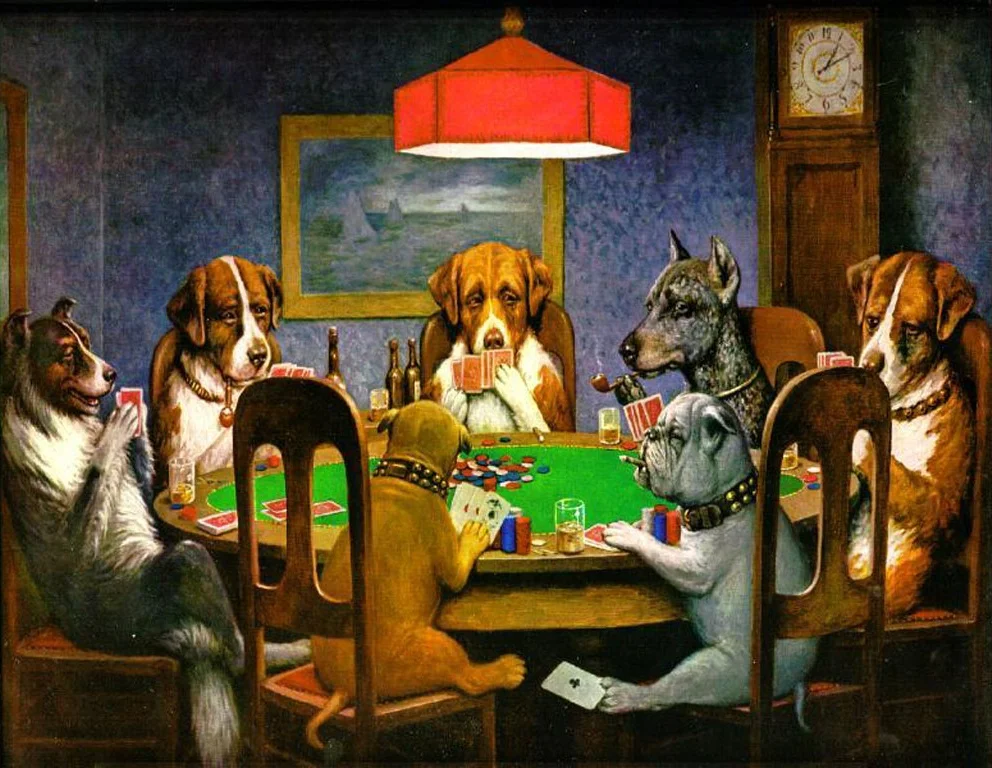
The story of Dogs Playing Poker forces an uncomfortable question into the center of art history: who actually decides what makes art important?
For generations, importance has usually been tied to ideas like technical mastery, originality, symbolism, or critical acclaim. Museums, curators, collectors, and historians helped shape those standards. And while those measures matter, they don’t fully explain why certain images become unforgettable while others quietly disappear.
Because outside galleries and textbooks, people create a different kind of history.
Audiences preserve the images they emotionally adopt into everyday life. They remember the artworks that make them laugh, comfort them, entertain them, or become part of shared culture. That kind of survival cannot be fully controlled by institutions. It happens organically, through repetition and connection.
Dogs Playing Poker may be one of the clearest examples of that phenomenon.
Despite decades of being labeled “lowbrow” or unserious, the painting achieved something many celebrated masterpieces never managed: permanence in public imagination. People who know nothing about art history still recognize it instantly. That level of cultural memory is extraordinary.
And maybe that matters more than the art world likes to admit.
The painting’s legacy suggests that memorability itself has value. Accessibility has value. Humor has value. Emotional familiarity has value. Art does not survive only because experts protect it, sometimes it survives because ordinary people continue carrying it forward generation after generation.
That doesn’t mean every popular image becomes great art.
But it does challenge the idea that popularity automatically makes art less meaningful. Sometimes the images that stay alive the longest reveal something essential about the people who keep returning to them.

More than a century after they were painted, the dogs are still here.
They survived changing art movements, evolving tastes, the rise of photography, television, the internet, meme culture, and entire generations of critics insisting they weren’t “serious” enough to matter. Yet somehow, these poker-playing dogs remain instantly recognizable almost everywhere.
That kind of endurance is difficult to explain away as a joke.
Part of the reason may be that the paintings capture something deeply human beneath all the absurdity. The dogs bluff, cheat, panic, perform confidence, and read each other’s faces across the table. Strip away the costumes and cigars, and the scene becomes less about animals and more about us. The humor works because people recognize themselves inside the chaos.
But there’s another reason the image survives: it never asks viewers to feel inadequate.
A lot of art can feel distant, intellectual, or locked behind explanation. Dogs Playing Poker offers the opposite experience. It invites people in immediately. You can laugh at it, live with it, parody it, or genuinely admire it without needing permission from the art world. That openness gave the painting a life far beyond galleries.
And maybe that’s what makes it culturally powerful.
Not every artwork survives because it is technically revolutionary. Some survive because people keep choosing them over and over again. They become part of conversations, homes, jokes, memories, and visual culture itself.
The art world may never fully embrace Dogs Playing Poker as a masterpiece.
But history has already done something perhaps stranger: it refused to let the painting disappear. Which “non-serious” artwork do you think deserves more respect?
You can also explore Artists Who Captured the Feeling of Sunlight in Paintings for another look at how certain paintings continue to stay emotionally and visually unforgettable across generations.