






What Is It About the Night That Artists Haven’t Been Able to Ignore for Centuries?

Before the street empties and the last light fades, there is a moment painters have chased for centuries. Not dusk, not darkness, that brief, suspended threshold where the sky still holds colour and the lamps have just begun to matter. It is an unlikely kind of beauty. Quiet, a little uncertain, and entirely its own.
Artists have returned to the night not because it is easier to work in, but because it asks something different of them. Daylight is generous, it shows everything. Night is selective. It decides what you see, and in doing so, it decides what you feel. A reflection in still water can hold as much presence as the sky above it. A single streetlamp can carry an entire composition. What is left out becomes as meaningful as what remains.
This is what nocturnal painting has always understood: darkness is not absence. It has an atmosphere, weight, and quiet drama. From the luminous water in Starry Night Over the Rhône by Vincent van Gogh to the soft glow of Evening on the Pier by John Atkinson Grimshaw, these are not paintings that show you the night, they show you how it feels to be inside it. Unhurried. A little still. Aware, suddenly, of things you had stopped noticing.
Moonlit Landscape With Bridge – Aert van der Neer
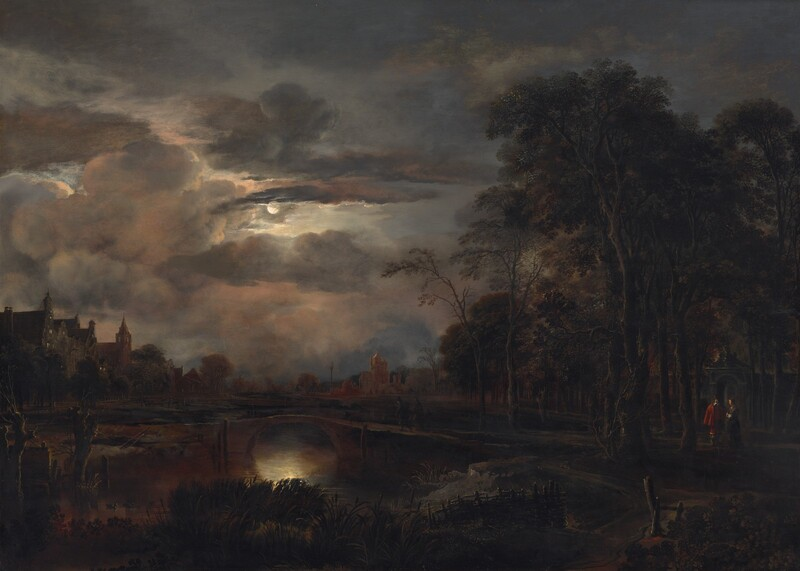
In Moonlit Landscape With Bridge, Aert van der Neer demonstrates a quiet mastery of night long before it became a central subject in modern painting. Created in the 17th century, the work belongs to a period where darkness was not merely a backdrop, but a compositional challenge, one that van der Neer approached with remarkable sensitivity.
The beauty of this painting lies in its restraint. The moon does not flood the scene with light; instead, it offers just enough illumination to trace the edges of the world. The bridge arches gently over the water, framing the reflection of the moon, while faint silhouettes of trees and figures emerge slowly from the darkness. Nothing is sharply defined, yet everything feels present.
Van der Neer’s brilliance is in how he allows light to guide the viewer’s eye. The brightest point, the moon’s reflection, becomes a quiet focal anchor, while the surrounding darkness creates depth and atmosphere. This interplay gives the painting a sense of stillness, as if time itself has paused. Even the figures, barely visible along the path, seem absorbed into the landscape rather than separate from it.
Unlike later artists who would dramatize the night, van der Neer treats it with subtlety. There is no spectacle here, only a gentle unfolding of light across space. And in that softness, the painting captures something essential: the way night simplifies the world, reducing it to silhouettes, reflections, and a few carefully held moments of light.
Evening on the Pier – John Atkinson Grimshaw
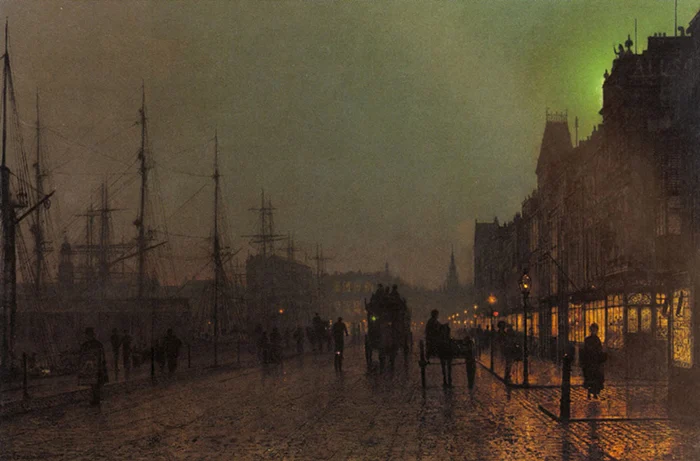
With Evening on the Pier, John Atkinson Grimshaw turns the ordinary into something almost cinematic. Known for his nocturnal cityscapes, Grimshaw had an uncanny ability to capture the glow of artificial light against damp streets and mist-filled air, an effect that feels both precise and atmospheric.
Here, beauty emerges through contrast. Gas lamps line the pier, casting a soft, greenish-yellow light that diffuses into the surrounding haze. The wet ground reflects this glow, doubling the illumination and creating a sense of depth that pulls the viewer inward. Figures, barely detailed, move through the space as silhouettes, their presence suggested rather than defined.
What makes this painting particularly compelling is its balance between realism and mood. Every architectural detail is carefully rendered, yet the overall effect is less about accuracy and more about sensation. The mist softens edges, the light blurs into reflections, and the scene feels suspended between clarity and obscurity.
Grimshaw’s night is not dramatic, but immersive. There is no single focal point demanding attention; instead, the eye wanders, following light as it fades into darkness. This creates a quiet rhythm, one that mirrors the experience of walking through such a space, where perception shifts with every step.
In this way, the painting captures a distinctly modern kind of beauty: one shaped not by nature alone, but by the interplay of light, environment, and fleeting human presence.
Starry Night Over the Rhône – Vincent van Gogh
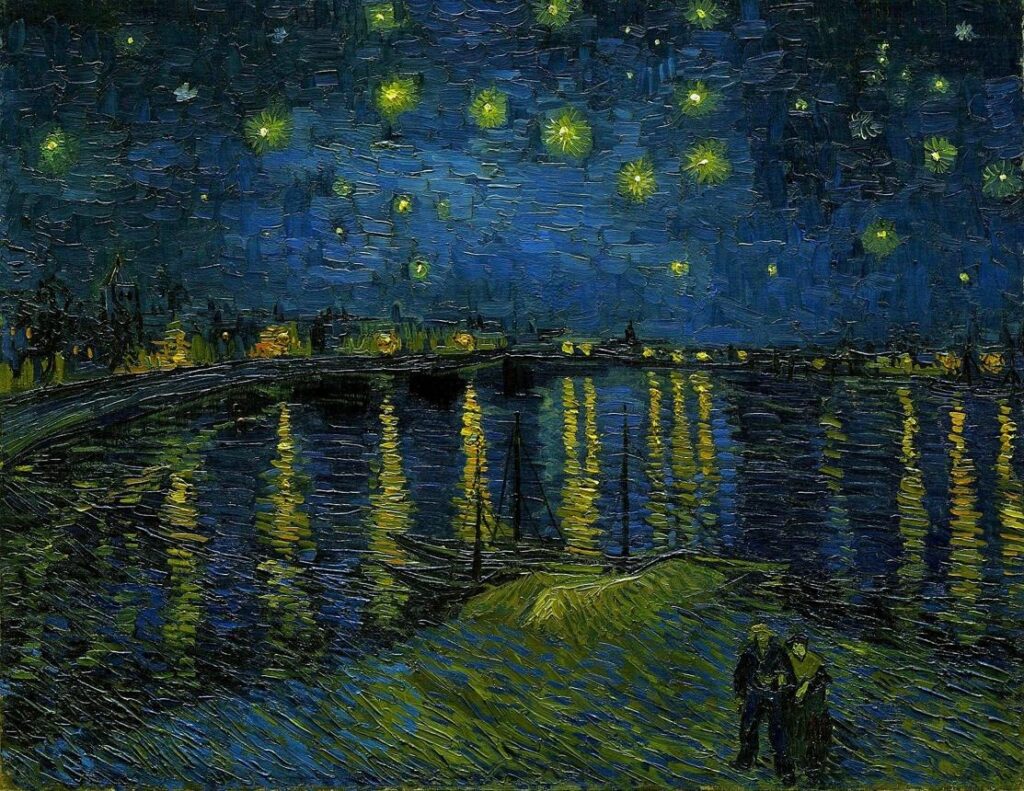
Painted in 1888, Starry Night Over the Rhône by Vincent van Gogh is often understood as one of the most tender interpretations of night in Western art. Unlike the turbulence of his later works, this painting feels composed, almost quiet, yet it glows with an intensity that is impossible to ignore.
What defines its beauty is not just the sky, but the relationship between sky and water. The stars do not remain distant; they descend, stretching into elongated reflections across the Rhône. The warm gaslights of Arles echo this effect, creating a rhythm of gold against deep blue. It’s a careful orchestration of contrast, cool and warm, stillness and movement, distance and immediacy.
Van Gogh’s approach to night was radically different from many of his predecessors. Rather than relying on darkness to define the scene, he built the night out of color. Blues are layered, not flat; yellows are luminous, not merely bright. As he once wrote, the night was “more alive and richly colored than the day,” and this painting becomes a direct translation of that belief.
There is also a human presence, subtle but essential. The small couple in the foreground anchors the vastness of the sky, reminding us that this beauty is not abstract. It is experienced, witnessed, felt. In this way, the painting becomes less about the night itself and more about what it does to us: how it slows time, deepens perception, and turns even the simplest view into something unforgettable.
Stormy Sea at Night – Ivan Aivazovsky
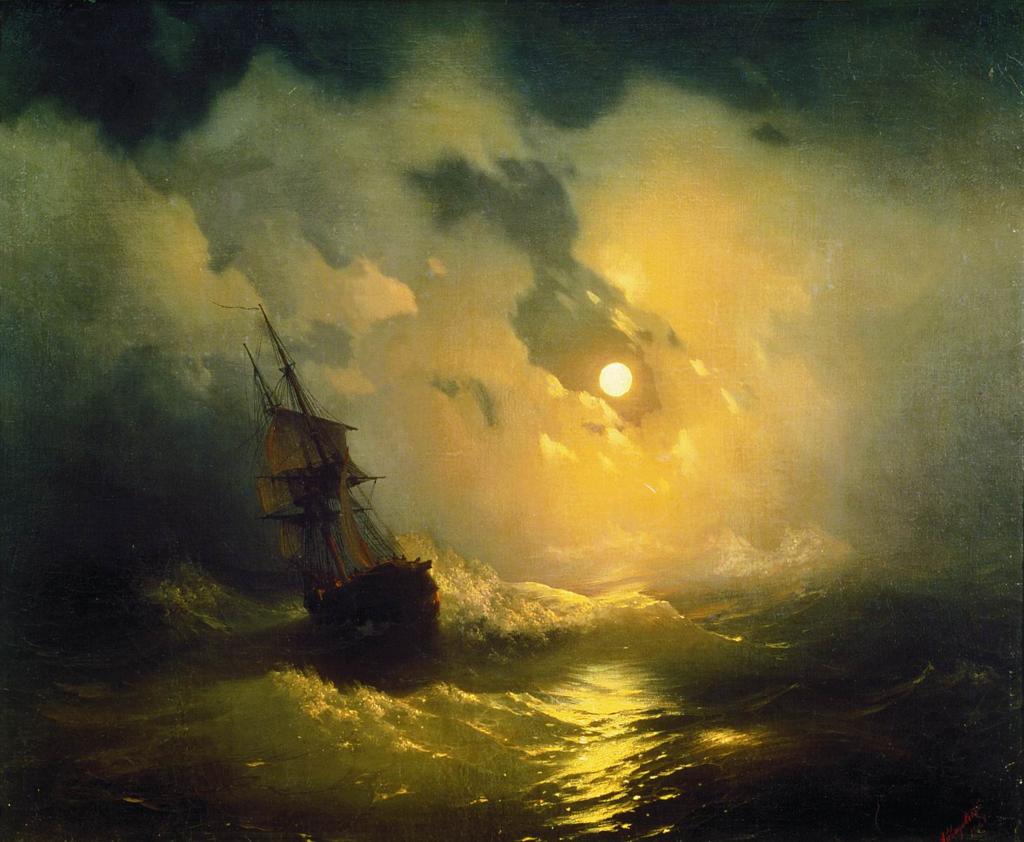
In Stormy Sea at Night, Ivan Aivazovsky transforms the night into something vast, volatile, and deeply luminous. Unlike quieter nocturnes, this painting does not ask for stillness, it confronts the viewer with movement, tension, and the overwhelming force of nature.
At the center of the composition is the moon, partially veiled by clouds yet powerful enough to dominate the entire scene. Its light cuts through the darkness, illuminating the restless surface of the sea. Waves rise and fall with a sense of urgency, their edges catching the moonlight in sharp, fleeting highlights. The result is a constant interplay between visibility and obscurity, where forms appear and dissolve almost simultaneously.
Aivazovsky’s understanding of light is what gives the painting its intensity. The sea is not rendered in bright blues; instead, it absorbs the yellow glow of the moon, turning darker, more muted, and almost black in places. This subtle shift makes the illuminated areas feel even more radiant, as if they are emerging directly from the darkness rather than sitting on top of it.
There is also a quiet human drama embedded within the scene, often a distant ship or fragile figures caught within the vastness. They are not the focus, but their presence amplifies the scale of the environment. Against the endless sea and sky, they appear momentary, almost insignificant.
Here, beauty is not calm or gentle. It is powerful, unstable, and awe-inspiring, found in the tension between light and chaos.
Rainy Midnight – Childe Hassam
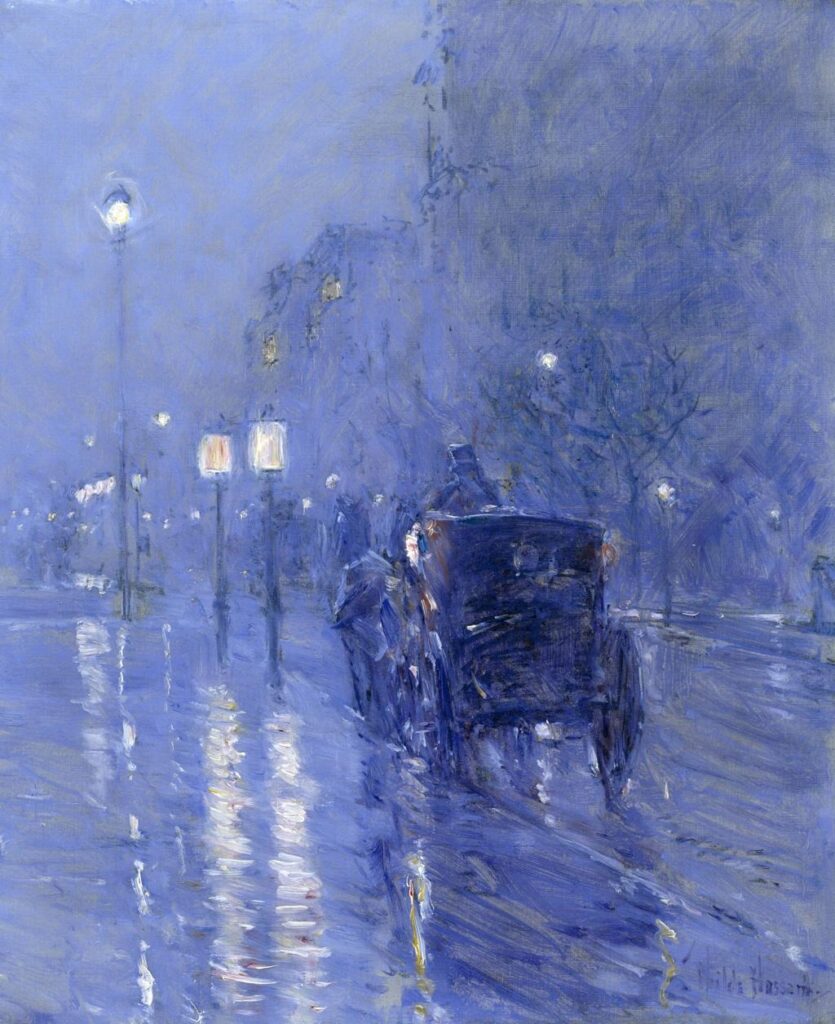
In Rainy Midnight, Childe Hassam offers a quieter, more atmospheric vision of the night, one that feels less constructed and more fleeting. Unlike dramatic nocturnes, this painting leans into softness, where edges dissolve and light becomes diffused through rain and movement.
What stands out immediately is its unexpected lightness. Rather than relying on deep blacks, Hassam builds the scene through muted greys, soft yellows, and gentle blues. The street is slick with rain, turning the ground into a reflective surface where lamplight stretches and blurs. These reflections are not precise; they shimmer and break, echoing the instability of the moment.
The figures, if noticed at all, are secondary. They pass through the composition almost anonymously, their forms suggested through quick, impressionistic strokes. This lack of definition is intentional, it allows the environment itself to take precedence. The rain, the glow, the atmosphere become the true subjects of the painting.
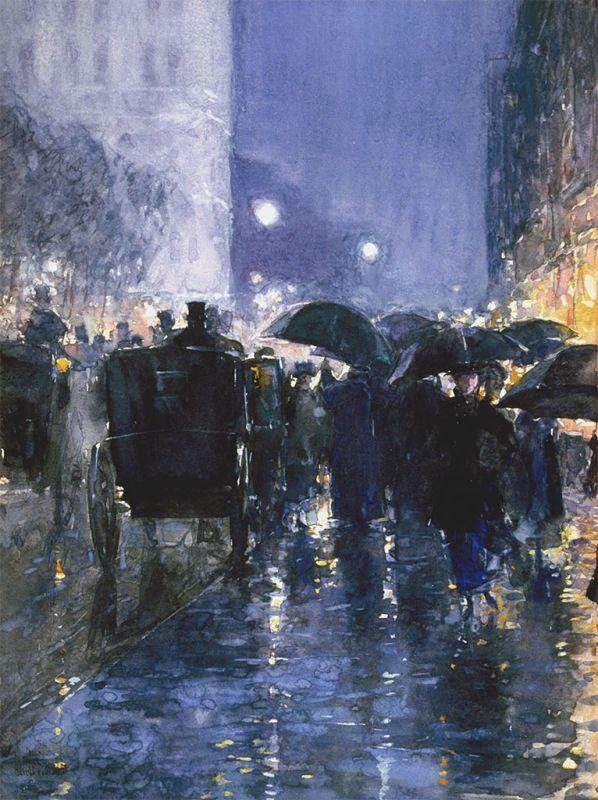
Hassam’s approach reveals a different kind of beauty, one that exists not in clarity, but in transience. The scene feels as though it could vanish at any moment, as if the light might fade or the rain might stop, altering everything instantly. It captures the sensation of being present in a fleeting moment, where perception is shaped by weather, light, and movement.
In this way, the night is not something to be observed from a distance, but something to be experienced, soft, shifting, and quietly luminous.
River Landscape by Moonlight – George Henry
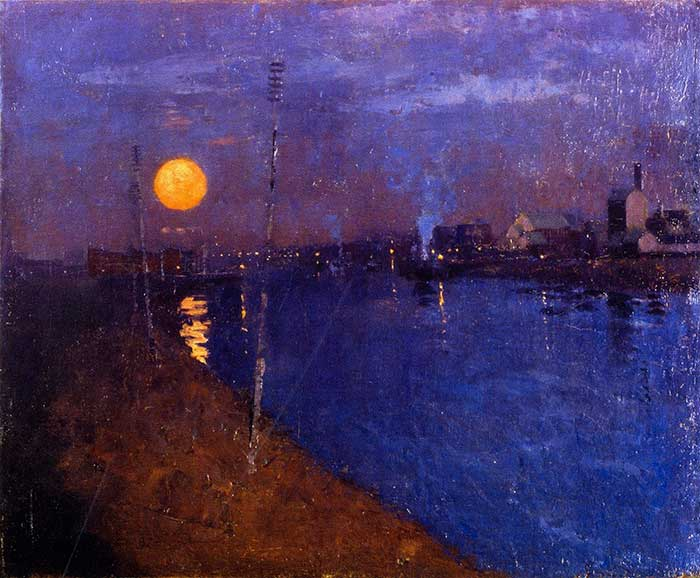
In River Landscape by Moonlight, George Henry approaches the night not as something subdued, but as something vividly alive. Where many artists lean into darkness and restraint, Henry embraces color, pushing it beyond realism to create a scene that feels almost heightened, if not entirely imagined.
The palette is striking. Deep purples and rich blues dominate the landscape, but they are punctuated by glowing yellows and warm highlights that ripple across the water. The moon becomes less of a distant object and more of an active force, its light spreading outward and transforming everything it touches. Reflections shimmer with intensity, giving the river a sense of movement that contrasts with the stillness of the surrounding land.
What makes this painting particularly compelling is its balance between observation and interpretation. The forms, trees, water, sky, are recognizable, yet they are simplified and stylized. This allows color to take precedence over detail. Instead of describing the scene precisely, Henry evokes how it feels to witness it, emphasizing sensation over accuracy.
There is a quiet boldness in this approach. Night, which is often associated with limitation, becomes an opportunity for expansion. Colors are not muted, they are amplified. Light is not scarce, it radiates.
In this way, the painting redefines beauty at night. It is no longer just about subtlety or calm, but about intensity, about how even in darkness, color and light can become more expressive, more emotional, and unexpectedly vivid.
In Front of the Café (Berlin at Night) – Lesser Ury
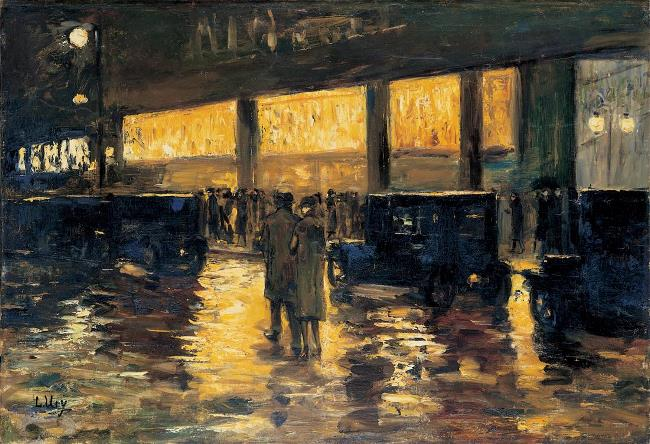
In In Front of the Café (Berlin at Night), Lesser Ury captures a distinctly urban kind of beauty, one shaped not by moonlight, but by the glow of artificial illumination. The scene unfolds at the edge of a café, where warm interior light spills outward into the darker, ambiguous space of the street.
What defines the painting is this contrast. Inside, there is warmth, clarity, and activity; outside, shadows stretch across wet pavement, absorbing and distorting the light. The reflections on the ground become as important as the figures themselves, turning the street into a shifting surface of golds, browns, and deep blacks. It is through these reflections that the painting gains its depth and rhythm.
Ury’s brushwork is loose, almost fleeting, allowing forms to dissolve into the atmosphere. Figures are suggested rather than described, their presence felt through movement and posture rather than detail. This gives the scene a sense of immediacy, as if it has been captured in passing, an ordinary moment elevated through light.
Unlike the stillness of rural night scenes, this is a night in motion. People come and go, light flickers, surfaces change with every step. And yet, there is a quiet intimacy to it all. The glow of the café acts as a focal point, drawing both the viewer and the figures toward it, offering a sense of refuge within the darkness.
Here, beauty is found in contrast, not just between light and dark, but between inside and outside, presence and distance, warmth and solitude.
Fishermen at Sea – J. M. W. Turner
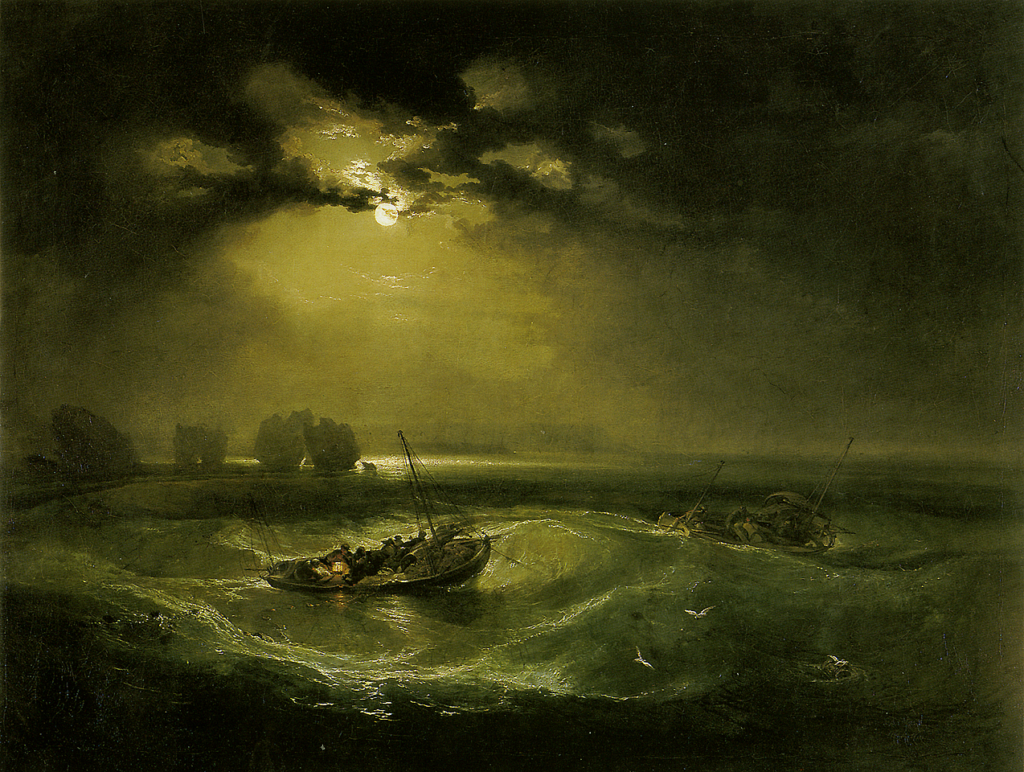
In Fishermen at Sea, J. M. W. Turner presents the night not as a quiet backdrop, but as a force, expansive, luminous, and quietly threatening. Painted early in his career, the work already reveals Turner’s fascination with light as something emotional rather than merely descriptive.
The composition is built around a striking contrast. A small fishing boat drifts in the foreground, its fragile presence dwarfed by the vast sea and sky. Above, the moon breaks through layers of cloud, casting a cold, almost spectral light across the water. This illumination is not even or gentle; it appears in bursts, catching the edges of waves and leaving large portions of the scene in deep shadow.
What makes the painting so compelling is this imbalance. Light does not comfort, it exposes. The sea feels restless, the sky unsettled, and the boat precariously suspended between the two. Turner uses this tension to heighten the emotional impact, turning a simple nocturnal scene into something far more dramatic.
At the same time, there is an undeniable beauty in how the light moves. It shimmers across the surface, creating moments of clarity within the surrounding darkness. These fleeting highlights guide the eye, offering just enough visibility to hold the composition together.
Here, the night is not peaceful, it is powerful. And its beauty lies precisely in that power: in the way it reveals both the grandeur of nature and the vulnerability of those within it.
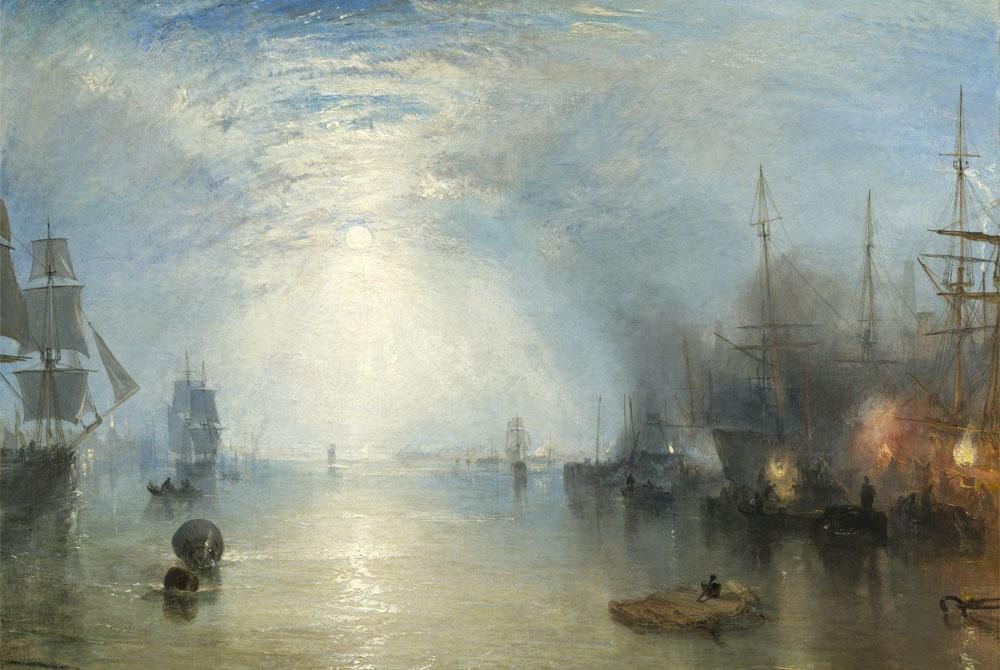
If there’s anything these paintings make clear, it’s that the night doesn’t hold just one kind of beauty.
Taken together, they move between moments, the still glow of a river, the restlessness of the sea, the softness of rain-soaked streets, the quiet pull of moonlit landscapes. Each artist decides what to show and what to hold back, and in that balance, the night begins to feel less like a setting and more like an experience.
What stays constant, though, is the presence of light. Whether it appears as a reflection, a flicker, or something barely holding its place in the dark, it shapes how we move through these scenes. It guides the eye, builds depth, and gives form to what would otherwise disappear.
Maybe that’s why these paintings linger. They don’t show everything. They leave space, for interpretation, for memory, for feeling. And in that space, the night becomes something personal.
So, which of these is your favourite?