

The Darkest Paintings in Art History: Goya’s Black Paintings
There are paintings that are created to be seen, carefully composed, exhibited, and preserved with the expectation of an audience. And then there are works that feel like they were never meant to leave the space they were born in. Among them, Goya’s Black Paintings stand apart, not just for their darkness, but for the way they resist being fully understood.
In the final years of his life, Francisco Goya created a series of haunting images now known as the Black Paintings. Unlike most masterpieces, these were not painted on canvas or prepared for display. Instead, Goya painted them directly onto the walls of his home, with no titles, no explanation, and no intention of showing them to the public.
They remained hidden until after his death.
What we encounter today, then, is not just a body of work but something closer to a private record. The paintings resist interpretation in a way that feels deliberate. They don’t guide the viewer or offer resolution. Instead, they sit in ambiguity, unsettling in both subject and mood.
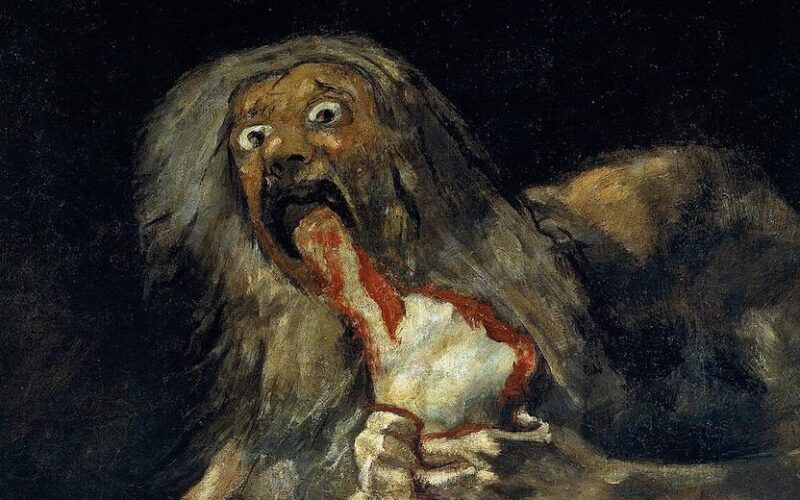
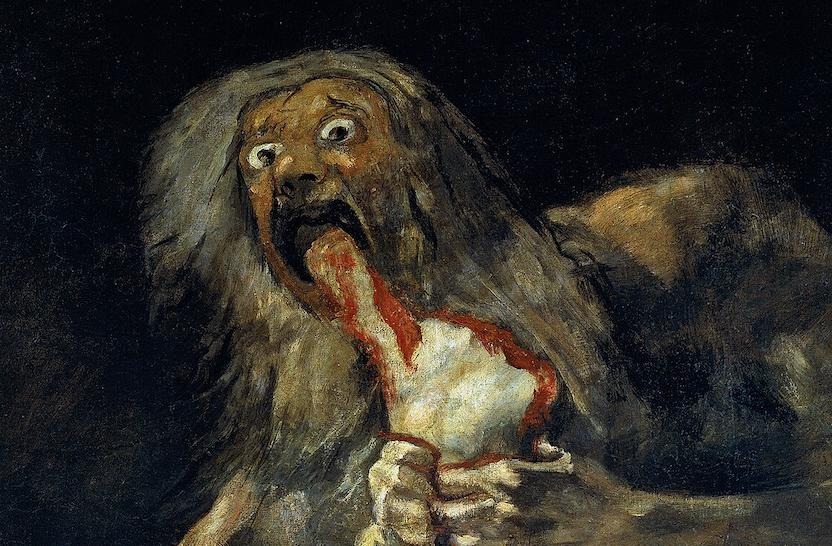
One of the most striking among them, Saturn Devouring His Son, captures this tension perfectly. A figure emerges from darkness, locked in an act that feels both mythological and disturbingly real. The violence is immediate, but what lingers is something quieter, the sense that this image was never meant to be witnessed.
And perhaps that is what makes these works so enduring. Not just what they depict, but the uneasy feeling that, in looking at them, we are stepping into something deeply private, something that was never meant for us at all.
Before the Darkness, There Was Light
Before the Black Paintings, Francisco Goya was not the artist we often imagine today.
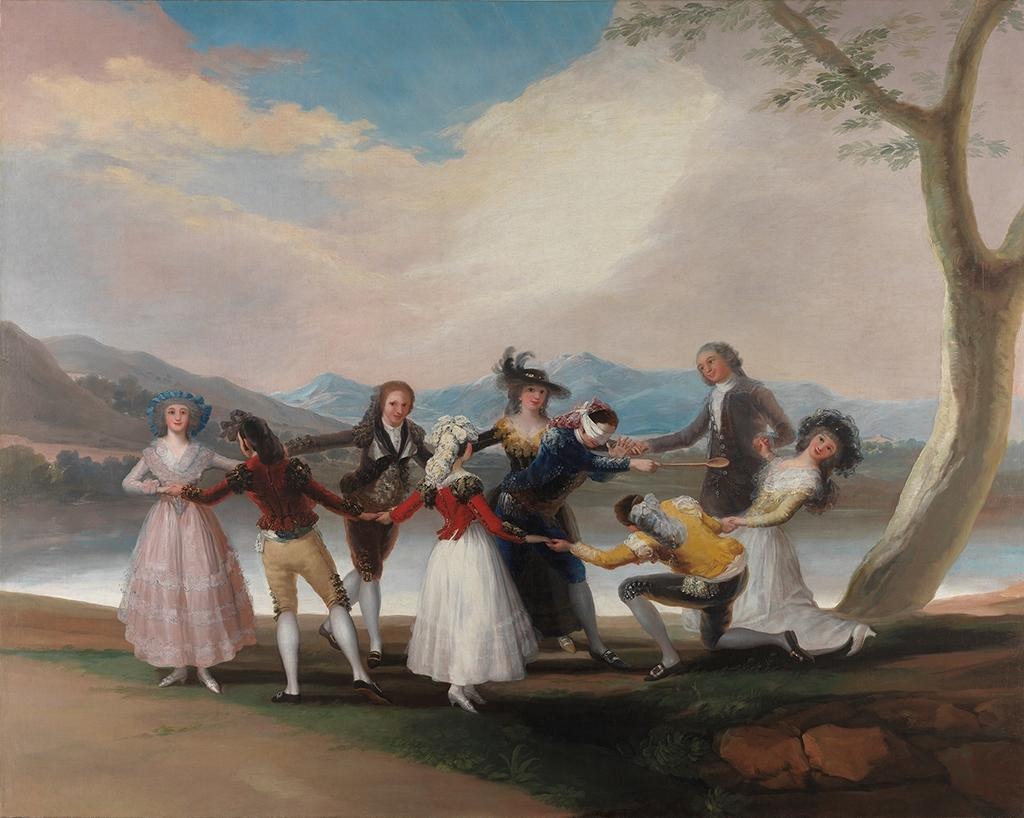
He was successful, well-connected, and deeply embedded in the cultural life of Spain. His early works, particularly his tapestry designs, were filled with light, movement, and everyday joy. Scenes of leisure, games, and rural life unfolded in soft palettes that echoed the elegance of Rococo painting. These were works made to please, and they did.
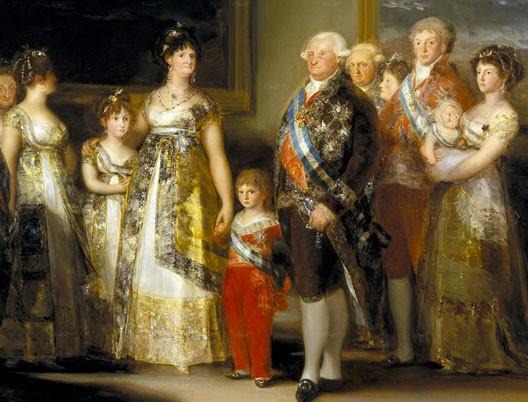
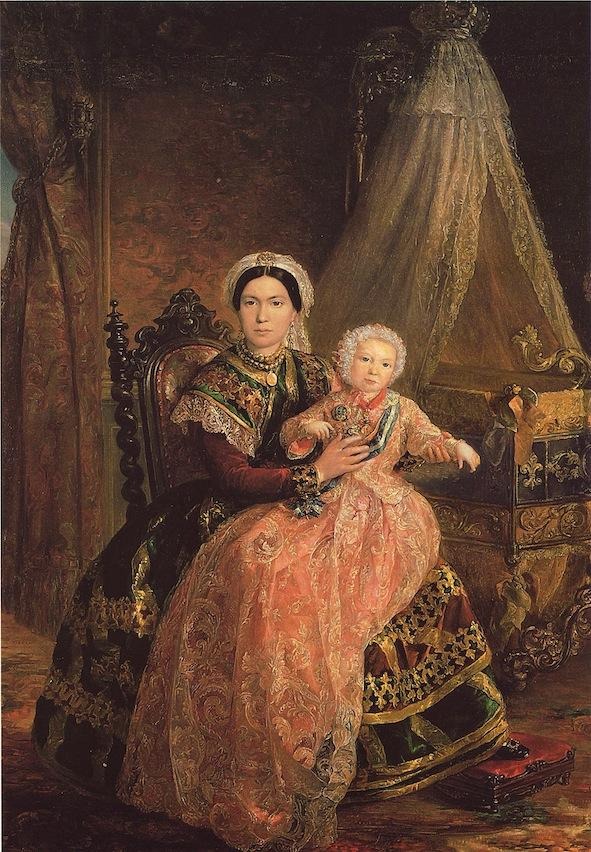
Goya quickly rose through the ranks to become a court painter, creating portraits for Spanish royalty. On the surface, these paintings fulfilled their purpose, formal, composed, and technically refined. But even here, something begins to shift. His portraits carry a subtle honesty, an almost uncomfortable clarity in how he depicts his subjects. The grandeur is present, but so is a quiet exposure.
It’s tempting to see this phase as entirely separate from the darkness that would follow, but that would be too simple. The seeds were already there, not in overt subject matter, but in the way Goya observed the world. He wasn’t just painting appearances; he was paying attention to what lay beneath them.
At this point, his life still held structure, patronage, recognition, stability. But what makes this period significant is not just its brightness, but the contrast it creates. Because when the shift comes, it doesn’t feel like a sudden change.
It feels like something that had been building all along.
When the World Began to Fracture
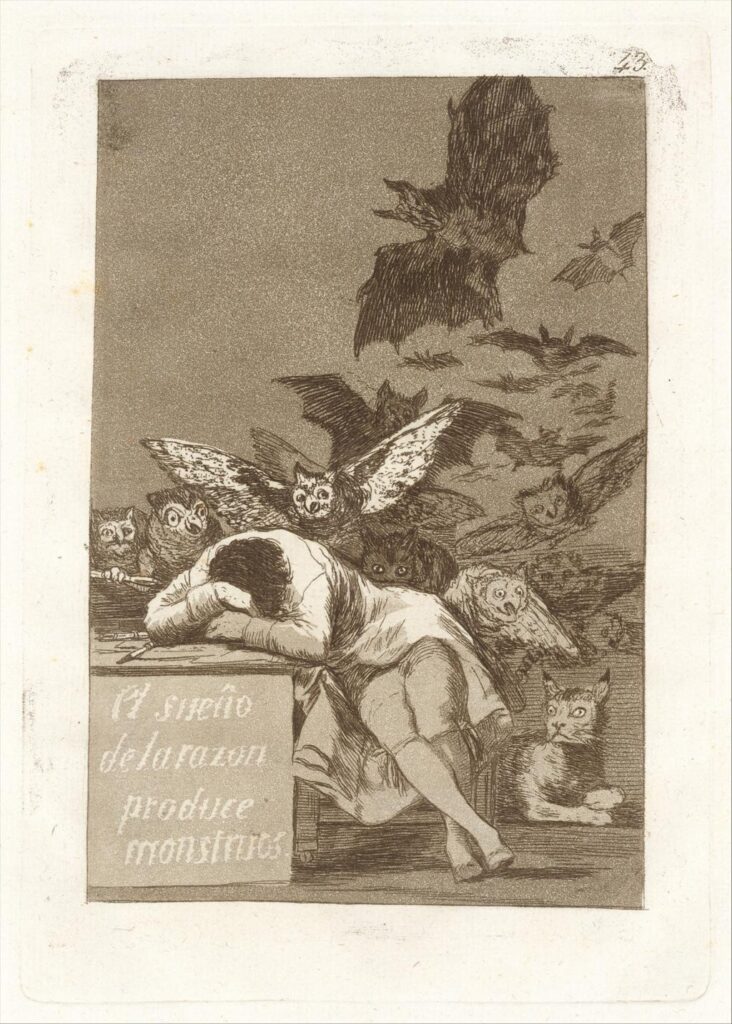
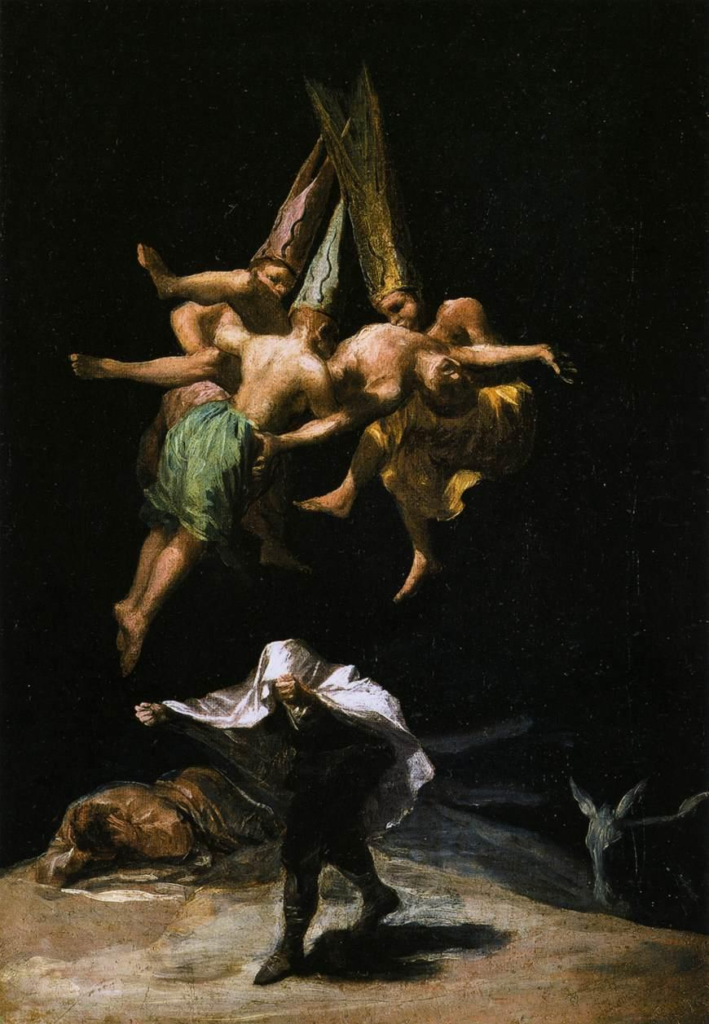
The shift in Francisco Goya’s work did not happen overnight. It began with something deeply personal.
In 1792, Goya fell seriously ill. The exact cause remains uncertain, but the aftermath was permanent, he lost his hearing. For an artist who thrived in conversation, music, and social life, this was more than a physical condition. It was a rupture. The world he had known became quieter, more distant, and increasingly internal.
What followed was not immediate darkness, but a gradual change in how he saw and painted the world.
In works like yard with Lunatics, figures twist, grapple, and drift in a space that feels both real and deeply psychological. There is movement, but no clarity. Control seems to slip from both the subjects and the scene itself. Soon after, in his series Los Caprichos, Goya turns outward again, but this time with sharp critique. Society appears irrational, filled with superstition, vanity, and distortion.
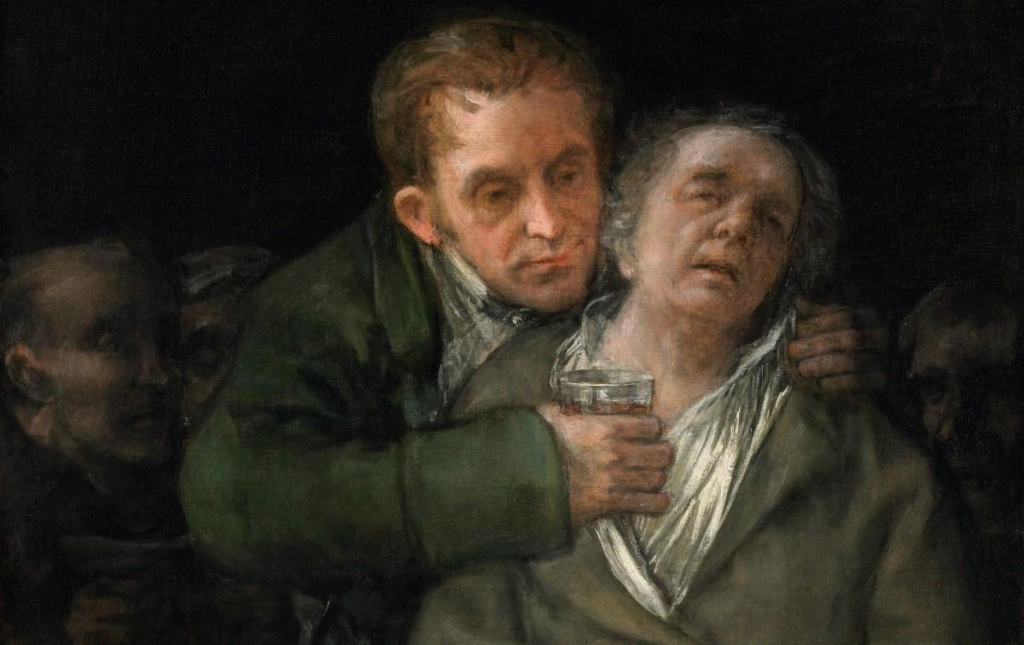
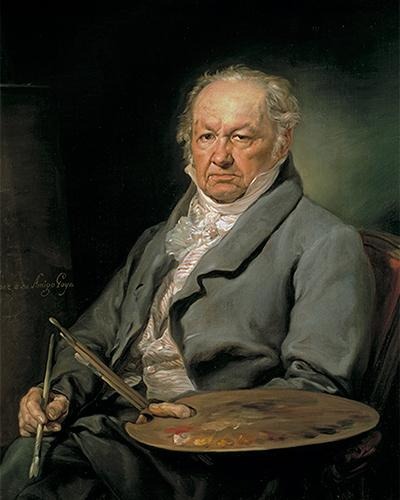
One image in particular, The Sleep of Reason Produces Monsters, becomes almost prophetic. It suggests that when reason fades, something darker inevitably takes its place.
These works are not yet the Black Paintings, but they carry their emotional weight. What changes here is not just style, but perspective. Goya is no longer painting what the world looks like, he is beginning to paint what it feels like when it starts to lose its sense of order.
And once that shift begins, there is no returning to the earlier light.
Saturn Devouring His Son
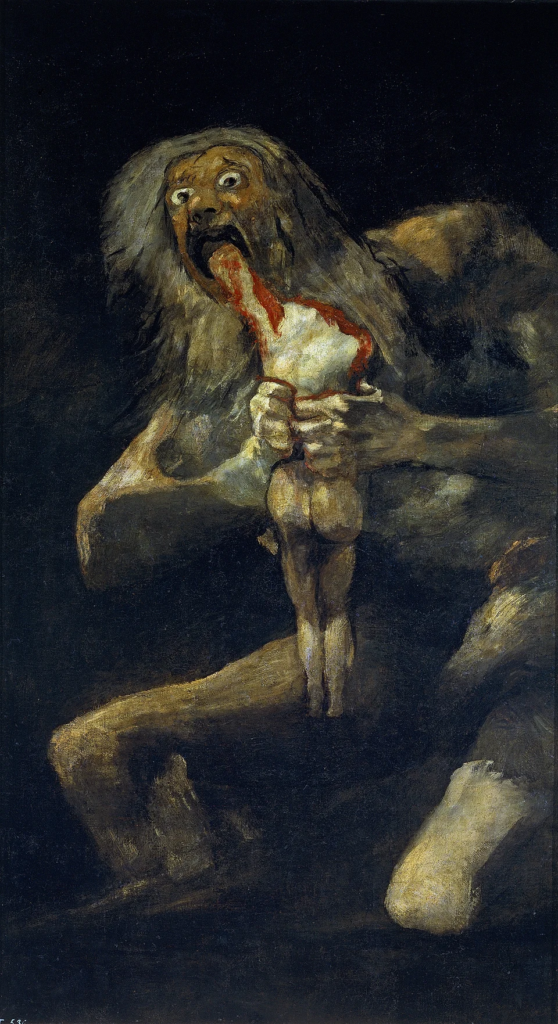
Among the Black Paintings, Saturn Devouring His Son stands apart, not just for its violence, but for the way it refuses distance.
At first glance, the subject comes from mythology. Saturn (or Cronus), fearing a prophecy that one of his children would overthrow him, consumes them at birth. It is a story that had been painted before, most notably by Peter Paul Rubens, where the act still carries a sense of narrative and structure.
But Francisco Goya removes all of that.
There is no setting. No context. No divine authority. The figure is no longer a god, but something closer to a man, hunched, wide-eyed, caught in a moment that feels both frantic and inevitable. The body in his hands is not an infant, but a fully formed figure, making the act feel even more unsettling. Blood runs through his fingers as he grips the body with a force that feels desperate rather than calculated.
What remains is not myth, but emotion.
Some interpretations read this as a reflection of power, leaders consuming their own people to maintain control. Others see something more personal: a meditation on time, aging, and the fear of being overtaken by what comes next. Saturn, after all, is also the god of time, and Goya painted this in his seventies, confronting the limits of his own body and life.
But perhaps what makes the painting so difficult to resolve is that it holds all of these meanings at once. It is violent, but also anxious. Mythological, yet deeply human.
And most unsettling of all, it feels aware.
As if the figure, caught in the act, knows exactly what it has become.
Witches’ Sabbath (The Great He-Goat)
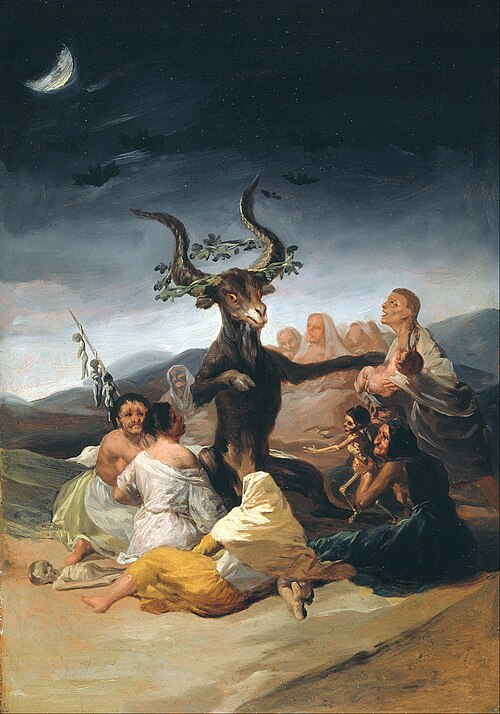
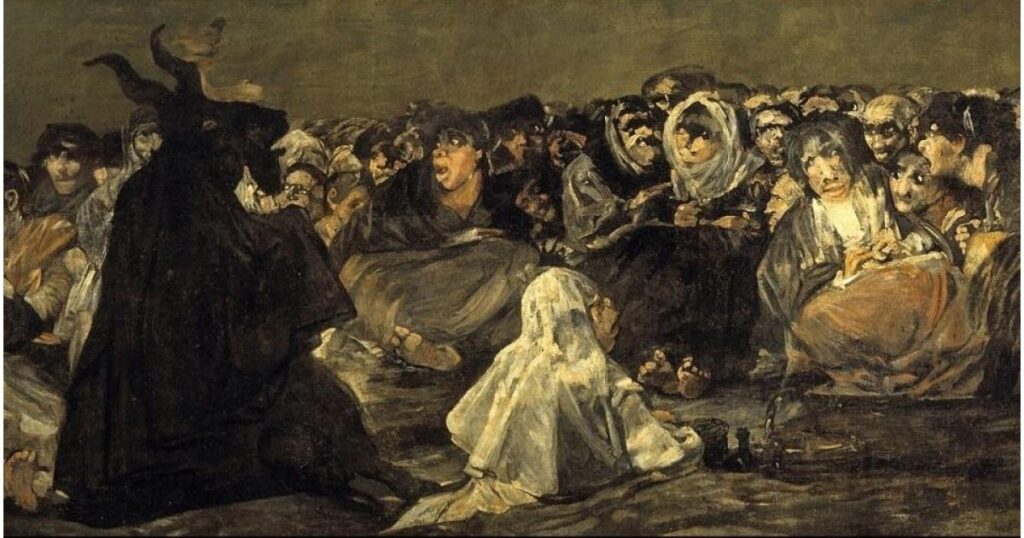
If Saturn Devouring His Son feels like a moment of private madness, Witches’ Sabbath expands that unease into something collective.
In this painting, Francisco Goya presents a gathering, figures clustered in darkness around a looming, shadowy presence often interpreted as a goat-like figure, or the devil himself. The composition is wide, almost theatrical, but instead of clarity, it offers distortion. Faces emerge from shadow, elongated, hollow, and strangely attentive, as if caught in a ritual that is both absurd and deeply serious.
At first, it may seem like a continuation of themes Goya had explored earlier in Los Caprichos, where witches and supernatural imagery were used to critique superstition and ignorance in Spanish society. But here, the tone shifts. This is no longer satire.
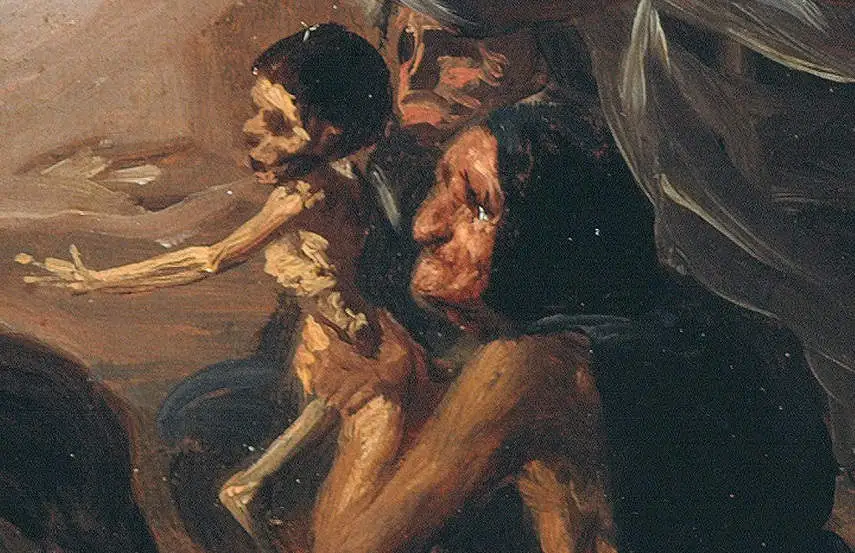
There is no clear irony, no exaggeration meant to expose folly. Instead, the scene feels immersive, almost participatory, as if the viewer has stumbled into something already in progress. The figures are not reacting to us; they are absorbed in something else entirely.
What makes the painting particularly unsettling is its ambiguity. It is unclear whether we are witnessing belief, performance, or delusion. The central figure dominates, but not through action, through presence. The surrounding faces seem suspended between fascination and submission.
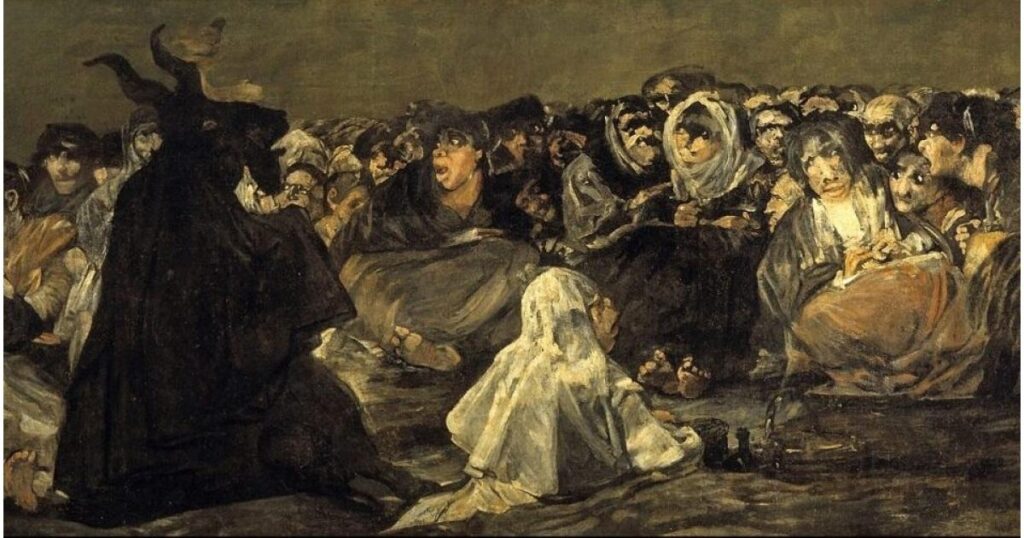
In this way, Witches’ Sabbath becomes less about witchcraft and more about collective psychology. It suggests a world where reason has quietly dissolved, replaced not by chaos, but by something far more controlled and far more difficult to explain.
The Dog
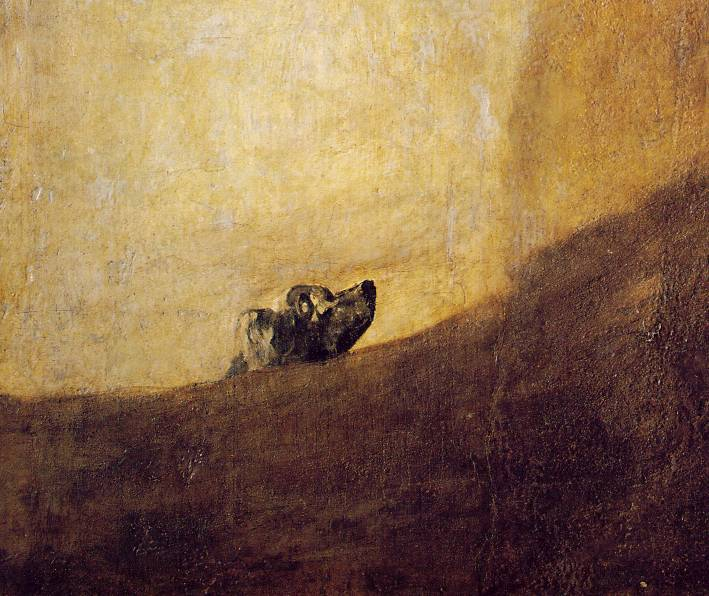
Among all the Black Paintings, The Dog is perhaps the quietest, and the most difficult to explain.
At first glance, it seems almost empty. A vast, undefined space fills most of the composition, with a muted, sandy-brown expanse rising toward a dark, open void. Near the bottom edge, barely noticeable at first, is the head of a small dog. It looks upward, its expression somewhere between alertness and resignation.
Nothing else happens.
There is no violence here, no grotesque figures, no narrative to follow. And yet, the painting feels just as unsettling, if not more. Where works like Saturn confront the viewer directly, The Dog does the opposite. It withdraws, leaving space that feels overwhelming in its silence.
This absence becomes the subject.
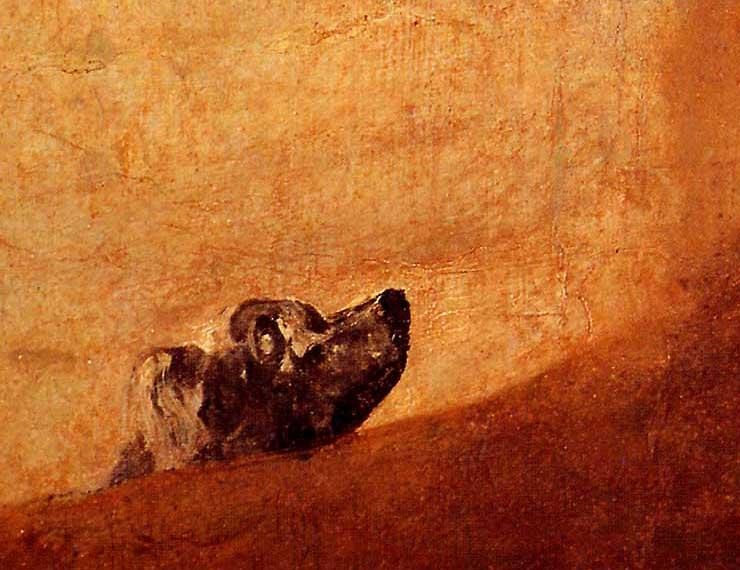
Some interpretations suggest the dog is sinking, swallowed by the earth beneath it. Others see it as a symbol of isolation, small, vulnerable, and surrounded by something it cannot understand or escape. The lack of context only intensifies the effect. There is no ground, no horizon that offers stability, no clear sense of where the dog exists.
What makes this painting remarkable is how modern it feels. Stripped of detail and narrative, it anticipates a kind of minimalism that would not fully emerge until much later.
But more than that, it captures something deeply human.
Not fear in its loudest form, but in its quietest, the feeling of being present, aware, and completely alone.
Judith and Holofernes
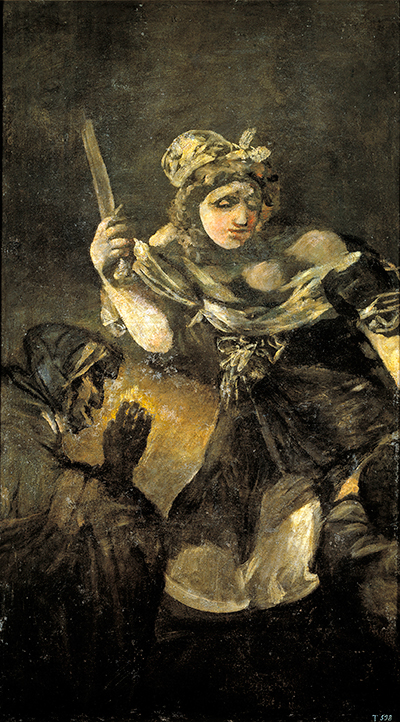
In Judith and Holofernes, Francisco Goya turns to a subject that had long been a staple of Western art, but strips it of the clarity and drama typically associated with it. The biblical story is familiar: Judith, a widow, beheads the Assyrian general Holofernes to save her people. In earlier paintings, this moment is often depicted with theatrical intensity, emphasizing courage, triumph, and divine purpose.
Goya offers something entirely different.
The scene is swallowed in darkness, with only fragments of the figures emerging into view. Judith is present, but not glorified. There is no sense of heroism, no clear narrative peak. Instead, the moment feels suspended, caught somewhere between action and aftermath. The violence is implied rather than explicitly staged, which makes it feel more unsettling. What we are witnessing is not the event itself, but its emotional residue.
This ambiguity shifts the focus. Rather than telling a story, the painting becomes about presence, about what it feels like to inhabit a moment charged with tension and consequence. The lack of detail forces the viewer to linger, to search for meaning in gestures and shadows rather than in clear forms.
In this way, Judith and Holofernes reflects the broader language of the Black Paintings. It removes structure, certainty, and resolution, leaving behind something quieter but far more disquieting. The story remains, but it no longer offers comfort.
Two Old Men Eating Soup
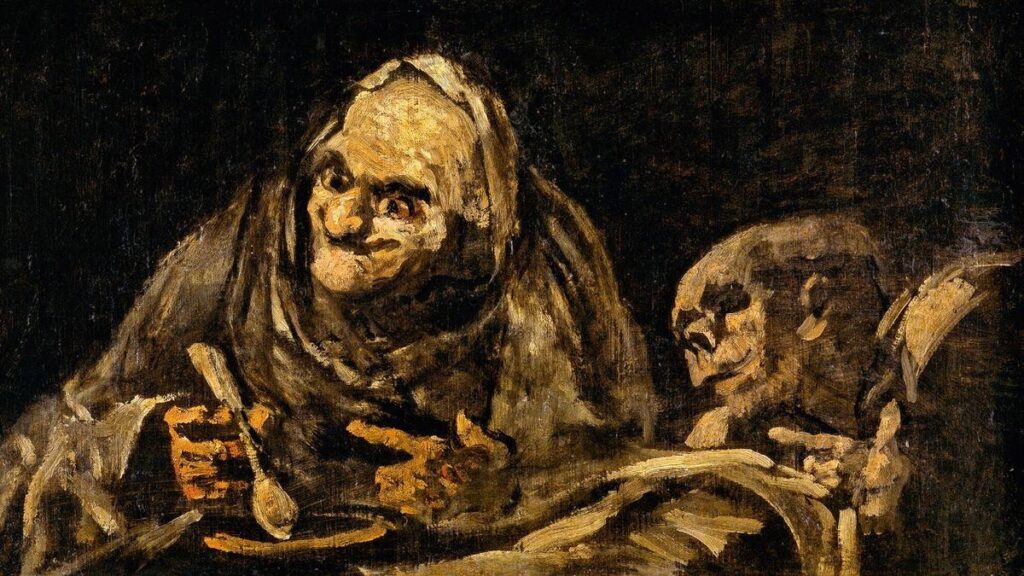
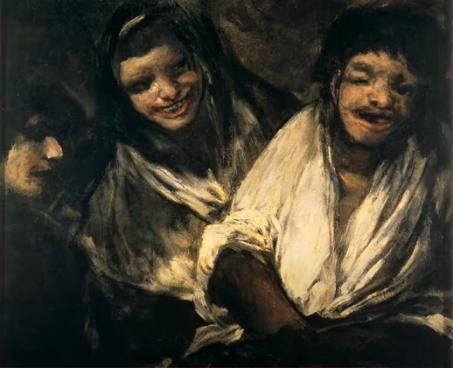
At first glance, Two Old Men Eating Soup appears almost ordinary, two figures seated close together, engaged in a simple, everyday act. But in the hands of Francisco Goya, even something as familiar as sharing a meal becomes deeply unsettling.
The figures are aged, but not gently so. Their faces are distorted, hollowed, and exaggerated, hovering somewhere between human and spectral. One leans forward with an almost skeletal intensity, while the other appears withdrawn, as if fading into the surrounding darkness. Their expressions do not meet, and there is no sense of interaction between them. They occupy the same space, yet feel entirely separate.
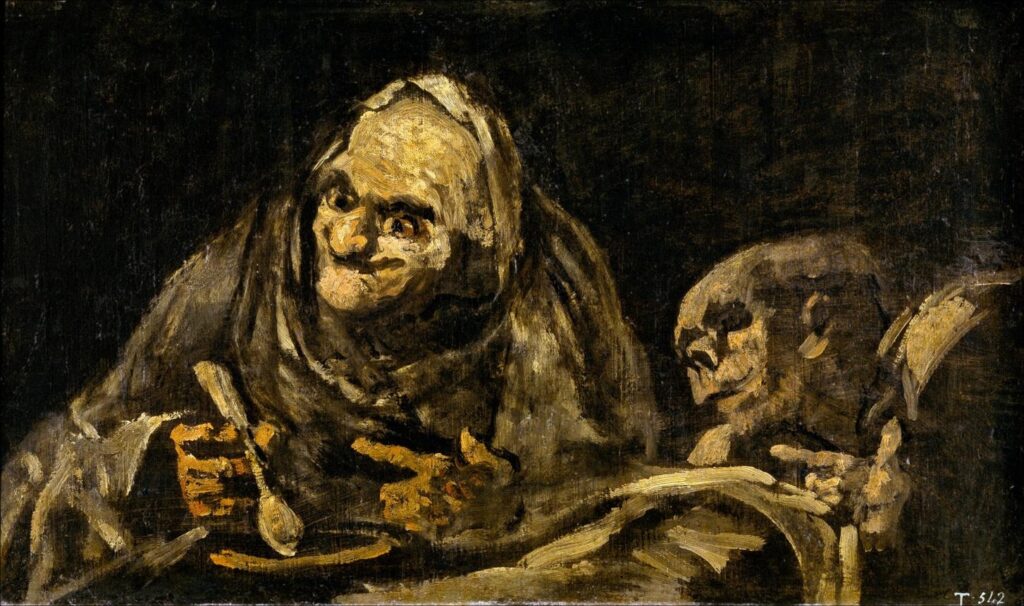
The act of eating itself feels mechanical, stripped of comfort or routine. It no longer suggests nourishment or companionship, but something closer to habit, something that continues without thought or presence. The soup, the bowl, the gesture, all become secondary to the atmosphere surrounding them.
What emerges is a quiet meditation on aging, but without sentimentality. There is no softness here, no attempt to dignify the passage of time. Instead, Goya presents old age as something raw and exposed, where the body and identity begin to lose their clarity.
The darkness surrounding the figures does not just frame them, it consumes them. And in that space, the ordinary becomes something far more difficult to look at.
Fight with Cudgels
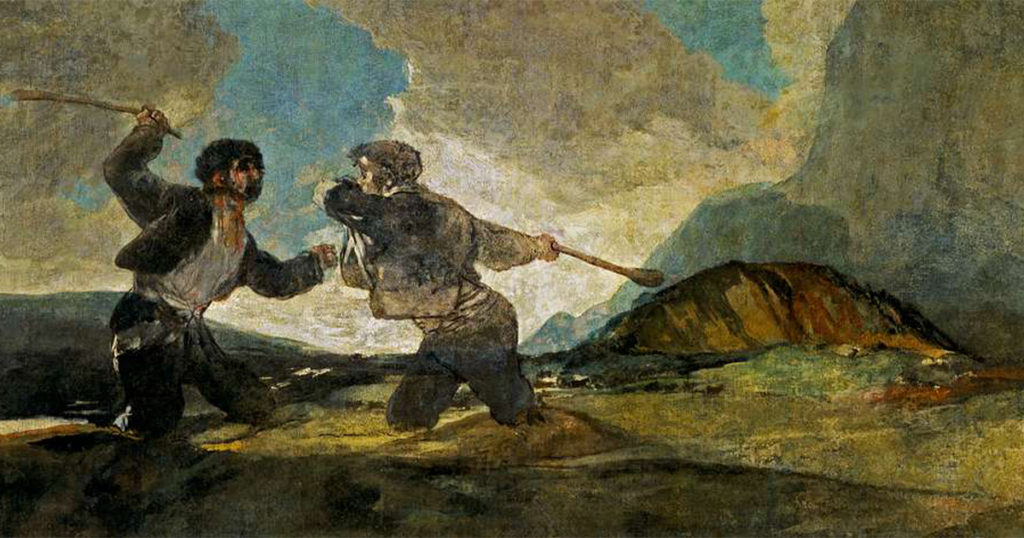
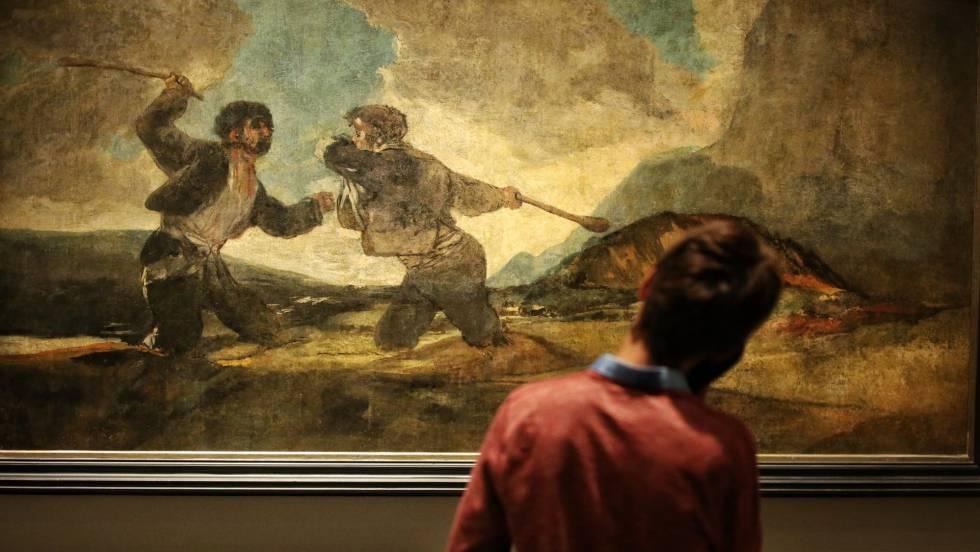
In Fight with Cudgels, Francisco Goya presents a scene of direct conflict, two men locked in combat, raising heavy sticks against one another. At first, it appears straightforward: a violent encounter, frozen at its peak. But the longer one looks, the more the painting resists that simplicity.
What immediately stands out is the ground. The figures are not standing freely; they seem partially submerged, as if the earth itself is holding them in place. This detail changes everything. Movement becomes limited, escape impossible. The fight is no longer dynamic, it is contained, almost inevitable.
There is no visible beginning or end to this conflict. The men do not appear to be advancing or retreating. Instead, they are suspended in a moment that feels continuous, as if the act of fighting has no resolution. The violence is present, but it lacks direction. It does not build toward victory or defeat; it simply exists.
This stillness gives the painting a different kind of tension. Rather than focusing on action, it emphasizes entrapment. The figures are bound not just to each other, but to the situation itself, unable to step away from the cycle they are caught in.
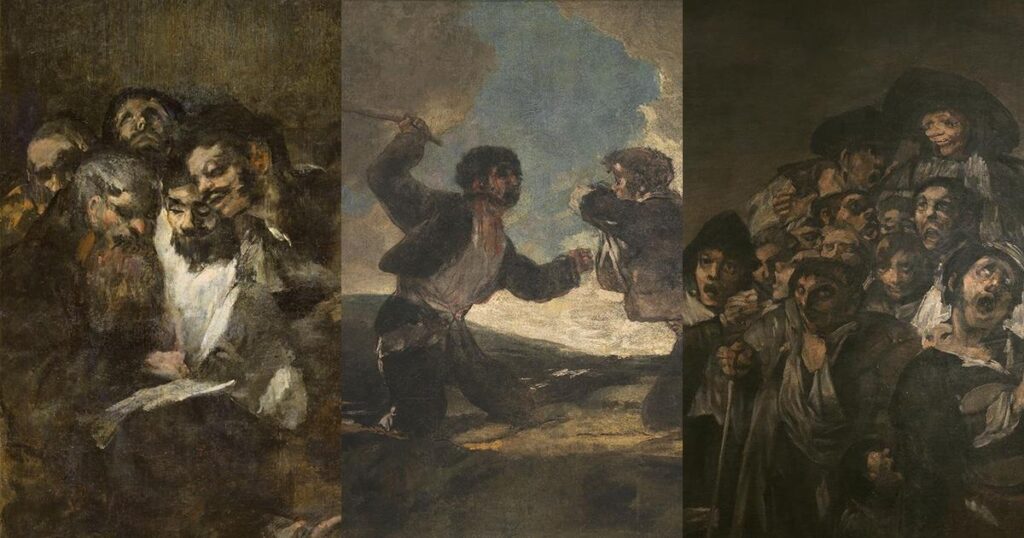
Seen this way, Fight with Cudgels moves beyond a depiction of physical struggle. It becomes a reflection on conflict as something repetitive and inescapable, where the outcome matters less than the fact that it continues at all.
Atropos (The Fates)
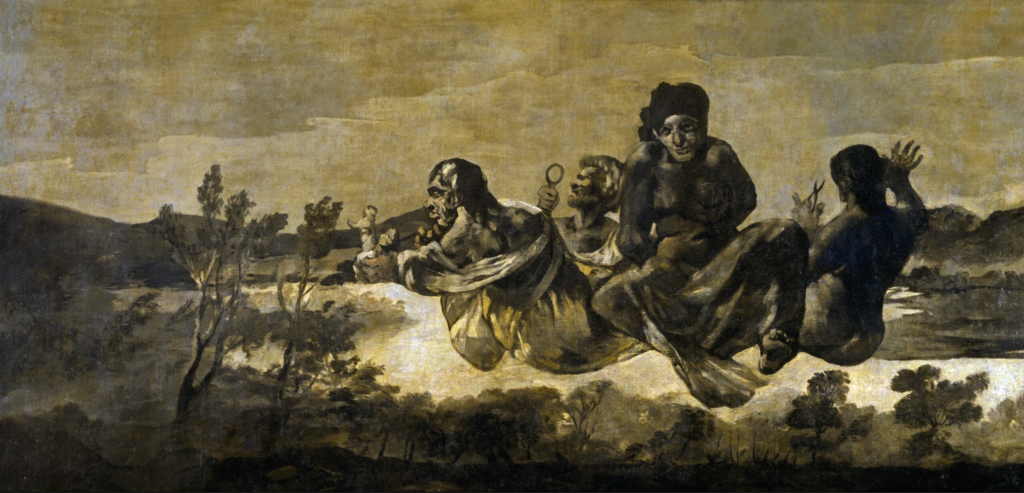
In Atropos (The Fates), Francisco Goya returns to mythology, but strips it of the order and symbolism it traditionally carries. The Fates, figures who, in classical belief, control the thread of human life, are usually depicted with clarity and purpose. They measure, spin, and cut destiny with precision.
Here, that certainty dissolves.
The figures appear suspended in an undefined space, neither grounded nor fully in motion. Their forms are indistinct, almost dissolving into the darkness around them. There is no clear hierarchy, no focal point that anchors the composition. Instead, the painting feels weightless, as if it exists outside of time and structure.
What makes this unsettling is not what is shown, but what is missing. The sense of control that usually defines the Fates is absent. They do not seem to be actively shaping destiny, but rather drifting within it. The thread of life, if present at all, is no longer visible or emphasized.
This absence creates a different kind of tension. Instead of inevitability being clearly imposed, it becomes something quieter and more uncertain, something that surrounds rather than directs.
In this way, Atropos shifts the idea of fate from something structured to something abstract. It no longer feels like a system guiding life forward, but a presence that exists without explanation, leaving the viewer with a sense of inevitability that cannot be fully understood.
Why These Paintings Feel So Unsettling
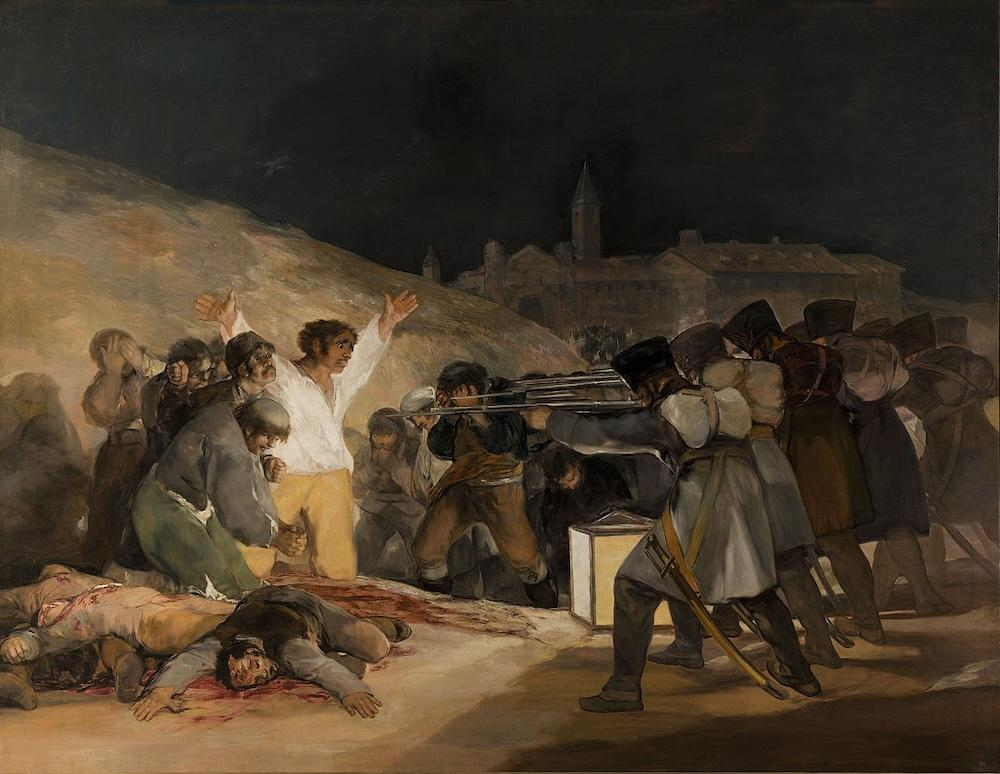
What makes the Black Paintings so unsettling is not just what they show, but how they exist.
Most art is created with an awareness of being seen. It is shaped, edited, and refined with an audience in mind. Even when it explores difficult themes, there is usually some structure guiding the viewer, composition, symbolism, or narrative clarity.
The Black Paintings resist all of that.
Painted directly onto the walls of his home, Francisco Goya did not treat these works as objects meant to last. They were not frescoes, not prepared surfaces, not preserved ideas. They were immediate, physical, and likely never intended to survive. That alone changes how we experience them. What we are looking at feels closer to a process than a finished statement.
There is also a noticeable absence of explanation. The figures are distorted, the spaces undefined, and the actions often unclear. Instead of guiding interpretation, the paintings leave gaps, forcing the viewer to sit with uncertainty. This is where their power lies.
In many ways, they feel unexpectedly modern. The loose brushwork, emotional intensity, and lack of resolution anticipate movements that would come much later, from Expressionism to psychological horror in cinema.
But more than influence or style, what lingers is something simpler.
These paintings do not perform.
They do not try to be understood.
And because of that, they feel less like something created for us and more like something we’ve come across by accident.
What Remains After
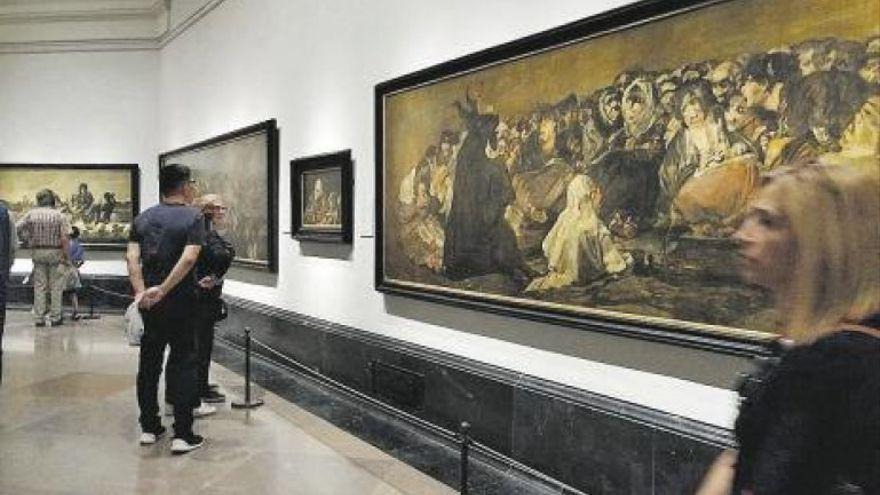
After Francisco Goya’s death in 1828, the paintings remained inside Quinta del Sordo, unseen by the public for decades. It was only later, in the 19th century, that they were removed from the walls and transferred onto canvas, a process that preserved them, but also altered them. Details were lost, compositions shifted, and the original environment in which they existed disappeared entirely.
Today, they hang in the Museo del Prado, viewed by thousands of people each year.
But something about them still resists that setting.
Because these paintings were never meant to be framed, labeled, or explained under museum lights. They belonged to a specific space, a house, a room, a life. They were part of an environment shaped by isolation, memory, and thought. Removed from that context, they become both more accessible and more mysterious at the same time.
What we see now is not exactly what Goya painted, but what remains of it.
And yet, even in this altered form, they retain their intensity. Not because they shock, but because they linger. They don’t resolve into meaning or offer a clear conclusion. Instead, they stay with you in fragments, an expression, a gesture, a feeling you can’t fully place.
If these works were never meant to be seen, their survival feels almost accidental.
And perhaps that is what makes them unforgettable.
A question to leave with
If these paintings were never created for an audience,
What does it mean that we continue to look at them today?
For a different kind of hidden meaning in art, explore this:
https://artstoheartsproject.com/cats-in-art-hidden-meanings-roles/