

In Full Bloom: The Beauty of Flowers in Art
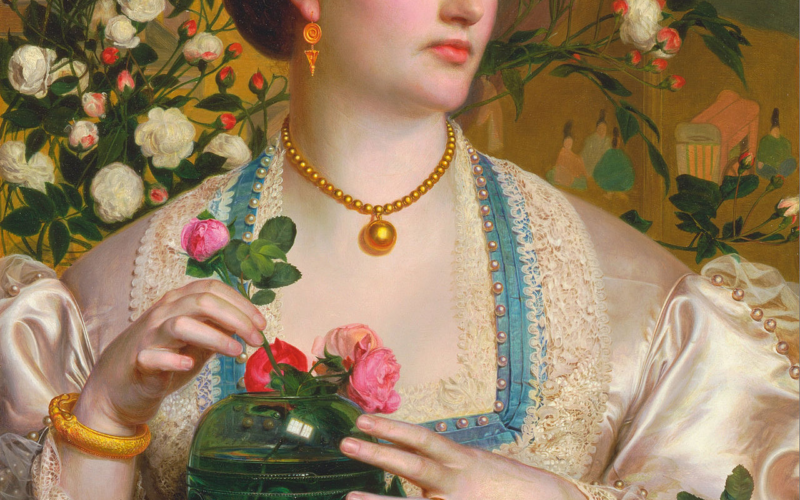
Flowers are everywhere in art.
They appear so often, so effortlessly, that it’s easy to stop questioning them, to see them as decoration, as filler, as something simply meant to be beautiful.But the moment you look closer, that illusion falls apart. What we call flowers in art are rarely just that, they are gestures, symbols, and quiet carriers of emotion, holding far more than their delicate forms suggest.
A hand grips a cluster of daisies a little too tightly. Roses sit perfectly arranged, already cut from their source. Chrysanthemums spill outward, heavy with something unspoken. Lilies stand untouched, almost unnaturally pure. And somewhere, in a garden that refuses to stay still, flowers dissolve into light before you can fully see them.
Nothing about them is neutral.
Across centuries, artists have turned to flowers not because they are easy subjects, but because they are complex ones, capable of holding contradiction in a way few other forms can. They are soft, but they carry weight. They are beautiful, but they are always on the verge of fading. They invite touch, and yet, the moment they are touched, they begin to change.
This is what makes them so enduring.
Not just as symbols of love or femininity or nature but as a way of thinking about time, about control, about presence and loss. Each painting doesn’t simply show flowers; it asks what it means to hold something that won’t last.
And perhaps that is why we keep returning to them.
Because in the quiet language of petals and stems, artists have always been saying something much larger, something about how we see, how we feel, and how we try, however briefly, to hold on.
Roses – Grace Rose, Frederick Sandys
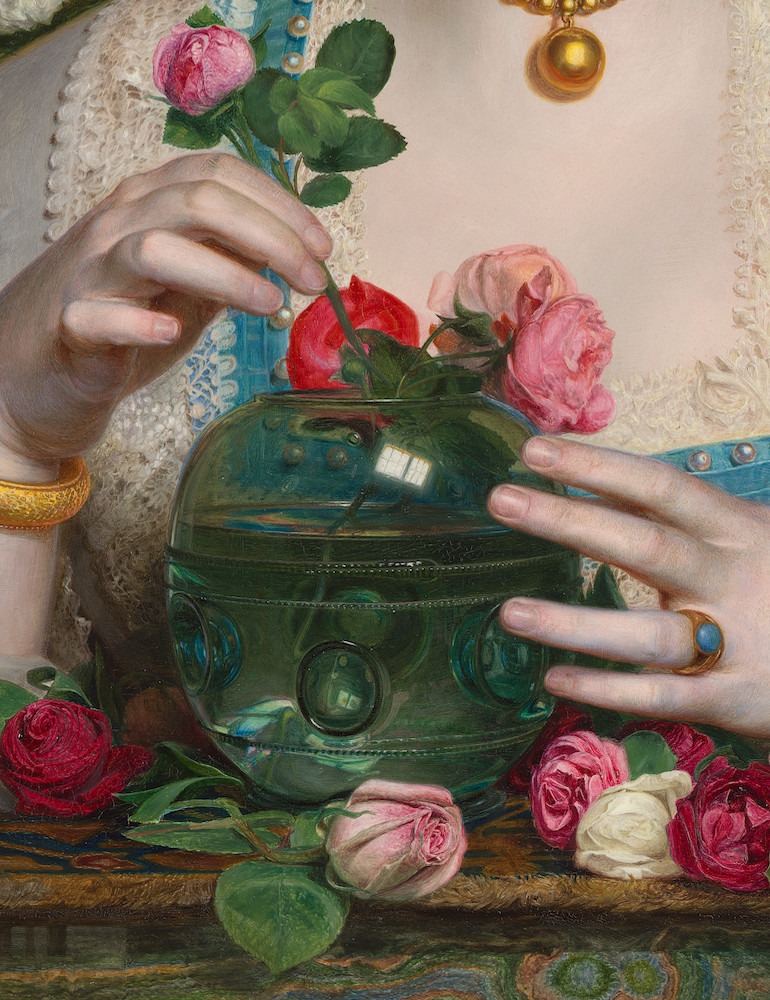
In Grace Rose, Frederick Sandys presents flowers not as something wild or fleeting, but as something carefully arranged, almost controlled.
The roses do not grow here; they are placed.
Set within a richly detailed interior, the composition draws attention to the act of handling. A single hand lifts a rose, while others rest nearby, already gathered, already contained within a glass vessel. The transparency of the bowl is striking, it allows everything to be seen, nothing to be hidden. Beauty, here, is not spontaneous. It is curated.
Roses have long symbolized love, but Sandys complicates that reading. These are not the untamed blooms of a garden; they are cut, selected, arranged for display. Their stems are shortened, their thorns removed, their lifespan quietly limited. What remains is perfection, but a controlled, almost suspended kind of perfection.
There is also a subtle tension between softness and structure. The petals are lush, full, almost excessive in their detail, while the surrounding elements, the jewellery, the fabric, the vessel, create a sense of restraint. The figure does not dissolve into the flowers; she manages them.
And that is where the painting lingers.
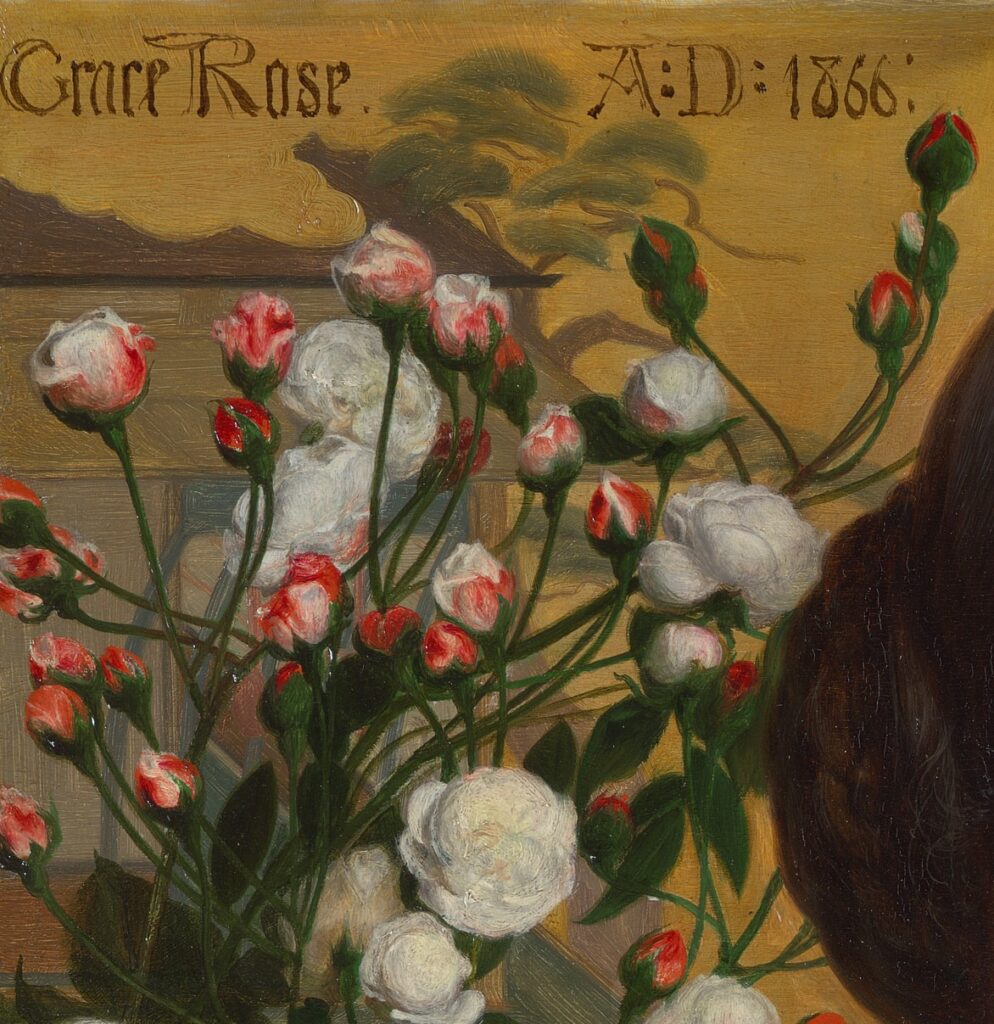
Because in Grace Rose, beauty is not just admired, it is shaped, held in place, and, in some ways, possessed. The roses become less about romance and more about the delicate balance between desire and control, between what is allowed to bloom and what must be contained.
Lilies – Carlo Dolci
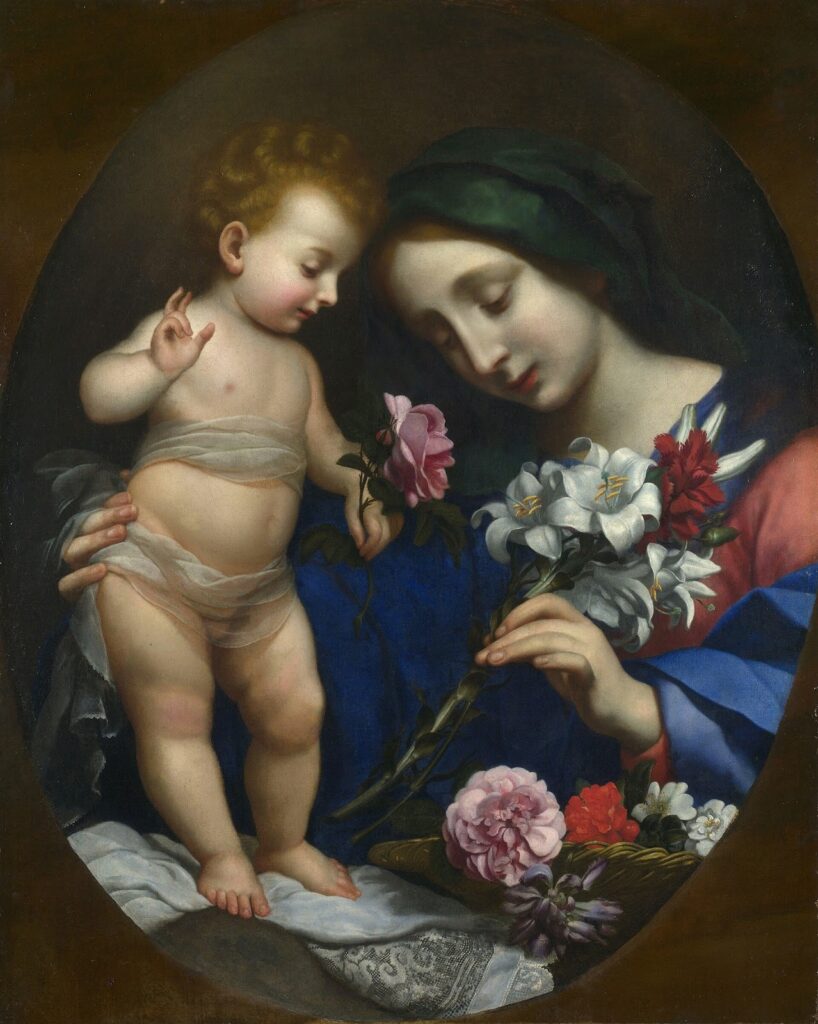
In the devotional works of Carlo Dolci, lilies appear with a kind of stillness that feels deliberate, almost controlled.
In The Virgin and Child with Flowers, they sit quietly within the composition, neither dominating nor disappearing. Instead, they punctuate the space with a clarity that feels intentional. Often associated with the Virgin Mary, lilies in such works function less as decoration and more as declaration, purity, obedience, divine grace, meanings that are assigned, reinforced, and repeated.
Unlike the lush abundance of roses or the emotional density of chrysanthemums, these flowers are restrained. They do not overwhelm; they guide the eye, anchoring the image within a moral and symbolic framework.
But what makes Dolci’s lilies compelling is not just what they represent, but how they are rendered. Each petal is smooth, unblemished, almost too perfect to belong to the natural world. There is no trace of decay, no suggestion of time passing. The flowers exist in suspension, preserved in a state that resists change.
That perfection carries its own tension.
Because purity, in this context, is not organic. It is constructed, protected, and, in many ways, imposed. The lilies do not grow freely; they are presented, almost like an offering that must remain intact. Their whiteness is not just visual, it is ideological.
And yet, beneath that stillness lies fragility.
Lilies, by nature, bruise easily and fade quickly. In Dolci’s work, that reality is erased. What remains is an ideal, something controlled, perfected, and held just beyond the reach of time.
Daisies – Leopold Schmutzler
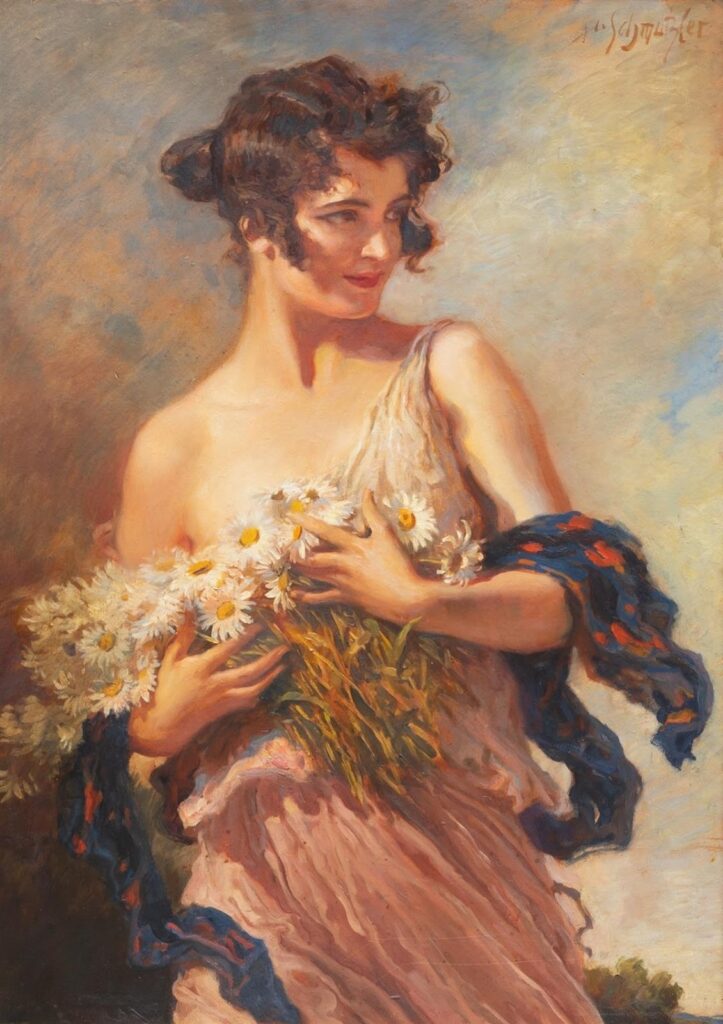
Lady with a Bouquet of Daisies
There is something immediately disarming about the way daisies appear in the work of Leopold Schmutzler. They are soft, unassuming, almost too gentle to carry meaning and yet, they do.
In this composition, the flowers are not simply arranged; they are gathered, held, touched. The gesture matters. Hands hover around them with a kind of care that feels both tender and fleeting, as if the act of holding is already a form of letting go. The daisies, often associated with innocence and youth, seem to exist in a fragile state, caught between being admired and being undone.
Schmutzler’s treatment of light and texture heightens this tension. The petals are luminous, almost dissolving into their surroundings, while the figure remains partially obscured, secondary to the quiet presence of the flowers. It shifts the focus away from portraiture and toward sensation, the softness of petals, the intimacy of proximity.
But what makes this work linger is not just its beauty. It is the suggestion that innocence, like these flowers, is something that cannot remain untouched. The more closely it is held, the more temporary it becomes.
In this way, the daisies are not merely decorative. They become a quiet meditation on transience, on how the most delicate things are often the ones we try hardest, and fail most inevitably, to preserve.
Chrysanthemums – Girl with Chrysanthemums, José Mongrell Torrent
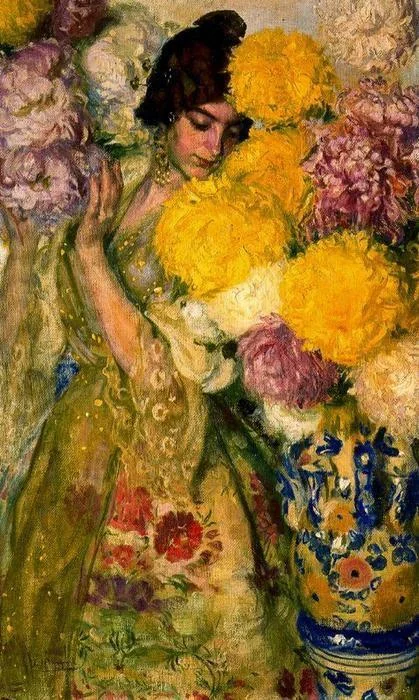
In Girl with Chrysanthemums, José Mongrell Torrent shifts the role of flowers from something held to something that almost overtakes.
The figure is present, but not dominant. Instead, the chrysanthemums expand outward, dense, textured, almost overwhelming in their abundance. Their yellow blooms carry a quiet weight, one that feels heavier than their softness suggests. Unlike roses or daisies, chrysanthemums are rarely just decorative. Across cultures, they are tied to mourning, remembrance, and the passage of time.
That association subtly alters the atmosphere of the painting.
The woman does not display the flowers; she seems to lean into them, as if seeking comfort or retreat. Her posture is inward, her gaze lowered. There is no performance here, no offering outward. The flowers create a space around her, protective, but also enclosing.
What makes this work particularly striking is how the boundary between figure and florals begins to blur. The textures echo each other: the softness of fabric, the layered density of petals. It becomes difficult to separate where the subject ends and the flowers begin.
And in that merging, something shifts.
The chrysanthemums stop being objects of beauty and become emotional landscapes. They hold a kind of quiet stillness, not dramatic grief, but something more subdued, more internal. A presence that lingers rather than declares itself.
In this painting, flowers are not there to be admired. They are there to be felt-absorbing, surrounding, and quietly reshaping the space they occupy.
Gardens – Claude Monet
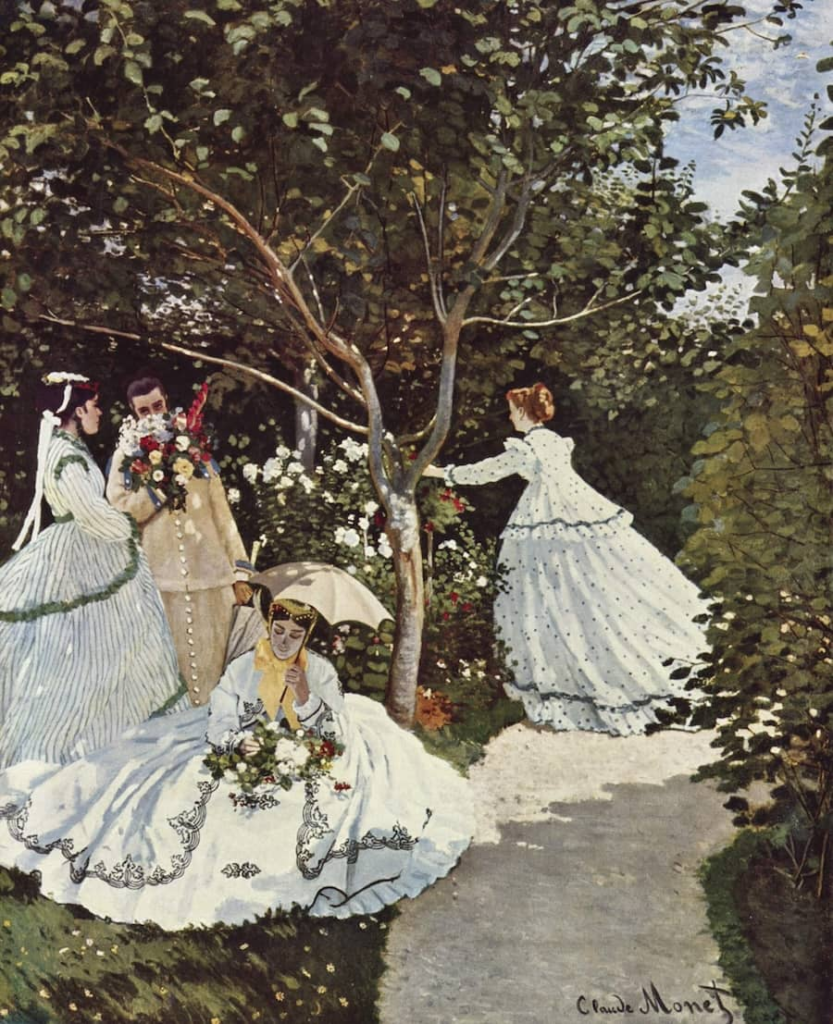
In the garden paintings of Claude Monet, flowers are no longer something to hold, arrange, or even study closely. They begin to dissolve.
Works like Woman in the Garden or his later scenes from Giverny shift attention away from individual blooms and toward atmosphere. Flowers lose their edges. They blur into color, into light, into movement. What matters is not the flower itself, but the sensation of being surrounded by it.
This is where Monet changes the language of floral painting.
Instead of isolating beauty, he immerses the viewer in it. The garden is not a subject, it is an environment. Figures, when they appear, do not dominate the space; they drift through it, almost secondary to the shifting surface of color around them. A dress catches light in the same way petals do. A pathway dissolves into brushstrokes. Everything begins to feel interconnected.
There is also a quiet temporality embedded in these works. Unlike the fixed perfection of earlier floral paintings, Monet’s gardens feel momentary, like something glimpsed and already changing. The light shifts, the colors vibrate, the forms refuse to settle.
And that is precisely the point.
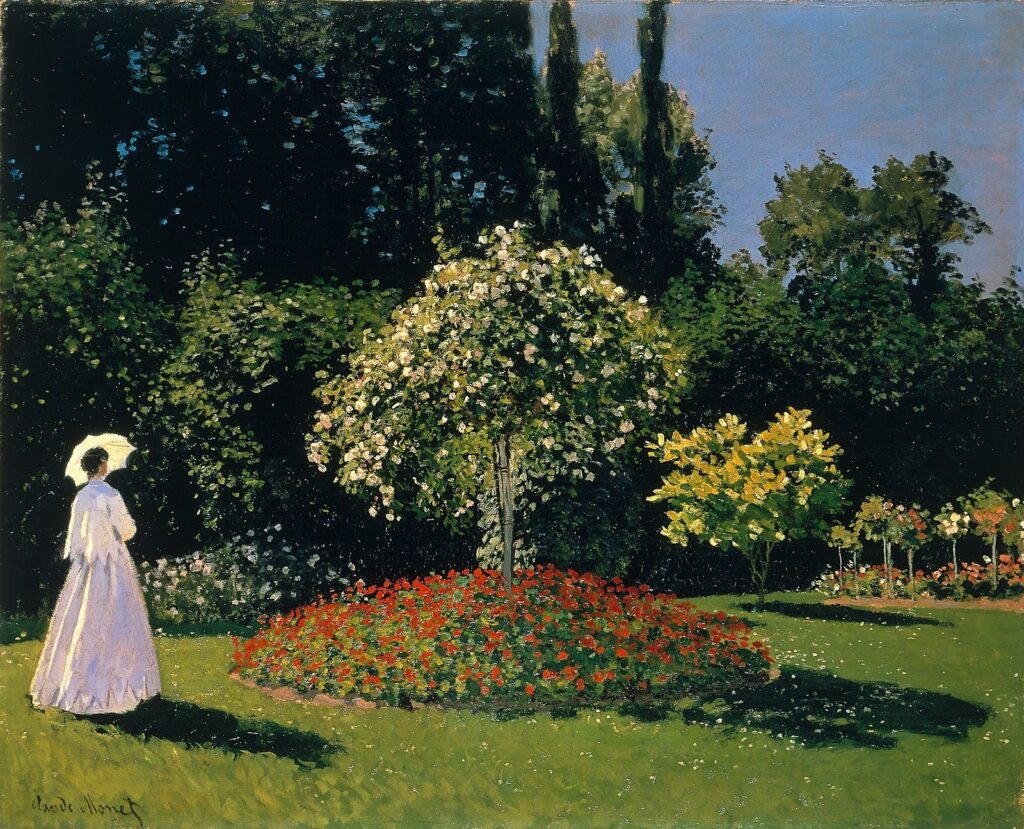
Here, flowers are not preserved. They are experienced. Not as objects of admiration, but as something fleeting, atmospheric, and impossible to hold onto.
In Monet’s world, beauty is not something you possess, it is something you move through, briefly, before it disappears.
Everyday Flowers – Suzanne Valadon
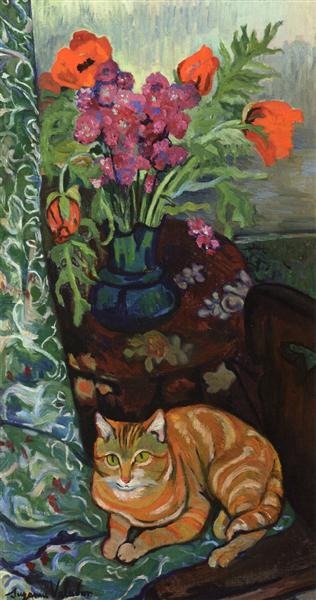
In the work of Suzanne Valadon, flowers lose their symbolic weight and enter the everyday.
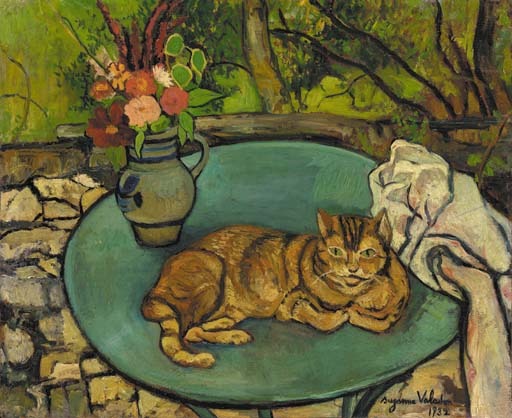
They are no longer tied to grand ideas, no overt references to purity, love, or mortality. Instead, they sit in vases, slightly uneven, sometimes leaning, placed on tables that feel used rather than staged. In paintings like Flowers and Cats (Raminou), the bouquet shares space with domestic life: a table, a patterned cloth, a watchful cat. Nothing feels overly arranged, and that is precisely what gives the work its presence.
Valadon’s approach resists idealisation. The flowers are not perfect; they are vivid, slightly unruly, painted with a directness that refuses delicacy. Thick outlines, bold color contrasts there is a kind of confidence in how they occupy space. They are not fragile objects to be admired from a distance; they are part of a room, part of a life.
What’s striking is how this shifts our relationship to them.
Without heavy symbolism, the flowers begin to feel more personal. They suggest routine rather than ritual, something picked up, placed down, lived alongside. Their beauty is not heightened; it is normalized.
And yet, that does not make them insignificant.
If anything, it does the opposite. By removing the pressure of meaning, Valadon allows the flowers to exist as they are, present, imperfect, quietly alive within the rhythm of daily life.
Here, beauty is not elevated. It is simply there, waiting to be noticed.
Lovers in Bloom – Marc Chagall
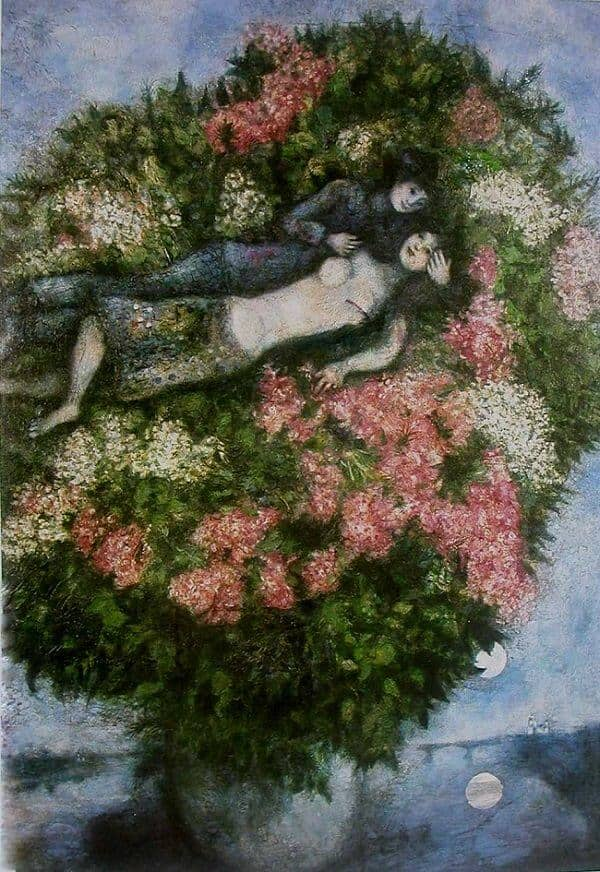
In Lovers in the Lilacs, Marc Chagall moves flowers out of the realm of observation and into something far more emotional, almost intangible.
Here, flowers are not arranged, held, or even distinctly separate from the figures. They expand, envelop, and dissolve the boundaries between bodies and surroundings. The lovers do not exist beside the lilacs; they exist within them. Color spills across the canvas in soft purples and greens, blurring distinctions between skin, air, and petals.
Chagall’s world is not governed by realism, and that is what allows the flowers to transform.
They become extensions of feeling.
The lilacs do not symbolize love in a traditional sense; they behave like it. They surround, overwhelm, and soften everything they touch. There is no structure holding them in place, no vase, no ground. Instead, the composition floats, suspended somewhere between memory and dream.
What makes this painting linger is its refusal to separate emotion from environment. The figures are not framed against the flowers; they are absorbed by them. Love, here, is not an interaction between two people, it is an atmosphere, something shared, something that dissolves the edges of individuality.
In this space, flowers are no longer objects of beauty.
They are experiences.
Something you don’t just see, but feel yourself slipping into, softly, completely, and without resistance.
Across these paintings, flowers never remain what they first appear to be.
They begin as something familiar – daisies, roses, lilies, chrysanthemums but with each artist, they shift. They are held, arranged, dissolved, lived with, and finally, felt. Sometimes they carry the weight of meaning, love, purity, grief. Other times, they resist it entirely, existing quietly within the background of everyday life. And in some moments, they become something else altogether, an atmosphere, a sensation, a state of being.
What connects them is not just beauty, but instability.
Flowers are among the few subjects in art that cannot escape time. They bloom, they fade, they collapse. Even when painted into permanence, that temporality lingers. You can feel it in the way petals are handled, in the way compositions are constructed, in the way artists choose either to preserve or to let them dissolve.
Perhaps that is why artists keep returning to them.
Not because flowers are beautiful, but because they are brief. Because they allow artists to hold something at the exact moment it begins to disappear. And in doing so, they offer a kind of quiet confrontation: with time, with change, with the impossibility of keeping anything exactly as it is.
To look at flowers in art, then, is not simply to admire them. It is to recognise how much of what we find beautiful is, by its very nature, already passing. If you could add one more flower painting to this list, which one would it be?
Still in the mood to explore more seasonal blooms? Take a look at Spring Paintings That Mark the Season, a collection that captures the fleeting beauty of spring in full bloom.