

This Artist’s hybrid creature art blends human bodies with amphibian heads┃ Gregory Jacobsen

At Arts to Hearts, we spend a lot of time looking for artists who are doing something that cannot be easily explained, easily categorised, or easily forgotten. Artists who are working in a space entirely their own where the rules they follow are the ones they made themselves and the work they produce could not have come from anyone else.
Our Best of the Art World editorial exists for exactly those artists. And today, we are bringing you one who has been quietly, consistently, and unapologetically doing just that for over two decades.
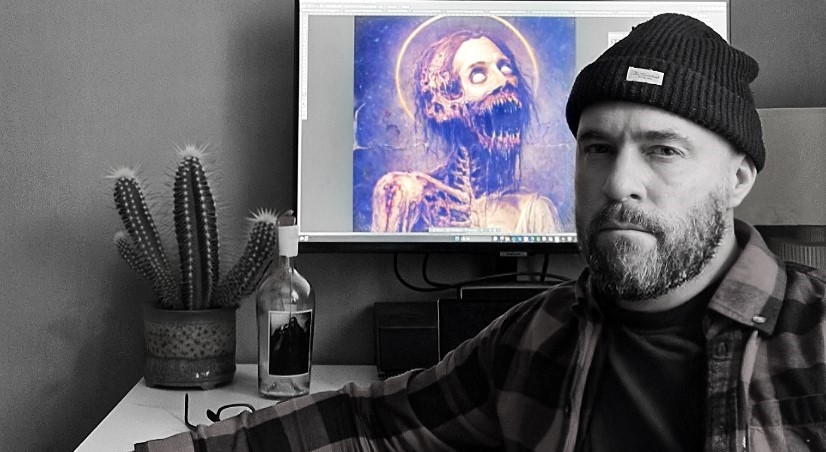
Gregory Jacobsen is a painter based in Chicago, and we will be honest with you when we first encountered his work, we were not entirely sure how to respond. And that, we quickly realised, is precisely the point.
His paintings are lush and technically gorgeous, built with the kind of craft and surface quality that makes you want to lean in closer. And then you do lean in closer. And something hits you.

Something dissonant, something that cannot easily be resolved, something that sits right at the edge of seductive and unsettling and refuses to fall neatly to either side. It is a feeling you do not forget. And the more time you spend with the work, the more you realise that feeling is not an accident. It is the whole project.
Gregory grew up in New Jersey and left for Chicago and the School of the Art Institute not because he had a clear plan, but because he wanted to make a dramatic move to get out of his town and into something bigger and stranger. He was nocturnal. He liked that the studios were open all night.
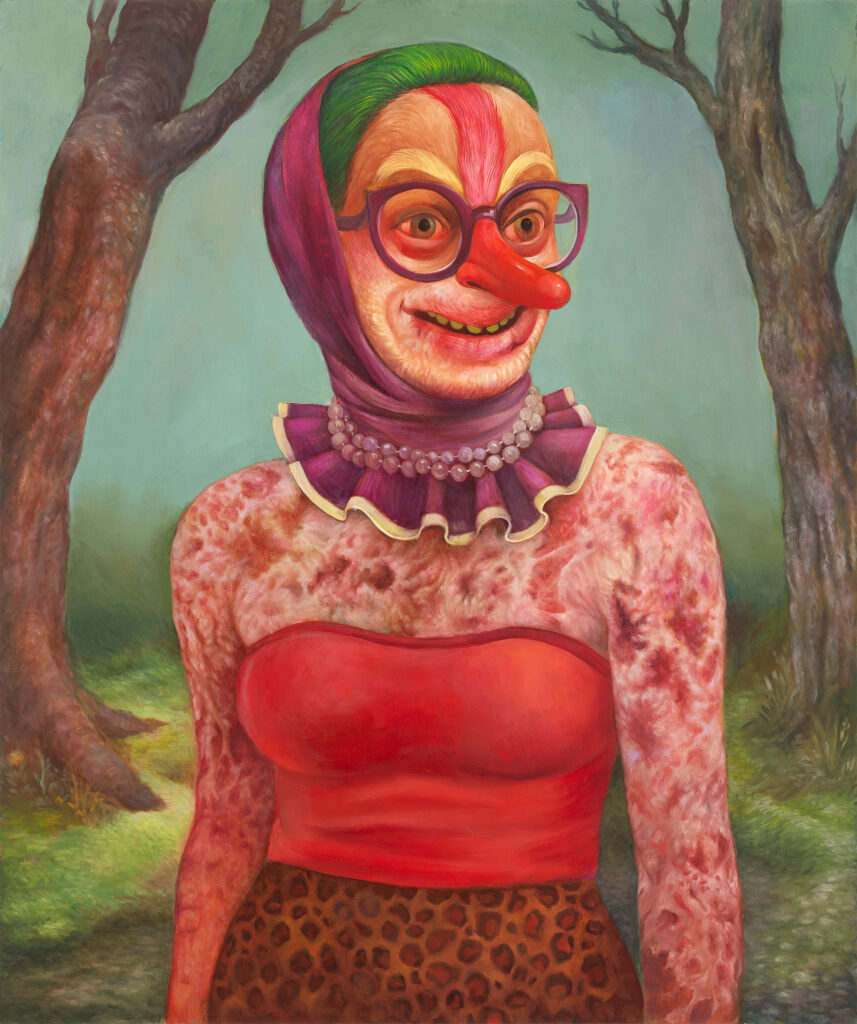
He spent his time at SAIC exploring sound, performance, and printmaking alongside painting, building a practice that has always been wider and more restless than any single medium could contain. And that restlessness never left him. Over two decades later he is still in Chicago, still working late, still painting figures and bodies and faces that exist somewhere between the human and the fantastical, between the beautiful and the grotesque, between a medical journal and a fever dream.

His surfaces are extraordinary, lush, glowing, almost seductive in the way they pull you in. He works in oil on panel, linen, and canvas, switching between them with real intention, knowing that a panel will make him detail obsessed and a canvas will loosen him up into bolder, more physical decisions.
And then there is a side of Gregory that surprises you until you realise it makes complete sense. Because underneath all the visceral ambiguity, underneath the surfaces that wow and unsettle in equal measure, there is an artist who loves craft deeply, loves people genuinely, and loves the challenge of making something that has never existed before.
His work is in the collection of MoMA. He has been showing for over two decades. And he still wakes up every morning and goes into the studio not because he has to, but because, as he puts it simply and completely, he gets to.
Let’s get to know Gregory through our conversation with him, where he talks about failure as a tool, ambiguity as a life philosophy, and what it really means to fall into your obsession and let it overtake you.
Q1. I’d love to start with just you, your story, where you come from. How did a kid growing up in New Jersey find his way to Chicago and end up spending over two decades painting some of the most viscerally honest work I’ve come across?
Art school was a way to get out of my town. New York City wasn’t far away but I wanted to make a dramatic move. I didn’t really know much about Chicago, I lived in a North East bubble. But I also really liked the program at SAIC. I liked that studios were open all night. I have always been nocturnal and having that freedom was important to me. The school also stressed interdisciplinary learning. I knew I wanted to paint but I had a lot of other art interests that I thought were important to develop alongside the more traditional artmaking. As such, I mostly focused on sound, performance, and printmaking during my time there. I did a little bit of figure drawing and painting but didn’t find the program to be particularly conceptually interesting.
Q2. Chicago has been your home base for a long time now. What is it about the city, its energy, its art scene, its people that has kept feeding your work all these years?
I’m not really a part of the art scene here. I’ve been showing consistently in Chicago for over twenty years but I have never really been able to fall into the various cliques that have swelled and receded over the years. My community has mostly come from the DIY experimental music scene. I’ve been here for so long because it’s a cheap significant US city. It’s a breeding ground for people to develop their art and themselves without having to submit to multiple soul-sucking jobs. It’s still possible to exist within the cracks.

Q3. You work in oil on panel, linen, and canvas sometimes switching between them. I’m curious whether the surface you paint on actually changes the emotional texture of what comes out, or if that’s more of a practical choice for you?
A lot of times it’s practical. I have been painting on panels for many years. In the early days it was because they were cheap- some garbage wood, some masonite. I was painting with acrylics for years- I think they look terrible on traditional canvas, at least with how I used them. It took me a while to learn how to use a rough canvas to my advantage. The two surfaces definitely affect how I approach a work and the resulting emotional texture. With panels I get very detail-obsessed, and with canvas I can let the surface do a lot of the work which loosens me up to make bolder decisions.
Q4. You paint everything from tiny 6×6 inch panels to full 40×30 inch canvases. Does a small painting ask something different of you emotionally than a large one, or is the intensity the same regardless of scale?
I can get lost in the smaller works. With large paintings I tap into a full-body physicality. I try to make the intensity the same regardless of scale. I would always work large if it was more practical for my studio, shipping, storage, etc. There’s nothing like being all-in physically with a painting. It’s a work-out! But I also love the recorded micro-movements of working small and demanding a viewer get in close.
Q5. Your surfaces are genuinely beautiful lush, glowing, almost seductive and then the subject matter hits you like a punch. Is that contrast something you’re engineering deliberately, or does it just happen because that’s how you see the world?
I like making beautiful well-crafted objects. I like finding beauty where it’s not expected. I always want to wow the audience with something otherworldly, something that is not encountered in everyday life. But I also want them to *feel* something new, something dissonant, something that can’t easily be resolved. Ambiguity is what keeps me coming back to anything in all parts of my life.
Q6. You’ve also worked in sculpture, printmaking, and performance. After exploring all of those, does oil painting still feel like the medium that lets you be most fully yourself?
For the most part, yes. I can be alone in my studio for hours with my thoughts and work on my own timeline. Performance is my other main vehicle. I feel I convey a great deal of myself through performance. I often wish I was a full-time performer in whatever capacity. I love collaboration. In my case, it has been with my band for the past 15 years or so. Being on stage is invigorating. It’s a necessary balance for the often lonely studio life. Instant feedback vs slow and steady work. Performance and painting feed of each other. Ideas bounce back and forth between the two, accumulating more conceptual depth and intentional aesthetics. I embody the characters in my paintings on stage. I create the ambiguous emotions in my paintings through movement and voice.
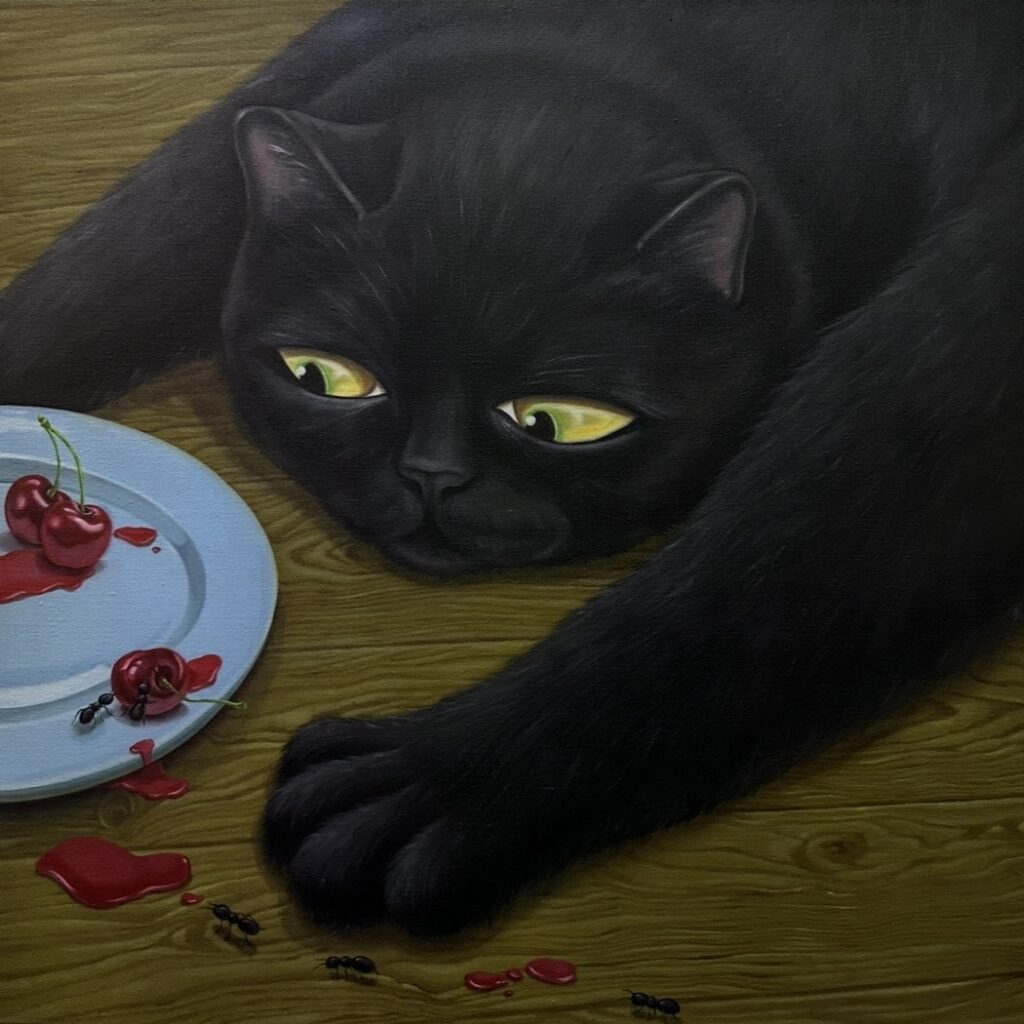
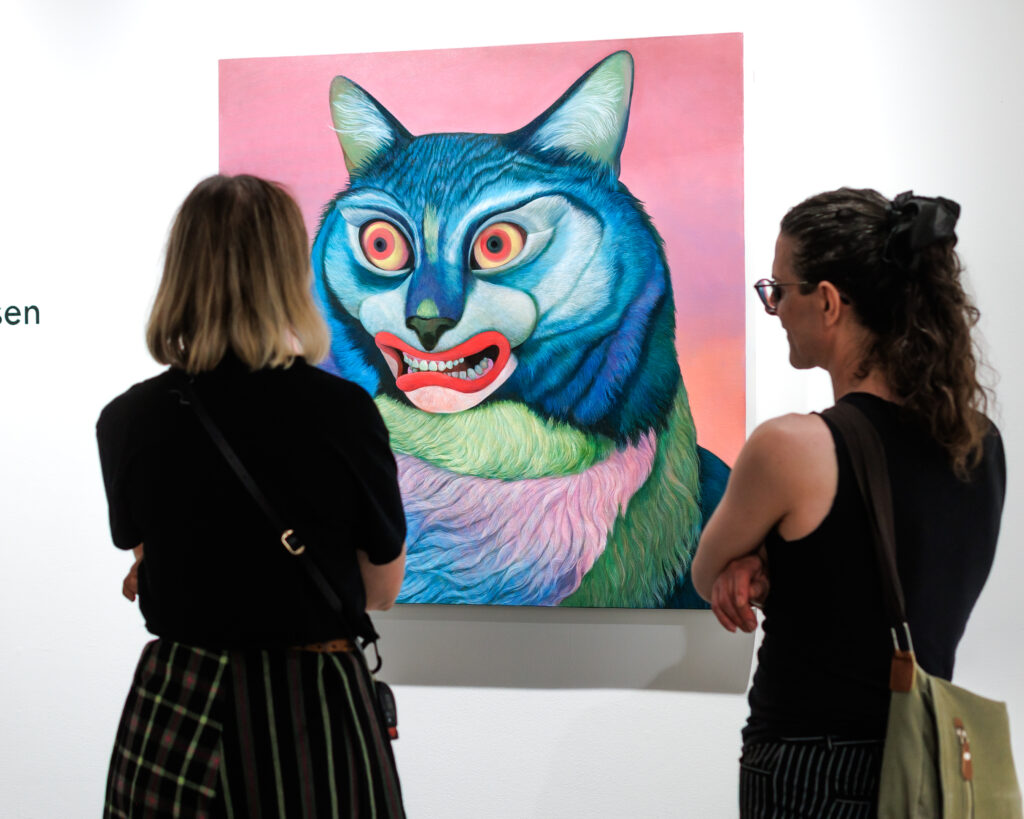
Q7. Your “Glamour Cats” series took a different direction from the rest of your work. What pulled you toward that subject, and did it teach you something about yourself that the body paintings hadn’t?
I did a little cat portrait as a lark. I had fun with it and people responded really well to it. I decided to collect photos from my Instagram followers of their cats to paint them. It gave me a lot to work from and gave me a way to interact with my following. They weren’t commissions, I was pooling source material. I look for a specific pose in the photos- like a yearbook photo or formal portrait. I like working with the extreme limitations and having to pick up on elements of the photos to push. Something like the lighting, or what may look like a small smirk, or just how the fur piles.
Every painting is a new challenge. And with all that, I’m also trying to make the cat look like the cat from the source photo.
I never worked a series before the Glamour Cats. The repetition has been very beneficial. Every piece is a formal experiment with extremely tight constraints. I also like doing the Glamour Cat paintings because they genuinely make people happy. Sometimes my work can turn a lot of people off, so it’s a great feeling.
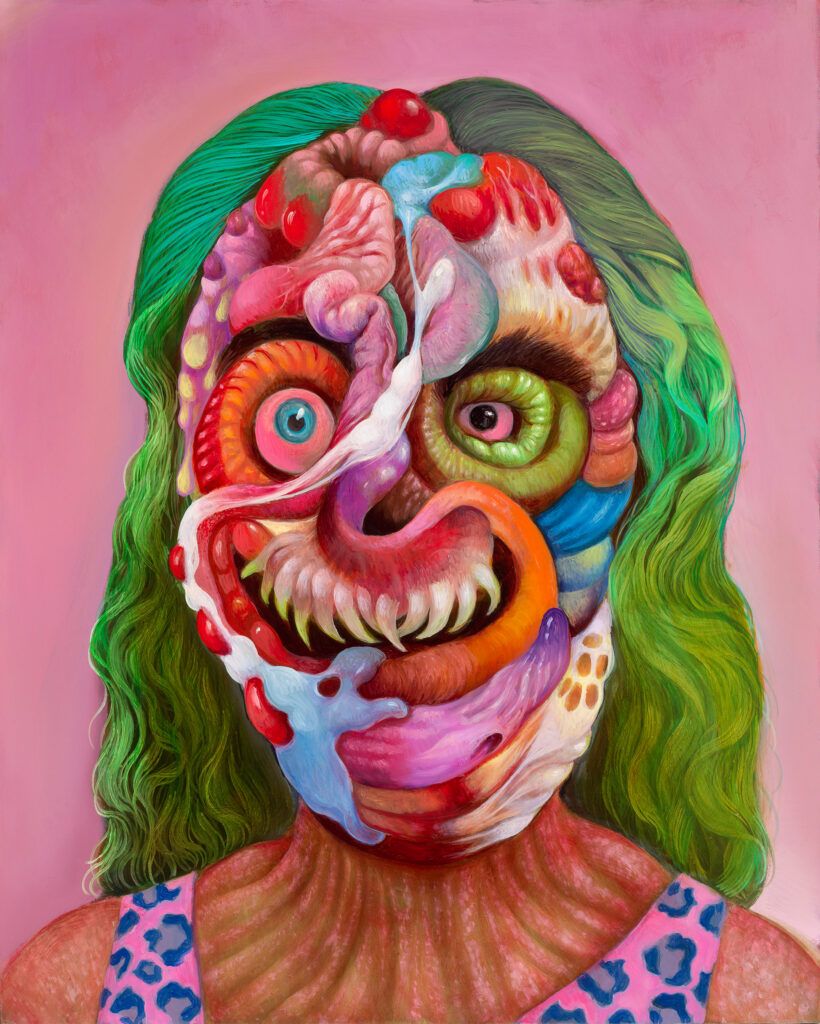
Q8. Your titles like “Erupted Confection Face with Elegant Chin Hairs” or “Flotsam Face Smeared with Exudate Milkshake and Spaghetti” are so vivid and unusual. Do they come before or after the painting, and do you see them more as descriptions, characters, or something closer to poetry?
I see them as closer to poetry, but dealing with words and descriptions in a very non-metaphorical and concrete way. It’s about the rhythm of the words and a burst of incongruous imagery. I do a lot of writing, mostly for lyrics for my band. I use a cut-up method and then edit, edit, edit, until an image and odd rhythm emerge. My source material ranges from cookbooks, medical journals, pulp novels, encyclopaedias. I combine cold clinical descriptions with crass writing, cliche phrases. I describe the fantastical as if it were mundane. The titles come during the painting process. Sometimes the title is plucked from a line from recent writing, sometimes the titles come from a literal and absurd but clinical description of the painting.
Q9.Your work challenges traditional ideas of beauty do you think contemporary art still needs to confront aesthetics in this way?
I think there are a lot of artists working with the question but too often the work gets compartmentalized, flattened into “the grotesque”.
Q10. You’ve described your work as being about “human failure and weakness groomed and developed to be an asset.” That’s such a powerful idea. Do you think the best art always comes from the parts of ourselves we’d rather hide?
I think people need to recognize their limitations and work within that. I don’t mean to say a person should limit themselves, but to find ways to work within the failure. I’m not a great drawer or painter but I figured out a way to make it work, to create something new that would not have existed if I didn’t develop through failure and incompetence. It’s really about working within a system. Like, say, if you’re doing a screenprint, you might be limited to three colors, you figure out a way to make it work, you get crafty. I guess the other part of it might be from what you brought up, parts of ourselves we’d rather hide. I have always liked people that put it all out there. Entertainers or comedians with a dark self-deprecating humor. You need to laugh at yourself to accept yourself. It circles back to my earlier point of having to be clever to leverage it in your favor.
Q10. How does a piece actually begin for you is it a face that appears in your head, a texture you want to chase, a phrase that becomes a title, or something more physical and instinctive than that?
For a long time I would just go in with paint. No preliminary sketch. I’d let the paint guide me. Lots of mistakes and wrong turns, painting over something I spent a long time on because it just doesn’t work- either compositionally or emotionally. I did that just the other day. I thought a painting was coming together easy and quick, but something just didn’t feel right. It was too easy. The face was well-rendered and interesting but it didn’t have the emotional punch. It was looking too illustration-like. I still rarely start with a sketch. Maybe just for the sake of the general composition. I tend to work out a lot in the underpainting, but I always know it’s going to change once I introduce color. It’s important to work within a certain looseness, to be able to take that left turn when the paint presents a roadblock. Otherwise I’d just be filling in shapes, making an illustration. Painting is about discovery, not illustrating a pre-conceived idea. But the simple answer is that I push paint around until something clicks. I try not to think too hard about why it clicks. I do that thinking after the deadline of getting work finished for a show.
Q11. If you had to pick one single painting across all your series from “Potatoland” in the early days to “Smiles & Piles” now that says the most about who Gregory Jacobsen really is, which would it be and why?
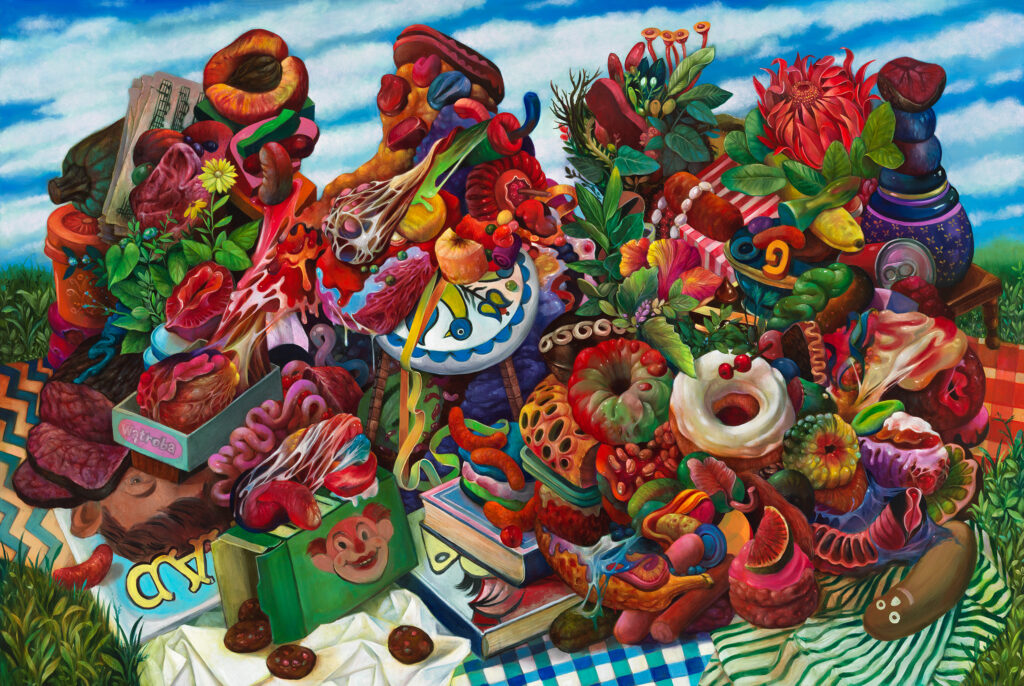
“The Day’s Bounty” because it is my most ambitious painting. It’s 9′ x 11′ and is packed with little details about my life and obsessions. It took me nine months to complete. I put my whole being into the painting. It was my entire life for that time. It was a well-paid commission, so I wasn’t worrying about “am I spending all this time on a painting that’s going to sit in my storage forever?” There was no existential crisis about purpose and finances. I woke up, had coffee, went into the studio to work on it all day and night. That freedom allowed me to live the painting and make no compromises. I want to walk into that painting and exist there.
Q12. You’ve said your process is about “calculating how to present myself to the world.” Has a painting ever surprised you mid-process given you an answer about yourself that you genuinely weren’t expecting?
I think over the years I have learned more about myself through my painting but I can’t point to one specific painting that surprised me.
Q13. What’s the proudest moment of your career so far that has absolutely nothing to do with a show, a sale, or a review just something that quietly meant the world to you?
That I’m able to do this every day. I often have to remind myself of that every day.
Q14. Here’s something I think about with your work do you believe the people who love your paintings and the people who are genuinely disturbed by them are actually having the same experience, just describing it with different words?
That’s a good insight. I don’t love it, but I do appreciate it when people are “disturbed” by the paintings, kinda. They are at least having a reaction. The worst is indifference. I think a lot of people easily write the work off because it doesn’t fit into a box or that it triggers a simplified reading. I’m always confused by people that are disturbed by the work. Aside from some of the cartoonish slippery guts and such, what exactly is disturbing? I think it comes down to that it’s a default language some people use to interact with the work.
Q15. If the Gregory who made her first solo show at Zg could see the paintings you’re making right now in 2025 what do you think he’d feel? Proud, surprised, confused?
I’d be impressed. I’m always striving to improve and expand my craft and conceptual scope. I look back on older work and it’s a whole other thing. I’ve come a long way!
Q16. When you look back at the full arc of your career from that first show to MoMA’s collection to “Smiles & Piles” is there a through-line, a single obsession or question that has never left you?
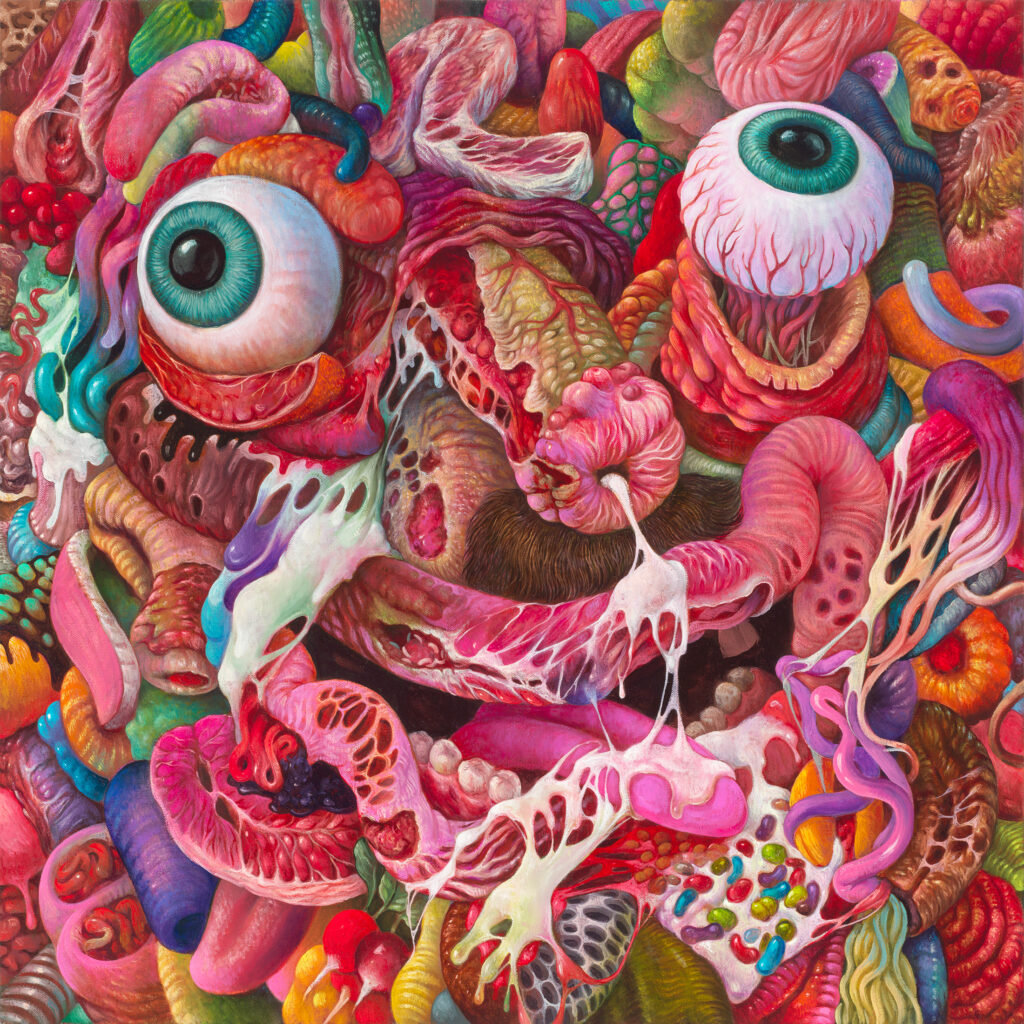
How to organize the body. how to organize excess. how to push and pull between the sensual and crass absurdism.
Q17. For an artist out there who knows their work is strange, doesn’t fit any category, and isn’t sure there’s an audience for what they make what would you want them to hear from someone who’s walked that road for two decades?
Fall into your obsession. Let it overtake you. But also approach it with rigorous discipline. Always look to push the conceptual scope further. Embrace failure. Don’t be afraid to throw shit away. An eraser is just as important as a pencil.
As our conversation with Gregory drew to a close, one thing became impossible to ignore there is a particular kind of artist who does not fit anywhere, and knows it, and has made that the foundation of everything.
Not as a pose. Not as a brand. But as a genuine, daily, deeply committed way of working and existing in the world. Gregory Jacobsen is that kind of artist. And two decades in, the work is sharper, stranger, and more assured than ever.
What is worth saying, from a critical standpoint, is how difficult it actually is to do what he does. The space he occupies between the technically beautiful and the viscerally unsettling, between craft and chaos, between painting and performance and sound is a space that most artists would find impossible to sustain.
Because it offers no easy validation. It does not sit neatly inside any movement or moment. It does not give the viewer a comfortable place to land. And yet Gregory has sustained it, show after show, decade after decade, without flinching and without simplifying. That kind of consistency, in a practice this uncompromising, is genuinely rare.
There is also something worth examining in the way he thinks about failure not as something to overcome but as the very material of the work. He is not a great drawer, he will tell you himself. He figured out a way to make that work. To create something new that would not have existed had he not developed through incompetence and limitation. That is not false modesty.
That is a sophisticated and hard-won understanding of how original work actually gets made. Not by transcending your limitations but by getting so deeply inside them that they stop being limitations at all.

That philosophy, lived out across twenty years of painting, is what you are looking at when you stand in front of a Gregory Jacobsen canvas. Not a finished idea. A discovered one. And the difference, when you feel it, is everything. His work sits in MoMA’s collection which tells you something about its critical weight.
But what it does not tell you is what it feels like to live with it. To have one of those lush, glowing, quietly destabilising surfaces as part of your daily environment. To walk past it on an ordinary morning and have it catch you off guard, again, the way it did the first time. That is what work made from genuine obsession does. It does not settle into the background. It keeps asking something of you. And for the people who respond to that who want their walls to hold something that refuses to be ignored there is very little else quite like it.
Follow Gregory Jacobsen through the links below. And give his work the time it deserves. It will give you something back that you were not expecting.