
10 Beautiful Paintings That Capture the Spirit of Spring
Spring has long been associated with renewal, growth, and the quiet return of life after stillness. In art, it takes many forms, from mythological scenes filled with symbolism to landscapes shaped by light, color, and atmosphere. Artists have returned to the season again and again, not just to depict nature, but to explore change, beauty, and the passage of time.
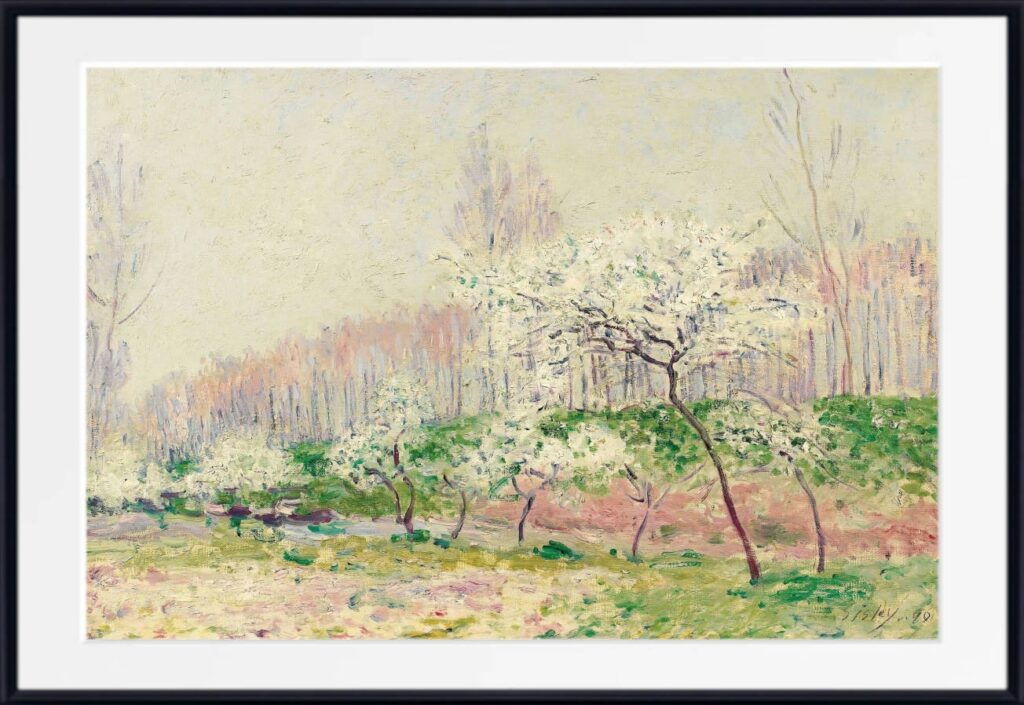
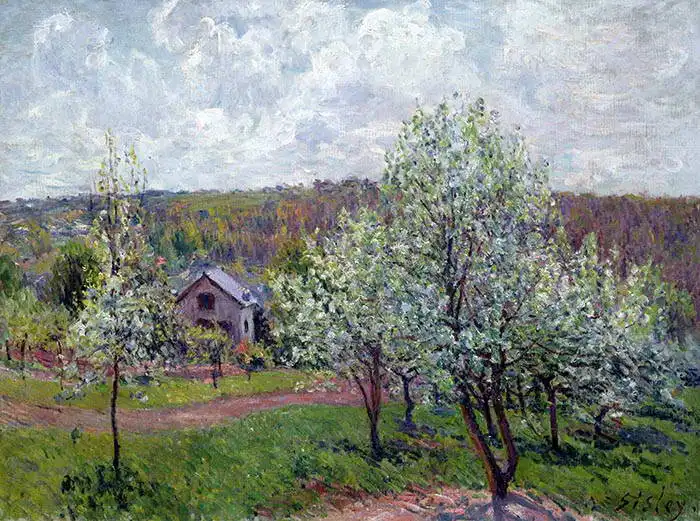
For Renaissance painters, spring often carried deeper meaning, expressed through allegory and carefully chosen symbols. Figures like Flora or Venus stood in for ideas of love, fertility, and harmony, turning the season into something structured and philosophical. By the 19th century, this approach began to shift. Artists like Monet and Sisley moved closer to observation, focusing on the softness of light, the presence of blossoms, and the fleeting quality of a moment outdoors.
What connects these works is not a single image of spring, but a shared attention to transition. The season exists between what has passed and what is just beginning, making it both familiar and difficult to define. Some paintings present it as joyful and abundant, while others suggest something quieter, even uncertain.
Together, these works show that spring is never just one thing. It changes depending on the artist, the time, and the way it is seen.
Here are ten paintings that capture the many ways artists have imagined spring.
1. Primavera – Sandro Botticelli (Florence, Italy)
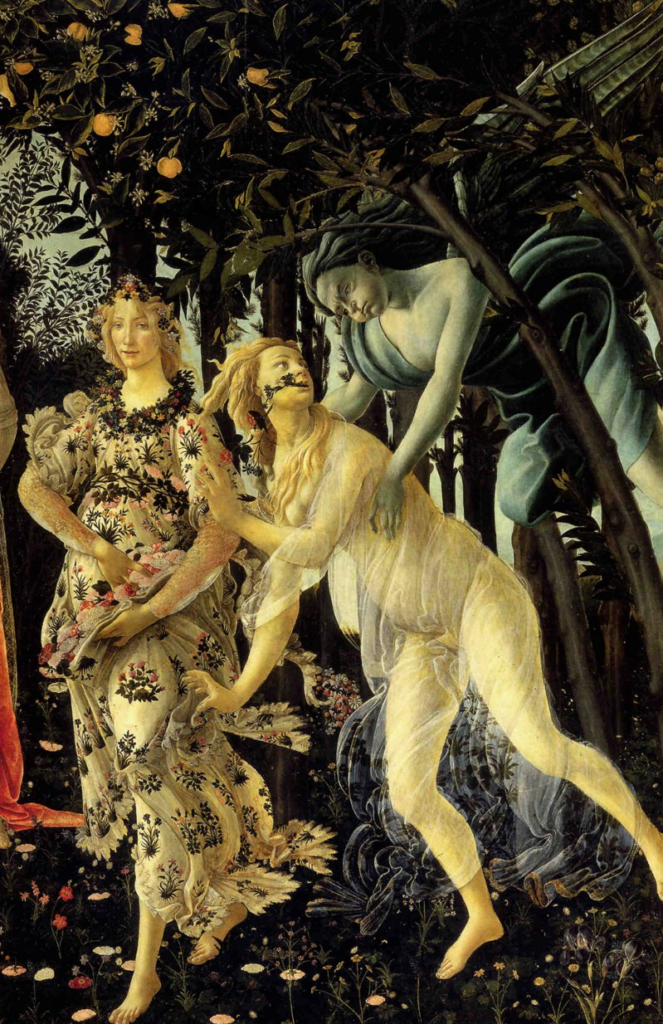
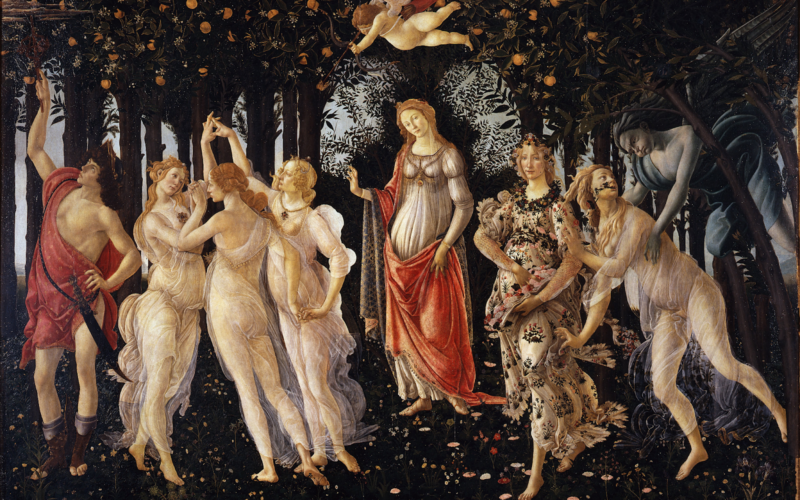
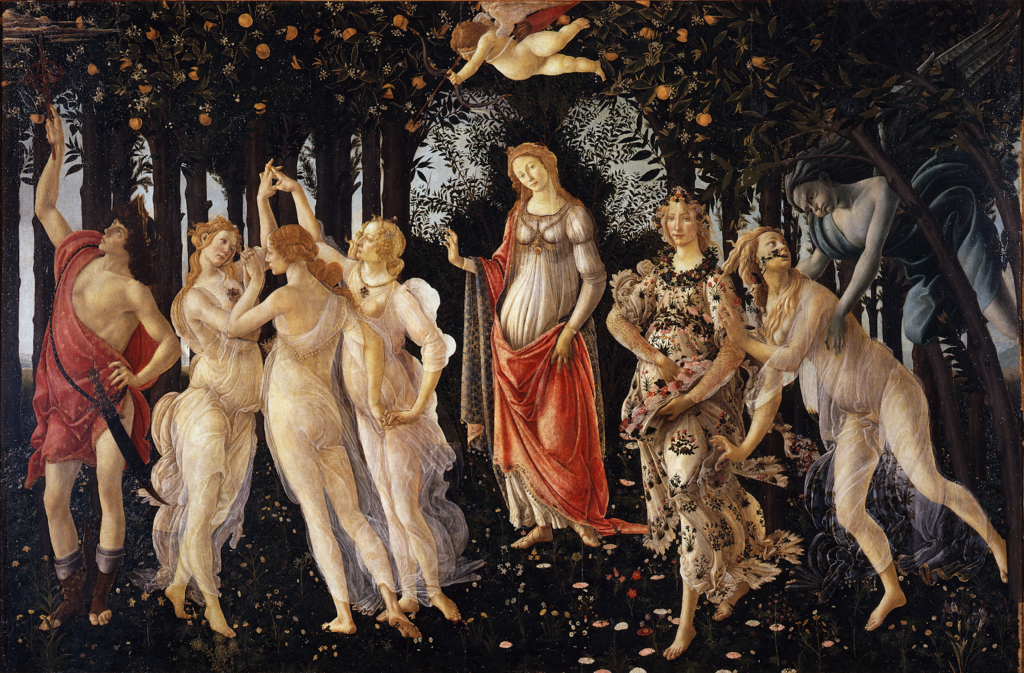
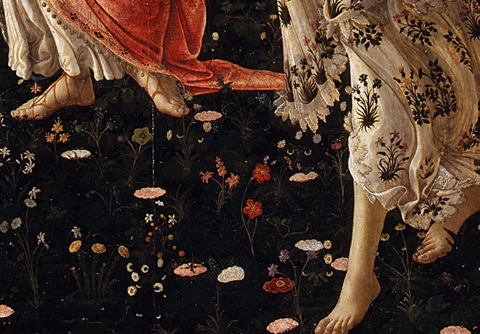
Painted in late 15th-century Florence, Primavera also known as the Allegory of Spring was created around 1482 by the Italian Renaissance painter Sandro Botticelli. Executed in tempera on panel, the work is often treated as the definitive image of spring in Western art, but its meaning extends far beyond seasonal description. Created within the intellectual climate of the Medici court, the painting reflects the influence of Neoplatonism, a philosophy that linked physical beauty to spiritual truth. Botticelli constructs a scene where mythology becomes a vehicle for abstract ideas, using the language of spring to explore harmony, desire, and transformation.
At the center stands Venus, framed by an arch of foliage that resembles both a natural canopy and a sacred space. To her right, Zephyrus, the god of the west wind, pursues the nymph Chloris, who transforms into Flora, the goddess of flowers, her mouth scattering blossoms across the ground. This progression from movement to bloom has often been read as a metaphor for the generative force of spring itself. On the opposite side, the Three Graces dance in measured rhythm, embodying beauty, chastity, and love, while Mercury stands at the edge of the composition, subtly clearing the clouds.
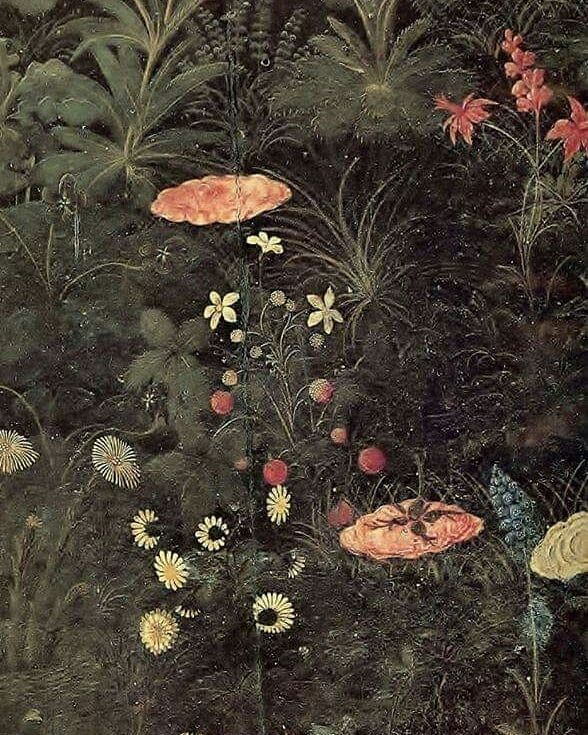
The ground beneath them is densely carpeted with botanically identifiable plants over 500 species, each carrying symbolic weight within Renaissance culture. Flowers here are not ornamental; they function as a coded language. In Primavera, spring is not simply a season, it is an idea carefully composed, where nature, mythology, and philosophy converge into a single, enduring image.
2. Spring – Giuseppe Arcimboldo (Milan, Italy)
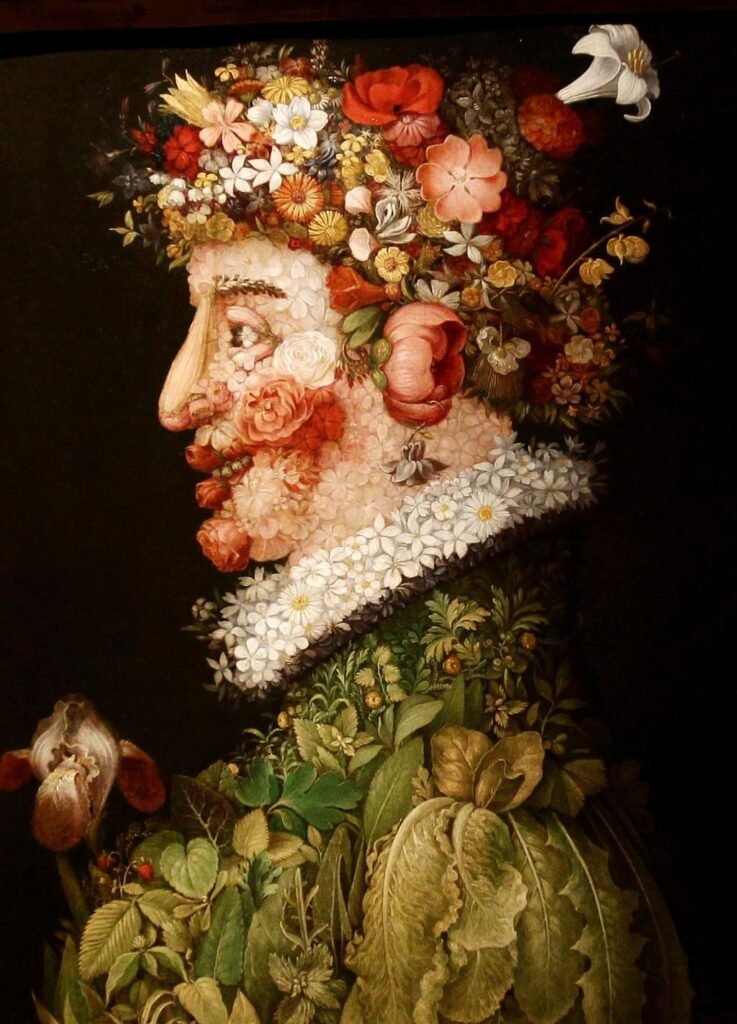
At first glance, this looks like a portrait. A young figure in profile, softly lit, almost conventional. But the illusion doesn’t hold for long. The face begins to fragment, into petals, stems, blossoms, until it becomes clear that what we’re looking at is not a person at all, but a construction of flowers.
Created in 1573 by Giuseppe Arcimboldo as part of his Four Seasons series for the Habsburg court, Spring turns the season into something both literal and strangely artificial. Roses form the cheeks, lilies curve into the neck, and clusters of smaller blooms gather into hair. Each element is rendered with botanical precision, yet assembled into a figure that could never exist outside the painting.
Arcimboldo’s work sits at the intersection of art, science, and spectacle. The Renaissance was deeply invested in observing and categorizing the natural world, and this painting reflects that impulse, though with a twist. Instead of presenting nature as it appears, Arcimboldo reorganizes it, turning classification into imagination.
What’s striking is how completely spring is absorbed into the figure. There is no landscape, no setting, no background narrative. The season doesn’t surround the subject, it becomes the subject. In Spring, spring is not something you witness unfolding. It is something constructed, piece by piece, into a form that is at once beautiful, unsettling, and impossible to ignore.
3. Almond Blossom – Vincent van Gogh (Netherlands / France)
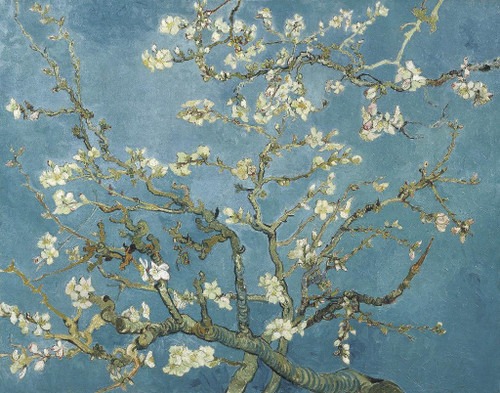
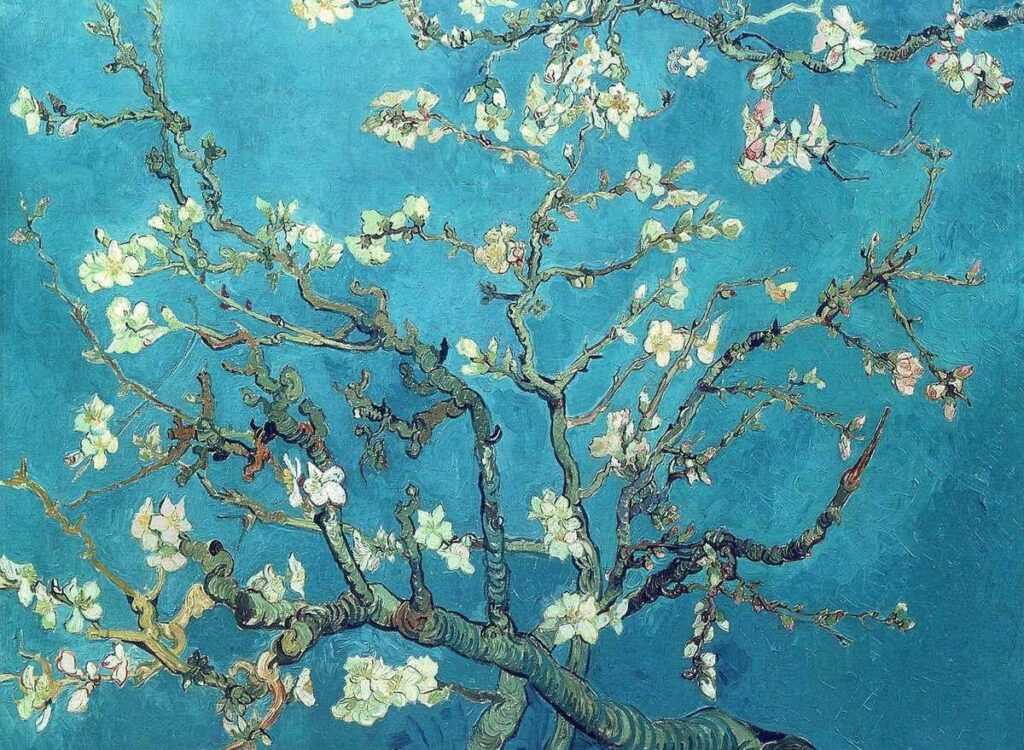
There’s something unusually quiet about this painting. No figures, no ground, no sense of place, just branches stretching across a field of blue. It feels less like a landscape and more like a pause.
Painted in 1890 by Vincent van Gogh while he was in Saint-Rémy, Almond Blossom was made to mark the birth of his nephew, Vincent Willem. The choice of subject wasn’t incidental. In the south of France, almond trees are among the first to bloom at the end of winter, making them a natural symbol of renewal and new beginnings. For Van Gogh, they carried a personal weight, something hopeful, even protective.
The composition reflects his deep engagement with Japanese woodblock prints. The branches are outlined with clarity, cutting across a flat, luminous sky that resists traditional depth. There’s no horizon to anchor the image, which gives the blossoms a kind of suspended presence, as if they exist outside of time.
Unlike many of Van Gogh’s later works, where the brushwork becomes restless and thick, here it is controlled, almost careful. The flowers don’t overwhelm the canvas, they hold it gently. In Almond Blossom, spring is not dramatic or expansive. It arrives quietly, in a single branch, carrying with it the fragile but persistent idea that something new can begin.
4. Springtime – Claude Monet (France)
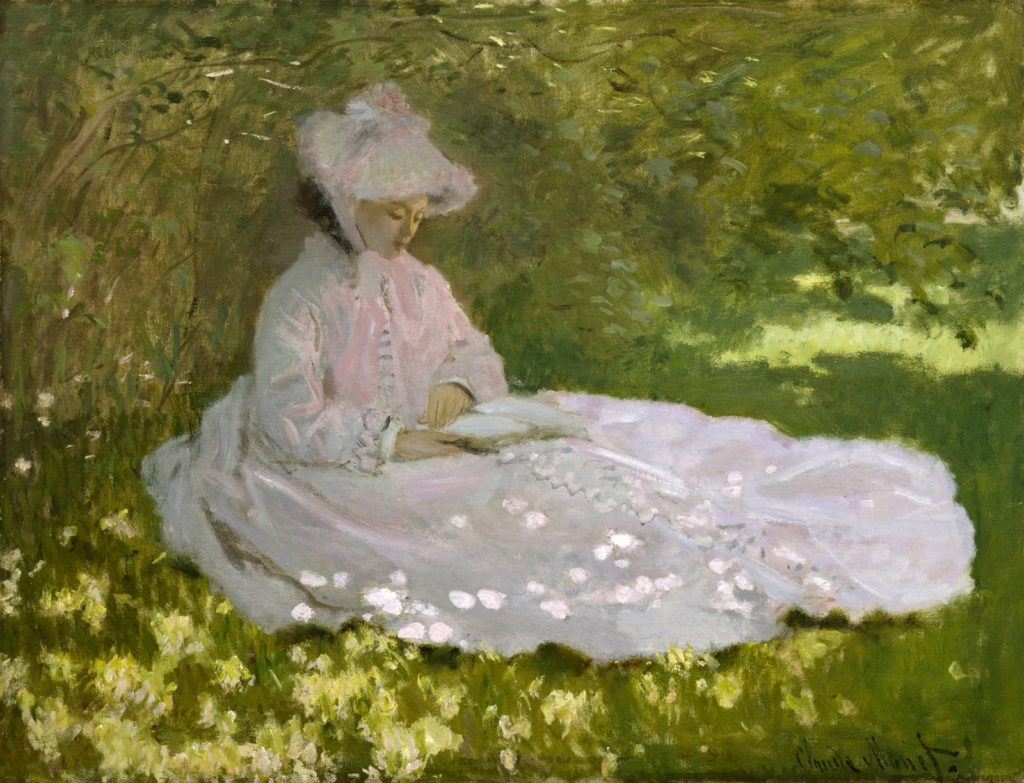
Nothing in Springtime feels fixed. The figure, the trees, even the light itself seem to shift as you look at them, as if the painting is still in the process of becoming.
Painted in 1872 in Argenteuil by Claude Monet, the work captures his first wife, Camille Doncieux, seated beneath a canopy of blossoming trees. Monet had moved to Argenteuil, a village just outside Paris, in 1871, where the changing light and lively atmosphere, frequented by fellow artists and visitors, became central to his practice. During that spring, he painted several works in his garden featuring Camille, returning to her presence as both subject and anchor within these shifting landscapes.
Camille is present, but she doesn’t dominate the scene. Her figure blends into the surrounding pinks, greens, and soft whites, becoming part of the landscape rather than separate from it. The brushwork is loose, almost provisional, giving the impression that the image could shift with the next change in light.
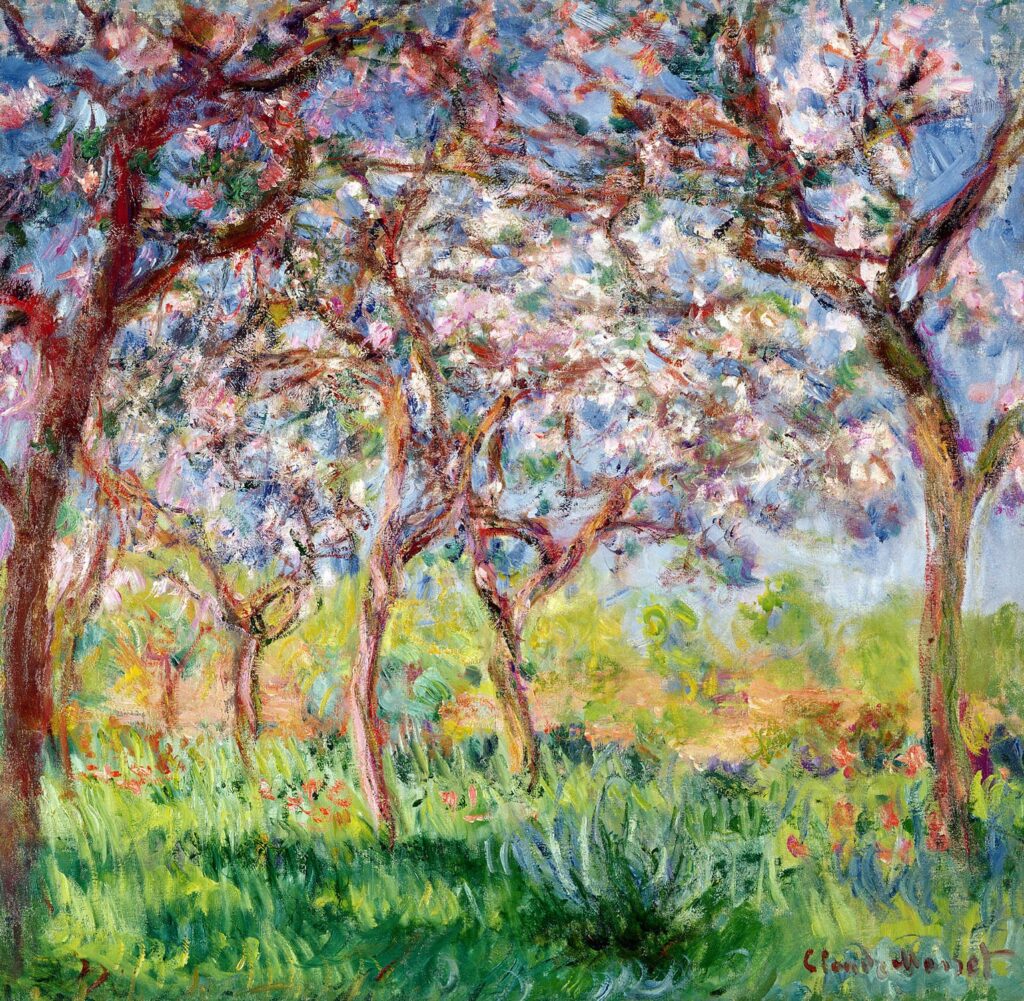
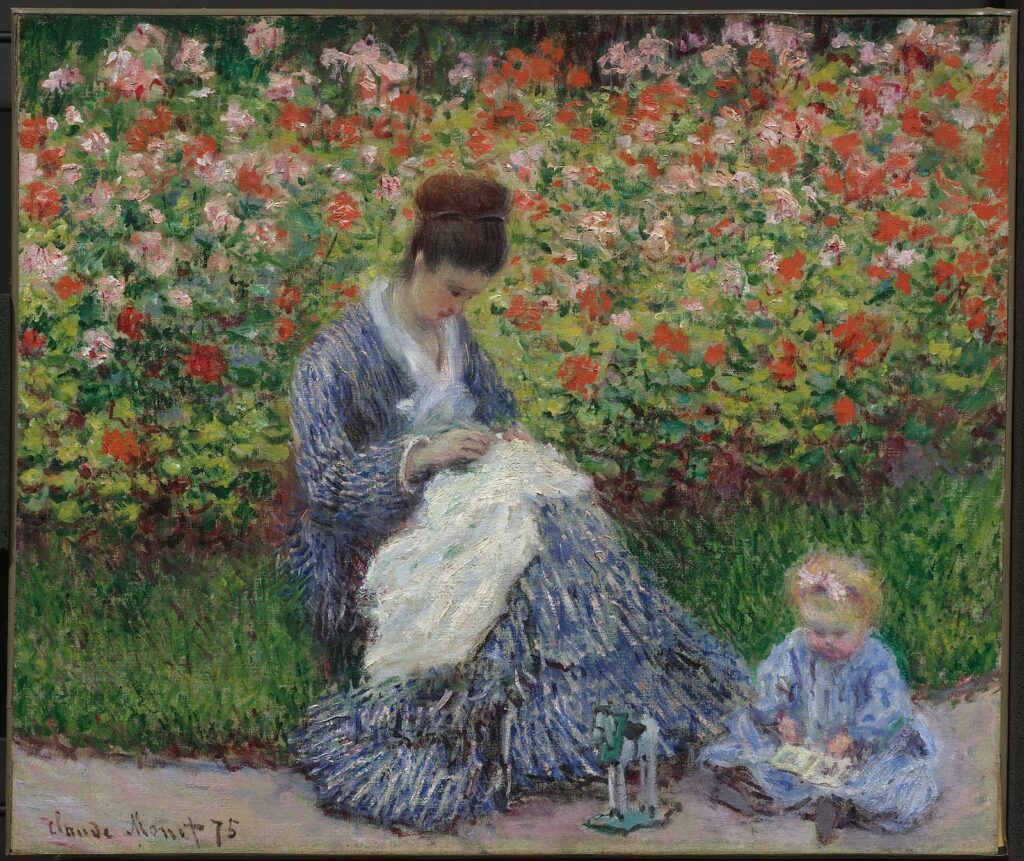
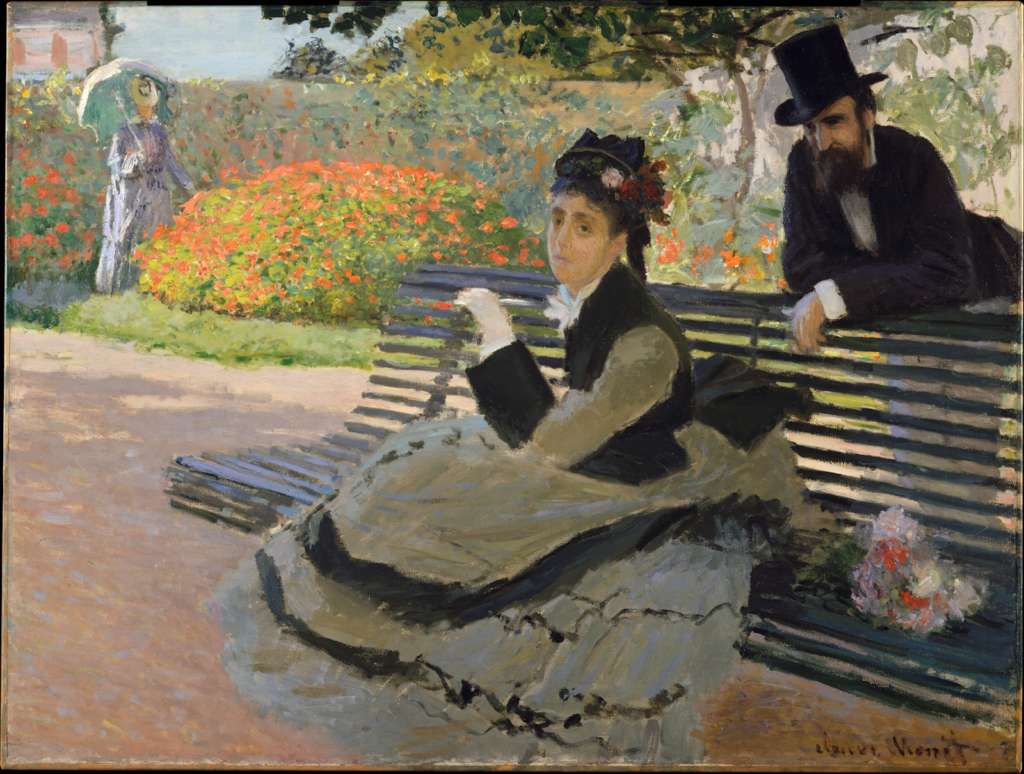
What makes this painting distinctly “spring” is not just the blossoms, but the sense of transience. Nothing here feels permanent. The petals will fall, the light will change, and the moment will pass. Monet isn’t trying to preserve it in a fixed way, he’s registering it as it happens. After Camille’s death, many personal traces of her were lost, making these paintings some of the most lasting records of her presence.
In Springtime, spring isn’t symbolic or staged. It’s immediate, fleeting, and tied to perception itself, a moment observed closely, and then let go.
5. Spring – Lawrence Alma-Tadema (Netherlands / United Kingdom)
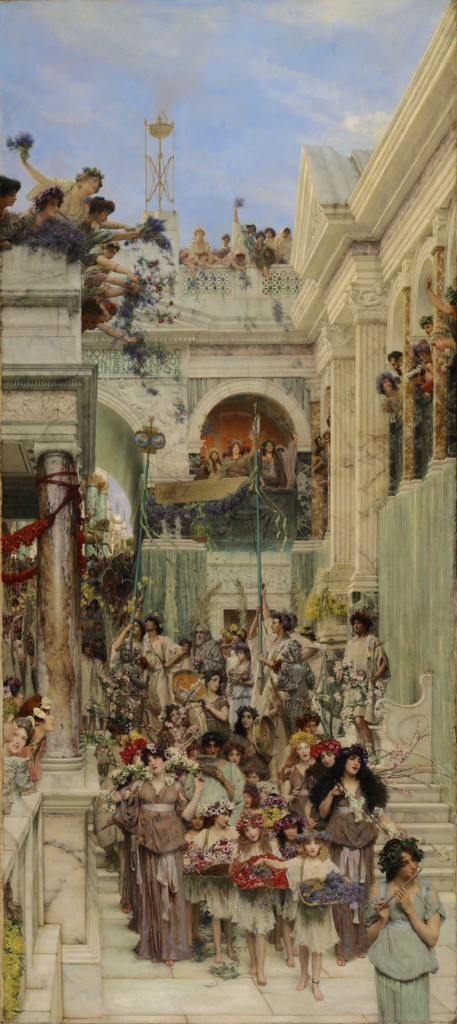
This is not spring as it is observed, it is spring as it is staged. Everything in the painting feels arranged, from the cascade of flowers to the carefully choreographed movement of figures descending the marble steps.
Painted in 1894 by Lawrence Alma-Tadema, Spring draws from the Victorian celebration of May Day, when children were traditionally sent into the countryside to gather flowers on the morning of May 1. But Alma-Tadema doesn’t place this custom in a contemporary setting. Instead, he relocates it to an imagined classical world, complete with Roman-style architecture, expansive terraces, and luminous stone surfaces that reflect light with almost photographic clarity.
A procession of women and children moves downward, their arms filled with blossoms, pinks, reds, yellows spilling across the composition in dense clusters. The figures themselves feel secondary to the spectacle of the flowers, which dominate both the palette and the rhythm of the scene. Alma-Tadema, known for his meticulous attention to historical detail, constructs an environment that feels both believable and entirely artificial.
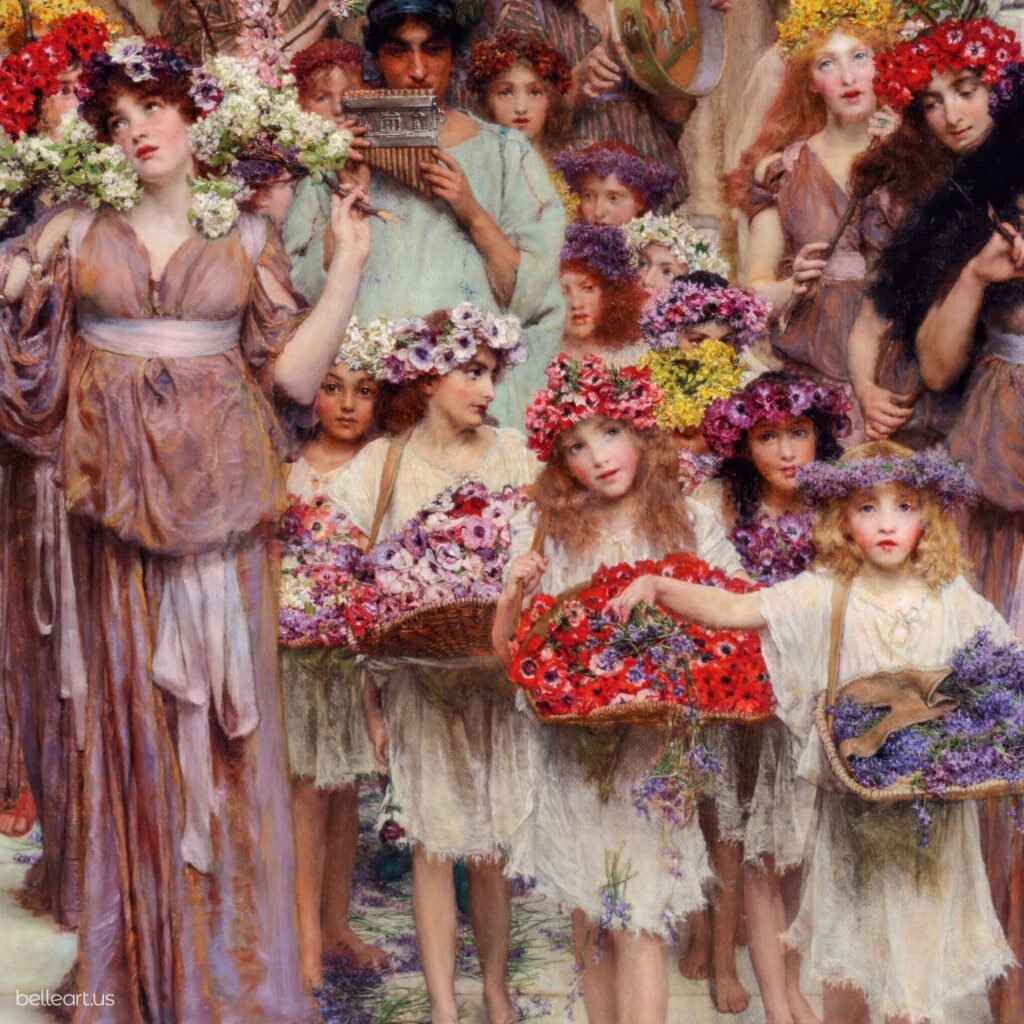
What emerges is a version of spring that is less about nature and more about display. It is ceremonial, decorative, and deliberately composed. The season becomes an event, something to be performed and witnessed rather than simply experienced. The painting’s grand, panoramic evocation of classical life would later resonate beyond the art world, even influencing visual elements in Cleopatra.
In Spring, spring is filtered through nostalgia and imagination, revealing how easily the natural world can be transformed into an idealized vision of beauty, order, and celebration.
6. The Loss of Virginity – Paul Gauguin (France)
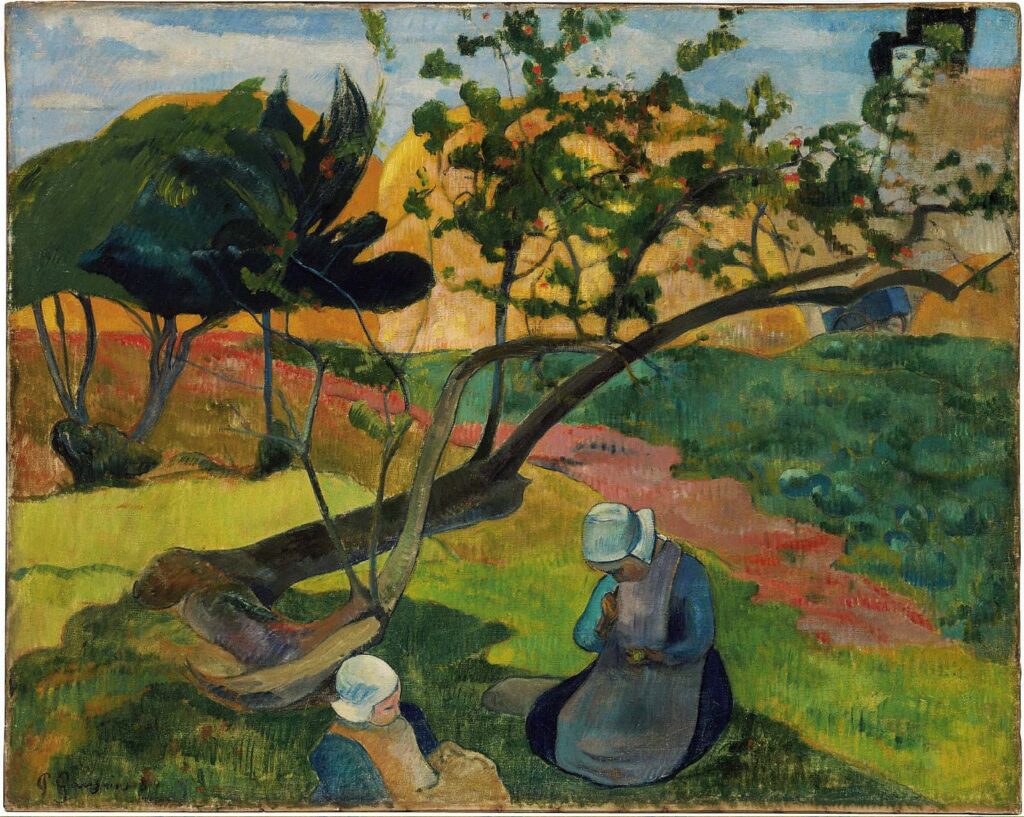
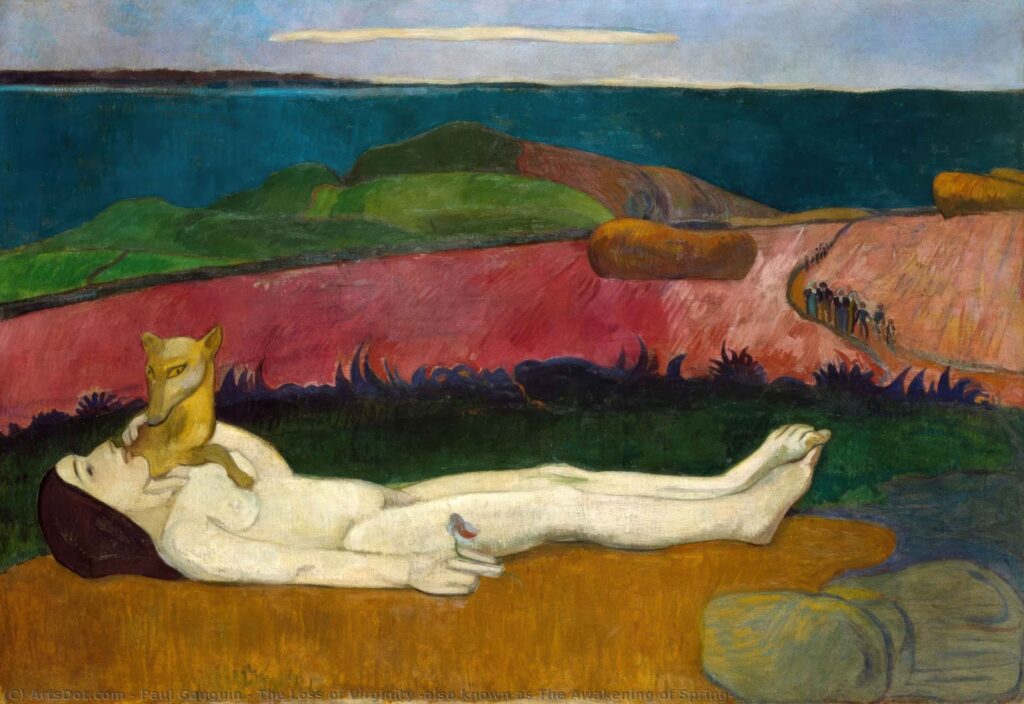
There’s a stillness in this painting that feels slightly uneasy, as if something has already happened, or is about to. The landscape is calm, but the mood resists that calmness.
Painted around 1890–91 by Paul Gauguin, The Loss of Virginity (Awakening of Spring) marks a moment when Gauguin was moving away from Impressionism toward a more symbolic, constructed language of painting. Set within a Breton landscape, the composition places a nude young woman in the foreground, her body turned away, her posture ambiguous neither fully at rest nor entirely at ease.
Beside her, a fox rests against her shoulder, a detail that shifts the entire reading of the work. Often interpreted as a symbol of lust, drawing from broader mythological associations, the animal introduces tension into what might otherwise appear as a pastoral scene. In the distance, a group of figures approaches, dressed in traditional Breton attire, suggesting a parallel narrative unfolding just beyond the central moment.
Unlike more conventional representations of spring as renewal or innocence, Gauguin complicates the idea. Here, the season becomes a threshold linked to awakening, but also to vulnerability, desire, and change that cannot be reversed. The title itself frames spring not as a beginning, but as a transition.
In The Loss of Virginity, spring is stripped of its simplicity. It becomes psychological rather than purely natural, revealing how the language of the season can also carry discomfort, ambiguity, and transformation.
7. A Song of Springtime – John William Waterhouse (United Kingdom)
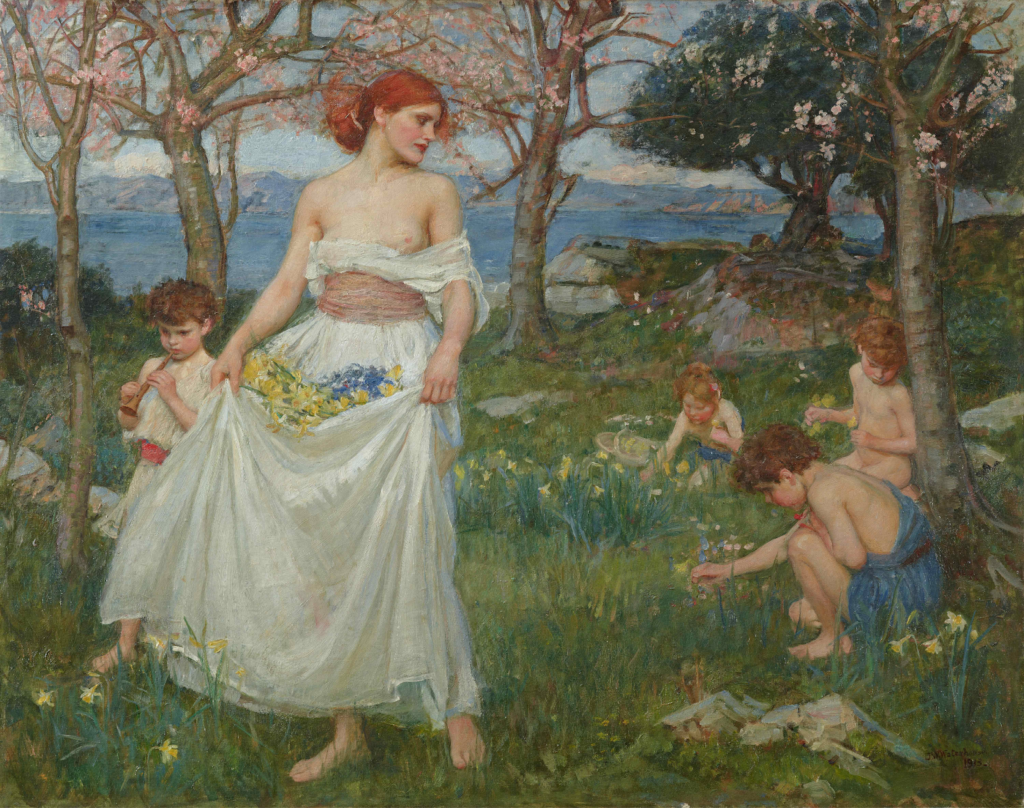
A group of women moves through the landscape, gathering flowers with an ease that feels almost instinctive. There’s no urgency in their gestures, no clear narrative pulling them forward, just a quiet continuity, as if the act itself is enough.
Painted in 1913 by John William Waterhouse, A Song of Springtime reflects the artist’s deep engagement with the later Pre-Raphaelite tradition. By this stage in his career, Waterhouse had moved away from tightly structured mythological scenes toward compositions that prioritize mood and atmosphere. Here, spring is not something illustrated through a specific story, but something diffused across the entire canvas.
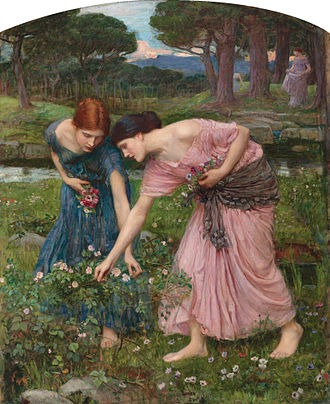
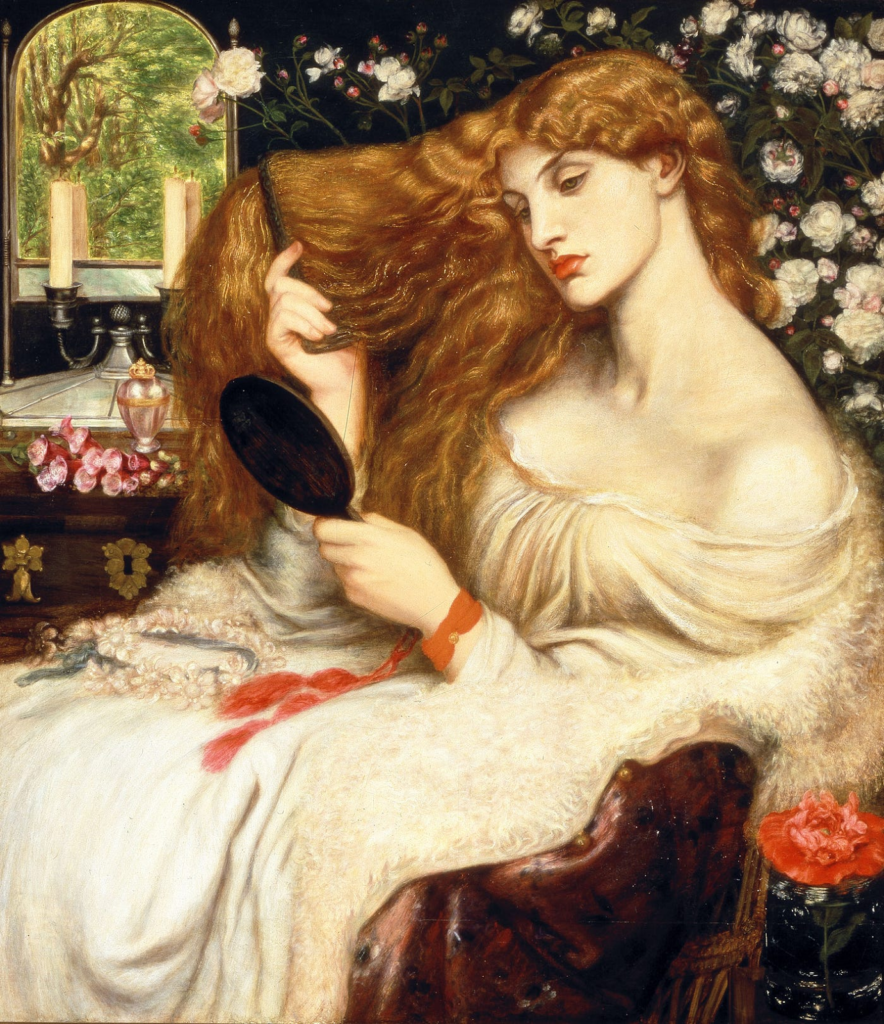
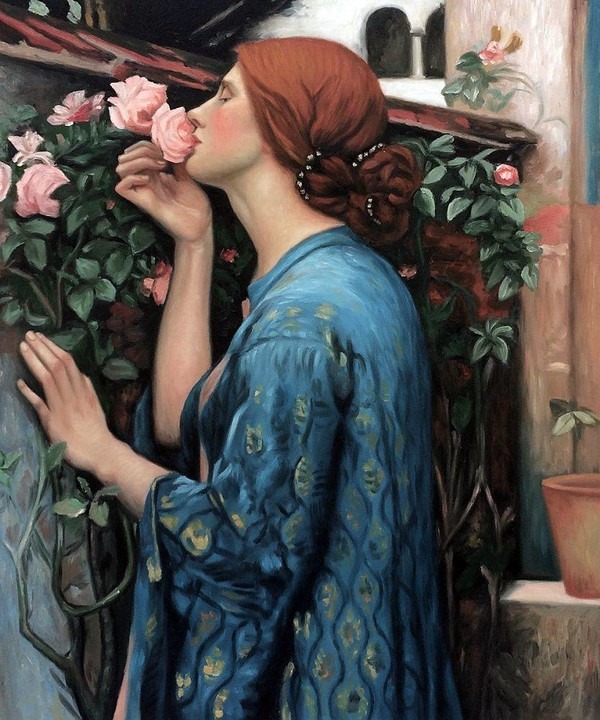
The figures feel suspended in time. Their flowing garments and soft gestures echo classical and medieval references, yet the setting resists precise placement. It exists somewhere between memory and imagination constructed, but not rigidly defined.
Color plays a crucial role in holding the painting together. The tones of the flowers, subtle pinks, yellows, and whites reappear in the figures themselves, creating a visual rhythm that moves across the surface without a single focal point. The eye drifts rather than settles.
In A Song of Springtime, spring isn’t declared, it’s absorbed. It exists in repetition, in gesture, in the slow accumulation of detail, unfolding less as a moment and more as a continuous state of being.
8. Spring – Édouard Manet (France)
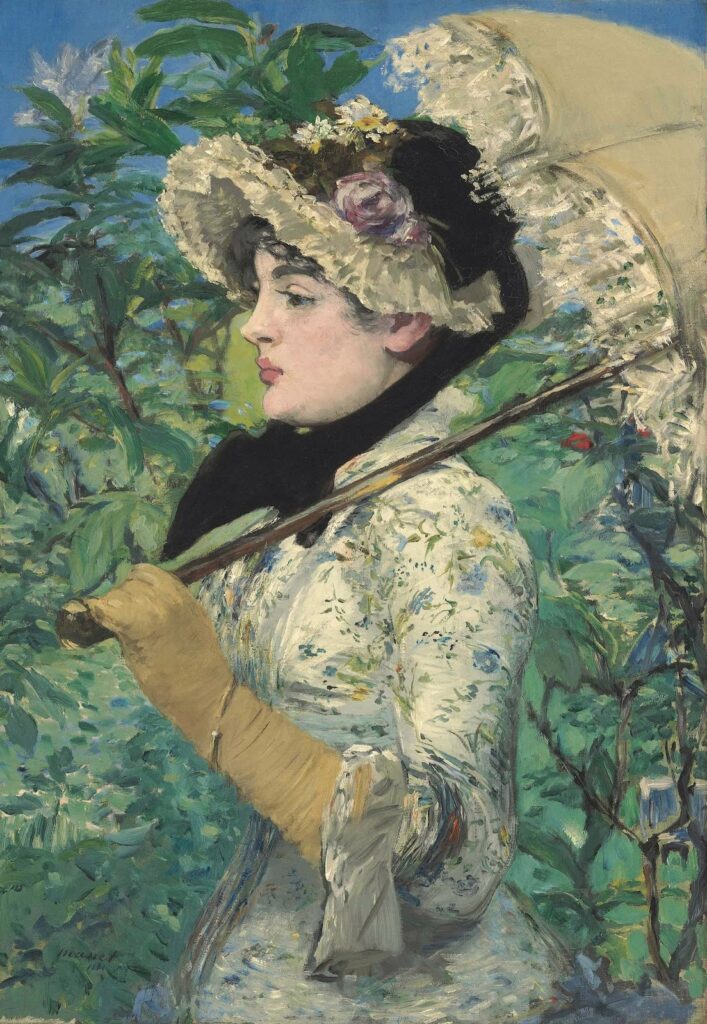
Unlike earlier representations of spring filled with mythological figures or expansive landscapes, this painting turns inward, toward the immediacy of modern life. The season appears not through narrative, but through presence.
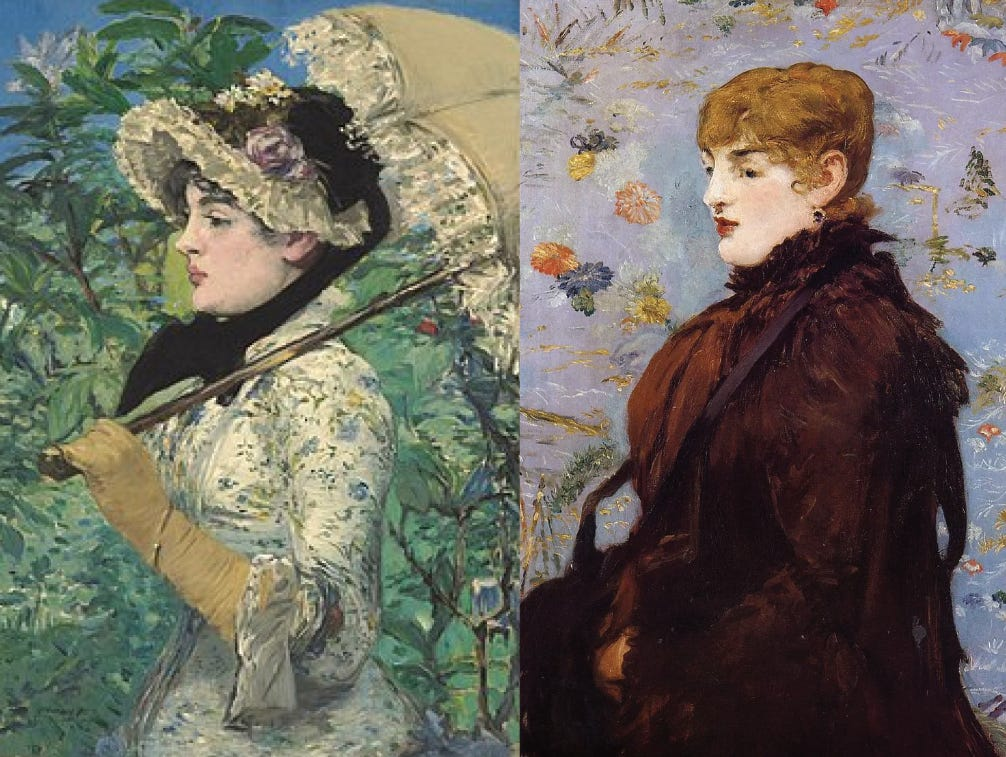
Painted in 1881 by Édouard Manet, Spring is part of an intended series representing the four seasons, though the full cycle was never completed. The painting features Jeanne Demarsy, a Parisian actress, depicted in contemporary dress and surrounded by fresh greenery and flowers. Her parasol, delicate bonnet, and patterned fabric place her firmly within the urban world of late 19th-century Paris.
What’s striking is how subtly spring is communicated. There are no overt symbols, no allegorical figures. Instead, it resides in the details, the softness of the light, the presence of blossoms, the suggestion of a moment spent outdoors. Manet shifts the focus from nature itself to how it is experienced within modern society.
The brushwork retains a sense of immediacy, avoiding excessive refinement. The background is loosely handled, allowing the figure to emerge without being fully separated from her surroundings. This balance reflects Manet’s broader interest in capturing contemporary life without idealization.
In Spring, spring becomes personal rather than universal. It is no longer an abstract concept or mythological event, but a lived moment, fleeting, fashionable, and unmistakably tied to its time.
9. The Terrace at Saint-Germain, Spring – Alfred Sisley (France)
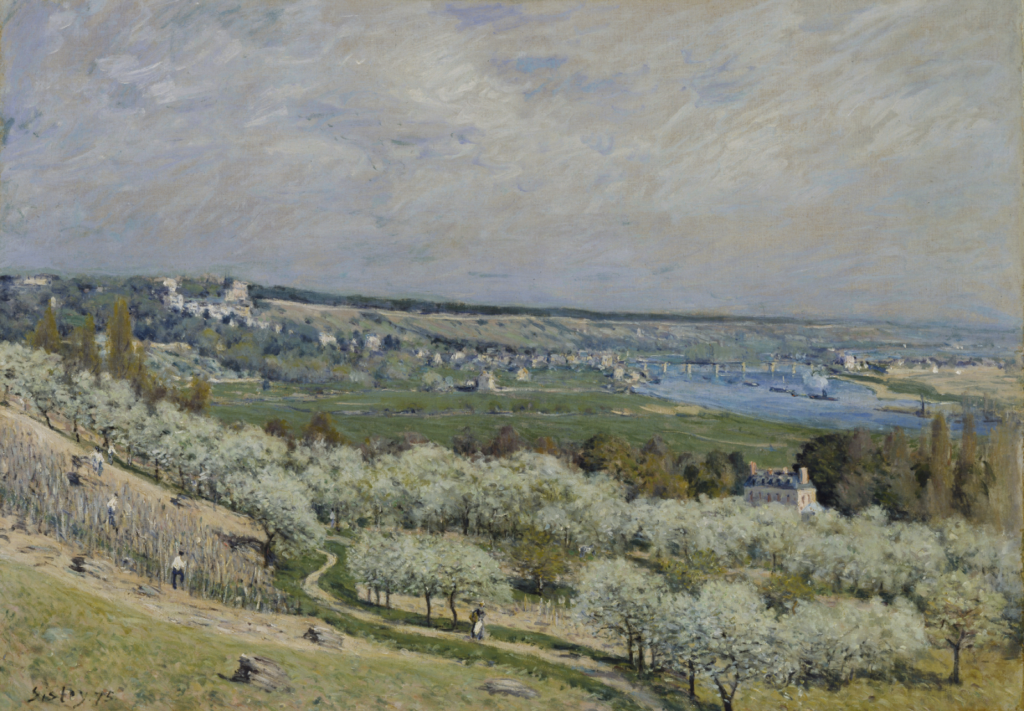
The eye moves outward in this painting, following the line of the terrace toward a horizon that feels open and continuous. There’s no central figure to hold attention, only space, light, and the quiet presence of people moving through it.
Painted in 1875 by Alfred Sisley, The Terrace at Saint-Germain, Spring reflects the Impressionist commitment to painting directly from nature. Overlooking the Seine Valley, the composition captures a moment when the landscape is just beginning to shift, trees in bloom, the air softened by light, the season still in transition.
Small figures are scattered along the terrace, walking or pausing, but they never dominate the scene. Instead, they serve as markers of scale, emphasizing the breadth of the landscape. Sisley’s attention remains on the atmosphere, the way light diffuses across the sky, the subtle variations of green and blue that suggest early spring rather than its full arrival.
Unlike Monet’s more intimate garden scenes, Sisley’s approach is expansive. The painting opens outward, inviting the viewer to move through it rather than focus on a single point. The brushwork is light, controlled, and consistent, avoiding the heavier emotional charge found in some of his contemporaries.
In The Terrace at Saint-Germain, Spring, spring is not dramatic or symbolic. It is a gradual, almost understated shift in atmosphere that unfolds quietly across space, rather than announcing itself all at once.
10. The Fate of Persephone – Walter Crane (United Kingdom)
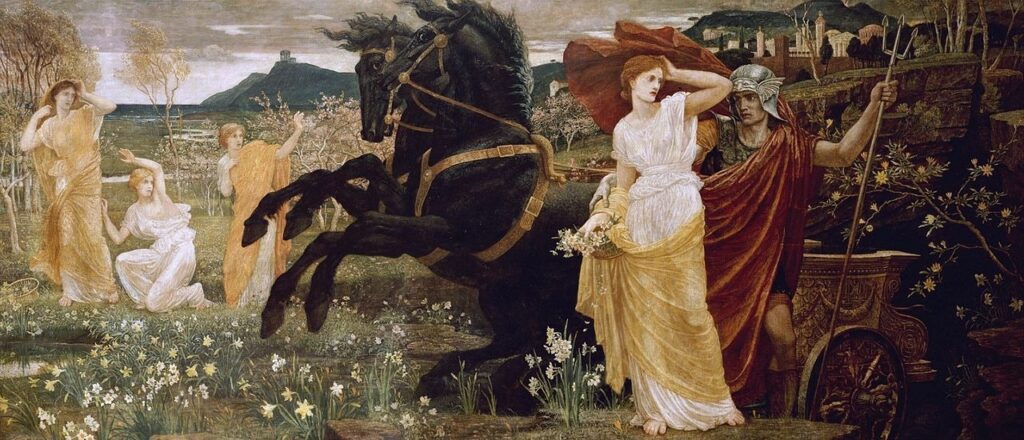
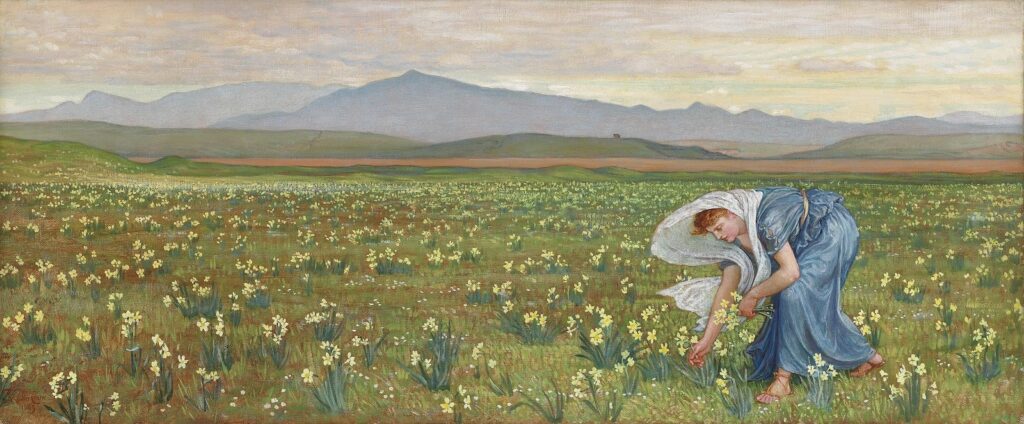
The story begins before the season does. A field of flowers, a moment of stillness, and then a rupture, spring, in this case, is inseparable from what interrupts it.
Painted in 1877 by Walter Crane, The Fate of Persephone draws from Greek mythology to explain the cyclical nature of the seasons. The scene captures the moment Persephone is taken into the underworld by Hades, an event that, according to the myth, causes her mother Demeter to plunge the earth into barrenness. Spring returns only when Persephone is allowed to rise again.
Crane fills the foreground with an abundance of flowers, narcissus and anemones in particular, rendered with decorative precision. These are not incidental details. The narcissus, tied directly to the myth, becomes both lure and symbol, marking the moment before the narrative shifts. Behind this dense foreground, the landscape opens into a more dramatic terrain, where movement and tension begin to unfold.
Unlike purely decorative images of spring, this painting situates the season within a larger cycle of loss and return. It is not just about blooming, but about what must precede it. The visual richness of the flowers contrasts with the underlying narrative, creating a tension between beauty and inevitability.
In The Fate of Persephone, spring is not a simple beginning. It is conditional, dependent on return, shaped by absence, and always tied to the idea that renewal comes after disruption.
Across these works, spring never settles into a single meaning. It moves between allegory and observation, between mythology and lived experience, sometimes carefully staged, sometimes caught in passing. For Sandro Botticelli, it becomes a philosophical construction; for Claude Monet and Alfred Sisley, a shift in light and atmosphere; for Vincent van Gogh, something quieter and more intimate; and for Paul Gauguin or Walter Crane, a season shaped as much by tension and return as by renewal.
What emerges is not a fixed image of spring, but a recurring attempt to understand change itself. A moment suspended between what has passed and what is just beginning, fragile, fleeting, and impossible to fully hold. These paintings don’t simply depict the season; they interpret it, each offering a different way of seeing and feeling its arrival.
Spring, in the end, is less about arrival and more about transition, something always in the process of becoming. Which is your favourite spring painting?