

This artist created eight massive paintings for Venice in the 2022 Biennale I Fintan Whelan
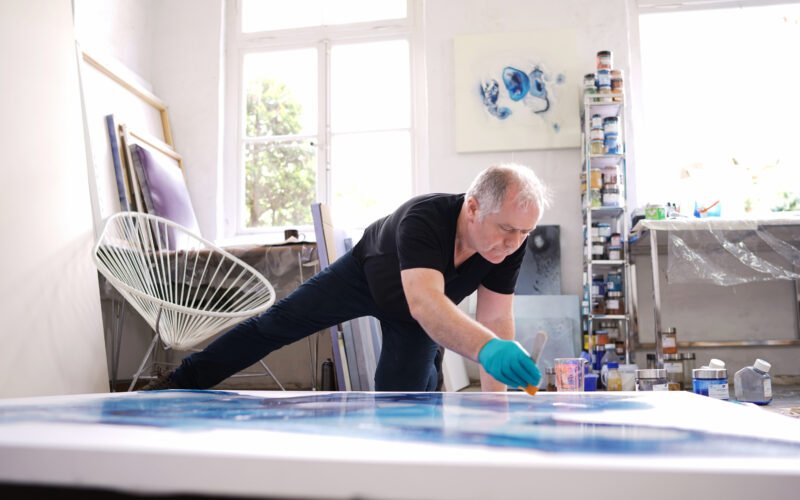
At Arts to Hearts, we have come to believe that the artists who matter most are not always the ones making the most noise. They are the ones making the most sense of the world, quietly, persistently, on their own terms. Our Best of the Art World editorial exists for exactly that reason: to find those artists, to sit with their work long enough to truly understand what it is doing, and to bring them to the people who are ready to receive it.
Today, we are honoured to introduce you to Fintan Whelan. We’ll be honest with you when we first came across Fintan’s work, we didn’t immediately reach for words. We just looked. And kept looking. There is something about his paintings that makes language feel slightly inadequate, like trying to describe a piece of music by talking about the notes. You can do it, but something essential slips through.
So we did what we always do when we find an artist who stops us in our tracks we went deeper. We researched, we read, we looked at every painting we could find, and the more we discovered, the more certain we became that this was someone our readers needed to meet.
Fintan grew up in a small town in Ireland, not far from Dublin, surrounded by shifting weather, open landscape, and the kind of nature that gets into you before you have the language to describe it. Wind and rain and constantly changing light these were not just the backdrop of his childhood, they were his first teachers. They taught him to pay attention. To notice how things move and change and transform.
To understand that the natural world is not a fixed thing but a living, breathing, endlessly restless force. And that understanding, absorbed so early and so deeply, became the quiet engine behind everything he makes.
His path to the studio was not a straight one and honestly, that makes his work even more interesting to us. He trained in graphic design. He worked in publishing. He lived in Granada, Spain, where something shifted and painting began to pull harder than everything else combined.
He didn’t abandon his previous life so much as let it be slowly, inevitably overtaken. And when you look at his paintings, you can feel all of it the design eye, the sensitivity to composition and colour, the years of careful looking layered into something that is now entirely and unmistakably his own.
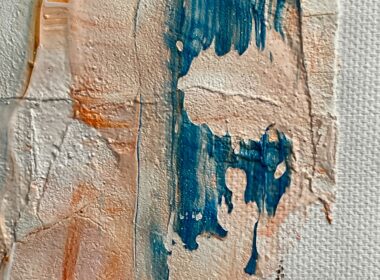
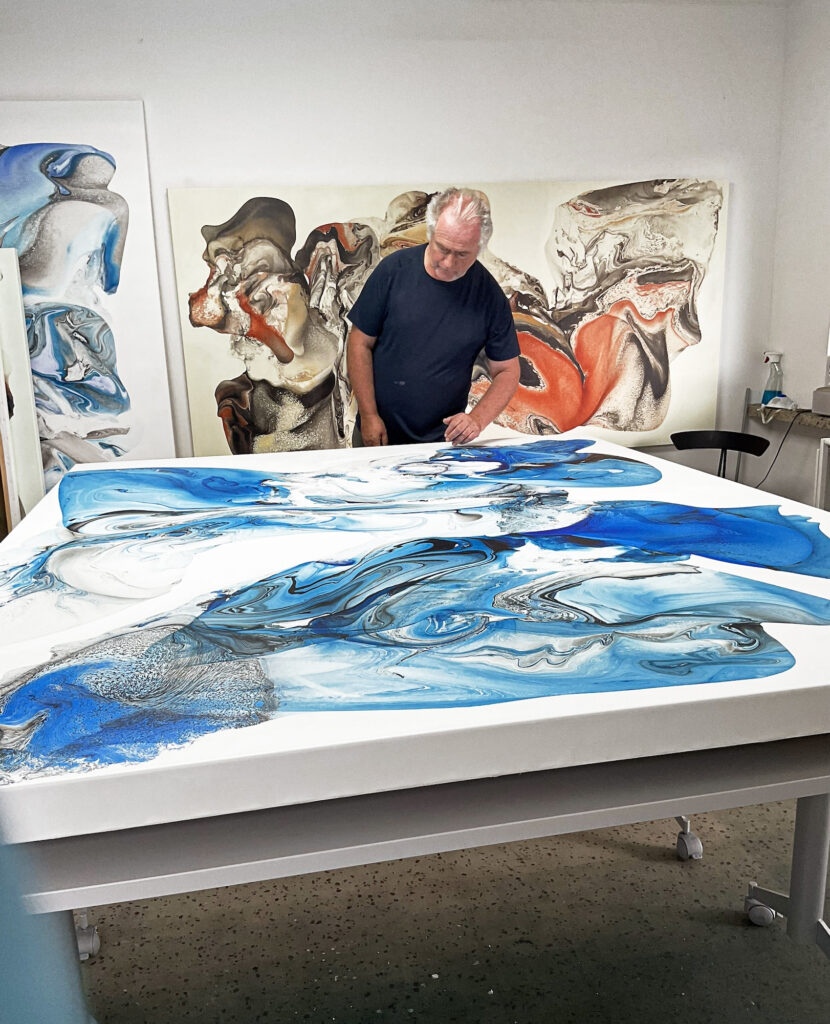
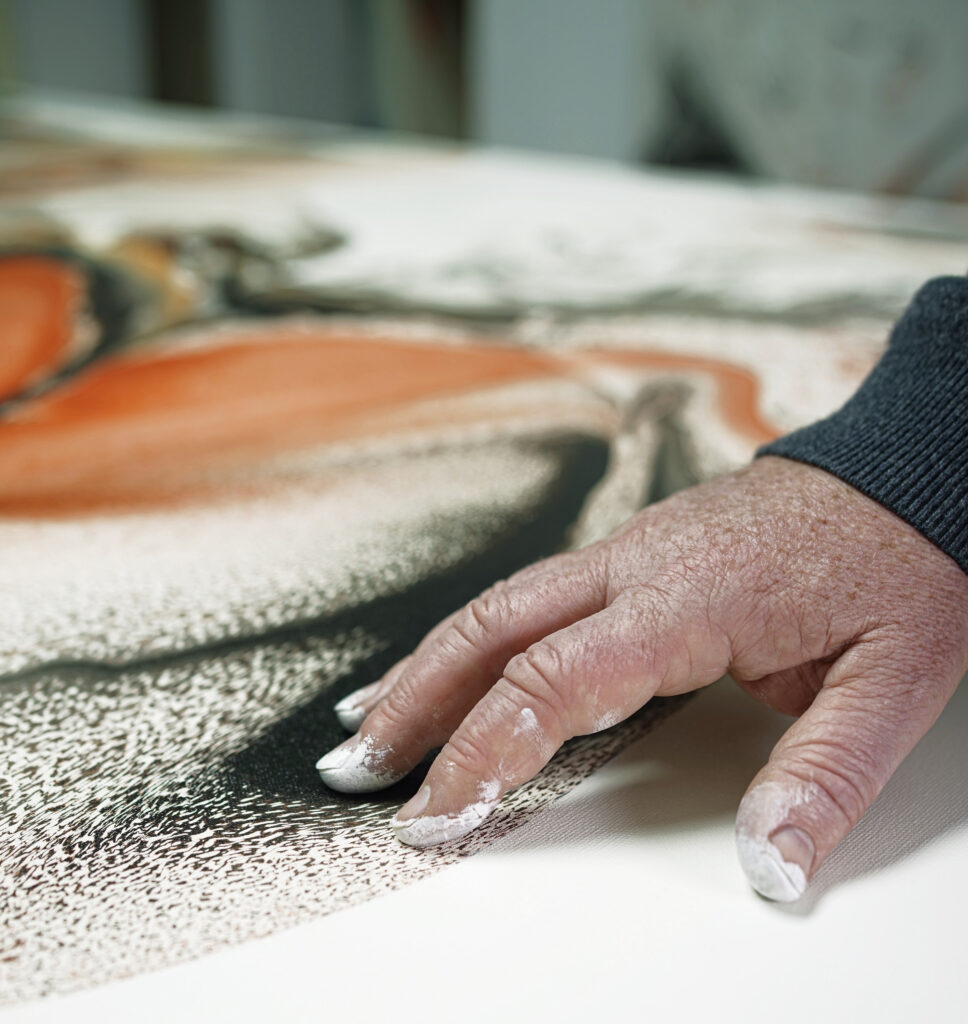
What he makes is extraordinary. Large scale, physically demanding, and breathtakingly alive. He pours, tilts, and layers oils, polymers, and pigments across raw silk and canvas, building surfaces that seem to hold light from somewhere within themselves. His palette moves between deep oceanic blues and blazing oranges and reds with the kind of confidence that only comes from a painter who has learned to trust what the materials are telling him.
His work draws from landscape and the human form, from the microscopic and the vast and yet he never imitates nature. He absorbs it. Its rhythms, its energy, its constant transformation become the raw material for something that feels as much like an experience as it does a painting.
Standing in front of one of his canvases, you don’t just see something. You feel something. And that, we have come to believe, is exactly what great art is supposed to do.
Let’s get to know Fintan through our conversation with him, where he shares the landscapes that shaped him, the process behind his extraordinary paintings, and what it truly means to make work that moves.
Q1. For those encountering your work for the first time, what do you want them to know about you who is Fintan Whelan, where do you come from, and how did your journey as an artist begin?
I grew up in Ireland in a small town not far from Dublin. From an early age I was surrounded by landscape, shifting weather, and the powerful presence of nature, which left a lasting impression on how I see the world. I loved drawing and painting what was around me, and that early interest led me to pursue a diploma in Art and Visual Communications after secondary school. I later worked in publishing as a graphic designer and repro master. Although much of that work was commercial, it kept me closely connected to visual culture and the discipline of image-making. My journey as a visual artist developed gradually alongside this. Creativity was always present in my life, but over time painting became the most direct and meaningful way for me to explore ideas about nature, movement, and human experience.
Q2. You trained in graphic design and worked in publishing before painting took over. What was the moment or was it more of a slow pull that made you walk away from that career and commit fully to the studio?
It was definitely more of a gradual pull than a single defining moment. I began painting seriously again while living in Granada, Spain. At that time I still had to support myself through other work, but the more I painted, the more the studio became the centre of my life. Over time I was able to dedicate more energy and time to the work, and slowly but surely the balance shifted until painting became my full-time commitment.
Q3. You’ve said you’re fascinated by everything organic whether microscopic or on a vast scale. Does that fascination come from somewhere specific, or has it just always been the way you see things?
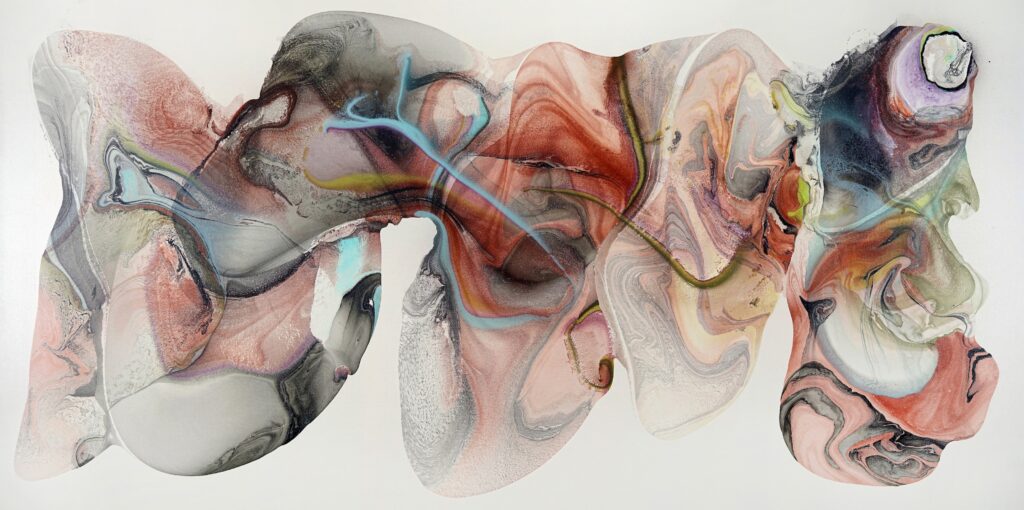
Letting in the Light, 2025, 200 x 100 x 4 cm / mixed media, raw silk & oil on canvasMuch of that fascination comes from growing up in Ireland. The landscape and the elements are incredibly present there – wind, rain, sea, constantly changing light. Being immersed in those conditions from a young age makes you very aware of natural processes and transformations. That early exposure stayed with me, and it naturally developed into a deeper curiosity about organic structures, whether they exist on a microscopic level or at the scale of vast landscapes.
Q4. You pour, tilt, and tip your materials across the canvas oils, polymers, pigments, raw silk. How did you land on that combination, and what does the silk do for you that canvas alone can’t?
Every painting evolves a little differently, but the process usually begins with an initial gesture – often a broad movement of colour that establishes an atmosphere. From there, the work develops through a series of layers and adjustments. I step back frequently, observing how the surface is changing and considering where the painting might need tension, balance, or space. Although the result can appear spontaneous, a great deal of careful observation is involved. The process becomes a rhythm of action and reflection – adding, altering, and sometimes removing – until the painting reaches a point where it feels resolved and nothing more needs to be said.
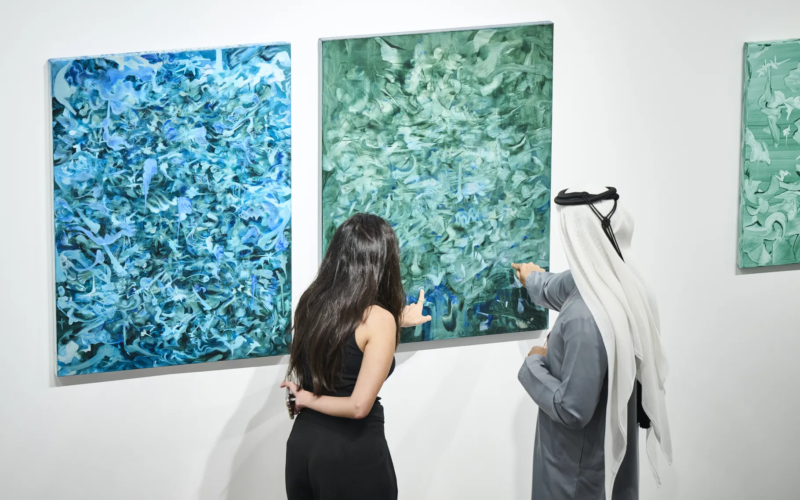
Q5. The Water Dance series you showed at Palazzo Bembo during the 2022 Venice Biennale you’ve called it a mantra for soaring beyond boundaries. Where did that series begin for you, and did the paintings change once you knew they’d be shown in Venice?
I began the series knowing in advance that the works would be installed in Palazzo Bembo. That context became the starting point. My goal was to create eight large canvases that could function as a unified installation while also standing independently as individual paintings. To achieve that, I produced many more works than were ultimately shown. The challenge was to find a rhythm between them – so that when they were placed side by side they created a continuous visual dialogue. In the end, eight paintings formed the final selection, each contributing to the overall movement of the series while retaining its own identity.
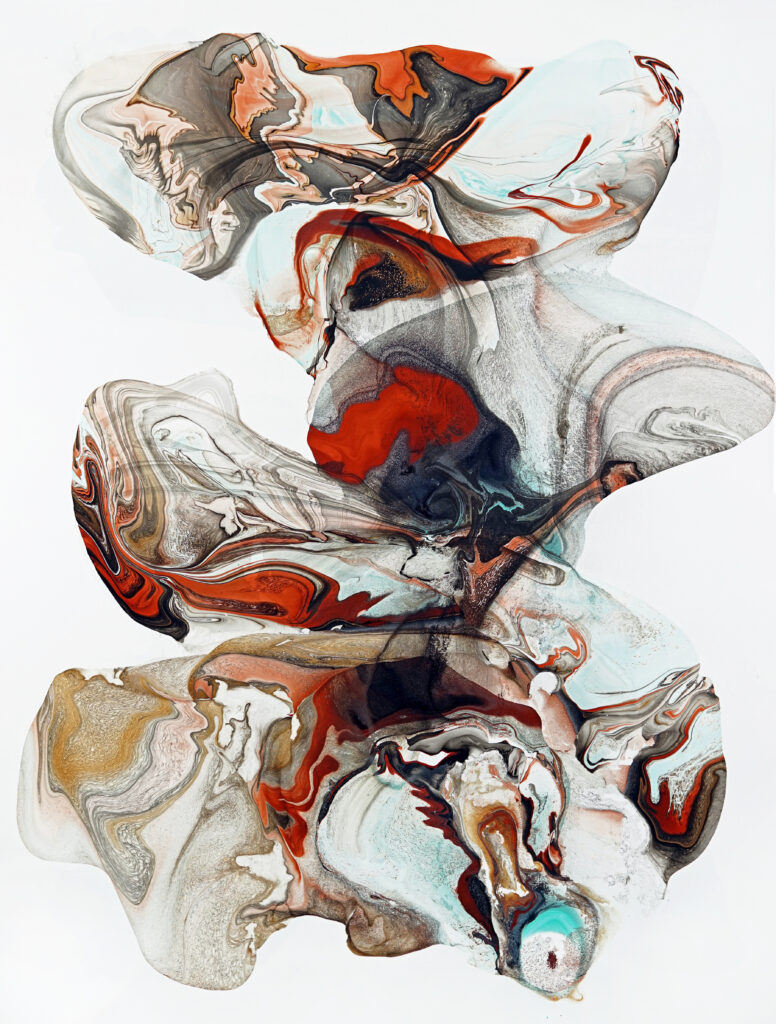
Q6. Your palette swings hard between deep oceanic blues and blazing oranges and reds. Is colour something you decide before you start a piece, or does it show up on its own?
Colour is often intuitive and not always predetermined. Sometimes I begin with a general sense of atmosphere or temperature – perhaps something cooler and more expansive, or something more intense and energetic. But as the painting develops, colour relationships begin to emerge on their own. The interaction between pigments can create unexpected harmonies or contrasts, and those discoveries often guide the direction of the work. I try to remain open to that process rather than forcing a strict plan from the beginning. Sometimes I work on a series of paintings, often in response to a specific project. While this can introduce certain restrictions, it also presents a valuable challenge. Those parameters encourage me to push beyond my usual boundaries and extend the limits of my practice.
Q7. A painting like Natural Rhapsody has this dreamlike, almost weightless quality to it, the purples and yellows just melt into each other. What were you after with that piece, and did it surprise you at any point while you were making it?
With Natural Rhapsody, I was interested in creating a sense of fluidity and lightness, almost as if the colours were dissolving into one another. I wanted the painting to evoke a kind of atmospheric movement – something that feels both natural and slightly dreamlike. Like many works, it evolved through moments of surprise. Certain colour combinations and transitions appeared that I hadn’t fully anticipated, and those moments became central to the character of the piece. Part of the excitement of painting is recognising when something unexpected happens and allowing it to shape to a certain extent the final work.
Q8. You’ve said you don’t want to imitate nature you want to draw inspiration from it. What’s the difference for you, in practice, when you’re actually painting?
For me, imitation would mean trying to reproduce what we already see in the natural world. But nature is far more complex and dynamic than any direct representation could capture. Instead, I try to absorb its rhythms, energy, and transformations. When I paint, I’m not attempting to depict a landscape or a specific natural form. Rather, I’m responding to the sensations and structures that nature suggests – movement, growth, erosion, light, and atmosphere. The painting becomes a reflection of those forces rather than a literal image of them.
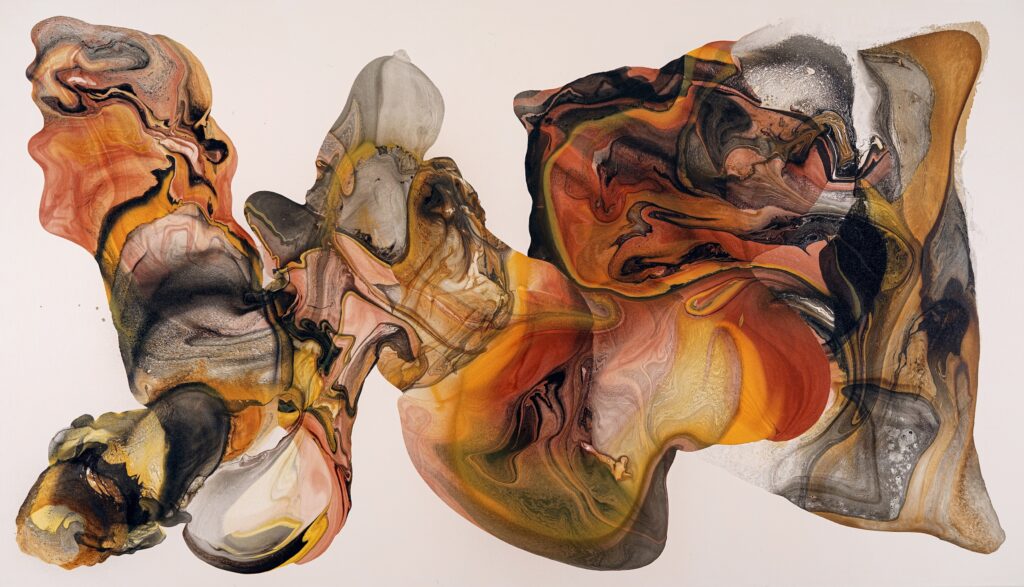
Q9. Light and texture are central to your work. When you’re mixing pigments and oils, are you chasing a specific quality of light, or is it more about creating the conditions for light to do something unexpected?
It is a combination of both. When I mix pigments and oils, I am often searching for a certain luminosity or atmosphere, but I’m equally interested in allowing the materials to behave in ways that surprise me. By layering, thinning, or altering the density of the paint, I try to create conditions where light can interact with the surface in unpredictable ways. Those moments of discovery – when the paint begins to refract or hold light differently than expected – often lead the work in new directions.
Q10. Your paintings draw from landscape and the human form but never show them directly. What is it about abstraction specifically that lets you get closer to those things than representation would?
Abstraction opens a different kind of space between the work and the viewer. Rather than presenting a fixed image, it allows for a more fluid exchange of meaning. For me, this creates the freedom to draw from aspects of nature – such as atmosphere, movement, or geological forms – and combine them with elements of human experience, like emotion, memory, and physical presence. Because these references are not depicted directly, they remain open and suggestive. The viewer can approach the painting through their own associations, and in that way the interpretation shifts to another level. Abstraction gives me the flexibility to explore these connections without the constraints of representation.
Q11. You work on large-scale canvases. Does the scale change how your body is involved in making the work is it a physical experience as much as a visual one?
Working on large canvases is both exhilarating and demanding. The scale inevitably brings the body into the process; painting becomes a physical activity as much as a visual one. I’m constantly moving around the surface -stepping back, reaching across, sometimes working from different angles – which creates a more immersive relationship with the painting. At times it can be exhausting or even daunting, especially in the early stages when the canvas feels overwhelmingly open. But that scale also offers a kind of freedom. It allows me to explore ideas more fully and develop gestures and layers without the restrictions that smaller formats can impose. The physical engagement with the work becomes part of how the painting evolves.
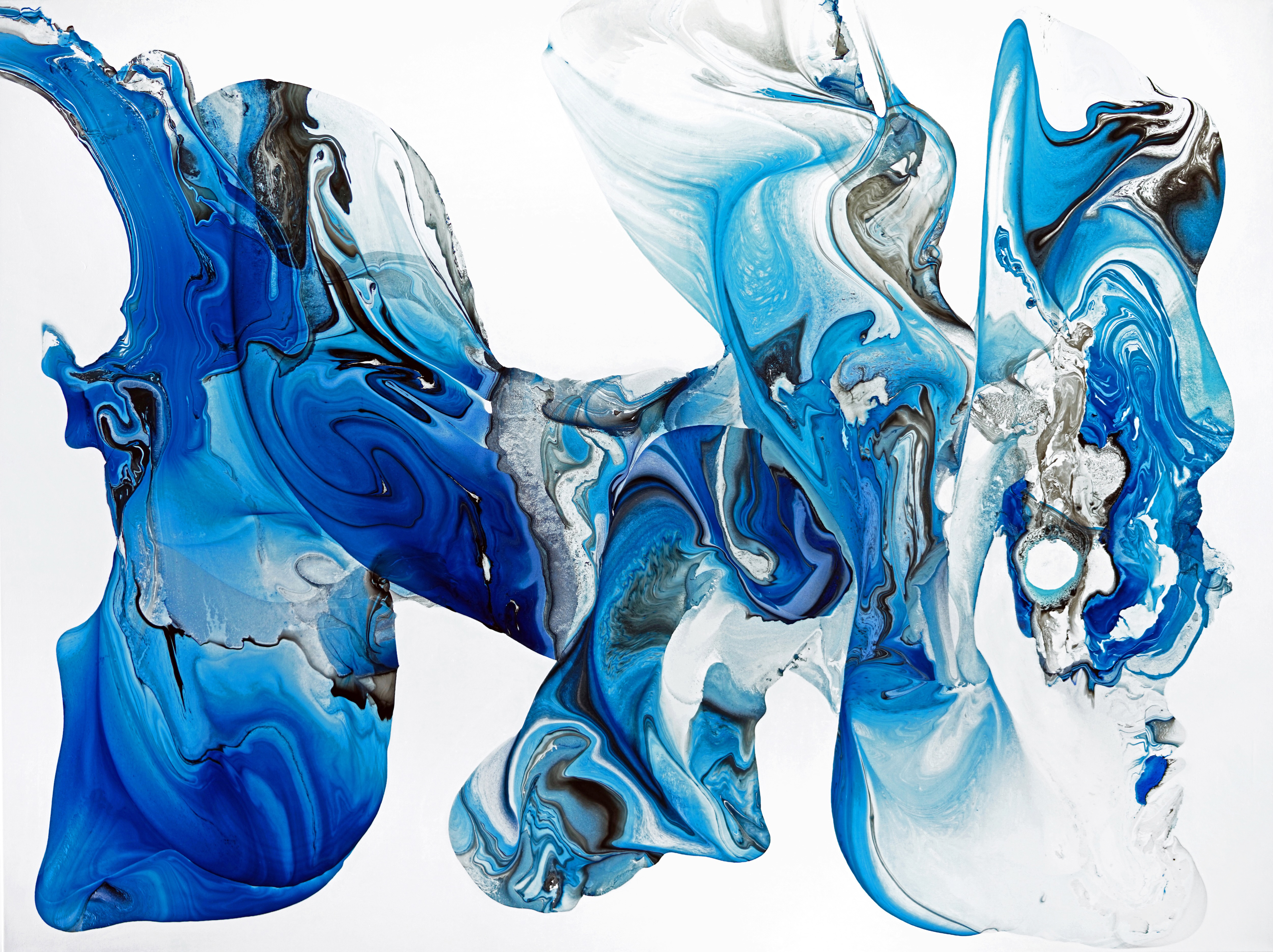
Q12. What does success actually mean to you at this point is it the work itself, the rooms it ends up in, or something that has nothing to do with either?
For me, success ultimately happens on the canvas. It’s about reaching a point in the work where something meaningful emerges – when the painting begins to carry the energy or clarity I was searching for. That sense of progress in the studio is the most important measure. Being able to continue working, developing new ideas, and embarking on new projects is also a form of success. Exhibitions and important shows are, of course, valuable opportunities, but I tend to see them as a bonus rather than the defining goal. The real success lies in the ongoing evolution of the work itself.
Q13. There’s always a moment in an artist’s life that quietly changes everything not a big exhibition or a prize, just a shift in understanding. Has that happened for you, and what was it?
In my experience, those shifts happen continuously rather than as a single defining moment. Over time I’ve developed the habit of stepping away from the studio – through travel or residencies – and then returning with a slightly different perspective. That distance allows me to see the work more clearly. When I come back, I often notice possibilities or problems that were invisible before. Reflection has become an essential part of my process. It helps renew my energy and encourages the kind of critical distance that is necessary for development as an artist.
Q14. You once said a fellow artist told you “there are no rules in art stick to what is working for you and stay true to it no matter what.” Is that still the advice you’d give, or has your thinking shifted?
I still believe strongly in that advice. Art doesn’t follow a fixed set of rules, and each artist has to discover their own path through experience and intuition. Staying true to what genuinely resonates in your work is essential. If I were to add anything, it would be to trust your instincts and to make the work primarily for yourself. At the same time, it’s important to balance that instinctive approach with periods of reflection – stepping back, questioning decisions, and allowing the work to evolve. That combination of intuition and reflection is what helps sustain a meaningful artistic practice.
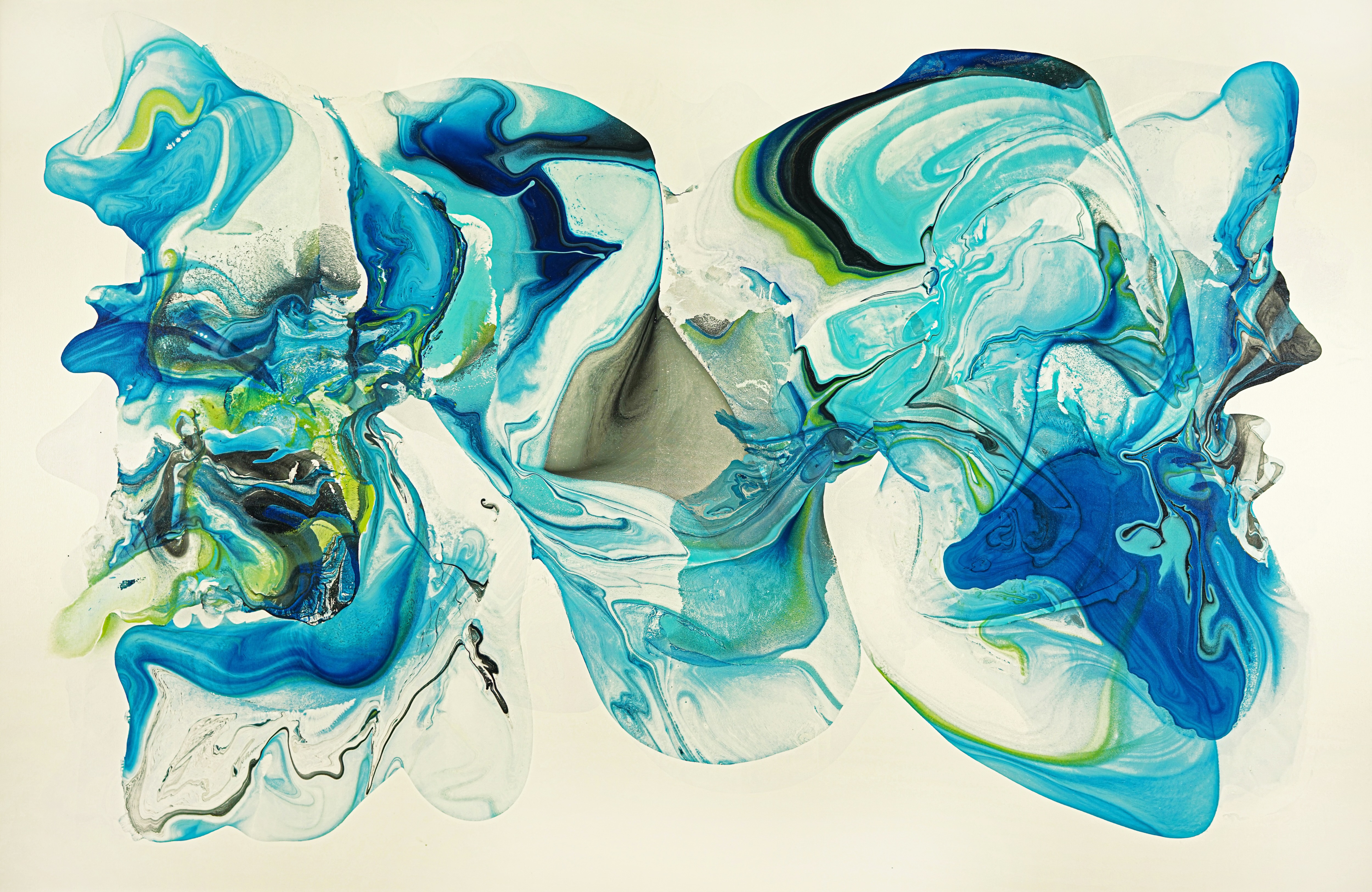
As we wrapped our conversation with Fintan, we found ourselves doing something we don’t always do after an interview we went back and looked at the paintings again. With fresh eyes. Knowing what we now knew about the process, the thinking, the years of looking and absorbing and translating.
And something shifted. Because that is what happens when you understand where a body of work is actually coming from. You stop seeing a beautiful surface and start seeing a conversation.
And Fintan’s work is very much a conversation. Between the artist and the material. Between intention and accident. Between the vast natural world and the human hand trying to make sense of it on canvas. When he talks about pouring and tilting and watching the paint behave, he is not describing spontaneity for its own sake he is describing a dialogue.
One where he sets the conditions, the materials respond, and then he decides what to keep, what to push further, what to let go. That back and forth, that rhythm of action and reflection, is what gives his paintings their particular aliveness.
They do not look controlled because they are not entirely controlled. And they do not look accidental because they are not accidental either. They live in the space between the two, which is exactly where the most interesting painting always lives.
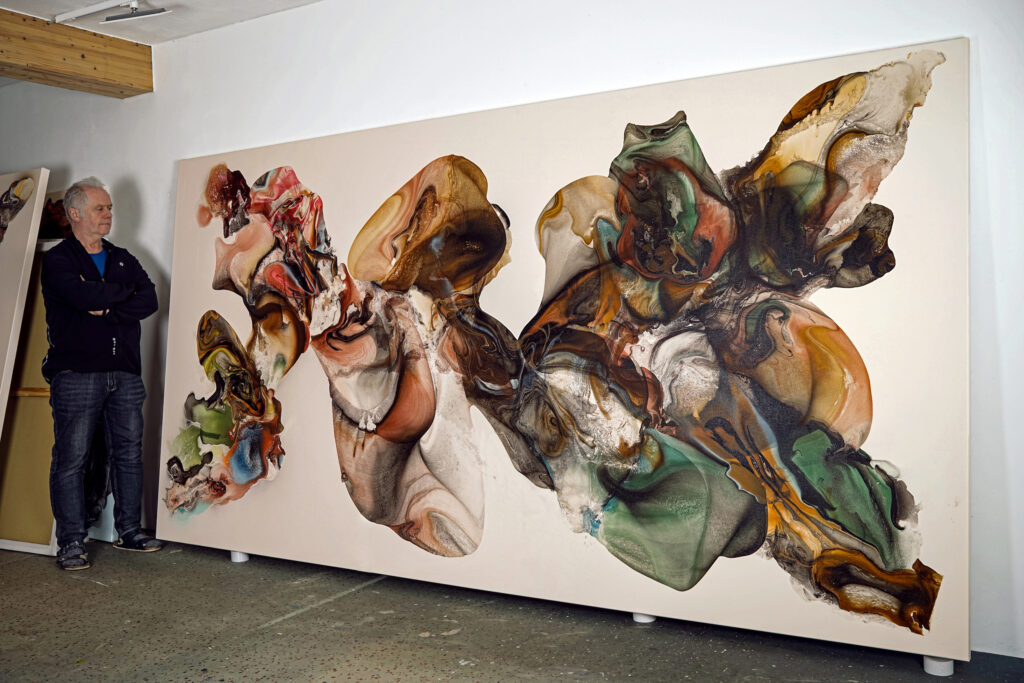
What also struck us and this came through clearly in conversation is how deeply rooted his work is in something real. This is not abstraction for abstraction’s sake. When Fintan talks about the Irish landscape, about wind and rain and constantly changing light, about his early fascination with entomology and botany, you understand that the work is not referencing nature loosely.
It is genuinely trying to get at something true about the natural world about its structures, its energy, its indifference and its beauty. That ambition gives the paintings a seriousness that you feel before you can articulate it. And that, we think, is the most honest thing we can say about his work. You feel it before you understand it. And then the more you understand it, the more you feel it.
Follow Fintan Whelan through the links below. Spend some time with his paintings. Let them work on you the way he intended slowly, openly, without rushing to a conclusion.