
Bike, Lake, Basket, Paints! Sometimes Your Whole Career Starts That Simply I Agnieszka Zabrodzkae
At Arts to Hearts Project, we love artists who have thought behind their art. Artists who aren’t just making something pretty, they’re making something that came from somewhere real. Something that cost them something. Something they needed to figure out by painting it. We’ve spent years trying to pinpoint the exact moment a painting becomes more than just an image.
You know the feeling you’re scrolling through hundreds of works, and suddenly something makes you pause. Not because it’s screaming for attention. Not because it’s technically perfect or conceptually clever. But because it feels like it knows something about you. Like it’s painted a place that only existed in your head until now. A forest you dreamed about as a child. A reflection in water that holds more than what’s visible. That strange, aching feeling of recognizing somewhere you’ve never been.
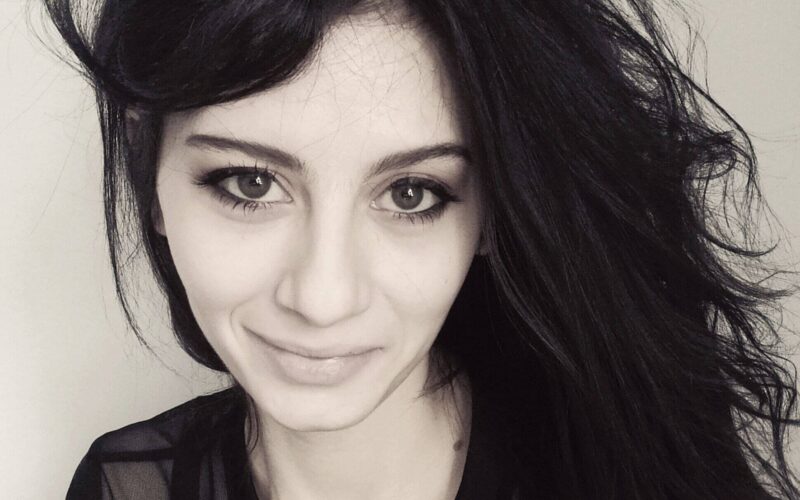
That’s what we felt when we saw Agnieszka Zabrodzka’s work.
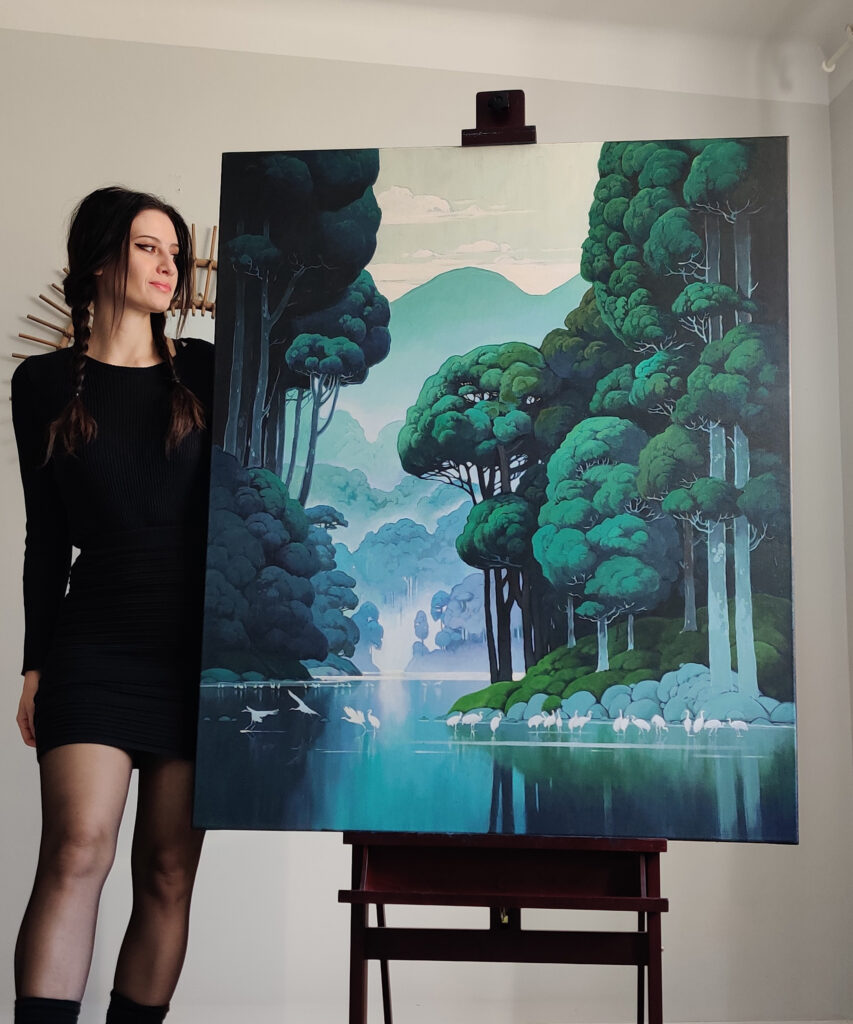
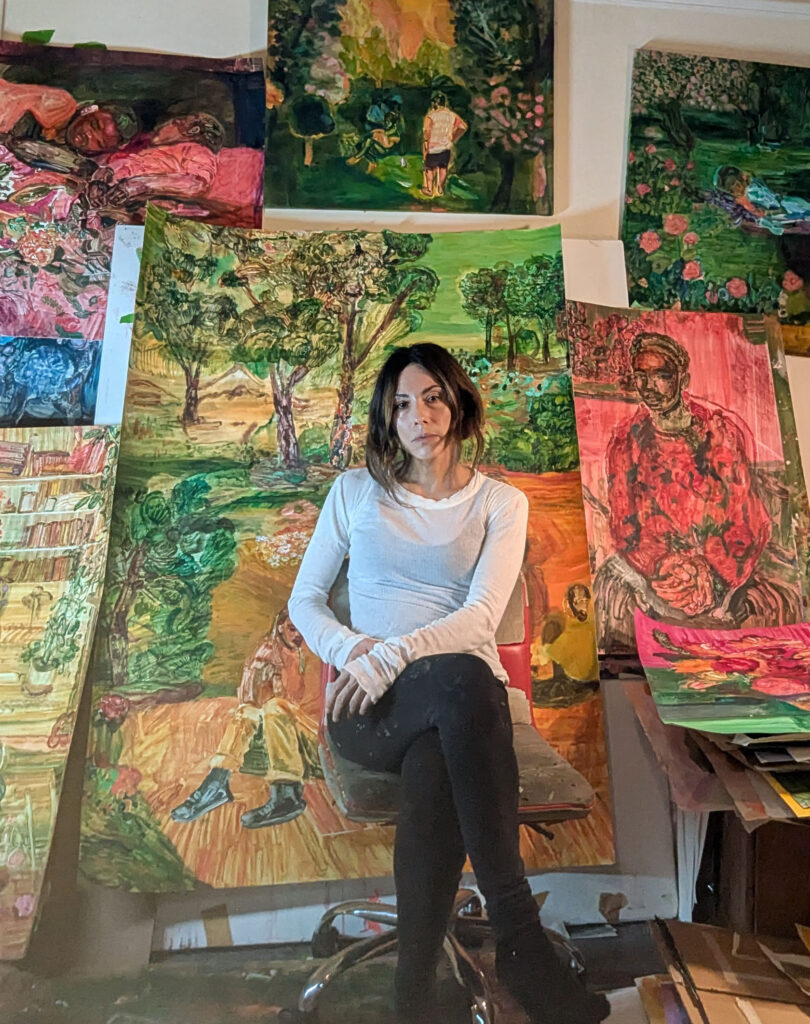
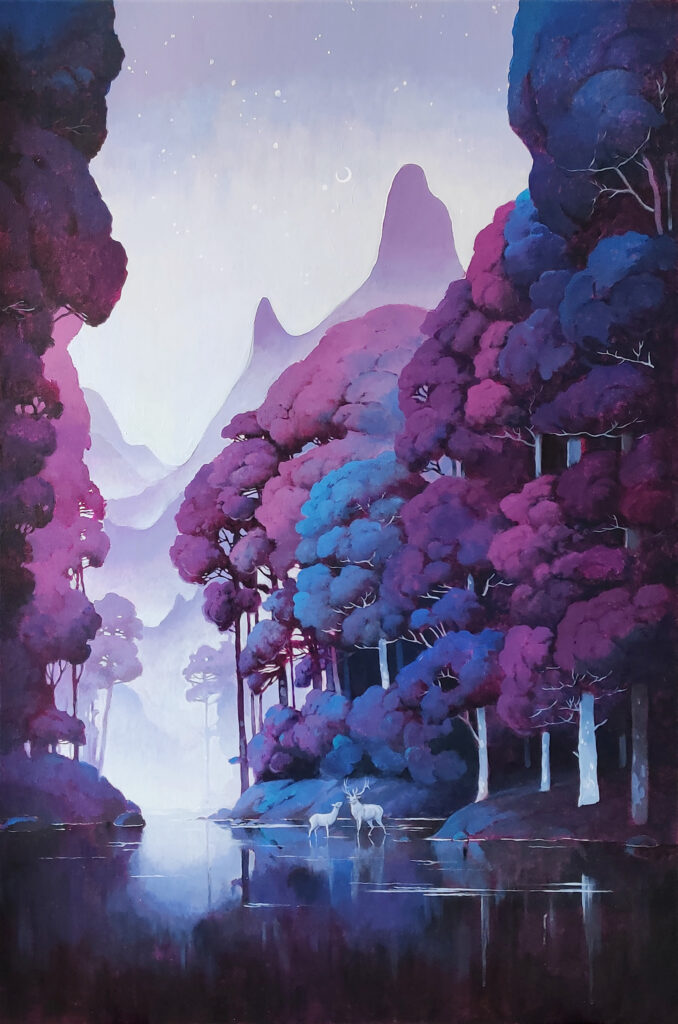
Her paintings don’t show you reality. They show you the world the way memory reshapes it softer, more mysterious, suspended in time. Forests that could be in Poland or Thailand or nowhere at all. Water surfaces that mirror not just trees but longing itself. Her work exists in that fragile space between what you remember and what you wish you remembered. Between the forest as it was and the forest as it felt when you were small enough to believe in magic.
We wanted to feature Agnieszka in our Best of the Art World series because her work rejects everything the art world typically rewards. It’s not trendy. It’s not fast. It’s not designed to go viral or shock you into paying attention. Instead, it does something harder: it asks you to slow down. To remember what it felt like when forests seemed endless and every path held secrets. To reconnect with that part of yourself that still believes in wonder, even if you’ve forgotten how to access it.
Agnieszka’s journey started with failure. Not the romantic kind where struggle leads to immediate breakthrough, but the grinding, frustrating kind where the thing you want most painting trees, capturing water feels impossible. At the Academy of Fine Arts in Warsaw, she fell deeply in love with Polish Modernism, with 19th-century landscape painters who worked en plein air, hauling their canvases into nature to paint what they saw. She tried to follow them. She tried so hard. But tree canopies defeated her. Water eluded her. Reality refused to translate.
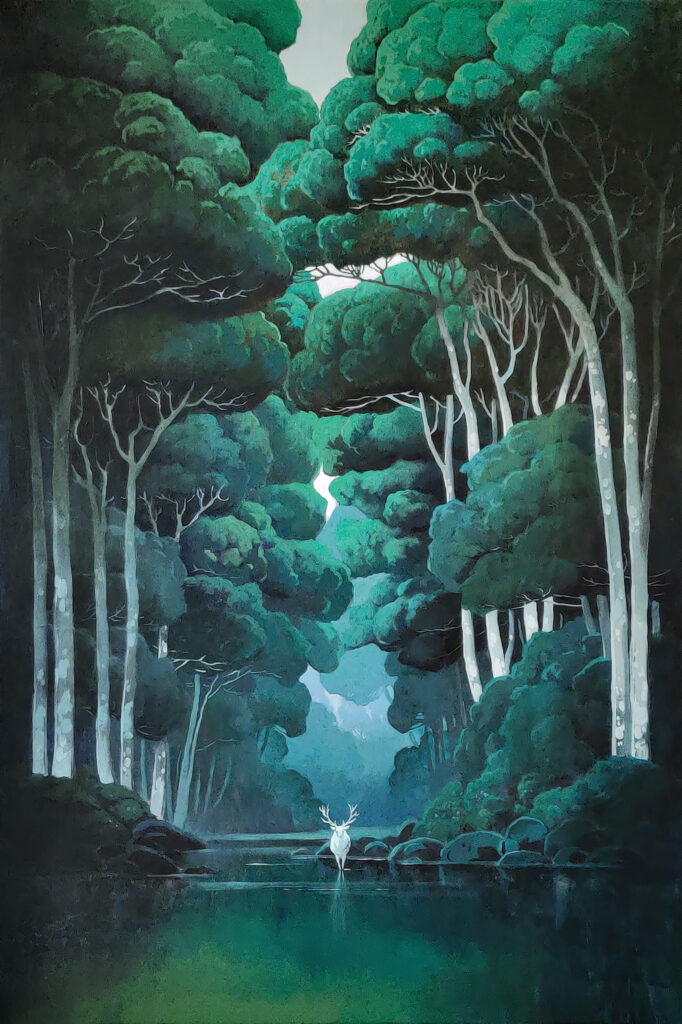
Then something shifted. During an Erasmus exchange in Antwerp, a port city where water was inescapable she discovered Peter Doig’s work. His water landscapes didn’t try to capture reality. They captured feeling. That discovery cracked something open. Back in her hometown, she started riding her bicycle to a small lake, paints balanced in the basket, trying not to paint what she saw but what she felt seeing it.
But here’s what makes Agnieszka’s work different from other landscape painters: she’s not interested in places. She’s interested in the feeling of place. Her forests don’t exist on any map. They exist in that psychological space where memory lives, where childhood wonder hasn’t quite faded, where trees still feel like towering colossi and every stream holds mystery. She paints refuge. Not escape, but return to the part of ourselves that knew how to be still, how to be moved by nature, how to feel small in the presence of something vast without feeling afraid.
Now, let’s hear from Agnieszka about how she found her voice, what Arcadia really means, and why she’s chosen to work slowly in a world obsessed with speed.
Q1. Can you share key moments from your early life or creative education that shaped your visual language and drew you toward the interplay of memory and imagined landscapes?
I often recall that at the very beginning of my painting practice, depicting trees or water on canvas was extremely challenging for me, especially tree canopies. While studying painting at the Academy of Fine Arts in Warsaw, I fell deeply in love with late 19th-century art, particularly the Young Poland movement (Polish Modernism). I was especially drawn to landscape painting by artists such as Jan Stanisławski, Julian Fałat, Stanisław Wyspiański, and Ferdynand Ruszczyc. This was the moment when I truly fell in love with painting landscapes. I tried to follow in their footsteps, working in close contact with nature. Taking my canvas and paints outdoors and painting en plein air. However, these were not yet the water landscapes I create today. I remember very clearly when the first painting from my Arcadian series was born – a series I continue to develop to this day. It was the summer before my diploma year at the Academy, shortly after returning from my Erasmus exchange in Antwerp. The inspiration for that painting came from a small lake in my hometown, where I used to ride my bicycle with paints in the basket, heading out to paint from life. At that time, I was strongly influenced by the Scottish painter Peter Doig, whose work I discovered during my Erasmus, particularly his water landscapes. Antwerp itself, as a port city, made the presence of water almost unavoidable; it surrounded me on all sides. That was where my first attempts at painting water motifs emerged, and the Arcadian painting became a kind of culmination of my creative explorations during that period. It felt like falling in love. I realized that forests and reflections in water were truly my subject. I wanted my paintings to present an Arcadian vision of the world. Forest landscapes with water motifs became a response to my romantic longings – a way of translating memory, imagination, and desire into an idealized, timeless space.
Q2. Forests, animals, and lush environments recur throughout your work. Do you see nature more as a subject, or as a psychological and emotional space for storytelling?
For me, nature functions less as a subject and more as a psychological and emotional space for storytelling. Forests, water, and animals become vessels for memory, longing, and inner states rather than elements of a literal landscape. The narratives in my paintings unfold through nature – it is a language I use to speak about emotions, imagination, and an idealized sense of harmony. These are not specific, identifiable places. I am interested in creating images that feel universal – forests that could exist anywhere in the world, outside of a particular geography or historical moment. There is no fixed time in my landscapes; instead, I aim for a sense of suspension, as if the viewer could step into them from different points of memory or imagination. The forest, in particular, represents a kind of personal idyll for me. A place of calm, a refuge from the noise of everyday life. In my paintings it appears as an Arcadia, yet not one devoid of darkness or wildness. This dual nature of the forest is what fascinates me most: it can feel familiar and safe, but also mysterious, untamed, and full of hidden secrets. It is a space that can offer comfort while simultaneously awakening a sense of unease. In my work, however, this darkness remains gentle and contained, something intimate rather than threatening. I often return in my thoughts to childhood, when the forest felt immense, almost monumental, filled with mystery and undiscovered paths. Those early memories – when trees seemed like towering colossi continue to shape my visual language. They inspire me to create paintings that do not recreate a specific reality, but instead convey a feeling of being both lost and deeply moved in the presence of nature. These impressions, drawn from both real and imagined journeys, merge in my work to form visions of forests that are at once familiar and elusive.
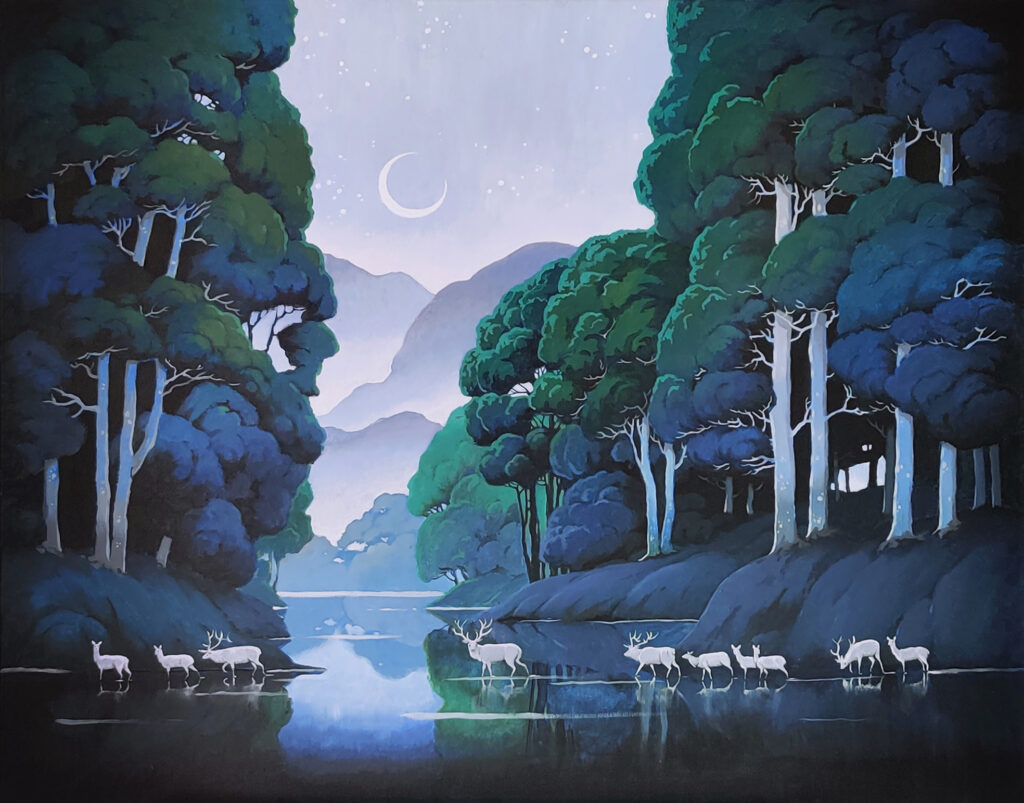
Q3. You often describe your paintings as an Arcadian vision of the world. What does Arcadia mean to you personally, and why does this idea continue to feel relevant today?
Arcadia, as it appears in my paintings, is not an image of perfection, but a quiet state of balance I continue to search for through painting. The idea of Arcadia is closely tied to personal experience, especially memories of childhood, when the world felt larger, more mysterious, and deeply connected to nature. There is always a gentle tension present in these images, between calm and uncertainty, light and shadow, safety and the unknown. This idea feels relevant today because many people long for spaces, even imagined ones, that allow them to step away from constant noise and movement. In my work, Arcadia is simply a way of imagining a softer, more attentive way of being in the world.
Q4. Can you walk us through your studio process? How much is guided by intention, and how much emerges through intuition as the work evolves?
When an idea for a painting starts to take shape in my mind, I like to support it by experimenting with composition and color beforehand. I often make a sort of collage on the computer, using scraps of images and inspirations I’ve collected. This helps me bring some order to the chaos in my head and clarify the concept, reducing the risk of endless repainting later on. Still, once I start painting, intuition often takes over. Sometimes I begin with a palette of greens, but then a few touches of violet appear, and suddenly they dominate the whole painting… It turns out the work didn’t want to be green at all! I often sit on the floor while I paint, creating a mix of quiet and chaos around me. During the process, things can change completely, even the composition itself, as if the painting is taking the lead. So, while I plan and prepare, the act of painting is very intuitive. There are moments when it feels as though the painting is guiding me rather than the other way around.
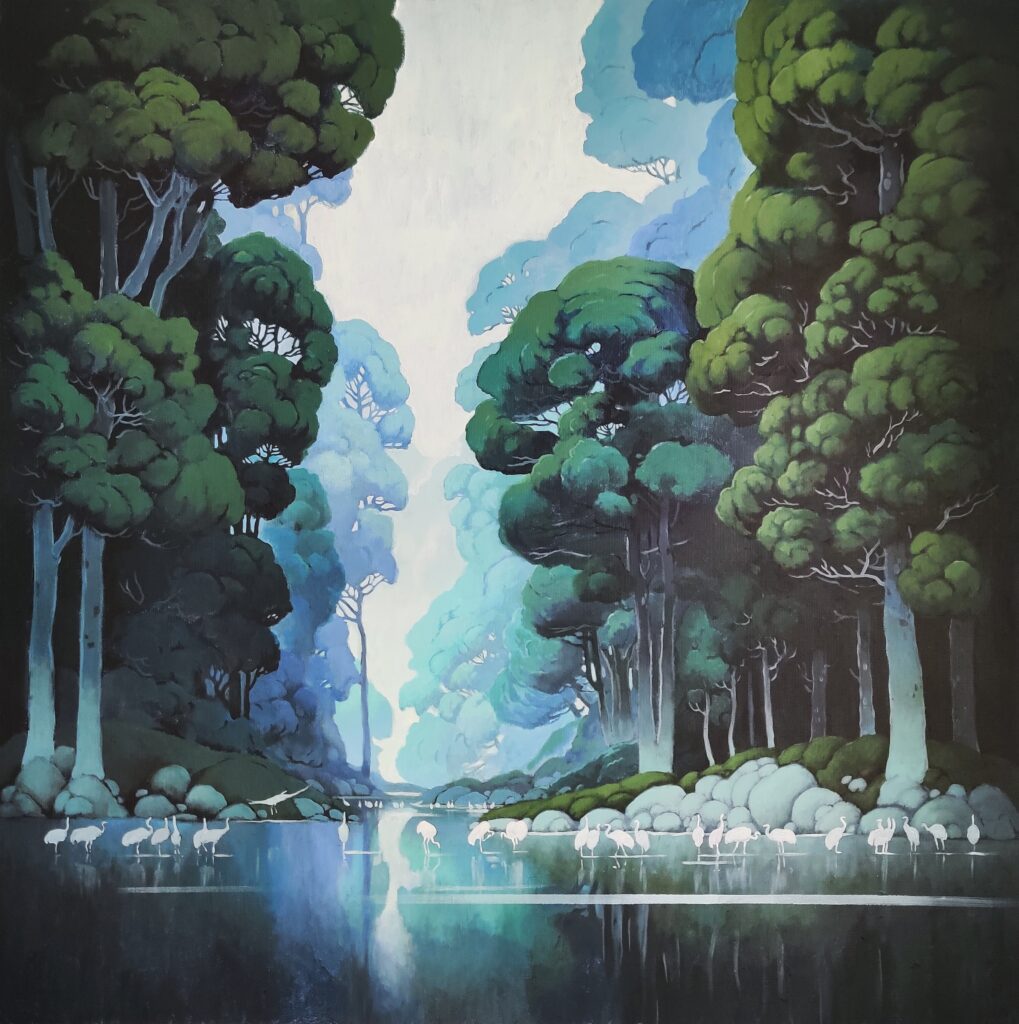
Q5. What kind of relationship do you hope viewers form with your work, quiet contemplation, emotional connection, escape, or something else entirely?
Viewers often tell me that my paintings feel strangely familiar. For some, they recall a forest near their family home in Poland; for others, they resemble places visited during travels in countries like Thailand or Vietnam. This sense of universality is something that fascinates me deeply. I am not interested in depicting specific locations, but rather in capturing the essence of a forest – an overall impression that many of us carry within us. I hope my paintings invite viewers into a space of nostalgia and quiet reflection, with a subtle sense of magic. It is the kind of magic we experience more strongly in childhood, and often begin to miss as we grow older. I would like my work to remind people of that feeling, of moments when the forest seemed endless, full of mystery and possibility. More than anything, I hope viewers can sense both the calm and the quiet wonder of the forest, as well as the fleeting nature of such moments, which pass and leave behind only an echo of memory. These landscapes carry something of a childlike sense of awe, when every path felt unexplored and every stream held a secret. Through painting, I try to hold onto that moment. The moment when magic still feels present.
Q6. What advice would you give to emerging artists who are still searching for their voice, especially those working slowly, intuitively, and outside fast-paced art trends?
I would tell emerging artists to create as much as possible and to experiment freely. Every sketch, study, or painting, even if imperfect, helps shape your visual language. It’s also important to observe the work of others – not to copy, but to let yourself be inspired. When something moves or excites you, a part of it stays with you, gradually helping you discover your own path. Equally, learning to trust intuition is essential. Sometimes a painting leads you in unexpected directions, and embracing these surprises can open new possibilities. When experimenting in painting, it’s nice to sometimes embrace chance. Patience is key. Finding your voice takes time and repeated practice. Finally, I would encourage artists to stay true to their pace and interests, even if it means working slowly or outside of trends.
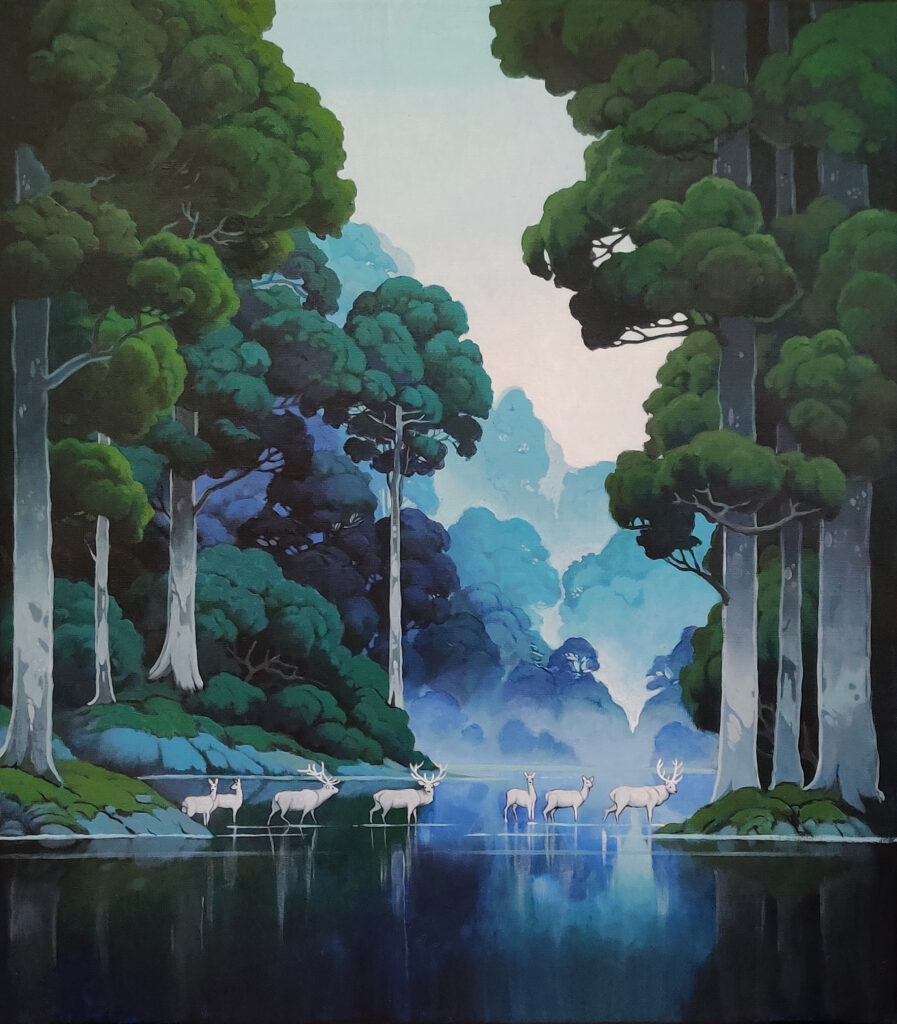
Wrapping our conversation with Agnieszka, I keep thinking about what she said when viewers tell her the paintings feel “strangely familiar.” That word, familiar. Not recognizable. Not accurate. Familiar. Like meeting someone you’ve known your whole life but can’t remember where from. That’s the difference between painting places and painting memory. Between showing someone a forest and showing them how forests feel.
What stays with me most is this: Agnieszka isn’t trying to take you somewhere new. She’s trying to take you back. Back to when trees felt monumental. When reflections in water held secrets.
When getting lost in a forest wasn’t scary, it was possibility. She’s painting that suspended moment before we learned to rush, before we stopped noticing, before magic became something we outgrew instead of something we forgot to look for.
And here’s what I realized listening to her this work isn’t about nostalgia for its own sake. It’s about what we lose when we forget how to be still. When we stop letting ourselves feel small in the presence of something vast.
When we mistake speed for progress and noise for meaning. Her Arcadia isn’t escapism. It’s a mirror. Showing us what we’re missing. Reminding us of it’s still there, that gentle darkness, that quiet wonder, that childhood awe if we’re willing to slow down long enough to find it again.
Follow Agnieszka Zabrodzka through the links below to see her process and new work as it develops.