




How these 5 Artworks of Hilma Af Klint Changed Modern Art

Hilma af Klint was born on 26 October 1862 at Karlberg Palace (near Stockholm, Sweden), into a family steeped in naval tradition and with a strong interest in mathematics, nature, and exploration. Early on she showed talent in visual art, eventually studying at the Technical School in Stockholm and later at the Royal Swedish Academy of Fine Arts, graduating with honours in 1887.

What makes Hilma af Klint truly extraordinary , and why she continues to captivate artists and historians , is that she began creating abstract, spiritually driven paintings decades before many artists traditionally credited with “founding” abstract art. Her work wasn’t just about shapes or colors: it was a bold attempt to visualize the invisible , spiritual energies, mystical ideas, cycles of life, and universal connections beyond the visible world.
For much of her life, her “real work” remained hidden: she believed the world wasn’t ready. Thankfully, decades later, her oeuvre resurfaced , and when it did, it challenged art history. Today, she is widely regarded as a pioneer of abstract art, and many scholars credit her as the earliest among major Western artists to paint pure abstraction.
In her work you see more than art , you see a bridge between mysticism and modern visual language. Her bold experiment changed what art could be, and it continues to inspire generations.
The Ten Largest” (Childhood → Adulthood → Old Age), from Paintings for the Temple (1907)

This series , often referred to simply as “The Ten Largest” , is part of what af Klint called her “Paintings for the Temple.” It maps the human life cycle from childhood through youth, adulthood, to old age, not through literal portraiture, but through abstract forms, swirling organic shapes, pastel hues, and symbolic geometry.
The colors and forms feel almost otherworldly: spirals and petals, circles and arches that evoke growth, transformation, and inner life. They feel symbolic rather than representational , a translation of human existence into visual metaphor.
These paintings are massive: over three meters tall. Their scale and ambition reflect af Klint’s spiritual vision: she wanted to create something like a universal map of life’s journey.

What’s impressive is how clear and mature this vision feels , not a tentative abstraction experiment, but a fully formed symbolic language. For many viewers today, seeing these works reveals that abstraction didn’t begin with modern “famous names,” but with a singular woman’s mystical insight.
The emotional weight of “The Ten Largest” comes from its universality: you don’t need to belong to a specific religion or spiritual tradition to feel the passage of birth, growth, maturity, aging through its forms.
In a sense, this series is her mission statement. It declares that art can be more than mimesis , that painting can be a map of inner life, unseen energies, and spiritual cycles.
Group X – Altarpieces, No. 1–3 (1915)

The Altarpieces series from 1915 marks the culmination of her “Temple” project. These are more geometric, with bold colors, gold leaf elements, and a much stronger sense of architecture and sacred space.
Here you see symmetry, balance, and a restrained palette , shapes like triangles, circles, petals, intersecting forms that suggest ritual, altar, sacred geometry. It feels less playful than earlier works, more meditative and solemn, as if designed for reflection rather than decoration.
The shift shows af Klint maturing from expressive spiritual visualization toward structured symbolic language , she was formalizing her visual theology.
These altarpieces suggest more than personal spirituality , they suggest universality: archetypes of existence, dualities (light/dark, male/female, material/spiritual), and cosmic relationships. The colors and shapes invite the viewer to meditate rather than interpret.
For a contemporary viewer, they feel ahead of their time: their design logic resonates with modern minimalism, sacred geometry, even contemporary graphic abstraction.
Ultimately, this series shows that af Klint’s spirituality wasn’t dreamy or decorative , it was architectural, conceptual, and serious. She treated painting as sacred craft.
Group IV – Adulthood (Nos. 5–8), c. 1907
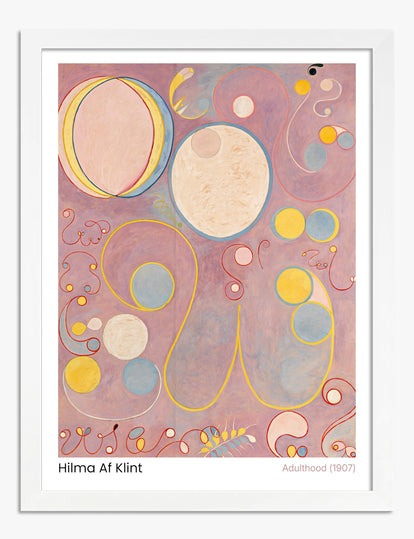
This sub‑series from 1907 belongs to a phase when af Klint was carving out more of her symbolic vocabulary. “Adulthood” visualizes maturity: forms that feel settled, balanced, perhaps more complex than childhood , circles, layers, folds, shapes that imply stability and depth.
The colors remain gentle yet resonant , pastels, soft curves, overlapping forms , conveying softness but also internal structure. It’s as though she’s mapping inner emotional landscapes rather than external ones.
What makes this work compelling is its dual nature: abstract enough to avoid any literal reading, yet emotionally grounded enough that the shapes carry weight. You sense growth, responsibility, introspection , all without figures or faces.
In many ways, this series feels like a bridge between innocence and wisdom: not the wild freedom of youth, not the final calm of old age, but a state of conscious being , aware, grounded, but fluid.
For modern artists and spiritual seekers, these works resonate as meditative mandalas or inner maps , they show that abstraction can be empathetic, human, and deeply psychological.
Through “Adulthood,” af Klint underscores that art doesn’t need representation to be deeply expressive. Emotional and spiritual complexity can live in form, color, and composition.
Later Series: Botanical & Natural‑Inspired Works (Post‑Temple period, 1919–1920)
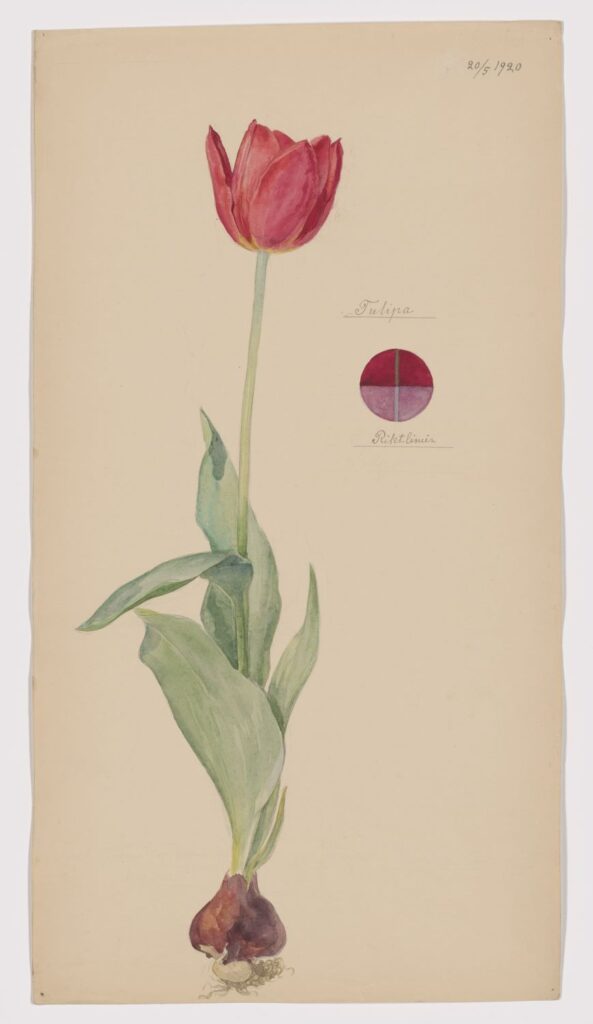
After finishing the “Temple” project, af Klint turned toward nature , a natural homecoming for an artist with early interests in botany and organic forms. She began sketching flowers, plants, and natural motifs , but always with a twist: subtle geometric overlays or symbolic marks hinting at deeper spiritual or energetic meanings.
These works show a different side of her practice. Rather than monumental canvases, she creates delicate, intimate drawings , a gentle blend of scientific observation and mystical interpretation. The lines are fine, the compositions thoughtful, and every detail matters.
The combination of botanical precision with spiritual symbolism feels pioneering: she treats nature as a mirror for inner life, as an interface between the physical and the metaphysical. The result is neither purely scientific illustration nor purely abstract painting , but something that marries both worlds.
For viewers today, these drawings challenge expectations: they show that abstraction wasn’t only about pure geometry , it could also be a bridge between the natural world and inner experience. It’s a reminder that abstraction can be rooted in observation, not just invention.
This turn back to nature suggests af Klint’s evolving spirituality: not only cosmic, universal, but also grounded, earthly, organic. The mystical and the natural were always two sides of the same coin for her.
In this sense, these botanical works feel deeply human , humble, curious, contemplative. They show that abstraction for af Klint wasn’t just about grandeur, but also about care, attention, and respect for life.
Her Hidden Legacy , Why her Story Still Shocks Us
Before even looking at one painting, af Klint’s biography is part of what makes her legacy powerful.
Despite her brilliance, she kept her abstract work secret during her lifetime. She believed people weren’t ready. After her death in 1944, she requested that her abstract works remain private for 20 years. It wasn’t until decades later , after much cultural and historical change , that the art world rediscovered them.
When her work re-emerged, it forced a rethink of art history: many believe she beat to abstraction other canonical names such as Wassily Kandinsky, Piet Mondrian, or Kazimir Malevich.
Her story also raises issues of gender, recognition, and history-writing: a talented, educated woman whose radical vision was hidden for decades because of social and spiritual concerns. That she is now widely celebrated feels overdue , and necessary.
Today her work speaks to new generations: artists, spiritual seekers, anyone who feels drawn to art as more than decoration , as exploration, as philosophy, as proof that what we cannot see still matters.
In a world still searching for balance between meaning and image, her legacy is a reminder: art can be sacred, even when it doesn’t depict anything literal. It can be about what’s invisible , not despite, but because of, abstraction.