
He Started with a Blank Wall and Found a New Beginning I Frank Janssens

Some artists find their voice by chance, others through study, but for Frank Janssens, the path has always felt like coming home a return to something deeply familiar, something he always knew was part of him. This week, in our Best of the Art World series, we’re excited to share Frank’s journey. As a child, he lived in a world of colour and imagination, spending hours drawing, painting, and shaping whatever materials he could find. Creativity was instinctual, a natural way to understand the world around him. Life led him down other paths studies, work, responsibilities but that early spark never went out. It stayed quietly alive, waiting for the moment to shine again.
That moment arrived years later in the simplest, most human way: during the renovation of the home. When he decided to paint some pieces for their walls, he didn’t expect anything more than the joy of making. But as soon as he picked up the brush, something long dormant opened up. What started as decoration became a return to himself a rediscovery of a creative language he had always spoken but had stopped hearing.

Frank’s path is unusual in its clarity. As an osteopath working in Antwerp for more than fifteen years, he has spent his life observing the body’s intelligence, its rhythms, its intuitive capacity to find balance and return to harmony. That embodied awareness now flows directly into his paintings. His art is not conceptual or cerebral it is physical, sensory, instinctual. He paints with the same trust he encourages in his patients: a belief in presence, listening, and the wisdom of the body.
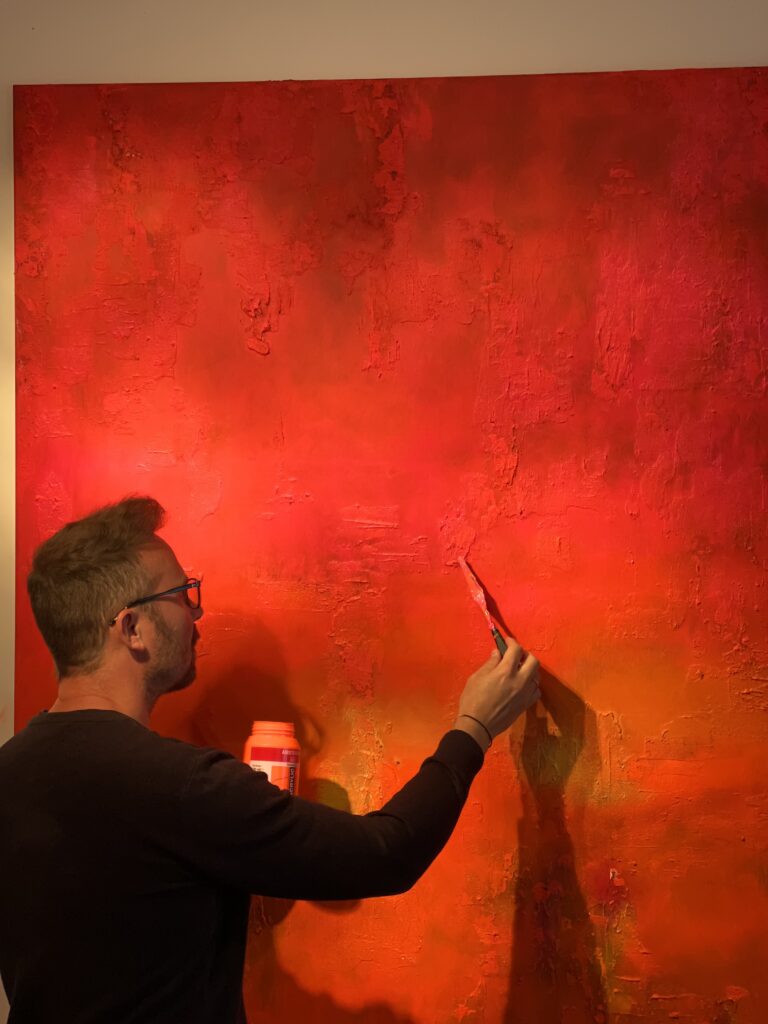
His canvases often large, textured, and deeply alive are built layer by layer, like rings in a tree. Each layer holds its own emotion, its own frequency, creating pieces that radiate warmth, movement, and unmistakable optimism. Colour is his native language: vibrant, bold, and full of emotional resonance. Through it, he offers a kind of light—joyful, grounding, and expansive.
In this conversation with Frank Janssens, we enter a practice where intuition leads, where colour carries energy, and where art becomes a form of healing not just for the artist, but for anyone who experiences it.
Can you share your background and how your life journey personal, professional, and creative eventually led you to becoming the artist you are today?
I’ve always been drawn to creating. As a child, I spent countless hours drawing, coloring, and experimenting with whatever materials I could find. I loved interpreting what I saw in my own way — adding color and emotion to the world around me. Later, when I started studying, art slowly moved to the background. It was only after finishing my first degree that I began experimenting again — mostly for myself, just to reconnect with that creative part of me. I tried different mediums, including oil paint, but at the time, it remained more of a personal outlet than something I pursued seriously. When I began studying osteopathy, creativity disappeared again for a while. And then, a few years ago, after buying and renovating our home, I told my husband that once everything was finished, I wanted to start painting again — this time to create works for our own space. That decision changed everything. I realized that, after all my studies and years of searching, something had been missing in my life — that need to create, to express. It’s something deeply rooted in me. Whenever I can channel that energy, whether through painting or other projects, I feel completely in flow. Over time, I found my language in acrylic paint. I love its immediacy and the way it allows me to work intuitively, sometimes adding touches of oil pastel to create more depth. On a personal level, I’ve been dedicated to self-development for over a decade — exploring who I am and what I want to bring into the world. I’ve discovered that I’m someone who naturally focuses on the positive, and I think that’s what my art reflects as well. Through colour, warmth, and movement, I try to share a sense of joy and optimism — to remind others of the light that exists within and around us.

Interestingly, you also have a background in osteopathy How does your medical or bodily awareness influence your visual language and your understanding of energy in art?
Yes, I graduated as an osteopath over fifteen years ago and have been running my own practice in Antwerp ever since, which I do with great dedication and passion. About five years ago, I gradually returned to creating my own artworks. The pace that followed, and the interest and demand from collectors, led me to decide a few years ago to treat patients only part-time, so that I could dedicate the rest of my time fully to my art — both creating and connecting with people who visit galleries or express interest in my work. Working as an osteopath has also influenced how I approach art. In osteopathy, you look at each person as a whole, analyzing how their body and life are interconnected. Through small techniques, you help restore harmony so that the body can function optimally and even heal itself. That focus on simplicity and balance is something I carry into my art. When I work on a painting, I try to think as little as possible and feel as much as possible — listening to what my body, and ultimately my soul, wants to express. Decisions about color, composition, and harmony emerge from that deep bodily and intuitive awareness. Over time, the more I follow my intuition, the more the work reveals itself. It’s about building something unique by syncing with feeling and energy. In many ways, it mirrors what I often tell my patients: learn to reconnect with your body, listen to it, and translate that awareness into action. In my art, I apply the same principle — feeling the energy within myself and expressing it on the canvas.
Your paintings are highly textured and layered. Could you walk us through the physical process of creating a piece, from the first gesture to the final layer?
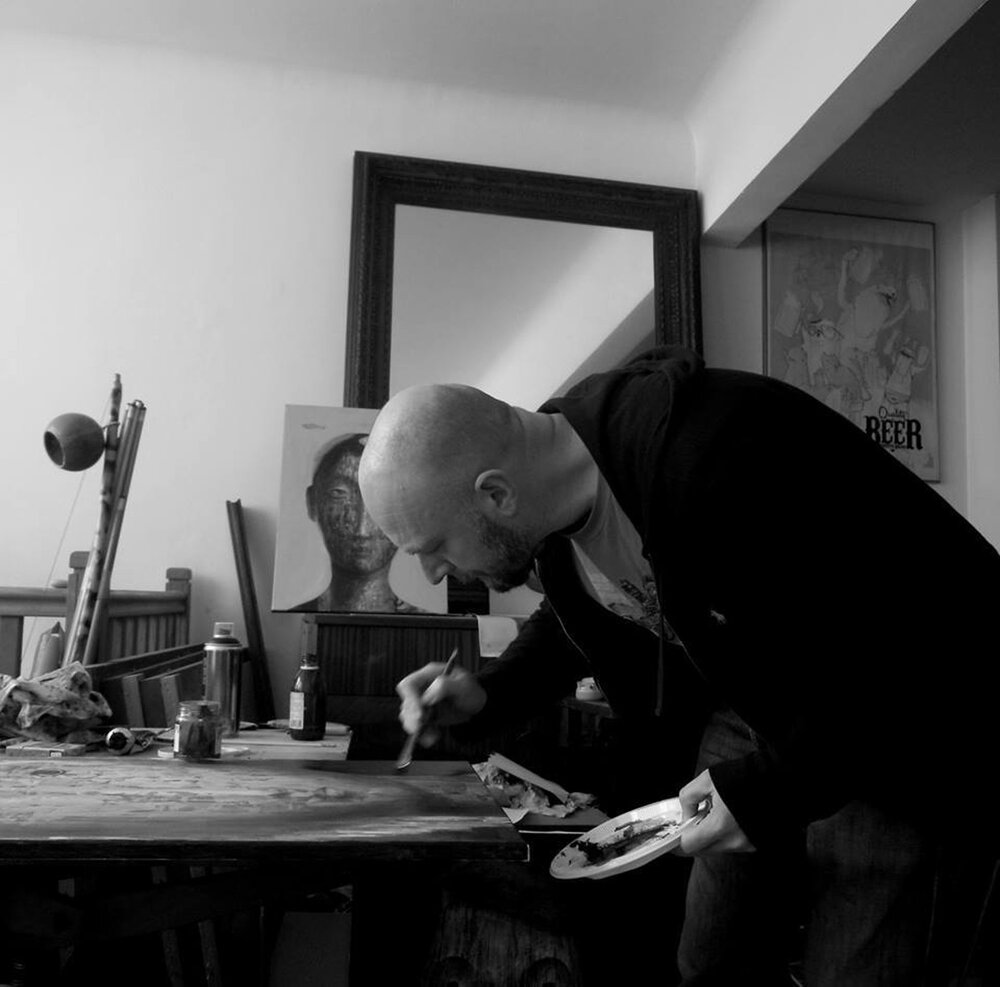
My creative process is very intuitive. It always starts with a feeling rather than a plan. I usually have a general idea of the color palette I want to begin with, but that doesn’t necessarily mean it will be the one I end up with. The piece itself guides me. I respond to the energy that comes from the canvas — it tells me in which direction to go. Layer by layer, the painting begins to take shape. I often compare it to the growth of a tree: each layer builds upon the previous one, forming something organic, alive, and unique. Every layer carries its own emotion and movement, and together they create a sense of depth and identity that makes each piece truly one of a kind. Because the process is so individual and responsive, it’s impossible for me to ever recreate the same work twice. I apply a layer, then step back to feel where the painting wants to go next. Sometimes I continue along the same palette, and sometimes I completely shift direction — it’s always a discovery. At a certain point, I can sense when a painting is complete. There’s no rational explanation for it — it’s purely a feeling. I’ve learned to trust that instinct, to stop thinking and let the body take over. For me, it’s all about disconnecting the mind and reconnecting to the body — listening, feeling, and allowing the work to reveal itself in its own time.
Many of your pieces are large-scale and immersive. How does working on such grand canvases influence your thinking and emotional engagement with the work?
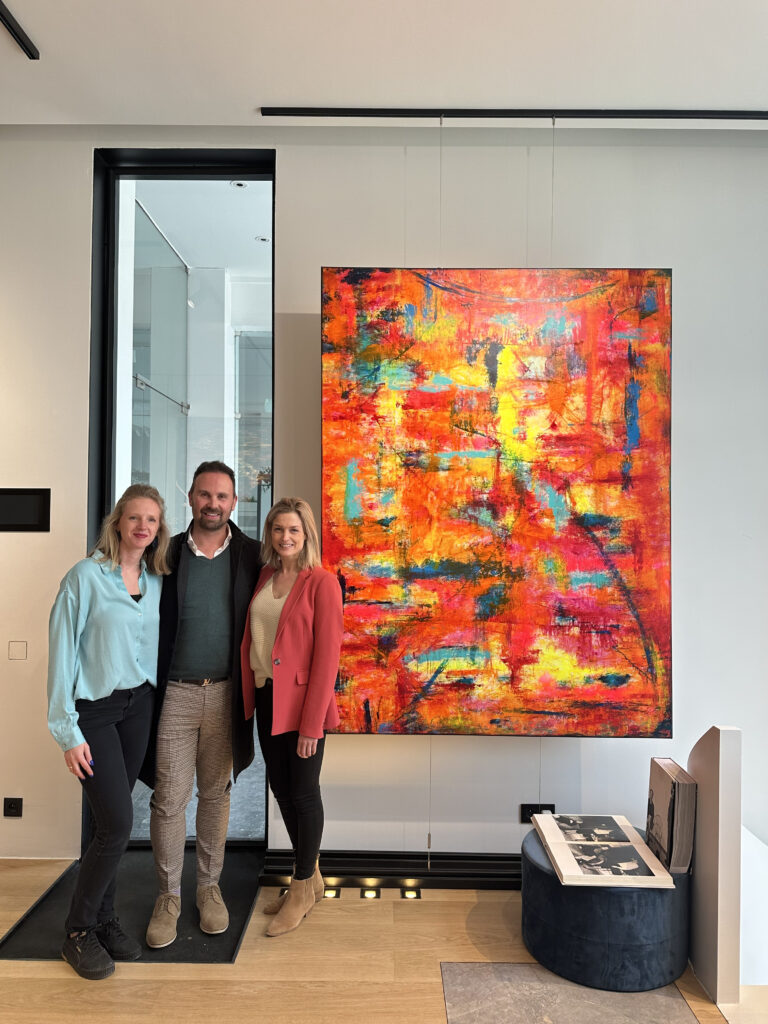
I’ve always been drawn to large canvases — it’s hard to explain exactly why. I simply feel that when the surface is too small, I can’t fully express what I feel. I need space — both physically and emotionally — to let my movements flow and to allow my emotions to unfold freely. Working on a large scale gives me a sense of freedom and openness. It allows me to move with my whole body, to step into the painting rather than just work on it. There’s something powerful about being surrounded by the colors and energy of a piece as it evolves. It becomes almost like a dialogue — immersive, physical, and deeply emotional.
How do you think about colour psychologically or symbolically when you create? Do certain palettes represent moods or states of being for you?
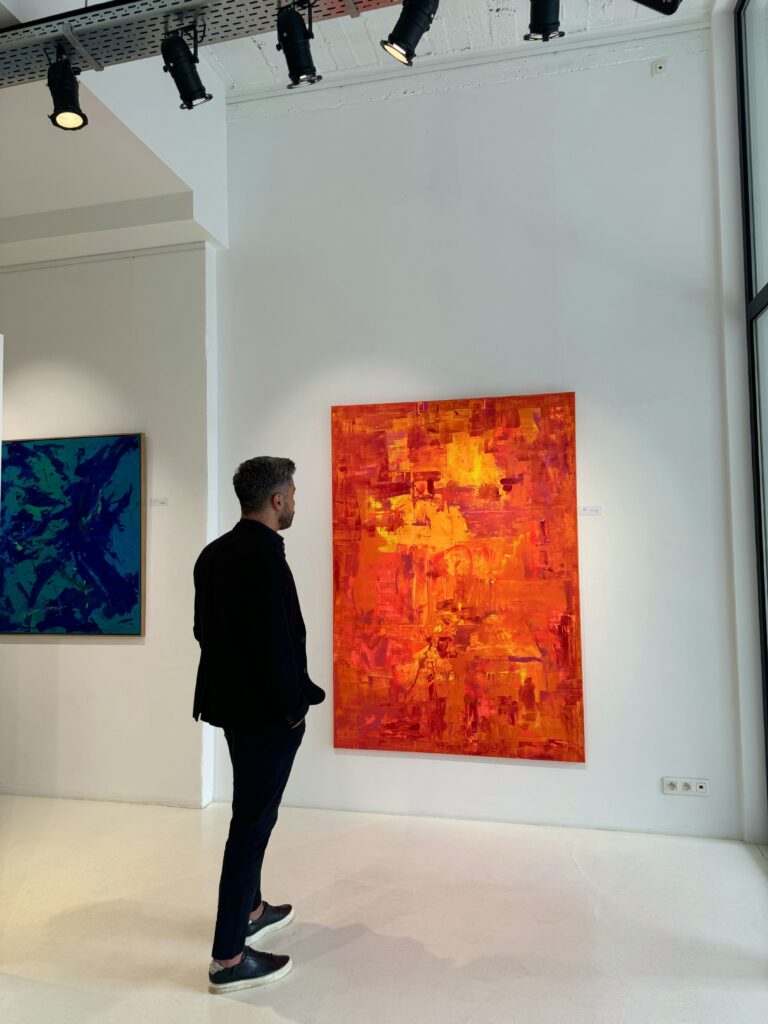
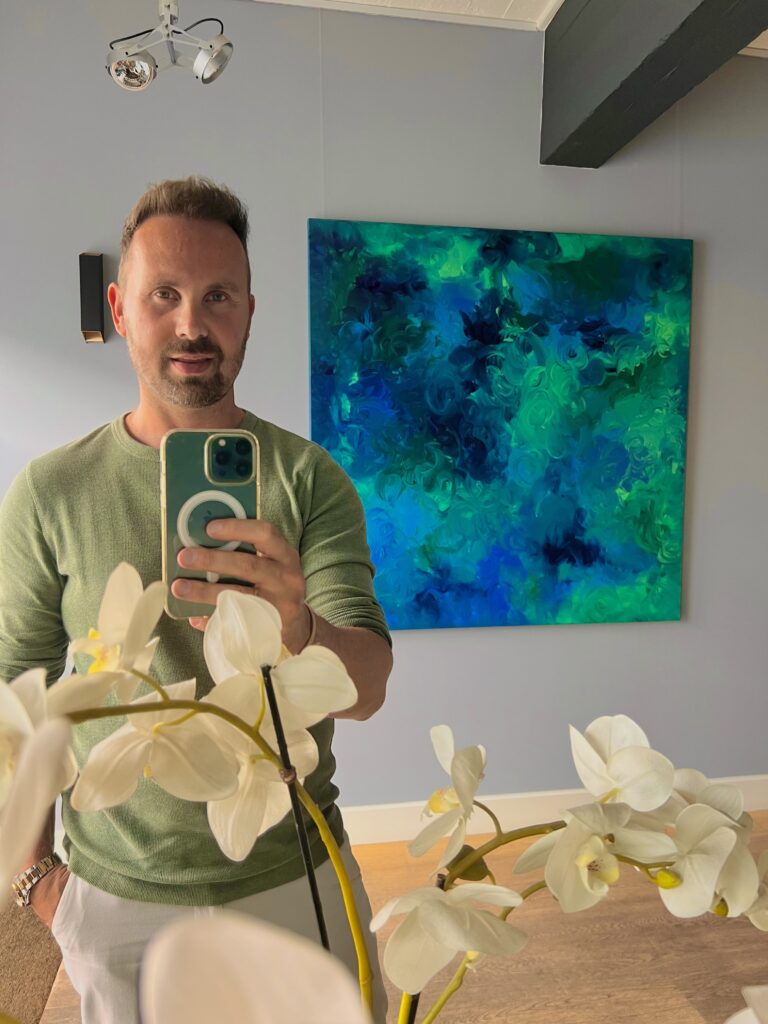
I believe colour has a strong influence — not only on me, but on everyone. I often notice how people are drawn to different palettes. Some are attracted to warm tones like red and orange, seeking a sense of vitality or warmth to bring into their space. Others feel more connected to blues or greens, which often evoke a feeling of calm or introspection. But I think these associations are deeply personal — colour resonates differently for each individual. When I paint, I don’t consciously assign meanings to colours. I let my intuition guide me. I simply feel what needs to emerge and how different tones interact with one another. Sometimes I choose harmony — colours that flow naturally together — and sometimes I seek contrast, like in my recent piece RAW, where vibrant orange and deep cobalt blue create a bold, energetic tension. For me, colour is essential. I’ve always said I could never work in black and white — colour carries emotion, life, and presence. It’s the language through which I express energy and feeling.
In today’s digital world, how has your relationship with your audience changed? How do you balance the spontaneity of physical painting with the constraints or opportunities of social media?
My relationship with my audience is very important, both on social media and in real life. About four or five years ago, I started engaging more actively online, and I’m still grateful to my husband for encouraging me to open my Instagram account — that’s really where it all began. From there, interaction with my audience grew quickly, and my social media presence developed strongly. I try to dedicate time daily, or at least every couple of days, to share glimpses of my art journey — what I’m working on in the studio, how a piece is evolving, and other aspects of my creative life. I believe that today, social media is an indispensable tool for artists. Beyond creating the artwork itself, it’s essential — especially if you don’t have a large team — to invest time and energy into communicating your work and building a direct connection with your audience. I’m deeply grateful that this platform allows me to connect directly with collectors, clients, and people who resonate with my work. At the same time, I try to maintain a careful balance: staying active on social media while remaining fully present in the studio, fully immersed in painting. It’s about finding harmony between sharing my journey and honoring the creative process itself.
Among all your works so far, is there one piece you consider a turning point where your understanding of your own practice shifted? What happened in that moment?
I would say that the creation of Phoenix, a large piece in warm tones of yellow, orange, and red, was a real turning point for me. When I completed it, I was honestly blown away that I had created it myself. That moment marked a shift in my practice and my artistic direction. With Phoenix, I let go of overthinking and fully trusted my intuition. It was a work created purely from feeling, without planning or restraint. After that, I felt more confident in following my instincts and letting my art unfold naturally. That piece really opened the door to a freer, more intuitive approach that has since become central to my work.
With abstraction, narrative is elusive. Do you ever use titles, stories, or prompts to guide interpretation? Or do you prefer the viewer brings their own narrative?
I always give each piece a personal meaning for myself, reflecting the emotions that emerge through the colors and style I use. But that’s mostly for my own guidance — to distinguish each work and give it its own identity. What I find most rewarding, however, is hearing the stories, emotions, and interpretations of the people who experience my art. Art, for me, is ultimately about individual experience. It starts with the unique perspective I bring as the artist, but every viewer interacts with a piece in their own way, based on their personal world and feelings. That’s what makes it truly alive and meaningful — seeing how each person connects with it in their own, unique way.
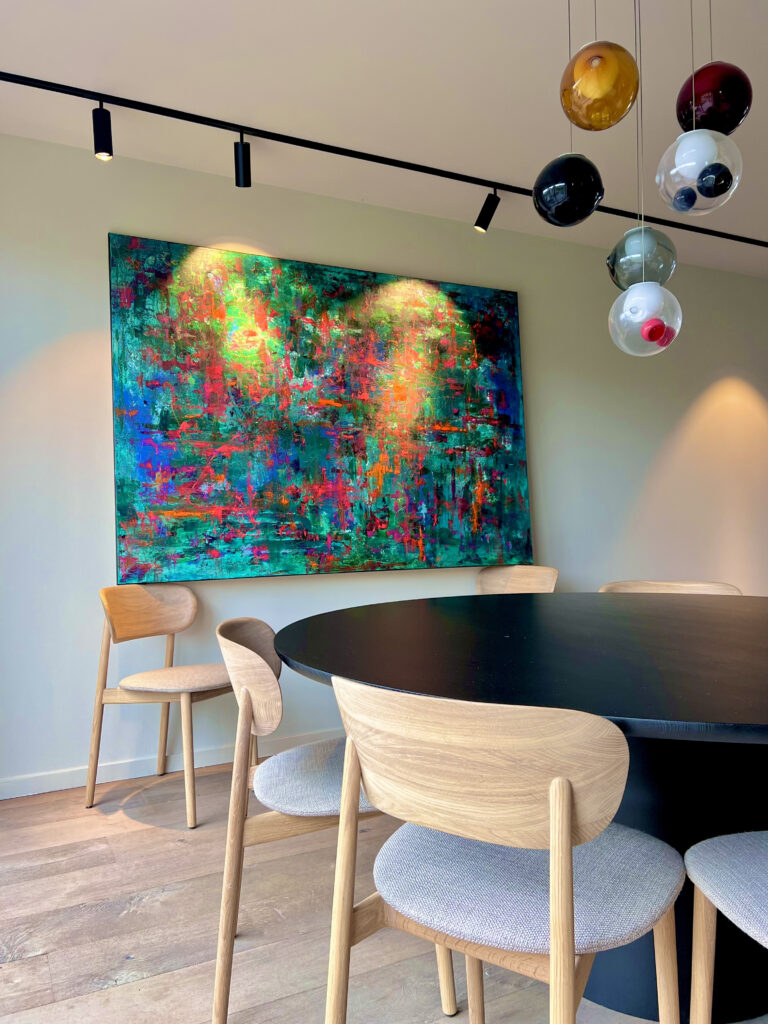
You sometimes envision your work in an interior while creating it (mentioned in your social posts). How much do you consider the eventual setting or viewer’s experience while making a piece?
When I envision a piece in an interior, it’s really guided by my own intuition and sense of the work. It’s more about exploring possibilities than setting anything in stone. Seeing a painting in a space can help viewers imagine the impact it might have — how it interacts with the room and the environment. It gives the artwork an added layer of meaning and helps people connect with it more vividly. However, this is just one of many interpretations a piece can have. It’s really just an example I use, not something fixed or rigid. Each viewer brings their own perspective, and that’s what makes the experience of the work so dynamic and personal.
When you look forward 5–10 years, what are the creative challenges or territories you want to explore that you haven’t yet?
That’s always a tricky question, because I like to leave it open — I let my art guide me and see where it takes me. I’m open to whatever comes my way. One goal I do have is to expand internationally, connecting with galleries that resonate with both my work and myself, and building meaningful, successful relationships. I want to reach more collectors so that my art can find its way into more spaces and homes. I also aim to continue challenging myself, exploring where my art can go in terms of style, originality, and the emotions it can evoke. For me, it’s especially rewarding when my work can bring joy or a positive feeling to people. Ultimately, I want to keep growing, experimenting, and discovering the possibilities within my own practice.
What advice would you give to emerging artists who want to create work that is deeply personal, emotionally resonant, and visually compelling?
My advice to emerging artists is to stay as authentic as possible in how you express yourself, how you create your art, and how you tell your unique story through it. Every artist has an audience; it may not always be easy to find or connect with them, but social media has made that bridge a little easier. For me, authenticity is what resonates most. There is only one you, and that uniqueness is what makes your art special. Embrace your individuality, trust your voice, and let your personal vision guide your creative journey.
Leaving our conversation with Frank, one thing becomes immediately clear: his work is not simply painted it is felt. His canvases come from the same place that guides his work as an osteopath: a deep trust in the body, in emotions, and in the subtle energy that moves through life. Frank doesn’t plan or map out his paintings; he follows feeling, letting colour and gesture grow naturally until the piece feels complete. That openness gives his work its warmth, energy, and unmistakable life.
Each painting invites viewers to slow down, breathe, and reconnect with their own inner world. His art reminds us that beauty doesn’t need explanation—only attention. In a world that rushes by, Frank’s work offers something rare: space, depth, and a chance to feel rather than overthink.
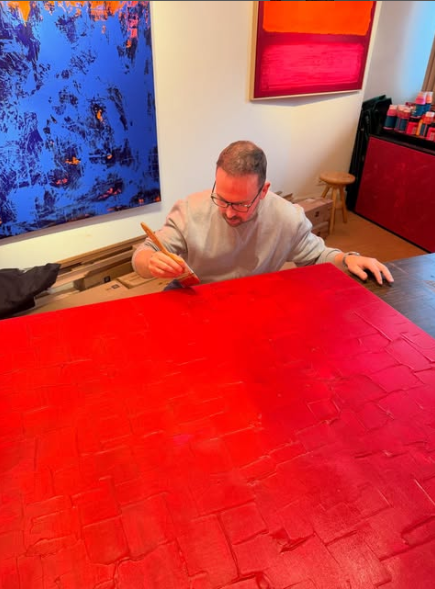
For Frank, painting is both freedom and alignment a way to honour the child who loved colour freely, and the adult who has learned to listen to the body’s wisdom. His journey shows what’s possible when we follow quiet impulses, trust intuition, and let creativity unfold naturally, layer by layer.
Follow Frank Janssens to experience a practice rooted in authenticity, feeling, and joy an artist who paints not just what he sees, but what flows through him, bringing light, energy, and connection to every canvas.