

Why This Artist Believes Vulnerability Is Her Superpower I Andrea Ehret

There is a quiet electricity in the work of Andrea Ehret a merging of breath, gesture, ink, and emotion that feels both intimate and expansive. Raised in Slovakia amidst forests, stones, and the poetic curiosities of nature, she grew up attuned to form and texture long before she had the language to name them. Her father uncovered beauty in the twisted grain of wood and the contours of rock; her grandmother spun worlds from stories. These early influences became the roots of Andrea’s inner landscape, a place where imagination was not an escape but a natural way of being.
This week, in our Best of the Art World series, we are delighted to share Andrea’s story, one shaped by deep attentiveness to the unseen currents of life. Prague became her artistic axis a city of mystery and lyricism where she now works within the atmospheric halls of the New Roman monastery. The creative community surrounding her has only intensified the sensitivity and clarity of her practice, allowing her to explore abstraction, calligraphy, and emotional resonance with increasing depth.
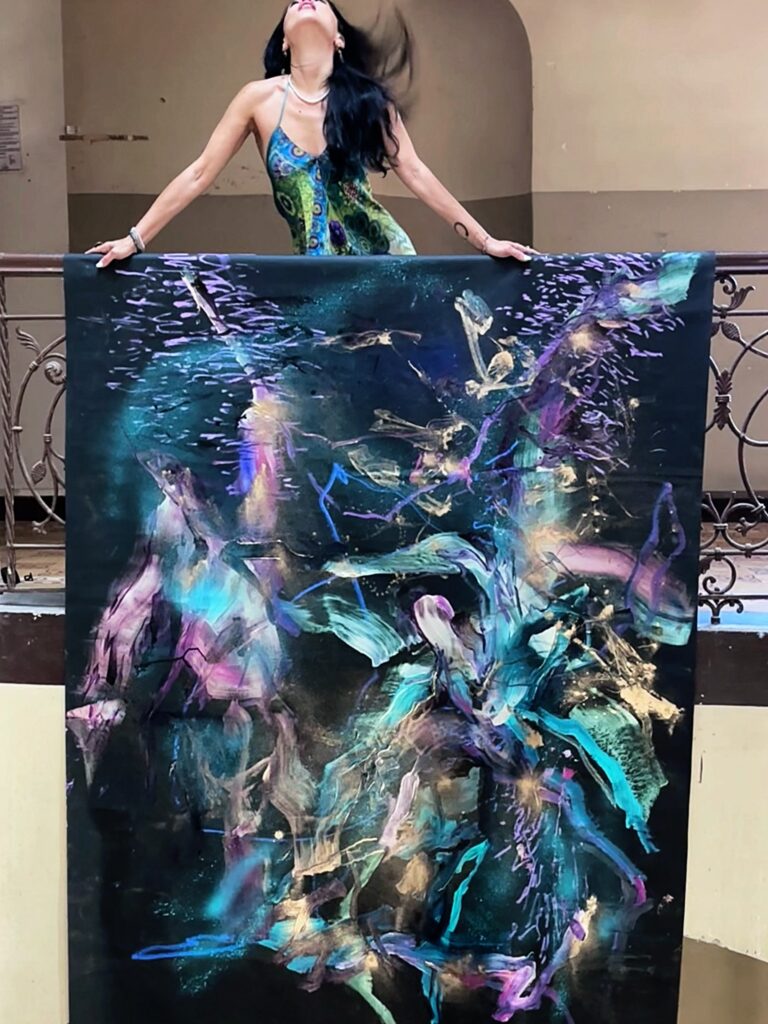
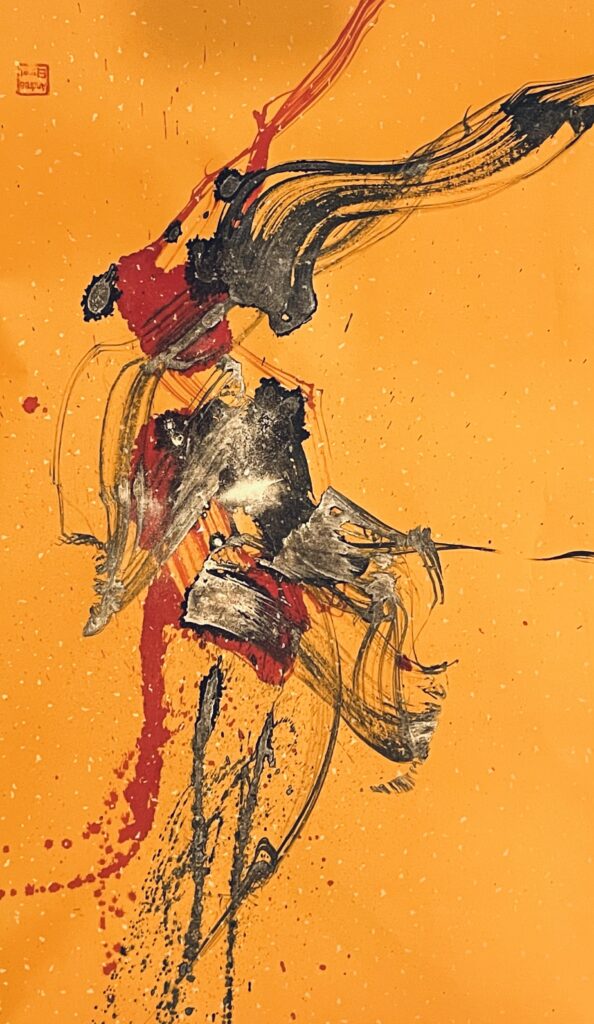
What makes Andrea’s paintings unmistakable is the sense of writing coursing through them, as though each stroke carries the weight of a poem. Calligraphy is not an influence for her; it is a language. Every brush of sumi ink, every sweep of her hand, becomes a meditation on presence, revealing the dialogue between light and shadow, inner tension and harmony, transience and stillness.
Motherhood further shaped her work, infusing it with tenderness and conflict, softness and strength. Her canvases hold the emotional residue of a life lived with awareness layered, intuitive, and unafraid to expose the delicate hinges of the human experience.
In our conversation with Andrea Ehret, we step into this profound interior world, where fragility becomes resilience, breath becomes gesture, and abstraction becomes truth made visible.
Can you tell us a little about your background and how your journey from growing up in Slovakia to living and working in Prague has shaped you as an artist?
I am very thankful I was raised by parents with an eye for beauty and a creative approach to life, my earliest memories are filled with explorations in the natural world. My dad’s love for discovering unique shapes in wood, rocks, and trees introduced me to the wonders of nature’s diverse forms and textures. This early connection to the outdoors, coupled with my grandmother’s enchanting storytelling, gave me a fertile foundation for my imagination. I was always encouraged to explore colors and experiment with paint from a young age, art became my refuge and self-expression, helping me process my emotions and bring my inner world to life. Prague is love, it is such an inspirational place to live, with all the magic and mystery, I love living and creating in Prague, I am fortunate enough to have my studio situated in New Roman monastery, where being part of large artist´s community is an inspiration itself.
Your work often explores themes of femininity, vulnerability, strength, and the fleeting nature of life. What first inspired you to work with these ideas, and how have they changed over time?
My work explicitly explores femininity, woman archetypes and polarities, celebrates the nuanced experiences that shape our identities. The initial spark was realizí vcéing that by embracing the fragility of our emotions, relationships, and our existence—we can actually unlock new realms of strength and resilience. Over time, this focus hasn’t changed as much as it has deepened, shifting from mere observation to an intentional practice that encourages myself and my audience to embrace stillness and appreciate the beauty in transience.
Calligraphy is an important part of your story. What drew you to it, and how do you bring that sense of writing and poetry into your paintings?
Calligraphy serves as a significant thread in my artistic narrative because its fluidity and grace, particularly the natural balance between darkness and light, resonate deeply with my exploration of life itself. It is my way of writing—my written language—that allows me to express the complexities of emotions and identity. I bring this sense of writing into my work through the very act of the stroke. Each stroke becomes a meditation, a reflection of my inner landscape, engaging in a dialogue with my own vulnerabilities and transforming them into visual poetry on the canvas.
Do you prefer to leave your paintings open for people’s own interpretations, or do you try to guide them with titles and details?
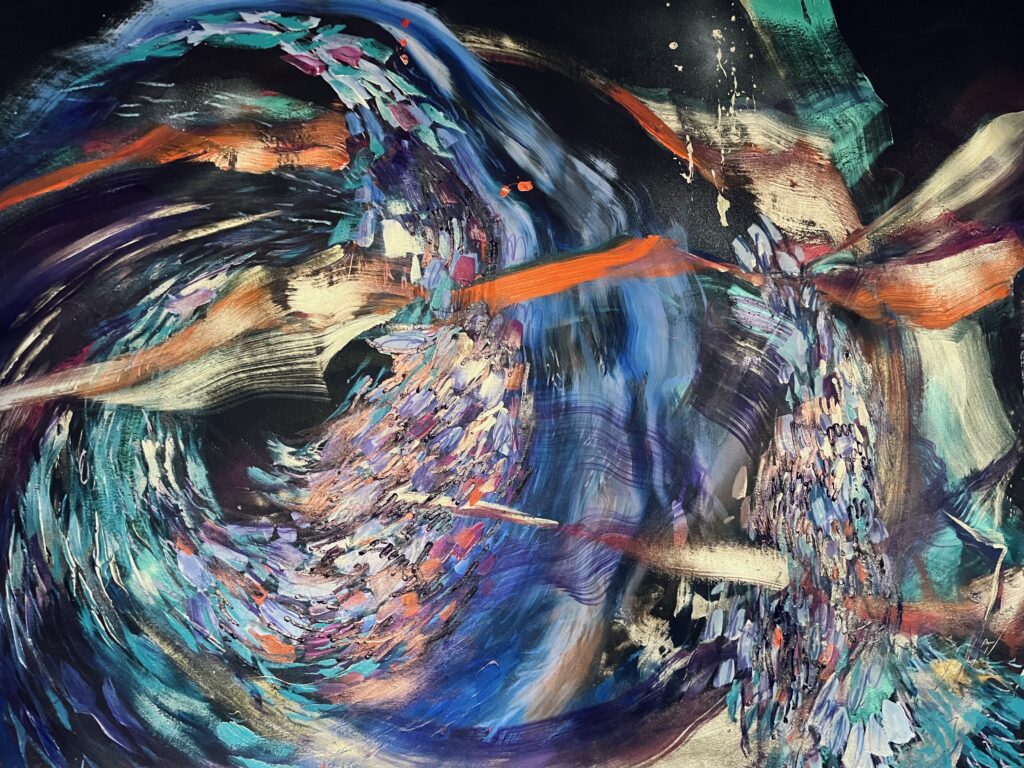
I aim to inspire the audience to observe the present moment with an intention. While I hope my compositions harmony guides them toward a feeling of peaceful equilibrium, I ultimately prefer the works to be open. By offering what I perceive as an energetic light and a more reflective shade, I want the viewer to find their own stories beneath the surface, mirroring the way life itself is comprised of an array of stories waiting to be told.
You’ve shared that motherhood influenced your work and even your techniques. How do your personal experiences shape your art today?
Yes, my personal life is the everyday source of material —sometimes conflicting—that coalesce in my abstract dreamscapes. Every piece is a testament to the fact that to be authentic and honest in your creation, you must continuously connect to yourself and conscious of your feelings and experiences. Motherhood undoubtedly made me not only better person but better artist too.

Since you describe painting as a meditative practice, do you follow any routines or rituals, or is your process more spontaneous?
The foundation is a contemplative present approach, which is a type of routine itself—a mindset of mindfulness. It all begins with the state of awareness , Especially while creating calligraphic pieces I connect with my breathing rhythm and the gestures are executed after deep focused moments.
You’ve shown your work internationally and built a strong presence. How do you balance sharing your art widely with staying true to your personal vision?
The balance lies in prioritizing the authenticity of the work first. As I’ve said, nobody is going to take away all the hours you spent in the studio working and it reflects how authentic your work is. We shall never forget that. Staying true to my personal vision is non-negotiable; it’s what ensures the work remains a genuine “expression of an inner world.” Opportunities to be seen and connect with an audience are vital, but they serve the art, not the other way around. Every chance to publish and connect is a good opportunity, but it’s the heart and honesty in the work that creates the impact.
You often explore light & shadow, inner states, flow, harmony, and tension. Which emotions or paradoxes do you find most compelling to express through abstraction, and why?
I find the paradox of fragility and resilience most compelling. Abstraction is the perfect language for this because it allows me to layer and juxtapose various materials and emotions. The canvas becomes a space where conflicting emotions can coalesce—the light and shade, the harmony and tension—reflecting the truth that beneath every surface lies a complexity. My expression of vulnerability is what ultimately helps to transform and heal.
When building layers in your paintings, do earlier layers guide later ones? Have you ever had to remove or change parts you thought were finished?
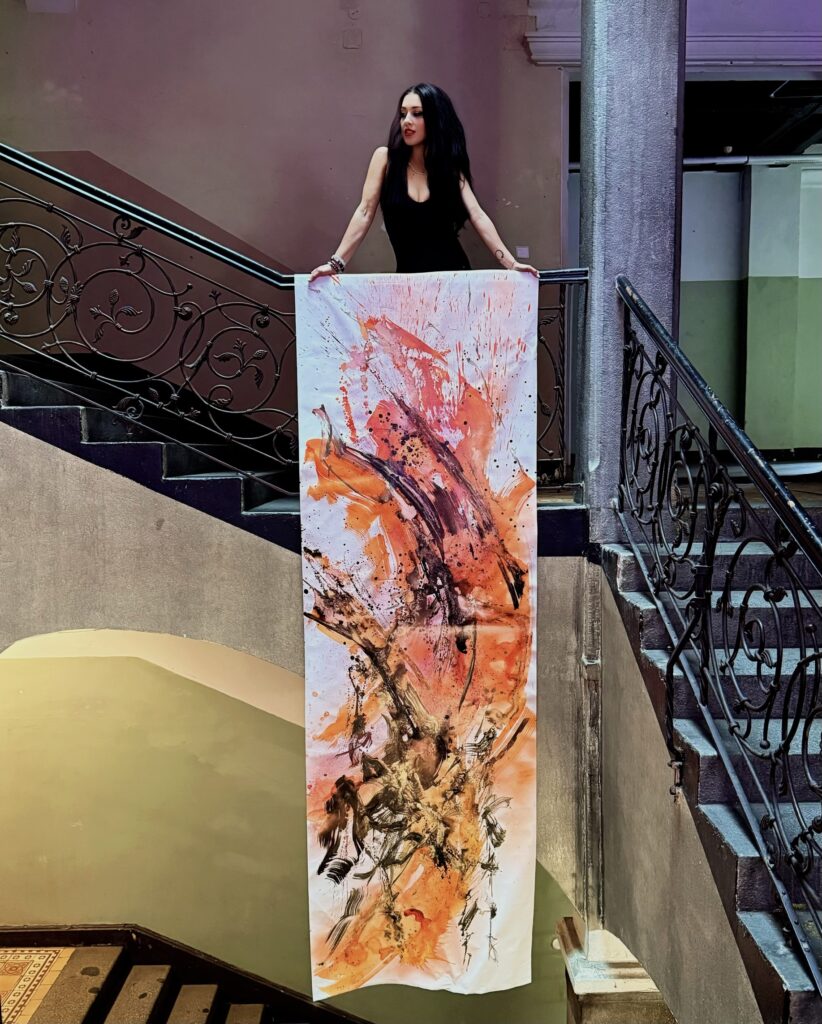
The multi-layered approach is central to my work—it mirrors the complexities of life itself. Yes, earlier layers certainly guide later ones; they are the foundation upon which the narrative of the painting is built. However, because the process is expressive and spontaneous, there is always a dialogue with the work.
Looking forward, are there new forms, scales, media, or collaborations you’re eager to explore beyond what you’ve done so far?1
My current focus is on my large abstract expressive mixed media works, which I was only able to create after establishing my atelier space in the Gabriel Loci monastery. While I deeply value this scale, I am always seeking ways to deepen the connection with the audience and the creative community. I am open to any meaningful collaboration- it brings me different level of joy, I often collaborate with my musician colleagues as my composer friend, Carmen Rizzo, also resident of Gabriel Loci monastery studios and my friends dancers , painters , sculptors. The mutual inspiration is beyond beautiful.
What advice would you give to emerging artists, especially in abstraction, about staying true to themselves and growing their practice?
In abstraction, your inner world is your greatest resource. Use intuition and expression not just as techniques, but as tools for self-transformation, because when you create with honesty and intention, you can touch lives in quiet but powerful ways. The most essential advice is to be authentic. The amount of time and passion you pour into your work will never remain unnoticed; it is in these quite moments you communicate within yourself and with your art. Do not rush anything but also do not hide your work in your studio.

As our conversation with Andrea Ehret comes to a close, her work becomes clear in its intent and feeling. She paints from within each layer revealing emotion, each gesture a breath, each canvas a reflection of vulnerability and strength. Her paintings live in contrasts: softness and power, stillness and movement, fleeting feelings and lasting presence.
Her calligraphic strokes read like quiet poetry, grounding her meditative process in both focus and freedom. They invite viewers to explore their own inner world, to notice the dance of light and shadow that exists in everyone.
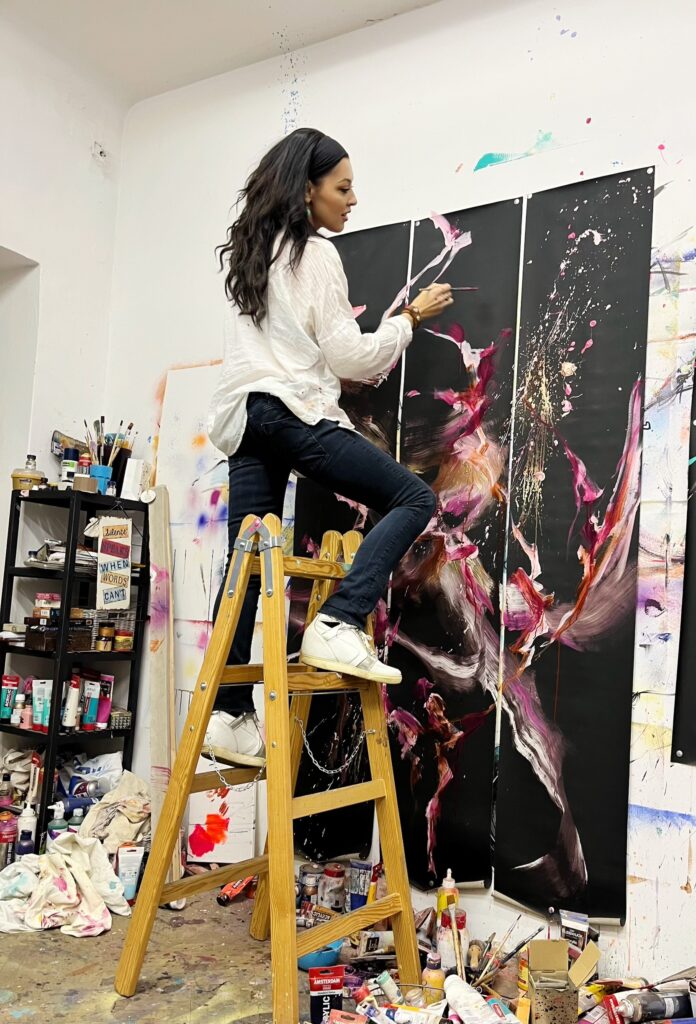
Even as her work reaches audiences around the world, Andrea stays rooted in authenticity. Being seen is important only when it honors the truth of the art. Her collaborations with musicians, dancers, and fellow artists in the monastery create a space of shared inspiration, where new ideas and energy continually flow.
Follow Andrea Ehret to witness how grace, abstraction, and emotion intertwine in works that feel less painted and more lived a testament to art as a form of meditation, truth, and luminous transformation.