






5 Kandinsky Paintings Every Art Lover Should Know

Color was never just color for Wassily Kandinsky, it was sound, motion, and emotion all at once. He saw hues the way composers hear notes, blending shapes and shades into something that felt more like music than painting. Every swirl seemed to hum, every burst of color seemed to sing. Long before anyone had words like “abstract art,” Kandinsky was already rewriting the language of what painting could be.
Born in Russia and trained in both law and music before turning to art, Kandinsky became one of the first true abstract artists. This pioneer believed that art could move people without depicting anything familiar. To him, color had a soul, and his brush was how he made it speak. He wasn’t painting what he saw, but what he heard and felt, translating emotion into line and rhythm.
His significance lies not only in his innovation but in the courage it took to trust intuition over imitation. In a world obsessed with representation, he dared to paint the invisible, the vibrations between sound and sight, chaos and calm. Kandinsky’s art opened the door for generations of artists to explore beyond the literal, proving that feeling could be form.
But his work isn’t something you simply admire, it’s something you experience. The way his compositions balance disorder and design, silence and color, logic and freedom, that tension is where his genius breathes.
These five paintings capture the arc of his vision. They’re not just famous works, they’re turning points , moments where abstraction found its voice. Each canvas marks another step in his quest to paint pure emotion, to make the unseen visible.
So whether you’re just discovering Kandinsky or have stood before his works feeling your heartbeat sync with their rhythm, this list will remind you why his art still feels electric. A century later, his colors haven’t faded, and neither has his ability to make us feel in ways words never could.
Composition VII (1913)
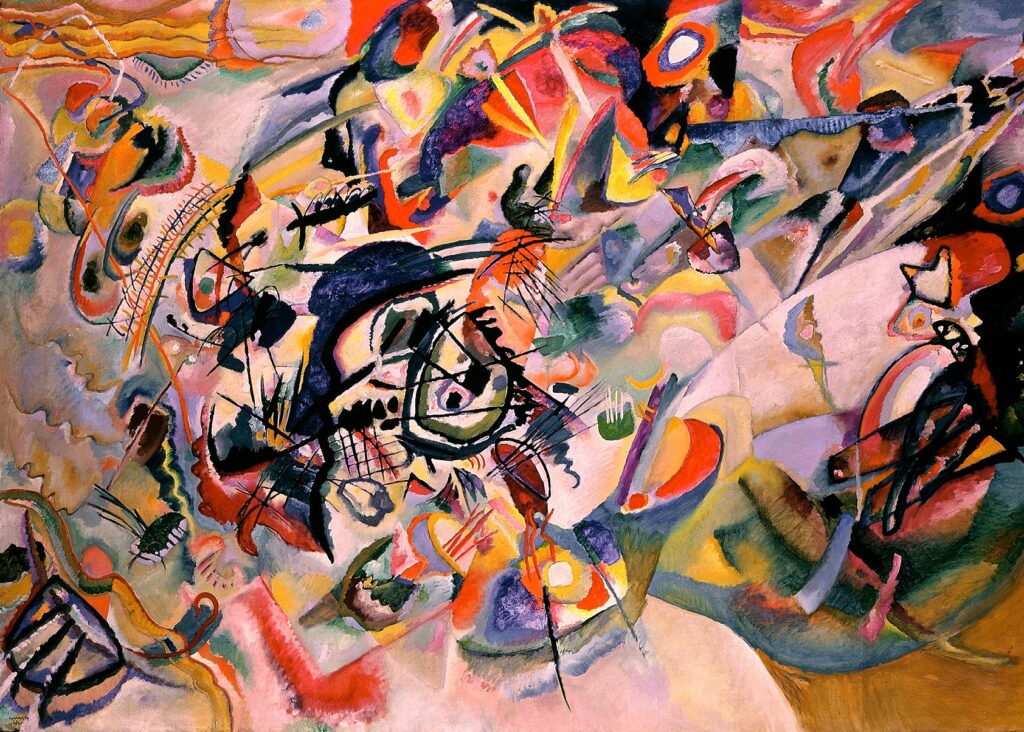
If Kandinsky ever had a masterpiece that screamed, “this is me at full power,” it’s Composition VII. It’s wild, unapologetic, and feels like it’s about to burst off the canvas. The first thing you notice is the chaos, color everywhere, forms colliding, no calm corner to rest your eyes. But the longer you stare, the more it all starts to hum in harmony. It’s like standing in the middle of a storm and realizing the wind has rhythm.
What makes this painting so unforgettable is how it captures movement without depicting a single thing. There’s no figure, no mountain, no object, and yet, it moves. Kandinsky believed colors and shapes could make you feel music, and Composition VII feels like a symphony turned visual. You can almost hear the drums in the reds and the violins in the blues.
Most people think abstract art is about “letting go,” but Kandinsky didn’t throw paint around randomly. This work was deeply structured beneath the apparent chaos. He made over thirty sketches before arriving at this final explosion. That’s what’s so fascinating, it looks spontaneous, but it’s carefully orchestrated emotion.
If you’ve ever had one of those creative moments where everything just clicks, where you stop overthinking and trust your instincts, that’s the energy this painting radiates. It’s creative surrender, but with purpose. Kandinsky was painting pure feeling, no filters, no explanations.
This is the kind of piece that teaches you something about bravery in art. It doesn’t care if you “get it.” It just is. There’s something liberating about that. It’s a reminder that sometimes, your best work won’t make sense to anyone but you at first.
That’s what keeps Composition VII timeless. It’s not a puzzle to solve, it’s an experience to feel. Once you stop trying to decode it, you start to see it. And maybe, in that moment, you start to see yourself a little clearer too.
Yellow-Red-Blue (1925)
If Composition VII was a storm, Yellow-Red-Blue feels like the calm that follows. It’s still bold, but more deliberate, like Kandinsky found a language for the chaos. Every color has its place, every line a purpose. There’s balance here, but not the boring kind. It’s balance with energy, the kind that feels alive.
The painting divides into two moods. On one side, cool blues and structured lines; on the other, warm yellows and circles that seem to pulse with light. It’s like logic and emotion trying to share the same canvas. You can almost feel them negotiating with each other.

What’s beautiful about this work is how it shows Kandinsky’s belief that colors have personalities. He thought yellow was lively and pushy, red was confident, and blue was spiritual and deep. Looking at this painting, you get it, he wasn’t just painting with color, he was painting through it.
It also marks his shift toward geometry and clarity. You can sense his Bauhaus influence creeping in, where he started exploring structure more seriously. But even then, his heart stayed lyrical. This wasn’t cold geometry, it was emotional architecture.
When you look at Yellow-Red-Blue, you can almost feel your own brain syncing to it. It pulls your focus, then relaxes it, like a visual breathing exercise. Kandinsky might’ve been one of the first artists to show that abstraction could be meditative.
It’s the kind of painting that makes you slow down and notice how you feel instead of what you see. And maybe that’s what makes it so special, it doesn’t shout; it whispers. But somehow, that whisper stays with you long after you’ve looked away.
Composition VIII (1923)
Composition VIII feels like the moment Kandinsky met math and decided they’d make art together. Circles, triangles, lines, it’s a playground of geometry. But there’s nothing mechanical about it. Each shape feels alive, like it’s part of some cosmic choreography you can’t fully decode but love watching anyway.
This painting shows a different kind of control. Gone are the wild swirls and emotional brushstrokes of his earlier work. Here, he’s precise, intentional, and almost scientific in how he arranges everything. It’s structure with soul.
Kandinsky once said he wanted to paint “inner necessity,” and that’s exactly what this feels like. The work has logic, but not the cold kind, it’s intuition turned mathematical. You can sense he’s chasing harmony, not perfection.
There’s a quiet playfulness here too. Those tiny circles and intersecting lines feel like they’re in conversation, bouncing energy back and forth. It’s almost musical in rhythm, like each shape is a note in an invisible score.
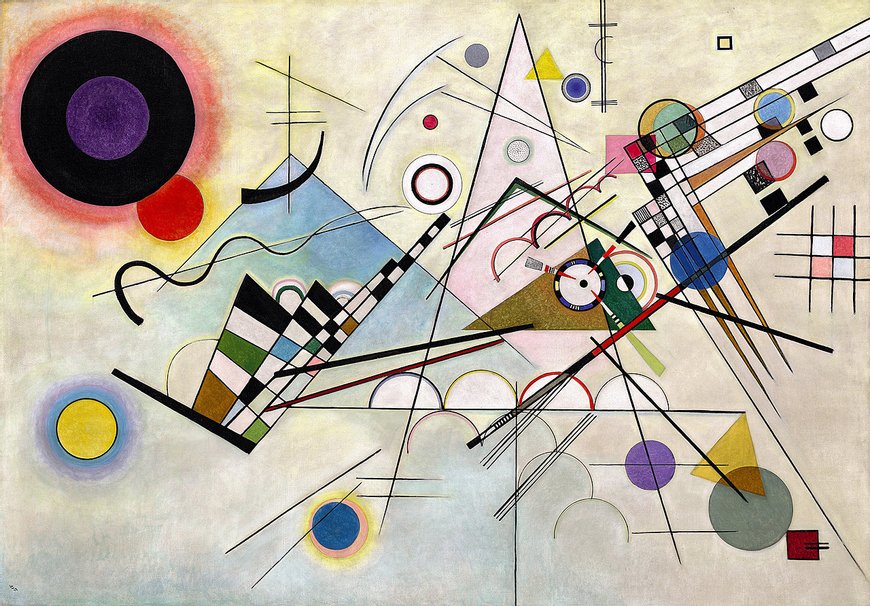
What’s so striking is how timeless it feels. Nearly a century later, it still looks like something out of a digital design lab. That’s how forward-thinking Kandinsky was, he painted like he’d already seen the future of abstraction.
This piece is proof that simplicity doesn’t mean emptiness. Sometimes, it’s what you leave out that gives the work its pulse. Kandinsky knew when to stop, and that’s an art form in itself.
Improvisation 28 (Second Version) (1912)
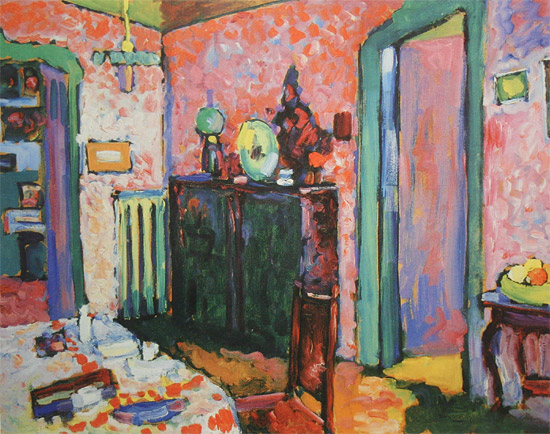
You can almost feel Improvisation 28 vibrating. It’s raw, emotional, and looks like Kandinsky just poured his subconscious straight onto the canvas. There’s urgency in every stroke, as if he couldn’t paint fast enough to keep up with what he was feeling.
At first glance, it’s chaos. Then you start noticing forms that might be waves, mountains, or figures, nothing defined, but everything hinted at. It’s abstraction before abstraction had rules, back when it was still brave and wild.
What’s powerful about this painting is that it captures a time when Kandinsky was still learning to trust the unseen. He was moving away from representational art, experimenting with the idea that color and form alone could express emotion. That was radical in 1912.
There’s also something deeply personal about it. He painted this around the time of political and social upheaval in Europe, and you can feel that tension, the push and pull between destruction and creation.
Every brushstroke feels alive, like thought made visible. It’s not tidy, it’s not polite, but it’s true. And maybe that’s why it still hits so hard today, it reminds you that creativity isn’t always comfortable. Sometimes it’s messy, loud, and full of doubt, and that’s exactly what makes it real.
Improvisation 28 is a painting you don’t just look at, you feel through. It’s a reminder that the best art doesn’t explain itself, it invites you to meet it halfway.
Several Circles (1926)
If Composition VII was chaos and Composition VIII was structure, Several Circles feels like peace. Just circles, floating in deep black space, glowing like planets in orbit. It’s quiet, deliberate, and somehow cosmic.
What’s amazing about this painting is how simple it looks at first, and how infinite it starts to feel once you really stare at it. Kandinsky said that “the circle is the most peaceful shape,” and you can sense his calm here. It’s still abstract, but it feels spiritual, like he’d found a kind of visual meditation.
The colors aren’t shouting anymore; they’re whispering. Each one has its place, its relationship to the others. It’s less about energy now and more about balance, presence, being. Kandinsky was evolving not just as an artist, but as a thinker.
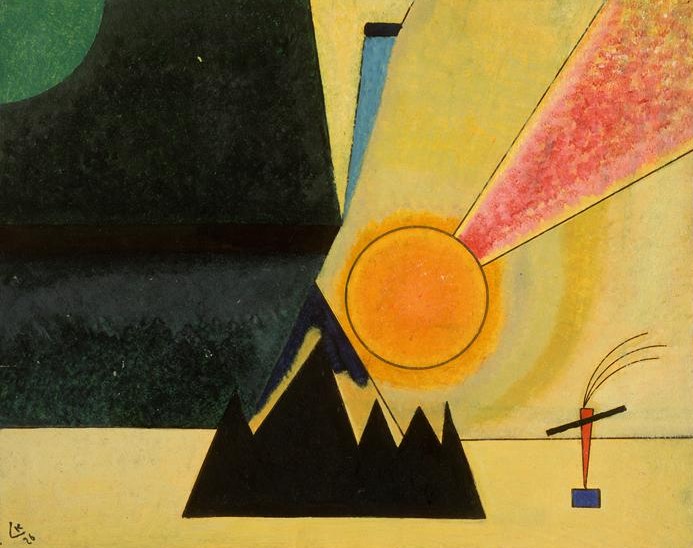
You could say this was his version of finding silence after the noise. He was still exploring how shapes could carry emotion, but now it was quieter, more intentional. There’s beauty in that restraint.
When you look at Several Circles, it almost feels like time slows down. The composition pulls you in without force, just gravity. It’s abstract art at its purest, a conversation between light, form, and feeling.
It’s the perfect reminder that sometimes the loudest statement an artist can make is through quiet confidence. You don’t have to fill every space to make something powerful. Sometimes, leaving room to breathe is what gives it life.