
This Artist Blends Observation and Imagination Effortlessly I Vanessa Van Meerhaeghe

At Arts to Hearts Project, we love celebrating artists who challenge our ways of seeing and bring fresh perspectives to contemporary culture. Through our Best of Art World series, we celebrate the voices shaping today’s creative landscape those who push boundaries, tell meaningful stories, and remind us of the power of art to connect us all.
This time, we had the pleasure of speaking with Vanessa Van Meerhaeghe, an artist whose work turns patterns, colours, and forms into intimate, living narratives. Her paintings balance precision with spontaneity, capturing moments that feel suspended between motion and stillness.
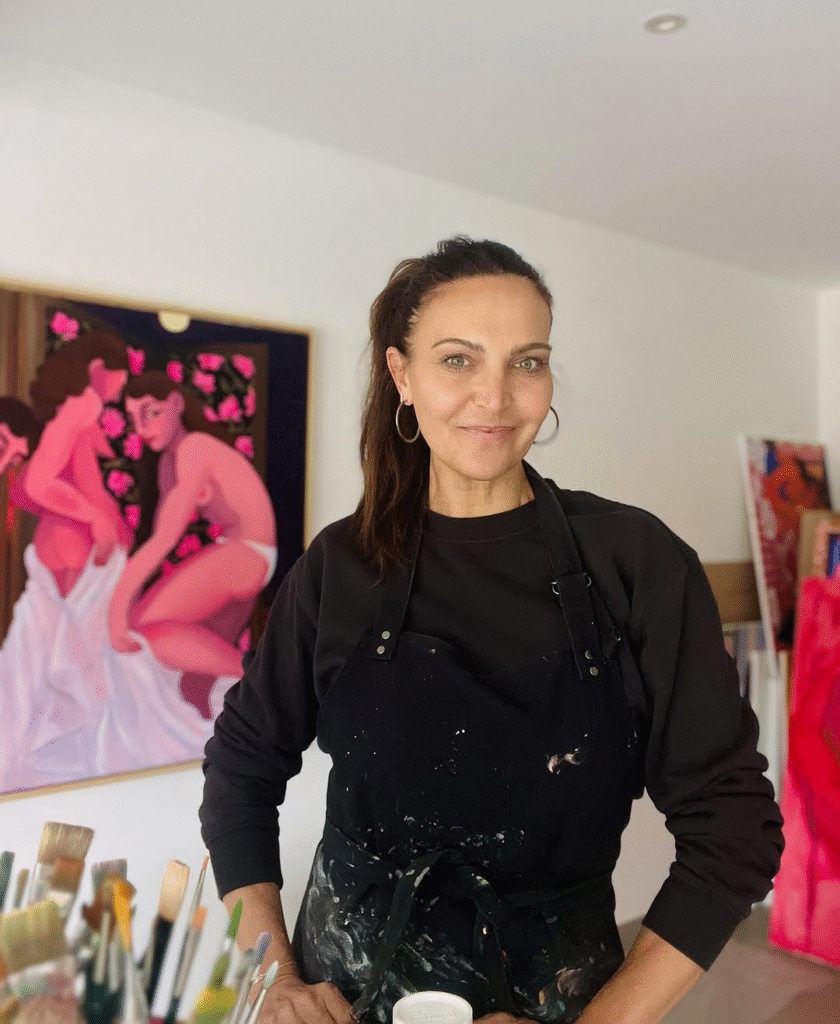
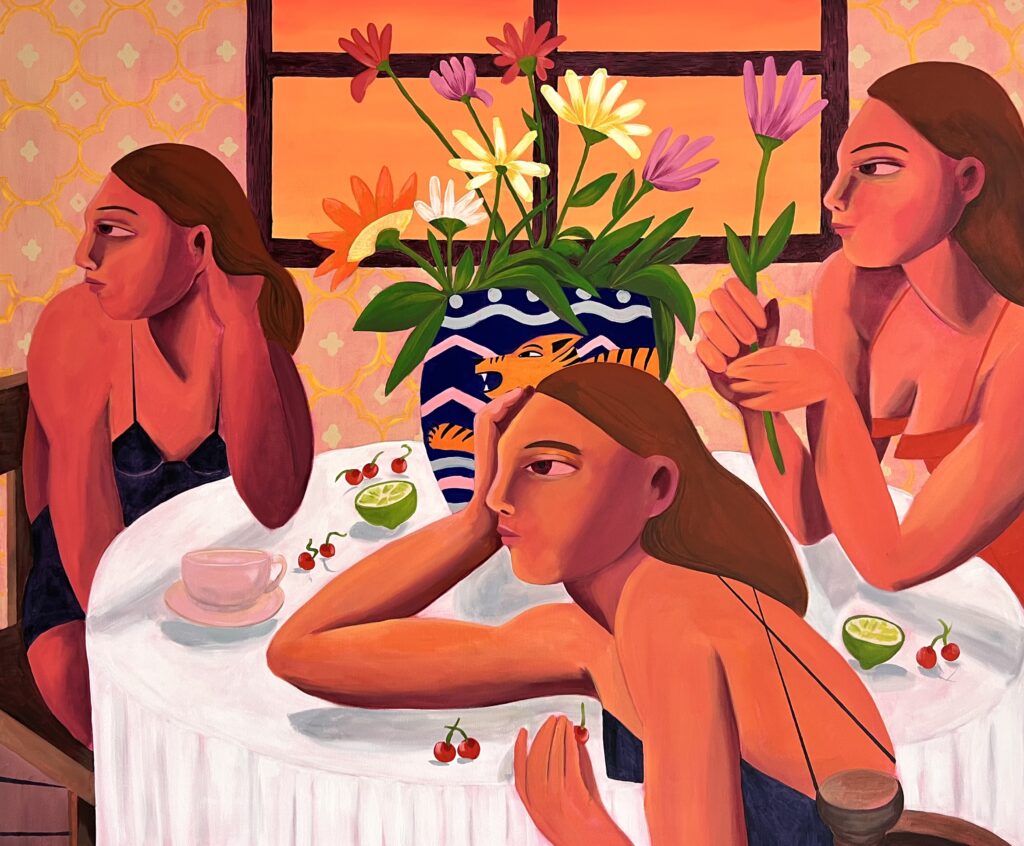
Influenced by textiles, fashion, and the poetry of everyday spaces, Vanessa creates worlds where bold palettes and striking patterns become part of the story. Her use of repetition and rhythm encourages viewers to slow down and stay present, finding layers of meaning in each piece.
Building an art practice is never easy, yet Vanessa has crafted a space for her voice to flourish. Her exhibitions and features have drawn the attention of collectors and curators who recognize the depth, honesty, and originality in her work.
Let’s step into her world and get to know Vanessa more closely in this interview.
Vanessa, you transitioned from a long-time career in fashion design to full time painting. Can you share what inspired this major creative shift?
It was a very organic shift. For years, while working in fashion, I kept illustrating for magazines and painting in my own time. I was always drawn to the human figure what began as fashion silhouettes gradually grew into complete scenes, with their own characters and moods. Little by little, painting took up more space in my life. It still carries the patterns, textures, and colours from my fashion days, but now those elements serve the stories I want to tell, rather than the other way around.
How did travel and immersion in nature awaken your relationship to colour, pattern, and form?
Travel and being in nature change the way I look at things. In the studio I control the process, but outside I notice how colour, pattern, and form work naturally, without anyone planning them. Nature is one of my main suppliers of colour, but also of beauty, and I like giving that a place in my work. You can stand in the same spot and see different colours, patterns, and shapes depending on the time of day or season. And in a different location, the whole mood changes. Those shifts influence how I combine colours and patterns in my paintings.
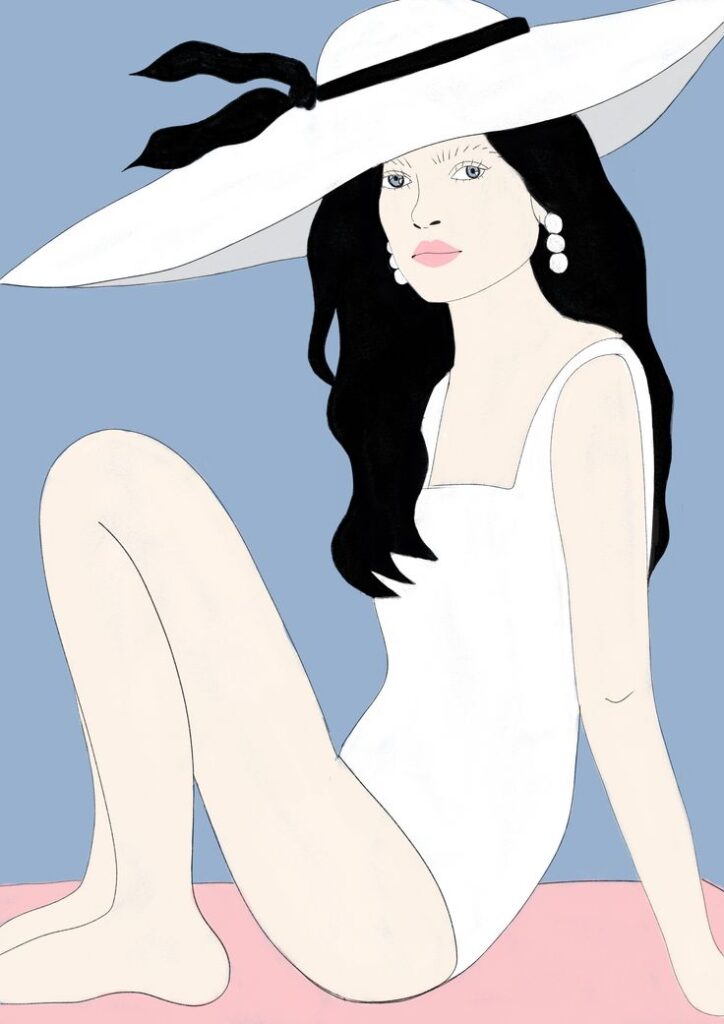
Your portraits often feature women amid bold, patterned environments. What do they signify?
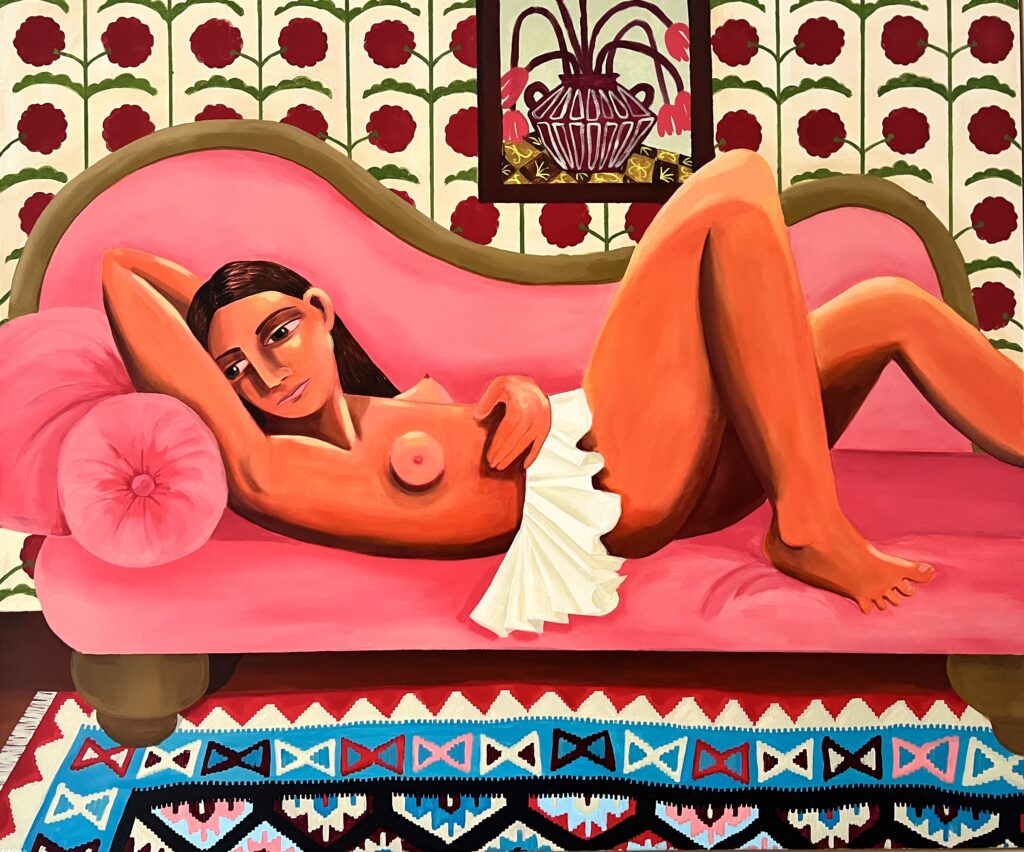
The patterns and settings come from a long-standing love of textiles, something I carried with me from my years in fashion. I like the feel of fabric, the structure it can give, and how a pattern can set a mood. In my paintings, it’s more than decoration—it connects to my background, but it also builds atmosphere, adds rhythm, and sometimes hints at the story behind the figure. They’re part of how I shape the scene, not just fill it.
How do you choose palettes to suggest mood, movement, or narrative?
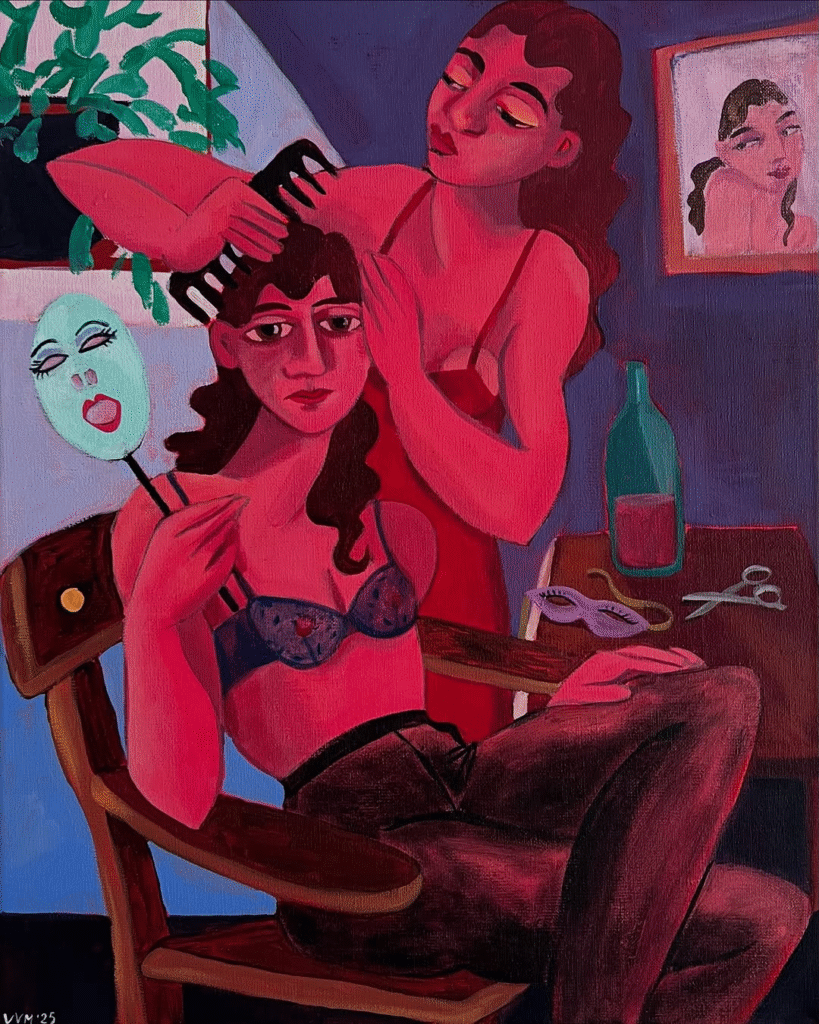
I usually start with an underlayer of colour to set the mood I want. For warm scenes, that’s often a bright red—it gives the painting energy right from the start. Or yellow if I’m aiming for a sunny, glowing atmosphere. I also have a soft spot for pink—it finds its way into many of my paintings, sometimes boldly, sometimes more quietly. The smaller works are often try-outs for colour combinations I might use in larger paintings. From there, I build the palette around the atmosphere I’m aiming for. Sometimes I use strong contrasts to create movement, other times I keep the tones closer together to make it feel more intimate. The palette has to fit the character and the scene, and even if nothing is moving, colour can still make the image feel alive.
You’ve exhibited in Belgium and across Europe, and your illustrations appear in Marie Claire, Esquire, and Milk magazine. Is there any particular one that has left a long-lasting impact on you?
There isn’t just one. It’s more of a cross-pollination—things feed into each other over time. An exhibition might push me to think bigger, while an illustration job sharpens my eye for detail and for narrative. It’s more direct and less subtle than my paintings, because I’m starting from a text that already exists and translating it visually. It’s a completely different approach, and I enjoy all aspects of both.
Are your works mostly autobiographical or observed and imagined based on social realities?
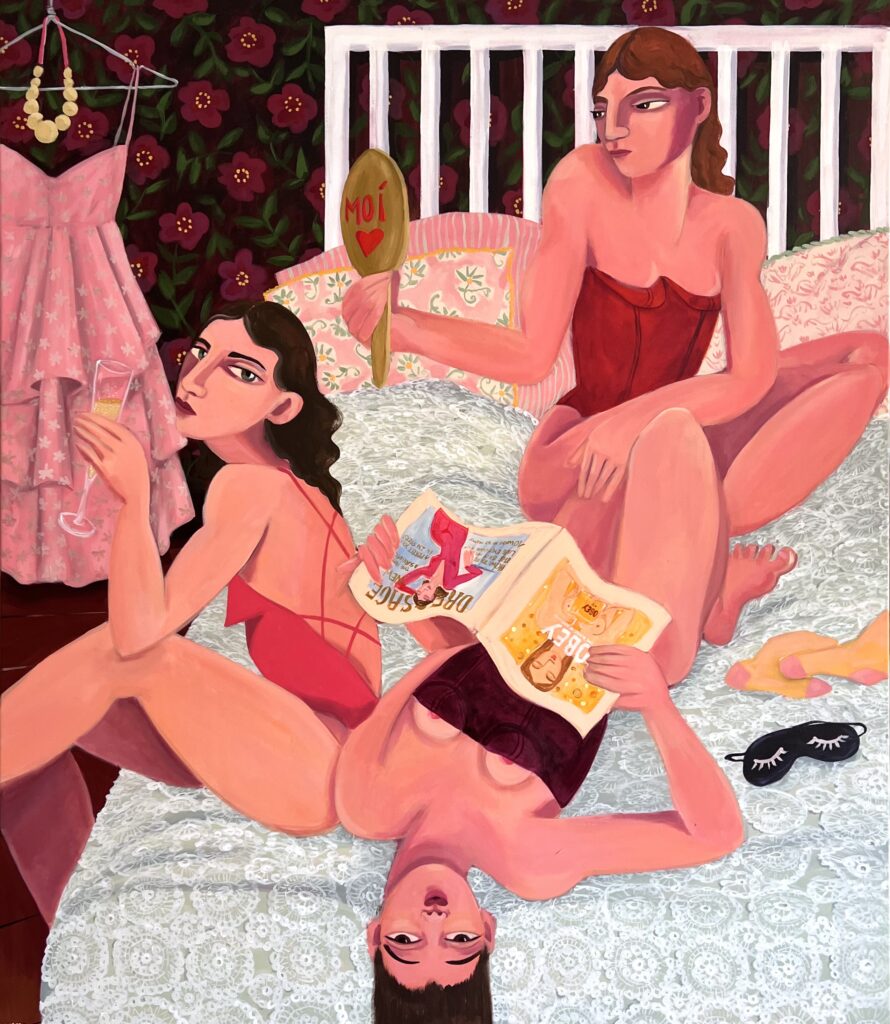
They’re not autobiographical in a literal way, but my perspective is always there. Even when the scene is imagined, it comes through in the way I compose it, the details I choose to include, and the balance between figure and environment. I combine observation, imagination, and elements of personal experience. Social realities often play a role, but I’m not pointing fingers it’s more about questioning them or simply noting they exist. And there’s usually a bit of humour or a wink, so it never becomes too heavy.
You describe your art as storytelling that is bold yet intimate. How do you expect your viewers feel – intrigued, seen, comforted, challenged?
I like my work to be layered. At first glance you might see a colourful, cheerful scene, but if you stay with it a little longer, small frictions or things that don’t quite fit start to appear. I enjoy that mix—it’s never only lightness, and it’s never only serious. There’s usually some humour or a wink in there too. I don’t expect one fixed reaction; some people are drawn to the colour and patterns, others pick up on the tension. I like it when people recognise something of themselves in the scene—that moment of ‘oh yes, I know this’. And it’s always interesting to hear how differently people read the same work.
If your studio had a signature soundtrack, what energy would fill the room while you painted?
If my studio had a soundtrack, it would shift between calm and chaos—some days it’s neat and focused, other days it’s a riot of colour, brushes, and half-finished ideas. The actual music changes just as much. Often the radio is on, sometimes it’s 80s or 90s tracks I know by heart and sing along to, other times it’s classical music or film scores. Whatever it is, it sets the pace for the day, whatever project I’m working on.
Do you face creative blocks while working on a piece? How do you overcome them?
Yes, of course it happens. Often, it’s about the colour palette: it has to feel right, and sometimes I just can’t see it for a while. Or I’m stuck on finding the right details to complete the scene. When that happens, I step away and work on something else—often a smaller piece or an illustration and there’s always the admin pile. That shift in focus keeps me moving and usually gives me fresh eyes when I come back. I work on different things at the same time large paintings, smaller works, illustrations so if one is stuck, I can still make progress on another. Sometimes I push through even if it’s uncomfortable, because solutions often show up while you’re in the middle of the work.
What would you advice young emerging artists trying to carve a niche for themselves?
I’d say: stay close to yourself your identity, your background, and the subjects that matter to you. Don’t follow trends; they come and go, and they’ll pull you away from what makes your work yours. Keep making and showing your work, and seek constructive, critical feedback from people whose opinion you respect. And be prepared for all the other parts of the job too there’s plenty of admin and organisation alongside the painting.
As we close our conversation with Vanessa, we’re left with the rhythm of her patterns, the glow of her colours, and the quiet humour woven into every scene.
Her paintings invite us to linger a little longer to notice the balance between playfulness and depth, between stillness and motion. Vanessa’s journey reminds us that art is not just about creating images but creating spaces where people can see themselves, reflect, and feel.
Stay connected with Vanessa and follow her work as she continues to transform colour, pattern, and memory into stories that stay with you long after you’ve stepped away.