

Beyond the Static Canvas: An Perspective on Anton’s Journey Through Shifting Realities

In the realm of contemporary art, few practices bend reality quite like Anton’s Progressive Multipaint technique, a groundbreaking method where a single surface holds multiple artworks, revealed or concealed depending on the light. As a self-taught Greek artist, Anton merges technical innovation with deep cultural roots, bridging pop culture, abstraction, and classical sculpture in ways that invite viewers into shifting dimensions. His paintings transform before your eyes, while his sculptures channel the spirit of Ancient Greece into a modern dialogue. In this conversation, Anton shares the curiosity that sparked his journey, the freedoms of forging his own path, and the rituals, inspirations, and experiments that keep his work alive and evolving.
Hi Anton, can you tell us more about the Progressive Multipaint technique and how did your journey begin?
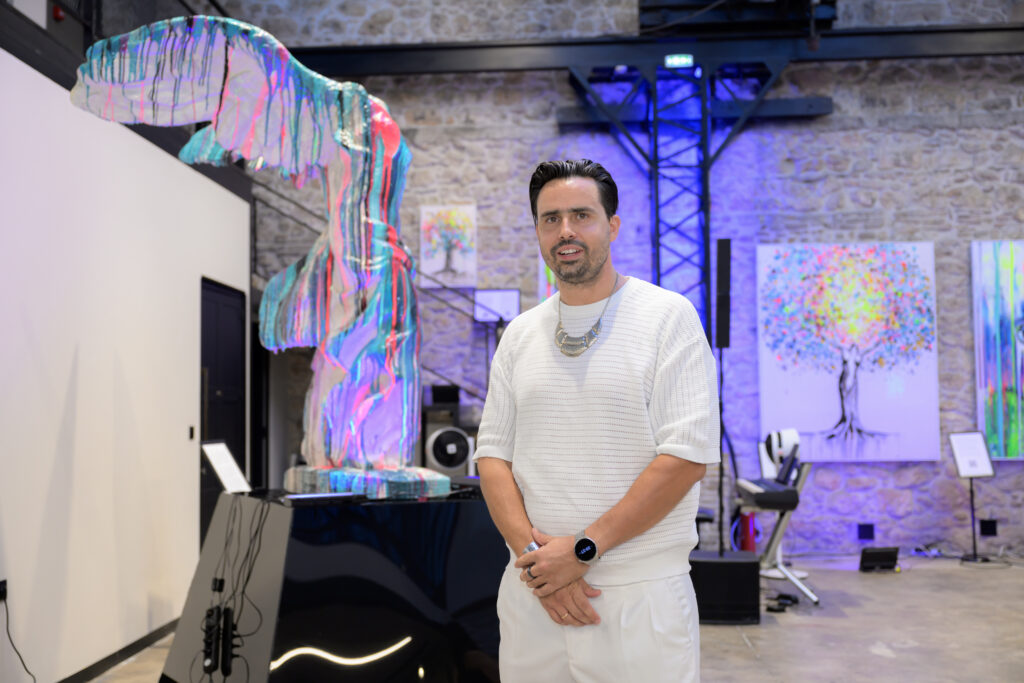
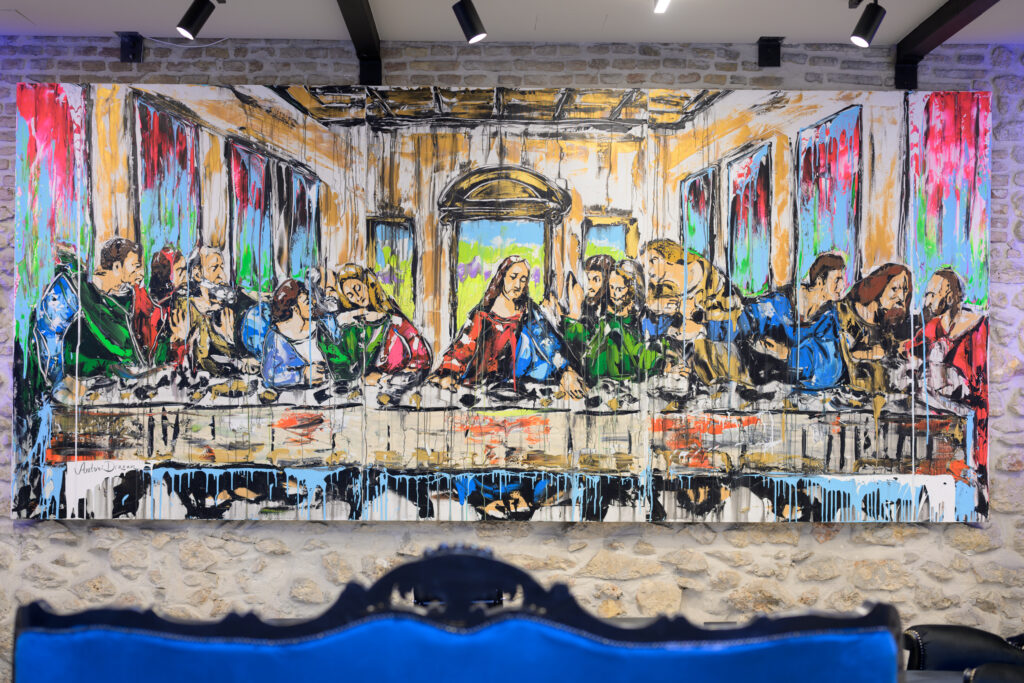
Hi, and thank you for inviting me into the Arts to Hearts space where creativity and community meet. it’s a pleasure to share my journey with you. The progressive multipaint technique is a unique method I developed where multiple artworks appear on the same surface, shifting depending on light conditions. It’s like hidden dimensions emerging under specific lighting what you see can completely change with a simple adjustment in the environment. This technique is rare, and to my knowledge, it’s unlike anything else practiced worldwide. My journey began from a desire to break static boundaries in painting. I was curious about how art could evolve in real time, not just through perception, but through actual environmental interaction. That curiosity became the foundation for this ongoing exploration.
You describe yourself as self‑taught. What challenges and freedoms did that path bring compared to traditional art education?
Being self-taught gave me complete creative freedom. I wasn’t bound by academic rules or trends, which allowed me to experiment fearlessly and develop my own techniques like the progressive multipaint method without external limitations. It also taught me to trust my intuition and pursue ideas that may not fit within traditional frameworks. That independence shaped my style as an artist in a very personal and unconventional way.
Your subjects range from pop‑culture icons to familiar yet abstract motifs. How do you decide who plays the hero in an artwork?
I choose the “hero” of an artwork based on emotional impact rather than status. Sometimes it’s a pop culture figure reimagined in a new context, other times it’s an abstract form that carries symbolic weight. I’m drawn to images that trigger memory, happiness, or curiosity. The subject becomes the hero when it can hold a presence strong enough to anchor the shifting visual layers of my technique, it needs to stand out, even as the artwork evolves under different light.
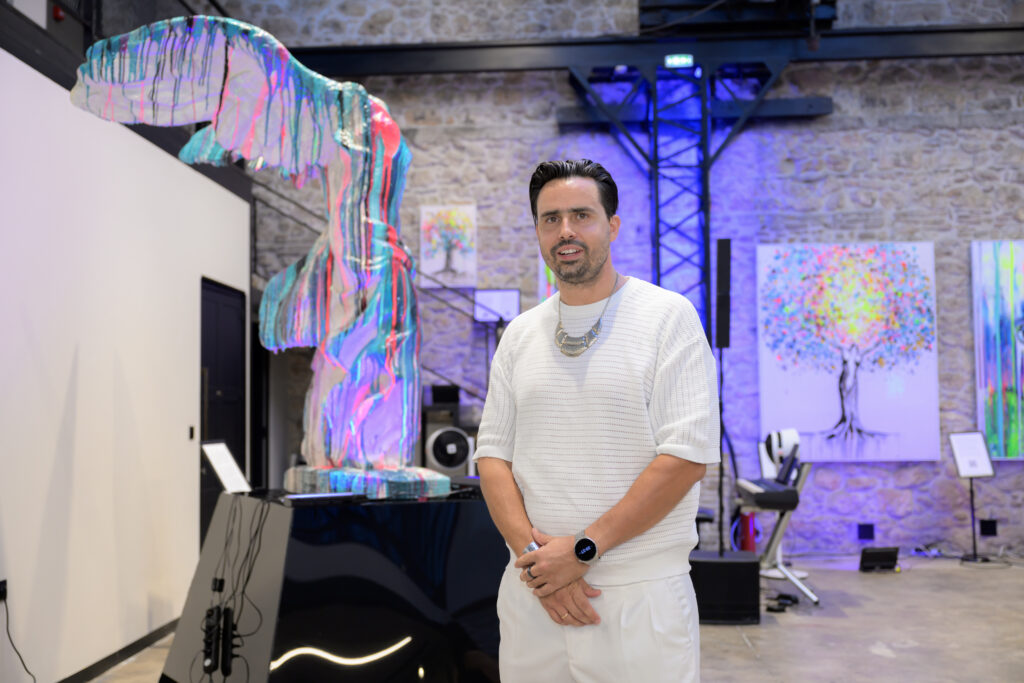
What are the main materials you use for your artworks and what significance does each of them hold?
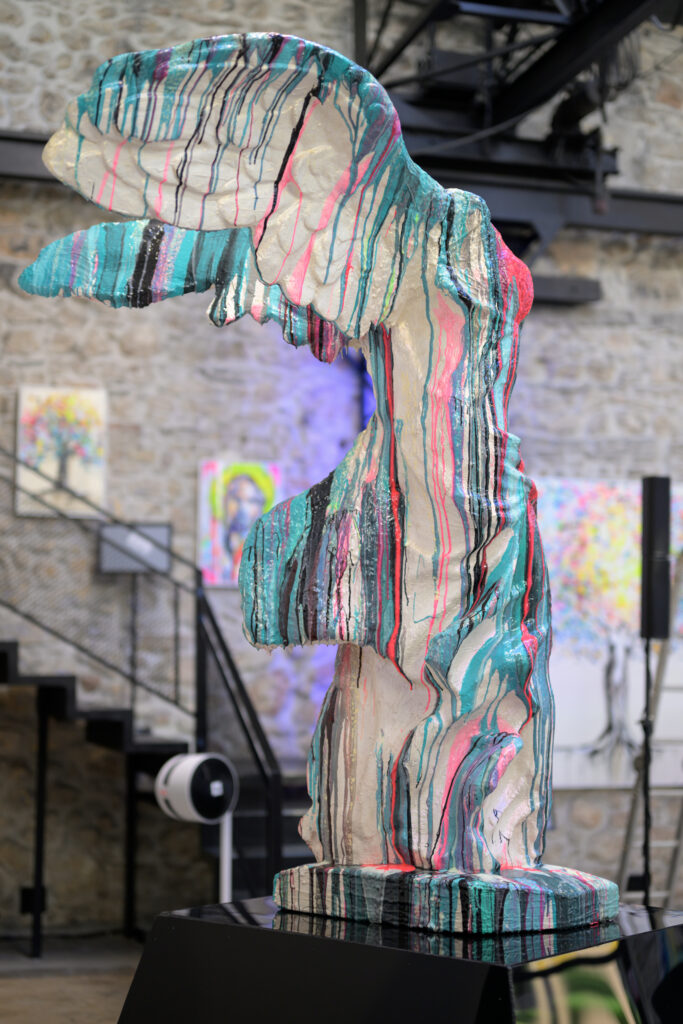
In my paintings, I work mainly with light-reactive paints, acrylics, and layered surfaces. The light-reactive paints are essential to my progressive multipaint technique, they allow different images to appear depending on lighting. Acrylics give me freedom to work quickly and intuitively, while the layered surfaces act like visual timelines, capturing the evolution of each piece. As a Greek artist, my sculptures have a deep personal connection to my cultural heritage. I primarily work with alabaster and other stones, often with marble bases or sometimes with no base at all, to let the form stand on its own. Many of my sculptures are inspired by Ancient Greek statues, not just in aesthetics, but in spirit. I see them as a continuation of that timeless dialogue between body, form, and myth. Each piece is a way to reconnect with that legacy while bringing it into a contemporary context.
Have you participated in International fairs and exhibitions? Could you state one experience that you’d remember throughout your life?
Yes, I’ve participated in various international exhibitions, and one unforgettable experience is seeing how audiences react when they encounter the progressive multipaint technique in person. There’s a moment of genuine surprise and excitement when the lights shift, or go off and a completely different painting appears on the same surface. Watching people realize they’re not just viewing a single image, but an evolving visual experience, is incredibly rewarding. That response reminds me why I created this technique in the first place to challenge perception and bring a sense of wonder back into viewing art.
What upcoming exhibitions, themes, or experiments are you most excited to explore next?
I’m really excited about upcoming exhibitions, many of which will take place on Greek islands, offering a unique natural light and atmosphere that perfectly complements my progressive multipaint technique. I’m experimenting with new light-reactive materials to create even more dynamic visual shifts. Thematically, I’m diving deeper into identity and memory exploring how personal and collective histories overlap and transform. On the sculptural side, I’m working on large-scale pieces inspired by Ancient Greek forms, including Nike sculptures which approach the original dimensions. This allows me to blend tradition with contemporary abstraction in a powerful way. These projects represent a natural evolution of my work, inviting viewers to engage visually, conceptually, and emotionally.
Anton’s work reminds us that art is never truly static; it moves, breathes, and transforms with time, light, and the viewer’s own perception. Whether through the hidden layers of his Progressive Multipaint paintings or the timeless grace of his sculptures, he invites us to look closer and linger longer, to see beyond the obvious and step into a space where imagination and reality intertwine. As his upcoming exhibitions bring his vision to new audiences, Anton continues to prove that the boundaries of what art can be are only as fixed as the light in the room.
To learn more about Antoni, click the following links to visit her profile.