


Merging Research and Psychology in Art |M.E. Klesse


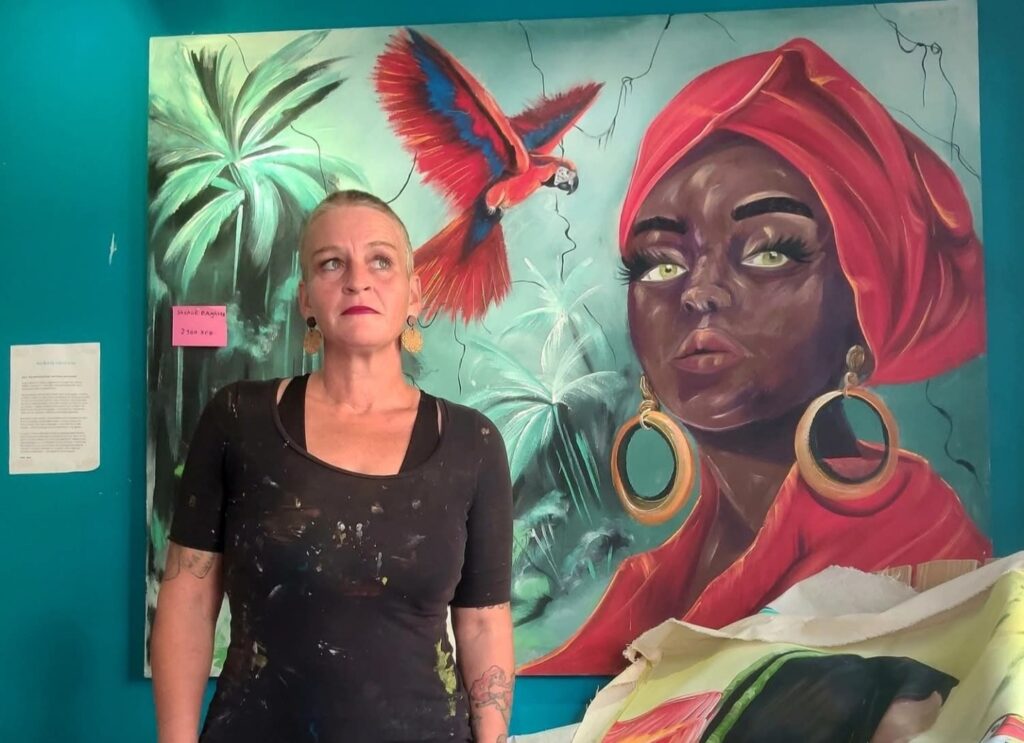
For our Arts to Hearts Project interview, we sat down with M. E. Klesse, a multi-sensorial artist whose work spans painting, sculpture, assemblage, and immersive installations. Based in Rockport, Texas, and exhibited in major cities around the world, Klesse brings an unusual combination of experiences to their practice—degrees in Philosophy, Nursing, and Management, decades of work with individuals from diverse backgrounds, and formal art studies at The Pratt Institute and the New York Studio School.
In this conversation, Klesse opens up about the driving forces behind their “artwork-clusters,” how music, scent, and tactile elements come together to shape an emotional space, and why material choice is as much an ethical decision as an aesthetic one. We learn how events—whether unfolding close to home or halfway across the globe—spark a process that begins with inquiry and research before ever taking form in the studio. Klesse also talks about exploring trauma from both the survivor’s and the perpetrator’s perspective, using their work to ask difficult questions about harm, memory, and resilience.
The interview offers a close look at how Klesse’s multi-sensory approach invites audiences to engage with complex social and psychological themes—not from a distance, but within an environment designed to be felt, heard, and even smelled.
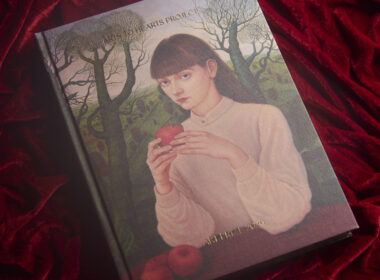
M. E. Klesse is a featured artist in our book, “100 Emerging Artists 2025” You can explore her journey and the stories of other artists by purchasing the book here:
https://shop.artstoheartsproject.com/products/the-creative-process-book


M. E. Klesse is a multi-sensorial artist based in Rockport, Texas, whose work has been exhibited internationally in cities including New York, London, Rome, Canada, and many other major US cities. Several of their pieces are part of permanent museum collections. Born in Point Pleasant, New Jersey, Klesse holds degrees in Philosophy from Rutgers University, as well as in Nursing and Management. Their professional background as a registered nurse and decades of volunteer work with individuals from diverse and disadvantaged backgrounds have deeply informed their understanding of the human psyche.
Formal art studies at The Pratt Institute and the New York Studio School further enrich this insight. Klesse’s artistic practice encompasses oil, cold wax, and encaustic painting, along with tactile works in sculpture and assemblage. They create ‘artwork-clusters’, multi-sensory installations that integrate visual, tactile, and auditory elements, to engage viewers in dialogues about psychological trauma, survival, and the societal issues that contribute to these experiences.
1. Your background in nursing and philosophy brings such a layered understanding to your work—how do those experiences influence the way you build each piece?
When an event, whether personal or global, elicits a strong emotional reaction, it sparks a need in me to create. I don’t start with form or aesthetics; I begin with inquiry. My nursing background draws me toward understanding the physical and psychological dimensions of the event, while philosophy pushes me to question the broader ethical, existential, and social implications. Whether the catalyst is something within my immediate life or a news story that resonates, I engage in in-depth research to unpack the underlying causes and human experiences at its core. I want to know the who, what, when, where, how, and why, not just for context, but to understand why I’m moved, and how others are surviving, coping, or resisting. My work becomes a process of both emotional and intellectual reckoning, where art functions as a space to process, honor, and bear witness.

2. You’ve said your work explores both survivor trauma and the guilt carried by perpetrators. What drew you to this dual perspective?
As a survivor myself, I’ve long been fascinated by the diverse ways people navigate and cope with trauma. That curiosity deepened through my work as a nurse, where I treated individuals bearing both physical and emotional wounds. In that space, I often witnessed the full spectrum of trauma; not just the pain of the survivor, but also the complex emotional interplay between survivor and perpetrator. Over time, I began to see how perpetrators are often shaped by their own unresolved trauma, sometimes even carrying deep guilt and flashes of empathy for those they harmed. This duality of survivor and perpetrator, wound and remorse, offers a more complete and honest view of human suffering and resilience. It’s that emotional complexity that fuels my work. I strive to hold space for uncomfortable truths, where trauma doesn’t live in binaries but in layered, intersecting experiences that ask viewers to look beyond judgment and into the roots of harm and healing.

3. Can you talk about how your multi-sensory “artwork clusters” come together—what guides the choice of sound, scent, or texture?
Absolutely. Traditionally, visual art allows for open-ended interpretation, filtered through the viewer’s personal experience, and while I respect that, I am looking to provide a different experience. I aim to guide the viewer into a shared emotional and sensory space, allowing them to process their experiences through their filters. The various components of the ‘cluster’ arise from the emotional state which inspires the work. My whole physical experience is immersed in the creation phase. I will have a particular piece of music playing in my head while I create. I
f I stop and concentrate, I can name the smells and tastes that I am imagining while I work. The tactile components come directly from the type of emotion I am experiencing. For example: during the creation of a piece called “Dancin’ in the Dark”, a piece based on the darker and more sinister side of the Brazilian festival of Carnaval, tribal dance music played in my head, I suppose as a reflection of the parade music; but the night murders, the political intrigue and the unmanageable mountains of trash gave me smells of hot asphalt mixed with ginger and chili pepper, the taste was of black licorice and the tactile experience was rough dried clay. I think of it as “excrypted-art”—not hiding meaning, but encoding it in multiple sensory dimensions so the viewer can unlock a more complete, embodied experience before interpreting it for themselves.
Material choice is never incidental in my work; it’s deeply tied to both the message and emotional tone of each piece.
M. E. Klesse
4. What role do materials like recycled plastics, wax, or natural fibres play in shaping the meaning or tone of a piece?
Material choice is never incidental in my work; it’s deeply tied to both the message and emotional tone of each piece. Any person, place, or thing that is being mistreated will have my support and empathy, and the environment is one of those living, breathing things that needs our support and attention. Although I do use some acrylic paint, I am cautious to dispose of it responsibly, and I choose to offset that microplastic pollutant by employing techniques which help clean the environment.
Scavenging for plastic waste in roadside ditches and waterways, purchasing organic materials from companies that replenish more than they harvest and creating artworks which are generally environmentally friendly are a few ways in which I can feel emotionally uplifted about what I am putting out into the world. When a work is explicitly aimed at an environmental cause, I often choose to utilise materials which are either directly affected or which hold promise for the rejuvenation of the planet. These decisions ground the work emotionally for me and hopefully invite viewers to consider not just what they’re seeing, but at what expense it came to exist and what it might help restore.
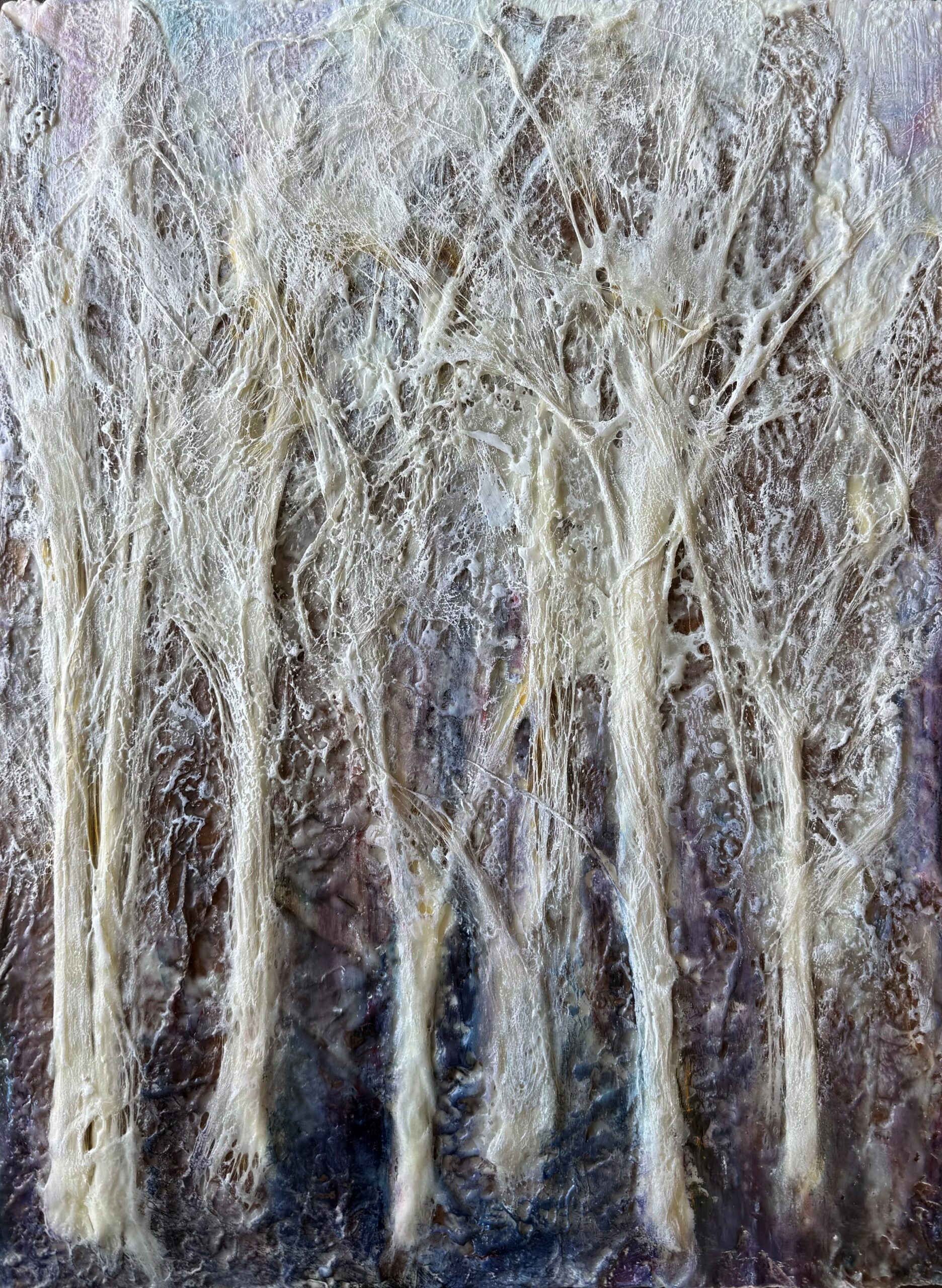
I don’t start with form or aesthetics; I begin with inquiry.
M. E. Klesse
5. Much of your work deals with emotional and psychological residue. How do you approach translating something so internal into something we can see or touch?
Much of my work begins as a therapeutic exercise, a way to communicate with the canvas when words fall short. I’m trying to translate what I feel viscerally into form, gesture, and colour. If I don’t get the exact tension in a figure’s hands or the specific hues of blue or lavender I associate with a particular emotion, then the piece doesn’t feel complete; it hasn’t yet spoken back to me. Certain areas of the work may appear less polished or more loosely rendered; these are often the supporting characters in the story, not the emotional heart. When I include poetry, I write directly onto the surface without stencils or guides. The handwriting is often raw and messy, but that’s intentional; the emotion lies in the words themselves, not their perfection.
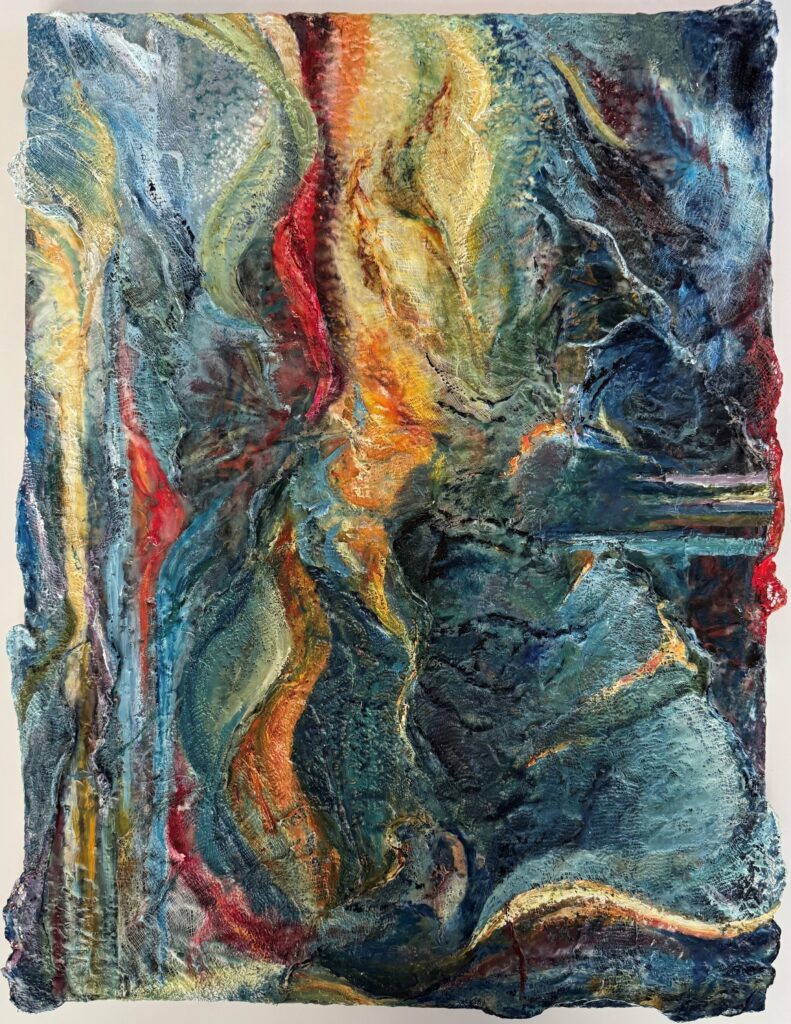
6. You’ve exhibited internationally and have work in museum collections—what kind of viewer interaction or response has stayed with you the most?
I’m not someone who cares for the spotlight. I tend to avoid openings when possible as I find that reactions in those settings can sometimes feel performative. What stays with me are the quiet, unscripted moments when someone goes out of their way to share how a piece moved them. One of the most meaningful experiences I’ve had was while volunteering at a museum where my work was on view. As I passed through the gallery, I saw two women reading the poetry embedded in one of my pieces. After a pause, one of them stepped back with her hand over her heart and said, “Oh, my.” That kind of honest, spontaneous response, unfiltered by context or expectation, holds the most meaning.
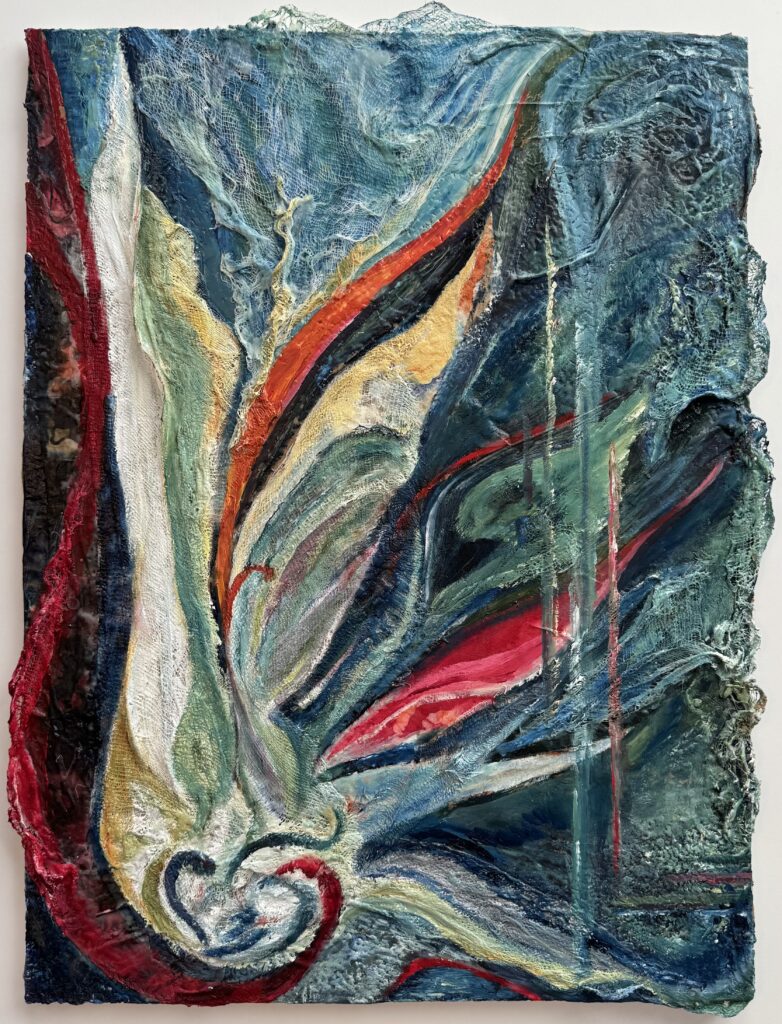
M. E. Klesse’s work is an intricate meeting of sensory experiences, layered research, and human psychology. Through painting, sculpture, assemblage, and the use of sound, scent, and texture, they create spaces that hold the weight of trauma, resilience, and ethical questions.
Their art asks us to step closer, to sit with discomfort, and to consider the complex ties between survivor and perpetrator, harm and healing. From their journey, we see how curiosity, empathy, and a commitment to inquiry can shape not just the work itself but the way it connects with people.
To learn more about M. E. Klesse, click the following links to visit her profile.
Arts to Hearts Project is a global media, publishing, and education company for
Artists & Creatives: An international audience will see your work of art, patrons, collectors, gallerists, and fellow artists: access exclusive publishing opportunities and over 1,000 resources to grow your career and connect with like-minded creatives worldwide. Click here to learn about our open calls.