


A Conversation on Dreamscapes and Demons with Lisa Lach-Nielsen

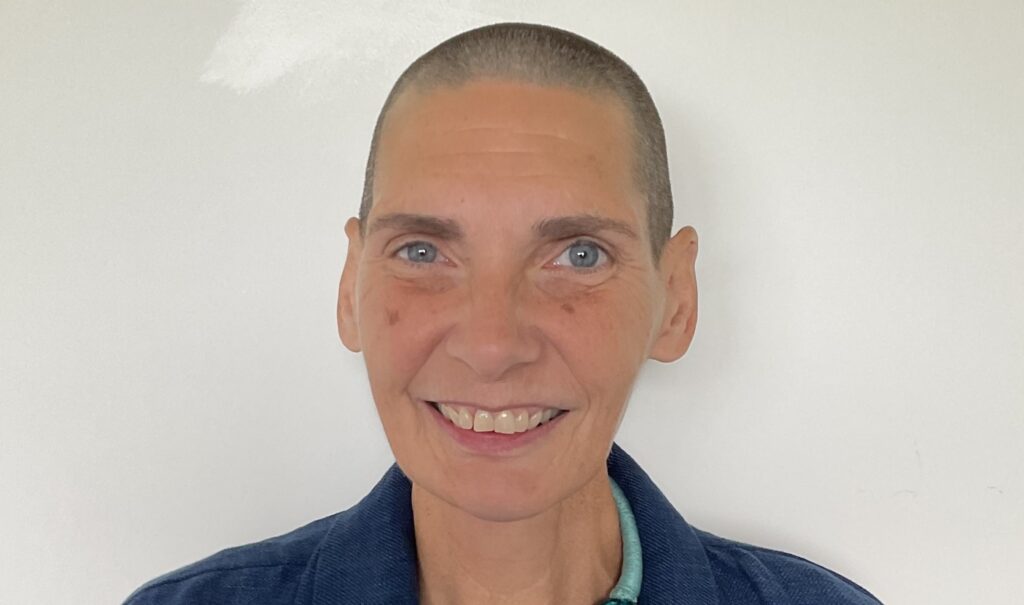
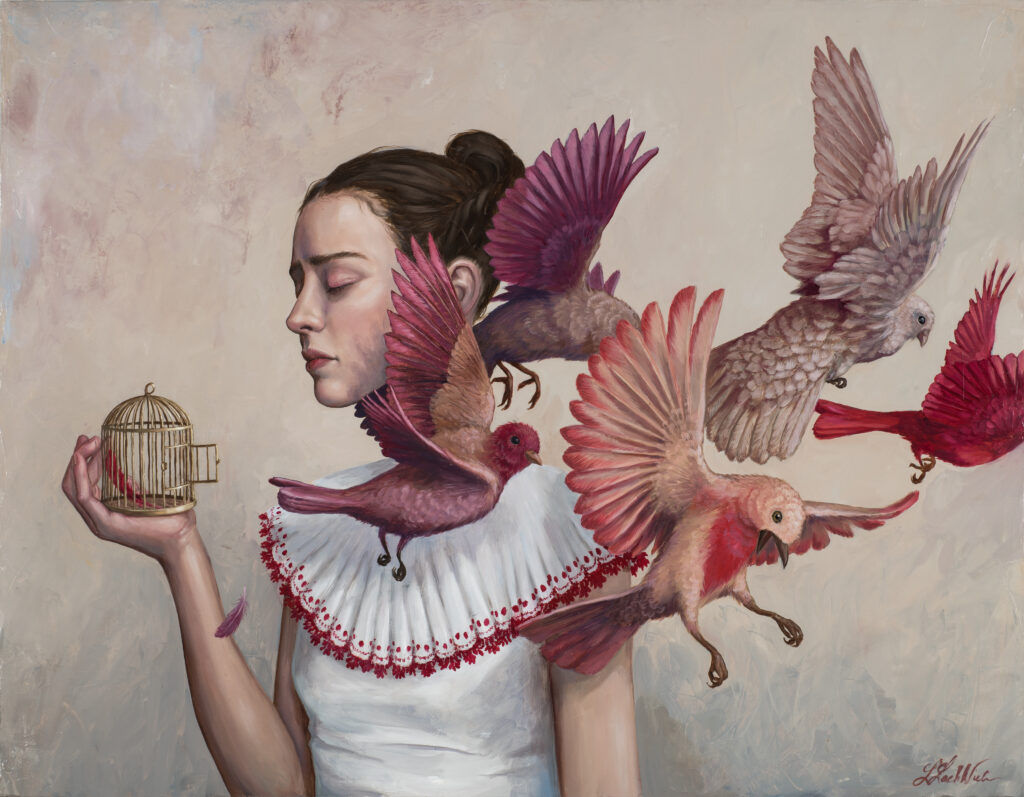
In today’s interview, we take a plunge into the preciously tender world of Lisa’s art; a space where surreal dreamscapes and psychological truths intertwine. Through muted tones, symbolic objects, and expressionless girls who seem at once familiar and unknowable, Lisa invites us to confront the feelings we often bury; feelings of shame, guilt, fear, envy with startling honesty. Her work doesn’t offer answers, but instead holds up a mirror to the viewer’s own emotional undercurrents. In this conversation, we explore the mind behind these evocative portraits along with her process, inspirations, and the quiet darkness that makes her paintings pulse with life.
Hi Lisa, can you take us through the central themes of your paintings and the thoughts behind them?
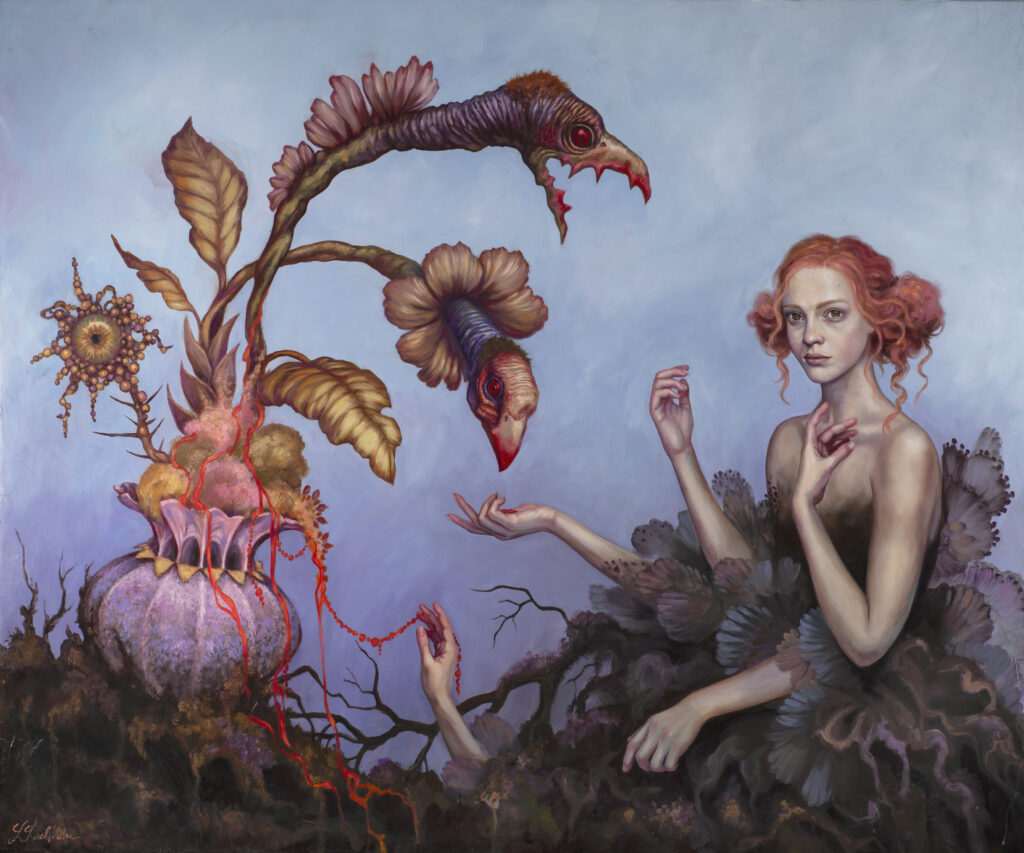
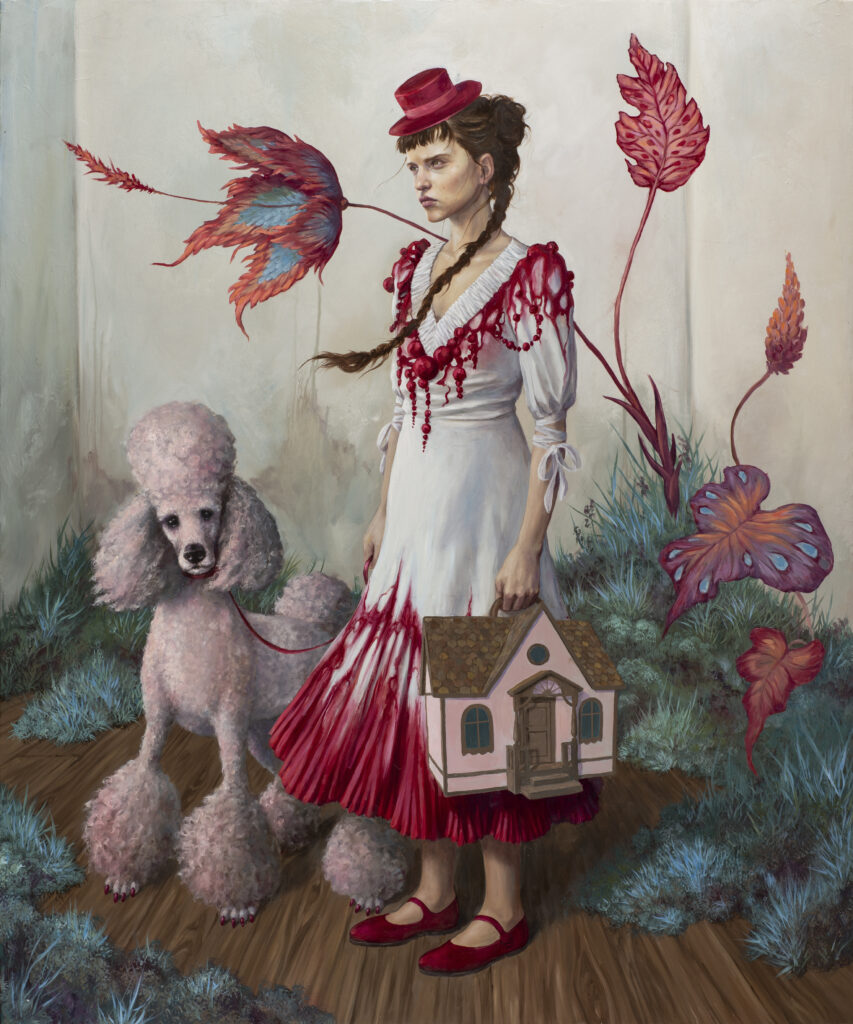
I’m very interested in psychology and what makes us who we are. I find it interesting to go into our mental treasure chamber and dig out all the stuff that makes us uncomfortable. Feelings that are natural in us humans but we often try to hide, like guilt, fear, shame, jealousy etc… I make portraits of young women and girls, because I am a woman, and I only have a daughter, so it makes it easier for me to relate. However I don’t tell my own or my daughter’s story, but I can relate in some extent to the feelings they represent. There is always a level of surrealism in my paintings, which gives a sense of being set in a dream or alternative universe. Most of the objects and animals in the pictures are symbols and metaphors for different feelings, and it’s up to the viewer to decide how to understand them. I find that people’s interpretations are always based on their own experiences, and therefore often different from mine. Some people find my paintings too scary…but then I tell them, that they get scared, because it makes them get in touch with their own demons, which always makes them laugh.
Your work often blends beauty with a subtle unease—how do you balance the dreamlike, surreal environments with the intense psychological themes beneath?
My intuition is my guide. If it doesn’t feel right in the stomach I work with the painting until it does. Sometimes I don’t understand the painting until I finish it. I can work on something and ask myself ‘what does it mean’, and finally everything falls into place and makes sense to me. I almost feel like the paintings have their own life and I just help them become real. The unease is necessary to me. I can not paint anything that is just nice and happy and has no psychological layers. I get bored and tired and feel stuck. There has to be a tiny bit of darkness, a conflict or at least sarcasm to make it interesting to me. Some people ask me if I had a lot of traumas in my life, but I say no, I’m a very happy person with a light mind, so I don’t feel the unease myself. I just like to observe what’s going on under the surface and bring it out in the open like a therapist.
What usually sparks the beginning of a new piece for you—is it a thought, a feeling, or something else entirely?
Everything. A feeling, a conversation, a dream, something in the news, a movie, something I read, a colour, a dress, nature, animals…. I do get inspired by other artists once in a while, but I would never use that inspiration directly in a painting. I’m terrified by the thought of accidentally copying someone. Some times I get an idea of the concept first. What is the feeling, the conflict or the dilemma and how can I make this into an image? But sometimes it’s the other way around, I see for instance a flower or a piece of furniture and I start to think how I can turn it into a story. Sometimes I simply get the full picture in my mind at once. I am able to visually imagine the painting in my mind…therefore I don’t make a lot of sketches. I usually just write the idea down in my phone so I don’t forget it, and then later on I may make a few doodles…
Has your work evolved over time both in technique and emotional depth?
Yes, in the beginning I think the images were a bit more humorous. Now they are more serious. I guess they have just matured like I have myself. Perhaps because I learned to feel more comfortable in the deep emotions, so I don’t have to ‘cover them up’ with something funny. Technically I think I have also developed. I started with acrylics and now I use oil, which is a lot more difficult, but once you learn it, I think it’s a much better to work with. In the first half of my career, I just worked from memory, so when I painted a person, I would only image how they looked. Later on, I started to use a photo reference which I create like a collage on my computer…but the finished painting never looks exactly like the reference, because I also develop it once I start working on the canvas.
You often use subtle textures and muted tones—can you tell us why these choices are so central to your artistic expression?
That’s very interesting because when you see the work of different artists, they all have their own and often recognisable colour profile. I can’t explain it. It must be an intuitive thing. I really like bright colours, but when I use them in my paintings they seem wrong. It’s like the paintings decide the colours, not me.
What is that one piece of advice you’d like to give emerging artists?
Just be honest. If you try do something because you think it is trendy or sellable, you’ll have trouble succeeding. People can somehow feel if what you are making is real and comes from within or not. Always use your defeats as fuel. If somethings is not working out for me I get angry, and I use that anger to find out how I can get better. I never use it to put myself down, I always lift myself up to a new level. I have gradually realised that development is always two steps forward and one step back. So don’t loose hope if you feel you are going back… soon you will take a big leap forward… Don’t expect to be a master from the beginning. I’ll be learning all my life, and if I’m not, I don’t see a point in continuing. The journey and the progress is what makes it exciting.
Lisa’s paintings may whisper rather than shout, but their emotional resonance lingers long after. In her quiet rebellion against surface-level prettiness, she crafts worlds where unease is necessary, where beauty coexists with conflict, and where art becomes a kind of psychological excavation. Her journey is a testament to artistic honesty and the slow, meaningful evolution of both craft and self. As she continues to peel back the layers of the human experience, we’re reminded that sometimes, it’s in the shadows that we find the most illuminating truths.
To learn more about Lisa, click the following links to visit her profile.