

Watch & Listen to this podcast Episode.
In this episode of the Arts to Hearts Podcast, host Charuka chats with Lizzie Glendonning—curator, gallerist, and co-founder of the Woolwich Contemporary Print Fair.
Lizzie opens up about how her journey in the arts began with a love for fashion, shifted into curating, and eventually led to running a gallery and starting a print fair with her husband. She shares how things didn’t always go as planned, how she balances work and family life, and why trusting your instincts matters.
This conversation is full of helpful takeaways for anyone in the creative world—especially about staying visible, building something slowly, and not being afraid to start even when you don’t have it all figured out.
This set effectively summarizes and segments the detailed content of the interview into easily navigable chapters for viewers.
00:00 – Intro
01:10 – How Lizzie got started in the art world
03:45 – Starting a small gallery with a big vision
07:20 – Challenges of curating and growing a fair
10:15 – Building artist relationships that last
14:00 – The behind-the-scenes work no one talks about
17:30 – How motherhood shifted Lizzie’s approach
20:00 – Advice for women in the arts
Charuka (00:00.896)
Okay, welcome to the podcast Lizzie. How are you doing?
Lizzie (00:04.931)
Hi, really well, great to be here. Thanks for having me.
Charuka (00:09.486)
Thank you so much. Lizzie, I want to start by first introducing yourself to everyone who’s listening. are the first guest for a new season and I’m very excited to have you here. How about we first start by you introducing yourself, what you do, who you are so that then we can dive into a nice chat.
Lizzie (00:31.105)
Okay, my name is Lizzie Glendonning and I’m a curator and gallerist. I run Brockett Gallery in the UK and I also co-founded and set up with my husband Jack Bullen Woolwich Contemporary Print Fair, which is the leading international offer for contemporary print.
Charuka (00:52.835)
Yeah.
Charuka (00:57.878)
Yeah, so that’s a lot in there in itself for us to start with. But before I go into that, I will ask a very common question, a question that I feel is such an integral part for everyone who’s in the arts. Did you ever consider yourself as an artist? Did you decide to pursue art as a career for yourself before you landed up into all of this? Do you consider yourself in that realm?
Lizzie (01:03.482)
Thank you.
Lizzie (01:27.939)
I’m creative, I’m not an artist. When I was younger, I wanted to be a fashion designer. Yeah, the idea, I mean, I’d love to have been. I just, can’t draw, can’t. I think I went into curation to articulate something creatively in a way that didn’t mean having to draw or.
Charuka (01:30.948)
Did that idea ever come to you?
Charuka (01:50.372)
10 balls
Lizzie (01:52.225)
Yeah, I just wasn’t very good at it. I wanted to be. I wanted to be a fashion designer, but I couldn’t draw a figure. So I went a different direction.
Charuka (01:57.88)
Yeah.
Charuka (02:01.802)
But the words are your brush in that sense.
Lizzie (02:05.059)
Yeah, yeah, so guess writing, writing and writing would be the most creative, artistic thing that I do.
Charuka (02:15.972)
Okay, tell me something about your journey. How did you get into the arts? I know your husband is an artist himself. You run a gallery, you are into curation, then you also have this fair. It is not an everyday norm that you suddenly, you you find your way to starting a fair, which is not only an art fair in the sense, but also like a print driven, which is very specific. So can you brush up through your journey so far? How did you start?
How did you get here? What brought you to the Earth?
Lizzie (02:47.173)
Well, it’s been a sort of organic journey. was deliberate. I deliberately did art history. I wanted to learn about, you know, reading, painting, art history, how to… I mean, for me, I was always interested in costume and fashion. So for me, reading a painting about sort of a portrait and getting the sort of social…
Charuka (02:56.098)
Okay.
Lizzie (03:12.665)
the sort of social history of someone through a portrait I found fascinating. And also the art historical sort of link with composition and approach to looking at anything I think was really important, especially because I’d originally wanted to go into fashion. So I thought that was a really interesting sort of angle.
to take. And it was pretty soon, my art history degree that I realized I wanted to be a curator. I’d seen an exhibition of dress, a costume exhibition. Well, it was fashion. was, it was a sort of intervention and installation when I was about 18 in a historic property in Northumberland. And I couldn’t articulate what it was. I just, I was like, this is exactly what I want to do. And I don’t know how to do it or
Charuka (03:39.192)
Yeah.
Charuka (03:57.198)
Yeah.
Lizzie (04:07.361)
And it wasn’t until I saw an MA for fashion curation and I was like, that’s it, that’s what it was. And it was very early on, it was only the second or third year of this MA and there was not many of us. It was very niche. It was an academic course, was a curatorial course that had an aspect of dress integrated into it. it was very versatile and…
Charuka (04:21.486)
Okay.
Lizzie (04:36.293)
As I pursued exhibitions of dress and costume when I was working freelance, I was also working within museums and sort of fell into fine art. And while I was in there, I met my husband, completely random, my future husband, who was an artist, he was special. And he suggested,
Charuka (04:50.627)
Yeah.
Charuka (04:59.716)
I’m
Lizzie (05:05.599)
maybe I was in a really good place. I left one gallery and kind of wanted to do my own projects. And he said, well, why, while you’ve got this time, why don’t we do some exhibitions together? And he was working at an amazing art school, so knew lots of people coming through. And they had the right kind of
we’re really interested in the making and the process and reinventing or reinterpreting, sorry it’s early, aspects of our historical techniques or narrative for contemporary audiences in new ways. We’re quite, I guess we have a niche eye that I can’t quite describe but we know it when we see it. Yeah.
Charuka (05:50.884)
Put in words. Yeah.
Lizzie (05:54.213)
So anyway, this school’s particular art school had a couple of artists that we were really keen to put together. And so we did that and we did a couple of temporary exhibitions. I don’t like the word pop-up because it almost devalues the kind of curatorial process and it seems less professional, whereas I’d been working in Mayfair and I wanted to have this really beautiful platform for emerging artists.
And after a couple of exhibitions, saw, well, basically a shop, very pretty Georgian shop opposite a cafe nowhere he worked. So we ran across the road and asked the renovators what they were doing with it. And we took on this small gallery space. It expanded upstairs eventually and…
During that time, we were working with lot of painters sculptures, we were doing external pieces that wouldn’t fit in the gallery. But one of the events that we did was a new collector’s evening where we would look at original prints as a way to educate some of our collectors on
Charuka (07:02.681)
Yeah.
Charuka (07:07.458)
get into collecting.
Lizzie (07:09.699)
get into collecting ways to learn about process so they can confidently talk about their work or experiment with different artists and different processes, sort of maybe find a niche or a trend that they like. And during that time, we were invited by a client to come and take over one of the big…
former factories on the arsenal. And parallel to that, Jack and I really love Venice Biennale. And we were like, why doesn’t anyone, you know, they have their arsenal where, you know, it’s full of contemporary art intervention. And completely separately, Jack and I had been like, I wonder what happens on our arsenal, on our arsenal. Nothing, what’s happening. And then this person generously invited us down. We installed a big installation by Italian artist, which was
Charuka (07:36.462)
Okay.
Lizzie (08:02.839)
It was sort of controversial, it was interesting, people loved or hated it, but they remembered us, so we were invited back. And so it wasn’t in our plan to set up an art fair. Yeah, it was, we have this amazing space. We need something more than just an installation, we need something that can attract lots of people.
Charuka (08:05.86)
Yes.
Charuka (08:18.062)
Tooth, here. Yeah.
Lizzie (08:29.849)
can be accessible but not undermining quality. There isn’t a contemporary print fair. There’s fairs for everything else, but there isn’t. There isn’t one. So we took that market.
Charuka (08:33.912)
Yeah.
Charuka (08:47.62)
Wonderful. What do you think was the biggest gap that you felt and something that became your biggest reason why you needed to do this? What was the biggest struggle that you saw at that point? Specifically for Radhiv.
Lizzie (09:02.895)
For artists, think in terms of printing, talking in terms of choosing print, it’s very much learning about what print is. I think it’s so under, it’s undervalued because people don’t understand what it is. So.
Charuka (09:20.568)
Yeah.
Lizzie (09:21.669)
I or think, excuse me, people have misunderstood printers being sort of printed off a digital printer. And actually it’s incredible. I mean, I educate myself. We collected printers as a family growing up, but even I, just didn’t, when my dad would try to, I just didn’t get it. And it took,
Charuka (09:34.784)
Yeah, they don’t know the traditional process or the kinds of… I also didn’t know actually for very long time.
Lizzie (09:51.341)
a long time to understand these are all originals. So what we would say as dealers, as sort of people in fine art, we would say, know, a print, an original print is a work of art conceived as a print in its first instance. So it’s absolutely not a reproduction of another work. So you can go to a museum or IKEA and get a sort of photocopy of an old painting.
Charuka (10:08.941)
Yeah.
Charuka (10:14.18)
Mm-hmm.
Lizzie (10:20.741)
but these are original works of art and they’re so diverse and it’s an incredibly, mean, print as a medium was the sort of way that sort of culture and knowledge crossed borders and artists could share work with other artists and other ateliers and they got their work out there.
Charuka (10:24.781)
That’s right.
Charuka (10:38.669)
Yeah.
Lizzie (10:46.861)
And they deliberately created print for that reason. So it’s been very socially impactful and historically impactful. it’s, so for those that don’t know that, you know, all these different mediums etching lithograph and then go moving into screen printing. I mean, when screen printing was introduced in the sixties, think it was the sixties, don’t quote me on that. Yeah, people were frightened of it.
Charuka (11:02.221)
Yeah.
Charuka (11:06.816)
Yeah, it’s such an old tradition.
Lizzie (11:14.085)
People have always been frightened of new technologies, I think. But print as a medium has always embraced and adapted and grown with that. I think in that sense, I’ve also learned to love it more and more because I’m seeing how diverse and how intricate and really
Charuka (11:17.976)
Yeah
Charuka (11:30.567)
So much. Yeah.
Lizzie (11:42.287)
quite progressive it is as a medium when it’s been under looked as a sort of. Sorry.
Charuka (11:45.988)
And it’s I think very diversified also. I think it’s so diversified also. when I took, I think I learned from Shivangi only who was also part of the whole which I think she won the prize I think. Yeah, she won the prize. And I remember doing chin kole because I love collaging and I didn’t know for a very long time that you know how chin kole was such a
Lizzie (12:02.125)
enterprise, yeah.
Charuka (12:13.092)
such an interesting medium via the printmaking method of how we were doing the etching and then you know blending it with so many different techniques and how much patience also it requires and like it is and I found you know I found it so different as to my own original process which is very much intuitive I felt like how printmaking was such a
such a great process which was also very process driven and yet you didn’t have a lot of control. It was just both ways. You had to go through a process but then you could also, there was so many unexpected results that could happen in so many different stages. And I found it very interesting because I feel as a regular practice, think printmaking,
seemed a little different while we approach the process of it.
Lizzie (13:13.175)
Absolutely. mean, I think when people are using print within their wider practice, which often happens, a lot of the artists that I work with directly work in different mediums. The intervention of that sort of final stage of a mechanic, maybe the mechanic, the machine, you know, the press or
just taking that sort of matrix away from your hand onto something else. You just don’t know what’s gonna come up. And I think that artists who make prints, that’s really, that’s the exciting part. You sort of, take…
Charuka (13:42.601)
that’s very.
Lizzie (13:52.729)
you take it out of your hands. And interestingly, had an artist who is a printmaker specifically up on my residency. I run a residency called the Brockett Residency. And many of my artists have been painters and different, you know, this woman was a printmaker specifically.
Charuka (13:55.33)
Yeah.
Charuka (14:05.197)
Yeah.
Charuka (14:29.953)
Yeah.
Charuka (14:36.525)
Yeah.
Charuka (14:50.048)
Yeah and every print is unique no matter how even if you’re you know re-printing the same yeah but it is a unique print you will see how the imperfections will be so much different and how like you know for if we see it from the creative eye or from an art eye every brush stroke every color the pigment of it it makes a whole new story and a whole new experience.
Charuka (15:23.031)
Yeah.
Charuka (15:37.152)
Yeah.
Lizzie (15:45.345)
you know, the print can be accessible in terms of prices. you know, people could get an original work of art and go that that way. There is, I guess, a trend for people, a lot of screen prints are very popular because of the way people buy online and late, maybe online. But for me, the intricacies, I mean, I like to see what I’m buying.
Charuka (15:49.548)
Accessible. Yeah, that’s true.
Charuka (16:06.39)
Yes. Yeah.
Lizzie (16:14.917)
in real life. You know, I like to see, mean, that’s, I’m sorry, go on. Yeah.
Charuka (16:15.938)
Yeah. Okay, tell me something. Sorry.
can’t hear you. Can you hear me? No, no, sorry, complete please. I missed you in between.
Lizzie (16:28.249)
Well, no, I mean, the reason we set up the fair was because of that sort of that education, that that that need for people to see and understand what it was in real life. But that’s been the challenge as well. And also.
Charuka (16:36.921)
Hmm.
Hmm.
Lizzie (16:43.397)
I mean, you asked me about challenges earlier. It’s not just that print was in the title. It’s that it was in a place that was hard to get to up until 2021. There wasn’t really an easy way to get to Woolwich. Now it’s really well connected. It’s sort of 10 minutes from Bond Street. It’s fantastic. But we were waiting for that transport to come. And so we’d sort of invested in this.
Charuka (16:46.852)
Yeah.
Yeah.
Lizzie (17:11.397)
area that was very emerging but also an art form that was very emerging as well, a sort of market. So yeah, it’s been quite a challenge.
Charuka (17:17.398)
emerging itself. Yeah.
Yeah. Okay. I want to actually go here a bit. You know, when we look at things and we look at people and you know, the work that we do or they do, you know, there’s this whole, we only see the outcomes, but not what goes inside of it. What’s going behind it. You know, I want to go and I want to, I don’t want to, I specifically want to hear from Lizzie’s perspective because you know, in so many victories, there’s so many continuous
small decisions, fears, or struggles we overcome. Can you dive into your own personal journey of how you evolved? You didn’t come from an experience of running a gallery, neither running an author like this, like a specific off print. But then you’re also doing something which is all of these and so spectacularly. I’m sure it wasn’t easy. Can you run me through your own role? only, and you know,
the diversion from being a curator but then once you start running a business there’s another layer that comes to it like you you’re responsible for people you are answerable to your team you really want to make sure that everything’s it’s completely on you so can you dive me into the first few early years of first running the gallery and then diving into the world which how what was where you were in your own part you know in your life
And what were the struggles that you faced and how you journeyed through them?
Lizzie (18:57.495)
Yeah, I mean, we went into it fairly naively, I think we went into it with this sort of.
Charuka (19:01.444)
I mean, I think this is something that’s completely constant with most of the people because if you would know what we were going into, probably wouldn’t have done. Yes, I also say the same. And I ask this question to a lot of people.
Lizzie (19:09.113)
You wouldn’t do it. No. Yes. I think you have to be very brave, first of all. Jack is very brave. And what’s great about, I guess, as a partnership, I have these ideas, which most people would say don’t be ridiculous. And he’s like, OK, let’s how can we make it happen? so there’s two ridiculous people.
Charuka (19:21.069)
Yeah.
Charuka (19:33.581)
Let’s…
So one crazy meets another crazy. That’s how all of these things happen. And you’re like…
Lizzie (19:38.757)
Yeah, and then he has these ideas which I’m like, no, not another idea. I can’t think of any more ideas. But we’re quite creative and find creative solutions. And I think creative solutions come from challenges. If we’d huge amounts of money with lawyers and business and accountants and everything, making some business plan 13 years ago to say,
Charuka (19:49.444)
you
Charuka (19:56.536)
Yeah.
Charuka (20:03.457)
Yeah.
Yeah.
Lizzie (20:08.055)
in the set up a gallery and then it’s going to go this way. It wouldn’t have been fun and there wouldn’t have been challenges, but we wouldn’t have probably done it. They would have been like, don’t be ridiculous. So I think we naively set up this gallery and but we had brilliant art to do, it was beautiful. It was small and originally we were sharing the space. We had a downstairs basement, which was quite cool and raw.
Charuka (20:14.872)
Yeah.
Yeah.
Charuka (20:23.574)
Okay.
Lizzie (20:33.817)
upstairs, was an antique shop, was a messaging, didn’t quite work as a brand. I think, but they left, because we kind of went into partnership to share the space, but they left and then we moved up and it felt more holistic and you know, it was our space. We had the two floors and we launched some really fantastic artists.
in and they all have they were all sort of process driven in a way which also kind of links to the reason we like print it’s not just print it’s the way that you know within our paintings that we’re showing through the gallery or sculpture how the process the the process of it how how things are
laid and layered onto the canvas. Why are they creating paint in that way? Or why are they looking at this sort of aspect of history or, you know, that sort of thing. It wasn’t completely dreamed up, the print, you know, as a sort of, let’s go for print. was because we enjoyed seeing the work.
Charuka (21:41.154)
Binding, yeah.
Lizzie (21:45.645)
I think, so for me, yeah, so we jumped into this thing. I was able, I guess at the time I was working separately as a consultant, like exhibition consultant within museums or other galleries, because we obviously needed a different income to help support our work. So we could never really, I felt…
Charuka (22:04.812)
Yes, absolutely.
Lizzie (22:11.077)
And I don’t know if Jack agrees, I felt that I could never really be invested fully in the gallery because I always had to do these other jobs, which was really, really frustrating for me. And then of course we had this community with Woolwich, so where we started growing men.
Charuka (22:20.899)
Yeah.
Charuka (22:24.3)
Yeah.
Charuka (22:36.895)
One.
Charuka (23:05.708)
Yes.
Charuka (23:17.75)
Yeah. Hmm.
Charuka (23:28.974)
Hmm.
Charuka (23:36.772)
That works.
Charuka (24:05.656)
Going. Yeah.
Charuka (24:16.611)
Hmm.
Charuka (24:30.062)
Mm.
Charuka (24:38.712)
Yeah.
Charuka (25:06.262)
Yeah.
Yeah.
Charuka (25:14.899)
How big is the team now?
Charuka (25:20.708)
wow, how do you handle, my god.
Really that’s very efficient.
Charuka (25:44.312)
Yeah.
Charuka (25:49.563)
Yeah.
Charuka (26:03.31)
Really?
Yeah.
And you didn’t have to blame it on yourself. You didn’t have to take that decision. It’s already been taken through you.
Charuka (26:23.104)
What?
Charuka (26:29.912)
Bye.
Yeah.
Charuka (26:54.062)
Yeah.
Charuka (27:03.914)
Yeah.
Charuka (27:09.228)
Blockbit.
Yeah, you could also see it could bring value to someone else.
Charuka (27:43.0)
without it.
Yeah.
Charuka (27:56.749)
Yeah.
Charuka (28:15.7)
new exhibit.
Charuka (28:26.359)
Yeah.
Charuka (28:31.822)
Yeah.
Charuka (28:37.732)
Tell me something, what does like now being between the gallery, your curation projects, the Woolwich Prize, working with artists, what does like a week, a day look like for you? How are you juggling the role as a mother, the role as a creative, you know, your writing, then your curation, but then also being a business owner, how does the dynamic working with your own husband? I’m, I also am interested because I think this is something that I personally really like.
Still figuring it out? I don’t know, I may continue to do that. Being a creative, being an artist, but then also running a business. then when you have too much ideas, like you said, I’m the crazy one. I have so many ideas and a lot of people around me are like, this is a great one. Why don’t you do that? I’m like, and I think being an artist in itself makes you brave because you’re like, you know, might, would just the desire to create something gets so strong that nothing else.
comes in the way as much. So can you take me through how your own life looks like now, how you juggle between these roles, how a day, a week or something comes like?
Charuka (30:57.156)
Mm-hmm. Mm.
Charuka (31:24.12)
in one.
Charuka (31:28.033)
Yeah.
Charuka (31:38.286)
Good plan.
Life happened. Yeah.
Charuka (31:48.406)
Yeah.
Charuka (32:01.379)
Yeah.
Charuka (32:16.0)
Absolutely, yes.
Charuka (32:20.74)
It does take a lot of effort and money and time.
Charuka (32:34.04)
Yeah.
Charuka (32:37.944)
Yeah.
Charuka (33:09.06)
Mm.
Charuka (33:16.739)
Yeah.
Charuka (33:20.59)
Mmm.
Charuka (33:28.398)
And I think that’s a deal breaker. think there’s a lot of capacity for artists if they’re able to represent themselves. Because not everybody has or is in the same connections and can find representation. And me not, think also with the times changing, not everybody needs representation. I think there’s a whole new genre of self-employed artists which are doing as great work as you know.
as independent brands like running a business, like a gallery, having systems and processes and just things in place for them. And I think this makes a great opportunity.
Charuka (34:26.55)
Yeah.
Yeah.
Hmm.
Charuka (34:43.446)
Yeah.
Charuka (34:48.6)
Yeah.
Charuka (35:22.052)
Yeah.
Charuka (35:31.768)
Adopted by galleries. Hi-yo!
Yeah.
Charuka (35:57.644)
Yeah, absolutely. It’s a lot of admin.
Charuka (36:05.261)
Yeah.
Charuka (36:17.557)
artist yeah
Which one?
Charuka (36:25.538)
Yeah.
Charuka (36:43.224)
Yeah.
Charuka (36:47.032)
That’s true. That’s incredible, I think.
Sorry?
Charuka (37:03.039)
wow.
Charuka (37:11.832)
that I’m going through.
Charuka (37:16.196)
What is your favorite thing about working with artists specifically? And what advice? Okay, last question. What is your favorite thing about working with artists and what advice would you give to artists who are, again, I think most the biggest thing is we have so much great talent, not enough resources, enough places, not enough, I think not enough books, not enough says.
Calories or collectors, all of that to be able to bring them in the forefront. So what advice would you give to artists who want to take their career seriously, want to really move ahead, but don’t know how to do that lesson.
Charuka (38:32.974)
Yeah.
Charuka (39:10.316)
Yeah.
Charuka (39:26.584)
Yeah.
Charuka (39:33.846)
Yeah, yeah.
Charuka (39:45.846)
Hmm.
Charuka (39:56.194)
Yeah
you
yeah yeah yeah that is true it is one of yeah
Charuka (40:23.734)
You
Charuka (40:35.734)
Yeah. Yeah.
Charuka (40:46.976)
The illusory, yeah, absolutely.
Charuka (40:56.227)
Yeah.
Charuka (41:16.514)
Hmm, it’s true.
Charuka (41:23.537)
Yeah, and it gives them people like a real look into their world.
Charuka (41:41.869)
Yeah.
I love them. Love them. They are so addictive.
It is a thing either these ASMR videos.
I remember there’s this artist I follow and we all love it. I remember she makes these prints and she has this big roller and she shows the print in the beginning and then she shows through her entire process. And just the beauty, like I am obsessed with her work. I literally am obsessed with her work.
Charuka (42:49.732)
Yeah, right.
Charuka (43:02.796)
Yeah, button making,
That is true.
Right.
Charuka (43:24.642)
date.
Charuka (43:30.667)
Yeah.
Charuka (43:42.532)
product, yeah. Yeah.
Charuka (44:18.596)
I love that. That is true. I really hope that that only happens more and more, more and more. The world gets to know about how beautiful this medium is. I think giving artists a lot more artist visibility and support. And I think the work that you’re doing as is has brought a lot of light. I think Woolwich has become a great name.
everybody recognizes and appreciates the work that you do. I think it also provides a lot of for a lot of artists as printmakers and I think which is remarkable. So yeah, I think you’re already on to a great start and I can’t wait to see what you do next with it.
Charuka (45:13.23)
Thank you so much, Lizzie. Same here. But before I let you go, is there something that you want to share with our listeners? How can people find you, support you? If somebody wants to be a part of the Woolwich print fair or about the gallery or the residency, could you share more about that so that people can reach out?
Charuka (45:41.804)
Yeah, by the time this is going to be out, it must have already been happened.
Charuka (46:21.315)
Okay.
Charuka (46:54.21)
Yeah.
Charuka (47:04.007)
wow.
Charuka (47:08.023)
wow.
Charuka (47:33.284)
Wonderful. Okay. Thank you so much Lizzie and for everyone who joined us today and I’ll see you in the next episode and I hope to see you soon back again Lizzie and I hope you have a wonderful time.
Charuka (47:50.948)
Thank you.
You’ll have to save.
.
About the Guest(s):
Lizzie Glendinning, Co-Founder & Curator of Woolwich Contemporary Print Fair. With 20 years experience of curating, collecting and directing within an arts and museum environment, Lizzie made the leap from running her own gallery, Brockeet Gallery London, to running her own art fair in 2016, when she founded Woolwich Contemporary Print Fair together with husband and business partner, Jack Bullen.
WCPF was inspired by the ‘New Collector Evenings’ Lizzie hosted at Brocket Gallery. Given the nature of editions, print-based works offered discerning new collectors the opportunity to purchase work at entry-level price points; learn about fine art techniques; discover new artists; develop tastes; and build confidence in talking about contemporary art and their choices.
Inspired by the Venice Art Biennale’s regeneration of their own Arsenale through fine art, Lizzie and Jack jumped at the opportunity to host WCPF at the UK’s own historic arsenal heritage site. Now approaching its ninth edition, the Fair continues to grow as a welcoming & interactive space for people to enjoy and engage with the best of contemporary print and support independent artists.

Episode Summary:
In this episode, host Charuka Arora sat down with Lizzie Glendonning to talk about her journey into the art world and how it led to the creation of the Woolwich Contemporary Print Fair. She shares how the fair has grown over the years, why printmaking continues to matter in contemporary art, and what it really takes to run a gallery space. From creative decisions to business responsibilities, Lizzie opens up about the challenges, wins, and lessons she’s learned while building something meaningful in the art world.
Key Takeaways
- Lizzie Glendonning’s journey into the art world
- The creation and growth of the Woolwich Contemporary Print Fair
- The importance of printmaking in contemporary art
- Challenges and successes in running an art gallery
- Balancing creative and business roles in the art industry
Notable Quotes:
“I’m creative, I’m not an artist… I went into curation to articulate something creatively in a way that didn’t mean having to draw.”
“An original print is a work of art conceived as a print in its first instance. It’s absolutely not a reproduction.”
“Creative solutions come from challenges. If we had huge amounts of money and lawyers and business plans, we probably wouldn’t have done it.”
“We went into it fairly naively… but we had brilliant art to do. It was beautiful.”
“The reason we set up the fair was because of that need for people to see and understand what print is in real life.”
Charuka Arora is the founder of the Arts to Hearts Project and Host of the Arts to Hearts Podcast. She is also an acclaimed Indian artist known for her contemporary embellished paintings. Her unique blend of gouache, collage, embroidery, painting, and drawing explores the intersection of art, culture, heritage, and womanhood. Through her work, she tells stories of female strength and encapsulates them in pieces that can be treasured for generations.

Charuka’s work draws inspiration from Hindu mythology, recognizing women as vessels of Shakti, the cosmic energy. She beautifully portrays powerful goddesses like Durga Maa riding a tiger or lion, symbolizing their unlimited power to protect virtue and combat evil.
Through her art, Charuka invites us into the world of women, showcasing their beauty, strength, and resilience. Her creations not only exhibit exceptional talent but also serve as an inspiration and a symbol of hope for those challenging societal norms.
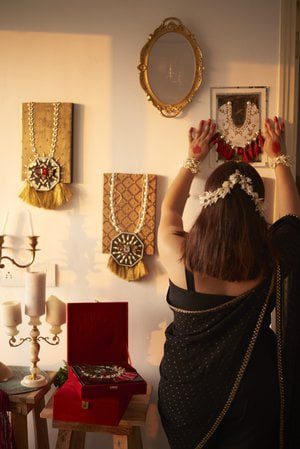
Arts to Hearts Podcast is a show delving into the lives and passions of renowned artists. From running creative businesses and studio art practices to cultivating a successful mindset, Charuka Arora engages in heartfelt conversations with her guests. Experience your personal happy hour with your favorite artists right in your studio.
Through candid discussions, Charuka and her guests reveal the joys and challenges of a vibrant creative life, both within and beyond our studios. Get ready to be inspired and uplifted as you tune in.
Lizzie Glendinning, Co-Founder & Curator of Woolwich Contemporary Print Fair. With 20 years experience of curating, collecting and directing within an arts and museum environment, Lizzie made the leap from running her own gallery, Brockeet Gallery London, to running her own art fair in 2016, when she founded Woolwich Contemporary Print Fair together with husband and business partner, Jack Bullen.
WCPF was inspired by the ‘New Collector Evenings’ Lizzie hosted at Brocket Gallery. Given the nature of editions, print-based works offered discerning new collectors the opportunity to purchase work at entry-level price points; learn about fine art techniques; discover new artists; develop tastes; and build confidence in talking about contemporary art and their choices.
Inspired by the Venice Art Biennale’s regeneration of their own Arsenale through fine art, Lizzie and Jack jumped at the opportunity to host WCPF at the UK’s own historic arsenal heritage site. Now approaching its ninth edition, the Fair continues to grow as a welcoming & interactive space for people to enjoy and engage with the best of contemporary print and support independent artists.
In this engaging episode of the Arts to Hearts Podcast, host Charuka sits down with curator and gallerist Lizzie Glendonning, co-founder of the Woolwich Contemporary Print Fair and founder of Brockett Gallery. Lizzie takes us through her journey, how she started, the decisions she never saw coming, and the unexpected ways her career has unfolded.
For someone now immersed in curation, galleries, and print fairs, Lizzie’s beginnings were rooted in something quite different: fashion. “I’m creative, I’m not an artist,” she says. “When I was younger, I wanted to be a fashion designer… but I couldn’t draw.”
That realisation nudged her toward art history and later, curating. The fascination remained: storytelling through visuals. A pivotal moment came when she visited an installation featuring costumes in a historic property—“I couldn’t articulate what it was, but I knew this is what I wanted to do.”
How a Temporary Project Turned into a Gallery
As Lizzie and her husband Jack—a printmaker and artist—teamed up for a few exhibitions, they stumbled upon a beautiful Georgian shop space. That led to what is now the Brockett Gallery. “I don’t like the word ‘pop-up,’” Lizzie says, “because it devalues the process. I wanted something beautiful and meaningful for emerging artists.”
Initially, a shared space with an antique shop, the gallery eventually became fully theirs. As Lizzie describes it, “Once it was just us, it felt holistic. It was our space.”
Starting a Print Fair Was Never Part of the Plan
The Woolwich Contemporary Print Fair didn’t start as a fully mapped-out venture. “We didn’t plan on starting a fair,” Lizzie explains. “We just had this amazing space and felt we needed to do something bigger than an installation.”
If you wait until everything’s perfect, you’ll never start
Lizzie Glendonning- Arts to Hearts podcast s05e04
As collectors themselves, both Lizzie and Jack had a love for original prints. But they realized that many people misunderstood printmaking. “People think of a print as something digital, something mass-produced,” she says. “But a print is an original work of art conceived as a print in the first instance. It’s not a copy.”
Their fair became not only a platform for artists but also a way to educate collectors—especially newer ones—on what goes into printmaking and why it matters.
When asked about the early struggles of running a gallery and starting a fair, Lizzie laughs, “We went into it naively. If we had known what it would take, we probably wouldn’t have done it.”
I’ve learned to really trust my gut. It’s usually right.
Lizzie Glendonning- Arts to Hearts podcast s05e04
But having a partner who’s just as adventurous made a difference. “Jack is brave. I come up with ridiculous ideas, and he says, ‘Okay, how do we make it happen?’” she shares.
They bootstrapped everything—from curating exhibitions to managing logistics—while also juggling freelance jobs to stay afloat. “I always had to work other jobs on the side, and that made it hard to feel fully invested in the gallery.”
The Printmaking Process Has a Life of Its Own
Lizzie’s admiration for printmaking is clear. “What I love is that moment where you take it out of your hands. You don’t fully control what comes out in the print. That’s the magic.”
She talks about watching artists who usually paint become fascinated by print. “It’s very process-driven but also full of surprises. That balance between control and unpredictability is what makes it special.”
Being visible is not about being everywhere—it’s about showing up consistently in the right places.
Lizzie Glendonning- Arts to Hearts podcast s05e04
You can’t be everything all the time
Lizzie is honest about the realities of working in the arts. “You can’t do everything. Some seasons you’ll be more of a business owner, sometimes more of a parent, sometimes more of a writer. It shifts.”
There’s no blueprint. Everyone’s journey in the art world looks different.
Lizzie Glendonning- Arts to Hearts podcast s05e04
And for artists trying to move forward, she has some grounded advice: “Be visible. Be consistent. And build systems for yourself. Not every artist needs representation now, but they do need structure.”
She encourages artists to understand the market, show up online, and take themselves seriously. “Collectors are watching, even if they’re quiet. So keep showing up.”
How to Connect with Lizzie and Her Work
For those interested in being part of the Woolwich Contemporary Print Fair, the Brockett Gallery, or the Brockett Residency, Lizzie encourages artists to visit the website and follow their Instagram accounts. Applications usually open early in the year, and all the information is made accessible there.
Lizzie’s story is a reminder that creative paths rarely follow a straight line. Whether it’s a missed drawing class or an unplanned gallery, sometimes you start, figure it out as you go, and let the work guide you. “We didn’t have a five-year plan. We just had ideas—and the willingness to try.”
Click here to read more about the Arts to Hearts Podcast and its episodes.
Listen to this & other episodes on
How Artist Sarah Fishbein Turns 1950s Romance Comics into Modern Paintings
Inside Susie Sprinkel’s Art Stories Woven with Fabric and Thread
How The Restless Creative Anita Clipston Turns Trauma into Art
Inside Radhika Gupta-Buckley’s Creative Journey with Indian Roots