
Inside the Anatomy of a Surrealist Who Traded Science for Storytelling | Rye Watts

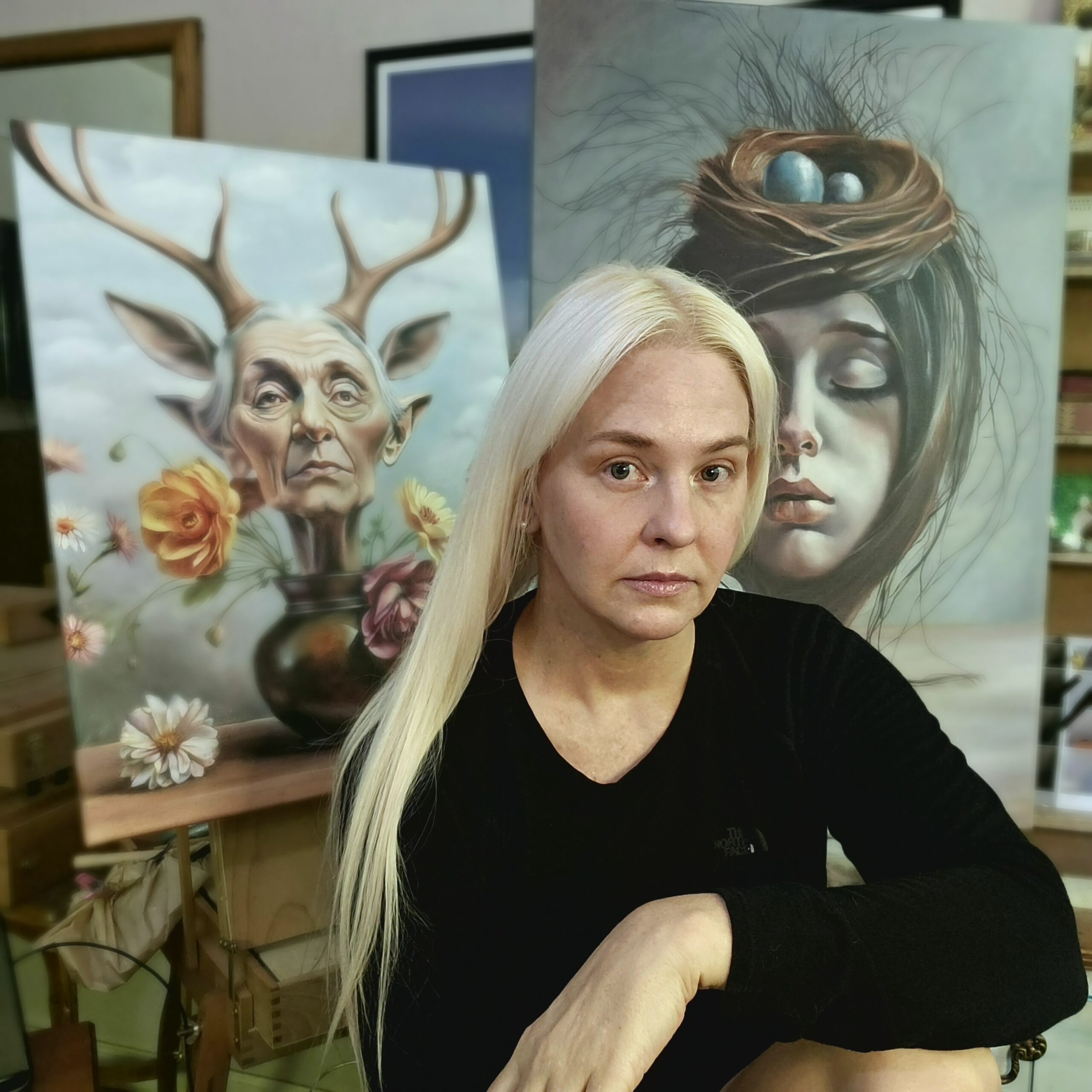
For this interview, as part of our Arts to Hearts Project, we spoke with contemporary surrealist painter Rye Watts, whose work blurs the line between the natural world and the inner world.
Living in the woodlands of the Pacific Northwest, Rye paints stories using animals, figures, and symbolic elements drawn from science, history, and philosophy. In this interview, she discusses how her background in biomedical science continues to influence her painting style, how cats have become her alter ego, and why switching materials keeps her practice fresh and exciting. We learn about the quiet systems behind her work—from sketchbooks filled with saved ideas to the way she builds frames by hand—and how her instinct guides when to start or end a series. Through it all, Rye shows us how painting becomes a way to explore life, identity, and everything in between.
Rye Watts is a featured artist in our book, “100 Emerging Artists 2025” You can explore her journey and the stories of other artists by purchasing the book here:
https://shop.artstoheartsproject.com/products/the-creative-process-book

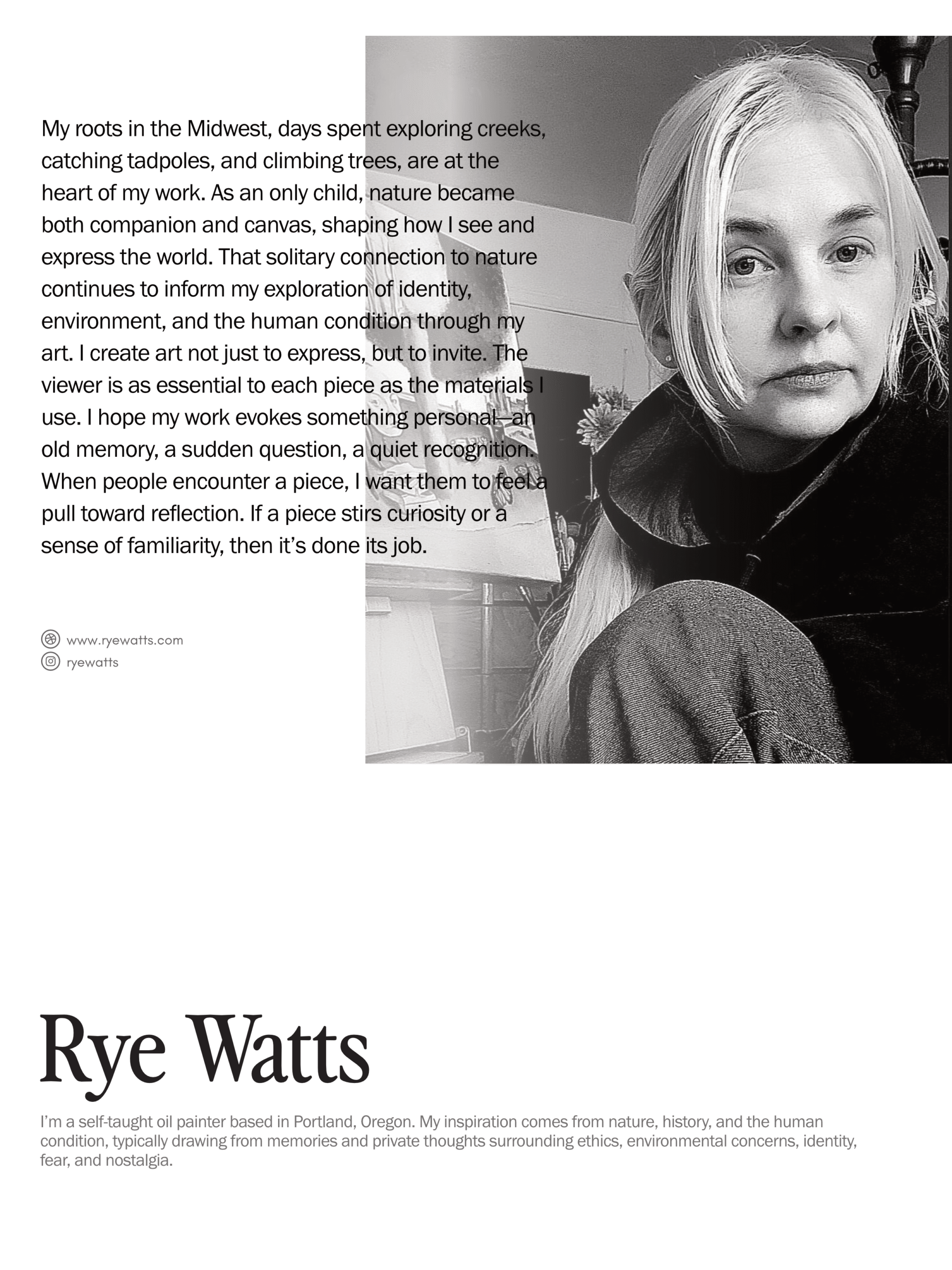
Rye Watts is a contemporary surrealist artist who lives and paints from her home in the woodlands of the Pacific Northwest. Her work is largely autobiographical, using symbolism and narrative to explore themes of ethics, identity, and the human condition. Her paintings are highly focused on storytelling and emotion. She often develops an entire series in text, sketch work, and collage before picking up a brush. A self-taught artist, Rye spent her childhood exploring watercolour and acrylic mediums before transitioning to oil and oil pastel. She continued her passion for art while pursuing her master’s degree in biomedical sciences. Rye began painting professionally in 2020 after retiring from a career in vaccine development.
Much of Rye’s inspiration stems from nature, philosophy, and history, drawing on memories and private thoughts that surround environmental concerns, spirituality, fear, and nostalgia. Her training in chemistry and anatomy continues to enrich her understanding of oils, pigments, and figure representation. She explores innovations in value and perspective to create spatial depth in her paintings and experiments with figure positioning, light, and blending to achieve movement and energy. She also enjoys woodworking and clay sculpting. Several of her pieces are painted directly into handmade wood or clay frames. Her work has been exhibited in galleries nationwide, featured in print articles and magazines, and sold to collectors in numerous countries, including the US, UK, Ireland, Canada, Australia, and Spain. Rye lives in Portland, Oregon, with her partner and a grey and white cat called Cloud.
1. Your work draws from science, history, and philosophy—how do these areas shape what you choose to paint?
I believe the influence of science, history, and philosophy on my work is akin to a layered conversation when it comes to the subjects I paint. It comes down to interest. I’ve been intrigued by these areas throughout my life, so they dictate what I choose to paint. Nature plays a huge role. Growing up in the midwestern U.S. surrounded by farms, lakes, insects, and all ranges of weather, nature became a close friend early on. I’m fascinated by how different cultures view nature, which can be revered, feared, or even controlled, and these ideas regularly appear in my work. My interest in both zoology and anatomy drives me to paint animals and human figures with a respect for how they move and exist in the world.
I enjoy depicting subjects in motion, in an awkward or active position that highlights the anatomy in a new way. I pay attention to how light interacts with the body, or how muscle and skeletal structure influence a character’s posture. History and philosophy have always fascinated me and often inform the narrative in my work, how I interpret and symbolise natural cycles, the spiritual versus corporeal, fragility, and power. Blending human traits with animal forms helps me tackle more intangible subjects, such as identity or the divide between instinct and reason. So, I guess I would say that these areas don’t just shape what I paint, but they shape the way I think about the relationships between the natural world, humanity, and the symbolic meanings we attach to everything around us.
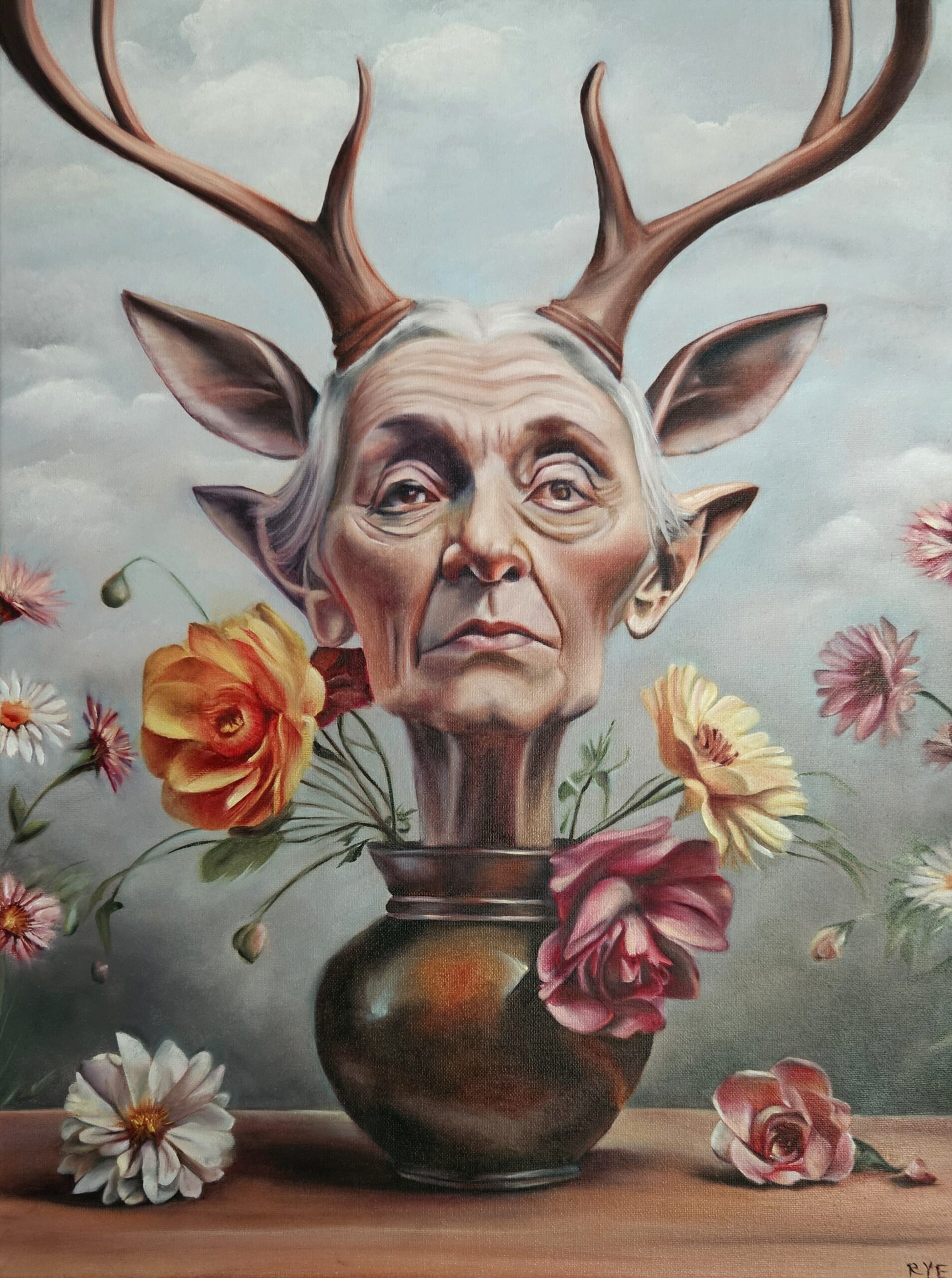
2. Many of your series seem tied to personal cycles—how do you know when it’s time to begin or end a theme?
I’m a very left-brained artist and try to schedule everything a year in advance, but as far as theme choice and timing, I’ve never been able to precisely schedule these (I wish I could). I aim for twelve works per series, all twelve based on an idea pulled from a collection of ideas that I may have written yesterday, last month, or three years ago. I have an eclectic assortment of ideas that I’ve gathered over the years. I write ideas down whenever they come to me. I collect ideas. The theme I chose for a new series is totally instinctual, just “which idea do I feel like exploring now?” This choice will be influenced by whatever I’m going through at the moment or whatever’s happening in the world. So yes, it is tied to personal cycles in this way.
Of course, my series rarely ends at exactly twelve works. Some are ten or eleven years old, some are fifteen or sixteen. The decision to stop one series and begin the next is also instinctual, very much dependent on what’s going on in my life at the time. I can just tell when it is time to begin or end a theme. I certainly fight for twelve paintings. I don’t just give up when I don’t feel like painting. I also don’t just keep going and neglect other ideas. But at some point, I just know it is time. In some cases, I am unable to continue a series. It’s like a paralysis. In other cases, I will start obsessing over another idea, feeling really energised
about it. That’s when I know it’s time to switch things up.
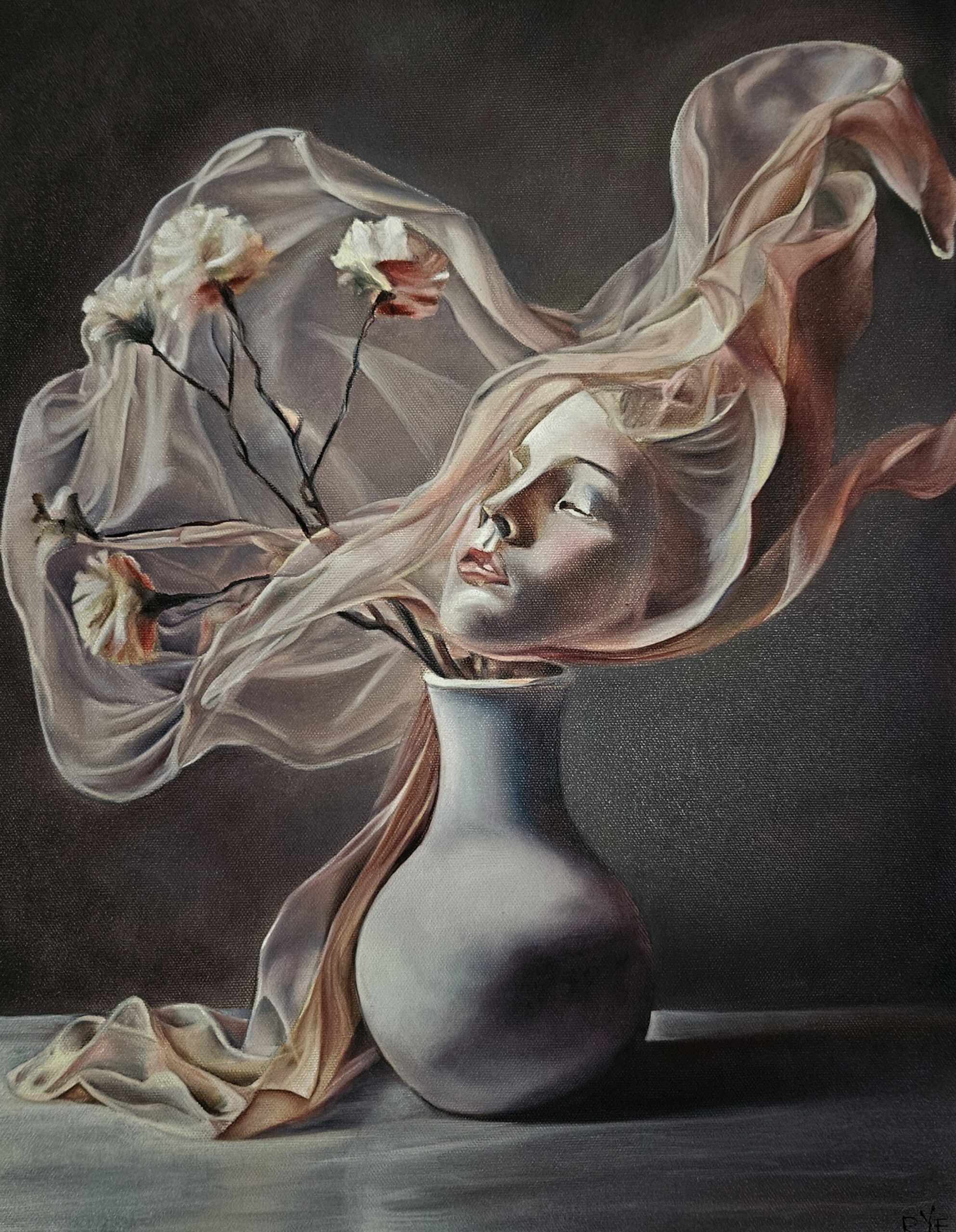
3. You often mix animals, figures, and surreal elements. What do those choices help you express that realism might not?
To me, surrealism offers a more open canvas. It allows me to express meaning beyond any limitations of realism. Combining animals or human figures and surreal elements helps me explore psychological and emotional landscapes in a way that I don’t know how to do with direct representation. For example, I’ll use animals to embody instincts, primal emotions, or symbolic roles in illustrating some human experience.
Human figures are significant for depicting personal or collective experiences, but the addition of surreal elements helps me to achieve a kind of universal resonance. Most of my work is not about what’s present, but what’s beneath the surface. Realism, for me, would ground the work too firmly in the literal, whereas the mix of these elements opens up space for interpretation and connection.
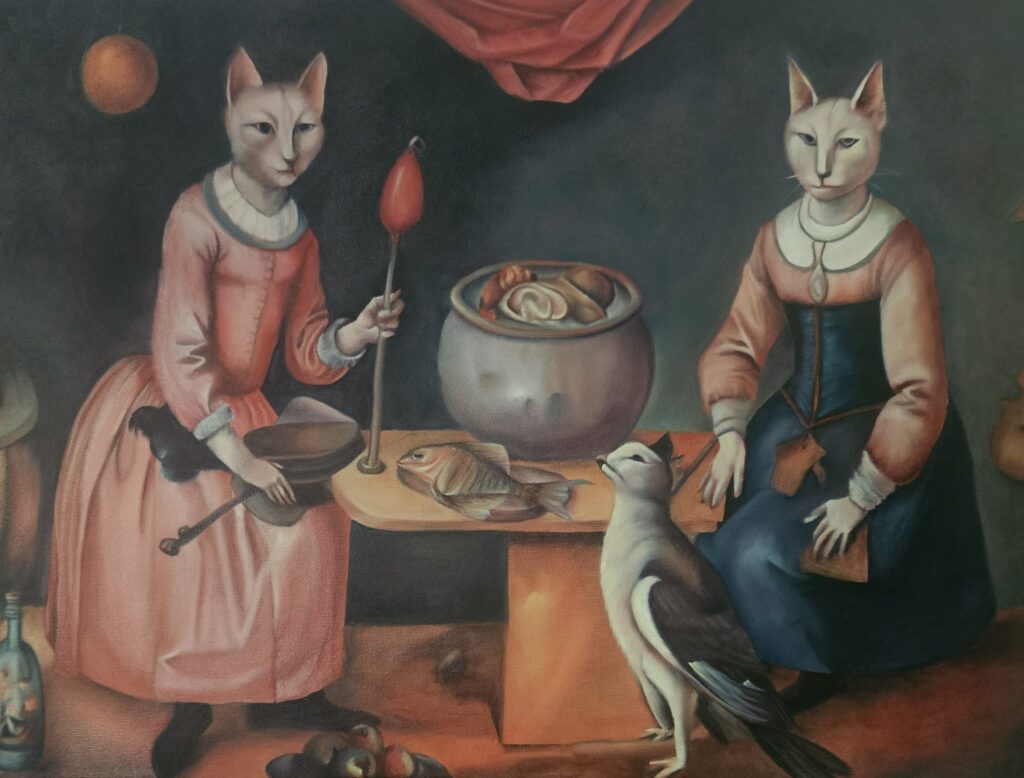
4. The “Cats” series uses the cat as a stand-in for you—what sparked that connection, and what are you still learning through it?
It’s funny. I actually grew up as a dog person. I didn’t seek out a cat as a companion until maybe ten years ago. But on paper, cats have always been present. I drew Dinah from Alice’s Adventures in Wonderland repeatedly as a child. In college, I became fascinated with the goddess Bastet and the sacred cats of Ancient Egypt. And then there is the maneki-neko of Japan, as well as the black cats of folklore and superstition. Eventually, for me, cats became a symbol of “life between.” In trying to express the complex space between spiritual and physical worlds, cats did it for me.
I suppose working with cats as subjects has taught me to embrace my contradictions as a source of their strength. In a way, cats are these quiet rebels. They strike a balance between their need for solitude and their desire for connection. Same. I see them as a kind of alter ego, a reflection of myself, but also a guide. They serve as mirrors for whatever I fear, value, or long to understand. They’re both wild and tame, playful and predatory, soothing and fierce. I continue to use cats in my paintings (I’m painting one today).
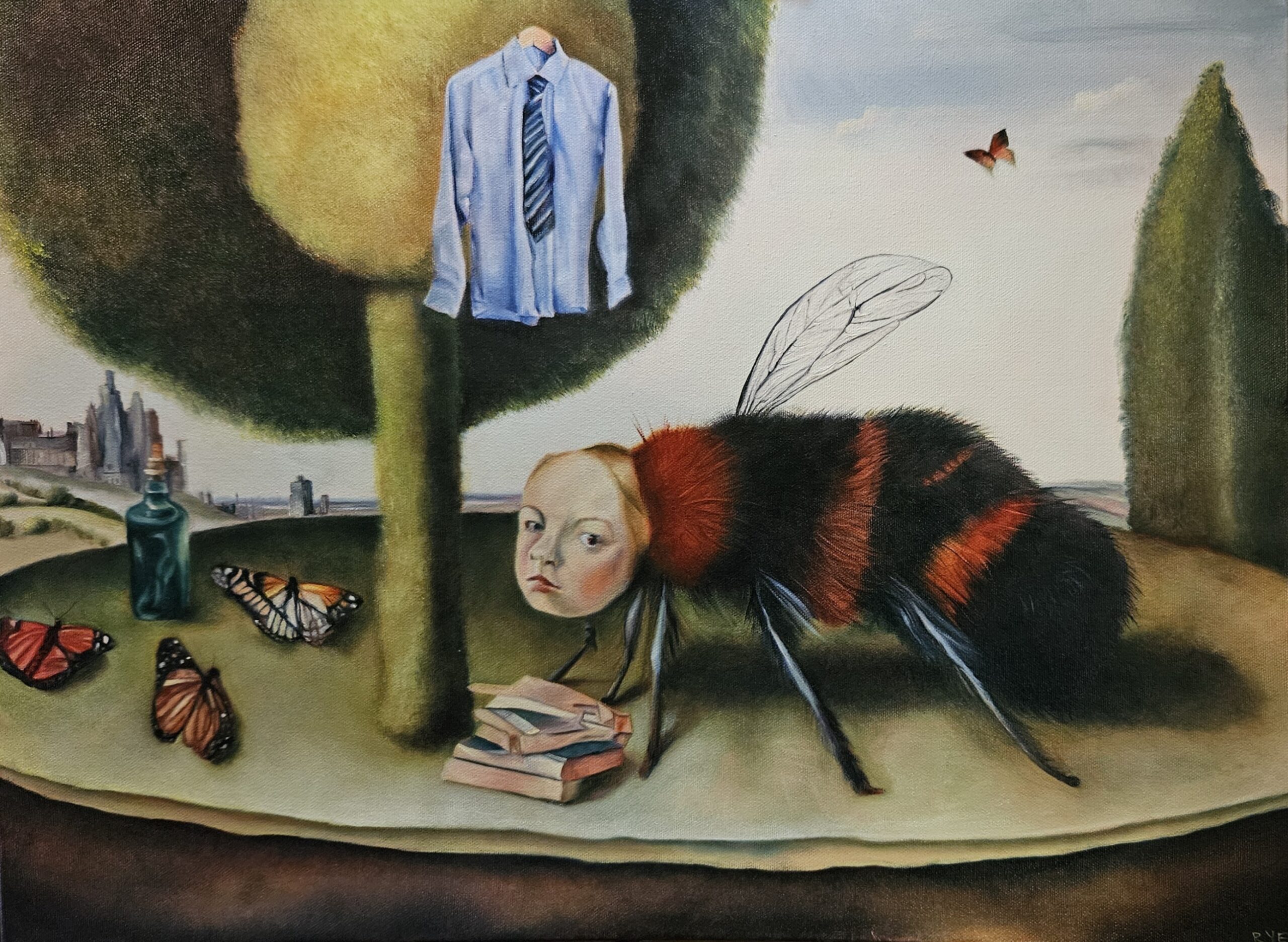
I collect ideas. The theme I choose for a new series is totally instinctual, just ‘which idea do I feel like exploring now?
Rye Watts
5. You work with oil and oil pastel, and even build your frames—how does working across materials affect the way you think about the finished piece?
Working across materials is a source of adrenaline for me. It’s easy to get comfortable with one set of materials. But cosy is not necessarily what I’m going for. So I push myself into uncomfortable situations. The switch in materials is more about shaking things up here in the studio than what the finished piece will look like. To me, building handmade frames from wood or clay is “dangerous” because it takes away from my painting time.
Shifting between wood, linen, and canvas, or using oils versus pastels, shakes things up because it takes time to adapt to the new materials. Any disruption of painting time is my version of living on the edge. Sticking to the same materials is smooth sailing. Shifting between materials creates waves, rocks the boat. And now and then I’m in the mood for that. I’m not so much thinking about the final product. I am confident that the finished piece will work. Because if it doesn’t work, it isn’t finished.
6. Science taught you about anatomy and chemistry—how do those skills show up in your studio on a regular day?
My background in anatomy gives me a kind of shorthand when working with the figure. I don’t have to research or second-guess the structure underneath the skin. I understand how muscles wrap around bones, how weight shifts through the hips or shoulders. This understanding enables me to employ exaggeration or abstraction without compromising the believability of my work. On the chemistry side, it’s everything—the paint itself, medium, solvents, surface preparation, paint layering, varnish, all that. For example, I’m big on blending, but also visible brushstrokes.
Surface preparation and medium are critical in making the paint work for me. The interactions between paint and various surfaces and mediums vary significantly. Absorption is different; the tooth is different. Pigment is another one. I use only four pigments in my work, allowing me to create a vast spectrum of colours without neutralising or losing saturation. Of course, every painter has their methods and go-to materials. And just like me, they likely developed those methods through years of trial and error. Ultimately, experimentation is the most effective way to learn how to manipulate paint. Still, I believe my training saves me time in troubleshooting and research.

Rye Watts’s paintings are stories built from memories, thoughts, and questions about what it means to be human. She employs animals, figures, and surreal settings to explore identity, change, and the complex relationship between nature and humanity. Through her work, we learn how science and creativity can coexist, and how personal history can influence the creations we produce. Her journey reminds us that it’s okay to follow our instincts, change direction, and make space for curiosity. Rye’s process shows how structure and spontaneity can work together to create something meaningful.
To learn more about Rye, click the following links to visit her profile.
Arts to Hearts Project is a global media, publishing, and education company for
Artists & Creatives: An international audience will see your work of art, patrons, collectors, gallerists, and fellow artists: access exclusive publishing opportunities and over 1,000 resources to grow your career and connect with like-minded creatives worldwide. Click here to learn about our open calls.