


How These 6 Artists Show The Many Moods Of The Sea
👁 267 Views
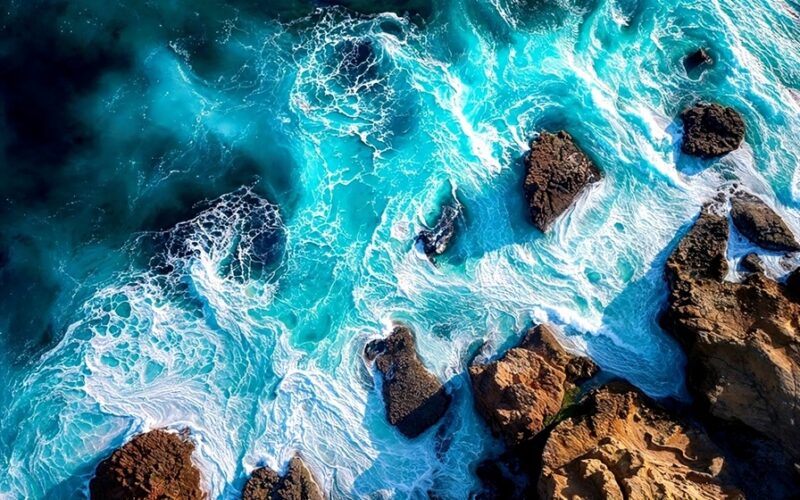
Across horizons and heartlines, the ocean has always been more than water it’s a mirror of emotion, a language of rhythm and depth that artists have tried to translate for centuries. In their hands, waves become words, tides become thoughts, and color becomes memory. Each brushstroke feels like a heartbeat beneath the surface, capturing the movement of something vast and alive.
Seascape artists don’t just paint what they see; they paint what they feel the quiet between waves, the pull of the horizon, the light that changes everything. Through blues, silvers, and infinite gradients, they remind us that the sea is both constant and changing, wild yet calm, near yet unreachable.
Their canvases hold the sound of distant tides, the whisper of wind, and the shimmer of reflection. From gentle coastlines to stormy depths, they trace the stories that water tells of longing, surrender, and renewal. These artists turn the infinite expanse of the ocean into something human: a space where we can see ourselves drift, anchor, and begin again.
At the Arts to Hearts Project, we celebrate these artists who turn tides into texture, who let the sea speak through their hands. Their work invites us to pause, breathe, and listen to the waves outside, and the ones within.
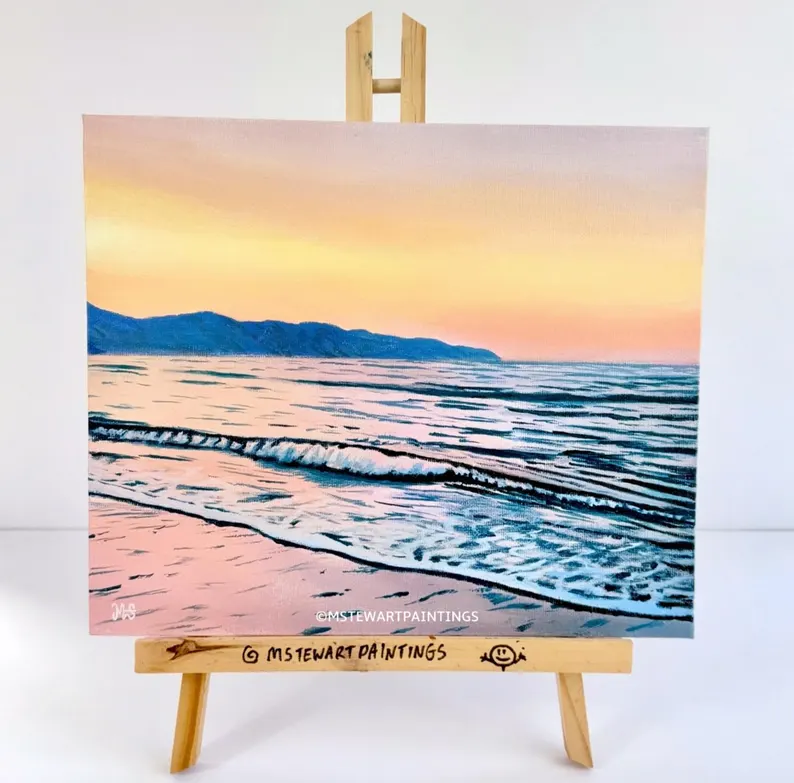
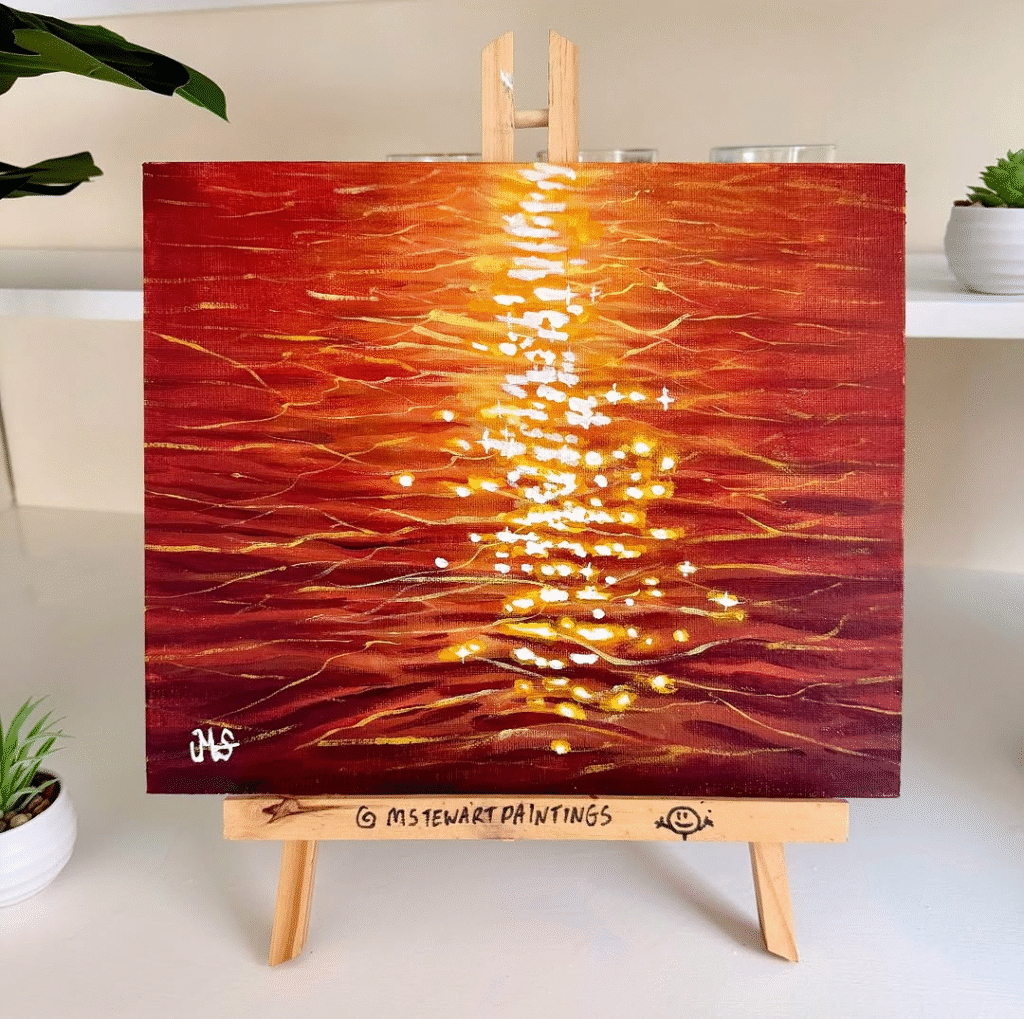
Murray Stewart @mstewartpainting
Murray Stewart paints the sea as if translating its language wave by wave, light by light. Fittingly, the sea runs deep through his life as well as his art his very name, Murray, means “by the sea”. Based in the UK, his canvases capture the moment where water and sky meet in motion, always shifting yet endlessly familiar. His seascapes hold that fragile balance between calm and storm, turning the ocean’s surface into emotion, each brushstroke a tide, each reflection a heartbeat of light. Working primarily in acrylic and oil, Murray transforms his deep love for the natural world into luminous compositions that feel both vast and intimate. His paintings breathe with atmosphere, translucent waters, rippling skies, and horizons aglow with quiet fire. You can almost sense the salt wind, the hush before the next swell, the golden flare of a disappearing sun. Light is his language not just a means of illumination, but a form of storytelling.

Through delicate layering and tonal harmony, Murray captures the rhythm of the sea: the slow inhale of the tide, the shimmer of dawn, the soft fade of dusk over water. His canvases dissolve boundaries between space and feeling, transforming walls into windows toward the horizon. What defines his work is intimacy within grandeur. Though his subjects are expansive, his paintings invite stillness a pause to listen to the hush beneath the waves, to rediscover the coastline as something both eternal and fleeting. Beyond his studio, he shares that connection through seascape painting workshops and tutorials, helping others learn to see with awe and paint with light. He also offers free tutorials on painting water and seascapes on his YouTube channel, a resource for anyone who feels the same pull toward the ocean’s edge. For Murray Stewart, the sea is both subject and storyteller. Each painting becomes a quiet conversation between movement and stillness, a reminder that beauty lives in the in-between: in the crest of a wave, in the meeting of colour and reflection, in the eternal pull that draws us back to the water.

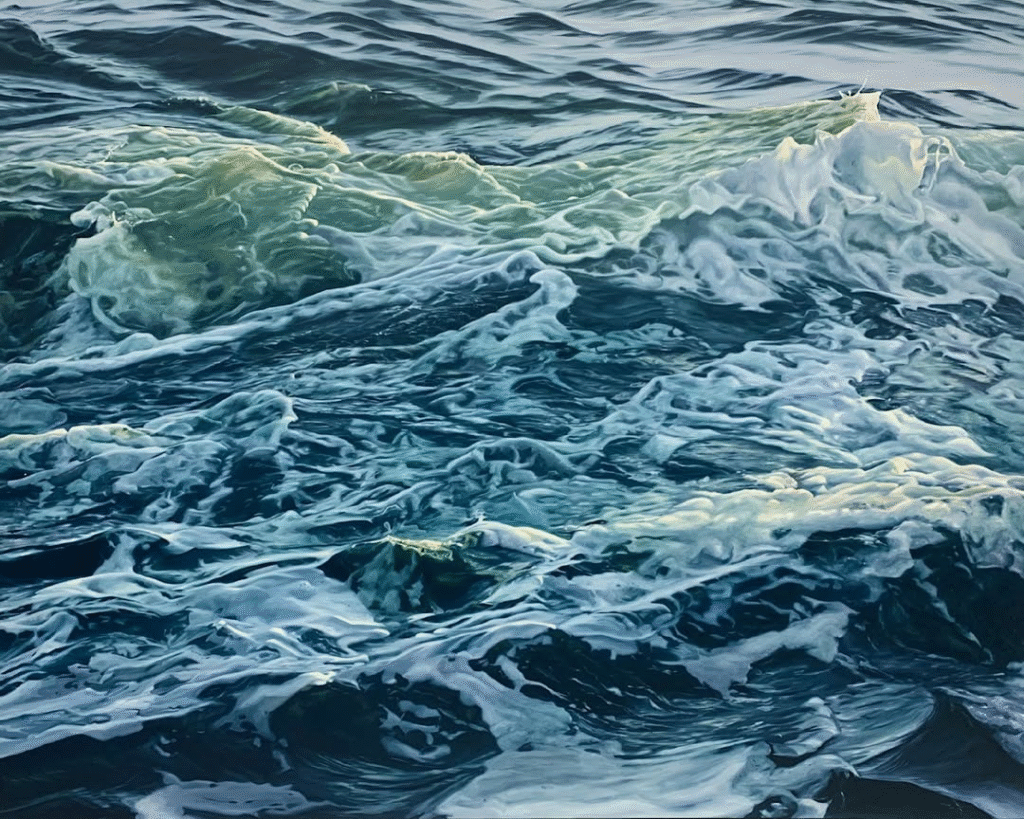
Gianluca Cremonesi @gianluca_cremonesi_art
Gianluca Cremonesi brings the sea’s power into stillness, each painting a moment of wave and light caught between surge and hush. Based near Milan in northern Italy, his studio becomes a place where oil on canvas translates the sea’s voice. According to his own words: “Recently I like to paint stormy seascapes with strong waves and vibrant colors. Cremonesi’s art is rooted in realism, yet there’s something more at play: the sea in his work is not simply depicted, it is interpreted. He writes of capturing emotion, of letting the viewer feel the sea’s mood rather than just see its form. His seascapes often lean into intensity waves curl, foam explodes, light fractures on water. Yet they also invite reflection. Whether a turquoise wave lit from within or the dark surge of a storm-tossed horizon, his canvases ask us to pause, to sense the rhythm beneath the surface.

What makes his practice stand out is the combination of realism and moment-feeling. There is a meditative power in Gianluca’s art, a dialogue between energy and stillness. His waves rise and fall like thoughts; his colors carry the scent of salt and wind. Sometimes the sea glows with violet dusk, sometimes it roars in shades of steel and foam but always, it holds the same truth: beauty exists even in turbulence. For Gianluca, painting is a connection, an act of empathy between artist, ocean, and observer. He once wrote that his greatest satisfaction is knowing someone feels the same emotion when looking at his work. That intimacy, that shared recognition, is what gives his paintings their quiet strength. Through his seascapes, Gianluca Cremonesi reminds us that the sea is not merely a view to admire, it is an emotion to experience. His art carries the heartbeat of the water itself, an unending song of depth, light, and resilience.


Debbie Daniels @debbiedaniels4567
Debbie Daniels brings the ocean into sharp, vivid focus, painting not just sea and sky but the finer details where wave meets rock, motion meets stillness. Based in Friday Harbor, Washington, her large-scale oil canvases draw on the landscapes of the San Juan Islands and the Tampa Bay area, rooting her work in places where water, light, and land converge. Self-taught and deeply intuitive, Debbie has spent over three decades exploring the language of water. Her process often begins outdoors kayaking, paddle-boarding, or walking along the shoreline before returning to her quiet studio, where memory and movement merge. As one profile beautifully noted, she “freezes the movement of water to preserve the delicacy of a fleeting moment in time.”

Her practice is anchored in photorealism waves, ripples, boats, and reflections rendered with near-tactile precision yet her work transcends mere depiction. Each painting invites the viewer not only to see the sea, but to feel it: to sense the cool hush beneath the surface, to follow the rhythm of light and shadow, to hear the pause between one swell and the next. In her words, she paints not just what the sea looks like, but what it is: a meeting of motion and stillness, of energy and calm. Every wave she paints holds a moment of transition: a crest about to fall, a reflection about to shift, a colour about to fade. Through her work, Debbie Daniels transforms the ocean into a meditation on time and transformation reminding us that even the smallest ripple carries the vast, unending story of the sea. What defines Debbie’s art is her balance of precision and mood. The sharply rendered texture of sea foam meets the calm suggestion of a horizon at dusk; the flicker of light on water meets the stillness that follows motion. Her large-scale oils pull the viewer in look long enough, and you’ll feel the swell, the salt, the hush after the crash.


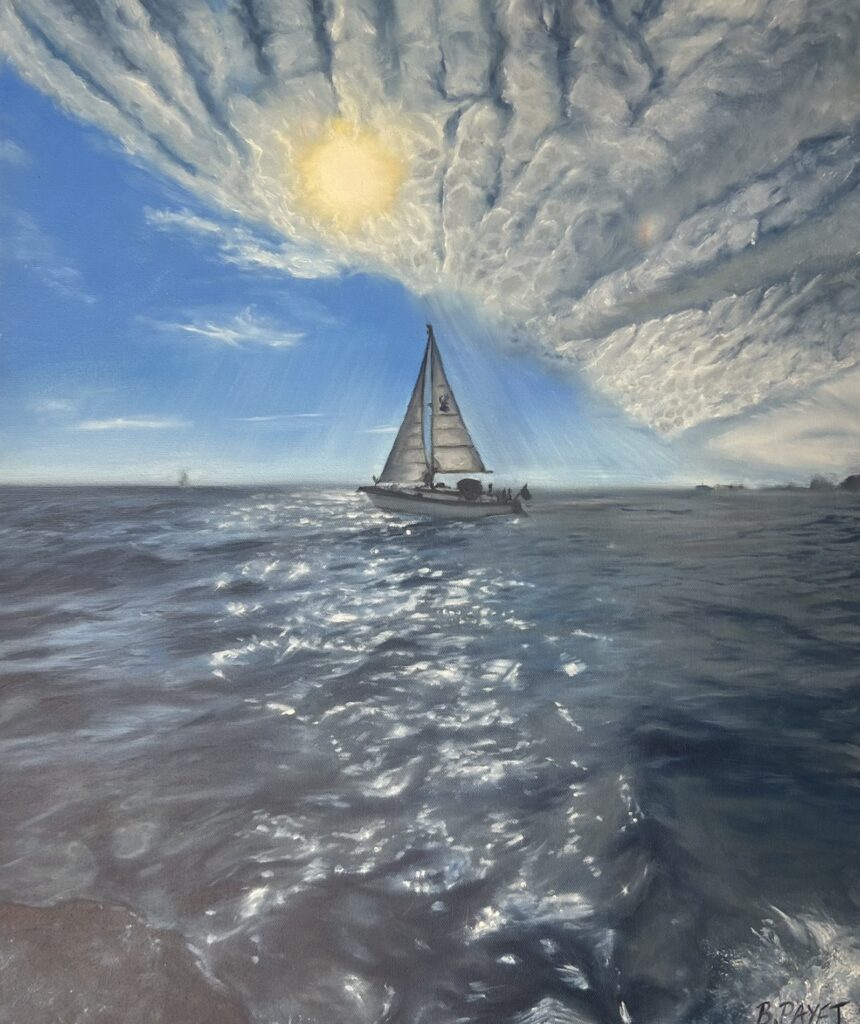
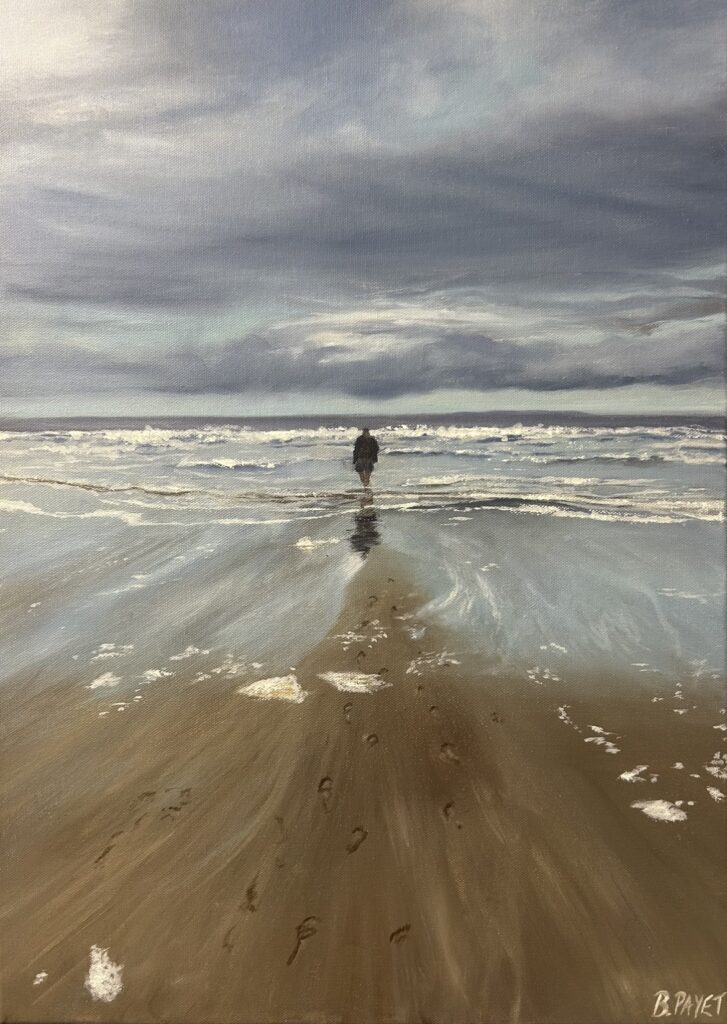
Bethany Payet @bethanypayetartist
Bethany Payet doesn’t paint grand gestures. She paints moments that most of us would walk past the way light reflects on ripples, the hum of color amongst clouds, the soft light that lingers after evening has gone. Based in Liverpool, she moves through her surroundings with quiet attention, letting ordinary scenes open themselves to her. Her paintings feel lived in not staged or distant, but familiar in the way real places are: messy, fleeting, full of light that won’t stay still. She paints the pale sky reflected in water, the tilt of flowers in the wind, the movement of waves. Each canvas feels like a held breath, that small, private moment before something changes. Bethany studied her BA in Fine Art in Lancaster, going on to teach the subject for 5 years alongside her practice. Her process is as unhurried as her images. She begins by walking through meadows, along the shore, in gardens taking in light and shape without needing to capture them right away. Later, in her studio, she paints from what stays behind: not just the view itself, but the feeling it left. The quiet that follows rain. The echo of color after sunset. The chaos and stillness of changing tides.
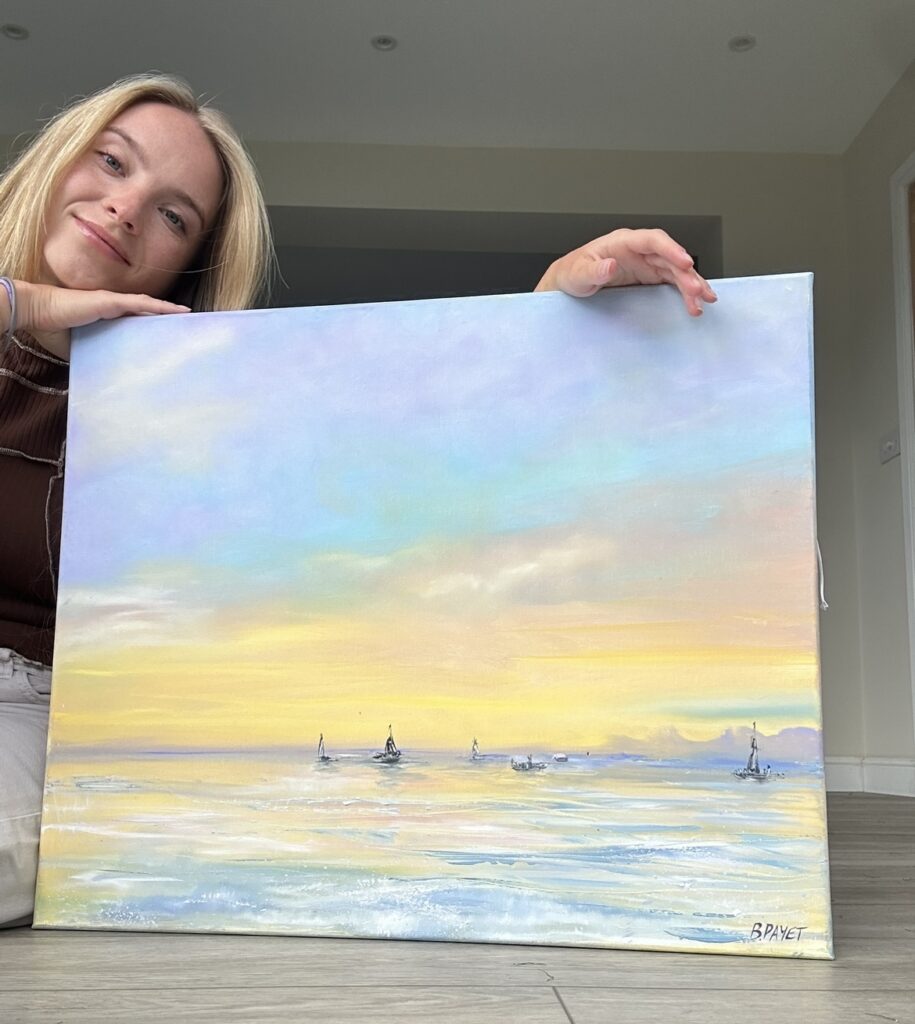
There’s nothing shallow in her approach. Every brush stroke relies on strong intuition and emotional depth. Her palette is soft and honest cool pastels combined with delicate yellows that hold warmth, blues that breathe, a flicker of red or gold when emotion calls for it. Her brushwork doesn’t try to impress; it listens. Each stroke feels like a conversation between what she saw and what she remembers. Bethany’s paintings are about noticing. They’re reminders that beauty doesn’t have to announce itself; it’s in the corner of your eye, in the sound of the tide, in the reflection you catch just before it disappears. Her work slows you down. It asks you to look again, more gently this time. There’s something deeply human about that. In a world that moves too fast, her paintings give you permission to stop. They hold space for quiet, for softness, for the kind of beauty that feels like exhaling. Bethany Payet paints what it means to be here alive, aware, standing in a patch of shifting light and in doing so, she makes the simple act of looking feel like belonging.

Ginger Lianne @gingerlianneart
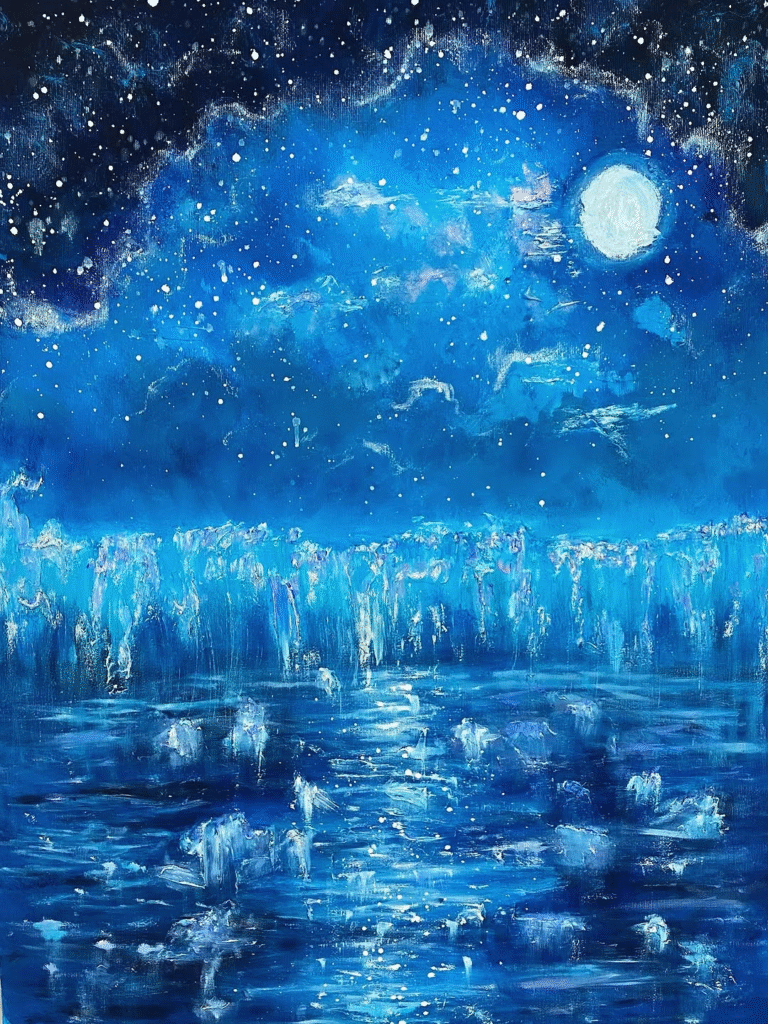
For Ginger Lianne, the ocean isn’t just a subject, it’s a mirror. It reflects everything she’s lived through calm and chaos, loss and renewal, fear and release. When she paints the sea, she isn’t painting a view. She’s painting the inside of her own experience, the tide of memory, the weight of silence, the slow rhythm of healing. Based on the rugged Gulf Coast, Ginger’s art carries the pulse of water in every stroke. Her seascapes are not bound by horizon lines or photographic accuracy; instead, they flow between abstraction and impression, between what is seen and what is felt. You can sense the undertow in her brushwork, the scraping, layering, and soft blending that mimic how the sea erases and remakes itself, again and again. Her palette shifts like tidewater: moody greys, deep teals, pale blues that fade into warmth each color carrying its own current of emotion. She works in layers, sometimes adding sand or texture medium, sometimes peeling paint back with a palette knife until the rawness beneath shows through. It’s a process of uncovering, not covering. The sea becomes both canvas and language, an open space where emotion finds its form.
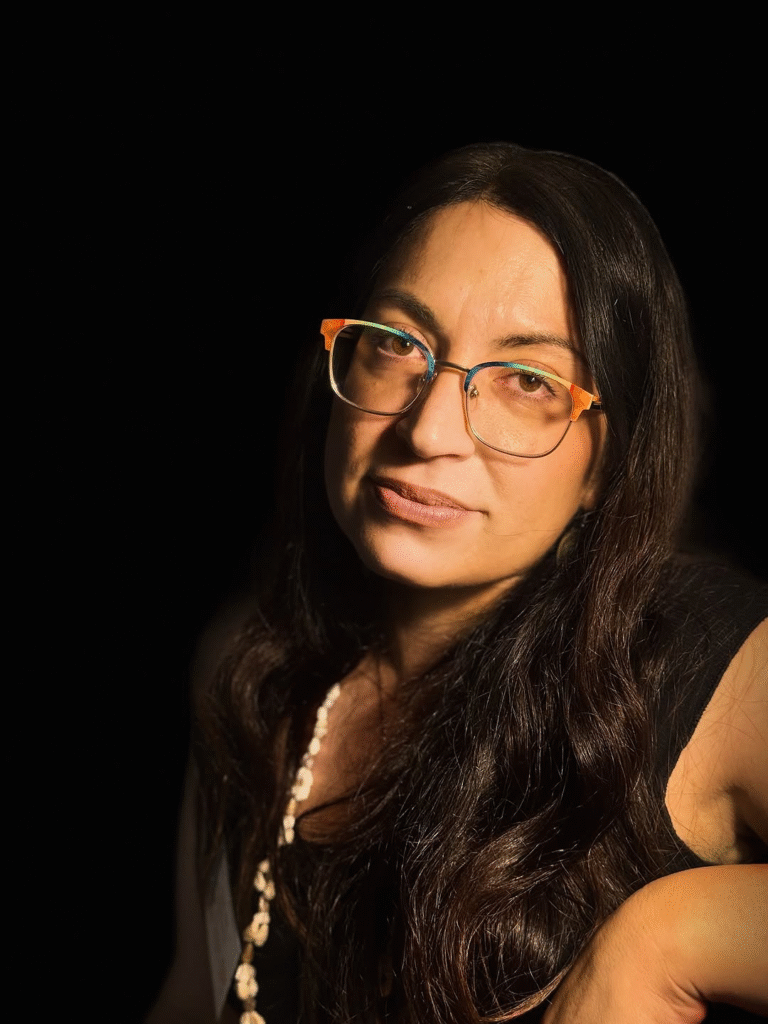
For Ginger, painting is survival made visible. She began creating as a way to heal to move through trauma, to let feelings take shape when words couldn’t. The sea offered her a kind of truth she could hold onto. In its depth and motion, she found both vulnerability and power. Her seascapes, though often serene at first glance, are full of movement, a quiet strength that comes from having known storms. Each piece is a meditation on balance: turbulence and calm, loss and light, destruction and renewal. Look closely, and you’ll see where a wave softens into mist, where the surface breaks just enough to show what lies beneath. Her paintings don’t just depict water, they breathe it. You can almost hear the low, steady rhythm of tide pulling back, the space between swell and stillness. Her art reminds us that water is both force and refuge, that healing, like the tide, is not a single moment but a continuous return. Standing before one of her canvases, you don’t just see the sea, you feel its pulse in your chest, its weight in your breath. Through her seascapes, Ginger Lianne gives us more than a view of the ocean. She gives us a way back to ourselves to that quiet place where motion meets peace, where the storm has passed but the sky still remembers.


Tanvi Parulkar @tan.we.not
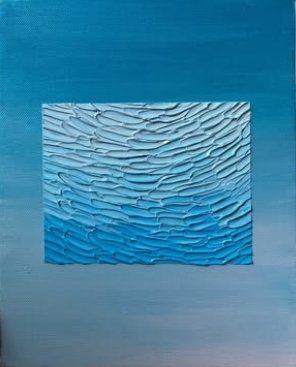
Tanvi Parulkar paints not just what she sees, but what she feels transforming the sea into an emotional landscape of memory, rhythm, and reflection. Based in Mumbai, she draws inspiration from the coast that cradles the city, translating the shifting moods of the ocean into delicate, layered works that breathe with movement and light. Her art lives in the spaces between tides, the pause after a wave retreats, the shimmer before another begins. Working across painting and sculpture, Tanvi’s practice bridges the material and the ephemeral. Each piece becomes a meditation on water, its stillness, its depth, its quiet power to reshape everything it touches. On her Instagram, her world unfolds in soft gradients and tidal tones, waves of blue and light flowing across paper and form. She captures the sea’s infinite expressions: its calm, its churn, its silken horizon as if translating its unspoken language into colour and gesture.

Vulnerability meets craft in her process; as she once shared, art for her is “both a rehearsal and a release.” In each brushstroke and curve, you can feel that release the moment where water becomes emotion, and light becomes memory. In her sculptural work, Tanvi speaks of “a mix of familiar and new materials coming together,” a reflection of the sea’s own duality ever-changing, yet eternal. This sense of exploration defines her art: a willingness to risk, to drift, to rediscover. Light, for Tanvi, is not simply illumination; it is the pulse of the ocean itself, a measure of depth, a ripple of time. Her pieces don’t shout; they breathe. They hold the quiet between two waves, the hush before the next swell, the glimmer of reflection that turns water into feeling. Each work she creates becomes a shoreline, a meeting place of light and longing, of material and emotion. Her art reminds us that the ocean is never still; it lives, like feeling itself, in motion forever returning, forever becoming.


Across these artists’ works from Cornwall’s tidal hush to Washington’s glimmering shores, from the Mediterranean’s sunlit depths to the imagined horizons born in studio light the sea becomes more than a subject. It becomes a mirror. Each brushstroke captures what words rarely can: the pulse beneath the tide, the silence between waves, the infinite conversation between motion and stillness. In every painting, we glimpse not just water, but emotion light bending, memory surfacing, reflection made visible.
Through their seascapes, these artists remind us that to look at the ocean is to look inward. Its surface holds our restlessness, our calm, our constant search for meaning. And perhaps that’s why we return to it again and again because somewhere within its depth, we recognize our own.