
Why Zhou Song thinks the Black Hole is the perfect metaphor for art itself

At Arts to Hearts, we have always believed that the most important art is the art that arrives slightly ahead of its time that is already grappling with something the rest of the world is only beginning to feel. That is what our Best of the Art World editorial was built for. And honestly, when we found Zhou Song, we felt exactly the way we hoped we would feel when we started this series.
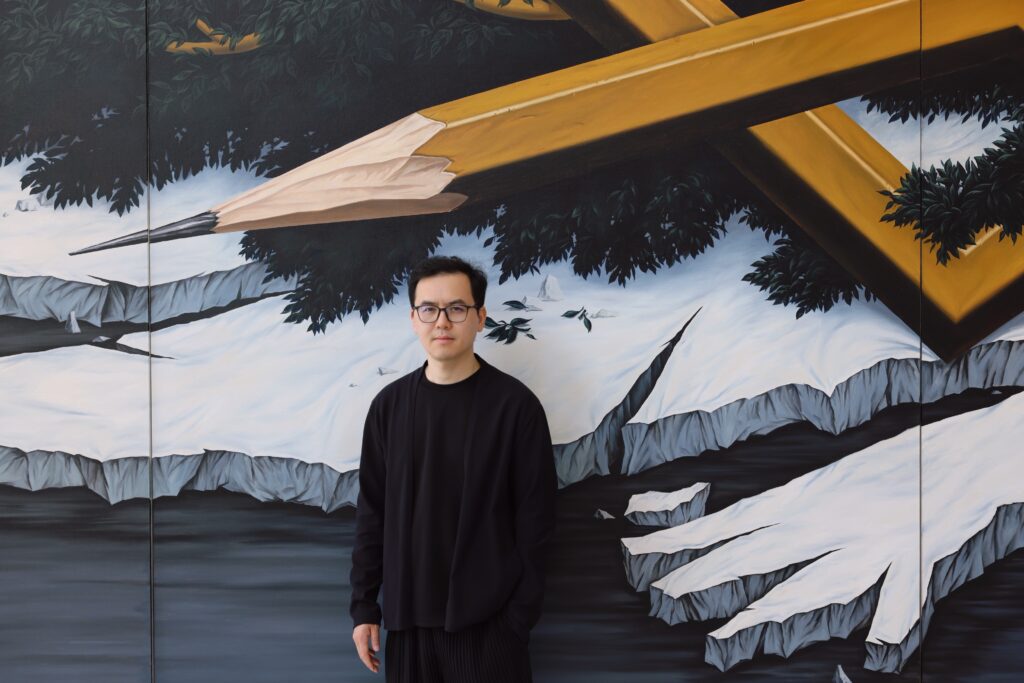
Zhou Song was born in 1982 in Jiangxi, China, and graduated from the Tianjin Academy of Fine Arts in 2006. In the two decades since, he has built a practice so rigorous, so philosophically serious, and so visually extraordinary that the international art world has been taking notice in the most significant ways.
His work is held in the collections of Harvard University’s CAMLab, Fondazione Benetton Studi Ricerche, the Osthaus Museum Hagen, the Center for Contemporary Art Bonn, and Aurora and Powerlong Museums in Shanghai, among many others.

He has had solo exhibitions at some of the most respected institutions in the world Tang Contemporary Art in Beijing, the Aurora Museum and Powerlong Museum in Shanghai, and the Osthaus Museum and Center for Contemporary Art in Germany. And a solo exhibition at the National Gallery of Modern and Contemporary Art in Rome is forthcoming. He is, in every measurable sense, an artist operating at the very highest level of international contemporary art.
But what his biography cannot fully tell you is what standing in front of one of his paintings actually feels like.
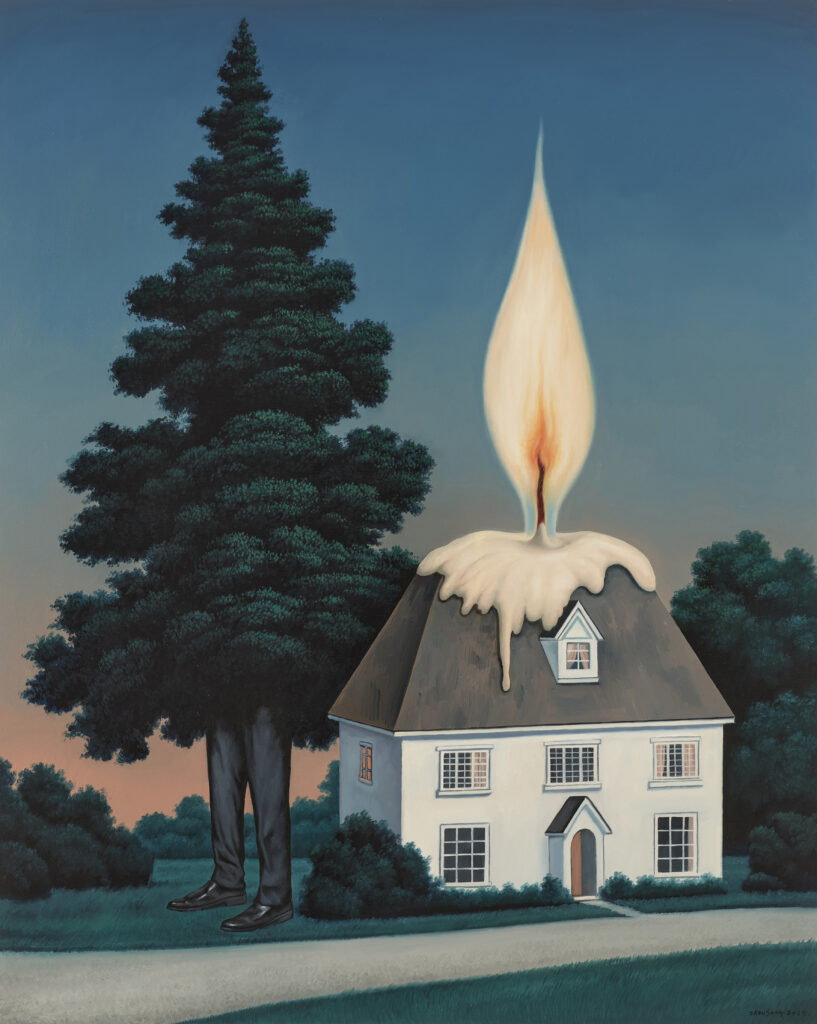
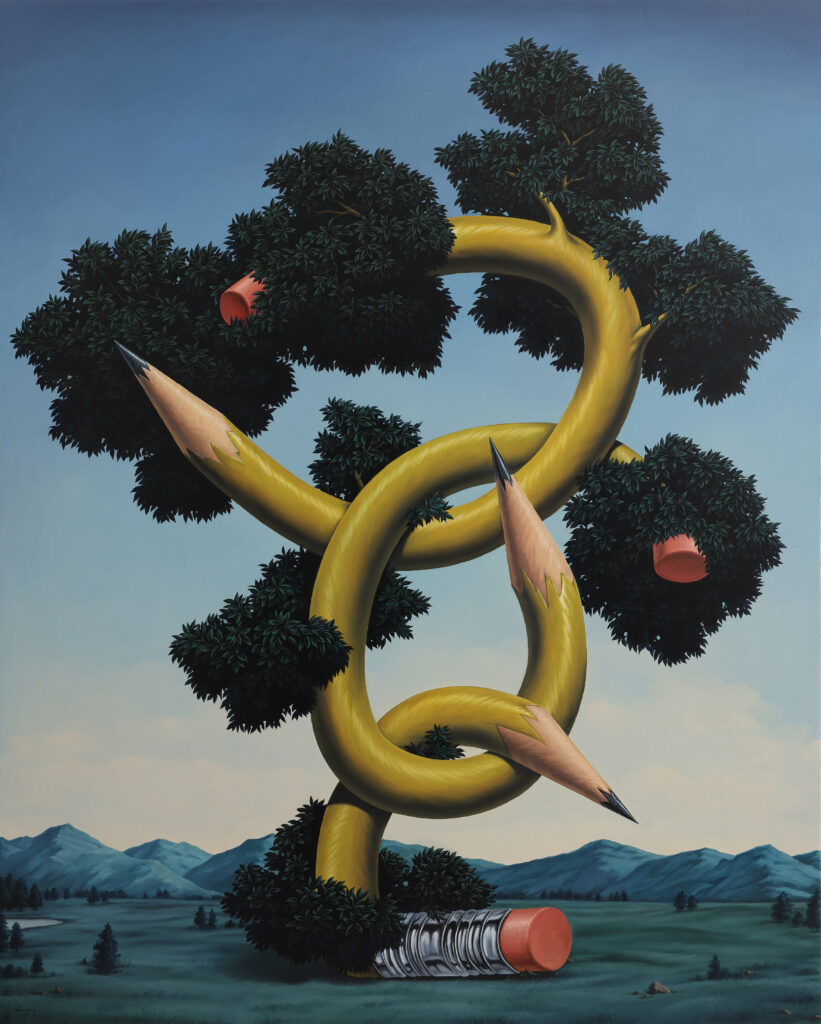
Zhou Song’s canvases exist in a space that is genuinely difficult to describe somewhere between science fiction and philosophy, between the observable world and the completely unknown. His paintings combine organic forms and mechanical structures, human bodies and cosmic forces, the recognisable and the alien, into images that feel less like representations of things and more like visual arguments about the nature of reality itself.
His practice has moved through three major bodies of work, the Red Field series, the Entropy series, and his current New Nature series each one a response to a different set of urgent questions about technology, civilization, and what it means to be human in a world that is changing faster than we can understand.
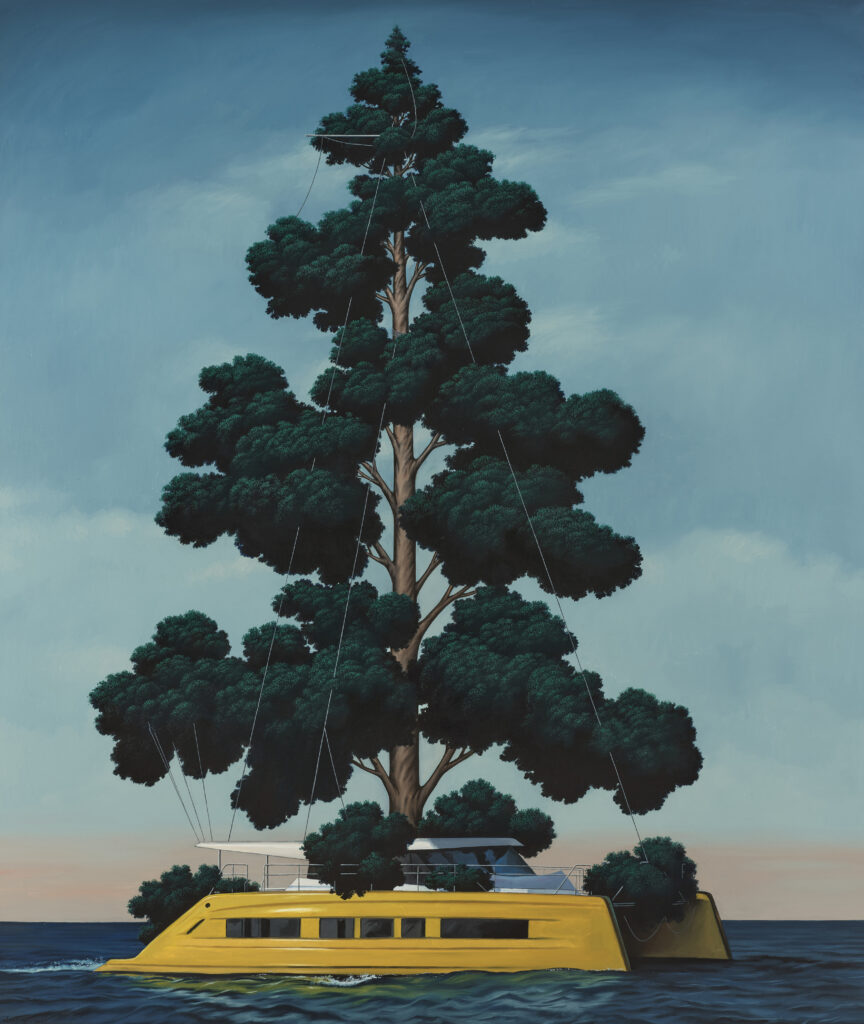
And that is precisely what makes his work so extraordinary right now. He is not painting a distant future. He is painting the present the moment we are already living in, where the boundaries between nature and technology and artificial intelligence and human desire are becoming impossible to separate.
His work does not answer those questions. It gives them form. And in doing so, it does what only the most serious art can do. We are genuinely in awe of what he is building. And we cannot wait for you to encounter it.
Let’s get to know Zhou Song through our conversation with him, where he talks about entropy, black holes, the new nature of nature, and what it really means to paint questions that have not yet been fully answered.
Q1. Zhou, looking back at your journey since graduating from the Tianjin Academy of Fine Arts, how have your questions as an artist evolved?
At the beginning, I was questioning what art essentially is, and where the boundaries of art might lie. When I had just graduated, I was more focused on the language of painting itself—how an image comes into being, and how technique can support the construction of a visual world. But as my practice developed over time, I gradually realized that art is not only a question of form or technique. It is more deeply connected to how one understands the world, how one understands reality, and how we confront the shifting spiritual conditions of our time.
Over more than twenty years of artistic practice, my work has roughly gone through three important stages. The first was the Red Field series. During that period, I was more concerned with the relationship between reality, the body, social experience, and imagery, trying to establish a certain tension between realism and surrealism. The second stage was the Entropy series, in which my attention turned toward technology, machines, artificial intelligence, and the uncertainty of human civilization. I began to think about what position humanity might occupy in a world increasingly accelerated by technology.

The third stage is the New Nature series, which has become my most important direction in recent years. It further brings together nature, technology, artificial intelligence, cosmic order, and post-human imagination. So these questions have continued to change. In the early stage, I was more concerned with how painting could break through the boundaries of image and technique.
Later, I gradually shifted toward questions about the human condition, technological civilization, and the future state of the human spirit. Now, what interests me most is this: when nature is no longer simply nature in the traditional sense, and when technology, AI, and human desire have all become part of our real ecology, how should we understand life, nature, and humanity itself? For me, artistic creation is a continuous process of moving through different stages in order to approach questions that have not yet been fully answered.
Q2. What first sparked your interest in combining science fiction and philosophy to imagine possible futures?
Human civilization in the twenty-first century is undergoing enormous technological transformation. In other words, we are already in the process of evolving into a post-human stage. Artificial intelligence, life sciences, space exploration, and various new technologies are changing the way we understand the body, nature, life, and reality. Against this background, both the real condition and the spiritual condition of humanity have undergone tremendous changes, and art is inevitably affected by this as well.
My interest in the future does not come only from science fiction itself, but from the changes that are already taking place in reality. The future is not something distant; it has already entered our everyday life in many different ways. When humanity faces great uncertainty, a series of questions about technology, desire, civilization, nature, and the spirit constantly stimulates my imagination. For me, this uncertainty is both unsettling and full of creative possibility. It is an important source of my work.
Q3. What does the “new” in New Nature represent about our changing relationship with nature?
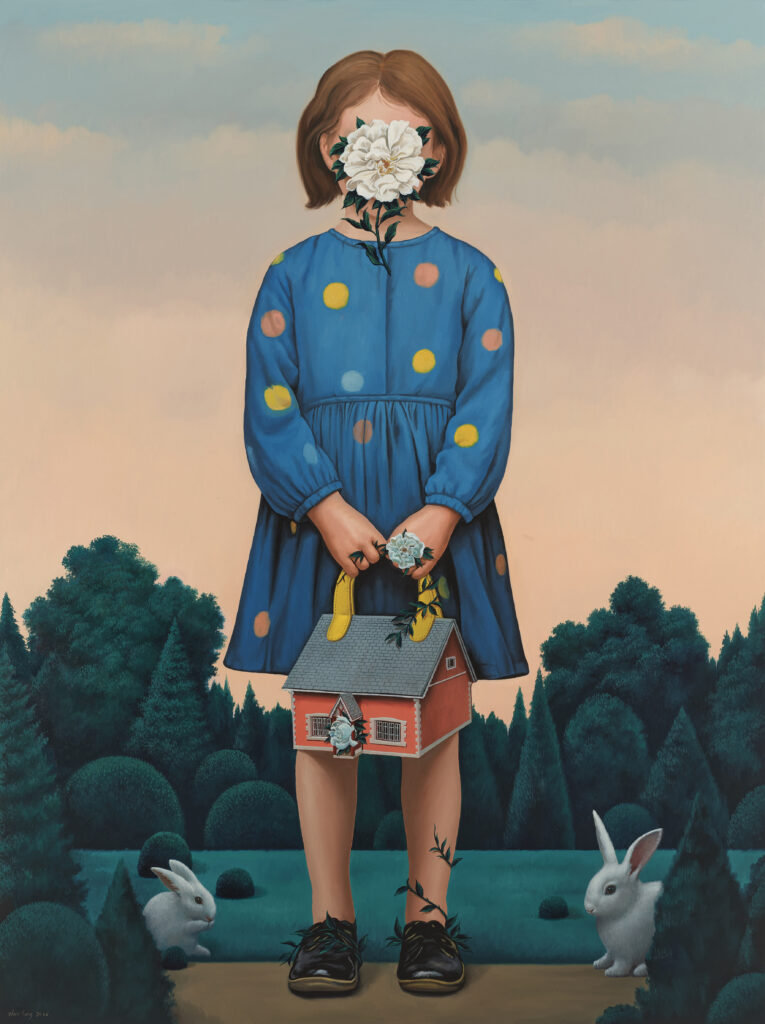
The “new” in New Nature points to many uncertain factors in the future, as well as to the complex changes taking place in our relationship with nature. In the past, when we spoke about nature, we might have thought mainly of mountains, rivers, plants, animals, or the ecological environment. But today, nature is no longer simply nature in the traditional sense. It is being reshaped by technology, artificial intelligence, data systems, and human desire. On the one hand, we still depend on nature.
On the other hand, we constantly try to transform nature, and even to create an ideal new world. For example, once AI has been created, it is no longer merely a tool. It gradually forms a new ecological system and becomes part of our reality. From this perspective, technology is also entering nature and becoming part of a new natural structure.
Therefore, the word “new” does not simply mean something fresh or futuristic. It refers to an uncertain relationship that is still in the process of formation. It means that the boundaries between nature, humanity, and technology are becoming increasingly blurred.
My work attempts to search for a new visual order and spiritual thread within this ambiguous zone.
Q4. Entropy is both scientific and philosophical in your work, what does it mean to you personally?
For me, entropy is not only a scientific concept. It is also a metaphor for the state of the world. It suggests the transformation of order, the dissipation of energy, and an irreversible process that cannot be fully undone. In the Entropy series, I was interested in the relationship between human civilization, machines, technological systems, and states of life. We live in an era of constant acceleration.
Technology seems to bring greater efficiency and order, but at the same time, it also creates new forms of chaos, uncertainty, and spiritual anxiety. So in my work, entropy does not simply mean decay or disorder. It also contains the possibility of generation. As one order breaks down, a new structure may already be forming. For me, art is precisely about searching for a new visual and spiritual space between order and chaos, control and loss of control.
Q5. The Black Hole is both an absolute ending and a point of infinite density. What does the black hole represent within your visual world?
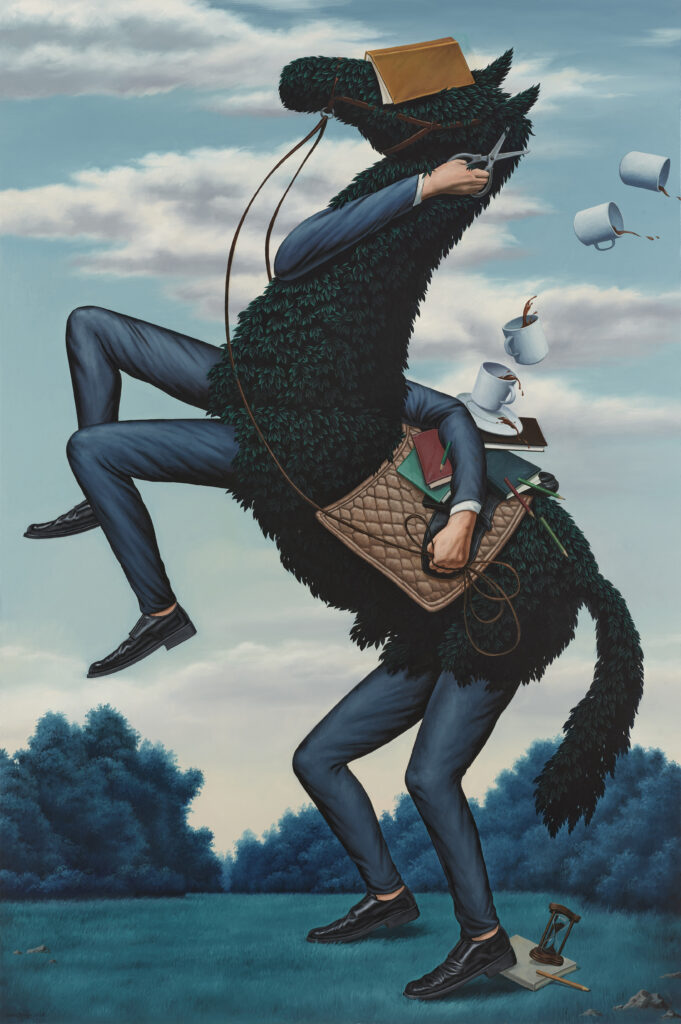
A black hole is one of the most mysterious and powerful symbols in the universe. It is like an absolute endpoint, but also like an entrance into the unknown. It suggests devouring, disappearance, density, gravity, and also a generative force that cannot be fully understood. When I painted Black Hole, I was not painting a black hole in the astronomical sense. I was painting a visual metaphor for the unknown.
In my visual world, it represents the mystery of art itself, as well as the unknowability within artistic creation. Very often, creation is not a completely rational act. It is more like being drawn by a certain force and moving continuously toward the depths of the unknown.
The black hole attracts me because it has a certain similarity to art. You are drawn into it, but you never fully know where it will take you. It is dangerous, yet deeply fascinating.
For me, this unknowability is one of the most important powers of art
Q6. What interests you about exploring cosmic forces, time, and the universe on such a vast scale?
I find questions on the scale of the universe extremely fascinating. Although human civilization has developed to a very advanced stage, when we face the universe, we still realize how small and ignorant we are. This feeling is very important to me. A vast scale is not a way of moving away from humanity.
On the contrary, it allows us to see humanity again. When human beings face the universe, time, space, and the unknown, our loneliness, desires, fears, imagination, and search for meaning are all magnified. The universe makes us aware of our own limits, and it also makes us reconsider the position of life and civilization.
This kind of scale fully activates my imagination and creativity. It is very similar to artistic creation: art also begins from limited personal experience and attempts to touch something much larger and unknown. For me, painting is a way of establishing a visual relationship between the finite and the infinite.

Q7. How do you balance technical precision with imagination and surrealism in your paintings?
Observation is my starting point, and fiction is my method. Objects, bodies, plants, mechanical structures, and natural forms from reality all become visual materials for me. But once they enter the painting, they are no longer merely what they were in reality. They are recombined, transformed, and given new relationships.
Very often, many imaginative ideas appear in my mind. These ideas excite me, and I quickly record them. Then, through the combination of different elements, I allow them to reach a magical and surreal state. This process requires rational control, but it also depends on emotion and intuition.
I do not think observation and fiction are opposed to each other. Reality itself is full of illusion, and fiction can sometimes reveal the deeper structures of reality. For me, the most interesting part of painting is creating a new world between reality and imagination. This world may appear precise, yet it cannot be fully explained by reality.
Q8. What parts of humanity do you think will remain unchanged, no matter how far technology advances?
First of all, the concept of the “human” is not fixed, and neither is human nature. As technology, civilization, and bodily experience change, human beings’ understanding of themselves will also continue to change. In the post-human age, human nature will certainly develop many new possibilities.
But even if technology continues to change the body, perception, and the structure of life, I believe that love, fear, loneliness, desire, death, and the search for meaning will still remain. These things may appear in new forms, but they are still core elements of what makes us human.
So I am not interested in imagining a completely cold technological future. What interests me is how the human spirit continues to exist after technological transformation. The future may change the external form of the human being, but our inner confusion, longing, and questioning of the unknown may still continue in some form.
Q9. Do you think technology is changing what it means to be human, or simply revealing qualities that were already there?
I think both are happening at the same time. Technology is certainly changing the meaning of “being human.” It changes our bodily experience, our modes of perception, our ways of communicating, and the ways in which we understand the world and ourselves. At the same time, technology also reveals certain qualities that have always existed within humanity. For example, human desire, the will to control, creativity, fear, loneliness, and the pursuit of eternity and the unknown are all exposed more clearly through the development of technology.
Human beings create technology in order to extend themselves, but in this process, they also constantly come face to face with themselves.
So technology is not something external to humanity. It is, in fact, an extension of the human spirit and human desire. Through technology, we transform the world, and through technology, we also come to understand ourselves again. But this understanding will never be completed all at once. It may never reach a final destination. Precisely because of this, humanity continues to explore.
Q10. Science and technology are becoming major themes in contemporary art, why do you think more artists are exploring them today?
I think this is inevitable, because science and technology have become among the most important forces in contemporary life. They have not only changed social structures, but also transformed the human spirit, the body, perception, and our imagination of the future. We are surrounded and shaped by science and technology, and we constantly use them to understand ourselves again. In the past, mythology, religion, and nature provided frameworks through which human beings understood the world.
Today, science and technology have, in a certain sense, become a new mythological system. They reshape our imagination of life, the body, time, the universe, and the future. More and more artists are paying attention to these issues because they have already profoundly influenced how we live, how we feel, how we fear, and how we imagine the future. Art cannot avoid these questions.
For me, science and technology are not cold systems of knowledge. Behind them lie humanity’s deepest desires, anxieties, and spiritual dilemmas.
Q11. What has shaped your growth most as an artist: technical skill, curiosity, or asking difficult questions?
I think art itself is a multidimensional issue. Technical mastery, curiosity, and the willingness to ask difficult questions are all very important. They are not separate from one another. Technique is the foundation. It allows an artist to establish their visual language with precision.
Curiosity allows an artist to remain open to the outside world and to continuously face new knowledge, new realities, and new possibilities. The willingness to ask difficult questions determines whether a work can truly touch the deeper spiritual conditions of the time and of human existence. But these are still far from enough.
An artist also needs extensive reading, thinking, and long-term accumulation, as well as sensitivity to everything that is happening in the world today. What truly matters is how to transform technique, knowledge, feeling, and critical awareness into a continuously developing system of thought and visual language. For me, art is not the result of a single ability, but of long-term, integrated judgment.
As our conversation with Zhou Song drew to a close, we kept coming back to one thought that there is a particular kind of courage in committing to questions that have no answer yet. That choosing to spend your creative life inside uncertainty, rather than retreating to what is already understood and already celebrated, is one of the most difficult and most important things an artist can do. Most people, given the choice, move toward clarity.
Zhou Song moves toward the unknown. And he has been doing it, with complete conviction and complete commitment, for over two decades. That is not a small thing. And it is not something that arrives easily.
It arrives through years of looking, thinking, reading, questioning, and refusing to let the work settle into anything comfortable. It arrives through the willingness to move from one body of work to the next not because the market is asking for something new but because the questions have genuinely shifted because the world has changed and the painting has to change with it. Zhou Song’s practice has done exactly that.
What we find most remarkable about him is that this seriousness has never become heavy or inaccessible in the work itself. His paintings are extraordinary to look at. Technically breathtaking, visually inventive, deeply alive on the surface even as they carry tremendous philosophical weight underneath.
That combination of genuine intellectual ambition and genuine painterly mastery is what makes his work so rare. Most artists who think this deeply do not paint this beautifully. And most artists who paint this beautifully do not think this deeply. Zhou Song does both. And the result is work that operates on multiple levels at once, that rewards the casual viewer and the serious collector and the philosopher in the same breath.
We also think there is something worth saying about the broader lesson his practice offers — not just for artists but for anyone building something in a time of enormous uncertainty. That the temptation to simplify, to resolve, to make things more comfortable and more immediately legible, is always there.
And that resisting it, staying inside the complexity, trusting that the question is worth more than the easy answer that is where the most meaningful and most enduring work always comes from. Zhou Song has proven that over twenty years of practice. And the world is still catching up to what he started asking long before anyone else was ready to listen.
For those who collect with genuine vision who want work that grows more urgent the longer it is in their life, that feels more prescient next year than it does today, that was already grappling with the future before the future arrived his paintings are exactly that. Work that does not age away from the present. Work that ages into it.
Follow Zhou Song through the links below and see his work for yourself.