



The Masterpieces That Spent Decades Hidden in Attics

There is something almost mythical about the idea of masterpieces remaining hidden in attics for decades. Not inside museums or behind climate-controlled glass, but beneath old furniture, inside forgotten storage spaces, and behind locked doors no one has opened in years.Forgotten among objects people stopped paying attention to decades ago.
The art world has always been fascinated by rediscoveries because they collapse the distance between ordinary life and cultural history. A leaking roof suddenly leads to an Old Master painting. A neglected canvas hanging in a private home turns out to belong to one of the most important artists in history. In these moments, art escapes the carefully ordered systems of museums, auction houses, and archives, reappearing instead through accident, memory, and chance.
What makes these stories especially compelling is that many of these works were not simply lost physically. They were doubted, dismissed, misidentified, or ignored for years before experts looked closely enough to recognize what had been sitting in plain sight all along.
Over the decades, forgotten works connected to artists like Vincent van Gogh, Rembrandt van Rijn, Gustav Klimt, Caravaggio, and Giovanni Battista Tiepolo have resurfaced from attics, hidden walls, and forgotten storage spaces, transforming into some of the art world’s most astonishing rediscoveries.
These discoveries feel cinematic, but they also reveal something deeper about art itself: masterpieces do not disappear quietly. Even after decades of neglect, they continue waiting for someone to notice them again.
Vincent van Gogh
Sunset at Montmajour

Time Lost: 1901–1970 (later traced to a Norwegian private collection in 1908)
Rediscovered: In a Norwegian attic
Authenticated: 2011 by the Van Gogh Museum
Publicly Revealed: 2013
In the summer of 1888, Vincent van Gogh stood outside Arles watching the landscape dissolve into gold.
The fields near Montmajour Abbey were wild and uneven, covered with tangled vegetation, limestone rocks, and low twisted trees catching the last light of the evening sun. Writing to his brother Theo, Van Gogh described the view as “romantic,” mesmerized by how the sunlight poured across the earth like “a shower of gold.” He worked quickly, trying to capture the shifting atmosphere before dusk disappeared entirely.
More than a century later, the painting itself would emerge from darkness in much the same way.
After disappearing from public view in the early twentieth century, Sunset at Montmajour quietly entered a private Norwegian collection around 1908. Years later, when the owner sought professional opinion on the work, it was reportedly dismissed as inauthentic by a French ambassador. Embarrassed by the rejection, the family removed the painting from display and stored it away in an attic, where it remained for decades, unseen, doubted, and nearly forgotten.
The irony feels painfully aligned with Van Gogh’s own life. During his lifetime, he struggled constantly for recognition, selling very little work and enduring repeated dismissal from critics and institutions. Even after his death, one of his paintings suffered the same fate.
Everything changed after renewed research began at the Van Gogh Museum. Through pigment analysis, canvas studies, stylistic comparisons, and Van Gogh’s letters, experts finally confirmed the work’s authenticity. In 2011, the museum authenticated the painting as a genuine Van Gogh from his celebrated Arles period, before publicly unveiling the rediscovery in 2013.
For decades, the painting sat hidden beneath the dust of an attic. What survived there was not just a forgotten canvas, but a lost fragment of one of art history’s most luminous years.
Rembrandt van Rijn
Unconscious Patient (Allegory of Smell)

Time Lost: Unknown – rediscovered in 2015
Rediscovered: In a New Jersey basement
Reattributed: Identified as an early Rembrandt after restoration and research
At first glance, the painting looked entirely forgettable.
The small oil panel, darkened by centuries of dirt and yellowed varnish, showed what appeared to be a strange domestic scene: three figures gathered around a fainting woman. When it surfaced at a New Jersey auction house in 2015, it was catalogued modestly as a nineteenth-century “Continental School” work, estimated at just a few hundred dollars. Nothing about it suggested the hand of Rembrandt van Rijn.
But beneath the damaged surface, another painting was waiting to reappear.
As specialists began examining the panel more closely, details slowly emerged that did not belong to an ordinary decorative work. The composition carried unusual theatricality. The facial expressions possessed a psychological tension uncommon in lesser paintings. Most revealing of all was the discovery of a hidden monogram connected to the young Rembrandt.
After restoration removed layers of varnish and overpainting, experts identified the work as Unconscious Patient (Allegory of Smell), created around 1624–25 when Rembrandt was still in his late teens. The painting belonged to an early series representing the five senses, produced before the artist became one of the defining figures of the Dutch Golden Age.
What makes the rediscovery especially fascinating is how close the work came to remaining anonymous forever. The painting had been physically altered over time, enlarged with additional paneling, and visually obscured by centuries of neglect. Even the auction house reportedly had little sense of what it truly possessed before bidding unexpectedly surged.
There is something almost poetic about the story: a painting about human sensation surviving centuries in near invisibility, only to be rediscovered through the act of looking more carefully.
Gustav Klimt
Portrait of a Lady

Time Lost: 1997–2019
Rediscovered: Hidden inside a wall at the Ricci Oddi Gallery in Italy
Recovered: Accidentally discovered by gardeners clearing ivy near the museum exterior
For more than two decades, one of Gustav Klimt’s missing paintings existed almost like a ghost story within the art world.
Portrait of a Lady vanished in 1997 from the Ricci Oddi Gallery in Piacenza, Italy, just before an exhibition was scheduled to open. The disappearance immediately became one of the most infamous unsolved art thefts in modern Europe. Investigators searched the museum, questioned staff, and chased theories ranging from organized crime to elaborate smuggling operations, yet the painting seemed to dissolve completely from view.
Then, in 2019, the impossible happened.
While clearing ivy from an exterior wall of the same museum, gardeners discovered a small metal door hidden behind vegetation. Inside the cavity sat a black garbage bag. Wrapped within it was Portrait of a Lady, the very painting stolen from the gallery twenty-two years earlier.
The discovery felt almost absurd in its simplicity. After decades of international speculation, the missing Klimt had apparently remained hidden at the crime scene itself the entire time.
Yet the painting carries mysteries beyond the theft alone. Years before it disappeared, a student discovered that Klimt had painted the portrait over an earlier image of another young woman. X-rays revealed traces of the first figure beneath the visible surface, transforming the work into what art historians call a visual palimpsest, a painting layered with both concealment and memory. Some scholars believe Klimt reworked the canvas after the original sitter died unexpectedly.
That history makes the rediscovery strangely fitting. Portrait of a Lady became a work defined by disappearance long before it was ever stolen: one image hidden beneath another, then hidden again from the world itself.
Caravaggio
Judith Beheading Holofernes
Time Lost: At least 1689–2014
Rediscovered: In a cluttered attic in Toulouse, France
Attribution: Still debated by some scholars
The discovery sounded almost too cinematic to be true.
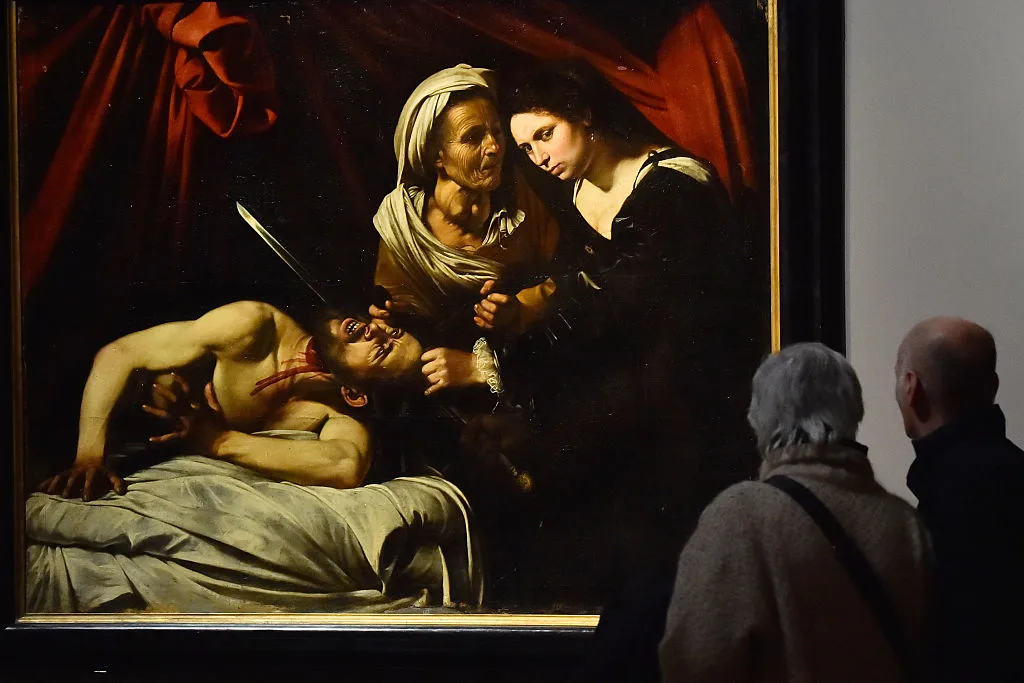
In 2014, while investigating a leak in the attic of a house near Toulouse, France, homeowners uncovered a large, dust-covered painting leaning against a wall beneath layers of forgotten storage. The attic was dark, cramped, and water damaged, hardly the kind of place where one expects to encounter a work potentially connected to Caravaggio, one of the most dramatic painters in European art history. Yet that is exactly what happened.
The painting depicted the biblical story of Judith beheading the Assyrian general Holofernes, rendered with the violent realism and theatrical lighting long associated with Caravaggio’s work. Faces emerge sharply from darkness. Flesh catches sudden light. Horror and determination exist simultaneously within the same frame.
Art historians quickly became divided.
Some experts argued the painting was a lost original by Caravaggio himself, possibly created around 1607 and unseen for centuries. Others believed it was instead produced by Louis Finson, a Flemish painter and known follower of Caravaggio. The debate transformed the rediscovery into one of the most controversial attribution battles in recent art history.
Part of the fascination lies in how extraordinarily rare a new Caravaggio would be. Only a small number of authenticated paintings by the artist survive today, making the possibility of another discovery almost unimaginable. Auctioneer Marc Labarbe famously described the find as uncovering “the 66th Caravaggio in the world.”
Even now, uncertainty continues to surround the painting. But perhaps that ambiguity only deepens the story. Hidden for centuries inside a forgotten attic, the work emerged carrying the same tension that defines Caravaggio’s art itself: darkness, revelation, and the uneasy space between truth and illusion.
Giovanni Battista Tiepolo
Portrait of a Lady as Flora

Time Lost: Around 1760–2008
Rediscovered: In the attic of a French château
Reappeared At Auction: Christie’s, 2008
For nearly two and a half centuries, the woman remained hidden above the ceilings of a French château.
Painted around 1760 by Giovanni Battista Tiepolo, Portrait of a Lady as Flora radiates the airy elegance that made Tiepolo one of the defining painters of the Rococo era. The subject appears draped in flowing fabric, crowned with flowers, and bathed in soft luminous color, less a portrait than an idealized vision of beauty itself. Art historians believe the painting may have been commissioned for Empress Elizabeth of Russia, though records remain uncertain as to whether it ever reached her collection.
What is known, however, is that the painting vanished from public view for generations.
According to reports surrounding its rediscovery, the canvas had been placed in the attic of a French château because members of the family considered the semi-nude subject too risqué for display. There it remained for centuries, removed from view yet remarkably preserved by its isolation. Hidden from sunlight, excessive restoration, and public handling, the painting escaped many of the damages that often alter works over time.
When the work finally resurfaced at Christie’s in 2008, specialists were struck not only by the quality of the painting itself but by its condition. The canvas had reportedly never been heavily cleaned or relined, allowing viewers to encounter something unusually close to Tiepolo’s original surface and brushwork.
There is an almost ironic symmetry to the story. A painting once hidden for being considered too visible, too sensual, too revealing, survived precisely because it disappeared from sight.
For over two hundred years, one of Rococo painting’s most delicate visions of femininity remained suspended in darkness above an old château, waiting for the world to look up again.

What makes these rediscoveries so unforgettable is not just the money, rarity, or headlines surrounding them. It is the unsettling realization that history can remain hidden in the most ordinary places.
A forgotten attic. A dusty basement. A painting dismissed as worthless for decades. Again and again, these stories remind us that art does not always announce its importance immediately. Sometimes masterpieces survive precisely because no one recognized them at all.
There is also something deeply human about these discoveries. Behind every rediscovered artwork is usually an accidental moment: someone cleaning a room, moving furniture, clearing ivy from a wall, or deciding to take a second look at an object they had passed by for years. Entire chapters of art history have re-emerged not through grand archaeological expeditions, but through curiosity and chance.
And perhaps that is why these stories continue to fascinate us so intensely. They allow us to imagine that history is never completely settled. That somewhere, in some overlooked corner of the world, another forgotten painting may still be waiting quietly in the dark.
Maybe the next great rediscovery is already hanging unnoticed in someone’s home. Which of these rediscoveries surprised you the most?
Sources: This article draws on reporting and research from Artnet News, Reuters, BBC News, The New York Times, Associated Press, Christie’s, The Leiden Collection, and Daily Mail, alongside archival material and museum research related to the rediscovery and authentication of the artworks discussed.
If you enjoy the stranger side of art history, you may also like reading about 8 Strangest Art Movements in History — from absurd anti-art rebellions to movements that completely redefined what art could be.