



10 Artworks Inspired by the Love of Reading
Books have shaped human history for centuries. They have preserved religious teachings, recorded scientific discoveries, inspired works of literature, and offered countless readers a chance to escape into other worlds. While the ways we consume stories and information have evolved, from illuminated manuscripts and printed volumes to e-books and digital screens, the act of reading remains one of humanity’s most enduring pursuits. Many of the artworks inspired by the love of reading explore not only books themselves but also the curiosity, imagination, and reflection they inspire.
Artists have long been fascinated by this quiet yet powerful activity. Across different periods and cultures, painters have depicted readers immersed in prayer, study, imagination, and contemplation. Some artworks celebrate books as symbols of knowledge and intellectual achievement, while others explore reading as a deeply personal experience capable of transporting the mind far beyond its immediate surroundings. Together, these images reveal how books have influenced not only what people learn, but also how they dream, reflect, and understand the world.
The ten artworks featured here span more than four centuries of art history, from the Renaissance to Modernism. Along the way, they introduce scholars, saints, artists, devoted readers, and even fictional characters whose lives were transformed by literature. Whether portraying a solitary reader lost in thought, a library filled with eager learners, or a stack of beloved novels, each work offers a unique perspective on the enduring relationship between art and the written word.
These paintings remind us that reading is more than a pastime. It is an act of curiosity, discovery, imagination, and connection, one that continues to inspire artists and readers alike.
1. Virgin Annunciate (1475–1476) – Antonello da Messina
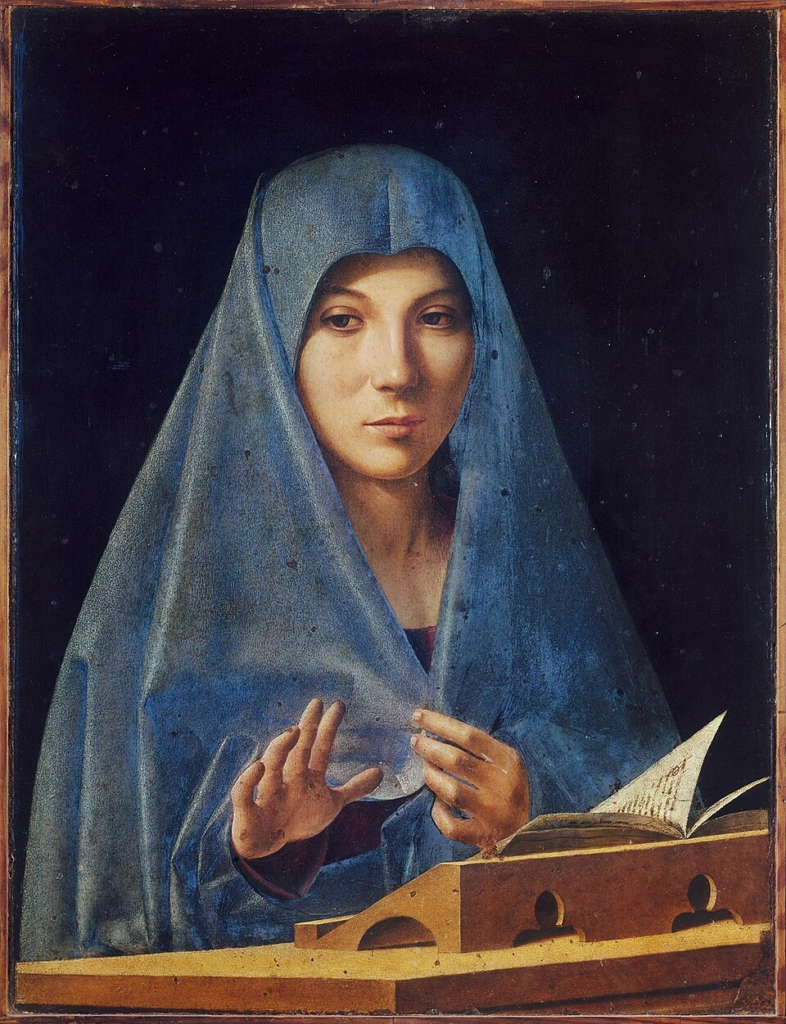
Few paintings capture the quiet power of reading as elegantly as Virgin Annunciate by Antonello da Messina. Created around 1475–1476, the work presents the Virgin Mary at the moment of the Annunciation, the biblical event in which the angel Gabriel tells her that she will give birth to Christ. Yet Antonello chose not to depict the angel at all. Instead, he focused entirely on Mary’s reaction, creating one of the most intimate and psychologically compelling images of the Renaissance.
Mary sits behind a lectern, her blue mantle draped around her shoulders. Before her lies an open book, suggesting that she has been reading scripture when the divine interruption occurs. Rather than dramatizing the event, Antonello captures a fleeting moment of contemplation. Mary’s raised hand appears to pause the unseen visitor, while her expression conveys surprise, thoughtfulness, and composure all at once.
The painting is remarkable for its simplicity. Unlike many fifteenth-century depictions of the Annunciation filled with elaborate architecture, angels, and symbolic objects, Antonello stripped the scene down to its essentials. This allows viewers to focus on Mary’s inner world and the act of reading itself. The book becomes more than a prop; it serves as a symbol of learning, devotion, and spiritual reflection.
Antonello was among the first Italian artists to fully exploit the possibilities of oil painting, and the medium’s subtle effects are evident in the delicate modeling of Mary’s face and hands. More than five centuries later, Virgin Annunciate remains a powerful reminder that reading has long been associated not only with knowledge, but also with contemplation, faith, and personal transformation.
Image Credit: Virgin Annunciate (c. 1475–1476), Antonello da Messina. Collection of the Palazzo Abatellis, Palermo, Italy.
2. Portrait of Luca Pacioli (c. 1495) – Jacopo de’ Barbari
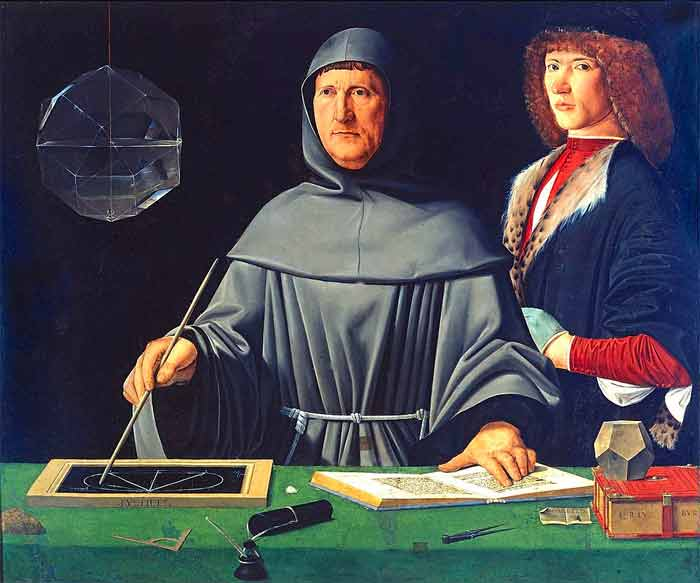
When we think of paintings about reading, we often imagine a solitary figure absorbed in a novel or devotional text. Yet Portrait of Luca Pacioli expands the idea of reading into something much broader: the pursuit of knowledge itself. Painted around 1495 by Jacopo de’ Barbari, the work depicts the renowned Franciscan friar, mathematician, and scholar Luca Pacioli at the height of the Renaissance.
Pacioli is shown teaching geometry from a book by the ancient Greek mathematician Euclid. One hand points to a geometric diagram while the other rests on an open volume, emphasizing the relationship between reading, study, and discovery. Beside him stands a younger figure, often identified as Guidobaldo da Montefeltro, Duke of Urbino, though scholars continue to debate the sitter’s identity.
The painting is filled with symbols of learning. Mathematical instruments lie on the table, and a transparent polyhedron hangs from above, demonstrating the Renaissance fascination with science, perspective, and the structure of the natural world. Every object reinforces the idea that books were not merely repositories of information but gateways to understanding the universe.
Pacioli himself played a pivotal role in intellectual history. He is best known for publishing Summa de Arithmetica in 1494, a comprehensive mathematical treatise that included the first widely disseminated description of double-entry bookkeeping, earning him the title “Father of Accounting.” His friendship with Leonardo da Vinci further places him at the center of one of history’s most remarkable intellectual circles.
Unlike many reading-themed artworks that focus on leisure or contemplation, Portrait of Luca Pacioli celebrates books as instruments of inquiry. It reminds us that reading has long been one of humanity’s most powerful tools for exploring ideas, advancing knowledge, and shaping the modern world.
Image Credit: Portrait of Luca Pacioli (c. 1495), attributed to Jacopo de’ Barbari. Collection of the Museo di Capodimonte, Naples, Italy.
3. A Young Girl Reading (c. 1770–1776) – Jean-Honoré Fragonard
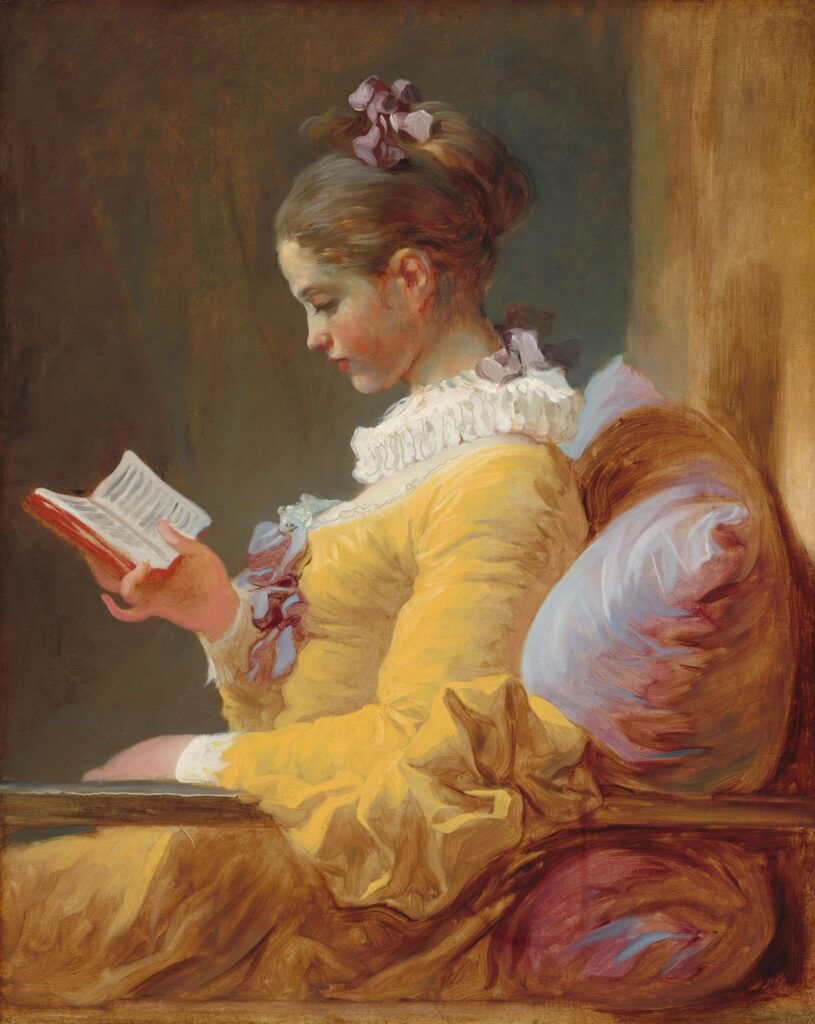
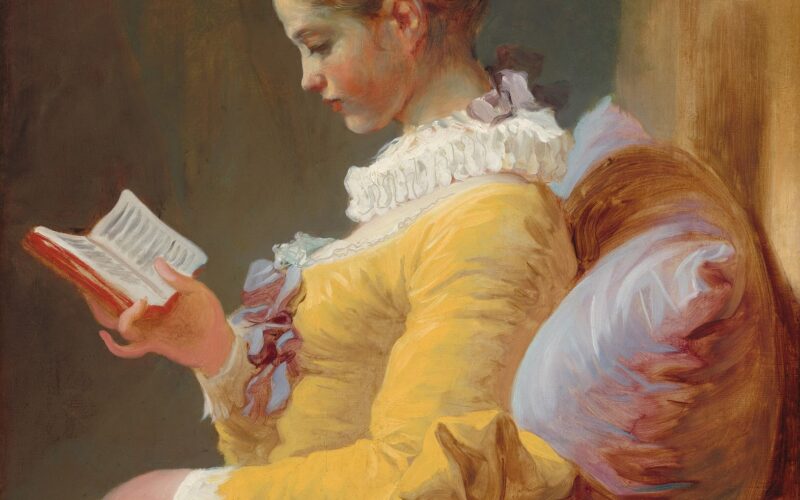
Among the many paintings that depict people reading, few are as instantly recognizable, or as captivating, as A Young Girl Reading by Jean-Honoré Fragonard. Painted around 1770–1776, this luminous portrait transforms a quiet moment of concentration into one of the most celebrated images of reading in Western art.
The young woman sits comfortably, dressed in a brilliant golden-yellow gown that dominates the composition. Her attention is entirely focused on the small book she holds delicately in one hand. Unlike traditional portraits, she does not look toward the viewer. Instead, she seems completely unaware of being observed, creating the feeling that we are witnessing a private and deeply personal moment.
This sense of intimacy is one reason the painting continues to resonate with modern audiences. Fragonard captures a universal experience familiar to anyone who has ever become lost in a book. The outside world appears to disappear as the reader enters another realm created by words and imagination.
Interestingly, the painting is also surrounded by a degree of mystery. Art historians believe it may be connected to Fragonard’s famous series known as the Fantasy Figures. Technical examinations have revealed earlier compositions beneath the visible surface, suggesting that the artist substantially reworked the painting before arriving at the version we know today. Even the identity of the sitter remains uncertain.
Created during the Rococo period, a style often associated with elegance, pleasure, and refinement, the work reflects the growing importance of reading in eighteenth-century European society. Books were becoming increasingly accessible, and reading was emerging as both an intellectual and leisurely pursuit.
More than two centuries later, A Young Girl Reading remains one of art history’s most enduring tributes to the simple yet transformative act of becoming absorbed in a book.
Image Credit: A Young Girl Reading (c. 1770–1776), Jean-Honoré Fragonard. Collection of the National Gallery of Art, Washington, D.C., United States.
4. Titus Reading (c. 1656–1657) – Rembrandt van Rijn
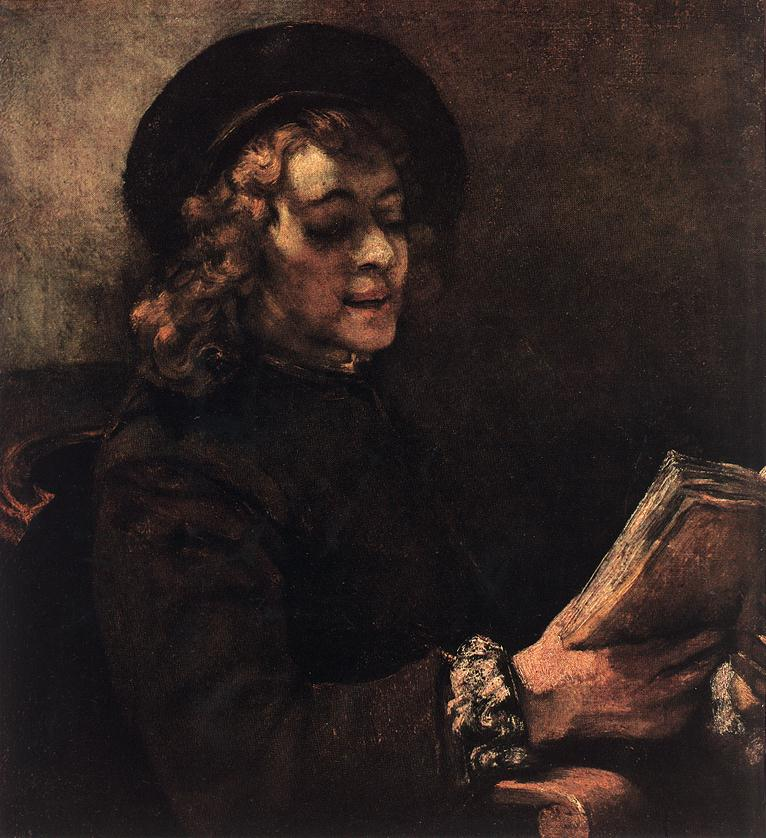
At first glance, Titus Reading appears to be a simple portrait of a young boy absorbed in a book. Yet behind this quiet scene lies one of the most touching family stories in art history. Painted around 1656–1657 by Rembrandt van Rijn, the work depicts the artist’s beloved son, Titus van Rijn, during a turbulent period in the painter’s life.
Titus was the only child of Rembrandt and his wife Saskia to survive into adulthood. By the time this portrait was painted, the artist was facing severe financial difficulties. Once among the most successful painters in Amsterdam, Rembrandt had accumulated significant debts and would declare bankruptcy in 1656. Against this backdrop of personal and professional hardship, the image of Titus quietly reading takes on a deeply emotional significance.
Rather than presenting his son as a formal sitter, Rembrandt captures him in a moment of genuine concentration. Soft light falls across Titus’s face as he studies the pages before him, while the surrounding darkness draws attention to his thoughtful expression. The painting exemplifies Rembrandt’s mastery of light and shadow, a technique that allows psychological depth to emerge from an otherwise ordinary scene.
The book itself is central to the painting’s meaning. In seventeenth-century Dutch society, reading was associated with education, moral development, and personal reflection. Here, however, the act of reading also becomes a symbol of youth, curiosity, and hope. At a time when much of Rembrandt’s world seemed uncertain, his son appears calm, focused, and full of promise.
Tragically, Titus would die in 1668 at just twenty-seven years old, only a year before his father. Knowing this history lends the painting an added poignancy. What remains is not merely a portrait of a reader, but a tender record of a father’s affection and a fleeting moment preserved forever through art.
Image Credit: Titus Reading (c. 1656–1657), Rembrandt van Rijn. Various versions and related portraits of Titus are held in major museum and private collections.
5. The Bookworm (c. 1850) – Carl Spitzweg
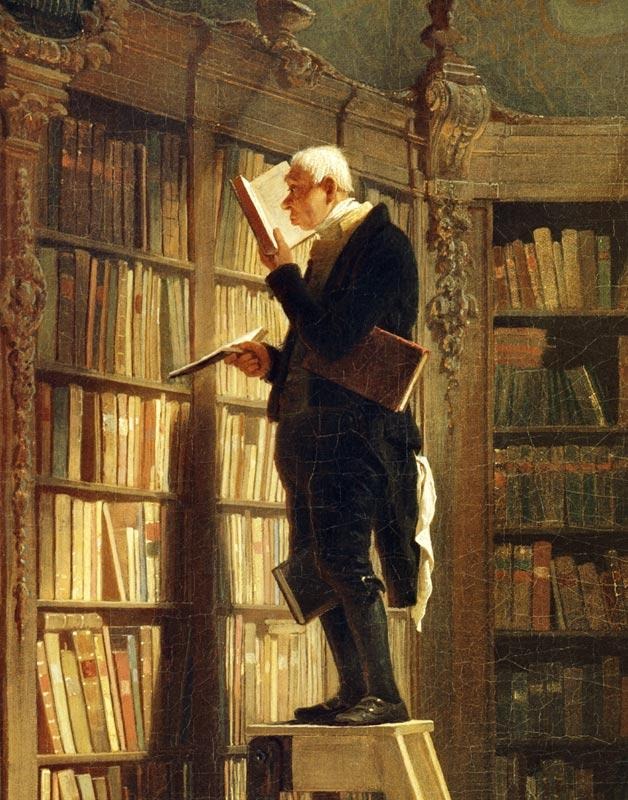
If A Young Girl Reading celebrates the pleasure of reading, then The Bookworm by Carl Spitzweg explores what happens when that pleasure becomes an obsession. Painted around 1850, this beloved work is one of the most humorous and recognizable depictions of book lovers in art history.
The scene is instantly memorable. Perched precariously on the top rung of a library ladder, an elderly scholar is so engrossed in his reading that he appears completely unaware of the world around him. He balances one book in his hands, tucks another beneath his arm, and seems to have yet another volume ready for consultation. Towering shelves packed with books surround him, creating the impression of a man who has willingly disappeared into a universe of knowledge.
Spitzweg painted during the Biedermeier period, a cultural movement in German-speaking Europe that often celebrated everyday life, domesticity, and gentle humor. Rather than portraying scholars as grand intellectual heroes, he preferred to depict them as eccentric and endearingly human. The reader in The Bookworm is not a figure of authority but someone whose passion for books has become all-consuming.
The painting’s charm lies in its relatability. Nearly everyone who loves books has experienced the desire to read just one more chapter, buy one more volume, or lose track of time while exploring a fascinating subject. Spitzweg exaggerates this tendency to comic effect, transforming his scholar into the ultimate bibliophile.
Yet beneath the humor is an affectionate tribute to intellectual curiosity. The scholar’s dedication may seem excessive, but his enthusiasm reflects humanity’s enduring desire to learn, discover, and explore ideas through books.
More than 170 years after it was painted, The Bookworm remains a favorite among readers because it captures a truth many would rather not admit: sometimes, there is no such thing as too many books.
Image Credit: The Bookworm (c. 1850), Carl Spitzweg. Versions of the painting are held in several collections, including the Museum Georg Schäfer in Schweinfurt, Germany.
6. Elizabeth Siddal Reading (1854) – Dante Gabriel Rossetti
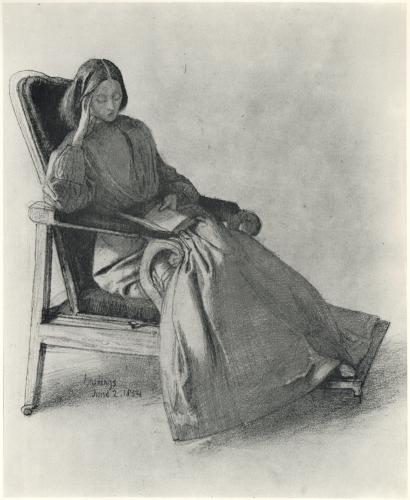
Few paintings about reading are connected to a story as captivating and tragic, as Elizabeth Siddal Reading by Dante Gabriel Rossetti. Created in 1854, the work portrays Elizabeth Siddal, one of the most iconic figures of the Pre-Raphaelite movement, quietly absorbed in a book.
When Rossetti first met Siddal in the early 1850s, she was working in a London milliner’s shop. Her distinctive appearance soon made her one of the most sought-after models among the Pre-Raphaelites. Yet Siddal was far more than a muse. She was an accomplished artist and poet in her own right, encouraged by Rossetti and other members of the movement to develop her creative talents.
In this intimate watercolor, Siddal sits outdoors with a book in hand, her attention fixed on its pages. Rossetti avoids dramatic gestures or elaborate symbolism, focusing instead on the act of reading itself. The scene feels private and contemplative, presenting Siddal not merely as a subject to be admired but as an intellectual participant in the cultural world around her.
The painting gains additional significance when viewed through the lens of the couple’s relationship. Rossetti and Siddal shared a passionate but often troubled romance that culminated in their marriage in 1860. Two years later, Siddal died at the age of thirty-two, a loss that devastated Rossetti. In one of the most famous episodes in Victorian literary history, he placed a manuscript of his unpublished poems in her coffin, only to have it exhumed years later so the poems could be published.
While that dramatic story often overshadows Siddal herself, Elizabeth Siddal Reading offers a different perspective. It presents her as a thoughtful reader, artist, and intellectual presence, reminding us that books have long served as sources of inspiration, creativity, and personal expression.
Image Credit: Elizabeth Siddal Reading (1854), Dante Gabriel Rossetti. Collection of the Ashmolean Museum, Oxford, England.
7. Don Quixote in His Study (1862) – Gustave Doré
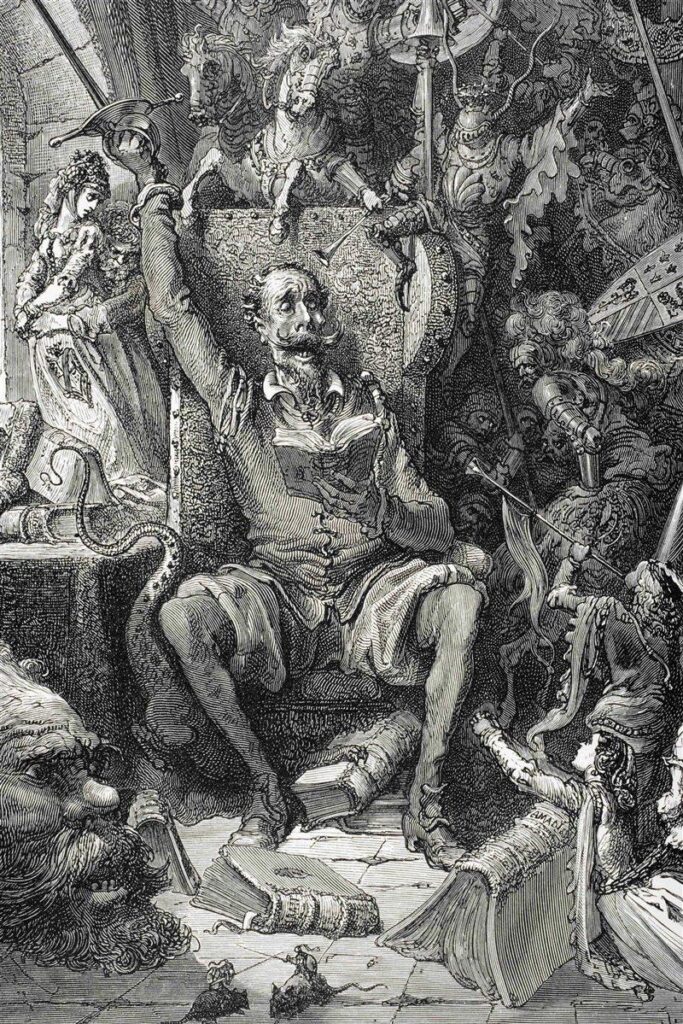
What happens when a person reads so much that the boundary between fiction and reality begins to disappear? That question lies at the heart of Don Quixote in His Study, an illustration created in 1862 by Gustave Doré for Miguel de Cervantes’ celebrated novel Don Quixote.
Unlike many works in this article, Doré’s image does not simply depict someone reading. Instead, it explores the transformative and sometimes dangerous, power of books. Cervantes’ protagonist, Don Quixote, has spent so many hours immersed in tales of chivalric knights that he begins to believe he can become one himself. His obsession ultimately leads him to embark on a series of absurd and often comic adventures, including his famous battle with windmills he mistakes for giants.
Doré was one of the nineteenth century’s most celebrated illustrators, producing images for literary classics ranging from Dante’s Divine Comedy to the Bible. His illustrations for Don Quixote are widely regarded as some of the most influential visual interpretations of the novel ever created.
In Don Quixote in His Study, the aging nobleman is surrounded by books, seemingly consumed by the world they contain. Doré fills the scene with dramatic atmosphere, suggesting that imagination itself has begun to take physical form around the reader. The study becomes a threshold between reality and fantasy, where literature possesses the power to reshape perception.
This makes the artwork especially fascinating in a discussion about reading. While many paintings celebrate books as sources of knowledge, Doré highlights another possibility: books can transport us so completely that they alter how we see the world.
More than a portrait of a reader, Don Quixote in His Study is a tribute to literature’s extraordinary ability to inspire dreams, adventures, and entire worlds beyond the page.
Image Credit: Don Quixote in His Study (1862), Gustave Doré. Created as part of Doré’s illustrated edition of Don Quixote by Miguel de Cervantes.
8. Piles of French Novels (1887) – Vincent van Gogh
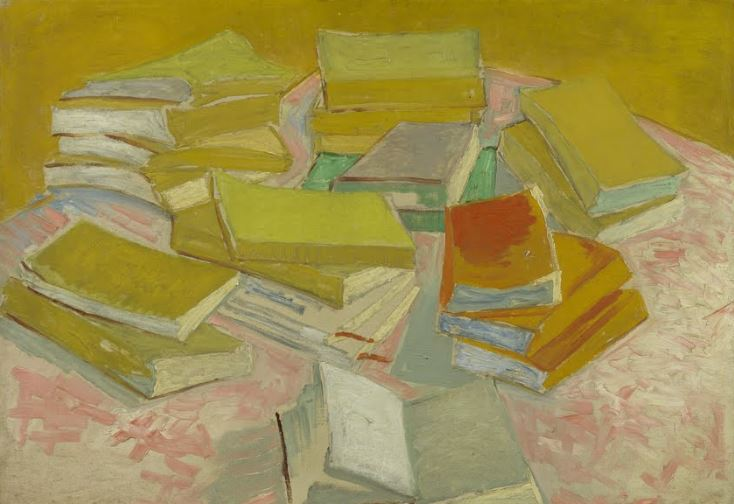
Most paintings about books feature a reader. Vincent van Gogh took a different approach. In Piles of French Novels, painted in 1887, the books themselves become the subject. The result is one of the most unusual and revealing works in this article, a portrait not of a person, but of the literature that shaped an artist’s life.
The painting depicts a stack of brightly colored paperback novels by contemporary French authors. Their titles and covers are prominently displayed, emphasizing that these are not anonymous objects but specific books that Van Gogh admired and read. Among the writers he greatly respected were figures such as Émile Zola and Guy de Maupassant, whose works explored modern society with honesty and compassion.
Van Gogh’s deep attachment to literature is well documented in his letters. Long before he became famous as a painter, he was an avid reader who believed books could offer comfort, understanding, and inspiration. In correspondence with his brother Theo, he frequently discussed novels and described reading as an essential part of his intellectual and emotional life. During periods of loneliness and uncertainty, books often served as trusted companions.
What makes Piles of French Novels so compelling is its simplicity. There are no dramatic figures or narrative scenes. Instead, Van Gogh invites viewers to consider the books themselves as sources of imagination and human connection. The vibrant colors and energetic brushwork transform ordinary paperbacks into objects of significance and affection.
Within the context of this article, the painting offers a refreshing perspective. Rather than showing the act of reading, it celebrates what remains afterward, the ideas, stories, and voices that continue to influence us long after we close a book.
Image Credit: Piles of French Novels (1887), Vincent van Gogh. Collection of the Van Gogh Museum, Amsterdam, Netherlands.
9. The Library (1960) – Jacob Lawrence
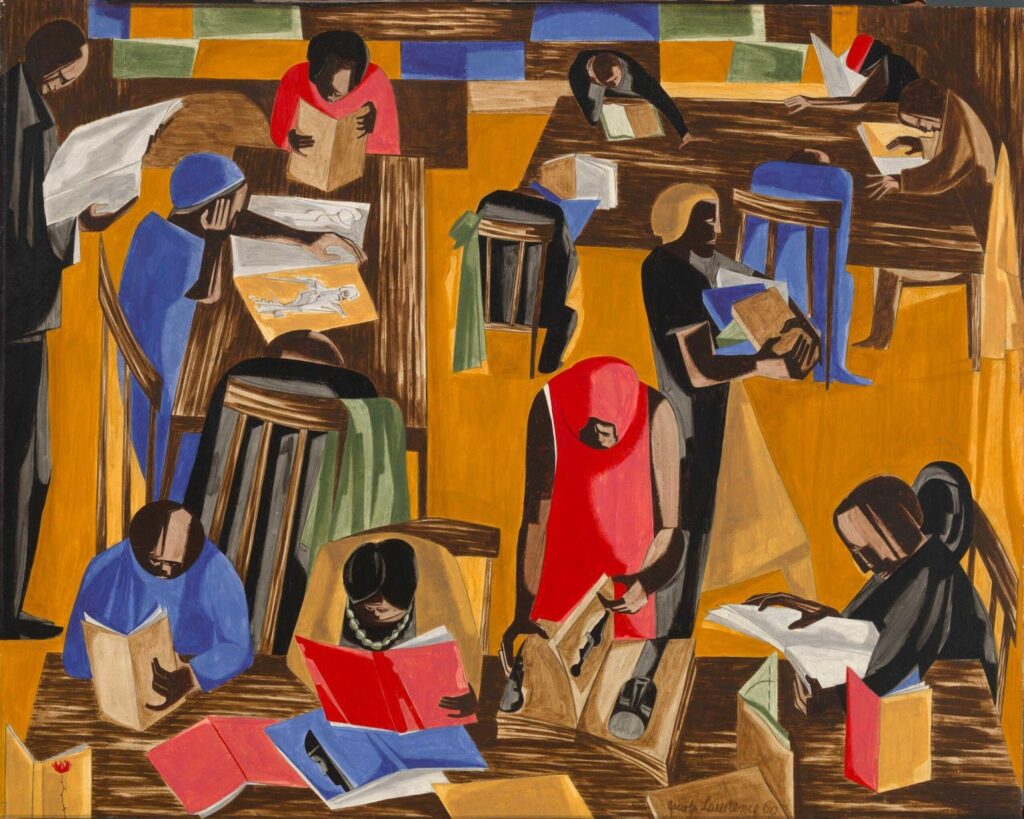
For many of the artworks in this article, reading is presented as a solitary activity. The Library by Jacob Lawrence offers a different perspective, showing reading as a shared experience that connects individuals to a larger community. Painted in 1960, the work reflects Lawrence’s lifelong interest in education, history, and the power of knowledge.
One of the most celebrated American artists of the twentieth century, Lawrence is best known for his vividly colored paintings that chronicle African American life and history. His distinctive style, characterized by bold shapes, flattened forms, and dynamic compositions, transforms everyday scenes into powerful visual narratives. In The Library, readers gather in a public space, each absorbed in a book, yet united by a common pursuit of learning.
The subject was deeply personal for Lawrence. Growing up in Harlem, libraries played an important role in his education. As a young man, he spent countless hours reading about Black history, literature, and prominent figures whose stories were often absent from traditional textbooks. These discoveries would later inspire many of his most important works, including his celebrated narrative painting series.
Unlike earlier depictions of reading that focus on scholars, aristocrats, or religious figures, The Library emphasizes access. Knowledge is not reserved for a privileged few; it is available to anyone willing to seek it. Lawrence portrays the library as a democratic space where people can encounter new ideas, explore their heritage, and expand their understanding of the world.
The painting also reminds viewers that books rarely exist in isolation. Behind every reader lies a network of authors, educators, librarians, and institutions that help preserve and share knowledge across generations. In this sense, The Library celebrates not only reading itself but the communities that make reading possible.
Image Credit: The Library (1960), Jacob Lawrence. Collection of the Smithsonian American Art Museum, Washington, D.C., United States.
10. Woman with a Book (1923) – Fernand Léger
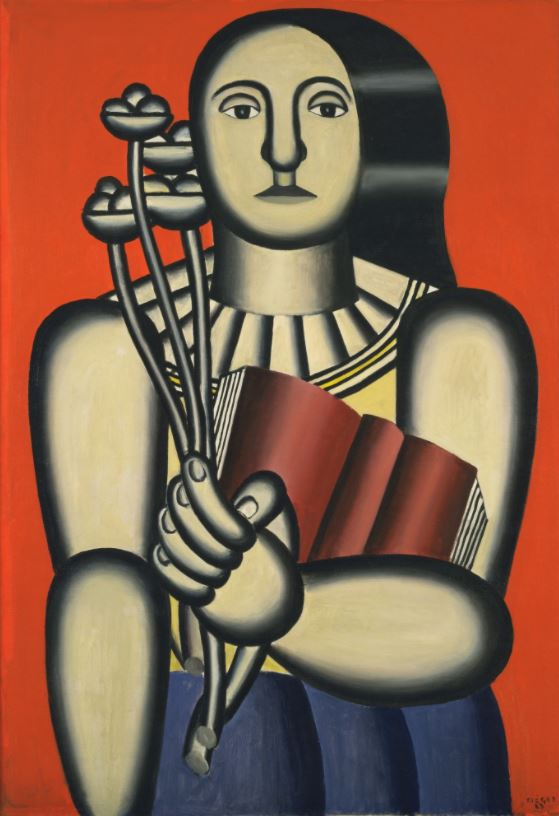
By the early twentieth century, artists were no longer interested in depicting the world exactly as they saw it. Instead, many sought new visual languages that could capture the speed, energy, and complexity of modern life. Woman with a Book, painted in 1923 by Fernand Léger, reflects this dramatic shift while demonstrating that books remained central to ideas of culture, learning, and progress.
At first glance, the painting appears far removed from the quiet readers found in works by Fragonard or Rembrandt. Léger constructs his figure using bold geometric shapes, strong outlines, and vibrant blocks of color. The woman holds an open book and a bouquet of flowers, yet she is rendered in a style that feels almost mechanical. This distinctive approach reflects Léger’s fascination with modern industry and the changing world that emerged after the First World War.
Like many artists of his generation, Léger was deeply affected by the conflict and its aftermath. In the years that followed, he sought to create an art that embraced modernity rather than retreating into nostalgia. Woman with a Book suggests that knowledge, beauty, and culture could help rebuild society in a rapidly changing age. The book becomes more than an object of study; it serves as a symbol of education, intellectual growth, and optimism for the future.
The painting also provides a fitting conclusion to the story told throughout this article. From the devotional reading of Antonello da Messina’s Virgin Mary to the community-centered learning of Jacob Lawrence’s library patrons, books have appeared in many forms and contexts. Léger’s modern figure demonstrates that even as artistic styles evolved dramatically over the centuries, the significance of reading endured.
In this sense, Woman with a Book is both a modernist experiment and a timeless reminder that books continue to shape how we understand ourselves and the world around us.
Image Credit: Woman with a Book (1923), Fernand Léger. Collection of the Museum of Modern Art, New York, United States.
From the quiet devotion of Virgin Annunciate to the bold modernism of Woman with a Book, these artworks demonstrate that reading has inspired artists for centuries in remarkably different ways. Some painters portrayed books as gateways to spiritual understanding, while others celebrated them as sources of knowledge, creativity, companionship, or escape. Together, these works reveal that reading is never simply the act of turning pages, it is an encounter with ideas, stories, and perspectives that can shape how we see ourselves and the world around us.
Whether depicted through a solitary reader absorbed in thought, a scholar exploring complex ideas, a library filled with eager learners, or even a stack of well-loved novels, books emerge as powerful symbols of human curiosity and imagination. Across cultures and centuries, artists have recognized that reading is both a personal and universal experience, one capable of inspiring reflection, discovery, and transformation long after the final page is turned.
If you could add one artwork about books, libraries, or reading to this list, which would it be?
And if you’re interested in how art continues to engage with major cultural moments today, you might also enjoy our look at museums and exhibitions celebrating the 2026 FIFA World Cup: Museums Celebrating FIFA World Cup 2026