




The Story Behind American Gothic
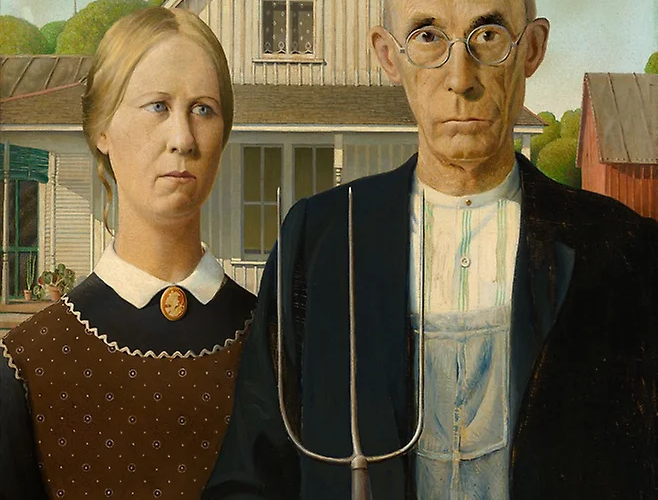
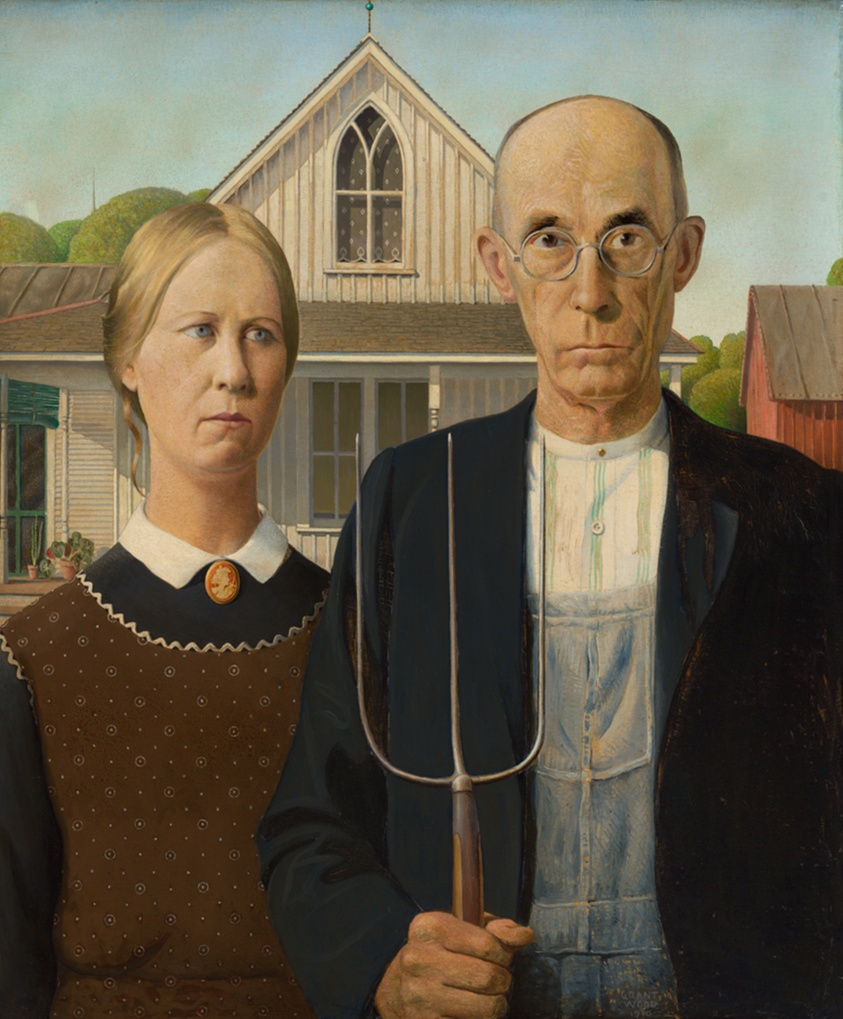
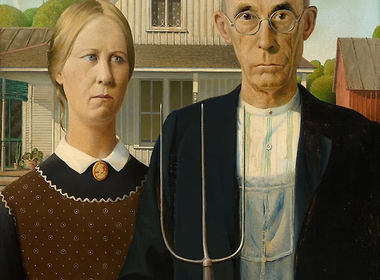
At first glance, Grant Wood’s American Gothic seems simple enough to understand. A stern-looking man holds a pitchfork. A woman stands beside him. Behind them is a small white house with an unusual pointed window. There are no dramatic gestures, no elaborate background, and no obvious action taking place.
Yet, nearly a century after its creation, the painting remains one of the most recognisable images in American art. Its two figures have appeared in countless parodies, photographs, advertisements, and popular culture references. More interestingly, people continue to disagree about what they represent.
Is it a tribute to hardworking rural Americans? A portrait of a vanishing way of life? Or simply an unusually memorable painting of two people who refuse to smile?
The story behind American Gothic reveals how an ordinary house, two familiar faces, and one artist’s distinctive vision came together to create an image that would eventually stand for far more than its creator could have anticipated.
The House That Inspired a Masterpiece
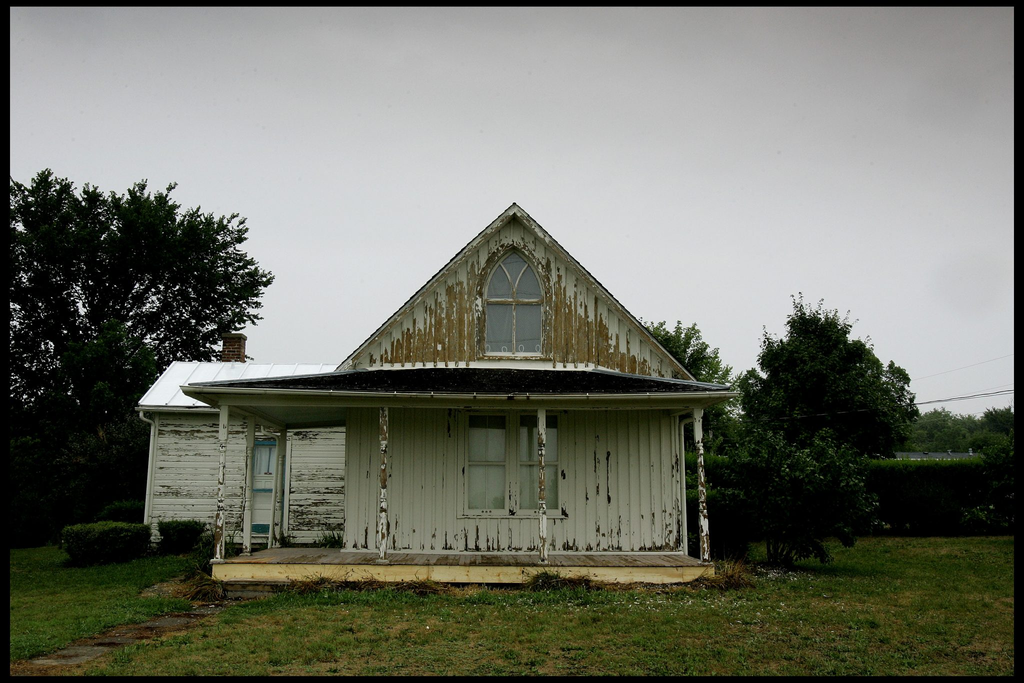
The house featured in the famous painting “American Gothic” by Grant Wood in Eldon, Iowa. Photo by David Howells/Corbis via Getty Images.
The story began in Eldon, Iowa, in 1930. While visiting the small town, Wood came across a white wooden cottage with a distinctive pointed-arch window on its upper floor. The house was built in the Carpenter Gothic style, which adapted features of Gothic architecture to relatively modest wooden buildings.
Wood was fascinated by the unusual window and sketched the house as a possible subject for a painting. Rather than depict the building on its own, he imagined the kind of people who might belong in front of it.
The house still stands today. Known as the American Gothic House, it is maintained by the State Historical Society of Iowa and has become a destination for visitors who want to see the real setting behind the famous painting.
But Wood’s interest went beyond architecture. The pointed window gave him a visual idea that would shape the entire composition. Similar forms appear in the pitchfork, the man’s overalls, and the patterns of the woman’s apron, connecting the figures to the house behind them.
Everything seems carefully arranged, almost as though the people and the building were designed to belong together.
That precision reflected Wood’s artistic development. After studying art in the United States and travelling to Europe, he became interested in the detailed realism of Northern Renaissance painters. During a visit to Munich in 1928, he encountered artistic approaches that helped shape his emerging style. By the end of the decade, he was moving away from the Impressionist style of some of his earlier paintings towards a more controlled approach, using precise forms and carefully constructed scenes to express the character of the American Midwest.
American Gothic brought these interests together in a way that was immediately distinctive.
Who Are the Two People in the Painting?
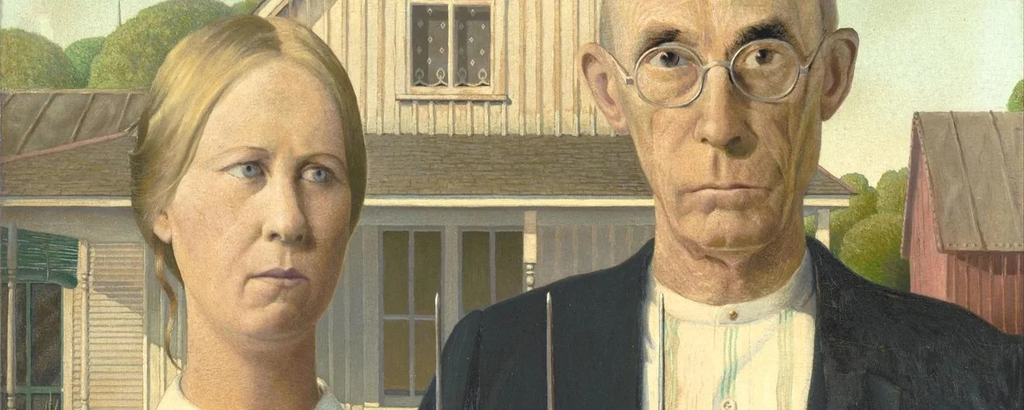
One of the most persistent misunderstandings about American Gothic is that it depicts a farmer and his wife. The painting certainly encourages that assumption: the man holds a pitchfork, both figures wear conservative clothing, and the house suggests a rural setting.
But Wood had a different story in mind.
The models were his younger sister, Nan Wood Graham, and his dentist, Dr. Byron McKeeby. Wood intended the imagined figures to represent a father and his daughter, not a married couple. They were familiar people transformed into characters rather than a portrait of an actual farming family.
Wood dressed his models in deliberately old-fashioned clothing, describing the figures as looking like “tintypes from my old family album.” Tintypes were photographs commonly produced in the nineteenth century, and their formal poses often give their subjects a serious, almost solemn appearance.
Wood recreated that feeling in paint. The man and woman stand upright, facing forward, with little visible emotion. Their expressions seem to belong to another time, even though the painting was made in 1930.
The figures’ elongated features and carefully arranged clothing also contribute to the painting’s distinctive visual character. Wood was not simply recording what his models looked like; he was shaping them to fit the atmosphere and structure of the scene.
Knowing the identities of the models changes the way we see the painting. These are not anonymous representatives of rural America, but people Wood knew personally, transformed into a carefully imagined composition.
Even so, the painting tells us little about their inner lives. That restraint is part of what makes it so compelling.
Read more : Five Bookshops to Visit in Paris
When a Tribute Was Mistaken for a Joke
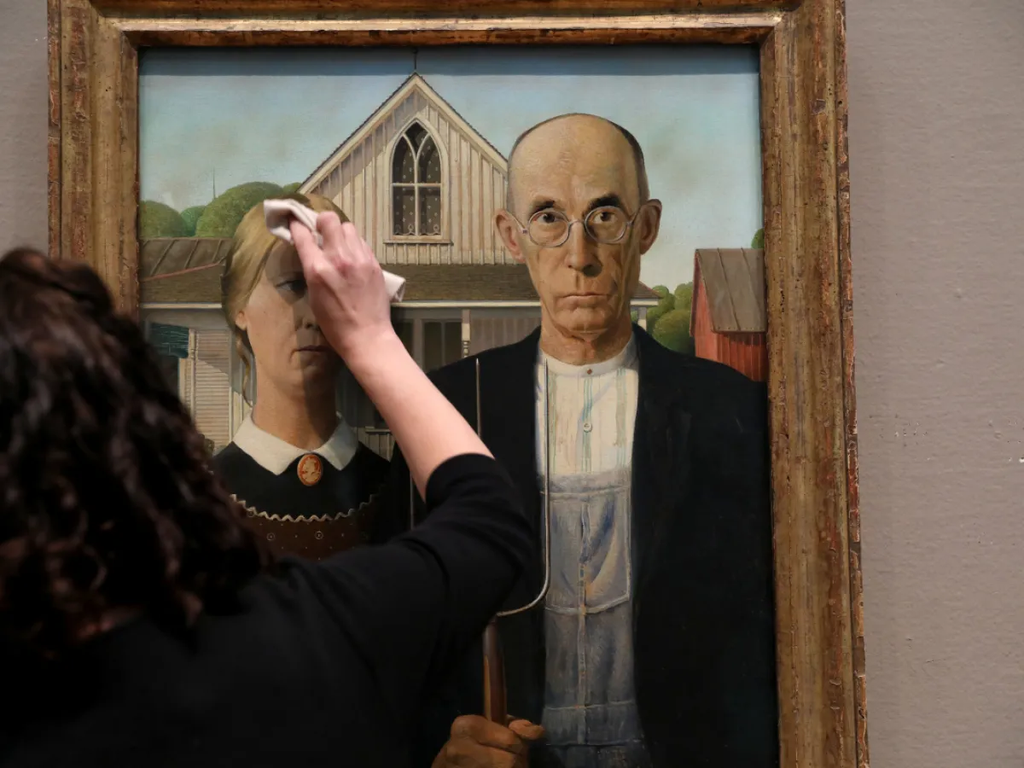
When American Gothic appeared at the Art Institute of Chicago in 1930, it attracted immediate attention. The painting received a bronze medal and a $300 prize, and the museum acquired it for its collection. Newspaper reproductions soon introduced Wood’s work to a much wider audience.
For an artist who had previously been known mainly within his local community, the response was a turning point.
However, the attention was not entirely positive. Many viewers interpreted the figures as a satire of Midwestern life. Their stern expressions and old-fashioned clothing seemed to suggest people who were suspicious of change, uncomfortable with modernity, and determined to hold on to traditional values.
The reaction was particularly uncomfortable for some Iowans, who felt that the painting made them look narrow-minded or humourless. The mistaken assumption that the figures were a farmer and his wife added to the criticism.
Wood maintained that this was not what he intended. He saw the painting as a tribute to the people and traditions he knew, rather than an attempt to ridicule them. His connection to Iowa was genuine, and his later work continued to explore the landscapes, people, and stories of the American heartland.
The timing also mattered. The painting appeared just after the Wall Street Crash of 1929, as the United States entered the Great Depression. At a time of widespread economic uncertainty, Wood’s carefully composed figures could be understood as an image of endurance and stability.
Their seriousness, which some viewers interpreted as unwelcoming, could also suggest determination. Their old-fashioned clothing could evoke continuity rather than backwardness.
The painting did not need to change for its meaning to change. Different audiences simply brought different expectations to it.
Why the Painting Leaves So Much Unanswered
Part of the appeal of American Gothic lies in its refusal to explain itself.
The figures look directly at us, but their expressions reveal very little. We cannot tell whether they are proud, uncomfortable, disapproving, or simply posing for a portrait. Their relationship is defined by Wood’s intended story, but the painting itself offers no conversation or action to confirm it.
This ambiguity fits Wood’s broader approach to portraiture. He was interested in creating figures that suggested a larger story without spelling it out. Rather than painting people as straightforward individuals, he often used them to evoke the character of a place, a community, or a particular way of life.
That approach gives viewers room to participate. Someone who associates the Midwest with hard work and resilience may see the figures as admirable. Another viewer may find their rigid posture and unsmiling faces intimidating. Neither response requires the painting to contain a single hidden message.
The architecture reinforces this sense of order. The pointed window echoes the pitchfork’s vertical lines, while patterns in the clothing repeat shapes found elsewhere in the composition. The figures appear almost inseparable from their surroundings, as though the house and its inhabitants express the same set of values.
Yet the result is not entirely comfortable. The painting is orderly, but it is also strangely still. Nothing appears to be happening, and nothing in the figures’ expressions tells us what might happen next.
That tension between clarity and uncertainty has helped keep the painting interesting to successive generations.
How American Gothic Became an Icon
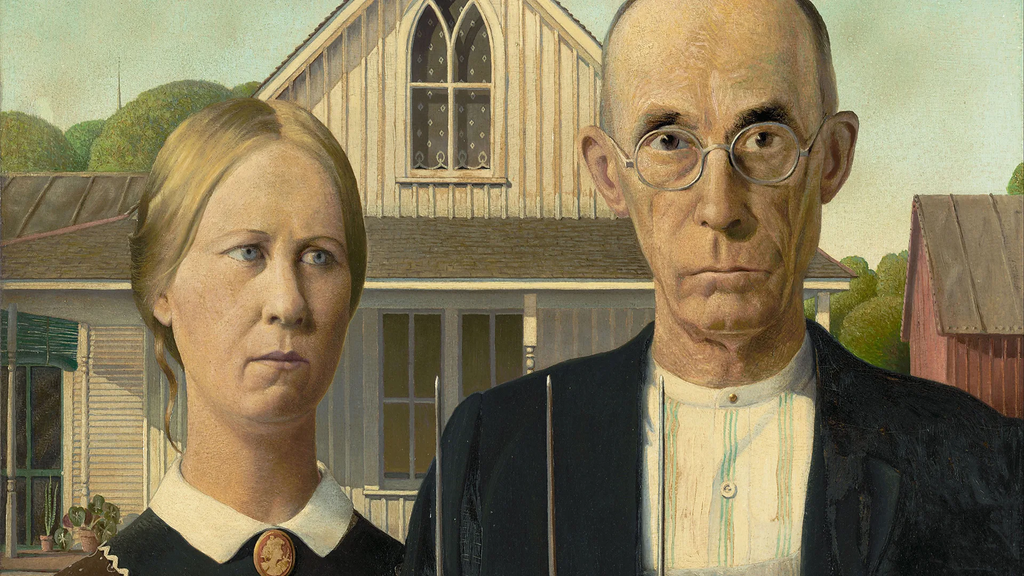
Wood’s painting has long outgrown its original setting. Its distinctive composition is easy to recognise, even when the people, objects, or circumstances are changed. That makes it particularly adaptable to parody and reinterpretation.
Over the decades, artists, photographers, advertisers, and popular entertainers have borrowed its familiar arrangement to comment on everything from family life to politics. The image can be used affectionately, humorously, or critically, depending on the context.
The American Gothic House has also become part of the painting’s cultural legacy, attracting visitors who want to see the building that inspired Wood’s composition and recreate the familiar pose.
But the painting’s fame is not simply a matter of recognisable faces and an easily reproduced composition.
Wood became one of the leading figures associated with American Regionalism, an artistic movement that focused on American people, places, and experiences rather than following the international trends dominating parts of the art world. His paintings helped establish the Midwest as a subject worthy of serious artistic attention.
Although American Gothic became his best-known work, Wood produced landscapes, portraits, murals, illustrations, and other paintings throughout his career. His wider body of work reveals an artist deeply interested in how Americans imagined themselves and the places they called home.
The painting’s lasting significance comes from the way it brings those concerns together in a single image. It is recognisably rooted in Iowa, yet it has become a symbol that audiences far beyond the Midwest can interpret in their own ways.
A Story That Never Quite Ends
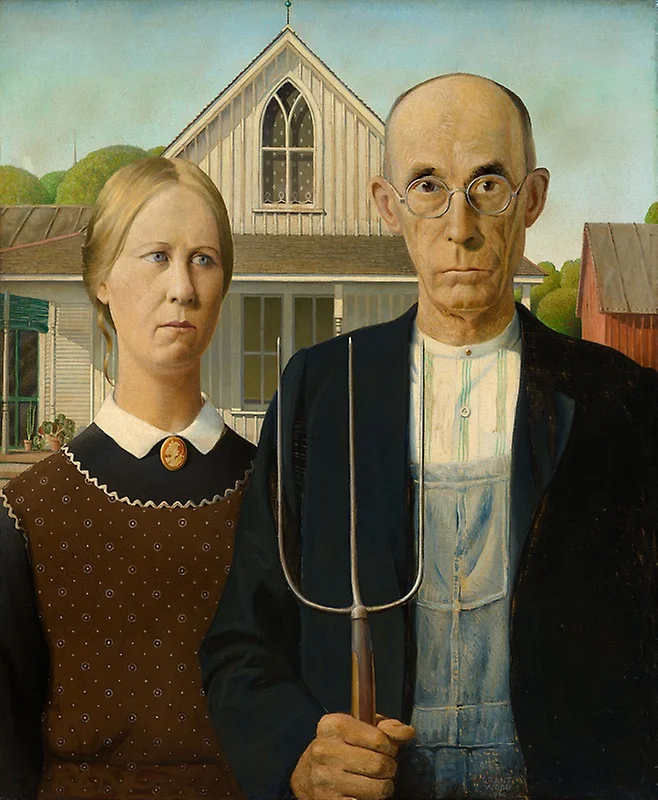
Nearly a century later, the man still holds his pitchfork, the woman still stands beside him, and the pointed window still rises behind them.
We know where Wood found his inspiration. We know who posed for the figures, and we know that he intended to honour the rural world he knew. We also know that the painting’s early reception differed sharply from his intentions.
What remains open is how we respond to it.
Perhaps the figures represent endurance. Perhaps they remind us of the distance between tradition and change. Or perhaps their expressions simply invite us to imagine a story that the painting never fully reveals.
That is the achievement of American Gothic. Grant Wood took a familiar house and two people from his own life and created an image that continues to invite questions without requiring a single definitive answer.
The painting may be famous for its stern faces, but its real staying power lies in what those faces leave unsaid.
Explore the current open calls and submit your work: apply.artstoheartsproject.com