



The Story Behind The Kiss
How Gustav Klimt Turned an Embrace into an Icon
Gustav Klimt’s The Kiss is one of those paintings that seems to belong everywhere.
Its image has travelled far beyond the museum, becoming one of the most widely reproduced paintings of the modern era. The gold is instantly recognizable. So are the two figures folded into one another at its centre. Somewhere along the way, Klimt’s painting became shorthand for romance.
The original asks for a slower look.
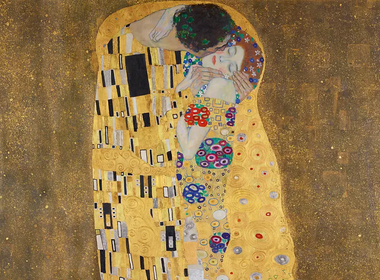
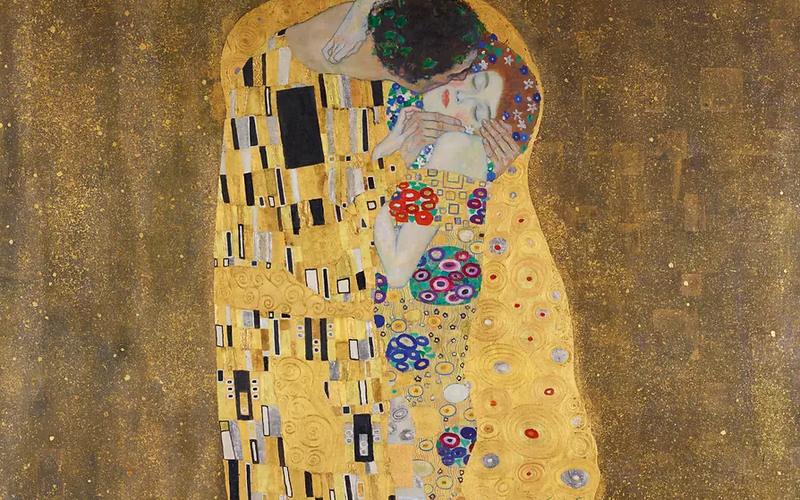
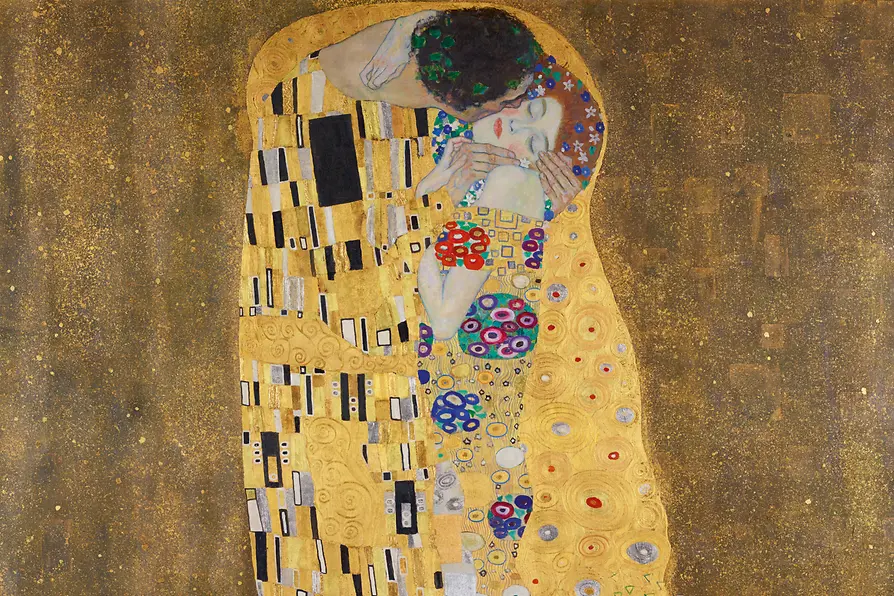
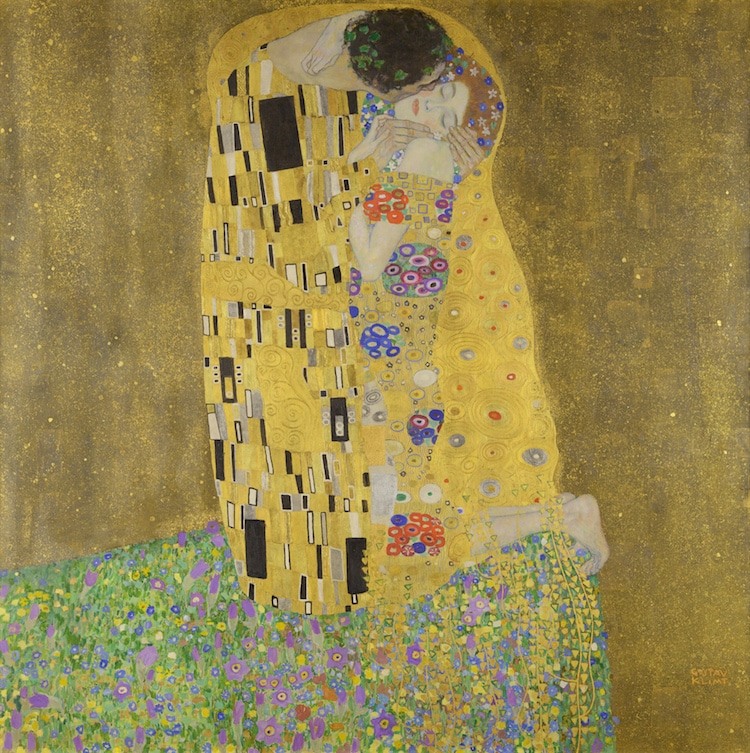
Painted in 1908 and completed in 1909, The Kiss (Lovers) is a perfect square, measuring 180 by 180 centimetres. The man bends over the woman, one hand holding her face as he presses his lips to her cheek. Her eyes are closed. One arm circles his neck; the other rests over his hand. Beneath them is a small patch of flowers. Beyond it, there is no ordinary landscape to return to, only gold.
Even their bodies are difficult to separate. Pattern takes over where anatomy should be, wrapping the pair into a single shimmering form while their faces, hands, and feet remain exposed.
And for an image this famous, it leaves a surprising amount unresolved.
We do not know with certainty who the lovers are. We cannot say exactly what Klimt wanted their embrace to mean. What we can trace is how he arrived here, and how one private gesture became one of the most public images of love ever painted.
Before The Kiss, there was Klimt’s Vienna
By the time Klimt painted The Kiss, he had already spent years moving away from the artistic traditions in which he had been trained.
Klimt studied at Vienna’s School of Applied Arts and began his career working on decorative commissions with his brother Ernst Klimt and Franz Matsch. Their work included major commissions for buildings such as Vienna’s Burgtheater and Kunsthistorisches Museum. Over time, however, Klimt’s own work became increasingly independent, with greater emphasis on symbolism, stylized forms and ornament.
In 1897, Klimt and a group of artists broke with the established Künstlerhaus and founded the Vienna Secession, with Klimt serving as its first president. The group wanted greater artistic freedom and a place for contemporary art that was not bound by the conventions of the established exhibition system.
That change in Klimt’s artistic world matters when looking at The Kiss.
The elaborate patterns in the painting are not simply decoration placed around the figures. They occupy the same visual space as the lovers themselves. The bodies, the robes, the ornament and the gold are woven together until it becomes difficult to tell where one ends and another begins.
Klimt had spent years moving toward that kind of image.
By the time he arrived at The Kiss, he was no longer simply placing figures against a background. He was building an entire visual world around them.
And that world was about to turn gold.
The Golden Period: Why is everything glowing?
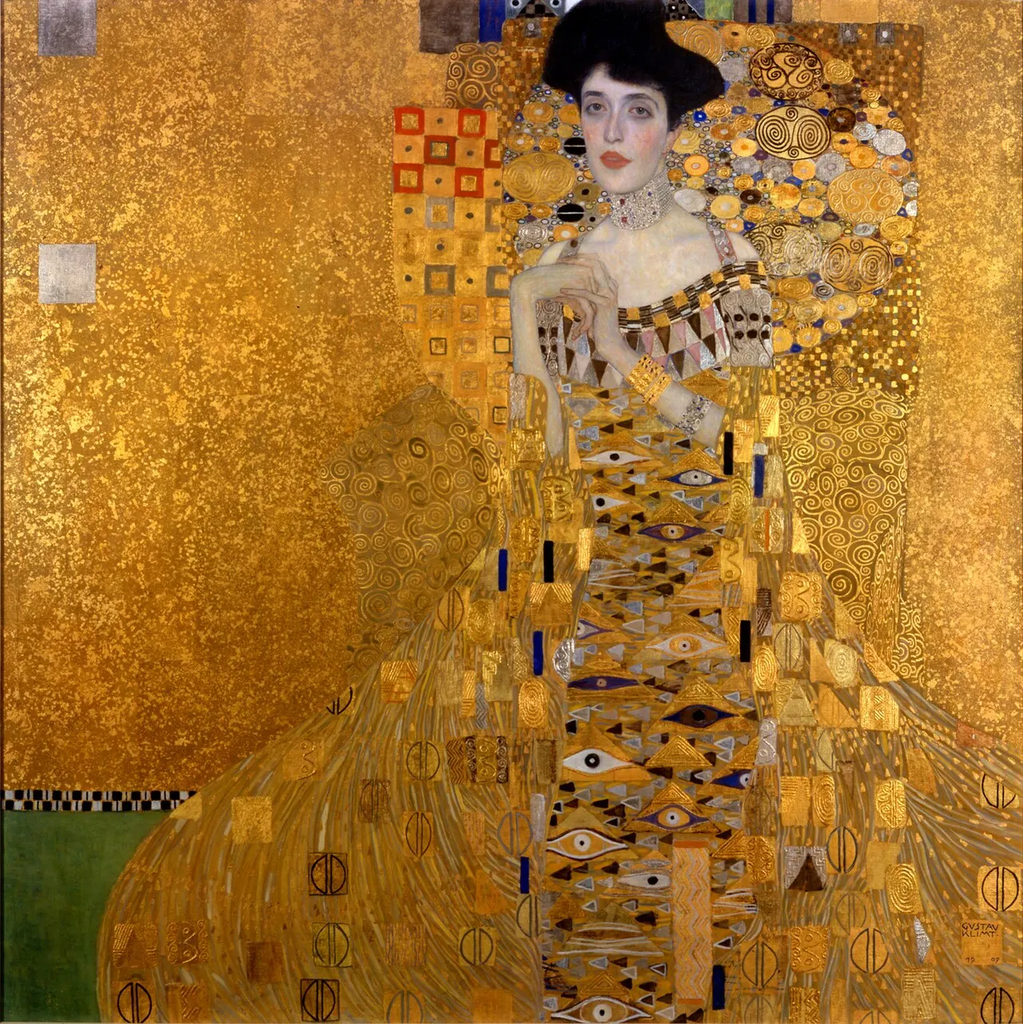
Portrait of Adele Bloch-Bauer I, Gustav Klimt, 1907.
Gold had been part of Klimt’s family background: his father, Ernst Klimt the Elder, was a gold engraver. But Klimt’s later use of gold became far more than a connection to his family’s craft. It became one of the defining features of his mature work.
A major turning point came in 1903, when Klimt travelled to Venice and Ravenna. In Ravenna, he encountered the shimmering Byzantine mosaics that would become an important influence on his Golden Period. Their luminous surfaces offered him a different way of thinking about space, colour and the relationship between figure and background.
Between 1907 and 1909, Klimt reached the height of this period. The Kiss stands at its centre. The painting combines oil paint with gold leaf, gold paint, silver and platinum, while the background incorporates beaten metal and metallic flakes.
The gold does more than make the painting glow.
It changes the space around the lovers.
There is still a physical world here: skin, hands, flowers, fabric. But the vast golden field behind them removes the ordinary sense of place. The couple remains recognizably human while appearing suspended somewhere outside everyday time.
The effect is almost icon-like. Two people are given the visual weight of something precious and timeless.
Klimt had found a way to make a very human gesture feel larger than the moment itself.
And in The Kiss, his experiments with gold reached their most famous expression.
Look closer: two people, one robe
The longer you look at The Kiss, the harder it becomes to see two separate bodies.
Klimt has wrapped the couple in richly patterned robes, turning the embrace into one almost continuous shape. Their faces remain distinct, as do their hands and feet, but nearly everything else disappears beneath the surface.
Then the patterns begin to separate them again.
The portion surrounding the man is built from angular shapes, rectangles and blocks of black, white and grey. Around the woman, the forms become softer and more rounded, with circles, spirals and floral details. These differences have often been interpreted as a visual contrast between masculine and feminine forms, but it is safer to see them as part of Klimt’s visual construction rather than as a fixed symbolic code that he explicitly explained.
The flowers beneath them bring the painting back to the physical world. A small, flower-covered meadow supports the couple while the gold behind them seems to dissolve any ordinary sense of place.
They are grounded and suspended at once.
That tension is part of what makes the painting so compelling.
We can feel the closeness of the embrace because Klimt gives us skin, hands, closed eyes and the slight tilt of the woman’s face. But he withholds most of their bodies from us. Instead, pattern takes over.
The lovers are no longer simply standing inside a golden setting.
They have become part of it.
And perhaps that is the most remarkable thing Klimt does here: he uses ornament not to distract us from the couple, but to make the embrace itself feel larger than the two people within it.
Who are the lovers? The question we cannot quite answer
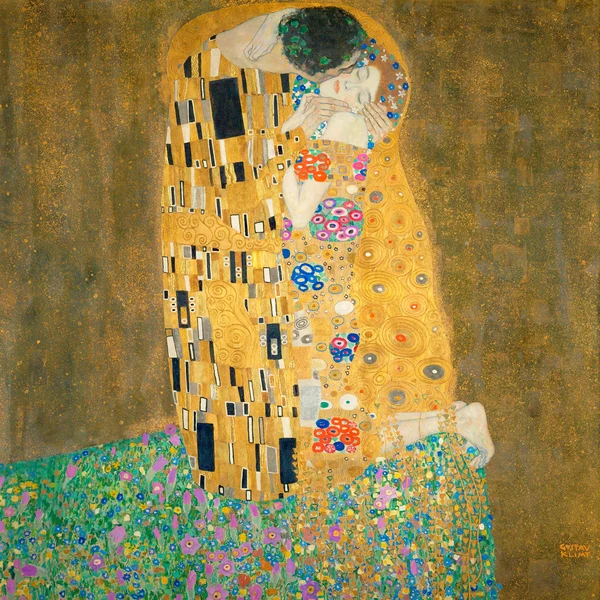
The woman in The Kiss has often been identified as Emilie Flöge, the Viennese fashion designer who was closely connected to Klimt. Flöge and her sisters opened their fashion salon, Schwestern Flöge, in Vienna in 1904, and Klimt was part of their creative circle.
A contemporary rumor identified the couple in The Kiss as Klimt and Flöge. There is also an intriguing piece of evidence from a later object: a brooch from 1908 depicting an embrace bears the names “Gustav” and “Emilie” beside the two figures, and a related preliminary study is inscribed “Emilie.”
But that still does not allow us to say that the woman in The Kiss is definitively Flöge.
The painting itself gives us no names.
And perhaps the uncertainty suits it.
Klimt gives us no setting that could tell us where the couple has come from or where they are going. No particular room, no city street, no recognizable landscape. Their identities are almost as hidden as their bodies beneath the patterned robe.
What we are left with is the gesture.
The woman closes her eyes as the man bends towards her. His hands cradle her face; hers hold onto him. The painting captures the moment of closeness rather than giving us a story about what came before or what happens afterwards.
So perhaps the better question is not who are they?
It is what happens when Klimt leaves them unnamed?
Without a definite identity attached to the couple, the embrace remains open to the viewer. It can belong to Klimt and Flöge as a possibility, but it can also belong to no particular couple at all.
The kiss had already appeared in Klimt’s work
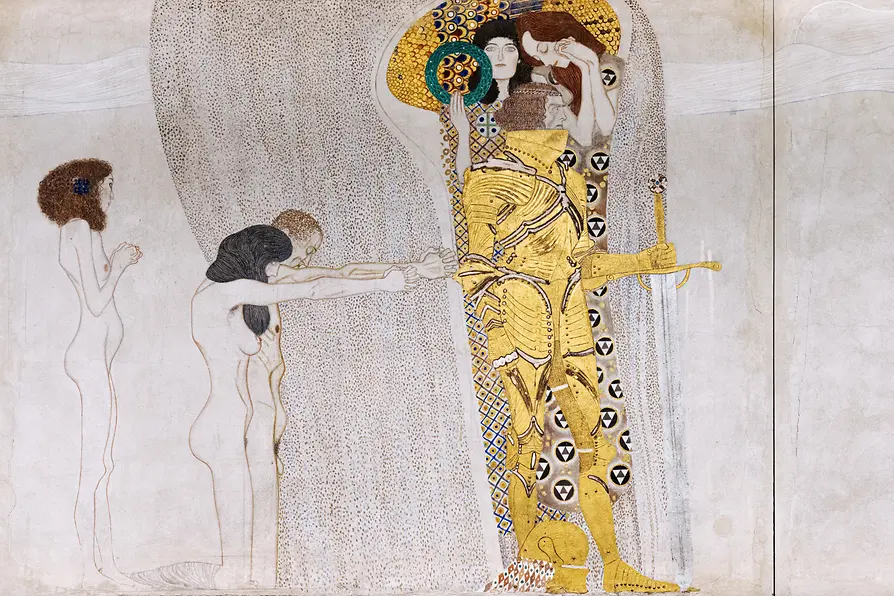
Klimt had painted this embrace before.
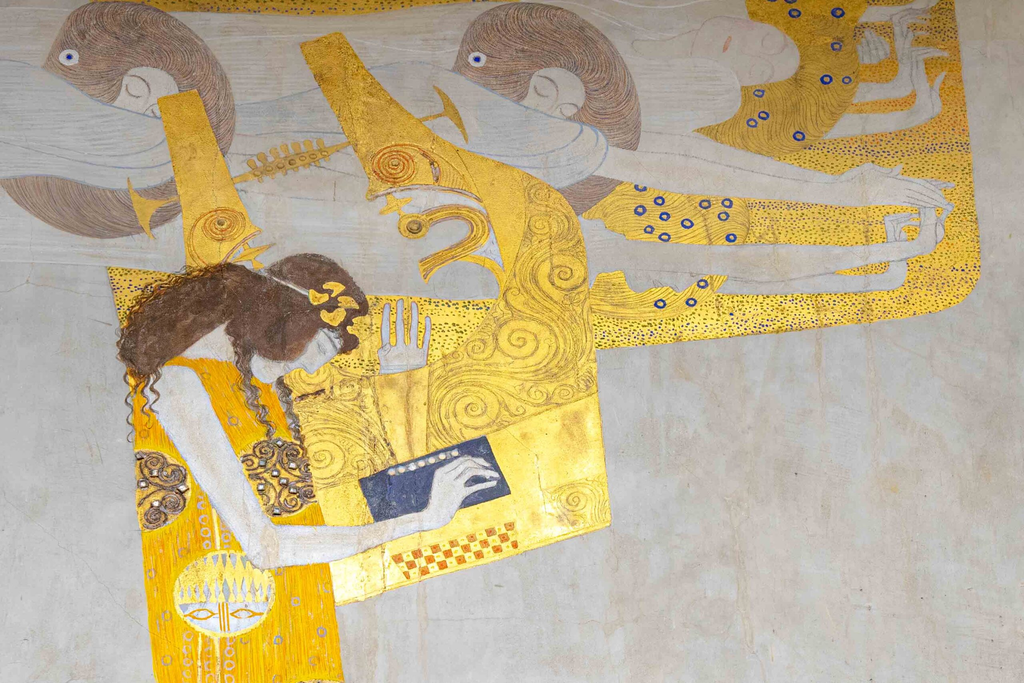
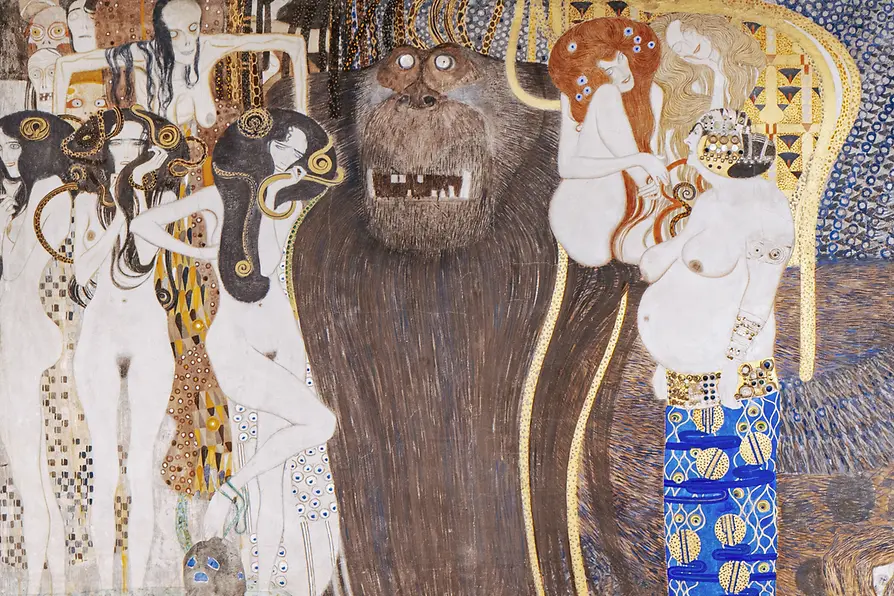
Six years before The Kiss, he created the Beethoven Frieze for the 1902 Vienna Secession exhibition. The monumental work follows a journey through suffering, the search for happiness and the forces that stand between humanity and fulfilment. At its conclusion, a man and woman come together in an embrace.
The connection is more than visual.
The final scene of the frieze refers directly to the concluding chorus of Beethoven’s Ninth Symphony, which sets Friedrich Schiller’s Ode to Joy. The embrace appears in connection with the famous line “This kiss to the whole world,” and the motif of the tightly embracing couple would return in The Kiss.
By the time Klimt created The Kiss, the larger narrative of the Beethoven Frieze had disappeared.
The angels, mythological figures and long procession of characters are gone. Instead, everything has been reduced to two people, a patch of flowers and an expanse of gold.
Yet the idea of the embrace remains.
In the Beethoven Frieze, the kiss is part of a larger story. In The Kiss, the embrace is the entire story.
And Klimt had found the perfect visual language for it: two bodies concealed beneath ornament until they almost become one.
Read more : Five Bookshops to Visit in Paris
The painting that Austria didn’t let go
When The Kiss first appeared in Vienna in 1908, it was shown at the Kunstschau Wien under the title The Lovers. The painting was still unfinished at the time. The Austrian state acquired it for the Moderne Galerie, and Klimt handed it over after completing it in 1909. The documented purchase price was 25,000 crowns.
The timing is remarkable.
Klimt’s The Kiss did not spend decades waiting to be rediscovered. It entered a state collection at the very beginning of its public life. The Belvedere records that it was acquired at its first presentation in 1908 and has remained in the museum’s collection ever since.
Today, it hangs at the Upper Belvedere in Vienna, where it has become the defining image of the museum and one of Austria’s best-known works of art.
The painting has travelled remarkably far since that first exhibition. Its image has been reproduced so often that the original can almost feel familiar before we have even stood in front of it.
But perhaps that is what makes its journey worth remembering.
Before The Kiss became a postcard, a poster or an icon, it was a new painting by a contemporary Viennese artist, one that the Austrian state saw, acquired and decided to keep.
Why does this kiss still work?
More than a century after Klimt painted it, The Kiss still has the ability to stop people in front of it. The Belvedere itself points to the work’s continuing immediacy and emotional impact, and it is easy to understand why once we look past its fame.
The painting is lavish, but the gesture at its centre is simple. The surface is covered in gold and intricate patterns, yet the faces and hands remain intensely intimate. It feels decorative and deeply physical at the same time.
And perhaps the painting remains so inviting because Klimt never gives us a complete story.
We don’t know exactly who the lovers are. We don’t know where they have come from or what will happen after the embrace. We are given only this pause: two people holding on to each other, enclosed within their own small world.
That makes The Kiss feel less like a scene we are watching and more like a moment we have been allowed to enter.
The image has become familiar. The feeling has not.
Maybe that is Klimt’s real achievement. He took a kiss that could have belonged to two people and painted it large enough for the world to recognize itself in it.
Explore the current open calls and submit your work: apply.artstoheartsproject.com