
In Her Surreal Art, Beatriz Bradaschii Blends Together Victorian Influences, Childhood Memory & Nature
At Arts to Hearts project, we believe that the most compelling creative worlds are the ones built not from research or reference but from a lifelong, deeply personal fascination with things that most people cannot fully explain.
Our Best of the Art World editorial was built to find exactly those artists. And today we are so genuinely excited to introduce you to one whose entire practice has been shaped by a pull toward the unknown that she describes as feeling almost like a physical thread.
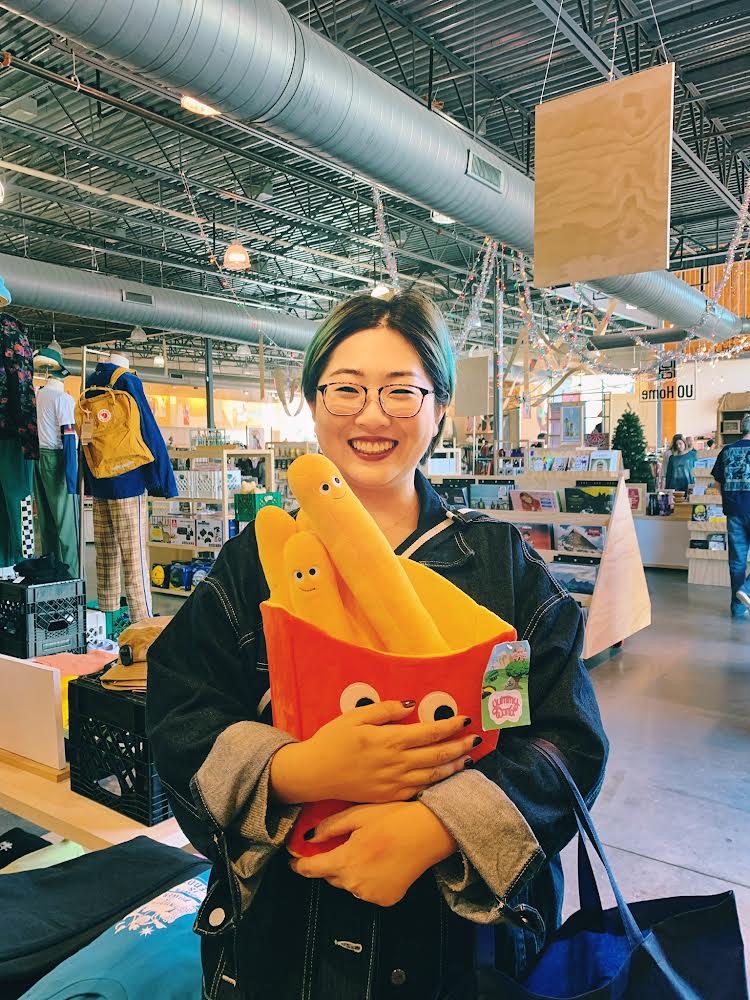
Beatriz Bradaschii known widely as Bea Bastet was born in São Paulo, Brazil, and has been making things for as long as she can remember. At four years old she was shaping play dough animals, stringing beads, drawing dinosaurs, making tiny figurines from wood scraps at her grandparents’ country house surrounded by nature and strange bugs and old toys.
From the very beginning, there was something in her that was drawn not just to making but to the mysterious to haunted houses and ghost stories and old photographs of people long gone, to the feeling that there is more going on beneath the surface of everyday life than what we can easily see. That feeling never went away. It became the engine of everything she makes.
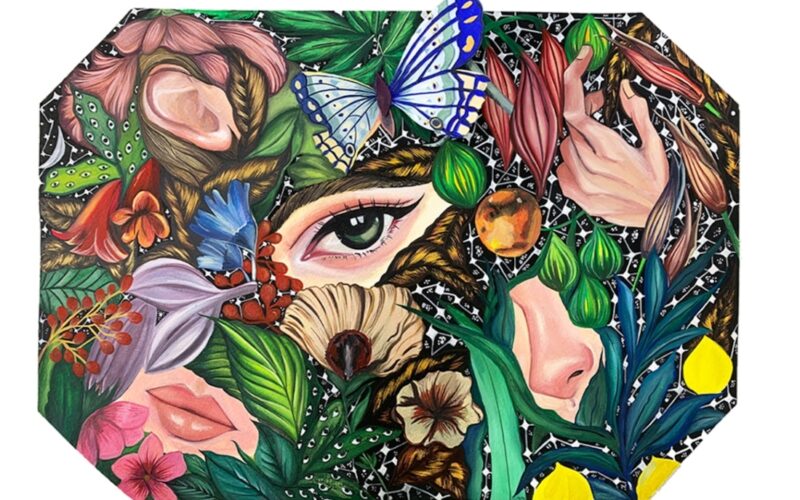
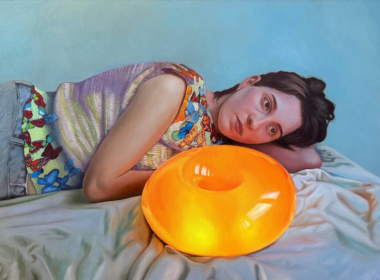
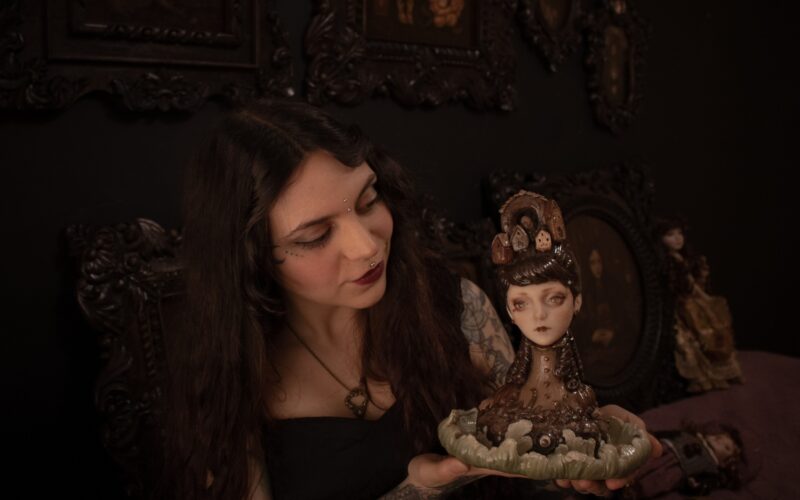
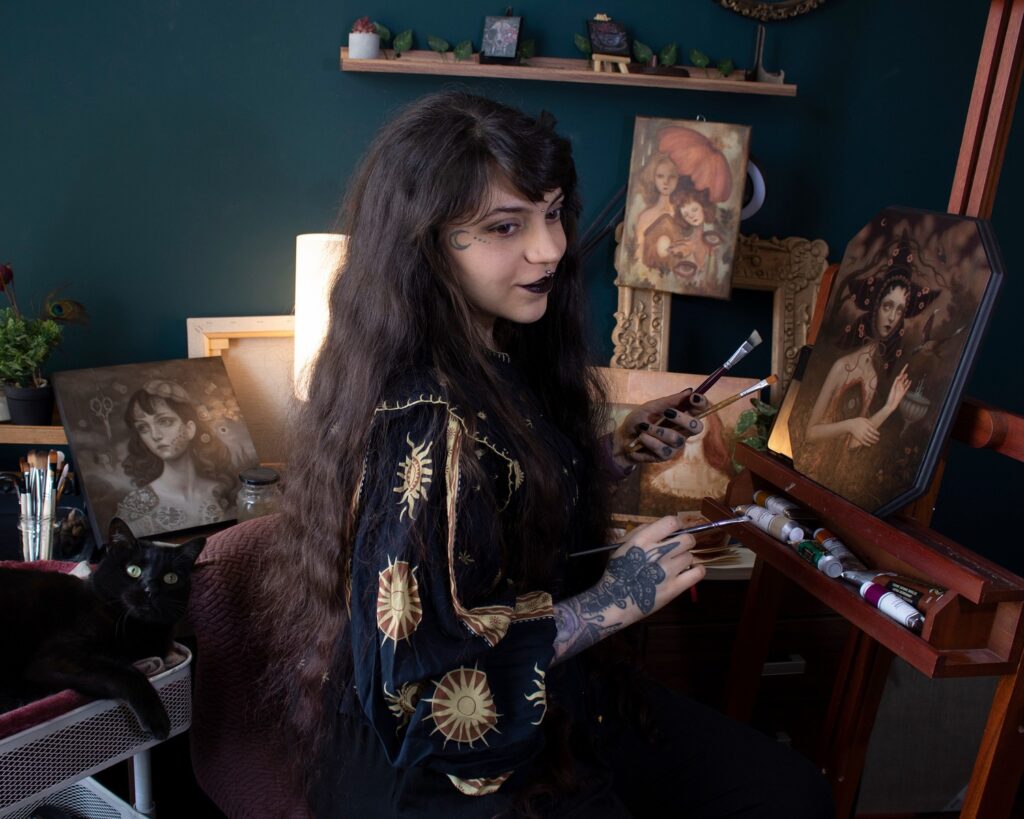
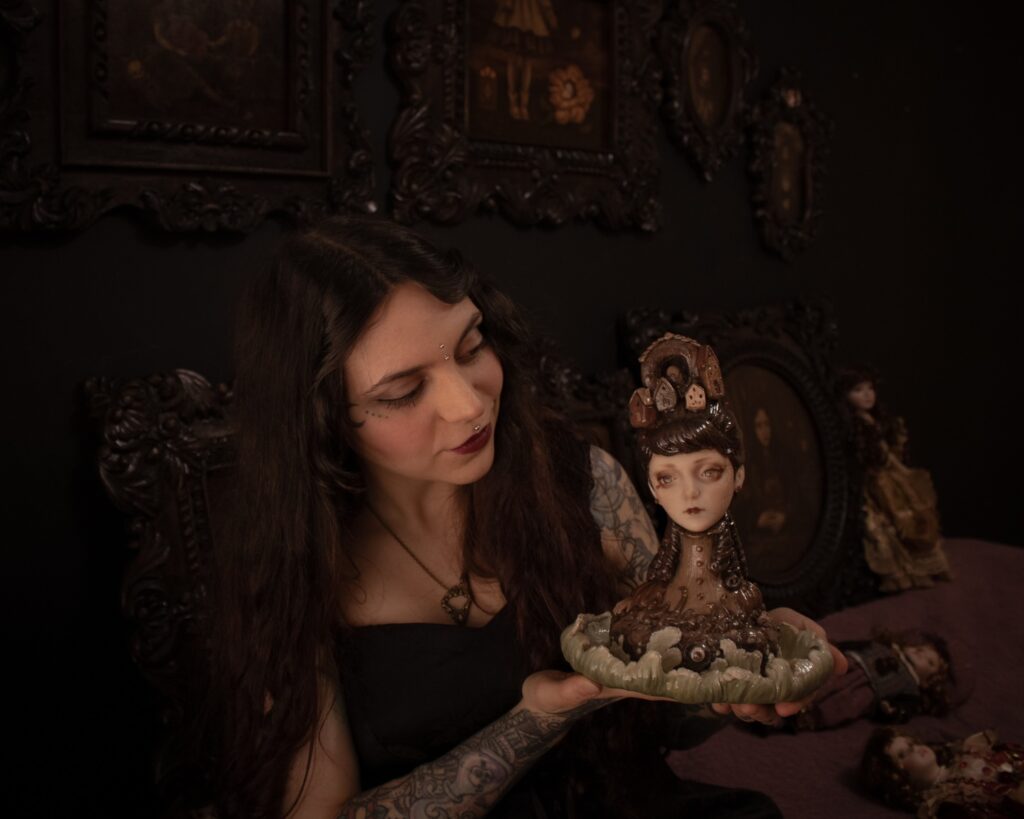
Today her work spans paintings, drawings, mixed media, sculpture, wearable art, and digital pieces each one an extension of the same deeply personal visual world she has been building since childhood. Her paintings fuse oil with polymer clay and UV resin, creating works that exist somewhere between painting and object, between the two dimensional and the sculptural, between the real world and somewhere else entirely.
Her imagery draws from dreams, childhood memories, Victorian academic art, Pre-Raphaelite painting, 19th century Symbolism, Gothic Romanticism, and survival horror games she played on PlayStation as a child all of it absorbed and transformed into something completely and unmistakably hers.
She has built a strong international following while protecting the integrity of her vision completely. Galleries have come to her. Collectors across the world have found their way to her work. And through all of it she has remained committed to the most important thing building a visual language that is authentic, personal, and built to last.
She wants you to go deeper. To explore what is behind the trees, at the other side of a door, at the end of the stairs. To come back knowing something you did not know before.
Let’s get to know Beatriz through our conversation with her, where she shares the childhood fascinations, the dreams, and the practice she has built from a lifelong pull toward everything that cannot quite be explained.
Q1. Beatriz, can you take us back to your earliest memories of making art?
I was around 4. I had a small plastic table for drawing, where I’d use a bunch of kits that my mom bought me. My favorite was a kit to learn how to draw dinosaurs. I also had a large acrylic white board.
I remember making homemade play dough with flour to shape animals, and beads to put on a string and wear as a necklace. I would also draw with my grandma and make tiny figurines out of small wood pieces with my grandpa at their country house, about an hour away from the city, where I was always inspired by nature, weird bugs, and old toys.
Q2. You’ve always been drawn to the strange and unconventional. Where do you think that fascination began?
I don’t know where it came from, but since I can remember, I’ve always had a very strong feeling of there being more going on than what we can easily see, that there is more to dreams too, and a strong pull towards the “unknown” that felt almost like a physical thread. I’ve come to understand those things much more now.
I was drawn to haunted houses, ghost stories, and old photographs of people that were long gone. I liked to imagine dolls coming to life and the presence of supernatural beings moving things around. Burying objects, creating amulets, and writing spells as some sort of ritual without really knowing what I was doing.
Q3. Your work brings together dreams, memories, and reality. How do you know when those elements belong together?
The core composition and the main elements tend to arrive naturally, while I consciously choose additional details and make decisions as the piece develops. As for knowing when everything has clicked into the right combination, I don’t really have a formula.
It’s a feeling more than a thought. At a certain point, I simply feel that the image has become what it was meant to be… It’s mostly intuitive.
Q4. Many of your pieces fuse oil painting with polymer clay and UV resin, what led you to work across these forms?
There wasn’t a specific moment when I decided to combine painting and sculpture. I’ve always loved working with clay, making little decorative ornaments, charms, and decorating things. Also painting on any surface I could find like shells, stones, wooden boxes, etc. So combining them always came naturally, initially through play and experimentation. I’ve never felt drawn to working in just one medium. I enjoy exploring different materials and ways of creating.
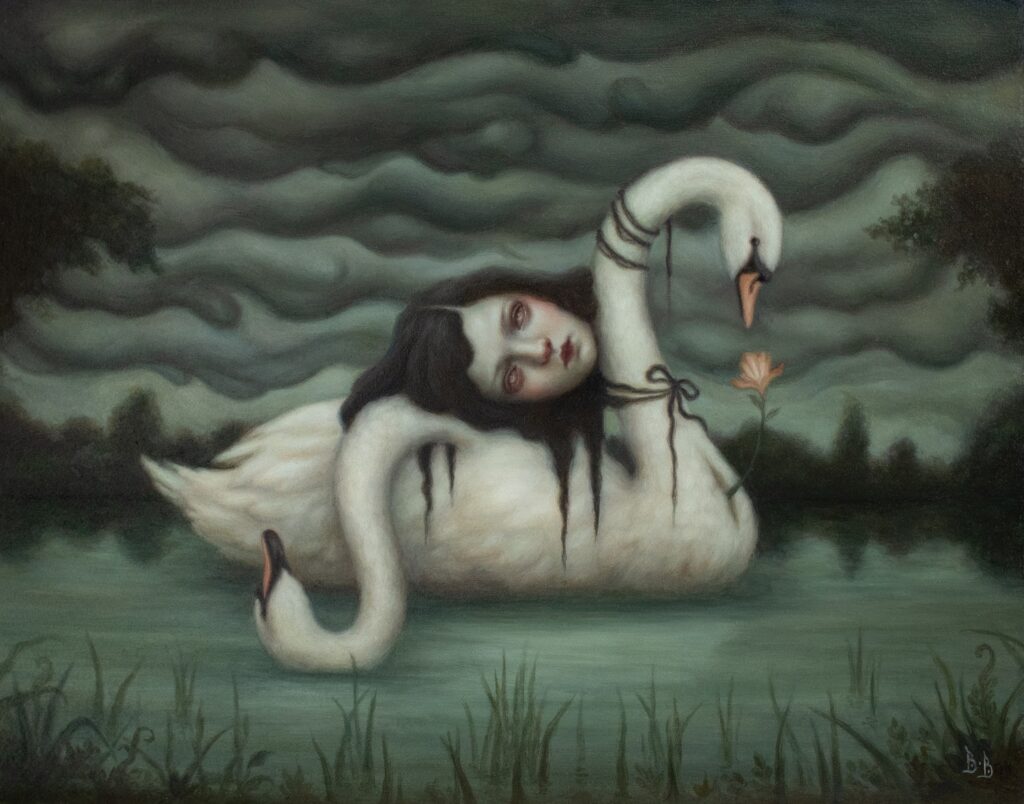
Q5. You move between oils, graphite, sculpture, and jewelry. Does an idea usually arrive with its medium?
For sculptures, yes. For 2D mediums, I’d say most of the time, but that’s not always the case. There have been times where I started a graphite drawing and I knew it had to be a painting. The colors and atmosphere popped up in my head, and I would sometimes just discard it and make it a painting instead.
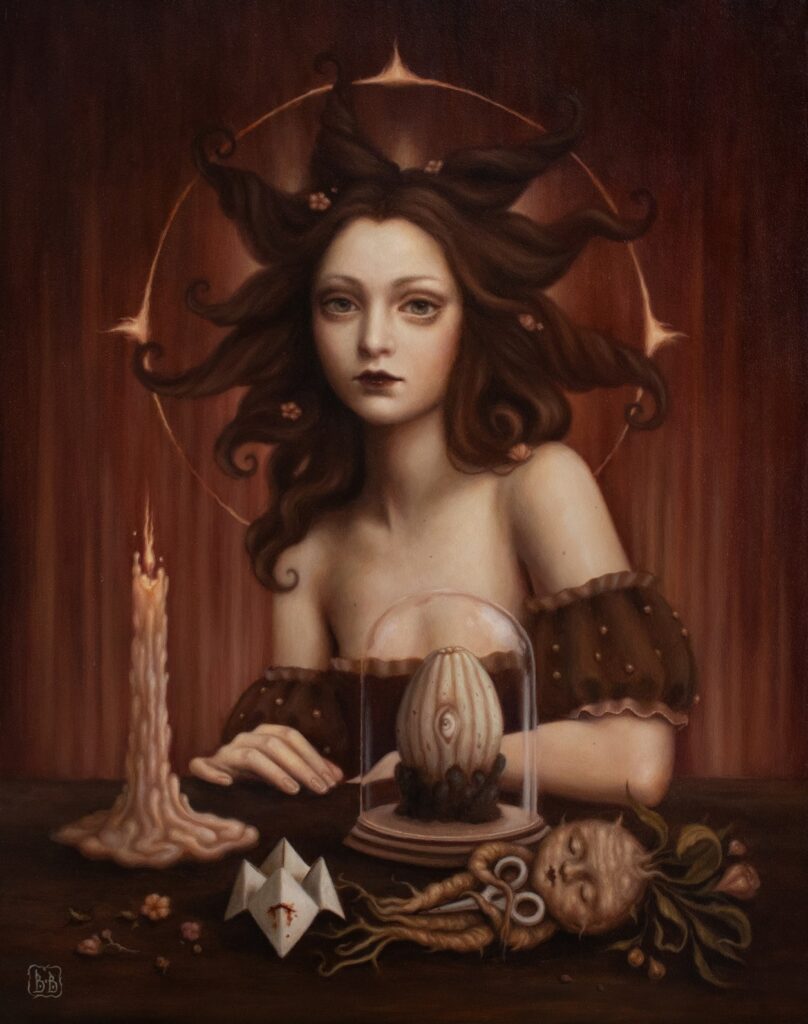
Q6. In works such as The Sacred Vessel, symbolic objects become central to the narrative. What inspired this particular piece
This was made for a group exhibition with “Goddess” as a theme. Instead of depicting a goddess in particular, I focused on the goddess that resides within the feminine as a primordial force of creativity, and a sacred space where ideas are brought into existence. The egg here is a symbol of the womb of creation. It honors the many ways creation emerges through the feminine through art, ideas, dreams, and the ability to bring beauty and meaning into the world.
Q7. Your titles often add another layer to the work. How do they usually come to you?
Titles can come months before I start a piece, during the process and sometimes weeks or months after it’s finished. I try not to think too much about titles and they usually emerge on their own. Other times, the title takes longer to find. I might need to spend some time reflecting on the piece and searching for the right words to capture what it expresses.
Most of the time, I enjoy titles that add another layer of meaning or invite the viewer to look at the piece from a different perspective and expand the feeling or idea behind the work. but that not a strict rule and sometimes the title is just simply what is there.
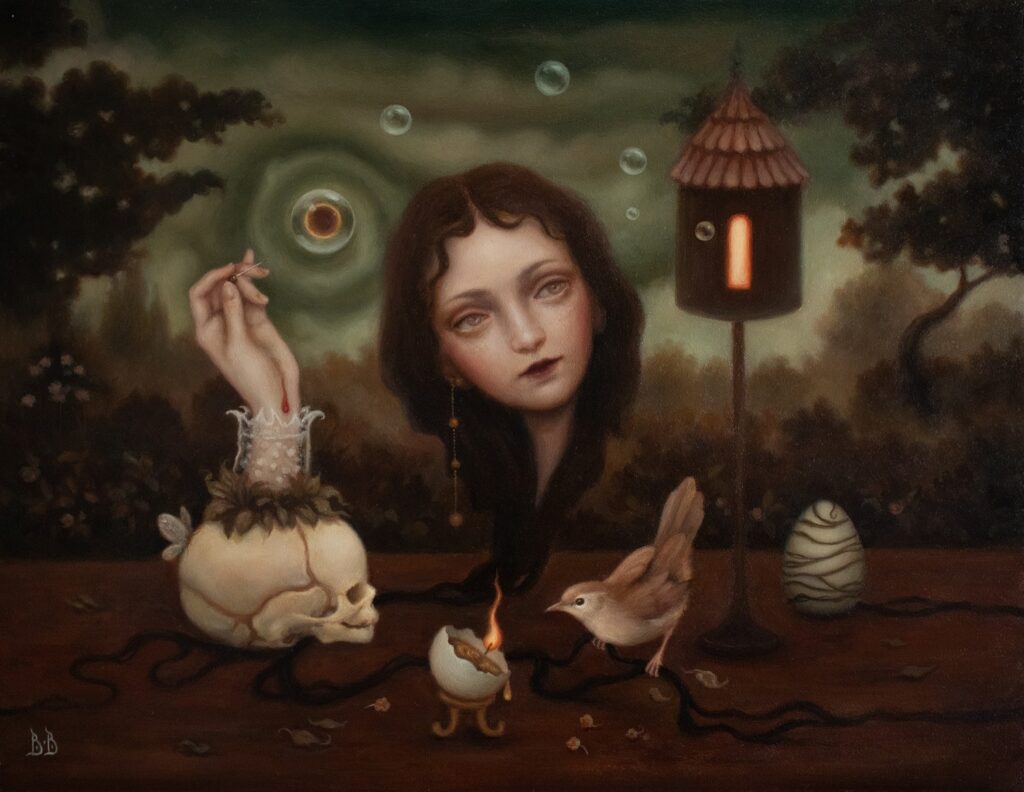
Q8. If someone stepped into one of your paintings as a real place, what would you want them to feel in the first few seconds?
I love this question. I know it sounds contradictory, given that a lot of my pieces are described as eerie, but I would want them to feel calm mixed with a need to explore, notice the sounds, to go and see what’s behind the trees, or at the other side of a door, at the end of the stairs.
To ask the people inside the paintings as many questions as they want. To know that there is not a dangerous thing in those places and that if they go deeper, they will always go back home knowing something they didn’t before.
Q9. Your work is highly detailed without feeling overcrowded. How do you decide when a composition has everything it needs?
The overall composition usually comes to my head intuitively and I tend tu build up from there. But as I work, I pay attention to whether each element contributes something to the overall feeling of the piece. If something feels like it is there without purpose, I remove it. It reaches a point where adding more would take away from the image rather than enhance it.
Q10. Victorian art, Symbolism, Gothic literature, and film all appear among your influences. What continues to inspire you today?
I draw inspiration from Victorian academic art, Pre-Raphaelite, 19th-century Symbolism, and also Rococo. I love Victorian and Gothic Romanticism literature too. One of my earliest influences was survival horror games I used to play on PS2, and Tim Burton movies. I was always drawn to aesthetics that were whimsical and eerie, and colorful yet dark. My biggest inspiration now are dreams and nature itself.
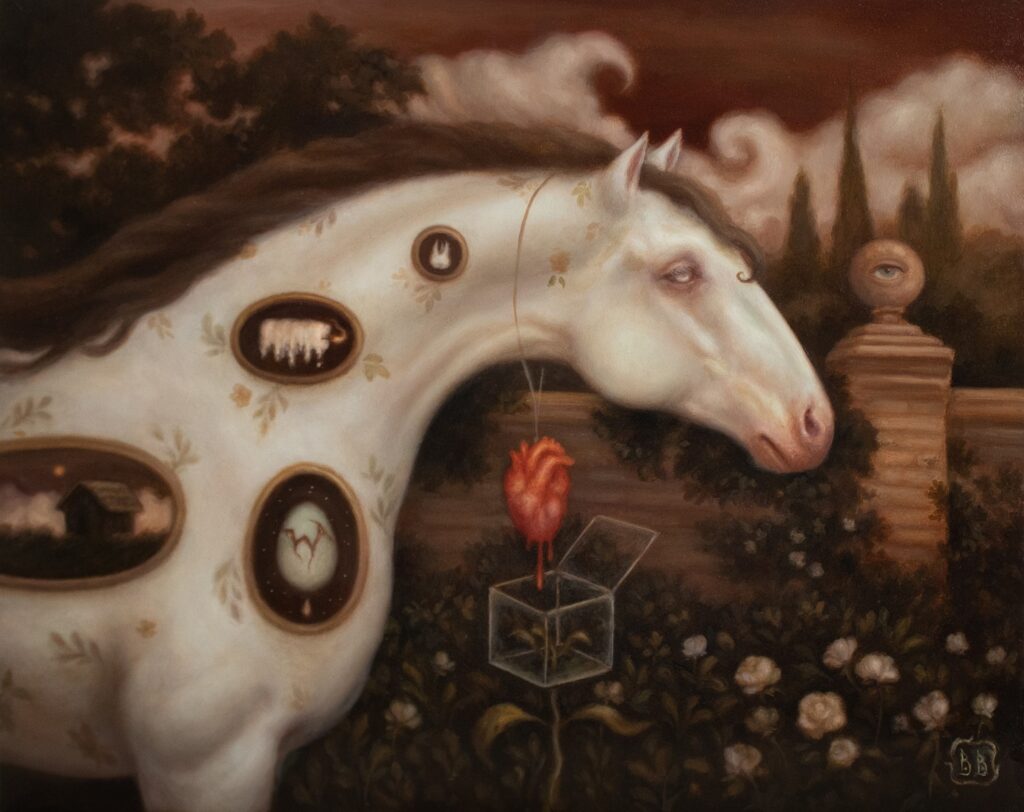
Q11. Looking back on your journey, what has been the most meaningful milestone in your career so far?
One of the most meaningful milestones was reaching the point where various galleries began inviting me to exhibit my work. My work had already started to find its audience, and I believed in it and my vision, but hat recognition gave me the confidence to feel that it was ready to reach a wider audience. It was a reassuring moment that reminded me the years I’d spent developing my visual language had led to something others believed in as well. It was a catalyst for more growth and expansion, and I’m incredibly grateful to them for those opportunities.
Q12. How do you protect your visual language while building an international career?
To be honest, I don’t feel that I’ve fully balanced those two things yet. Building an international audience has been incredibly rewarding, but creating a sustainable career is an ongoing process rather than something I’ve figured out. Protecting the integrity of my work is really important to me. I’ve focused on developing a visual language that feels authentic to me and trusting that the right audience will connect with it over time.
That path requires patience and time, and may not always be the fastest route to growth, but I believe that creating meaningful, personal work builds a stronger and more lasting connection. My goal is to continue finding practical ways to support that vision without compromising what drew me to create in the first place.
Q13. Art has been part of your healing journey. What can creativity reveal about ourselves?
Yes, and I think it will always be. When people use creativity as a means of exploration, allowing ideas and symbols to emerge spontaneously, they create an opportunity to connect with deeper parts of themselves and gain a greater understanding of their inner world.
Creating each piece is in many ways similar to a shadow-work process, they work as an instrument to slowly reveal parts of ourselves that we reject and bury throughout the course of our life.
So creating becomes a way of turning inward, revealing deeper layers of the self and bringing us closer to self-awareness, process emotions, and gain new perspectives. The creation becomes a mirror which we can have a conversation with. These understandings help us become more and more unstuck, one step at the time.
Q14. What advice would you give artists who want to build a visual world that feels truly their own?
Spend time discovering what genuinely fascinates you, while improving the skills you need (techniques, materials, shapes, colors, composition, symbolism, etc.) to give those ideas a form. It goes hand in hand with the concepts, ideas, creativity, and translating your vision onto the canvas. I love making boards and lists. A distinctive visual world is usually built through curiosity, experimentation, and a willingness to explore the subjects, symbols, and ideas that draw you in over and over again.
Spending time imagining how your inner world looks like, how it feels, what sounds and what smells are there… I think that a lasting artistic voice comes from developing a personal relationship with your work. Creating consistently, exploring ideas deeply, and allowing yourself to follow unexpected paths are what help a unique visual language emerge over time. And also remembering that it can change and evolve, I think this is a wonderful part of all of this.
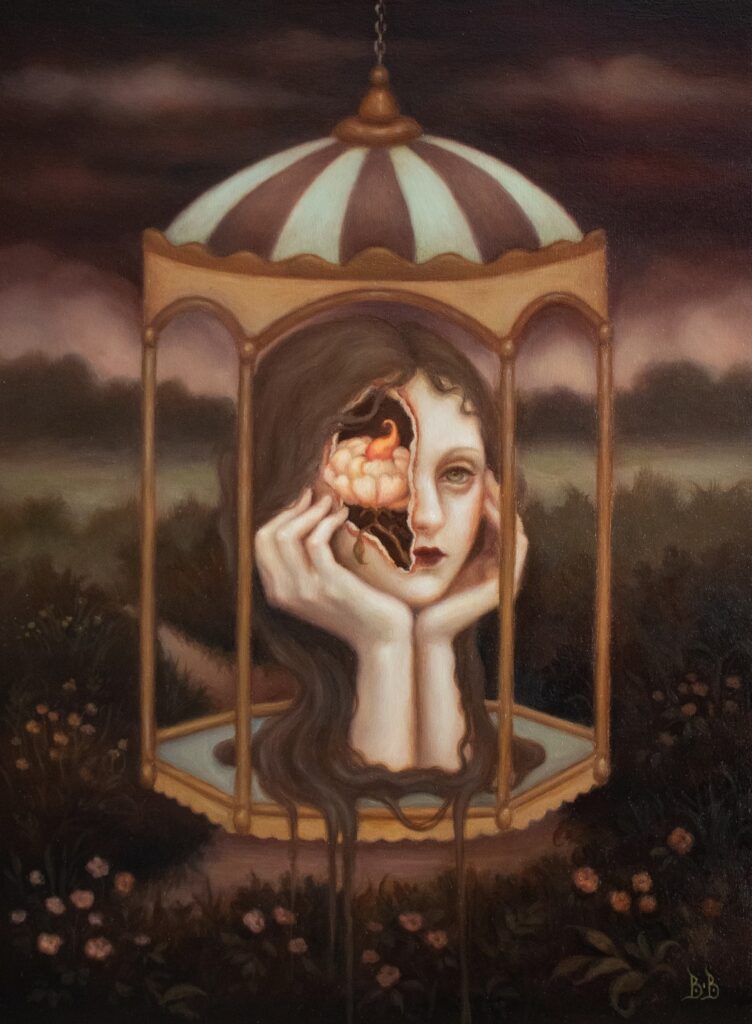
As we wrapped our conversation with Beatriz, something settled in us that we were not expecting. A kind of calm. Because talking to an artist who has never once doubted the world she is building who has simply been finding better ways to show it is a genuinely rare and genuinely steadying experience.
Because most of us treat the strange and the uncanny as something to observe from a safe distance. Something to admire in a horror film or a gothic novel and then return from. Beatriz has never returned.
Since she was a child burying objects and writing spells and feeling that physical pull toward something she could not name, she has been building her home in that in-between space the place where the real world and something older and stranger overlap. And she has spent her entire creative life finding more precise and more beautiful ways to show us what it looks like from the inside.
That is an extraordinarily rare thing. Most artists who work with dark or uncanny imagery do it at arm’s length, as an aesthetic choice, a style, a reference. You feel the distance. With Beatriz you feel none.
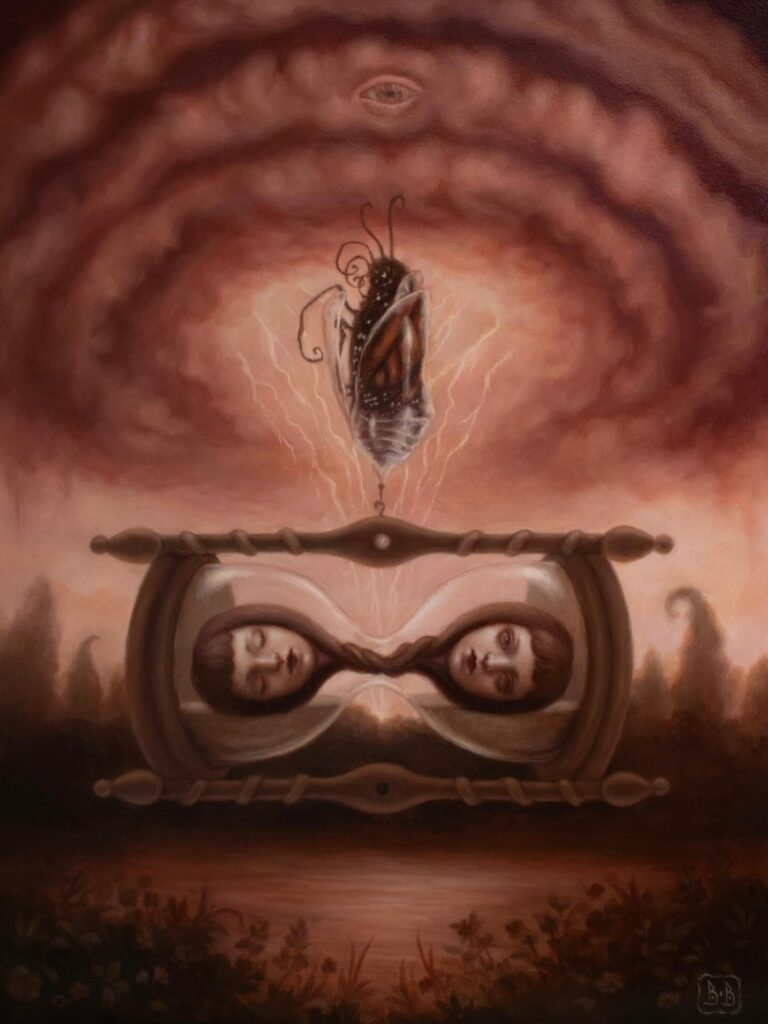
Her worlds carry the logic of places that actually exist somewhere. Her symbols are not chosen from a reference book. They come from dreams she has had and childhood memories she has carried and a genuine, sustained, lifelong relationship with the parts of experience that most people prefer not to look at too closely.
And here is what that produces work that does not just look beautiful but feels true. Work that you step into and immediately sense you are somewhere real, even though you have never been there before. Work that invites you to go deeper rather than stopping at the surface, because the person who made it went deeper too, and left something there for you to find.
For those who collect work that carries that kind of genuine interior life — that rewards patience and return visits, that reveals more of itself as you grow alongside it — Beatriz’s paintings are exactly that. The kind that you find yourself thinking about on an ordinary Tuesday. The kind that always has something more to show you.
Follow Beatriz Bradaschii through the links below and let her world find you.