


9 Edward Hopper Paintings That Celebrate the Beauty of Solitude
When was the last time you spent a few quiet moments completely alone?
Not scrolling through your phone. Not listening to a podcast. Not catching up on work. Just sitting with your own thoughts.
For many of us, those moments have become surprisingly rare. We live in a world that celebrates constant connection, where silence is quickly filled with notifications, conversations, or endless distractions. Being alone is often mistaken for being lonely, as though our own company is something to avoid rather than appreciate.
Few artists understood this quiet contradiction better than Edward Hopper.
His paintings are often described as portraits of loneliness. At first glance, it’s easy to see why. A woman sits by a window lost in thought. A late-night diner glows against an empty street. A lone figure pauses in an office overlooking the city below. Hopper’s subjects rarely smile or interact, and they often appear suspended in moments of profound stillness.
But look a little longer, and another story begins to unfold.
His figures aren’t always waiting for someone. They aren’t always isolated or unhappy. Instead, they seem comfortable inhabiting their own inner worlds, finding meaning in silence, sunlight, routine, and reflection. Hopper reminds us that solitude isn’t necessarily something to escape. It can be a place where we pause, notice the world more closely, and reconnect with ourselves.
Perhaps that’s why his work continues to resonate decades after it was painted. In an age that rarely slows down, Hopper’s quiet scenes feel more relevant than ever—not because they tell us how to be alone, but because they invite us to rethink what solitude can mean.
These nine paintings reveal that behind Hopper’s still figures and empty spaces lies something far more hopeful than loneliness. They offer gentle reminders that some of life’s most meaningful moments happen when nothing much seems to be happening at all.
Nighthawks
Being Alone Doesn’t Always Mean Feeling Lonely
How often have we mistaken silence for sadness?
Walk into a café alone, and people might assume you’re waiting for someone. Sit quietly without reaching for your phone, and it can feel almost uncomfortable, as though being by yourself must mean something is missing. We’ve become so accustomed to filling every quiet moment that solitude often looks like loneliness from the outside.
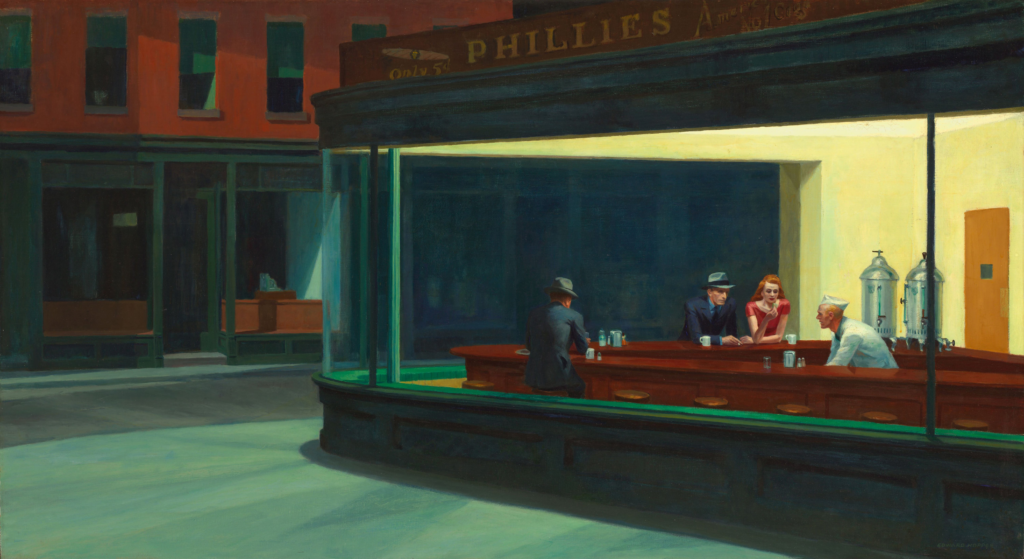
Edward Hopper’s Nighthawks has long been called one of the loneliest paintings ever made. The late-night diner, the empty streets, and the figures who seem lost in their own thoughts have made it an enduring symbol of urban isolation. But spend a little longer with the painting, and another story begins to emerge.
No one in Nighthawks appears distressed. No one is reaching for the exit or searching desperately for company. Instead, Hopper captures something much quieter: people simply existing in the same space, each absorbed in their own world. The silence isn’t heavy, it feels contemplative. Even the vast emptiness outside the glowing diner seems less like abandonment and more like a pause, a rare moment when the city finally exhales.
Perhaps that’s why the painting continues to resonate more than eighty years after it was created. It reflects something many of us have forgotten: there is a profound difference between being alone and feeling lonely. One is a circumstance. The other is an emotion. Hopper leaves us wondering whether the people inside the diner are isolated, or simply comfortable in their own company.
Maybe Nighthawks isn’t asking us to fear solitude. Maybe it’s asking us to look at it differently.
Morning Sun
The Quietest Conversations Are the Ones We Have With Ourselves
There are moments in life when nothing is happening, and yet everything is.
A slow morning before the phone begins to ring. A patch of sunlight on the floor. A few quiet minutes where the only voice you hear is your own. We often rush through these moments without noticing them, but they’re where some of our most honest thoughts begin.
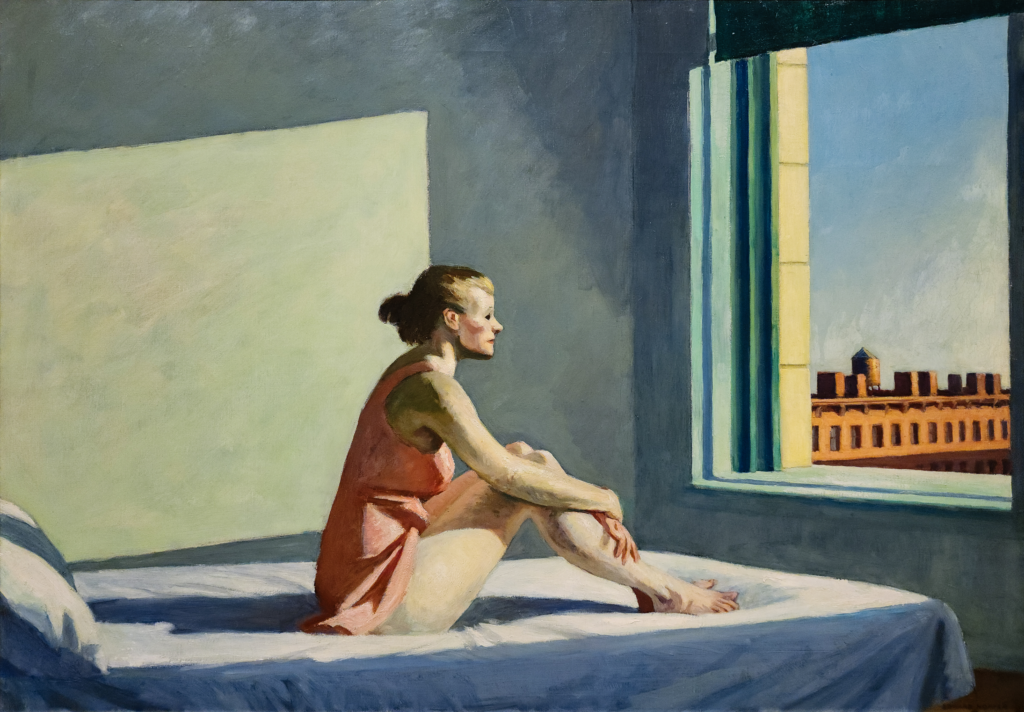
In Morning Sun, Edward Hopper paints a woman sitting on the edge of her bed, bathed in warm morning light as she gazes out of the window. There is no dramatic narrative, no clear destination, and no obvious emotion for us to decode. Hopper offers only a moment of stillness, inviting us to linger instead of searching for answers.
It’s tempting to assume she’s lonely because she’s alone. Yet the painting never asks us to pity her. Instead, she appears fully present, suspended between the quiet of the room behind her and the world waiting beyond the window. The sunlight doesn’t simply illuminate the space, it becomes a symbol of clarity, gently suggesting that solitude can be a place of reflection rather than emptiness.
Perhaps that’s why Morning Sun feels so deeply personal. We’ve all had mornings like this: moments when the day hasn’t quite begun, when we’re caught between yesterday and whatever comes next. These pauses rarely make it into photographs or conversations, yet they often become the moments we remember most.
Hopper understood that life isn’t made up only of extraordinary events. Sometimes, the most meaningful conversations are the silent ones we have with ourselves. And perhaps that’s exactly what Morning Sun captures, not a woman waiting for life to happen, but someone quietly making sense of it.
Automat
The Difference Between Loneliness and Solitude
We often use the words loneliness and solitude as though they mean the same thing.
But they don’t.
Loneliness is the ache of wanting connection and not finding it. Solitude is choosing, even for a little while, to be alone with your own thoughts. One can leave us feeling empty; the other can leave us feeling restored. Somewhere along the way, we’ve forgotten the difference.
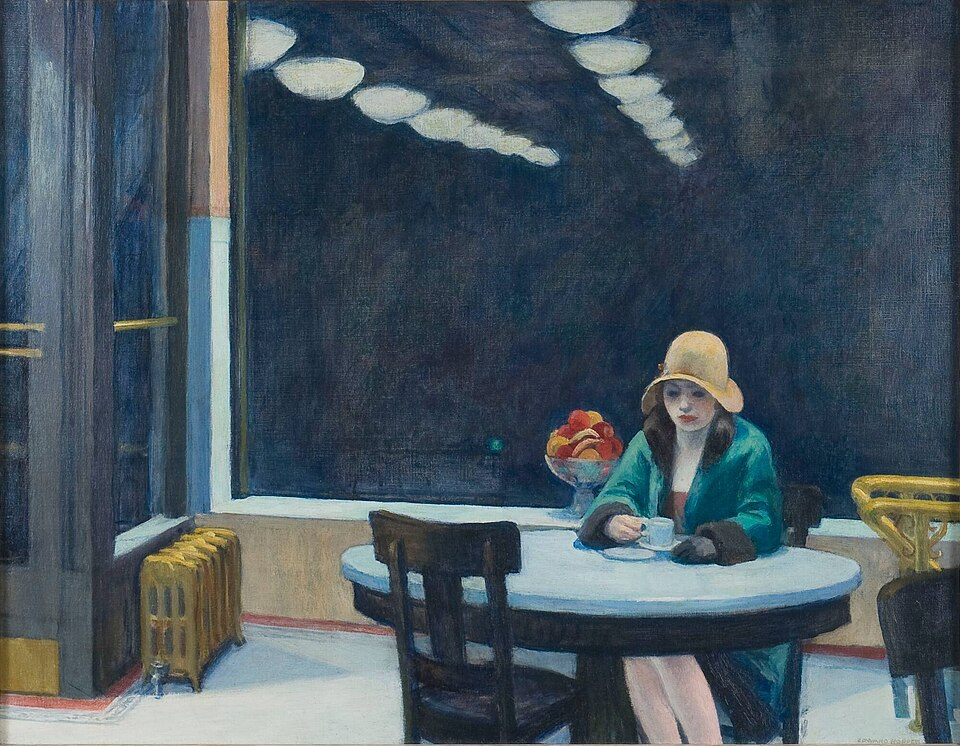
Few paintings capture that distinction as quietly as Automat. A young woman sits alone at a small café table, a cup of coffee before her, her gloved hands resting gently in front of her. Beyond the window is only darkness, offering no clues about where she’s been or where she’s going. Hopper doesn’t tell us what she’s thinking, and that’s precisely what gives the painting its emotional power.
For decades, viewers have looked at Automat and seen loneliness. It’s an understandable reading. She is alone, after all. Yet nothing in the painting suggests despair. Her posture is calm, the scene unhurried, almost meditative. She isn’t reaching for someone else or trying to escape the moment. Instead, Hopper invites us to consider another possibility: perhaps she’s simply enjoying the rare luxury of being with herself.
That ambiguity is what keeps Automat alive. The painting becomes a mirror, reflecting our own relationship with solitude. If we see loneliness, perhaps it’s because we’ve been taught to fear being alone. If we see peace, perhaps it’s because we’ve learned that quiet moments don’t always need to be filled.
Hopper never tells us which interpretation is right. Instead, he leaves us with a gentler question: When did we begin believing that our own company wasn’t enough?
Gas
Finding Meaning in the Most Ordinary Moments
Not every meaningful moment announces itself.
Most of life happens in between, the quiet drive home after a long day, the familiar route you’ve taken a hundred times, the small routines that seem too ordinary to remember. Yet when we look back, it’s often these unremarkable moments that stay with us the longest.
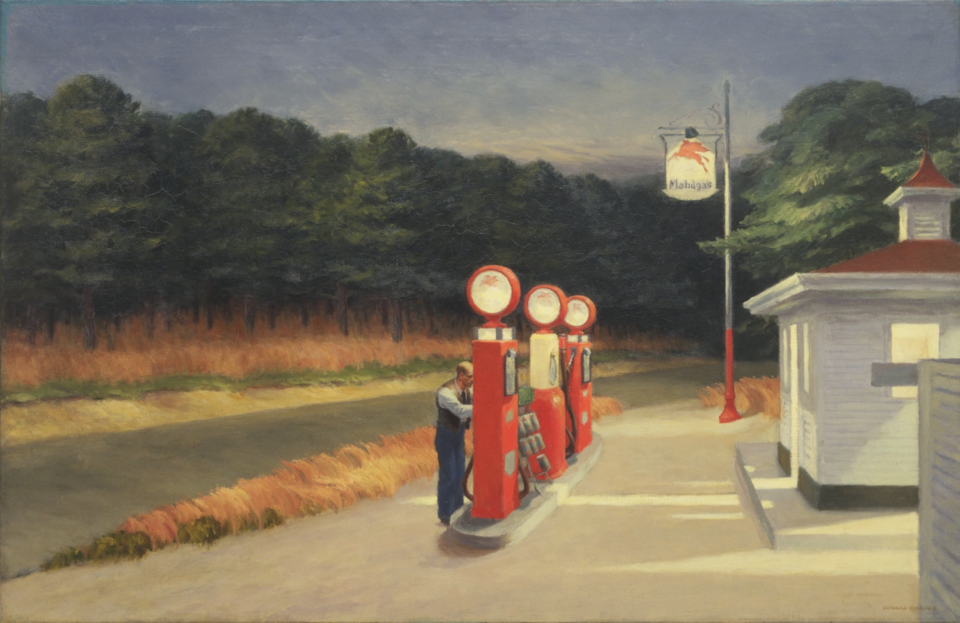
In Gas, Edward Hopper paints a lone attendant standing outside a rural filling station as daylight quietly gives way to evening. The road disappears into a darkening forest, no customers are in sight, and there is little to suggest that anything important is about to happen. The scene is almost painfully ordinary, yet it’s impossible to look away.
Hopper had an extraordinary ability to transform the everyday into something quietly profound. The attendant isn’t portrayed as bored or burdened by his solitude. Instead, he seems completely absorbed in the simple act of preparing for the night ahead. The glowing pumps, the fading light, and the empty road create a sense of calm rather than emptiness, reminding us that stillness can exist even in the middle of routine.
In a world that constantly tells us every moment should be productive, exciting, or shared, Gas offers a different perspective. It suggests that meaning doesn’t always arrive through grand adventures or life-changing events. Sometimes, it lives in the rituals we repeat without thinking, the places we pass every day, the work we quietly carry out, and the peaceful pauses between one chapter and the next.
Perhaps that’s why Gas feels so comforting. It reminds us that an ordinary day doesn’t have to become extraordinary to matter. Sometimes, simply being present is enough.
New York Movie
You Can Be Surrounded by People and Still Drift Into Yourself
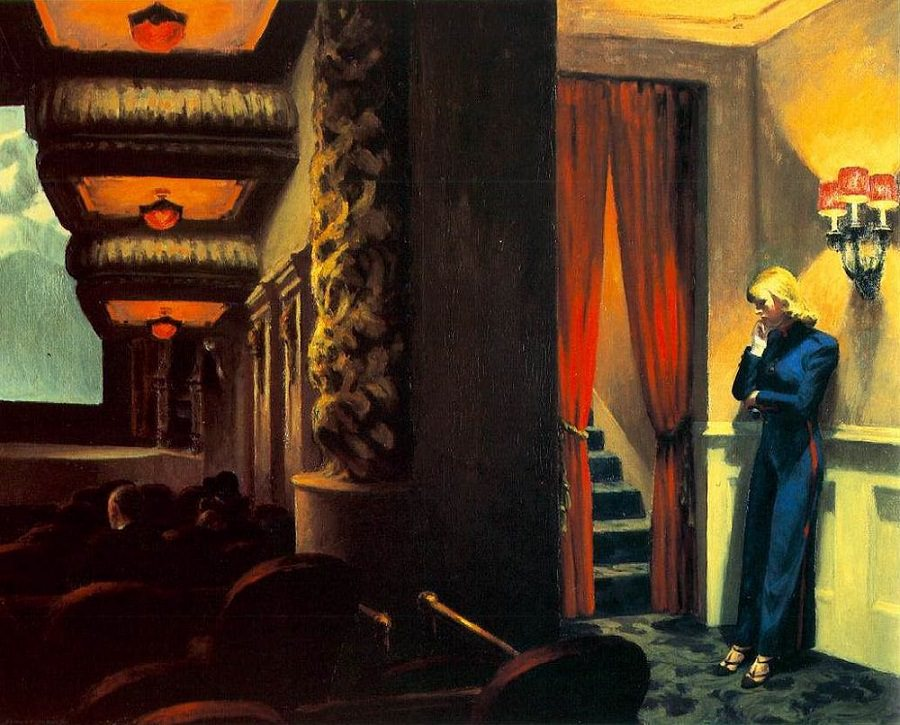
We often think of solitude as something we find in empty places.
But some of the deepest moments of solitude happen in crowded rooms, on a busy train, in a packed café, or while sitting among strangers in a dark theatre. Our bodies remain present, but our minds quietly wander somewhere else.
Edward Hopper captures this feeling beautifully in New York Movie. While a film plays before an unseen audience, an usherette stands alone in the corner of the theatre, her head gently bowed in thought. She isn’t watching the screen, greeting guests, or distracted by the crowd around her. Instead, she seems completely absorbed in an inner world that exists beyond the reach of the bustling cinema.
It’s this contrast that makes the painting so compelling. The theatre is designed to transport people into someone else’s story, yet Hopper shifts our attention to the woman who has quietly stepped outside that shared experience. She reminds us that even in spaces filled with people, we often retreat into ourselves, carrying private thoughts that no one else can see.
There is something profoundly human about that moment. We’ve all experienced it, the conversation that fades into the background, the meeting where our thoughts drift elsewhere, or the film that suddenly gives way to memories of our own life. Hopper understood that solitude isn’t always about physical distance. Sometimes, it’s the quiet space we create within ourselves, even while standing in the middle of the world.
Perhaps that’s the real story unfolding in New York Movie. Not the one playing on the screen, but the invisible one inside the usherette’s mind. And maybe that’s the story Hopper wanted us to notice all along.
Cape Cod Morning
Sometimes Looking Outward Helps Us Look Within
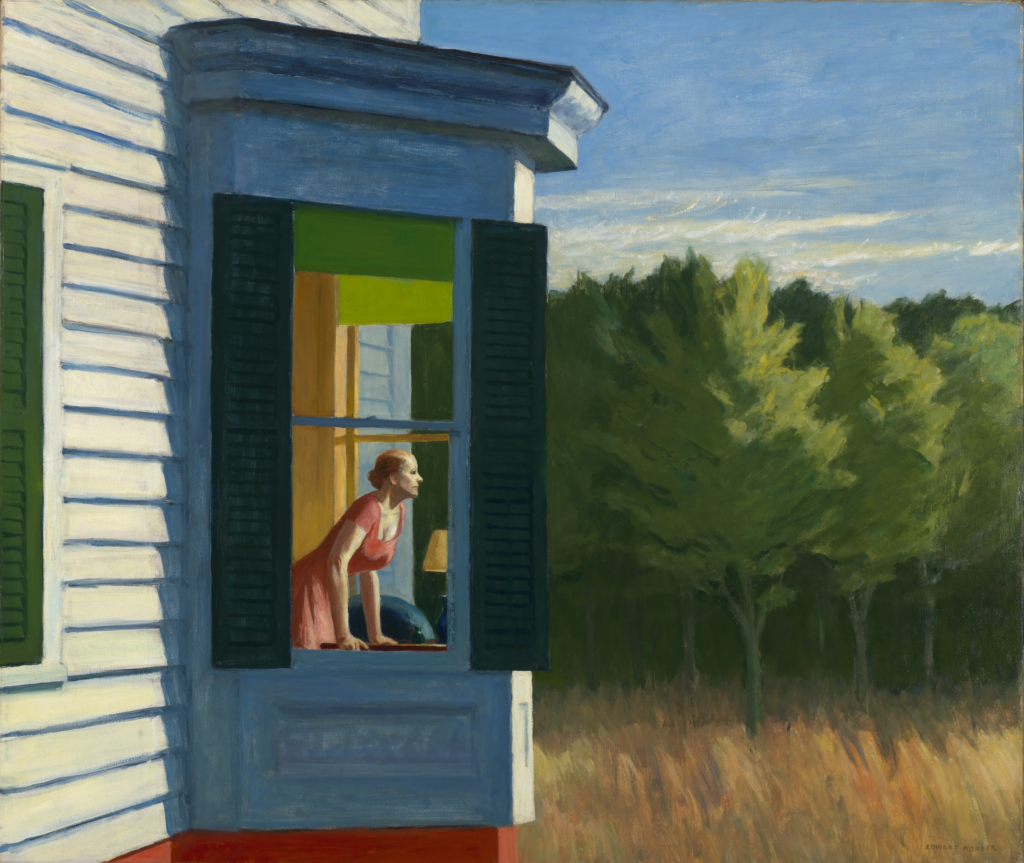
How many times have you found yourself staring out of a window without really looking at the view?
Perhaps you were waiting for news. Perhaps you were replaying a conversation in your mind. Or perhaps you simply needed a moment to pause before stepping back into the world. Windows have a curious way of becoming mirrors, reflecting not just what’s outside, but what’s happening within us.
In Cape Cod Morning, Edward Hopper paints a woman leaning forward, her gaze fixed beyond the window. A dog stands beside her, equally alert, yet Hopper never reveals what has caught their attention. The landscape remains quiet, the answer forever out of sight. Instead of giving us a story, he leaves us with a question.
That uncertainty is what makes the painting so captivating. Is she expecting someone? Watching a new day unfold? Hoping for change? We can never know. Hopper deliberately withholds the moment’s resolution, allowing every viewer to bring their own emotions into the scene. The painting becomes less about what the woman sees and more about what she might be feeling.
There is something deeply familiar about that posture. We’ve all stood at a window searching for clarity, believing that if we looked a little farther, the answers might appear. Yet more often than not, those moments have little to do with the world outside. They become opportunities to slow down, to reflect, and to quietly untangle our own thoughts.
Perhaps that’s the quiet brilliance of Cape Cod Morning. It reminds us that sometimes we don’t look out because we’re searching for something beyond ourselves. We look out because, in those rare moments of stillness, we finally have the chance to look inward.
Chair Car
Life Isn’t Always About Movement – Sometimes It’s About Noticing

We spend so much of our lives focused on the destination that we forget the journey has a life of its own.
On trains, planes, and buses, we instinctively reach for our phones, answer emails, or count down the hours until we arrive. We treat travel as time to get through rather than time to experience. But what if the quiet hours in between are just as meaningful as the places we’re rushing towards?
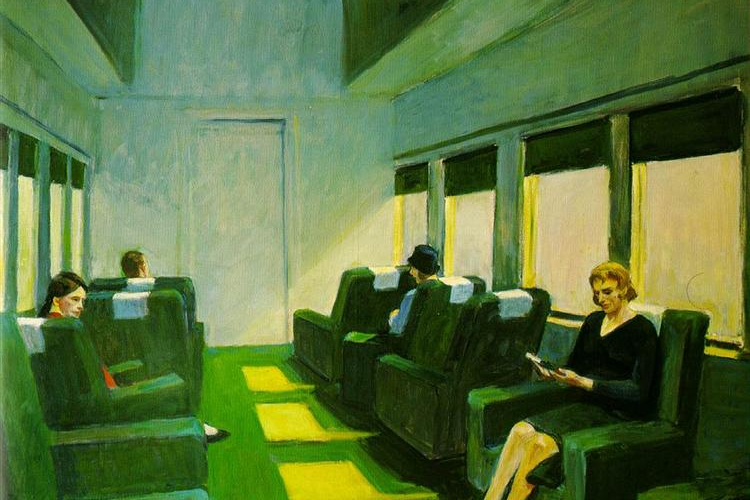
In Chair Car, Edward Hopper invites us into one of those in-between moments. Passengers sit scattered throughout the train carriage, each enclosed within their own private world. A woman gazes out of the window as sunlight pours across her face, while others read, rest, or simply sit in silence. No one is interacting, yet the scene doesn’t feel lonely. It feels deeply human.
Hopper understood that travel isn’t only about crossing landscapes; it’s also about moving through our thoughts. There’s a unique kind of solitude that comes with watching the world drift by from a train window. The changing scenery asks nothing of us. It simply gives us permission to pause, observe, and let our minds wander without urgency.
Perhaps that’s why Chair Car feels so timeless. Even today, those fleeting moments between departure and arrival often become unexpected opportunities for reflection. Removed from the routines of everyday life, we find ourselves noticing things we normally overlook, a memory that resurfaces, an idea that suddenly makes sense, or the simple beauty of watching light shift across a passing landscape.
Chair Car gently reminds us that not every journey is measured by how quickly we reach the end. Sometimes, the most valuable part is the quiet space in between, where we’re no longer thinking about where we’ve been or where we’re going, but simply allowing ourselves to be exactly where we are.
Sun in an Empty Room
When Silence Becomes the Main Character

Do empty rooms ever really feel empty?
Light spilling across a wooden floor. An open window letting the afternoon drift in. Even without people, certain spaces seem to hold memories, as though the lives once lived there haven’t entirely disappeared. Sometimes, absence can feel just as powerful as presence.
Edward Hopper’s Sun in an Empty Room takes this idea to its quietest extreme. There are no figures to follow, no expressions to interpret, and no story unfolding before our eyes. Instead, sunlight streams through the windows, casting bold geometric shapes across bare walls and an empty floor. It’s one of Hopper’s simplest paintings, and perhaps one of his most profound.
Without people to guide our emotions, we begin noticing everything else. The changing light, the stillness of the room, the strange warmth that fills a place where nothing seems to be happening. Hopper asks us to look beyond action and discover that a space can have a presence all its own. The room doesn’t feel abandoned. It feels as though it’s taking a deep, quiet breath.
It’s a painting that resonates because we’ve all stood in places like this. An apartment after the boxes have been packed. A childhood bedroom that’s no longer ours. A house waiting for its next chapter. Empty rooms often become containers for memory, holding traces of people long after they’ve left.
Perhaps that’s why Sun in an Empty Room feels so unexpectedly moving. It reminds us that silence isn’t something to be feared or filled. Sometimes, it allows us to notice what constant noise never could. In Hopper’s hands, even an empty room becomes a portrait, not of the people who occupied it, but of the quiet moments they left behind.
Office in a Small City
Perhaps Solitude Isn’t Escaping Life – It’s Returning to It

We often imagine solitude as something we have to escape to.
A cabin in the woods. A quiet beach. A weekend away from emails and endless notifications. But perhaps solitude isn’t about leaving the world behind. Perhaps it’s about finding a moment to reconnect with yourself, even while life continues all around you.
In Office in a Small City, Edward Hopper paints a man standing at the window of a modern office building, looking out over the city below. His desk sits behind him, his work seemingly paused, while the buildings outside stretch toward the horizon. Hopper never tells us what has drawn his attention away from his office. Instead, he leaves us suspended in that fleeting, familiar moment when the mind briefly steps away from its responsibilities.
It’s a scene that feels remarkably contemporary. Even today, many of us find ourselves gazing out of office windows, losing ourselves for a few quiet minutes before returning to the task at hand. Those pauses aren’t signs of distraction or laziness. They’re moments when we catch our breath, gather our thoughts, or simply remember that there’s a world beyond the screen in front of us.
Hopper understood that solitude doesn’t always require silence or isolation. Sometimes, it exists in the middle of a busy workday, hidden within a glance through a window or a few uninterrupted moments of reflection. The city continues to move, deadlines remain, and life carries on, but for a brief instant, we’re allowed to step outside the noise without ever leaving the room.
Perhaps that’s the quiet truth running through all of Hopper’s paintings. Solitude isn’t about turning away from life; it’s about returning to it with a clearer mind and a quieter heart. In a world that rarely stops asking for our attention, Office in a Small City reminds us that some of the most meaningful moments are the ones we spend simply being present with ourselves.
Edward Hopper never painted dramatic endings.
His figures don’t embrace, argue, celebrate, or collapse into despair. More often than not, they simply sit, stand, wait, or look out of a window. At first glance, those moments can seem uneventful. But the longer we spend with them, the more we realise Hopper wasn’t interested in grand events, he was interested in the quiet spaces where life unfolds almost unnoticed.
Perhaps that’s why his paintings continue to resonate so deeply today. In a world that celebrates constant movement, endless productivity, and being perpetually connected, Hopper gently reminds us that there’s another way to exist. One where silence isn’t awkward, stillness isn’t wasted, and being alone doesn’t automatically mean being lonely.
Each of these paintings offers a different perspective on solitude. Nighthawks shows us that sharing a space doesn’t always require conversation. Morning Sun finds beauty in the first quiet moments of the day. Automat challenges us to rethink what it really means to be alone, while Gas uncovers meaning in the ordinary rhythms of everyday life. From the inward gaze of New York Movie and Cape Cod Morning to the reflective journeys of Chair Car, the silent presence of Sun in an Empty Room, and the thoughtful pause in Office in a Small City, Hopper returns to the same gentle truth again and again: solitude is not something to fear.
Maybe that’s the lesson we’ve been overlooking all along.
Not every quiet moment needs to be filled. Not every pause needs a purpose. Sometimes, the moments we spend alone are the ones that allow us to notice the light changing across a room, gather our thoughts before moving forward, or simply enjoy our own company without apology.
Edward Hopper’s paintings don’t ask us to withdraw from the world. They invite us to return to it with greater attention, to find meaning in ordinary days, beauty in silence, and comfort in the simple act of being present.
Perhaps that’s why they still feel so timeless. They aren’t just portraits of solitary people. They’re quiet reminders that, every once in a while, the person we most need to reconnect with is ourselves.
Do you enjoy spending time alone, or do you prefer being around people? We’d love to hear your thoughts.
Don’t miss our feature on The Many Faces of the Angel of Death, where seven remarkable paintings reveal how artists across centuries have reimagined one of art history’s most enduring symbols.