

Why Iryna Grytsenko turned to art to explore fear, anxiety & self-doubt

At Arts to Hearts Project, Art and Woman Edition 3 keeps surprising us with women whose creative paths started somewhere unexpected and ended up somewhere no one could have predicted.
Iryna Grytsenko is one of our selected artists for this edition. And the fact that she came to painting through architecture tells you something important about how she sees people before she ever picks up a brush.
Iryna is a Ukrainian artist who graduated from Kharkiv State Technical University of Civil Engineering and Architecture and is now based in Fès, Morocco. She paints people in watercolour, but not in the way portrait painters usually paint people. She paints the thing underneath the face. The feeling behind the expression. The moment between poses when someone forgets they are being looked at and becomes completely themselves.

Her subjects often look like they do not know they are in a painting. They look caught in the middle of something private, a thought, a pause, a gesture so small and so honest that most people would miss it entirely. Iryna does not miss it.
She trained as an architect before she ever became a painter. Spent years learning to observe space and rhythm and structure and relationships between forms. And then at some point she realised she was more interested in what people carry inside them than in the buildings around them.
That shift from architecture to portraiture, from exterior structures to interior states, changed everything about her practice and it gives her work a compositional intelligence that you can feel even if you cannot name it.

She works in watercolour. A medium that most people associate with softness and delicacy but that Iryna uses with a precision and an emotional directness that can catch you completely off guard.
There is a freshness and a spontaneity in her surfaces that makes every painting feel like it was made in a single breath and yet the control underneath that spontaneity is clearly the result of years of understanding what water and pigment can do when you stop fighting them and start listening.
Let’s get to know Iryna through our conversation with her about how architecture taught her to see people, why watercolour refuses to be fully controlled and why she loves that, what the Demons series is really about, and why the most honest moments happen when people forget they are being watched.
Q1. Can you tell us about your journey and what first drew you toward painting people and everyday life?
I actually came to painting through architecture. Architecture taught me to observe space, rhythm and relationships, but at some point I realized I was becoming much more interested in what people carry inside than in the buildings around them. People and ordinary moments became a way of talking about emotions.
A quiet look, a gesture, a child absorbed in their own world these moments reveal something honest because they aren’t performed. Looking back, I see that those works were the beginning of a larger journey. Today my work has evolved into more symbolic narratives, but it all started with a curiosity about the invisible emotional life we all carry.

Q2. Your portraits feel deeply personal. What do you hope to capture beyond a person’s appearance?
I’m never interested in making someone simply recognizable. A portrait becomes meaningful when it reveals something that cannot be photographed — vulnerability, tension, uncertainty, hope, silence. Sometimes I don’t even think of the person in the painting as a specific individual. They become a mirror in which viewers recognize something about themselves. When someone tells me, “I felt that,” I know the painting has done its job.
Q3. Watercolour can be unpredictable. What keeps you coming back to this medium?
Probably because it refuses complete control. Watercolor constantly reminds me that not everything has to obey the artist. There is always a dialogue between intention and chance. I enjoy that balance. Years of practice have taught me how to guide the process, but I still leave room for the paint and water to surprise me. Those unexpected moments often become the most beautiful part of the work.

Q4. The title Overcoming suggests resilience in the face of challenges. What inspired this work?
Like many of my paintings, it began with a personal feeling but gradually became something more universal. Life constantly asks us to overcome something — fear, loss, doubt, change. I wasn’t trying to illustrate a specific story.
I wanted to capture that quiet inner moment when a person decides to keep moving forward, even if no one else notices that battle. I think we all recognize that feeling in one way or another.
Q5. Many of your paintings feature children with honesty rather than sentimentality. What draws you to childhood as a subject?
Children don’t try to perform. They don’t think about how they look or whether they are making the “right” impression. They are completely present in what they’re doing. I find that honesty incredibly moving.
When I painted children, I wasn’t interested in creating cute images. I wanted to preserve those quiet moments when curiosity, concentration or wonder become visible.

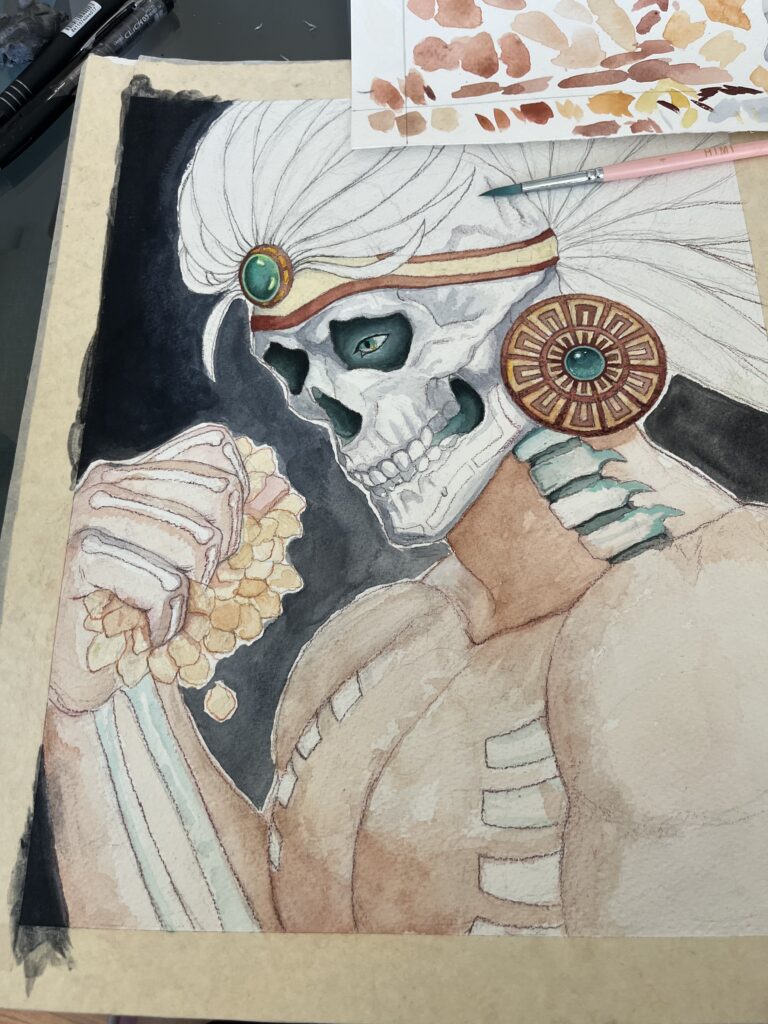
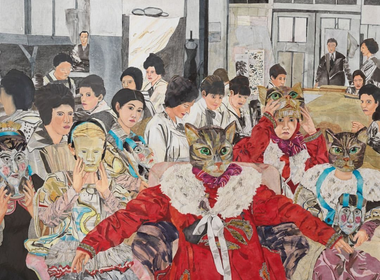
Q6. Your Demons series explores a much darker emotional space. What inspired that shift?
That series came from a desire to acknowledge emotions we often hide. Fear, anxiety, self-doubt, anger—they are part of being human, yet we usually pretend they don’t exist. Painting them felt less like creating darkness and more like bringing hidden feelings into the light. Once we can look at them, they lose some of their power.
Q7. Many of your subjects appear in quiet, unguarded moments. What do those moments reveal to you?
When people stop posing, they become themselves. A thoughtful pause, an unfocused gaze or a small gesture can reveal much more than a carefully arranged expression. Those are the moments when people seem closest to who they really are. I think viewers instinctively recognize that honesty.

Q8. How much of a painting is planned, and how much do you leave to the movement of water and pigment?
The idea and composition are usually very clear before I begin. But once water touches the paper, I stop trying to control everything. Watercolor has its own intelligence. Sometimes the most beautiful passages appear because I allowed the paint to behave naturally instead of forcing it. I’ve learned to work with the medium rather than against it.
Q9. In an age of constant photography, what can a painted portrait reveal that a photograph cannot?
A photograph captures a moment. A painting captures attention. When I paint someone, I’m not trying to record every detail. I’m deciding what matters emotionally and what can be left out. A portrait becomes an interpretation rather than a document, and sometimes that reveals a deeper truth than perfect accuracy.

Q10. Do you see portraiture as a way of understanding others, or ourselves?
I think it’s both. We begin by looking at someone else, but we always bring our own experiences into what we see. That’s why different people can stand in front of the same portrait and connect with it in completely different ways. In the end, every portrait becomes a conversation between the artist, the subject and the viewer.
Q11. What has shaped your growth most as an artist, technical skill, observation, or understanding people?
Technique gives you freedom, observation teaches you to notice, but understanding people gives a painting its meaning. If I had to choose only one, I would choose observation—not only of others but also of myself. The more honestly I observe life, the more honestly I can paint it.
Q12. What advice would you give artists who want to create work that feels both personal and universal?
Don’t try to make your work universal. Make it honest. The more specific and truthful you are about your own experience, the more likely other people are to recognize something of themselves in it. Trends change quickly, but sincerity doesn’t. That’s something viewers can always feel.

As we wrapped up our conversation with Iryna, we kept thinking about honesty. Not the dramatic confessional kind. The quiet kind. The kind where someone is sitting across from you and they look away for a second and in that second their face does something they did not plan and you see who they actually are underneath everything they were performing a moment ago.
That is what Iryna paints. Those seconds. And we think about how many of those seconds we miss every day because we are too busy or too distracted or too focused on the performance to notice when it drops.
Most of us walk through our lives surrounded by people having real unguarded moments and we do not see them because we are looking at our phones or thinking about the next thing or just not paying the kind of attention that noticing requires.
Iryna pays that attention. She has been paying it for years. First as an architect studying the spaces people move through and then as a painter studying the people themselves. And her work is the result of someone who has trained herself to see what most of us look right past.

The pause. The gesture. The child who is so absorbed in what they are doing that they have forgotten the entire world exists. The adult who lets their guard down for half a second and shows you everything.
That skill, the skill of noticing, is something every artist can develop and every person would benefit from. It does not require special talent. It requires slowing down and looking at the people around you as if they actually matter. As if what they are feeling right now in this moment is worth your full attention. Iryna does that with a brush and watercolour. The rest of us can do it with our eyes.
And if we did it more often the world would be a less lonely place because the thing most people want more than anything is to be seen. Not admired or evaluated or judged. Just seen. The way Iryna sees her subjects. Without agenda. Without performance. Just honest quiet attention to whoever is in front of her.
For art lovers and collectors, Iryna’s watercolours carry an emotional presence that is disproportionate to their physical size. The medium is transparent and luminous and the way she uses it gives her subjects a vulnerability that heavier mediums cannot achieve. These are paintings that bring a quality of quiet attention into a room.
They remind you to slow down and actually look at the people in your life the way Iryna looks at the people in her paintings. That is a rare thing to get from a piece of art and it does not wear off.
Follow Iryna Grytsenko through the links below and see her work for yourself.