

8 Legendary Female Warriors Artists Never Stopped Painting

Some warriors are remembered through monuments. Others survive in ancient poems, oral traditions, or fragments of historical records. But some achieve a different kind of immortality, they live on through art.
Across centuries and continents, artists have returned again and again to the stories of extraordinary women who rode into battle, challenged empires, defended their people, and stepped far beyond the roles society expected of them. Painted on ancient Greek pottery, carved into monuments, celebrated in royal portraits, and reimagined by contemporary artists, these figures occupy a fascinating space between history and myth. Some were real women whose achievements grew into legend. Others emerged from folklore and mythology, becoming symbols of courage that transcended their origins.
What makes these warrior women so compelling is not simply their ability to fight. Their stories reveal how different cultures understood power, leadership, sacrifice, and resilience. A teenage girl hears divine voices and changes the course of a war. A daughter disguises herself as a soldier to save her father. A queen refuses to let an empire crush her people. A goddess of war becomes a protector rather than a conqueror. Through each story runs a common thread: the refusal to accept limitations imposed by circumstance, tradition, or expectation.
Art has played a crucial role in preserving these legacies. Long after battles ended and kingdoms disappeared, painters, sculptors, printmakers, and storytellers continued to reinterpret these women for new generations. Their images evolved with time, reflecting changing ideas about heroism, nationhood, identity, and womanhood itself. In many ways, the artworks they inspired have become as enduring as the legends they left behind.
From medieval France and ancient Greece to Vietnam, India, West Africa, and the islands of Samoa, these eight legendary female warriors continue to captivate the imagination. Through the eyes of artists and the stories that shaped them, we revisit the women who rode into legend, and never truly left.
1. Joan of Arc: The Warrior Saint Who Became an Artistic Icon
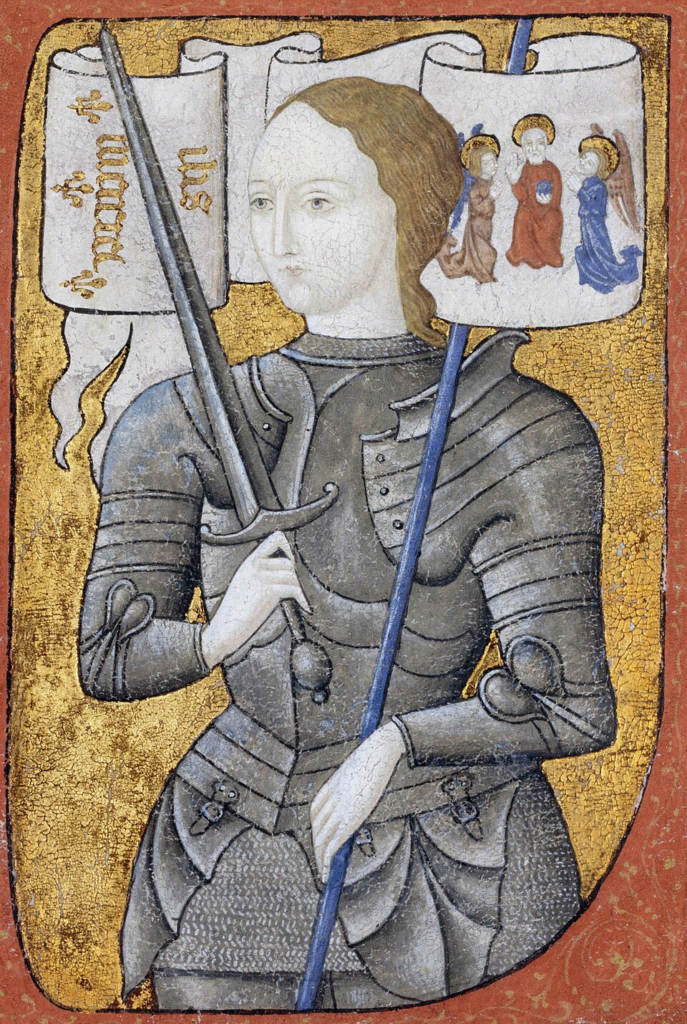
Jules Bastien-Lepage, Joan of Arc, 1879, The Metropolitan Museum of Art, New York
Standing in a quiet garden, surrounded by twisting trees and the familiar landscape of her village, Joan of Arc appears frozen between two worlds. In Jules Bastien-Lepage’s celebrated 1879 painting, the teenage girl gazes into the distance as ghostly saints emerge behind her. It is not a battle scene, yet it captures the moment that would change the course of French history. Rather than portraying Joan as a triumphant military leader, Bastien-Lepage presents her as a young woman on the threshold of destiny, torn between ordinary life and an extraordinary calling.
Born around 1412 in Domrémy, France, Joan claimed that she began hearing the voices of Saint Michael, Saint Catherine, and Saint Margaret during her adolescence. These visions urged her to support Charles VII and help liberate France during the Hundred Years’ War. Against all expectations, the daughter of a peasant family convinced military and political leaders to trust her. By the age of seventeen, she had become a symbol of hope for a nation exhausted by conflict. Her presence during the Siege of Orléans in 1429 helped inspire a major French victory, transforming her into a legendary figure almost overnight.
Artists have been fascinated by Joan ever since. In Jean-Auguste-Dominique Ingres’ Joan of Arc at the Coronation of Charles VII (1854), she appears in gleaming armor, proud and resolute, embodying national pride and unwavering faith. Meanwhile, Paul Delaroche’s depictions focus on her vulnerability, capturing the loneliness of her imprisonment before her execution. Across centuries, painters, sculptors, illustrators, and stained-glass artists have continually reimagined Joan, each finding a different balance between warrior, martyr, visionary, and saint.
Perhaps that is why Joan of Arc remains such a compelling subject in art. Her story is not simply about military victory. It is about belief, belief powerful enough to transform an unknown teenager into one of history’s most enduring symbols. Through the eyes of artists, Joan becomes more than a historical figure; she becomes a reflection of courage, conviction, and the timeless human desire to answer a calling greater than oneself.
2. Hua Mulan: The Warrior Who Lives Between Legend and Art
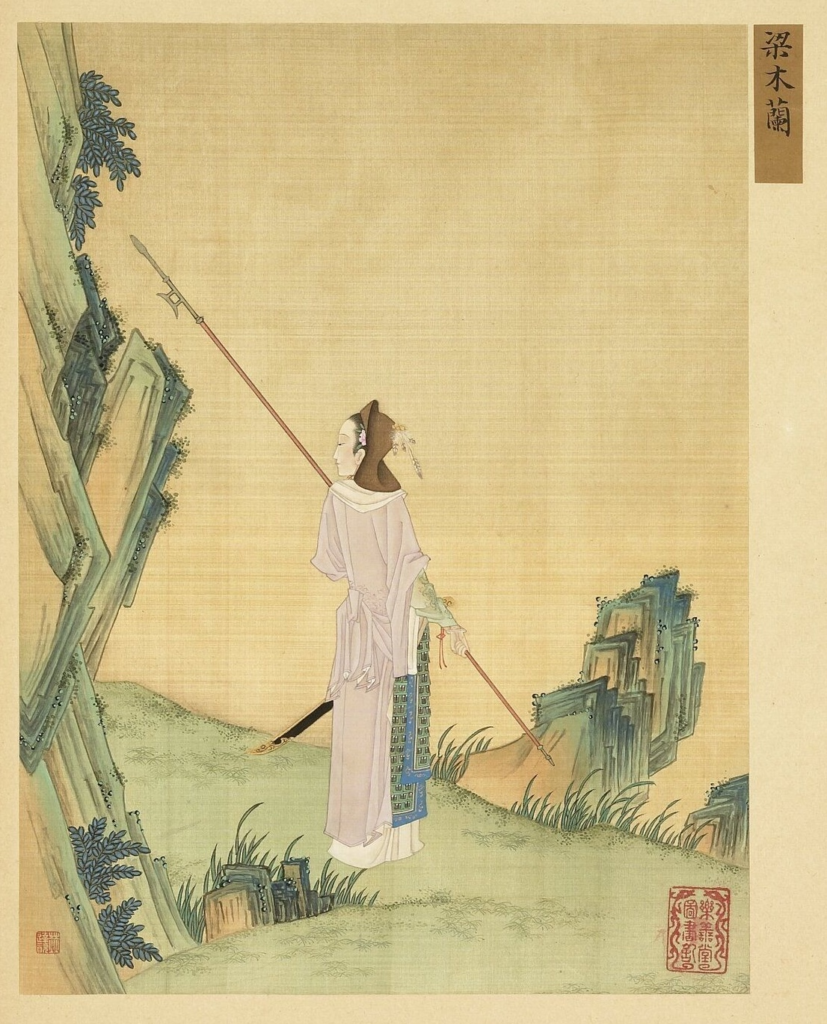
He Dazi, Hua Mulan, from Gathering Gems of Beauty, 18th century, National Palace Museum, Taipei
Few legendary women have been reimagined by artists as often as Hua Mulan. Across centuries of Chinese painting, poetry, theater, and illustration, she appears in a moment of transformation, sometimes dressed in flowing robes before her departure, sometimes mounted on horseback in military armor, and sometimes returning home after years of war. The enduring fascination lies not only in what Mulan did, but in who she chose to become. Her story unfolds at the intersection of duty, identity, and sacrifice, themes that have inspired generations of artists to revisit her image.
The earliest surviving account of Mulan comes from The Ballad of Mulan, a folk poem believed to date to the Northern Wei period. According to the legend, when an imperial conscription order arrived at her family’s home, Mulan’s elderly father was called to serve in the army. Unwilling to see him face almost certain hardship, she disguised herself as a man and took his place. For years she fought alongside fellow soldiers, concealing her identity while earning distinction through courage and skill. Only after returning home was her secret revealed, astonishing those who had served beside her.
Artists have long been captivated by this duality. In He Dazi’s eighteenth-century portrayal, Mulan is neither solely a warrior nor solely a dutiful daughter. Instead, she embodies both roles at once. Traditional Chinese painters often emphasized elegance alongside strength, presenting her as a figure who challenged expectations without abandoning cultural ideals of virtue and loyalty. In later centuries, Mulan became a popular subject in Chinese opera, woodblock prints, and illustrated manuscripts, each interpretation reflecting contemporary ideas about gender, heroism, and national identity.
What makes Mulan such a powerful figure in art is that her legend transcends warfare. She is remembered not because she sought glory, but because she stepped beyond the boundaries imposed upon her to protect those she loved. Artists continue to return to her story because it speaks to a universal experience: the courage required to redefine oneself when circumstances demand it. Through every brushstroke and retelling, Mulan remains a symbol of transformation—proof that true strength often begins with an act of devotion.
3. Penthesilea: The Amazon Queen Who Rode Into Legend
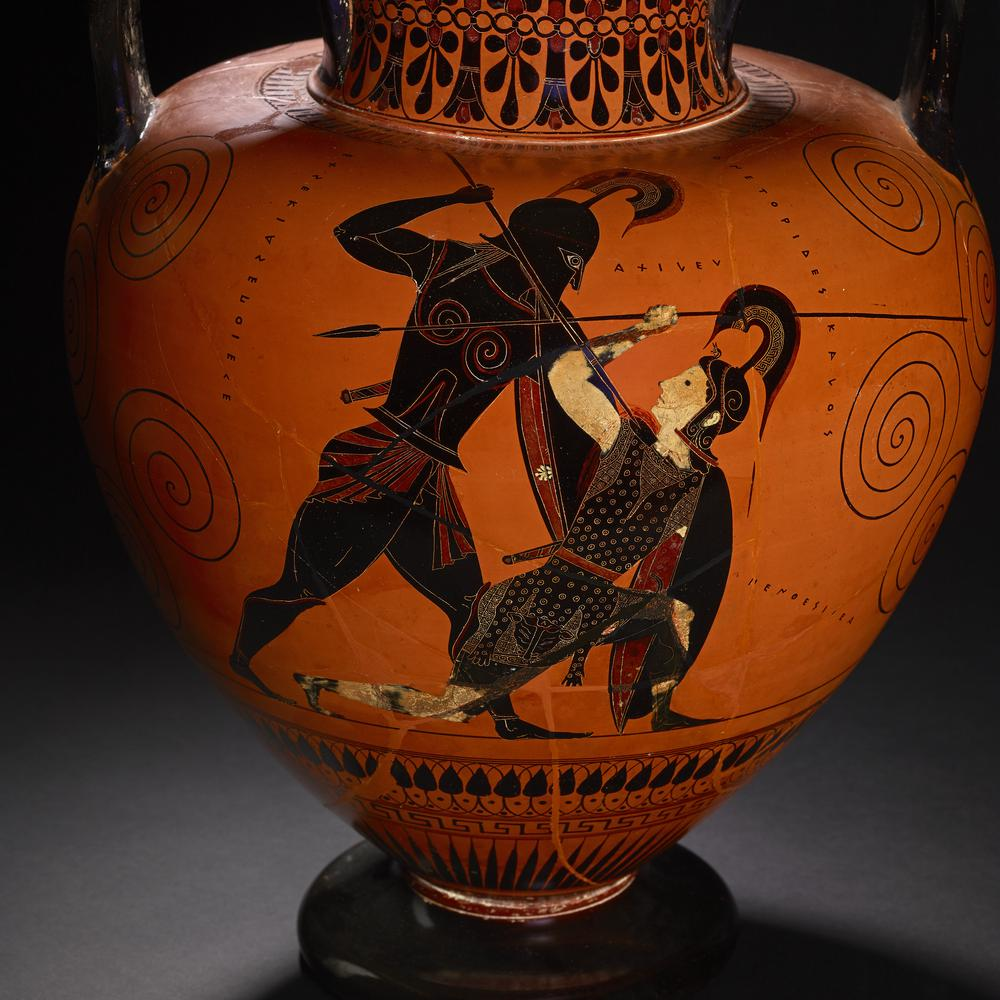
Exekias, Achilles Killing Penthesilea, c. 540–530 BCE, British Museum, London
On an ancient Greek amphora attributed to the master potter and painter Exekias, a single moment unfolds with extraordinary intensity. The warrior Achilles drives his spear into Penthesilea, the queen of the Amazons. Yet this is no ordinary battle scene. According to later retellings of the myth, it is in the instant of her death that Achilles truly sees her, recognizing her beauty, strength, and humanity. The image has fascinated viewers for centuries, transforming Penthesilea from a mythological opponent into one of the most compelling female warriors in classical art.
Penthesilea belonged to the legendary race of Amazons, a society of women warriors who occupied a unique place in Greek mythology. Said to be the daughter of Ares, the god of war, and the Amazon queen Otrera, she inherited a lineage steeped in battle and heroism. After the death of Hector during the Trojan War, Penthesilea arrived in Troy with her army to aid the city’s defenders. Ancient poets described her as fearless, skilled in combat, and unmatched on horseback. Her arrival offered the Trojans a brief glimmer of hope before she ultimately met Achilles on the battlefield.
For Greek artists, Penthesilea represented both admiration and anxiety. The Amazons appeared frequently on pottery, temple sculptures, and relief carvings, often shown fighting Greek heroes in dramatic scenes known as Amazonomachies. These images celebrated martial courage while simultaneously exploring ideas about gender, power, and the boundaries of the known world. In Exekias’s famous amphora, Penthesilea is not portrayed as a monster or villain. Instead, she stands as a worthy adversary, commanding respect even in defeat.
What makes Penthesilea endure in art is the complexity of her legend. She embodies a paradox that artists have long found irresistible: a warrior defined by strength, yet remembered through a moment of vulnerability. More than two thousand years after her story was first told, Penthesilea remains one of mythology’s most captivating figures, a queen whose brief appearance in the Trojan War secured her a permanent place in the visual imagination of the ancient world.
4. The Trưng Sisters: The Warrior Queens Who Became Symbols of Resistance
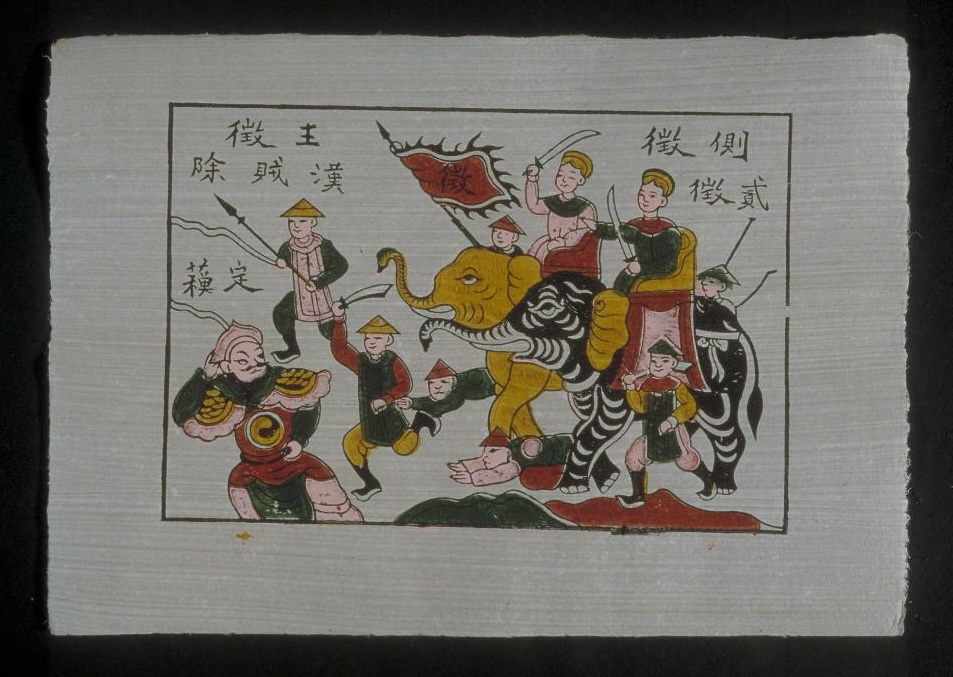
Nguyen Huy Sam, The Trưng Sisters, 2001, Asian Civilisations Museum, Singapore
In Vietnamese art, the Trưng Sisters are rarely shown standing still. More often, they appear mounted on war elephants, banners raised high, leading an army into battle. Their images can be found in paintings, temple sculptures, public monuments, and contemporary illustrations throughout Vietnam, where they are remembered not only as warriors but as national heroines. More than nineteen centuries after their deaths, Trưng Trắc and Trưng Nhị remain among the most powerful symbols of resistance in Vietnamese cultural memory.
The sisters lived during the first century CE, when northern Vietnam was under the control of China’s Han dynasty. Historical accounts and legends tell of growing unrest under foreign rule, which intensified after the execution of Trưng Trắc’s husband, Thi Sách, a local noble who opposed Han authority. In response, the sisters launched an uprising that would become one of the most celebrated acts of resistance in Vietnamese history. Gathering supporters from across the region, many of them women, they successfully drove out Chinese officials and established an independent administration.
Although their rule lasted only a few years before Han forces returned and defeated them, the sisters’ legacy proved far more enduring than their brief victory. Vietnamese artists have continually reimagined their story, emphasizing courage, leadership, and sacrifice. In Nguyen Huy Sam’s contemporary painting The Trưng Sisters, the warriors are depicted with a sense of dignity and determination that connects the ancient struggle to modern ideas of national identity. Monumental statues across Vietnam similarly portray them atop elephants, transforming them into larger-than-life figures whose bravery transcends historical time.
What makes the Trưng Sisters so compelling in art is that they represent more than military resistance. They embody the enduring belief that courage can emerge in moments of profound injustice. Artists continue to return to their story because it speaks to collective memory, the way nations preserve certain figures not simply for what they achieved, but for what they came to symbolize. Through paint, stone, and bronze, the Trưng Sisters remain a testament to resilience, leadership, and the power of refusing to surrender one’s freedom.
5. Tarabai: The Queen Who Refused to Let an Empire Win
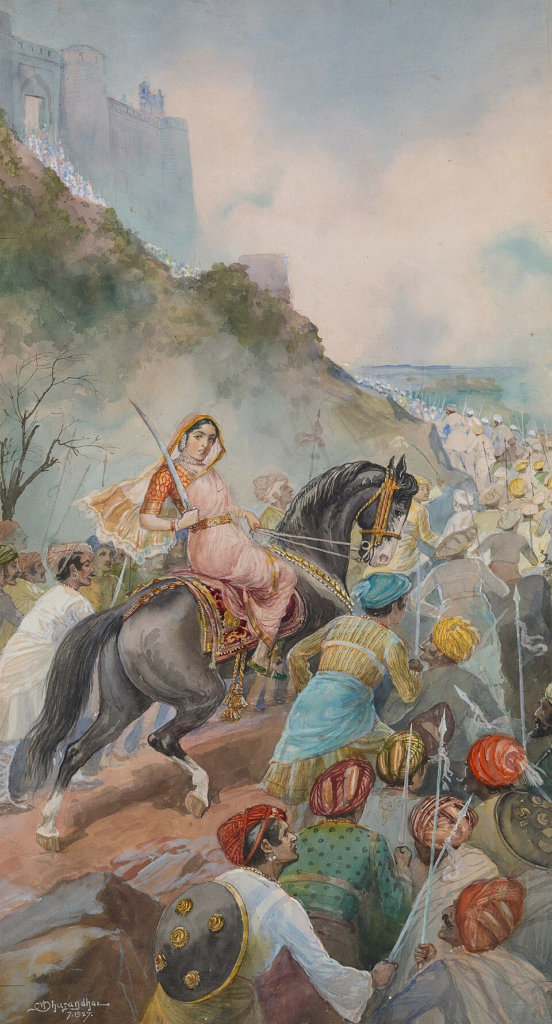
M. V. Dhurandhar, Tarabai – Founder of the Kolhapur Confederacy, 1927, Private Collection
Unlike many warrior women who survive primarily through myth, Tarabai Bhonsle occupies a fascinating space between history and legend. Her story is rooted in documented events, yet over the centuries she has come to symbolize something larger: resilience in the face of overwhelming odds. In paintings and popular memory, Tarabai often appears mounted on horseback or dressed in regal attire, projecting the confidence of a ruler who refused to surrender her kingdom’s future.
Born in 1675 into a powerful Maratha family, Tarabai entered one of the most turbulent periods in Indian history. The Mughal Empire, under Emperor Aurangzeb, was engaged in a prolonged campaign to expand its control across the Indian subcontinent. When Tarabai’s husband, Rajaram Maharaj, died in 1700, many assumed the Maratha resistance would weaken. Instead, the young queen stepped forward as regent for her son and assumed leadership during a moment of profound uncertainty.
What followed transformed her into one of the most remarkable military leaders of her era. Tarabai coordinated campaigns, directed military strategy, and helped sustain Maratha resistance against a vastly larger imperial force. Under her leadership, Maratha armies continued to challenge Mughal authority, carrying the conflict deep into enemy-controlled territories. Historians often credit her determination and political skill with preserving the Maratha state during one of its most vulnerable chapters.
Artists have long been drawn to this image of steadfast leadership. One of the most notable depictions is M. V. Dhurandhar’s 1927 painting Tarabai-Founder of the Kolhapur Confederacy, which presents her as both a sovereign and a strategist. Rather than emphasizing battlefield violence, the painting highlights authority, composure, and vision. Like many artistic representations of Tarabai, it celebrates not merely a warrior, but a ruler capable of shaping the course of history.
Perhaps that is why Tarabai continues to resonate today. Her legacy challenges the notion that power is measured solely by physical conquest. Through art and history alike, she emerges as a figure of endurance, a queen who inherited a crisis and transformed it into an opportunity for resistance. In every retelling, Tarabai stands as a reminder that some of the most formidable warriors fight not only with weapons, but with determination, intelligence, and an unwavering belief in their people’s future.
6. Yennenga: The Warrior Princess Who Became the Mother of a Nation
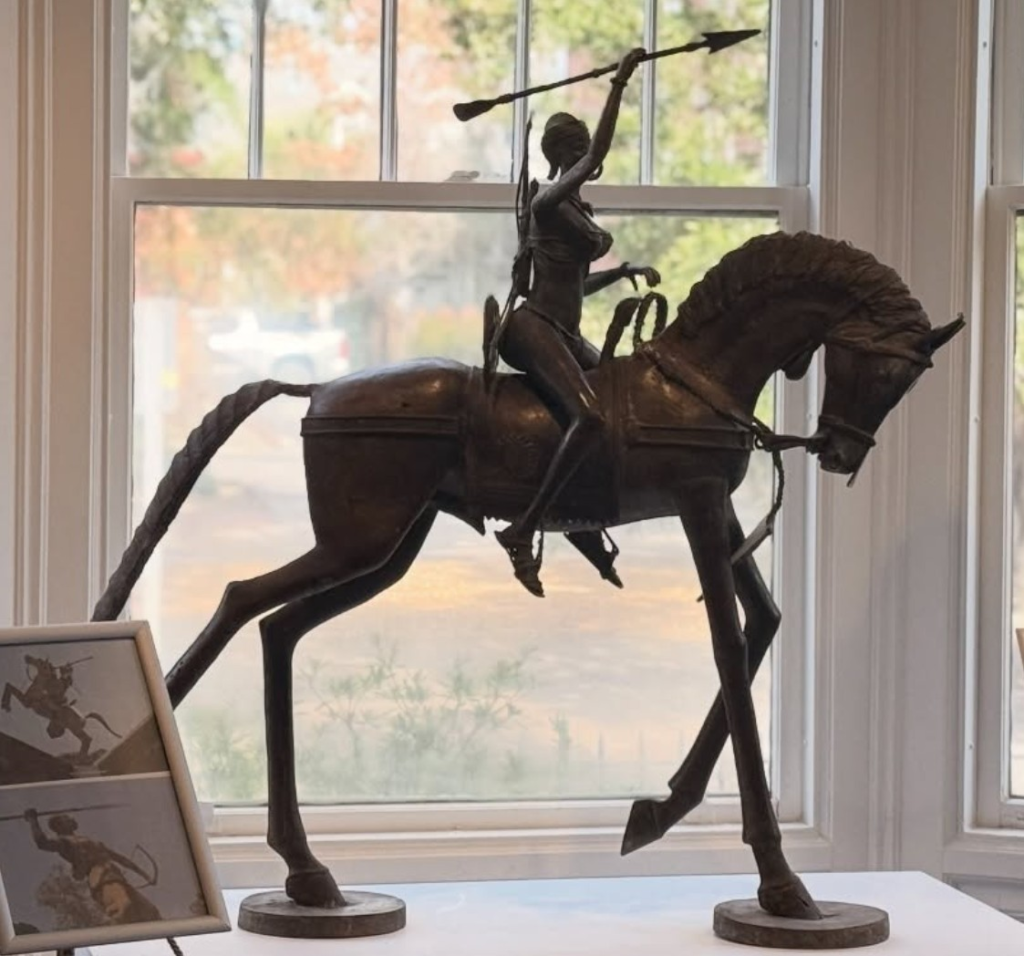
Equestrian Figure of Princess Yennenga, late 19th–early 20th century, Savannah African Art Museum
Across Burkina Faso, few figures are as deeply woven into cultural identity as Yennenga. Her image appears in public monuments, sculptures, ceremonial art, and contemporary paintings, often depicting her astride a horse, spear in hand, riding toward a destiny that would shape an entire people. Part warrior, part princess, and part founding ancestor, Yennenga occupies a unique place where history, mythology, and national memory converge.
According to oral traditions, Yennenga was the daughter of a powerful ruler in the Gambaga region, an area that today lies within northern Ghana. Unlike most noblewomen of her time, she was trained in horseback riding, hunting, and warfare from a young age. Her skill in battle earned admiration throughout her father’s kingdom, and she became known as a courageous and capable warrior. Yet while her military accomplishments brought her recognition, they also created an unexpected conflict. As the legend goes, her father became reluctant to let her marry, fearing the loss of his most talented fighter.
Determined to forge her own path, Yennenga eventually left her father’s court. During her journey, she met a hunter named Rialé, and together they became the parents of Ouedraogo, the legendary founder of the Mossi Kingdoms. Through this lineage, Yennenga came to be celebrated as the symbolic mother of the Mossi people, one of the largest ethnic groups in Burkina Faso.
Artists have long been captivated by this story of independence and transformation. Traditional sculptures frequently emphasize her relationship with the horse, a powerful symbol of nobility, movement, and leadership throughout West African visual culture. Contemporary artists continue to reinterpret her image, portraying her not only as a warrior but also as a figure of self-determination and nation-building. In many representations, the horse becomes almost an extension of her identity, underscoring the freedom and courage that define her legend.
What makes Yennenga endure is that her story extends beyond battle. She is remembered not merely for the wars she fought, but for the future she helped create. Through art, oral tradition, and cultural memory, Yennenga remains a powerful reminder that some of history’s most influential warriors leave behind more than victories—they leave behind entire legacies.
7. Semiramis: The Queen Whose Life Became a Legend
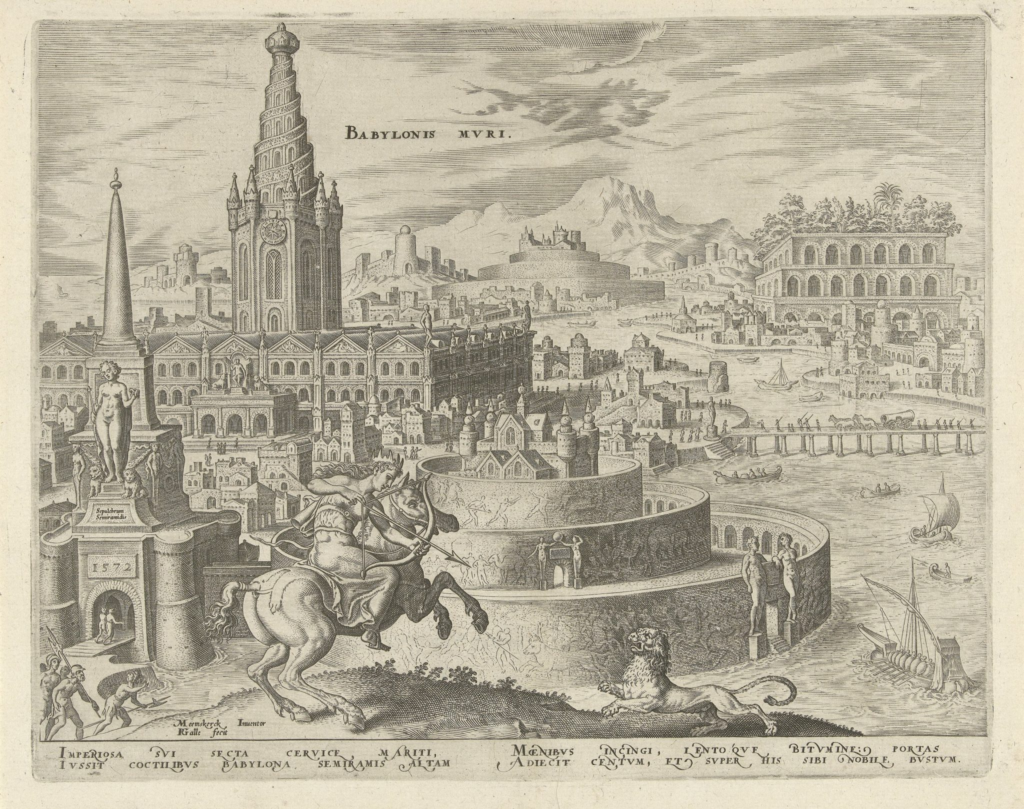
Philips Galle after Maarten van Heemskerck, Semiramis at the Walls of Babylon, from The Eight Wonders of the World, 1572, Rijksmuseum, Amsterdam
Few women from the ancient world have inspired as much artistic imagination as Semiramis. For centuries, painters, printmakers, poets, and historians transformed her into a larger-than-life figure, a warrior queen, master builder, conqueror, and even a demigoddess. Somewhere beneath these layers of legend lies the historical figure of Shammuramat, an Assyrian queen who lived during the ninth century BCE. Yet it is the mythical Semiramis, shaped by centuries of storytelling, who has captivated artists for generations.
Ancient writers described Semiramis as the daughter of the goddess Derceto, abandoned at birth and miraculously protected by doves before rising to become one of the most powerful rulers of her age. Greek historian Diodorus Siculus recounted tales of her military brilliance, claiming she led campaigns across vast territories stretching from Mesopotamia to Egypt, Ethiopia, and even India. Whether these accounts were fact, exaggeration, or pure invention, they elevated Semiramis into the realm of legend, where she stood alongside the greatest rulers of antiquity.
Artists were particularly fascinated by her association with Babylon. In Philips Galle’s engraving after a design by Maarten van Heemskerck, Semiramis appears overseeing the magnificent walls of Babylon, one of the ancient world’s most celebrated cities. Rather than depicting a battlefield, the artwork focuses on creation and ambition, portraying her as a ruler whose vision reshaped landscapes and civilizations. During the Renaissance and Baroque periods, European artists frequently painted Semiramis surrounded by architectural wonders, emphasizing her intelligence, authority, and grandeur.
What makes Semiramis such an enduring figure in art is the mystery surrounding her. Unlike many legendary warriors, her story exists in a space where history and imagination constantly overlap. Artists have repeatedly filled those gaps with their own interpretations, creating a queen who is at once conqueror, builder, ruler, and myth. Through these images, Semiramis became more than a historical figure, she became a symbol of the extraordinary power that societies have both admired and mythologized in women throughout history.
8. Nafanua: The Goddess of War Who Fought for Justice
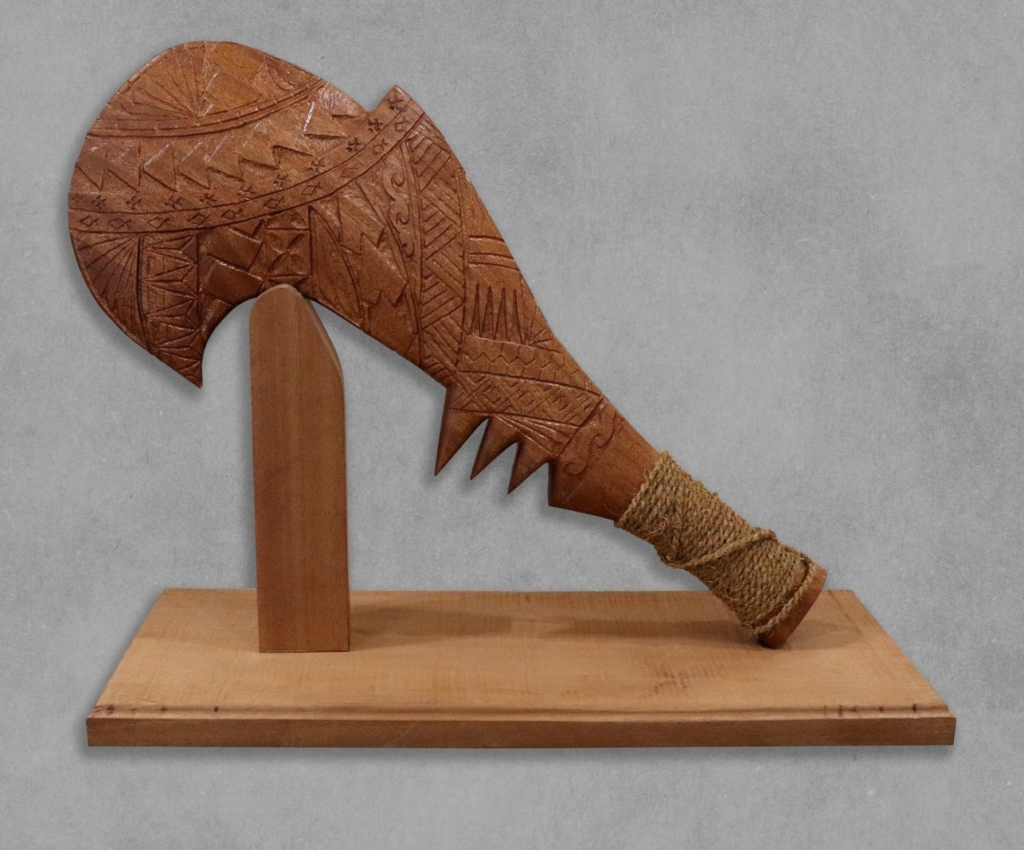
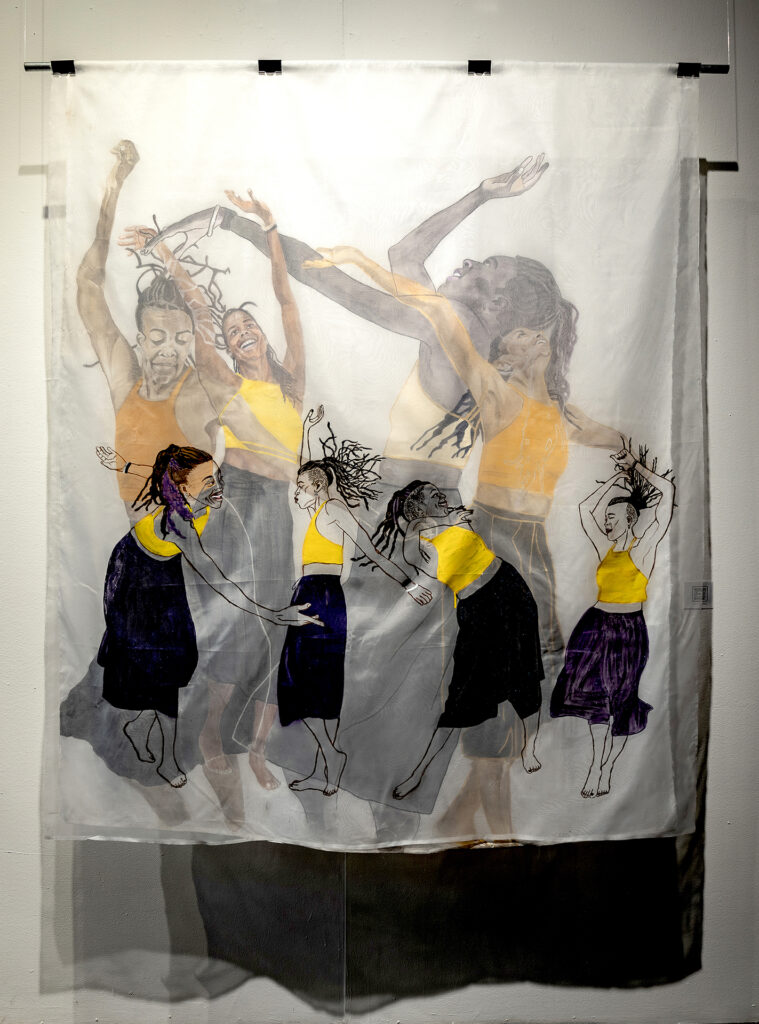
Sulika Laulu, Ta Fesilafa’i: To Kill with Courtesy, c. 2024, Urban Arts Gallery, Salt Lake City
Unlike many warrior women whose stories begin on a battlefield, Nafanua’s legend begins with a promise of protection. Revered in Samoan mythology as the goddess of war, she is remembered not as a conqueror seeking glory, but as a defender of her people. Across oral traditions, songs, carvings, and contemporary artworks, Nafanua emerges as a figure who wielded power in the service of justice, transforming warfare into an act of guardianship rather than domination.
According to Samoan legend, Nafanua was born during a time of conflict and social unrest. The stories surrounding her vary, as oral traditions often do, but they consistently portray her as a woman of extraordinary strength and determination. One of the most enduring accounts describes her opposition to a powerful chief who sought to expand his authority through violence and humiliation. Refusing to accept the suffering imposed upon her community, Nafanua took up arms and led resistance against oppressive forces. In some versions of the legend, she fashioned weapons from the very coconut trees that surrounded her, turning everyday elements of island life into symbols of resilience and resistance.
Because traditional Samoan culture relied heavily on oral storytelling, Nafanua’s image was preserved differently from many Western mythological figures. Rather than surviving through ancient paintings or sculptures, her story lived through chants, ceremonial practices, and collective memory. Today, contemporary Pacific Island artists have embraced her legend as a powerful symbol of cultural identity and female strength. Works such as Sulika Laulu’s Ta Fesilafa’i: To Kill with Courtesy reinterpret themes of protection, dignity, and resistance, connecting ancestral narratives to present-day conversations about heritage and empowerment.
What makes Nafanua particularly compelling is that she represents a different kind of warrior. Her power is not measured solely through victory in battle but through her commitment to defending others. Artists continue to revisit her story because it speaks to a timeless ideal: that true strength lies not in domination, but in the courage to stand between danger and the people one loves. Through contemporary art and enduring oral tradition, Nafanua remains one of the Pacific’s most powerful legendary figures, a goddess whose legacy continues to inspire far beyond the islands that first imagined her.
The stories of these legendary female warriors have endured not simply because of the battles they fought, but because of the meanings people continued to find in them long after those battles ended. Across different cultures and centuries, they became symbols of courage, resistance, devotion, leadership, and transformation. Some may have existed as historical figures whose lives grew into legend. Others belong entirely to the realm of mythology. Yet all of them continue to inspire because they challenge familiar ideas about who gets remembered and why.
Art has played a vital role in keeping these women alive in our collective imagination. Through paintings, sculptures, monuments, manuscripts, and contemporary reinterpretations, artists have preserved their stories while continually reshaping them for new audiences. Each generation sees something different in Joan of Arc’s conviction, Mulan’s sacrifice, Penthesilea’s bravery, or Nafanua’s protection of her people. These artworks do more than document the past, they invite us to reconsider power, heroism, and identity through a new lens.
Perhaps that is the true legacy of these warrior women. Their stories remind us that history and mythology are not static. They are living narratives, revisited and reimagined every time an artist picks up a brush, a sculptor shapes stone, or a storyteller shares a tale. Long after kingdoms have fallen and battlefields have disappeared, these women continue to ride through our cultural imagination, proving that some legends never fade, they simply find new ways to be told.
If you could meet one of these warrior women, who would it be?
Interested in how art and legacy are preserved across generations? Explore our feature on some of the world’s most remarkable private collections and the stories behind them: